The Ampere Gambit: A Suburban War of Bureaucracy, Voltage, and the Anatomy of Absolute Retribution
CHAPTER 1: The Meters Hum
The kitchen was a tomb of silence, but the air felt heavy, ionized. I looked at the bill again. It was a mathematical impossibility, a gross violation of the physics of my daily life. I hadn’t run the heavy appliances in weeks; the well pump was stagnant, the barn was dark, and the coffee maker was cold. Yet, here it was: a number that suggested I was powering a small city.
I moved to the window. Outside, the backyard was a canvas of shadows and silver moonlight. The meter, attached to the outer wall of the house, was a small, circular eye of glass and metal. I stepped out onto the porch, the wood groaning under my weight. The cold night air didn’t shock me—my blood was already running hot with a focused, analytical precision.
I reached the meter. It wasn’t spinning erratically like a faulty gauge. It was turning with a steady, calculated pace, a slow-motion dance that spoke of a consistent, deliberate drain. My hand rested on the cool metal casing. I felt the vibration through my fingertips—a pulse that didn’t belong to my home.
Someone was siphoning.
I didn’t feel anger—not yet. Anger was a messy, inefficient emotion that clouded the edge of a blade. What I felt was the chilling clarity of a chess player who had just realized the board had been altered while they weren’t looking. I began to walk, eyes tracking the low-hanging wires and the hidden conduits that snaked toward the property line. The grass was wet with dew, clinging to my boots, but I kept my pace rhythmic, silent.
I reached the barn, expecting to see the breaker box. I checked it. All switches were thrown to the off position, yet the meter behind me continued its rhythmic, confident spin. That was the first true shock—the realization that the drain wasn’t originating from my internal grid; it was coming from an external bypass I hadn’t yet identified.
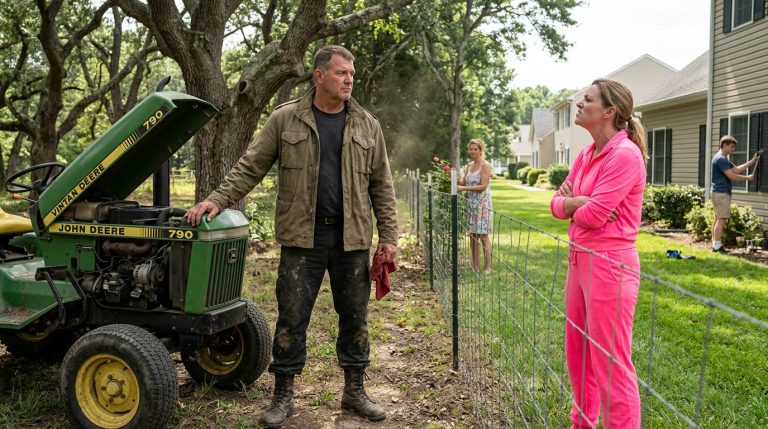
I moved toward the fence line, where the weeds grew thick and tangled. I knelt, pushing aside the brittle stalks. There, glowing a dull, synthetic orange under the moonlight, was an extension cord, half-submerged in the dirt like a buried root. It was thick, heavy-duty, and it didn’t look like it had been there for a day. It had been there for weeks, perhaps months.
I followed it. I traced the orange line as it navigated the uneven earth, bypassing the barn, cutting across the hidden gap in the fence, and disappearing into the dark, manicured sanctuary of the neighbor’s yard.
My heart didn’t race. Instead, it slowed, every beat a cold, hard strike. I reached the fence slat, peering through the gap. The cord didn’t lead to a tool or a light. It snaked upward, disappearing into the heavy, velvet curtains of the house next door.
I pulled my phone from my pocket, the screen casting a pale blue light on my face. I aimed the camera, adjusted the zoom, and focused on the connection point. The flash clicked, a sharp, white intrusion in the dark.
I wasn’t just losing money. I was being used. And as I stared at the point where the cord vanished, I noticed something else—a faint, rhythmic clicking sound coming from inside her garage wall, a high-speed mechanical stutter that had nothing to do with a simple porch light.
CHAPTER 2: The Wire
The clicking sound was rhythmic, insistent, and utterly alien to the quiet, suburban landscape of the backyard. It wasn’t the erratic chirping of crickets or the shifting of settling wood. It was the frantic, high-frequency labor of processors working in the dark, hidden behind the vinyl siding of a house that belonged to the neighborhood’s self-appointed moral auditor.
I stayed crouched by the fence line, my knees sinking into the damp earth. The coldness of the ground bit through my jeans, a sharp contrast to the heat radiating from my own skin. I didn’t move. To move was to risk being seen, and to be seen was to forfeit the only advantage I possessed: the element of surprise.
My eyes were locked on the orange extension cord. It didn’t just snake into a wall; it had been surgically integrated into the structure of her garage. A small, reinforced grommet had been installed—too professional to be a DIY fix. Someone had done this with intent. The memory hit me then, unbidden and cold: the sound of a failing hard drive from my own defunct business, that same desperate, mechanical stuttering before everything I had built fell apart. It was a phantom weight in my chest, a reminder that machines, like people, had breaking points.
I checked the fence gap again. I had to know what was on the other side.
I shifted my weight, the damp leaves crunching with agonizing clarity. I pressed my ear against the wooden slat. Beneath the persistent drone of the server bank, I heard a second sound: the muffled, intermittent chime of a notification bell—a sharp, digital ping that signaled an incoming message.
Karen wasn’t just stealing electricity. She was running something. A data node? A secure hub? The realization settled in my mind with the cold finality of ice. She wasn’t the petty tyrant she pretended to be; that was the mask. This—the servers, the clandestine draw, the calculated risk—this was the core of her influence. She needed that power to maintain her position, to monitor the threads of the neighborhood, to enforce her iron-clad version of order.
I reached out, my fingers tracing the length of the orange cord where it met the dirt. It was warm. The resistance of the wire was telling me everything I needed to know about the load it was carrying. It was straining.
I looked back at my house, dark and dormant. I could go inside. I could call the police, or I could report her to the utility company. But the moment the lights went out in her garage, the proof would vanish. She would play the victim, spin the narrative, and emerge as the wronged party. If I wanted to win, I couldn’t just stop her; I had to expose the architecture of her hypocrisy.
I pulled a small notepad from my back pocket and a pen. In the dim light, I scribbled a timestamp and a brief observation of the cord’s placement. Then, I did something I hadn’t planned on doing. I reached into my jacket and pulled out a small piece of black electrical tape.
With a steady hand, I marked the cord at the junction where it exited the ground. It was a petty gesture, a mark of ownership, but it served a dual purpose: it would tell me if she moved it, and it would confirm that my investigation was no longer hypothetical. I was engaged.
As I stood, the muscles in my back protested. The night had grown colder, and the air smelled of ozone and damp cedar. I walked back toward the dark outline of my own home, keeping to the shadows. Every step was calculated, a rejection of the frantic impulse to confront her head-on.
She was playing a game of power, literally and figuratively. She thought she was the one holding the board, the one directing the flow of the current. But she had made a mistake. She had plugged into me. She had made herself dependent on a resource that I controlled, and in doing so, she had given me the one thing she could never afford to lose: a vulnerability.
I reached my back door and paused, looking back one last time. The porch light on her house flickered, a tiny, stuttering heartbeat in the dark. I didn’t reach for my phone to call anyone yet. Instead, I stood on my own threshold, letting the cold air clear my head.
Tomorrow, the game would change. Tomorrow, I would start drafting the first of many documents. I wasn’t going to break the wire; I was going to turn it into a leash.
CHAPTER 3: The First Invoice
The desk in my home office was cluttered with remnants of a life that felt increasingly like a rehearsal for this moment. I pulled out a fresh sheet of heavy-stock bond paper, the texture satisfyingly crisp under my thumb. My printer sat silent, a dormant beast, but I didn’t need it. The art of the ruse required a human touch; it required the deliberate imperfection of a hand-written document that screamed authenticity.
I dipped my fountain pen into the black ink. I had spent the last three hours crafting the persona: the Utilities Compliance Division. It sounded dry, vaguely governmental, and entirely unassailable. I drafted the charges with clinical indifference.
Residential energy redistribution fee: $2.00.
Unauthorized extension line service charge: $0.75.
Infrastructure draw surcharge: $25.00.
The numbers were small, calculated to be annoying rather than life-altering. If I went too high, she would panic and call an electrician to remove the line. If I went too low, it would look like a joke. The total—$27.75—sat on the page like a verdict. I added a fake contact number at the bottom and a series of bureaucratic disclaimers about “formal review processes” and “mandatory compliance.”
I leaned back in my chair, the leather creaking in the stillness of the room. The house felt different now. The refrigerator’s hum—that steady, rhythmic vibration I had hated only yesterday—had transformed into a background soundtrack for my work. It was no longer a sign of my bankruptcy; it was the hum of a power plant I now presided over.
I waited until midnight. The neighborhood was a void of lightless windows, a quiet sprawl of sleeping lives. I stood at my front door, the envelope tucked into my coat pocket. It felt heavier than it should have, a burden of intent. I walked out into the cool, damp night, the air tasting of earth and latent rain.
The path to her mailbox was a familiar, rhythmic exercise. I didn’t rush. I moved with the slow, deliberate pace of a process server. Her yard was immaculate, the grass trimmed to a height that defied nature, a testament to her need for total, suffocating control. I felt a flicker of grim satisfaction as I approached the mailbox.
I slid the envelope into the slot. It disappeared with a soft, final thud.
I didn’t turn to run. I walked back to my porch, sat in the wicker chair, and waited. I didn’t need to see her reaction; I needed to hear the silence she would inevitably break. The night stretched on, a vast, unblinking eye. I watched her house, my eyes tracing the silhouette of her roofline against the stars.
Somewhere around two in the morning, a light flickered in her kitchen. I didn’t move. I watched as the shadow moved across the blinds, a frantic, jagged silhouette. She was up. She had found it. The invoice was an intrusion, a foreign object in the pristine ecosystem of her evening.
The light stayed on for twenty minutes, then snapped off. She was processing. She was trying to fit this new, irrational variable into her rigid world-view.
The next morning, the ritual began. I didn’t check the mailbox until after I knew she had finished her morning inspection of the street. I walked to the edge of the property, the sun just beginning to peel back the layers of the morning mist.
Taped to my mailbox was a tiny Ziploc bag. Inside, three crisp one-dollar bills. Attached to it was a small, sticky note in her precise, sharp handwriting: Payment enclosed. Hope this clears things up.
I stood there, the baggie in my hand, and felt a rush of cold clarity. She had paid it. She hadn’t knocked. She hadn’t complained. She had simply accepted the debt because the alternative—confrontation—would mean acknowledging that the world was no longer under her total jurisdiction.
I walked back inside and set the baggie on the kitchen counter. It was a small victory, but it was absolute. I picked up my coffee, the heat radiating through the ceramic, and looked out at the backyard. The orange cord was still there, snaking through the weeds, but it no longer felt like a violation. It felt like a tether. I had initiated the exchange, and she had agreed to the terms.
I sat down at my desk and pulled out another sheet of paper. The first invoice had been a test. Now that I knew the frequency she responded to, I could begin to compose the rest of the symphony. I had a week to prepare the next, more complex set of charges, and my mind was already buzzing with the mechanics of the next fee.
She thought she was buying peace. She didn’t realize she was buying a decline.
CHAPTER 4: The Payoff
The morning light hit the kitchen counter with an unforgiving brightness, illuminating the dust motes dancing around the three one-dollar bills. I didn’t move them. I left them there as a totem, a physical manifestation of the bargain we had struck. The house was quiet, but the silence felt thinner today, pressurized by the secrets hidden on the other side of the fence.
I picked up the baggie, the plastic crinkling under my fingers, and tossed it into the trash can. It wasn’t about the money. The money was the tether. If she paid, she was consenting to the new reality where I was the auditor of her chaotic, entitled existence. I needed to know more about the “load” she was pulling.
I walked out to the backyard, my boots crunching on the dried grass. It was a clear, crisp day, the kind that made every detail stand out with artificial sharpness. I bypassed the barn, keeping my eyes fixed on the ground, tracing the orange line of the extension cord. When I reached the fence, I stopped, letting my eyes adjust to the angle of the sun.
I leaned against the wood, scanning the exterior of her garage. It was a sturdy, windowless structure, painted a sterile shade of white that seemed designed to repel scrutiny. My gaze drifted along the baseboards, looking for the tell-tale signs of a high-draw connection. That’s when I saw it: a small, black plastic square, barely larger than a postage stamp, mounted discreetly into the side of the garage siding near the service door.
It was a keycard reader.
I froze. A garage for a standard suburban home didn’t need a secured entry system. My pulse quickened, a single, sharp beat against my ribs. This wasn’t just a server bank; this was a controlled access point for something else. I leaned in, my shadow falling over the device. It looked weathered, the plastic slightly sun-faded, but the sensor light was a dull, persistent red. It was active.
The reality of the situation began to layer itself in my mind. She wasn’t just siphoning power to run a computer. She was maintaining a secondary perimeter. Why? What could she possibly have in there that required such restrictive, high-tech access?
The memory of the invoice—and her compliance—flashed through my mind. She had paid me to keep me quiet, or perhaps to keep me from asking questions. But by paying, she had given me the leverage to look closer. I pulled out my phone, not to record, but to act as a decoy. I pretended to take a photo of the fence, angling the screen so that if anyone were watching from her windows, they would see only a homeowner documenting property maintenance.
I stayed there for a full minute, memorizing the layout. The cord ran into the side wall, not the door. The reader was for the service entrance. As I stepped back, I realized the full extent of the psychological war I had signed up for. She was guarding something, but she was guarding it with a flaw—her own, overwhelming need to look normal.
I walked back to my porch, the weight of the new discovery sitting heavy in my pockets. I needed to see what happened when the power was cut. Not tonight, maybe, but soon. The “infrastructure surcharge” I had planned for next week would have to be more than just a line item on a bill. It would have to be an excuse for an inspection.
I sat on the porch and watched her house. She appeared on her patio, holding a cup of tea, her movements stiff, controlled, and precise. She glanced toward the fence—a quick, sweeping motion of her head that didn’t linger. She was checking the perimeter. She was looking for me.
I didn’t look away. I stared back, my face an unreadable mask, holding her gaze for a second longer than was polite. She turned back to her tea, her shoulders tightening just a fraction of an inch. She knew. She didn’t know what I knew, but she knew the dynamic had shifted.
The “Utilities Compliance Division” was no longer a game. It was a surveillance unit. I had three more days before the next invoice was due. In those three days, I didn’t need to do anything spectacular. I just needed to be the ghost in her machine, the silent auditor that never went away.
I realized then that the decoy secret—the server bank—was already beginning to lose its mystery. It was a distraction. The real secret was in the access, the security, the lengths she would go to in order to keep the garage sealed away from the rest of the world. And the more she tried to lock it, the more I would force her to open it.
I went inside and pulled out the ledger. I started writing. Section 12, Paragraph 4: Unauthorized Access Point Usage. Penalty: $42.50.
It was time to escalate.
CHAPTER 5: The Escalation
The first drop hit the window like a bullet, followed immediately by a curtain of gray, relentless water. I stood by the glass, watching as the backyard transformed into a shimmering, blurred landscape. The drainage in my yard was uneven; I knew that in less than ten minutes, the low-lying patch near the fence line—exactly where that orange extension cord was buried—would become a shallow, muddy trench.
If the cord shorted, the mystery ended. If the earth shifted enough to expose the line to the neighbors, the game ended.
I grabbed my heavy coat and a flashlight. I didn’t think; I moved. I kicked the back door open, the wind whipping the rain against my face with stinging intensity. The transition from the dry, calculated silence of my office to the violent, chaotic reality of the storm was jarring. I stumbled across the porch, the wet wood slick under my boots, and vaulted the steps into the muck of the backyard.
The wind howled through the fence slats, a high-pitched, mournful sound. I reached the fence line, my flashlight beam cutting a useless, yellow cone through the downpour. The water was already pooling, swirling with silt and debris. I could see the orange plastic undulating under the surface of the mud, a bright, unnatural vein in the dark earth. It was vulnerable.
I heard a movement from her side of the fence—the heavy, rhythmic thud of a service door closing. She was out here, too. She must have realized that the load on her hidden servers would be compromised if the line grounded out.
I crouched behind a dense patch of ornamental grass, my heart drumming against my ribs. Through the deluge, I saw her. She was wearing a yellow slicker, her face obscured by the hood, struggling to shove a piece of plywood over the muddy depression near the fence. She was panicked. I had never seen her lose her composure before; her movements were usually calculated, predatory, but now she was frantic, slipping in the mud, her hands clawing at the earth to protect the connection.
She wasn’t just worried about a power bill. The way she handled that cord—the way she cradled it as if it were a wounded thing—told me that the server bank in her garage was the only thing standing between her and a total collapse.
I moved closer, just enough to see her face as a flash of lightning illuminated the yard. Her jaw was clenched, her eyes darting toward my house. She wasn’t looking at the cord; she was looking at my porch, expecting me to be watching. She knew I was the auditor of her secrets, and the fear in her eyes wasn’t just about the storm. It was the fear of being seen for who she really was.
I didn’t step out. I didn’t confront her. I watched as she jammed the plywood into place, her breath coming in ragged, visible clouds. She was exhausted, shivering, and entirely exposed.
Then, she did something that stopped my heart. She pulled a small, ruggedized remote from her pocket and pressed a button. The clicking from the garage wall changed pitch—it deepened, then silenced. She was shutting down the servers to prevent a surge. She was effectively blinding herself to protect the hardware.
She turned and sprinted back to her house, her heels clattering against the patio concrete. She left the plywood skewed, a clear sign of a desperate, emergency intervention.
I waited until she was back inside, the door locked, the lights extinguished. Then I moved. I waded through the freezing slush until I reached the fence. I knelt, my hands sinking into the icy mud, and dug around the edge of the plywood she had abandoned.
I didn’t cut the line. I didn’t unplug it. Instead, I carefully wrapped a piece of waterproof tape around the junction she had been trying so hard to shield, effectively anchoring it in place. It was a gesture of dominance—a way of telling her that even her desperate, final-ditch efforts were something I controlled.
I stood up, soaked to the bone, the rain plastering my hair to my skull. I felt a chill, but it wasn’t from the weather. It was the realization that I had crossed a line. I was no longer an observer of her dysfunction; I was a participant in its preservation.
I walked back to my house, the mud sucking at my boots with every step. My mind was already racing, calculating the next move. She was vulnerable, her systems were down, and the HOA meeting was only two days away. She had panicked in the dark, and in her panic, she had shown me exactly how much she had to lose.
I walked into the office, the room cold and smelling of wet wool. I sat at my desk and opened the ledger. The ink from my previous entries was smudged, but I didn’t care. I wrote the final charge of the night in bold, black letters: Emergency Intervention Fee: $150.00.
It wasn’t a bill. It was a demand for total surrender. She would pay it, and when she did, she would know that I was the one who had watched her in the rain.
CHAPTER 6: The HOA Trap
The desk lamp cast a harsh, clinical light over the stack of documents I had spent the last twenty-four hours perfecting. Every invoice was meticulously cross-referenced, every “fee” documented with a level of bureaucratic pedantry that would make a tax auditor weep with envy. I had categorized the “Unauthorized Shade Casting” and the “Bird Deterrence Fees” into a professional-looking binder, complete with a fake seal for the Utilities Compliance Division.
I sat in the dark for a long time before dawn, listening to the house settle. My mind wasn’t on the money, nor was it on the vengeance. It was on the structure of the trap. I had been careful to plant the seeds; I had made sure that a few key members of the HOA board—people who had long chafed under Karen’s iron-fisted rule—would receive anonymous, “leaked” copies of these invoices yesterday afternoon. I was the architect, but I needed them to believe they were the detectives.
The meeting was set for seven o’clock in the high school gymnasium. I arrived early, finding a seat in the back corner where the fluorescent lights buzzed with a low, irritating hum. The room smelled of floor wax and stale coffee. Slowly, the retirees began to file in, their hushed whispers and shuffling papers filling the space.
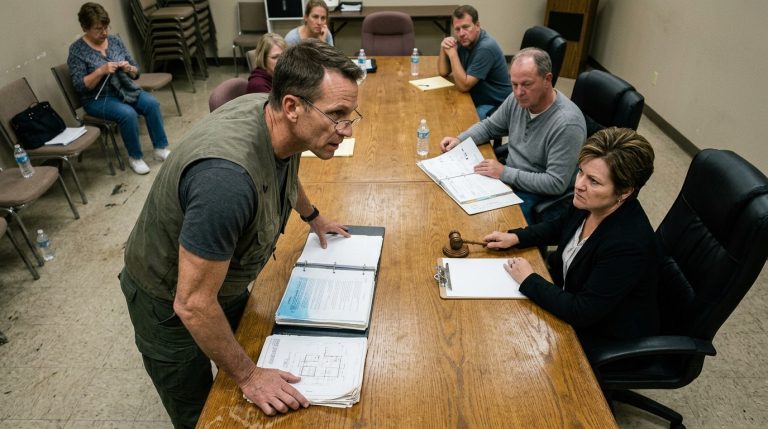
When Karen walked in, the temperature in the room seemed to drop. She wore a tailored blazer, her scarf knotted with military precision, and she held her agenda like a shield. She didn’t look at anyone. She moved straight to the front table, her posture defiant, her expression an impenetrable wall of practiced indifference.
But as she sat, I noticed the tremor in her hands. She opened her agenda, and for a split second, her eyes widened as she caught sight of a stray document on the table—a copy of one of my invoices that someone had left prominently displayed. She didn’t react, didn’t flinch, but her grip on her pen tightened until her knuckles turned white.
The meeting began with the usual mundanities: lawn maintenance schedules, patio chair color palettes, and budget amendments. It was a farce, a slow-motion dance of suburban triviality. My heart was steady, my pulse the only calm thing in the room. I waited for the motion for the “New Business” section.
“I move to discuss a discrepancy regarding utility usage and local compliance,” a voice called out from the third row. It was Miller, a retired accountant who had been on the receiving end of one of Karen’s more vicious fines.
Karen’s head snapped up. “That is not on the agenda,” she stated, her voice sharp and brittle.
“We are adding it,” Miller retorted, sliding a folder onto the table.
I watched as the board president, a weary man who had clearly had enough, opened the folder. He flipped through the pages, his brow furrowing. He pulled out a copy of my invoice for the “Infrastructure Draw Surcharge.” He looked at Karen, then back at the paper.
“Karen,” he began, his voice surprisingly steady. “Can you explain these charges? A ‘Residential Energy Redistribution Fee’?”
The room went deathly silent. The hum of the fluorescent lights suddenly seemed deafening. I felt a surge of cold, sharp vindication—the ghost of my own business failures, the memory of that stuttering server, all of it coalescing into this single, crushing moment of exposure.
Karen stood up, her composure momentarily fracturing. “This is a harassment campaign,” she spat, her gaze sweeping the room, looking for a target. “These are fraudulent documents created by someone with far too much time on their hands.”
“Then why,” Miller asked, leaning forward, “did you pay them?”
He tossed a printout of the bank transfer record onto the table. It was the “Smoking Gun”—the trail of payments she had made to my fake account, linked through a digital path that I had carefully obscured but made just transparent enough to trace.
Karen froze. She looked at the paper, then back at the crowd of retirees, who were now leaning in, their eyes hard and judgmental. She realized, in that moment, that the narrative had been stolen from her. She wasn’t the enforcer anymore; she was the anomaly.
I stood up, slowly, making sure she saw me in the back of the room. My voice was calm, devoid of any triumph. “It wasn’t a harassment campaign, Karen. It was an audit.”
I walked toward the front of the room, every eye on me. I didn’t rush. I walked with the deliberate, heavy-footed confidence of a man who had already won. I carried the folder of evidence—the photos of the orange cord, the video footage of her flickering porch lights, the log of her own frantic, midnight repair attempt during the storm.
As I reached the front table, the board president gestured for me to continue. I opened the folder. I didn’t need to speak, not yet. The weight of the physical evidence—the cold, hard documentation of her theft—was louder than any speech I could have delivered.
Karen sat back down, the strength in her shoulders finally collapsing. The scarf around her neck seemed to wilt. She looked small. She looked like exactly what she was: a frightened woman who had built a kingdom out of stolen power, and who now realized that the bill had finally come due.
The room was waiting for the hammer to drop. I looked at the board president, my gaze level and unyielding. The trap was sprung, and the silence in the gymnasium wasn’t just a lull—it was the sound of a reputation being stripped of its armor, one line item at a time.
CHAPTER 7: The Trial
The silence in the gymnasium held its breath. It was a thick, suffocating thing, the kind that follows a sudden structural collapse. Karen stood at the front table, her knuckles white as she gripped the wood, looking at the board president. He wasn’t looking at her anymore; he was looking at the folder I had handed over.
“Is this true, Karen?” the president asked, his voice drained of its usual authority.
Karen tried to speak, but her voice was a thin, reedy sound that died in the back of her throat. She looked toward the door, then back at the room full of faces—the same people she had spent years fine-tuning with her petty complaints and arbitrary rules. Now, those same people were staring at her not with fear, but with a cold, analytical curiosity.
I leaned back against the wall, feeling the sudden, hollow ache of victory. But as I shifted, my eyes met Miller’s. He was sitting in the third row, his arms crossed, a faint, barely perceptible smile playing on his lips. He didn’t look at me with gratitude. He looked at me with the satisfaction of a player who had just watched his piece take the Queen.
The realization hit me with the force of a physical blow. Miller hadn’t helped me because he wanted justice. He had fed me the leads, hinted at the extension cord, and guided my hand toward the invoices because he knew I was the only person in the neighborhood volatile enough to do the dirty work of removing Karen. I had been his proxy. I had been the blunt instrument used to clear the board, and now, with Karen’s reputation in ashes, the path to the presidency was wide open for the man who had stayed in the shadows.
“She’s defrauding the entire grid,” Miller shouted, standing up, his voice ringing with performative indignation. “She’s not just a neighbor; she’s a liability! We need a full audit of every action she’s taken this year!”
The room erupted. The retirees were on their feet, the quiet order of the meeting dissolving into chaos. Karen started to tremble. It was a visible, shuddering motion that began at her shoulders and worked its way down to her heels. She had been defeated, yes, but not by me. She had been defeated by a machine, and I was just one of its gears.
I pushed away from the wall, moving toward the front of the room. The air felt thin, like I was losing oxygen. I reached the table and grabbed the folder of evidence. The board president looked up at me, startled.
“This,” I said, my voice cutting through the shouting, “is the truth. Not just about the power, but about the control.”
I looked directly at Miller. He didn’t flinch. He watched me, waiting to see if I would realize that he was the next iteration of the same problem.
The president raised his hand, signaling for silence. “Karen, the board votes for your immediate suspension. All in favor?”
The hands went up—one by one, then all of them. Eleven to zero. A clean sweep.
Karen didn’t argue. She didn’t cry. She simply reached down, grabbed her bag, and walked toward the exit. Her heels struck the linoleum with a sound like pistol shots—hollow, echoing, and final. She walked past me without looking, but as she reached the door, she stopped. She turned back, her face a mask of cold, brittle indifference, and looked at Miller, then at me.
“You think you’ve won something?” she whispered, the sound barely audible over the fading noise of the room. “You’ve just changed who gets to hold the leash.”
She turned and left. The heavy gymnasium door swung shut behind her with a dull thud.
The room didn’t feel victorious. It felt clinical. The board members were already beginning to discuss the procedural requirements for a new election, their voices full of a sudden, eager energy. Miller was already standing, walking toward the front table, his hand extended toward the president.
I looked down at the folder in my hands. The evidence was real, the theft was real, and the justice was served. But as I watched Miller begin to speak—his tone mirroring the same clipped, authoritative cadence Karen had used—I felt the trap snap shut around me. I had removed the tyrant, but I had left the system exactly where it was.
I walked out of the gymnasium into the cool night air. The rain had stopped, and the stars were bright, uncaring pinpricks of light above the sleeping neighborhood. I had succeeded in exposing the fraud, but the weight of the ledger against my side no longer felt like a victory. It felt like a warning.
I looked toward the houses. Somewhere, in one of them, the systems were still humming. The power was still flowing, and the people who knew how to manipulate the current were already planning their next move.
CHAPTER 8: The Aftermath
The gymnasium was emptying, the sound of folding chairs clattering against the bleachers punctuating the sudden silence. I stood alone near the front table, the ledger still gripped in my hand, watching as Miller gathered his papers. He wasn’t hurrying. He moved with the relaxed, predatory grace of a man who had successfully offloaded a rival without ever having to raise a hand.
He looked up, catching my gaze. There was no pretense of camaraderie now, no shared nods of mutual success. He saw me for what I was: a tool that had served its purpose. He walked over, his footsteps muffled by the rubber floor.
“Clean work,” he said, his voice quiet, almost professional. He reached out and tapped the folder of evidence in my hands. “You did exactly what was needed.”
“I did what I believed was right,” I replied, the words feeling brittle, hollow.
Miller smiled—a thin, joyless curve of the lips. “Right and necessary are often the same thing in a neighborhood like this. Karen thought she was the law. She forgot that laws are only as strong as the people who enforce them.”
“And you?” I asked. “Are you going to enforce them?”
“I’m going to maintain order,” he said, the nuance clear. “That’s all anyone really wants, isn’t it? The power to keep things quiet. The power to stay in control.”
He didn’t wait for a reply. He turned and walked toward the exit, his silhouette framed by the harsh security lights of the parking lot. I stood there, the weight of the last few weeks pressing down on me—the invoices, the storm, the frantic scramble to unearth Karen’s secrets—and realized that the “truth” I had unveiled was merely a change in management.
I walked out to my car, the night air biting at my skin. The neighborhood looked the same as it had when I arrived, but it felt smaller, colder, and more tightly wound. I drove home, the headlights sweeping across the empty streets, past Karen’s dark, shuttered house.
A “For Sale” sign stood in the yard, its metal stake glinting in the dark. It was the only tangible evidence that anything had happened at all.
When I reached my house, I went straight to the garage. I needed to see it one last time. I walked to the fence, the mud still slick under my boots. The orange extension cord was still there, but it was dead—the power had been cut from the source. I reached out and pulled the plug from the ground, the plastic cold and lifeless.
It wasn’t a weapon anymore. It was just a cord.
I looked at the barn—the place where I had first realized I was being used. I walked inside and picked up the breaker box, the metal casing familiar and grounded. I spent the next hour manually inspecting the lines, tracing the bypasses and the taps that Karen had installed. It was a tedious, grueling process, but it was mine. I was reclaiming the house, piece by piece, from the influence of the system I had been tangled in.
I repaired the damaged insulation on the main line, my hands steady, my movements deliberate. It was a quiet, almost meditative task. As I worked, I thought about the symbolic closure I had sought. I didn’t need a grand gesture. I just needed to own the space I lived in again.
The sun began to bleed over the horizon, painting the sky in pale, muted shades of blue and gray. I walked back to the house and brewed a cup of coffee. I sat on the porch, watching the neighborhood wake up. A neighbor walked their dog; someone else pulled out their car to head to work. The rhythm was back, perfectly undisturbed.
I looked at the ledger, sitting on the table beside me. I picked up my pen and, with one clean, final motion, crossed out the last entry. Then, I closed the book and set it aside.
I was not the Auditor. I was not the Enforcer. I was just a man living in a house, finally aware of the weight of the walls around him.
The struggle had been real, the cost had been personal, and the victory was a hollow, echoing thing. But as the morning light caught the edges of my own porch, the wood seemed warmer, more solid than it had in months.
I took a sip of the coffee. It was hot, bitter, and entirely my own. The neighborhood was quiet, and for the first time, I felt like I was the only one in it who was truly awake. I reached out and touched the railing of the porch—solid, steady, and finally at peace.