A Devoted Father’s Simple Act of Airport Kindness Sparks an Unstoppable Chain Reaction of Hope
CHAPTER 1: LINE AT GATE 4B
The plastic strap of Emma’s faded pink backpack dug into Robert’s thumb as he adjusted his grip. Across the polished floor of Gate 4B, the boarding monitor flickered, signaling first-class passengers for Flight 447 to Denver.
Emma didn’t look up from her coloring book. Her small knees were pressed against the vinyl airport chair, her red crayon leaving steady, careful strokes across the page.
“Keep your feet tucked in, bear,” Robert said softly, his voice low and steady. He turned the worn brass challenge coin over in his right pocket, feeling the notched edges smoothed flat by twenty years of nervous thumbing.
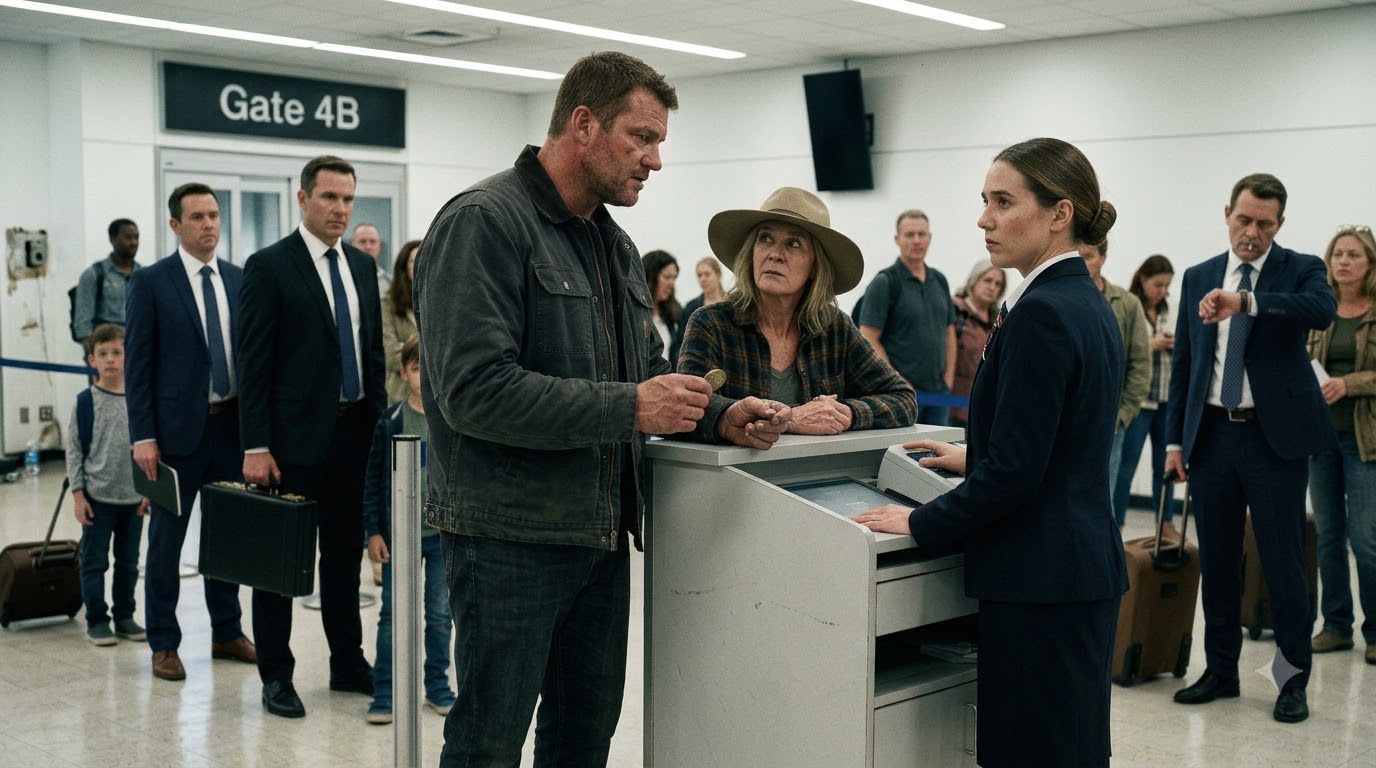
A sharp, elevated tone sliced through the general airport chatter. “Ma’am, I cannot validate this scan if you keep dropping the slip.”
Robert shifted his weight. Ten feet ahead, a woman in a wide-brimmed sunhat and heavy flannel sleeves fumbled with a paper stub. The summer heat inside the terminal was thick, but her skin was entirely covered right down to the wrists, where scarred, rigid tissue tightened over her knuckles.
“I’m trying,” the woman said. Her voice was thin, dry as paper. “My fingers… they don’t grip right.”
The gate agent didn’t pause her keystrokes. She tapped the edge of her scanner against the podium with a rhythmic, impatient plastic clack. “If you don’t have your photo ID out and ready, I’m going to need you to step aside so the priority line can clear.”
A man behind her in a sharp tailored suit checked his watch, letting out a loud, theatrical exhale. “Some of us actually have connections to make, lady.”
Emma stopped her crayon mid-stroke. “Daddy, why is that lady wearing winter clothes?”
Robert didn’t answer immediately. He dropped to one knee, bringing himself level with his daughter’s brown eyes, his boots squeaking faintly on the wax. “Sometimes people carry injuries you can’t see right away, Emma. The kind thing to do is give them room and show respect.”
He stood up, stepping out of the boarding lane and moving directly toward the podium. The brass coin clicked once against his pocket knife as his hand left his denim.
“Excuse me,” Robert said, his tone flat, unhurried, and impossible to ignore.
The gate agent snapped her head up. “Sir, we are currently boarding zone one only.”
“I know,” Robert said. He reached down gently, his large, calloused fingers catching the edge of the woman’s slipping paper before it hit the floor. He handed it back to her, backing off half a step so he didn’t crowd her space. “Take your time, ma’am. Let me hold the folder for you.”
The woman looked up. Deep brown eyes, framed by tight, grafted skin around the temples, met his. Shame hovered right at the surface of her gaze, but behind it was an intense, sharp intelligence.
“I didn’t mean to hold up the line,” she whispered, her voice raspy. “Housefire last year. My hands… the nerves don’t work the same.”
“No need to explain,” Robert said quietly. He took her boarding pass envelope, sliding the loose paper neatly into the notch so the barcode faced outward. He turned to the agent. “She’s ready now.”
The agent scowled, snatched the pass, and swiped it over the glass. The machine beeped green. “Seat 23B. Move along.”
Robert stepped up next, placing two pristine, upgraded first-class boarding passes on the counter—tickets he’d saved three months to buy for Emma’s first real vacation. He looked at the agent, then back at the woman who was slowly, painfully trying to balance a small carry-on bag with her stiff wrists.
“Hold those two passes for a second,” Robert said smoothly. “I’d like to make a swap.”
CHAPTER 2: ROW 23 DYNAMICS
“Row 23, middle and aisle,” I told the agent, my voice dropping an octave into that flat, unbothered tone that usually stopped arguments before they started. “Give her 2A.”
The gate agent stared at me, her mouth open just enough to show a sliver of dry teeth. “You’re trading first-class bulkheads for coach middle seats?”
“That’s what I said.” I pushed the blue pass toward her and took the crumpled coach slip from Sarah’s scarred fingers. “Change the names in your computer or don’t. We’re getting on the plane.”
The man in the suit behind us let out a harsh, wet snort. “Unbelievable. Some people just love making a scene.”
I didn’t turn around. I just rolled my brass challenge coin over my knuckles inside my jacket pocket, feeling the cold silver edge of the coin hit my index finger until the noise behind me faded into background static.
“Daddy?” Emma tugged on my sleeve, her coloring book tucked under her arm like a little leather portfolio. “Are we sitting in the back?”
“We’re sitting where we need to be, bear,” I said, kneeling down to zip her bag so she wouldn’t see the gate agent’s scowl. “It’s all the same sky.”
Ten minutes later, the air inside the Boeing 737 smelled like recycled ozone, stale coffee, and cheap carpet cleaner.
Row 23 was right over the wing, where the engine whine vibrated straight up through the soles of my work boots. I squeezed my shoulders in to avoid clipping a flight attendant who was aggressively jamming an oversized roller bag into the overhead bin.
“Watch your elbows, sir,” she snapped, not looking at me as she slammed the plastic latch shut with the palm of her hand.
“Always do,” I muttered, sitting down in 23C and letting Emma take the window seat in 23A.
The middle seat between us belonged to a guy already snoring against his neck pillow, his knees jammed straight into the magazine pocket of the seat ahead.
Emma pressed her forehead against the oval glass, her small fingers tracing the frost forming in the corner. “Look, Daddy. The trucks look like bugs.”
“They do,” I said, reaching over to click her seatbelt tight until the metal buckle gave that sharp, mechanical snap. “Keep your arms inside your space, all right?”
Down the long carpeted aisle, through the narrow gap between the blue privacy curtains, I could see the back of Sarah Mitchell’s head in seat 2A.
She was sitting perfectly still, her wide-brimmed hat resting on her lap, her head tilted slightly toward the window as if she couldn’t quite believe the soft leather headrest was real.
A flight attendant bumped my shoulder with the metal corner of the beverage cart as he hauled it toward the galley. “Sorry. Tight squeeze back here.”
I didn’t answer. I just pulled my arms in, turned the brass coin in my pocket once more, and watched a man three rows ahead slide a sleek black smartphone out of his jacket, discreetly taking a photo of the back of Sarah’s head.
CHAPTER 3: DENVER ARRIVAL
“Daddy, my ears feel like they’re full of water,” Emma mumbled, rubbing her jaw as the plane’s landing gear slammed down into the Denver tarmac with a heavy, metallic shudder.
“Swallow hard, bear,” I said, keeping my left arm braced against the seat ahead as the brakes grabbed the runway. “Like you’re drinking a glass of cold milk.”
The jet engines reversed, a deafening roar filling the cabin while the guy three rows up unbuckled his belt before the chime even sounded. He stood up fast, grabbing a thin leather briefcase from the overhead bin, his eyes darting toward the front curtain where Sarah was waiting for her hat.
I waited until the seatbelt sign clicked off before unbuckling Emma. “Stay right behind me. Keep your eyes on my boots.”
The concourse was a wall of noise—screaming PA announcements, rolling luggage wheels clicking over tile seams, and the smell of burnt cinnamon rolls wafting from a bakery stall.
Sarah was standing twenty yards past the jetway door, holding her hat in both hands while people brushed past her covered arms without a second glance.
“Mr. Hayes,” she said softly as I caught up, her voice nearly lost in the echo of the terminal. She reached into her coat pocket, her stiff wrist moving with visible effort, and held out a folded piece of white airline stationery. “I wanted to leave you this before your daughter gets tired.”
“You didn’t need to do that,” I said, taking the note. My fingers brushed against a heavy, hard cylinder tucked inside the folded paper envelope she handed over with it.
“You gave me a quiet place to breathe,” she said, her brown eyes meeting mine with an intensity that made the surrounding noise drop away. “In a world that usually looks away, you chose to see me.”
Ten feet behind her, standing near a concrete pillar by Gate B12, the guy in the slate-gray jacket pulled out his phone again, his eyes locked straight on the envelope in my hand.
I didn’t reach for my brass coin this time. I stepped sideways, placing my broad back directly between his phone lens and Sarah’s face.
“Get to your ride safely, Mrs. Mitchell,” I said quietly, watching her turn toward the baggage claim exit.
When I turned back around, the man in the gray jacket was already moving toward the escalator, his boots making no sound on the rubber steps as he vanished into the crowd.
CHAPTER 4: MOUNTAIN REFUGE
It wasn’t just a pen. It was solid sterling silver, cool and dense enough to weigh down my palm like a loaded magazine.
Engraved near the cap was a stylized crest—two entwined pine boughs over a stylized shield—and below it, stamped in tiny block letters: Apex Mutual Risk Assessment.
I turned the silver barrel over, my thumb catching on a subtle seam near the clip. I twisted it. The metal unthreaded with a faint hiss of compressed air, revealing a hollow core wrapped in a tight coil of waterproof paper.
Inside the cabin, the old refrigerator kicked on with a low, mechanical hum. Emma was fast asleep in the back bedroom, her red crayon still resting on the nightstand beside her small canvas shoes.
I unrolled the paper under the porch light. It wasn’t a thank-you note from Sarah; it was a printed ledger of claim dispute numbers, dates from eight months ago, and a list of five names—including my own former unit commander from Afghanistan and two other veterans who’d lost their benefits after the warehouse fire in Denver.
Layer 1 broke right there in the quiet pine air: Sarah Mitchell wasn’t fleeing bad memories. She was running from corporate investigators trying to prove she’d faked her injuries to hide a massive insurance payout.
And the man in the gray jacket at Gate B12 wasn’t just an annoyed passenger—he was the auditor sent to retrieve this ledger before she could hand it to a prosecutor.
A dry pine branch snapped sharply down by the gravel driveway, twenty yards past the cabin’s porch rail.
I didn’t reach for a rifle or call for backup that wasn’t coming. I simply slid the paper back into the silver tube, threaded the cap tight until the rubber gasket sealed, and dropped the pen deep into my denim pocket next to my brass coin.
“You’re walking on dry needles,” I called out into the dark, my voice steady and unhurried as I leaned my back against the sturdy log doorframe. “It’s easy to twist an ankle out here if you don’t know the trail.”
CHAPTER 5: THE GATEKEEPERS SHADOW
He stopped three paces short of the bottom porch step, his slate-gray jacket buttoned tight despite the humid mountain night. Under the porch light, his eyes were pale, calculating, and missing the slick confidence he’d projected at the Denver terminal.
“Mr. Hayes,” he said, his voice clipped and smooth, like a loan officer explaining an interest rate. “My name is Vance. I represent Apex Mutual.”
“You’re thirty miles off the interstate, Vance,” I said, my voice dropping into that heavy, deliberate calm. “And you’re standing on private property.”
He reached into his breast pocket—slowly, keeping his fingers flat and visible—and pulled out a pristine white business card. He didn’t offer it to me; he just rested the edge against the wooden handrail.
“Mrs. Mitchell possesses company records that do not belong to her,” Vance said, leaning his weight slightly onto his left hip. “She handed you a silver cylinder at Gate B12. I watched the transfer.”
Inside the cabin, the floorboards gave a tiny, familiar creak as Emma turned over in her sleep. I shifted my right boot two inches to the left, blocking the view through the screen door.
“She gave me a note,” I said, pulling the brass challenge coin out of my pocket and letting it click once against the heavy metal pen resting deep in my denim. “And a quiet thank-you for treating her like a human being.”
Vance’s lower lip twitched. “That document contains proprietary audit data regarding a pending arson investigation. If you withhold it, you are aiding in federal fraud concealment. Hand over the tube, Mr. Hayes. You’re a retired veteran living on a pension—you don’t have the leverage or the money to get dragged into this.”
He took one deliberate step up onto the first wooden stair, his hand sliding along the railing toward my space.
“You’ve got five seconds to take your foot off my porch,” I said, leaning forward just enough so my chest blocked the porch light, casting a long shadow straight down over his polished shoes. “Or we find out how much leverage twenty years of fixing heavy machinery gives a man.”
Vance froze mid-step, his jaw tightening as he realized I wasn’t backing down, wasn’t bargaining, and wasn’t scared of his legal threats.
“This doesn’t end on a porch,” Vance snapped, his voice finally losing its polished edge, turning sharp and defensive as he backed down the step. “You think you’re protecting a victim, Hayes? You’re sitting on a bomb.”
CHAPTER 6: QUIET GROUNDING
I didn’t run to the local sheriff or dial a high-priced lawyer. I walked back inside, clicked the door lock shut with a dull thud, and pulled out my old flip phone.
By dawn, the sun was just cresting the granite peaks when a dusty white county mail truck pulled up to the mailbox at the foot of the drive.
I walked down the gravel path, holding a thick manila envelope stamped with certified tracking numbers. Inside was a complete photo set of the ledger pages, addressed directly to the regional Inspector General’s office, along with a signed affidavit detailing Vance’s midnight trespass.
An hour later, Vance was back. He didn’t come alone; a local deputy sat in the cruiser behind him, looking weary and thoroughly uninterested in corporate civil disputes.
Vance marched up the gravel, holding a printed court injunction like a weapon. “You’re out of time, Hayes. Hand over the property or you’re obstructing an official fraud investigation.”
I stood on the bottom porch step, hands flat in my denim pockets, my brass coin resting quietly against my thigh.
“The original tube is in a certified USPS pouch on its way to the federal prosecutor in Denver,” I said, my voice cutting through the morning breeze with slow, undeniable weight. “And the digital copies hit six veterans’ legal assistance desks three hours ago.”
Vance’s face went dead white. The smug, corporate polish shattered completely, leaving his jaw working silently as he stared at me. “You… you had no legal right to disseminate internal company audits.”
“I have every right to protect my daughter’s peace from an trespasser,” I said softly, stepping off the bottom stair and closing the distance between us until he had to tilt his head back to look me in the eye. “And when people try to crush someone who’s already suffered enough just to save their own company budget, common sense says you drag the truth into the sunlight.”
The deputy behind him leaned out his window, resting an elbow on the door. “He didn’t break any local laws, Mr. Vance. You want to argue federal jurisdiction, you do it in Denver.”
Vance stood frozen on the dirt driveway for three seconds, his fingers clutching his paper injunction so tight the edges crumpled. Then, without another word, he turned on his heel, yanked his car door open, and sped back down the trail, kicking up a cloud of mountain dust that settled slowly over the wild pine needles.
The valley went quiet again. The sun hit the cabin deck, painting the worn cedar planks in warm gold.
Emma stepped out through the screen door, wearing her oversized flannel shirt, holding a half-finished mug of warm cocoa in both hands.
“Daddy,” she said, squinting up at the clear sky. “Is that quiet man gone?”
“He’s gone, bear,” I said, walking up the steps and sitting down beside her on the bench. I took a slow breath, feeling the cool pine air fill my lungs, free of airport noise, free of threats, and free of anger.
“Are we staying here all week?” she asked, leaning her shoulder against my arm.
“All week,” I said, pulling my brass coin out and placing it gently in her small palm. “We’ve got pine cones to pick up.”