When a Broke Waitress Rejects a Billionaire’s Cash, He Must Build Something Money Cannot Buy
CHAPTER 1: THE COUNTER PRICE
The glass counter at the toy store was smudged with finger-marks, but the crushed five-dollar bill resting on top of it felt heavier than an anvil.
Jade tightened her grip on her mother’s worn silver pocket watch, feeling the sharp nick on its cracked glass face press into her palm. She didn’t look at the crowd of shoppers hovering in the aisles of Pierce Toys. She looked directly at her six-year-old sister, whose shoes were splitting at the rubber seams.
“We don’t buy people, Lily,” Jade said, her voice raspy from a four-in-the-morning cleaning shift. “We pick up our money, and we go.”
The tall man behind the counter—Nathan Pierce—didn’t move like the executive he was supposed to be. He stood with his hands resting flat on the polished glass, his tailored jacket tight across his shoulders, watching them with an intensity that made Jade’s neck stiffen. He didn’t offer a polite corporate smile. He just looked at the frayed cuffs of Jade’s diner uniform and the stubborn set of her jaw.
“She wasn’t trying to cause trouble,” Nathan said softly. His voice had a low, grounded weight to it, completely devoid of the slick charm Jade expected from wealthy business owners. “She just asked a question.”
“She’s six,” Jade replied, sweeping the crumpled bill and thirty-seven cents in silver into her apron pocket. “She doesn’t know how the world works yet. I do.”
She grabbed Lily’s small hand and turned toward the glass double doors, ignoring the whispers of the parents standing in the board game aisle. She didn’t need pity, and she certainly didn’t need a audience for her family’s poverty.
By two o’clock that afternoon, the din of Romano’s Diner filled Jade’s ears—the sizzle of frozen patties hitting the grease trap, the clatter of thick ceramic mugs, and the heavy thud of the kitchen door swinging open. Jade carried a tray loaded with four plates of meatloaf toward Table 6, her knees aching from seven straight hours on vinyl-tiled concrete.
The bell above the diner door chimed.
Jade didn’t look up until a shadow fell across the condiment tray she was wiping down at the counter. Nathan Pierce stood there, towering over the laminated menus. He had dropped his suit jacket, wearing only a white shirt with the sleeves rolled back to his forearms, revealing a faded scar along his right wrist.
“The coffee’s two dollars,” Jade said, not breaking her rhythm as she scrubbed a ring of dried ketchup off the formica. “Booths are for paying customers only.”
“I’ll take a black coffee,” Nathan said, sliding onto a stool that groaned under his weight. He placed a thick paper folder on the counter between them. “And ten minutes of your time.”
Jade set down her rag and rested both hands on the edge of the stainless steel counter. “If this is about this morning, I already apologized. Lily won’t wander into your store again.”
“I’m not here for an apology,” Nathan said, reaching into his pocket. He didn’t pull out a checkbook or a stack of bills. Instead, he unclipped a plain ballpoint pen and clicked it once. The sharp click echoed against the diner’s tin ceiling. “I’m here because our flagship store is failing its community, and you know exactly why.”
Jade let out a dry, breathy laugh that carried no humor. “I clean toilets at five in the morning and serve gravy at noon. I don’t give corporate advice.”
“You raised a child alone while working ninety hours a week,” Nathan countered, his eyes locked on hers without a flicker of condescension. “You know what working parents need when they bring their kids downtown. My store sells six-hundred-dollar ride-on cars to people who don’t even look at the price tag. It’s empty of real life. I want to build a children’s program—reading groups, after-school spaces, craft workshops—and I need someone who actually lives in the real world to run it.”
Jade picked up her mother’s pocket watch from her apron, feeling the cold silver metal. “You’re offering a waitress a corporate job because her sister made a scene?”
“I’m offering you a job because you looked at me like I was a human being instead of a deep pocket,” Nathan said, his voice dropping an octave. “The salary is forty-two thousand a year. Full benefits. Flexible hours so you can pick up Lily from school.”
Jade’s hand clamped tight around the watch, the metal bite anchoring her against the sudden wave of lightheadedness that swept over her. Forty-two thousand. It was more than all three of her jobs combined. It meant rent paid on the first of the month. It meant shoes for Lily that didn’t let the rain in.
“What’s the catch?” Jade asked, leaning in close enough to smell the faint scent of cedar and pine on his shirt. “Men like you don’t hand out lifelines without a string attached.”
Nathan didn’t pull back. He met her gaze directly, the muscle in his jaw ticking once. “The catch is that my board of directors thinks the idea is a waste of capital. If it fails, they’ll use it to cut my operational control. I’m not offering you a handout, Jade. I’m asking you to step into a fight.”
CHAPTER 2: GLASS AND STEEL
The floor of the twentieth floor didn’t make a sound when Jade stepped off the elevator. Thick gray carpet swallowed the scrape of her worn soles, a silent contrast to the clatter of plates at Romano’s Diner.
Executives in crisp charcoal wool passed her without making eye contact, their voices muted as they tapped at tablet screens. Jade smoothed down the front of her navy dress—the one she’d worn to her mother’s burial—and felt the cold, hard outline of her mother’s silver pocket watch inside her pocket. She gripped the metal through the thin fabric, using the sharp nick on the glass face to ground herself.
A young woman behind a floating glass desk looked up, her smile tightly calibrated. “Can I help you?”
“Jade Washington. I have a meeting with Mr. Pierce.”
The receptionist’s eyes flicked down to Jade’s shoes, taking in the faint water strain along the leather toes, before returning to her monitor. “Take a seat. He’s finishing a call.”
Jade didn’t sit on the plush leather couch. Instead, she walked to the floor-to-ceiling window overlooking the city grid. Down there, forty stories below, the early shift workers were loading bread trucks and hauling trash. Up here, everything felt sanitized, sterile, and entirely removed from the sweat required to pay rent.
A heavy wooden door swung open down the hall. Nathan stepped out, holding a thick paper file. He wasn’t wearing his suit jacket today either—just a crisp white shirt with the cuffs rolled to his forearms.
“Jade,” he said, skipping the corporate greetings entirely. “Come in.”
His office was vast, but it lacked the personal clutter Jade expected from a man who owned twelve stores. A dark walnut desk sat near the window, bare except for a stack of store performance metrics and a black fountain pen.
“You look like you’re preparing for a deposition,” Nathan said, sitting behind the desk and motioning toward the leather chair opposite him.
“I’m preparing to make sure I don’t sign something that leaves me worse off than I was yesterday,” Jade said, remaining standing. She placed her leather folder on the wood. “I read the job description you sent over last night. You want me to build a children’s community center inside a luxury toy store. You haven’t listed a budget limit, and you haven’t listed a supervisor.”
Nathan leaned back, his jaw setting into a hard line. “Because you report directly to me. And the budget is carved out of the flagship’s local marketing allocation.”
“And that’s where the trap is,” Jade said, her voice quiet, sharp, and level. She pulled a printed page from her folder—a document she’d found attached to the email packet. “Your board of directors flagged this specific line item three weeks ago. It’s marked in red. They called it an ‘unsubstantiated operational leakage.'”
Nathan didn’t look at the paper. His dark eyes stayed locked on hers. “You read the financial appendix.”
“I work three jobs, Mr. Pierce. I read everything before I put my name on it.” Jade leaned forward, resting her knuckles on the edge of the dark wood. “You’re using this program to push a philosophy onto a board that wants you to maximize quarterly margins. If this fails, you lose leverage. But if it fails, I lose the only income keeping my sister out of foster care if I miss rent. You’re fighting a corporate war. I’m fighting for survival.”
Before Nathan could speak, the office door clicked open.
A woman in her early sixties stepped inside without knocking. She wore a tailored gray skirt suit, her silver hair pulled back into an immaculate knot. Her eyes swept over Jade—lingering on the faded navy cotton of her dress—before shifting to Nathan.
“Margaret,” Nathan said, his tone dropping into a neutral, flat register. “We’re in a private meeting.”
“I see that,” Margaret Hoffman said, stepping further into the room. She didn’t offer a hand to Jade. She simply stood at the edge of the desk, radiating an unearned, institutional authority that made the air in the room feel dense. “The board needs the final quarterly projections before twelve, Nathan. And we heard you were interviewing for the new outreach position.”
She turned her gaze fully onto Jade, her expression one of polite, dismissive evaluation. “Miss Washington, isn’t it? The waitress from Romano’s.”
Jade felt her posture go rigid, her common sense keeping her feet planted firmly on the plush carpet. She didn’t flinch. She reached into her apron pocket, let her thumbs brush the cracked glass of her mother’s watch, and looked Margaret straight in the eye.
“That’s right,” Jade said cleanly. “I serve food to people who work for a living. And right now, I’m explaining to Mr. Pierce how those same people spend their money.”
Margaret’s eyebrows rose a fraction of a millimeter. “A fascinating perspective. But Pierce Toys is an elite retail brand, not a social work experiment. Nathan, the board expects you to present a viable expansion plan today, not a community project that drains our primary flagship’s margins.”
Nathan stood up slowly, his tall frame cutting off Margaret’s line of sight to Jade. “The program moves forward, Margaret. Miss Washington is taking the role.”
“Is she?” Margaret asked, her voice dangerously soft as she looked past Nathan’s shoulder at Jade. “Then I hope she understands that every dollar spent on this initiative will be audited weekly by my team. One mistake, one misallocated resource, and the entire program gets liquidated. Along with the position.”
The threat hung in the quiet, temperature-controlled air of the office.
Jade looked at Nathan’s back, then at Margaret’s cold, calculating smile. They were expecting her to crumble under the weight of their corporate grandstanding. They expected a broke girl from the lower east side to back out, terrified of the risk.
Jade stepped around the desk, standing shoulder-to-shoulder with Nathan. She picked up her pen from the folder.
“I don’t make mistakes with money, Mrs. Hoffman,” Jade said, her voice dropping into a hard, unwavering register. “I’ve survived on thirty-one thousand a year while raising a child. Give me the contract.”
CHAPTER 3: THE SANCTUARY FLOOR
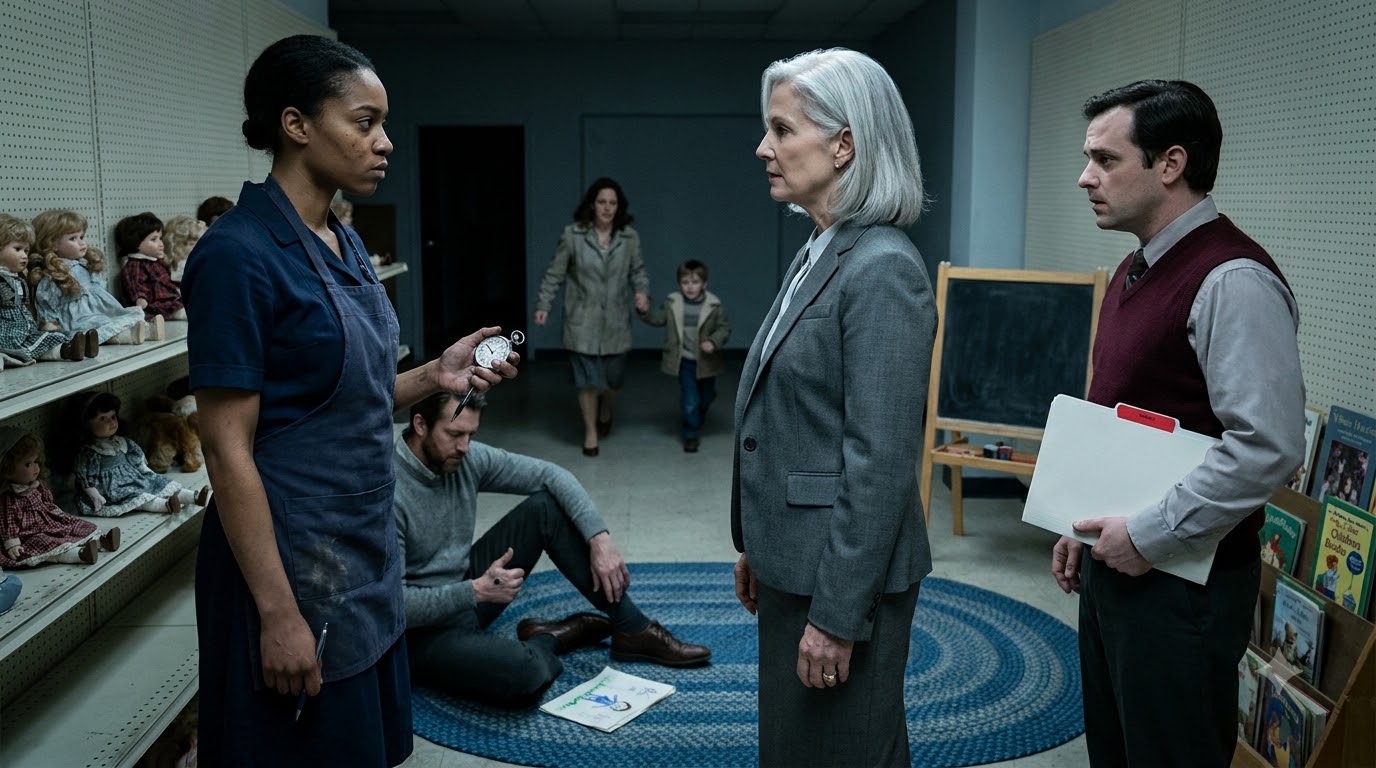
The alcove had been a dead retail zone—a dark corner stacked with overpriced porcelain collector dolls that no child was allowed to touch.
Jade ignored the two clerks whispering near the plush aisle. She pulled a worn paperback from the crate, wiping a smudge of dust from its cover before placing it on the low wooden shelf she had dragged over from the back storage room herself.
“You’re not allowed to move floor fixtures,” one of the clerks said, stepping forward. He wore a crisp maroon vest with a silver name tag that read Julian. “Store manager said layout changes need regional approval.”
“Store manager didn’t sign my contract,” Jade replied, her voice calm and clipped as she stacked another set of picture books. “Mr. Pierce did.”
“It’s an audit risk,” Julian muttered, though he took a step back, unable to meet her steady gaze. “Mrs. Hoffman’s team comes through at four.”
Jade pulled her mother’s silver pocket watch from her apron pocket, clicking the catch to check the time. Three-fifteen. She ran her thumb over the cracked glass face, feeling the familiar notch.
“Then we have forty-five minutes to finish setting up the rug,” she said, tossing him a roll of heavy masking tape. “Grab the other end.”
Julian stared at the tape, hesitated, then crouched down to help anchor the blue braided carpet to the polished oak floor.
A quiet rustle came from behind the display case. Nathan stood at the edge of the alcove, holding two paper cups from the street cart outside. He wore a gray sweater with the sleeves pushed up, a smear of black printer ink lingering across the side of his thumb. He handed one cup to Jade.
“Coffee’s bitter,” he said, sitting down directly on the wooden bench Jade had refinished that morning.
“It’s fifty cents,” Jade said, taking a sip and letting the hot liquid cut through the chill of the air-conditioned floor. “Better than the machine in the executive lounge.”
Nathan looked around the space—the low shelves filled with donated children’s classics, the small wooden tables, and the chalkboards mounted at kid-height along the wall. “The board sent an internal auditor down twenty minutes ago. They’re taking photos of the floor square footage.”
“Let them,” Jade said, setting her cup on the corner of a shelf. “Square footage sitting empty doesn’t buy bread. If we bring forty parents in here every Saturday, ten of them buy birthday presents before they leave. It’s basic math.”
“They don’t want basic math, Jade,” Nathan murmured, watching her work. “They want predictable margins.”
Before she could answer, the bell at the front entrance chimed. A woman in a faded winter coat walked in, holding the hand of a small boy with a scuffed shoe. The boy pulled away, his eyes locking onto the chalkboards in the back, and ran straight toward the rug.
Jade dropped to one knee, matching the boy’s eye level as he grabbed a blue piece of chalk. She didn’t offer a rehearsed sales pitch. She just pointed to a clean spot on the board.
“Draw me a dragon,” she said softly.
From the edge of the display aisle, Nathan watched the child begin to draw, his expression shifting from corporate exhaustion to a quiet, concentrated still. He walked over, sitting awkwardly on the edge of the low rug next to the boy, pulling a second piece of chalk from the tray.
“Need a tail?” Nathan asked the kid.
Jade stepped back, watching the billionaire owner of Pierce Toys sitting on a taped-down rug with chalk dust smudging his trousers. For the first time since walking into the building, the heavy, artificial pressure of the corporate office seemed to lift from the air.
Then Jade saw it.
Lying on the lower shelf of the display unit right beside Nathan’s sweater—left behind by the internal auditor who had passed through minutes earlier—was a single white folder marked with a red compliance tab. The top page was turned over, exposing a bold, black heading across the top line: PROPOSED TRANSFER OF OPERATIONAL AUTHORITY — EXECUTIVE VOTE.
Jade’s hand tightened around her mother’s watch in her pocket. The board wasn’t just auditing her program. They were using it as the primary evidence to strip Nathan of his company entirely.
CHAPTER 4: THE BOARDROOM STRIKE
Nathan didn’t see the document. He pushed himself off the rug, flexing his shoulder as he stood up.
Before Jade could slide the red-flagged memo into her leather folder, heavy footfalls echoed down the main aisle. Two men in dark three-piece suits rounded the corner, flanked by Margaret Hoffman. Her silver hair picked up the overhead track lighting like spun wire.
“We gave you thirty days to show operational metrics, Nathan,” Margaret said, her voice cutting through the quiet hum of the store’s air conditioning. She didn’t look at the chalkboards or the blue carpet. Her focus stayed locked on Nathan. “Instead, you’ve turned primary retail floor space into an unvetted daycare.”
Nathan adjusted his sleeves, his face hardening into a expressionless wall. “This floor space was generating zero margin on discontinued inventory, Margaret. The community outreach program brought sixty-two family visits into this building since Tuesday.”
“It brought liabilities,” the taller board member said, stepping forward. He pulled a black tablet from under his arm. “Unapproved capital expenditure. Unauthorized fixture relocations. And an employment contract signed without board review.”
Jade felt her fingers tighten around her mother’s pocket watch inside her coat. The metal felt cold against her knuckles. She didn’t shrink back into the display shelving. She took one step sideways, placing herself directly between Margaret and the low wooden shelves she had set up.
“The contract is valid under executive discretionary limits,” Nathan said, his voice quiet, flat, and absolute. “You know the bylaws.”
“The bylaws allow discretionary hiring for existing store operations,” Margaret countered, taking a single, calculated step closer. Her gold ring clicked against the leather strap of her handbag. “Not for creating new administrative titles for former diner staff. The board has called a emergency vote for five o’clock. We are freezing all discretionary allocations pending an independent management audit.”
Jade saw the trap laid out in plain sight. They weren’t just challenging the budget. They were engineering a paper trail to declare Nathan unfit for operational governance, stripping his voting leverage before the fiscal quarter closed.
“You can’t freeze local floor allocations without a two-thirds majority,” Nathan said.
“We have seven out of nine signatures, Nathan,” Margaret replied smoothly. “The motion is already logged.”
Nathan’s jaw tightened, the muscle along his cheek twitching once—his single visible reaction to the blow.
Jade’s coat pocket buzzed with a sudden, violent vibration. She pulled out her cracked flip phone, flipping it open with one thumb.
“Jade?” Mrs. Garcia’s voice came through the speaker, tight with panic over the static. “It’s Lily. Her school called. She collapsed during outdoor recess—they’re taking her to Children’s Hospital right now. They think it’s her appendix.”
The sterile air of the store seemed to drop ten degrees in an instant. The polished oak floor beneath Jade’s feet felt unstable, like thin ice over dark water.
Jade closed the phone with a sharp snap. She didn’t glance at Margaret, and she didn’t look at the tablet the board member was holding.
“I’m leaving,” Jade said, her voice raspy but steady as she grabbed her leather folder from the shelf, deliberately sweeping the white compliance memo inside with it.
“If you abandon your post during an active audit, Miss Washington,” Margaret said without turning her head, “your contract is subject to immediate cause termination.”
“My sister is in an ambulance,” Jade said, stepping right into Margaret’s path until they were standing less than a foot apart. “Keep your contract.”
Nathan grabbed his jacket off the display fixture. “I’m driving you.”
“Nathan,” Margaret warned, her tone dropping into a icy register. “The emergency board session starts in twenty minutes. If you walk out of this store now, you forfeit your right to present a defense.”
Nathan didn’t hesitate. He didn’t even look back at Margaret. He tossed his corporate ID badge onto the glass display case next to her elbow.
“Call the vote,” Nathan said.
CHAPTER 5: THE TRAP AND SEPARATION
The automatic doors slid open with a sharp gust of rain-chilled air, sweeping through the hospital lobby. Jade walked toward the desk, the smell of rubbing alcohol and industrial floor floor-cleaner hitting her face.
“Lily Washington,” Jade said to the clerk behind the desk, her voice raspy. “She came in by ambulance twenty minutes ago.”
“Pre-op,” the clerk said without looking up from her screen. “Room 104. Third door on the left past double doors.”
Jade moved down the tiled hall, her shoes squeaking on the wet linoleum. Nathan followed three paces behind, his hands shoved deep into his coat pockets, his heavy tread echoing against the cinderblock walls.
When Jade reached the room, Lily was sitting upright on the gurney, a plastic ID bracelet loose around her small wrist. Mrs. Garcia sat in a metal folding chair beside her, holding a styrofoam cup of tea.
“Jade!” Lily called out, her voice thin but bright. “The doctor said they have to take out my appendix before it pops like a balloon.”
Jade dropped to her knees beside the bed, wrapping her arms around her sister’s small shoulders, smelling the rain on Lily’s cotton sweater. “You’re okay, baby. I’m right here.”
“Mr. Nathan came too?” Lily asked, looking past Jade’s shoulder.
Nathan stayed in the doorway, his tall frame blocking the fluorescent light from the hall. He didn’t step into the room. He nodded once to Lily, a quiet, grounded gesture that carried no performance.
“He drove me,” Jade said, smoothing Lily’s dark hair back from her forehead.
A nurse stepped in, sliding a clipboard into the door slot. “Family guardian? We need to verify insurance coverage before transfer to the surgical suite.”
Jade stood up, reaching into her leather folder for her state assistance card and work ID. She handed the papers over. “She’s on my dependents’ policy through the cleaning union.”
The nurse scanned the paper, then tapped her screen. “This policy dropped coverage on the first of the month due to hours reduction.”
Jade’s hand froze over her folder. “That’s impossible. I worked thirty-two hours two weeks ago.”
“System says inactive,” the nurse replied flatly. “Self-pay deposit for emergency appendectomy prep is four thousand dollars. Otherwise, we hold for county transfer.”
Jade felt the room tilt. County transfer meant three hours in an ambulance transport across the city, delaying a procedure that needed to happen now.
She pulled her mother’s silver watch from her coat pocket, her fingers digging into the cracked glass face until her knuckles turned white. She had seventy-two dollars in her checking account until Friday.
Nathan stepped forward from the door frame. He pulled a black leather wallet from his jacket. “I’ll cover the deposit on my business card.”
The nurse reached for the card.
“No,” Jade said, her voice dropping into a hard, razor-sharp register that stopped both of them in their tracks.
Nathan looked at her, his dark eyes tightening. “Jade, she needs the surgery now.”
“She is getting the surgery now,” Jade said, stepping directly between Nathan and the billing counter. She pulled out the leather folder she had carried from the store, reached inside, and pulled out her official employee contract with Pierce Toys—the one she had signed two days ago in his office.
She slammed the contract down on the nurse’s desk, pointing her finger at the third clause under Emergency Executive Health Provision.
“Read line four,” Jade told the nurse, her voice cutting through the hall’s background chatter like a blade. “Full medical coverage for primary staff and dependents takes effect upon contract execution, funded directly through the store’s operating account line item 402. It is not personal charity. It is a legal corporate benefit.”
The nurse blinked, looked at the contract stamp, then typed rapidly into her terminal. “Line item 402 is active under Pierce Toys corporate routing. Coverage verified.”
Nathan stared at Jade, his arm slowly dropping back to his side. “Jade—”
“You thought you were saving us,” Jade said softly, looking Nathan dead in the eye while the nurse pushed Lily’s gurney toward the surgical doors. “You thought you could just pull out a piece of plastic and buy our way out of a corner, just like you do with your board.”
“I was trying to stop them from moving her,” Nathan said, his voice low, gravelly with exhaustion.
“You were treating me like a charity project,” Jade said, her voice trembling with a quiet, furious dignity that made Nathan take an involuntary step back. “You didn’t trust me to use my own contract. You didn’t trust me to hold my own ground. You wanted to be the hero with the deep pockets.”
She pulled her leather folder against her chest, her mother’s cracked watch locked tight in her fist.
“I don’t need a savior, Nathan,” Jade whispered, each word landing with the weight of an iron vault door closing. “I need an equal. And until you figure out the difference, stay away from my family.”
She turned her back on him, following the gurney down the hall without looking back once.
CHAPTER 6: THE FOUNDATION BLUEPRINT AND COLLAPSE
The paper cup crumpled under the pressure of Jade’s thumb as heavy, deliberate footsteps stopped in front of her.
Nathan stood in the hallway, his suit coat gone, his white shirt wrinkled and stained with dried coffee along the cuff. He didn’t offer a corporate check, and he didn’t reach for a pen. He held out a thick, legal-bound folder tied with a simple red cloth ribbon.
“The board voted at six this morning,” Nathan said, his voice raw from lack of sleep. “Margaret executed the operational freeze. They stripped my personal authority over the store network’s liquid capital.”
Jade looked up, her thumb resting against the cold, cracked face of her mother’s silver watch inside her pocket. “So you lost.”
“I lost the board,” Nathan said, sitting down on the bench beside her, leaving two feet of space between them. He rested his elbows on his knees, staring down at the linoleum. “Because I was trying to run a community program out of a private balance sheet. Margaret was right about one thing—corporate capital is designed to extract, not build.”
He pushed the legal folder across the vinyl seat toward her.
“That’s not Pierce Toys money,” Nathan said softly. “It’s a non-profit trust charter—The James Pierce Foundation. I filed the paperwork at midnight using my personal equity shares as the initial non-liquid endowment. Under state charter laws, the board cannot touch it, freeze it, or audit it for store margins.”
Jade didn’t touch the folder right away. “What is it?”
“It’s a community-owned operational entity,” Nathan said, turning his head to look at her. His eyes were bloodshot, but his gaze was completely clear. “It funds emergency medical grants, after-school childcare, and working-parent programs. But under the charter rules I drafted, I am legally barred from serving as Executive Director. The board must be comprised of community representatives—people who actually live the work.”
He pointed to the signature line at the bottom of the front page.
“There’s no personal salary from me in there, Jade. No handouts. No corporate line items that can be revoked when a board member gets nervous. It pays a standard, board-governed salary through the foundation’s independent trust. If you take the job, you aren’t working for me. You’re running the entity that holds the store’s community lease.”
Jade picked up the document, her fingers tracing the crisp black ink of the charter. She read the clauses—each line structured to protect the dignity of the families receiving aid, requiring sweat equity and community input rather than passive charity.
“Margaret will fight this,” Jade said quietly.
“She already tried,” Nathan replied, a dry, faint shadow of a smile touching his jaw. “She showed up at the registrar’s office at seven to claim the flagship store’s back alcove for retail shelving. But the foundation signed a twenty-year zero-cost lease for that floor space at six-fifteen. She can’t touch the reading room without violating state trust law.”
The door to Room 104 clicked open. A nurse pushed Lily out in a wheelchair, a small blue blanket wrapped around her knees. Lily blinked against the bright morning light, her hands clutching a worn stuffed elephant.
“Jade?” Lily called out, her voice small but steady. “Is Mr. Nathan still here?”
Nathan didn’t jump up or make a grand gesture. He stood up slowly, keeping his hands in his pockets, and walked over to the side of the wheelchair, stopping a polite distance away.
“I’m right here, Lily,” Nathan said softly.
Lily looked up at him, then at Jade, who was holding the signed foundation charter in one hand and her mother’s silver pocket watch in the other.
“Did you two stop fighting?” Lily asked with a long, exhausted sigh.
Jade walked over, crouching down next to the wheelchair. She reached into her pocket and gently placed her mother’s pocket watch into Lily’s small palm, wrapping her sister’s fingers around the cool metal.
“We weren’t fighting, baby,” Jade said, looking up at Nathan and meeting his eyes without a single layer of defense left between them. “We were just figuring out how to build something that lasts.”
Nathan reached out, offering his hand not as a savior with a checkbook, but as a partner standing on the exact same floor. Jade took it, her grip firm, grounded, and equal.
Through the double doors of the recovery ward, the morning sun reached the blue rug in the back alcove of Pierce Toys, where the low wooden shelves stood exactly where they belonged.