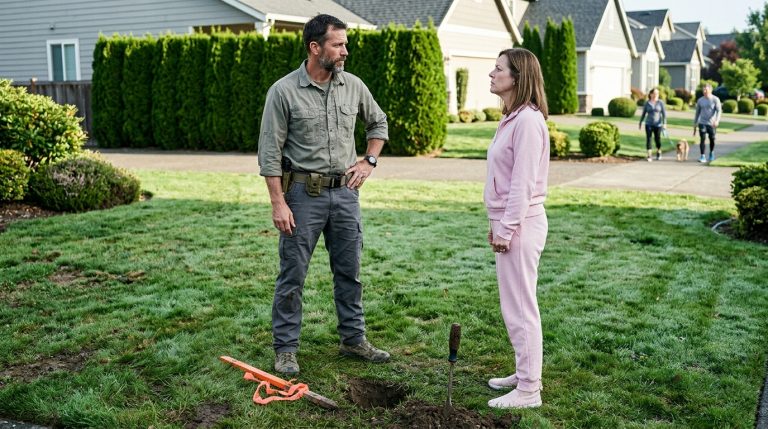
The Silent Hum of Order: A Gated Community’s Reckoning with Stolen Property and Hidden Truths
CHAPTER 1: The Midnight Absence
I woke up to the silence. It wasn’t a peaceful stillness; it was the suffocating absence of the low, steady vibration that usually defined my life in Desert Vista. In the office, the rack of servers—the backbone of my security architecture—had gone dead. The hum of the kitchen refrigerator had vanished. My phone vibrated against the nightstand, its screen glowing like a fever in the dark: System Offline. Power Loss.
I rolled out of bed, the floorboards cold beneath my feet. I didn’t reach for a weapon; I reached for my gear. A tactical flashlight, heavy and cool in my palm, and my boots. I moved through the hallway with a practiced, measured gait, my mind already running diagnostics. The house was a fortress I had spent three years fortifying, yet someone had found the single, fatal pressure point: the dedicated power line running to the backyard generator.
When I stepped into the Arizona night, the air felt thin and unforgiving. I didn’t see the motion lights flicker on. I didn’t hear the hum of the cooling fan. I walked along the side of the house, the beam of my light cutting through the dust motes dancing in the dark.
The enclosure was wide open. The generator, a massive iron-clad unit I’d labored for weeks to wire into the structural heart of the property, was gone.
I froze. My pulse was a steady, rhythmic thrum in my ears, but my thoughts were calculating—not with panic, but with the cold, hard logic of a man who realized his assets had been liquidated without his consent. The gate lock had been sheared off with surgical precision. Deep, fresh furrows marred the grass, the tread marks of a heavy-duty trailer cutting deep into the hard-packed clay.
I followed the tracks to the street. They didn’t aim for the perimeter exit. They led straight toward the community clubhouse.
I stood there on the asphalt, the flashlight beam bouncing as my hand shook, not from fear, but from the sudden, sharp realization of the scope of this. There were lights burning three blocks away at the clubhouse—the bright, artificial glare of a setup in progress. I turned, walked back to my truck, and pulled the door shut. The metal sounded hollow in the quiet night. As I backed out, I noticed something that made the air in my lungs grow stale: a small piece of blue-painted metal, a scrap from the generator casing, lay discarded in the gutter, reflecting the dim glow of the streetlamp like a warning.
CHAPTER 2: The Trail of Tracks
I didn’t immediately turn the truck toward the clubhouse. I sat in the driver’s seat for a long moment, the engine idling with a rough, uneven vibration that felt like a mockery of the steady hum I had lost. I stared at the scrap of blue metal in my palm. It was jagged, the paint chipped in a way that spoke of a hurried, violent removal. This wasn’t a requisition; it was a raid.
I shifted into drive, the truck lurching forward. The desert road ahead was a ribbon of cracked asphalt, illuminated only by my headlights. Every shadow cast by the low-slung desert shrubs looked like a threat, a trick of the light that made my pulse hitch. I was operating on a heightened level of awareness, my eyes scanning the peripheral, searching for the tell-tale signs of the trailer’s path.
The tire tracks were there, etched into the soft shoulders of the road where the desert dust had accumulated. They were deep, indicating significant weight—my generator, stripped from its foundation, bouncing along behind a truck that had no business hauling such a load. They didn’t weave; they were direct, purposeful, and, most damning of all, they were oblivious. Whoever had taken it hadn’t tried to hide their exit. They had moved with the arrogance of those who believe they own the very pavement they traverse.
As I neared the community clubhouse, the glow intensified. It wasn’t the warm, inviting light of a neighborhood gathering; it was a clinical, harsh brightness, like an operating theater dropped into the middle of the desert night. The parking lot was mostly empty, save for a heavy-duty pickup truck and the flatbed trailer I had been dreading to see.
I parked at a distance, killing my engine. The silence that rushed back in was different now—it was filled with the faint, rhythmic thrum of an engine. My engine. My generator, roaring away in the dark, tethered to the clubhouse by thick, black extension cords that snaked across the concrete like venomous vines.
My breath hitched. The absurdity of it was staggering. It wasn’t just that they had taken it; it was how they were using it. The wiring wasn’t a temporary, desperate measure. It was a complex, multi-line hookup, requiring a level of technical knowledge that suggested this hadn’t been a spur-of-the-moment decision.
I stepped out of the truck, the desert air biting at my skin. My hands were balled into fists, the scrap of metal still digging into my palm. I wasn’t just angry; I was cold. A strange, creeping paranoia began to settle over me. If they had bypassed my security, if they had known exactly how to detach that unit, they hadn’t just studied my yard—they had studied my life.
I approached the trailer cautiously. The clubhouse windows were dark, but a sliver of light escaped from the main entrance. I heard a muffled voice, then another—a sharp, authoritative tone I recognized immediately. Patricia Williamson. Even from this distance, the cadence of her speech was unmistakable. It was the sound of a woman who had never been told “no,” a sound that grated against the rusted gears of my own pragmatism.
I didn’t storm the building. Instead, I circled the clubhouse, keeping to the shadows of the landscaping. My mind was a furnace, burning through the logic of the situation. Why here? Why now? The charity breakfast wasn’t for hours. There was no reason to have the power running unless there was something inside that couldn’t afford to be dark, or something that needed to be hidden behind the cover of a temporary “emergency.”
I leaned against the stucco wall, the rough texture scraping my shoulder. My vision felt sharp, perhaps too sharp. I noticed the way the extension cords were anchored—heavy-duty tape, professional-grade, secured with a precision that hinted at someone who did this often. I caught a flicker of movement behind the glass of the kitchen door. A shadow passed, then another. They weren’t just setting up for coffee and pastries. They were moving crates.
The weight of the realization was heavy: this was not a dispute about community resources. This was something deeper, a structural collapse of the trust I had placed in the people who shared this gated enclave. I gripped the corner of the wall, my knuckles white. I had come for a machine, but I was looking at the first crack in a foundation that had been rotting long before tonight.
I needed to see what was behind those crates. I needed to know why my life’s backup power was currently subsidizing the clubhouse’s clandestine operation. I reached into my pocket, my fingers brushing the cool, reassuring metal of my multi-tool. It was time to stop observing and start verifying.
CHAPTER 3: The Confrontation
The back door was a standard industrial-grade slab, but it wasn’t locked. That, in itself, was a deviation. Desert Vista Estates prided itself on impenetrable security, yet here was an unguarded entry point, the hinges slightly weathered, suggesting it was used far more often than the protocol demanded. I pushed it open just enough to slide through, the metal edge whispering against the frame.
The air inside the clubhouse was thick with the scent of floor wax and stale coffee. I kept low, moving along the perimeter of the main hall. The decorations were festive—balloons swaying in the draft, tables draped in crisp, white linens—but the atmosphere was anything but celebratory. The low, guttural thrum of my generator reverberated through the floorboards, a jarring, industrial heartbeat that didn’t belong in this space.
I found the source of the power cables. They weren’t just feeding the lights or the sound system. They were snaked behind the heavy oak bar, disappearing into the kitchen area.
I crept closer, my boots making no sound on the industrial carpet. Through the service window, I saw her. Patricia Williamson was leaning over a terminal, her face illuminated by the harsh blue light of a screen. She looked exhausted, her movements frantic as she tapped at the keys. Beside her, a man I didn’t recognize—a suit, his posture too rigid, his eyes constantly tracking the door—was packing a stack of ledger books into a plain, nondescript briefcase.
“The grid is too unstable,” the man said, his voice clipped and strained. “If we don’t have the backup power for the transfer by 4:00 AM, the server will dump the records. We lose the transaction trail, Patricia. Everything.”
Patricia didn’t look up. “I know that, Miller. The generator was the only option. Kendrick won’t even wake up until sunrise. By then, the reroute will be complete and the land transfer will be finalized. It’s a clean break.”
My heart hammered against my ribs, a dull, aching thud. I had come looking for a piece of machinery, but I had stumbled into something that sounded dangerously like a corporate liquidation. Transaction trails? Land transfers? This wasn’t about a charity breakfast.
I stepped into the light of the service window. My presence wasn’t intended to be a surprise, but the look on Patricia’s face—the absolute, hollowed-out terror—was a revelation. She dropped the tablet she was holding. It clattered against the stainless-steel counter, the sound echoing like a gunshot in the quiet room.
“Lucas,” she breathed, her composure fracturing. She recovered quickly, her chin lifting into that familiar, brittle arc of self-righteousness. “You’re trespassing.”
“I’m retrieving my property, Patricia,” I said, my voice steady, stripped of the anger that had driven me here. I gestured toward the cables disappearing behind the bar. “What is this? You risked a theft charge for a breakfast? Or is there something else running on my power?”
Miller, the man in the suit, had moved behind the counter, his hands disappearing into his jacket pocket. I saw the shift in his weight—the classic, practiced stance of someone who expected conflict. I didn’t flinch. I kept my eyes on Patricia, letting the silence grow heavy between us.
“You have no idea what you’re interfering with,” Patricia said, her voice dropping to a low, dangerous register. “This is for the community. The development plans—the upgrade to the infrastructure—it all requires a certain… agility. The HOA board isn’t just a committee, Lucas. It’s a vehicle for managing growth. You’re just a homeowner. You don’t see the mechanics.”
“I see a generator that doesn’t belong to you,” I countered. I walked toward the bar, my pace measured. “I see a man in a suit I’ve never seen in Desert Vista, packing records that have nothing to do with charity. And I see a president who’s terrified of a sunrise.”
Miller stepped forward, his expression blank. “Mr. Kendrick, you need to leave. Now. If you don’t, I’m authorized to contact the board’s private security firm. It’ll get ugly.”
I stopped, my hand brushing the edge of the bar. The generator outside spiked in its RPM, a brief, high-pitched whine that signaled a heavy load being pulled. Patricia’s eyes darted toward the server rack behind the wall. The decoy was holding—she was still playing the role of the beleaguered leader—but the man in the suit was the real threat. He wasn’t part of the community. He was an auditor, or worse, a fixer.
“Call them,” I said, a grim smile touching my lips. “But tell them to bring a warrant. Because that generator is wired into my house’s secondary security network. The moment you disconnect it, or the moment it goes offline, an automated alert goes to the county sheriff’s cyber-crimes unit. They’re already watching the logs.”
It was a bluff, a thin, desperate gamble, but it hit its mark. Patricia paled, her fingers trembling. Miller hesitated, his hand shifting in his pocket. For a second, the entire room seemed to hold its breath. I realized then that my presence was the one variable they hadn’t calculated. I was the rust in their machine, the glitch in their perfectly executed plan. And for the first time, I felt the terrifying, exhilarating weight of being the person who could bring the whole thing crashing down.
CHAPTER 4: The Police Intervention
The tension in the clubhouse kitchen was a physical thing, thick enough to taste, like copper and dry desert dust. Miller’s hand remained half-buried in his jacket, his eyes flickering from my face to the generator humming outside, then back to Patricia. She looked small suddenly, stripped of her executive bravado, her shoulders hunched as if she were trying to occupy less space in the room.
“Mr. Kendrick,” Miller said, his voice lower, the professional veneer cracking. “You’re making a monumental mistake. This isn’t just about HOA politics. If you force this to the point of police involvement, you’re going to be the one on the losing end of the litigation.”
“Then let’s litigate,” I replied. I didn’t move toward him, but I didn’t step back either. I kept my posture loose, my center of gravity low. I wasn’t a fighter, but I was a man who understood the value of structural integrity—in my house, in my security, and in my word. “But first, I’m taking my property back. Now.”
I reached past him, not toward the bar, but toward the extension cord junction he had rigged. He stiffened, but he didn’t pull the weapon. That told me everything I needed to know. He was a professional, likely a corporate hire, and he wasn’t going to pull a firearm in a public building for the sake of an HOA president. He was a bully, but he was a calculated one.
I yanked the junction apart. The hum of the generator outside pitched upward, then cut out entirely. Silence flooded the clubhouse, so sudden and absolute that it made my ears ring. The emergency lights in the kitchen flickered once, then failed. We were left in the dim, amber glow of the parking lot lights bleeding through the windows.
“I’m leaving,” I said, my voice cutting through the dark. “And if either of you tries to stop me, the next person to walk through those doors won’t be an auditor. It’ll be the sheriff.”
I didn’t wait for a response. I turned and walked out, my boots clicking sharply on the hardwood. I kept my back to them, counting the seconds. One. Two. Three. No movement. No shout. I pushed out into the cool night air, the smell of ozone and sagebrush hitting me with renewed intensity.
I was halfway to my truck when a pair of headlights swept across the clubhouse parking lot. A cruiser. Officer Morrison. He slowed as he spotted my truck, then pulled in, blocking the exit. He stepped out, his flashlight cutting through the dark like a laser.
“Mr. Kendrick?” he called out, his voice familiar and calm. “What are you doing here at this hour?”
I stopped, my breath hitching. I hadn’t actually called the police yet, but my bluff had effectively brought the law to my doorstep. I walked toward the officer, my hands open, visible. The irony wasn’t lost on me: I had come to stop a crime, and now I had to navigate the very system I had claimed was already in motion.
“Officer,” I said, keeping my tone measured. “I’m here to recover stolen property. My generator is inside that trailer.”
Morrison looked at the trailer, then at the clubhouse, his brow furrowing. “Patricia Williamson called the station ten minutes ago. She reported an intruder. Said you were threatening the staff and tampering with community equipment.”
“She’s lying,” I said, the words coming out flat and sharp. I reached into my pocket, pulled out the scrap of blue metal, and held it out under his flashlight. “She didn’t rent this. She raided my property at 3:00 a.m. and hardwired it to the clubhouse to run an illegal server operation. Check the back door. Check the junction behind the bar. You’ll see the override.”
Morrison’s expression shifted, the professional detachment giving way to the wary suspicion of a man who dealt with neighbor disputes every single day. He looked at the clubhouse, then back at me. “Mr. Kendrick, you’re describing a felony theft, not a board dispute. You sure about this?”
“I’m looking at it,” I said. “And the records are inside, packed in a briefcase. If you don’t secure that scene, those records will be gone by dawn.”
He stared at me for a long moment, then nodded, signaling for his partner to join him. I leaned against my truck, the adrenaline beginning to ebb, leaving behind a cold, hollow fatigue. I wasn’t just defending my property anymore. I had pulled the thread, and now the entire fabric of Desert Vista was starting to unravel. As I watched the officers head toward the clubhouse, I realized the ‘rusted truth’ was finally coming to the surface—and it was going to be a lot harder to clean up than I ever imagined.
CHAPTER 5: The Forensic Evidence
The red and blue lights of the cruiser washed over the clubhouse walls, turning the beige stucco into a flickering, strobe-lit nightmare. I stayed by the truck, the metallic scent of the generator’s exhaust lingering in the air like a cold, industrial fog. Officer Morrison was inside now, his silhouette moving past the windows. I could hear the muffled sound of voices, the sudden, frantic scrape of furniture being pushed aside.
I didn’t stay put. The adrenaline was a static charge in my nerves, forcing me to move. I circled back toward the service entrance, my boots crunching on the dry gravel. If Miller had been telling the truth about the server dumping the records, then Morrison’s arrival was the catalyst for a total system wipe.
I reached the doorway just as the heavy thud of a door slammed shut inside. Through the crack, I saw the man in the suit—Miller—shoving a stack of papers into a portable shredder he’d pulled from under the bar. He wasn’t panicked; he was mechanical, his movements precise, almost bored. This was a contingency plan, and he was executing it with the practiced ease of a man who’d burned bridges in a dozen other towns.
I pushed the door open. Miller didn’t look up. “Officer is already in the main hall, Mr. Kendrick. You’re too late to play the hero.”
“I’m not playing,” I said, stepping into the room. The air smelled of ozone and shredded paper. I moved toward the terminal Patricia had been using. It was still active, a blinking cursor on a black screen. I didn’t know what I was looking for, but I knew that these people had been operating in the dark for a reason.
I looked at the terminal. It wasn’t connected to the web. It was a local bridge, a way to move data from the clubhouse’s internal ledger to an external drive. I reached into my pocket, pulled out the multi-tool, and bypassed the port, plugging in my own portable drive. My hands were shaking, a fine, rhythmic tremor that made every movement feel like it was taking hours.
As the drive mounted, I saw the directory tree. It was sprawling. It wasn’t just HOA maintenance budgets; there were architectural schematics, land surveys, and digital signatures—dozens of them, all under the name of a holding company I’d never heard of.
Then, the timestamp on the screen caught my eye. 4:12 AM.
The system was set to initiate an automatic wipe in eight minutes.
Miller stopped shredding. He turned, a strange, tight smile on his face. “You’re looking at a trail, Lucas. But you’re a decade behind. You think you’re uncovering a crime? You’re just looking at the accounting for a property value increase. The land transfer is already signed, sealed, and filed with the county. You can copy those files all you want, but you’re just documenting your own displacement.”
“The land isn’t yours to transfer,” I said, my voice tight.
“Legally, it’s not yours either,” he replied. “The HOA bylaws—the ones Patricia ‘reinterpreted’—give the board sole discretion over common area disposition. It’s all in the legal structure. You signed the covenant when you bought your house. You gave us the authority to act in the community’s best interest. And the ‘best interest’ just happens to be a luxury condo development that will triple the local tax base.”
He picked up the briefcase, his gaze steady. “You think you’re standing up for ‘right’? You’re standing in the way of a hundred-million-dollar upgrade. Keep the files. They’ll just make it easier for the developers to identify who needs to be bought out.”
He walked past me toward the exit, his suit jacket brushing my shoulder. I stood frozen, the data transfer bar crawling across the screen. 55%… 60%…
I heard Morrison’s voice from the main hall. “Miller? Step away from the door.”
But Miller was already gone. I turned to look at the screen, my gut twisting. The files were still downloading, but as the screen refreshed, a new window popped up. It wasn’t just a land transfer. It was a list of names—homeowners in Desert Vista, categorized by ‘compliance’, ‘negotiable’, and ‘priority removal’.
My name was at the top of the ‘priority’ list, marked with a red tag that hadn’t been there when I started the sequence. The realization hit me with the weight of a physical blow: this wasn’t an accident. The theft of my generator hadn’t been a random act of arrogance; it had been a targeted move to force my hand, to lure me into a legal entanglement that would freeze my assets and force a default on my mortgage.
I looked at the directory again. The ‘Illegal Land Sale’ was the decoy. The true reality was something far more surgical: the systematic, legal erasure of the entire community, one house at a time. And I hadn’t just uncovered the truth—I had walked directly into their trap.
CHAPTER 6: The Emergency Meeting
Officer Morrison’s heavy boots echoed against the far hallway floor, a rhythmic, encroaching sound that cut through the silence of the room. My heart was a frantic bird in my chest, slamming against my ribs with every thud of his approach. I ripped the drive from the port, my fingers fumbling, nearly dropping it on the polished surface of the stainless-steel counter.
“Mr. Kendrick?” Morrison’s voice boomed from the doorway. He sounded strained, his flashlight sweeping the room with a wide, blinding arc. “The suspect has vacated the premises through the rear service exit. I need you to stay where you are.”
I didn’t answer. I shoved the drive deep into my pocket, the plastic edge sharp against my thigh. I wasn’t going to wait to be questioned—not when I knew what was waiting on that drive. My name was on a list, and if I stayed here, I’d be just another variable to be ‘adjusted’. I slipped behind the heavy oak bar, keeping my movements low and fluid, the way I’d practiced during the dry-runs of my home security drills.
“Kendrick?” The footsteps halted. Morrison was close. Too close.
I moved toward the side exit, pushing open the heavy fire door with just enough pressure to avoid the alarm trigger. The air outside was cooler, the smell of damp earth and sagebrush a stark contrast to the sterile, panicked air inside. I didn’t head for my truck—it was too visible, a sitting target in the clubhouse lot. I faded into the shadows between the manicured hedges and the perimeter fence, my breath hitching in my chest.
My thoughts were a cascading series of failure states. I had thought this was a conflict about local authority, a battle of wits with an arrogant HOA president. I had been playing a game of checkers while they were rewriting the map. They weren’t just taking my generator; they were stripping away the legal legitimacy of every home in Desert Vista. The ’emergency’ I had witnessed tonight was just the final, public act of a process that had been grinding away in the background for years.
I reached my house on foot, the walk feeling like a blur of adrenaline and cold realization. The perimeter lights were still dark, the lack of the generator leaving the house feeling hollowed out and vulnerable. I stepped inside, locking the door behind me with a series of deadbolts that suddenly felt like toys.
I didn’t go to the office. I sat on the kitchen floor, the darkness wrapping around me like a shroud. I plugged the drive into my laptop, the small screen the only source of light. As the files loaded, I saw the true scope of the project. It was a massive, tiered redevelopment plan. They weren’t just buying out the residents; they were creating a debt-trap infrastructure. By intentionally failing the maintenance systems—the generators, the water mains, the security networks—they were triggering clauses in the HOA covenants that allowed the board to levy ‘special assessments’ that would force owners into default.
My generator wasn’t just a stolen piece of equipment. It was the linchpin. If they could force my system to fail, they could create a liability that would justify the ‘reconstruction’ of the entire block.
I leaned my head back against the refrigerator, the cold metal seeping into my skin. I was tired, a deep, bone-aching exhaustion that made the air feel heavy. The community meeting was scheduled for 7:00 AM—three hours away. Patricia would be there, and even with the police report, she’d likely try to twist the narrative to fit her ‘community leadership’ persona.
But I had the list. I had the schematics. And I had the signatures.
I looked at the names again. Margaret Chen, the treasurer, was marked as ‘pending’. That meant she wasn’t in on it—she was a target, just like me. I picked up my phone, the screen showing a half-dozen missed calls from her. She had been trying to reach me since the police arrived. I opened the message app and typed a single line, my thumbs steadying as the logic of the situation clarified: They aren’t trying to fix the community, Margaret. They’re liquidating it. Meet me at the clubhouse before the meeting. Bring the original bylaws.
I hit send, the blue light of the screen fading as the phone locked. The silence of the house wasn’t peaceful anymore; it was the quiet of a war-room before the first strike. I stood up, the fatigue replaced by a cold, sharp resolve. They wanted a liquidation? I’d give them an audit.
CHAPTER 7: The Cold Calculus
The pre-dawn light was a bruise-colored gray when I pulled into the clubhouse parking lot. My truck tires crunched on the gravel, a sound that seemed abnormally loud in the vacuum of the early morning. I didn’t kill the engine. I sat for a moment, the drive still heavy in my pocket, the cold weight of it a grounding force. I had reviewed the files four times during the short drive. The complexity of the scheme was staggering—the board had been using the community’s own infrastructure failures to create artificial defaults, siphoning the maintenance funds into the holding company while simultaneously setting the stage for a total land liquidation.
Margaret’s car was already there, a lonely silhouette under the dim glow of the security lights. She stood by the entrance, clutching a thick leather-bound volume to her chest—the original HOA bylaws, a relic of a time when the community was built on trust rather than algorithms.
I stepped out, the air crisp and biting. “Margaret,” I said, my voice cutting through the quiet.
She looked up, her face pale, her eyes rimmed with the exhaustion of someone who had spent the night realizing her world was a lie. “Lucas. I saw the emails. The ones from the treasurer’s portal. I didn’t believe it until I saw the transaction timestamps.” She clutched the bylaws tighter. “They aren’t just mismanaging the funds. They’ve been gutting the community assets for months. But why? Why go through all this to liquidate? This place is their home, too.”
“It’s not their home,” I said, stopping a few feet from her. “It’s a portfolio. They’re treating every yard, every square foot of Desert Vista as a depreciating asset to be liquidated for a premium. They’ve already sold the development rights to the holding company. Our homes are just the obstacles to the profit.”
She shook her head, a slow, disbelieving motion. “Patricia told the board it was necessary to avoid a tax lien. She said—”
“Patricia lied,” I interrupted, my tone sharp but not unkind. “She and Miller have been running this since before the first break-ins started. Those break-ins weren’t random, Margaret. They were the catalyst. They were the reason for the ‘security’ upgrades that failed. They were the reason for the need for the generator.”
I reached into my pocket and handed her the drive. Her fingers brushed mine, and they were freezing. “The signatures are all there. Digital, but verified. They’ve been using the HOA’s own legal authority to bypass the voting requirements for land disposition. They’ve been acting as the board of directors, the landowners, and the developer all at once.”
She took the drive, her hand trembling. “If I take this to the emergency meeting at 7:00, they’ll have me removed. Patricia has the board’s support, Lucas. She’s convinced them that any questioning of her authority is a threat to the community’s stability. They’re terrified of losing the property value.”
“They’ve already lost it,” I said. “And they’re going to lose their homes, too, if we don’t bring the reality to the floor. We don’t need a vote, Margaret. We need an audit. And we need to show them that the person they trust to manage their ‘security’ is the one who’s been dismantling it.”
A black sedan turned into the parking lot. It slowed, the lights cutting through the darkness, before pulling up alongside us. Patricia stepped out, followed by Miller. She looked radiant, her hair perfectly coiffed, her expression a mask of practiced, professional calm. She didn’t look like a woman who had been exposed; she looked like a woman who was ready to close a deal.
“Margaret,” she called out, her voice smooth. “Glad you could make it. I trust you have the financial records for the board to review? We have a lot of work to do before the residents arrive.”
She didn’t even look at me. I was a non-entity, a minor inconvenience that she had already factored into the cost of doing business. The absolute arrogance of it was almost impressive. She reached the door, her hand poised to unlock it, but she stopped when she saw the look on Margaret’s face.
“Is something wrong, Margaret?” Patricia asked, her voice dropping to a concerned, nurturing tone.
“I have the audit, Patricia,” Margaret said, the drive glinting in her hand. “And I have the bylaws. We’re going to discuss the land transfer. All of it.”
Patricia’s smile didn’t vanish; it sharpened. She turned to me, her eyes cold, calculating. “You really don’t understand, do you, Lucas? You think this is a neighborhood disagreement. It’s a transition. And you’re about to be transitioned out.” She signaled to Miller, who stepped forward, his hand once again disappearing into his jacket. “This is private property. If you don’t leave, I’m calling the police. Again.”
“Do it,” I said, my heart steady, the rust and iron of the morning air filling my lungs. “Because this time, I’m not the one who’s going to be answering questions.”
CHAPTER 8: The New Equilibrium
The morning air felt suddenly thin. Patricia stood by the clubhouse door, her hand frozen on the handle, her eyes darting between Margaret’s resolute expression and the approaching sirens of the local precinct. She had banked everything on the assumption that nobody would ever bridge the gap between a missing generator and a corporate land-grab. She hadn’t accounted for the fact that a community isn’t just a set of bylaws—it’s a network of people who know when the foundations are shifting.
“You’re finished, Patricia,” Margaret said, her voice clear, amplified by the morning’s quiet. She held the drive up, a simple piece of plastic that had become the heaviest object in Desert Vista. “The board knows. The sheriff knows. And the residents are already starting to park their cars.”
Patricia’s gaze snapped to the entrance, where the first of the breakfast donors were pulling into the lot, confused by the presence of three cruisers. The illusion of the ‘charity breakfast’—her final, desperate decoy—was collapsing in real-time. She turned to Miller, expecting the fixer to step in, to offer a solution, a diversion, or a threat. But Miller was already stepping backward toward his sedan, his face a mask of cold professional detachment. He was a creature of contract, and the moment the liability outweighed the profit, he was gone.
“This is an overreach!” Patricia hissed, her poise finally shattering, her mask of executive calm replaced by a raw, jagged desperation. She pointed a shaking finger at me. “You caused this. You and your petty, selfish obsession with that machine. You have no idea what you’ve destroyed.”
“I destroyed a parasite,” I said, my voice steady, the cold anger I’d carried all night settling into a calm, hard reality. “You didn’t destroy a community. You just made the mistake of thinking you could replace it with a balance sheet.”
The police moved in then, their presence professional and clinical. They didn’t need to use force. They simply walked up to Patricia and read the situation. When Morrison held out the cuffs, the fight drained out of her, leaving behind only a hollow, brittle shell of the woman who had spent years acting as the queen of our cul-de-sacs. As they led her toward the back of the cruiser, she didn’t look back. She just stared straight ahead, a woman who had finally been defeated by the very system she had tried to manipulate.
The next few hours were a blur of statements, signatures, and the quiet, surreal process of dismantling the illegal server rig inside the clubhouse. I watched from the sidelines as the techs worked—the same team I’d once hired to install my own security, now working to undo the damage done by the board’s greed.
By mid-morning, the parking lot was empty. The charity breakfast was canceled, the balloons were sagging in the desert heat, and the clubhouse sat silent. Margaret walked over to where I was leaning against my truck, the generator now sitting quietly in the back of my bed, a piece of industrial hardware that had suddenly become a symbol of something far more important.
“The board is dissolved,” she said, leaning against the fender. Her hands were still, the tremors gone. “We’re holding an emergency vote for an interim committee next week. People are scared, Lucas. They’re finding out their titles aren’t as secure as they thought.”
“It’ll take time,” I said. “But the rot is out.”
She nodded, looking out over the desert scrub that lined the community’s edge. “You saved this place. You know that, right?”
“I just wanted my power back,” I said, a small, tired smile touching my lips.
Later that afternoon, I went back to the side of my house. The enclosure was still scarred where the thieves had torn the door from its hinges, the metal bent and ragged. I didn’t rush to fix it. I spent hours, working with a file and a welder, smoothing out the jagged edges, realigning the frame until it sat perfectly, the latch clicking home with a solid, satisfying weight. It wasn’t a perfect repair—you could still see the marks of the struggle—but it was solid. It was mine.
I walked back into my office. The servers were humming again, a steady, low-frequency pulse that traveled through the floorboards and into the walls. I sat in my chair and looked at the plaque Margaret had handed me, the one about standing up for what’s right. I didn’t hang it up. I placed it on the corner of my desk, a reminder not of a victory, but of the cost of staying vigilant.
The house was quiet, the desert outside bathed in the long, soft light of a cooling sun. I realized then that the security I had built wasn’t just about the wires or the backup power. It was about the knowledge that no matter how complex the threats got, there was still a basic, human truth that couldn’t be encrypted or sold off. You look after your patch of ground, you watch out for the people sharing it, and you never, ever let someone else tell you that your boundaries aren’t yours to defend.
The hum of the servers, the soft breeze against the window, the feeling of the house breathing again—it was a new equilibrium. And for the first time in a long time, it felt like enough.