The Architect of Silence: A Veteran’s Measured Siege Against the Suburban Sovereign of Willow Creek
CHAPTER 1: The Hollow Boundary
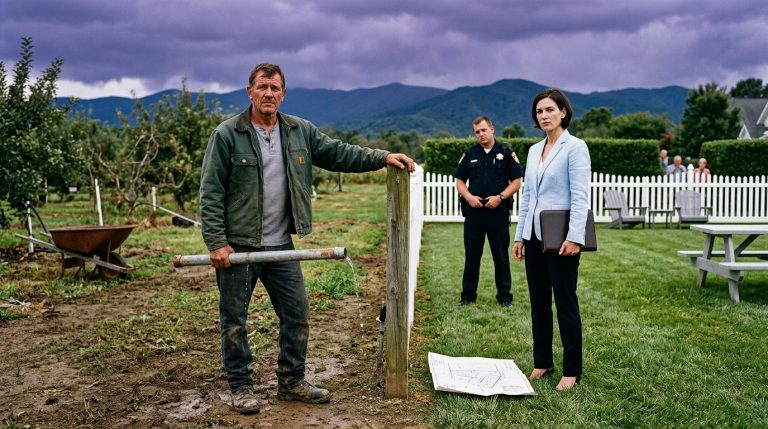
The air held the metallic tang of early morning frost, but the heat in my chest was immediate, focused, and steady. I knelt where the orange survey stake had stood only hours ago. Now, there was nothing but a void in the dirt and the faint, rhythmic scraping of leather on a patio stone just twenty yards away.
I didn’t turn around. I didn’t need to. I knew the cadence of that step—heavy, practiced, and dripping with the arrogance of someone who had never been told “no.”
“These little sticks don’t mean anything here, Mr. Hayes,” her voice drifted over the damp grass, slick with that signature venomous sweetness.
I stood up, brushing the damp soil from my knees. I kept my movements slow, calculated. My pulse was a metronome, locked into a steady sixty beats per minute. A decade of command in the Corps had taught me that the moment you let your blood pressure spike is the moment you hand your opponent the advantage. I looked down at the empty hole where a thousand dollars of professional labor had been yesterday.
“Property lines aren’t suggestions, Karen,” I said, my voice quiet, cutting through the humid morning air.
I turned then, just enough to catch her in my peripheral vision. She was holding the orange stake like a scepter, her knuckles white against the plastic. She looked past me, not at me—a classic psychological tactic to diminish an opponent by refusing to acknowledge them as a peer. She was the president of Willow Creek Estates, a monument to suburban tyranny wrapped in a pastel pink sweatsuit that struggled to contain her ego.
“I decide where your property ends and my community begins,” she replied, her eyes finally snapping to mine. There was no joy in her face, only a cold, mechanical necessity. It was the look of a predator who had just decided the perimeter of her hunting ground.
I reached into my pocket, my fingers brushing against the cold brass of the workshop key. It was a grounding weight. My workshop was supposed to be my peace—a steel building, a car lift, the silence of a welder’s arc. Instead, I was standing on a battlefield of suburban lawn, staring at a woman who had just discarded legal documents like trash.
I caught a movement near the base of her patio—a glint of something silver tucked partially behind a potted fern. It wasn’t just the rebar. Something else was there, something out of place: a small, dark-handled screwdriver, its tip still coated in fresh, damp earth. A stray thought pricked at my mind: why would she need a screwdriver for a rebar stake?
The realization hit with the chill of a shifting wind. This wasn’t just vandalism; she’d come prepared for a structural removal, not just a petty spite-pull. The stakes were a threat to her, but the screwdriver suggested a deeper anxiety—a fear of being exposed, or perhaps, a fear of what might be measured beneath the surface.
I felt the gap between us widen, not just in feet, but in intent. She didn’t just want the stakes gone; she wanted the uncertainty of my boundary to remain. As she turned to retreat into her air-conditioned fortress, she let the orange stake fall onto the grass. It landed with a hollow, mocking thud, the ribbon tangled in the morning dew. I knew then that the war hadn’t started when she pulled the stakes—it had started the moment I dared to define the land I owned. And she had just signaled that she was willing to dig much deeper than the dirt to keep me out.
CHAPTER 2: The Tactical Appraisal
I didn’t move for a long minute. The silence of the morning, usually peaceful, felt heavy with the specific, suffocating stillness that comes before a major engagement. Karen’s Lexus SUV was parked in her driveway like a blunt-nosed turret, its windows reflecting the morning sun with a sterile, unforgiving glare. I let my eyes trace the property boundary—not the one she claimed, but the one defined by the county records tucked securely in my truck’s glove box.
The missing rebar cap—the one Ben had spent hours setting with such professional pride—was gone, but the physical reality of the border remained etched in my mind. The soil where it had been torn up was freshly turned, a dark, moist patch against the emerald green. My hand went to my pocket again, wrapping my fingers around the brass key of my future workshop. I pulled it out, feeling the cool, solid weight of it against my thumb. It was an anchor. Without it, the frustration could easily have curdled into mindless, impulsive anger, the kind that loses wars.
I walked to my truck, my boots crunching on the gravel path I’d laid. The act of movement helped. I’d spent twenty years in the Corps learning to compartmentalize, and this morning was no different. I climbed into the cab and started the engine, though I didn’t drive away. I simply sat there, watching her house.
A sudden, jarring memory surfaced—not of the desert, but of a supply depot in a remote, rain-slicked sector of the AO years ago. We’d been tracking a leak in the logistics chain, a ghost in the system that was rerouting vital equipment to the black market. We’d spent weeks watching the perimeter, documenting the smallest discrepancies, waiting for the one arrogant move that would break the cover. I remembered the feeling of the rain on my neck and the absolute, unwavering patience required to map the pattern of the thief’s movements.
The parallel was almost uncanny. Karen wasn’t just a neighbor having a bad day; she was a variable in a system that relied on predictability and control. Her reaction to the stakes wasn’t just a physical outburst; it was a desperate defensive maneuver against the unknown.
I pulled out my phone and tapped into the notes app. I didn’t just record the time and the event; I started mapping. Subject 01: Karen. Variable: Territory. Trigger: Visual disruption of the aesthetic baseline. I realized then that I had been thinking about this too simply. I’d been viewing her as an isolated obstacle. But looking at the symmetry of the Willow Creek lawns, I saw the patterns: the identical mailbox heights, the mandatory lawn-edging hours, the way the neighborhood seemed to breathe in unison.
Something clicked. It wasn’t just aesthetic harmony. It was a closed loop.
I picked up my camera, the one I’d been keeping for documenting the workshop progress, and adjusted the lens. I needed a baseline. I began to photograph the perimeter, focusing not on her house, but on the small, standardized signs posted in every third yard. They all bore the same company name: Apex Landscape & Maintenance. It was an obscure detail, the kind a casual observer would ignore, but my mind had been conditioned to spot the oddities in the supply chain.
I watched as a white van from that company pulled onto the street, moving with a familiar, almost proprietary speed. The driver didn’t check addresses; he knew exactly where to stop. He spent six minutes on a lawn, despite the fact that the grass was perfectly cut, and then moved to the next. He wasn’t maintaining; he was patrolling.
The sharp edges of the suburban morning felt like a tightening wire. My anger was gone, replaced by a cold, surgical clarity. She wasn’t just enforcing rules; she was protecting a closed system. The stakes hadn’t just been a violation of her lawn; they were an unauthorized injection into a machine that she and her contractors had carefully calibrated for profit.
I watched the van finish its route and pull away, then I stepped out of my truck. I needed to see more. I wouldn’t cross the property line—not yet—but I would walk the public sidewalk that hugged the edge of Willow Creek Estates. I needed to know if the entire neighborhood was built on this same fragile, artificial foundation. As I started walking, the rhythmic thud of my boots on the pavement felt like a drumbeat. I was already planning the next move, mapping the terrain of a war that was no longer just about a workshop, but about the structure of the world she had built.
I stopped near the edge of the first manicured lawn, observing the way the sprinklers hit the sidewalk, creating a precise, wet boundary. I reached down and touched the edge of the grass with my boot, noting the texture of the soil. It was dense, packed down, and remarkably uniform. Karen had created a masterpiece of control, but every machine, no matter how perfectly maintained, has a point of failure. I just had to find where the rust was starting to show.
CHAPTER 3: The Brothers Arrival
I kept my pace steady, moving with the measured gait of a man who knew exactly where the cracks in the pavement were. The sidewalk was perfect—too perfect. No weeds, no uneven slabs, no signs of the slow, inevitable erosion of time. It was a sterile, human-made horizon. As I reached the intersection where my property met the cul-de-sac of Willow Creek, I saw a familiar heavy-duty Ford F-250 idling near the curb, its paint gleaming under the morning sun.
Ben was already out of the truck. He was wearing his high-visibility vest over a crisp, collared shirt, and the logo on his chest—Bennett Surveying Inc.—caught the light, projecting an authority that made the surrounding beige-and-pastel landscape look fragile by comparison. He didn’t look up when I approached; he was focused on his total station, his hands moving with the practiced, almost surgical efficiency of a man who trusted tools more than he trusted people.
“I expected you to be halfway through the perimeter by now,” I said, stopping a respectful distance from his tripod.
Ben finally looked up, his eyes shielded by dark, polarized glasses. “I’m not doing this twice, Alex. The markers she pulled were amateur work—or rather, her removal of them was. If I’m going to build a legal case that a judge can’t look away from, I need the control points to be indisputable. We’re doing this by the book, down to the millimeter.”
He gestured to the back of the truck, where Carlos, his assistant, was unloading a case of galvanized steel pipe. The sight of it felt like a tactical shift. This wasn’t just a survey; it was a fortification.
“She was out here at dawn,” I said, my voice low enough that it wouldn’t carry toward the houses. “She’s watching every move. You’re going to be the center of her universe for the next few hours.”
Ben let out a short, dry laugh. “Let her watch. That’s the point. I’m not just surveying your line, I’m creating a record of professional necessity. Every time she comes out to screech, I’m marking it in the logbook.”
He reached into the truck bed and pulled out a leather-bound logbook, tapping the cover. It was worn at the edges—the mark of a professional. But as he went to tuck it into his vest, something shifted. A small, blue-covered notebook, clearly out of place and bearing the faint, grease-smudged logo of Apex Landscape & Maintenance, slid out from the seat pocket and tumbled into the dirt near my boots.
I looked at it, then back at Ben. He hadn’t noticed. I leaned down and picked it up. The cover was damp with the morning dew, but the binding was tight. I didn’t open it immediately. I could feel the texture of the material, a cheap, plastic-coated cardboard that felt entirely out of place in the high-end, manicured world of Willow Creek.
“You find this in the truck?” I asked.
Ben took it from me, frowning. He flipped it open, his brow furrowing as he scanned the entries. “No. Carlos must have picked it up near the cul-de-sac when we parked. It’s a maintenance schedule, but look at the times, Alex.”
I leaned in. The entries were bizarre. 06:00-06:06: Property 14. 06:10-06:18: Property 22. The timing was frantic, almost manic. And there, scrawled in the margins, were recurring initials: K.P. Next to each set of initials was a dollar amount—figures that looked far too high for simple lawn maintenance.
“She’s paying them for more than grass,” I whispered, the weight of the book in my hand feeling suddenly heavy, like a piece of evidence that had been discarded in haste.
Ben’s face tightened. The professional mask he usually wore remained, but the jaw set, the eyes behind the dark lenses becoming flinty. “If she’s using the landscape company to funnel HOA funds, that’s not just a boundary dispute. That’s embezzlement. That’s a leverage point that blows this whole thing wide open.”
He took the book from me, sliding it into a waterproof sleeve inside his vest. He didn’t say another word about it; he simply turned back to his equipment, his movements now fueled by a quiet, lethal efficiency. He didn’t need to say anything. The stakes were no longer just about the property line. We had found a crack in the foundation of her kingdom, and now, we had the tool to pry it open.
“Get the gear, Carlos,” Ben commanded, his voice devoid of the earlier pleasantry. “We’re going to stake the line, and we’re going to make sure every single resident on this street knows exactly where the legal boundary is.”
I watched him go, the realization hardening in my mind like concrete. Karen wasn’t just a bully; she was an architect of a rigged game, and she had just handed us the blueprints to tear it down. I walked to the edge of my own land, where the orange ribbons from the last survey had been violently stripped away. I stood there, feeling the wind catch the edge of the new, pink-flagged wooden stake Ben had just driven into the earth. It wasn’t just a boundary marker anymore. It was a spearhead.
CHAPTER 4: The Midnight Sabotage
The sky didn’t darken so much as it bruised, deep purples and grays churning above the treeline. The temperature plummeted with the kind of sudden violence that only the high plains can deliver, and within moments, the first fat, heavy drops of rain began to hammer the earth.
I looked at the survey monuments—the steel pipes Ben and Carlos had anchored in concrete earlier that day. They stood like infantry in a trench, defiant against the sudden shift in the environment. Ben was packing the sensitive total station into its protective hard case, his movements hurried but deliberate. He knew the drill. In the field, equipment is life, and the rain was the enemy of precision.
“We need to get the truck moved to higher ground, Alex,” Ben shouted over the rising wind, his voice strained. “If this front dumps the way I think it’s going to, this entire access path is going to turn into a slurry.”
I watched the house at 112 Willow Creek Lane. The lights in the kitchen had flickered on, a harsh, electric yellow that cut through the gloom of the approaching storm. I saw the curtain twitch—a sharp, angular movement that felt less like a resident checking the weather and more like a predator tracking prey. She was still watching.
“I’m staying,” I said, my voice barely audible against the roar of the wind.
“Don’t be a fool,” Ben grabbed my shoulder, his grip firm. “We’ve got the monuments set. We’ve got the documentation. If she comes out here in this, she’s only going to prove the felony count, but you don’t need to be standing in the line of fire to record it.”
“I’m not going to give her a chance to clear the path, Ben. If she wants to play the vandal, she’s going to have to do it with me standing right here.”
Ben looked at me for a long moment, the rain plastering his hair to his forehead. He saw the shift in my posture—the shift from civilian observation to the mindset of a sentry. He knew that look. He’d seen it in the desert, seen it in the eyes of men who had decided that the perimeter was the only thing that mattered. He didn’t argue. He signaled to Carlos to get the truck moving, and within minutes, the F-250 was retreating toward the main road, leaving me alone on the edge of the darkness.
I hunkered down in the brush, pulling my heavy canvas jacket tight. I had positioned myself exactly where the trail camera’s field of vision was widest, nestled behind a cluster of thick, wind-whipped oak saplings. I watched the house. The rain intensified, a rhythmic, driving force that turned the world into a blur of gray.
At 2:17 a.m., the notification buzzed on my phone, a dull vibration against my thigh that felt like a gunshot. The feed loaded, and there she was.
Karen. She didn’t look like the HOA president now. She was a silhouette of desperation, shrouded in a heavy, oversized floral bathrobe that whipped around her legs in the gale. She held a long, heavy crowbar that caught the dim light from a distant streetlamp, its surface slick with rain. She moved with a strange, unnatural urgency, her gaze locked on the concrete-anchored monuments.
She reached the first one, the one closest to her property line. She didn’t hesitate. She jammed the crowbar into the softened earth and heaved. The rain had turned the ground into a muddy mess, and for a second, I thought she might actually slip, her feet skidding on the saturated turf. But she rallied, her face contorting into a mask of pure, unadulterated fury. She leaned her entire body weight into the lever.
The monument didn’t budge. Ben had been thorough; the concrete anchor was a solid, uncompromising foundation. Karen grunted, a guttural sound of frustration that was audible even over the wind. She adjusted her grip, her fingers slipping on the rain-slicked metal. She was fighting the laws of physics, fighting the permanence of my boundary, fighting the very reality I had built to keep her out.
She was so consumed by the physical struggle that she didn’t see the flash—the almost imperceptible flicker of the trail camera’s infrared light as it captured her face in high definition. She was a woman drowning in her own sense of entitlement, literally digging her own grave with every strained, ineffective heave of the crowbar.
I felt a cold, sharp thrill. She was doing it. She was committing the crime in real-time, under the worst possible conditions, driven by a malice so potent it had blinded her to the fact that she was being recorded. She finally managed to twist the monument, the concrete base groaning as it broke free from the suction of the mud. She pulled it from the earth, the pipe clattering against the crowbar, and stood there for a moment, panting, looking out into the darkness where I sat.
She was ten feet away from me. I could see the water running down her cheeks—or perhaps it was sweat. She looked fragile, human, and utterly, terrifyingly dangerous. She took a step toward the second monument, her movements sluggish, her breath coming in ragged, audible gasps. I tapped the record button on my phone, ensuring the file was encrypted and uploaded to the secure server simultaneously.
She wasn’t just destroying property. She was destroying her own life, one monument at a time. And I was the silent witness, the architect of the trap she was now fully enclosed within. I didn’t feel triumph. I felt only a profound, hollow weight. This was the cost of the line. This was what it took to be left alone in a world that demanded you conform to someone else’s beige, manufactured dream.
CHAPTER 5: The Infiltration
I didn’t head straight to the clubhouse. I spent the daylight hours in the quiet, dusty corners of the county records office, tracing the threads of the Apex Landscape & Maintenance paper trail. The records were a labyrinth of shell companies and interlocking directors, a classic camouflage strategy designed to make the money trail vanish into the mundane business of grass cutting and tree trimming. But the numbers didn’t lie. The billing cycles for the “aesthetic improvements” in Willow Creek weren’t just inflated; they were systematic, a recurring surcharge that appeared every time an unapproved project was flagged by the HOA board.
By late afternoon, the sun was hitting the horizon with a harsh, slanted intensity, casting long, needle-like shadows across the street as I drove toward the Willow Creek clubhouse. I wasn’t there as a resident—I was there as an auditor.
The clubhouse was a beige, unremarkable structure that sat like a tombstone at the center of the development. As I stepped out of the truck, the evening breeze carried the smell of chlorinated pool water and freshly trimmed turf—the scent of controlled environments. The windows were dark, but as I approached, I could see the flicker of interior lights.
I didn’t walk through the main entrance. I circled the perimeter, my boots making no sound on the perfectly laid pavers. I found a service door that had been left slightly ajar—a small, physical lapse in the rigid security of the kingdom. I slipped inside, the sudden drop in temperature making the air feel thin and sterile.
I moved into the shadow of a storage closet near the main meeting room. I could hear the muffled, agitated drone of voices. They weren’t just discussing lawn maintenance; there was a frantic, discordant energy to the cadence of the speakers. Karen’s voice was there, cutting through the others like a jagged blade, though I couldn’t make out the specific words. It was the sound of a woman backed into a corner, her tone teetering on the edge of hysteria.
I leaned in, my senses straining. The hallway was lined with floor-to-ceiling mirrors, an architectural choice meant to make the small space feel grand, but in the dim light, they did something else. They fractured the hallway into a hall of distorted reflections, making every shadow look like a phantom. For a split second, I saw myself—a dark, rugged figure in the mirror—and it felt like looking at a stranger, a man who had lost his way in the pursuit of a boundary that wasn’t just physical anymore.
I shook the thought away, centering myself. The Apex notebook was in my pocket, a tactile, heavy reminder of why I was here. I needed to see the board’s reaction to the latest round of “maintenance” invoices.
I pushed deeper toward the meeting room door, which was cracked open just enough to allow a narrow sliver of light to spill across the carpet. I watched through the gap. Karen was at the head of the table, her hands flat against the mahogany, her knuckles white. She looked diminished, the pastel pink of her outfit seeming to drain the color from her skin. Across from her, a man I recognized as one of the board members was pointing at a stack of papers—the same style of notices she had sent to me.
“The audit doesn’t care about your aesthetic standards, Karen,” he said, his voice cold. “The county oversight committee is asking about the Apex billing discrepancies. If they look at the books and see where this money is actually going, the whole board is exposed.”
Karen’s head snapped up. Her eyes were glassy, unfocused. She began to laugh, a low, wet sound that made the room go deathly silent. It wasn’t the laughter of someone in control; it was the laughter of someone witnessing their own reality collapse.
“The county?” she whispered, the words trembling. “You think you can stop this by looking at numbers? I built this place. I kept the value up. I kept the riffraff out. You think a few thousand dollars in landscaping invoices matters when the entire neighborhood’s identity is at stake?”
I felt a surge of cold, analytical adrenaline. She wasn’t just defending her power; she was terrified of what would happen if the curtain was pulled back. She was protecting something far more fragile than a few invoices. I watched the board members look at each other, their faces a mix of fear and greed. They weren’t fighting for the integrity of the HOA; they were fighting to protect their own investment.
I reached for my phone, ready to record, but my hand brushed against a fire alarm pull station on the wall. The plastic was brittle, and it groaned under the pressure. I pulled my hand back, my heart hammering against my ribs. I had the evidence. I had the confession. But as I watched Karen stare into the empty space in front of her, I realized that the fight was escalating beyond the legal realm. She was a woman who had traded everything—her sanity, her moral compass, and her community’s trust—to maintain a facade that was now burning to the ground.
I retreated, moving back into the dark labyrinth of the hallway, my eyes catching the fractured, flickering images in the mirrors. I was the architect of this downfall, but looking at the chaos I had helped trigger, the lines I had drawn began to feel less like a defense and more like a cage I had built for both of us.
CHAPTER 6: The Public Confrontation
The night air was thin and bit at my lungs as I retreated from the clubhouse service door. My hands were steady, but my mind was a high-frequency wire. The scene inside—that splintering of a woman’s reality—wasn’t a victory; it was a detonation. Karen wasn’t just a neighbor anymore; she was a collapsing structure.
I reached my truck and sat in the darkness, the engine cold. I watched the clubhouse doors. Ten minutes passed, then fifteen. Then, the main doors swung open. A cluster of board members spilled out, their faces pale, their movements hurried and jerky. They dispersed into their separate vehicles with a frantic lack of coordination, avoiding eye contact. Then, Karen appeared.
She stood on the sidewalk, the overhead security light casting her in a harsh, unblinking glare. She didn’t move toward her Lexus. She just stood there, staring at the empty lot, her arms wrapped around herself as if she were trying to hold her physical form together.
I had intended to drive away, to let the panic consume them from the inside. But the sight of her, so utterly exposed, triggered a memory I hadn’t revisited since my final tour—the sound of a support beam snapping in a half-finished bridge in a remote province. I’d been the one to sign off on the material specs, and I’d been wrong. The collapse hadn’t killed anyone, but the weight of that failure—that moment when I realized that the math was sound but the application was rotten—had never truly left me. Karen looked exactly like that bridge. She was a woman whose entire infrastructure had been built on a lie she had convinced herself was the truth.
I put the truck in gear, but I didn’t drive away. I pulled around to the front of the clubhouse, my headlights sweeping across the pavement, pinning her in the beam. I saw her flinch, her hand coming up to shield her eyes. I didn’t get out. I rolled down the window, the silence of the night rushing into the cab.
“The Apex records are filed, Karen,” I said, my voice quiet but projecting clearly in the heavy, still air.
She didn’t scream. She didn’t reach for her phone. She slowly lowered her hand, her eyes locking onto mine with a terrifying, hollow clarity. “You think you’ve won,” she said, her voice raspy, as if she hadn’t used it in hours. “You think you’re exposing something. You’re just pulling the thread that holds the whole tapestry together. You have no idea what happens when people like them lose their illusion of order.”
“I know what happens when someone builds a life on a foundation of theft and harassment,” I replied. “It’s not an illusion. It’s a liability.”
“Is that what this is for you? An audit?” She took a step toward the truck, her movements jagged. “You came here to build a workshop. You came here for peace. Look at you. You’re as obsessed with the mechanics of this as I am. We’re the same, Alex. You just prefer a different kind of tool.”
Her words hit with the force of a physical impact. I looked at the dashboard, at the phone that held the recordings, at the notebook tucked into the seat pocket—my arsenal of evidence. Was she right? Was the process of taking her down just another form of construction? I felt the sharp edges of my own resolve, the cold, structural rigidity that had defined my life since the Corps.
“I’m here because you didn’t leave me a choice,” I said. “You decided to play the king. I’m just the guy who’s reminding you that the dirt under your lawn doesn’t belong to you.”
She stopped a few feet from the hood of the truck, her face a mask of exhaustion. She looked smaller than she had in the daylight, the pastel colors of her clothes faded in the moonlight. “If you go to the authorities with that notebook, the HOA dies. The value of these homes, the equity that every one of these people has worked their entire lives for—it all evaporates. You aren’t just hurting me. You’re burning the neighborhood to the ground.”
“Then maybe the neighborhood needs to be built on something more solid than your greed.”
I didn’t wait for her to answer. I shifted into gear and pulled away, the tires crunching on the asphalt. As I drove back toward my own property, the dark, unmanicured edges of my two-acre lot felt like a sanctuary. I had the truth, but the truth felt heavy—a weight I hadn’t fully anticipated. I had come here to clear brush and build a dream. Instead, I had become the architect of a neighborhood’s collapse. I looked in the rearview mirror, expecting to see her still standing there, but there was only the long, empty street of Willow Creek, a monument to a perfect, artificial order that was already beginning to show the cracks I had helped carve into its skin.
CHAPTER 7: The Clubhouse Impeachment
The drive back to the clubhouse wasn’t a return trip; it was a tactical maneuver. The momentum of the previous night had become a physical weight in my chest. By the time I pulled into the parking lot, the beige facade of the community center looked different—less like a neighborhood hub and more like a bunker. The parking lot was already filling with vehicles, the residents emerging with the frantic, restless energy of a community that had been held underwater for too long and was finally gasping for air.
I stayed in the truck for a moment, watching the flow of people. Mr. Garcia was there, leaning on a cane, his wife by his side, both of them looking weary but determined. George Miller, the retired colonel, was speaking to a small group of neighbors, his jaw set, his hands cutting sharp lines through the air. The fear that had kept this place silent was evaporating, replaced by a raw, jagged indignation.
I stepped out, the gravel crunching under my boots—a sound that felt amplified in the heavy, still air. As I walked toward the entrance, I saw Karen’s car. It was parked at an awkward, sideways angle near the main door, a white Lexus that looked suddenly, starkly vulnerable. On the driver’s side window, a bright neon-orange notice from the county sheriff’s office had been affixed—a foreclosure filing. It was the first physical sign of the collapse I had only suspected. The facade wasn’t just cracking; it was being stripped away.
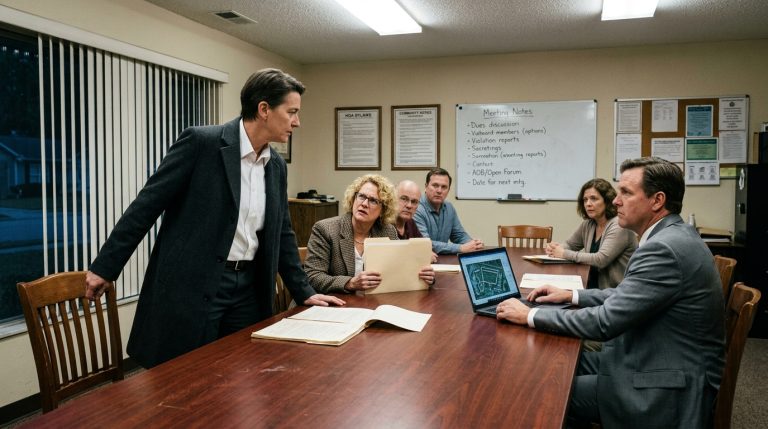
I entered the clubhouse. The air inside was stifling, thick with the smell of floor wax and stale coffee. The main meeting room was packed—standing room only, with residents spilling out into the hallways. The temperature was rising, and the murmur of voices was a low-frequency hum that vibrated through the floorboards.
Karen was already at the table. She sat alone at the center, the other board members having conspicuously distanced themselves, leaving an empty, circular buffer of space around her. She didn’t look up when the room grew quiet. Her hands were folded on a stack of invoices, her knuckles white, her posture rigid. She looked like a prisoner of her own design.
“This meeting is called to order,” she said, her voice thin, devoid of its usual authority. She didn’t use the gavel.
“We’re not here for the agenda, Karen,” George Miller’s voice boomed from the back, cutting through the room like a shot.
The silence that followed was heavy, pressurized. I moved to the front, my presence acting as a physical signal. I didn’t need to speak. I just reached into my jacket and pulled out the USB drive containing the footage of her vandalism, and the Apex maintenance notebook. I walked to the table and placed them side-by-side in front of her.
The room erupted. It wasn’t a roar; it was a tidal wave of voices—stories of fines, of harassment, of petty tyrannies that had ruined lives. People stood up, one after another, their testimonies weaving a portrait of a predator who had used the HOA bylaws as a weapon for personal gain.
Karen sat through it, her eyes fixed on the USB drive. She wasn’t defending herself; she wasn’t denying it. She was listening to the collapse of her empire, the sound of her own life being dismantled by the very people she had spent years trying to control.
“You had no right,” she whispered, her voice barely audible over the chanting demands for her resignation.
“I had the right to own my land,” I said, my voice cutting through the noise, directed only at her. “The rest—the fraud, the kickbacks, the vandalism—that was all your choice.”
A board member to her left, a man who had previously been her most loyal enforcer, stood up. His face was gray, his hands shaking as he pointed at the foreclosure notice he had clearly just seen on her car. “Is it true? Are you bankrupt? Have you been using our dues to cover your personal debts?”
The question hung in the air, a final, lethal blow to the remaining illusion. Karen looked up then, her eyes meeting mine. There was no rage left, only a terrifying, vacant exhaustion. She knew it was over. The game had reached its terminal velocity.
I watched as the room took back its agency. A motion was put to the floor—a vote of no confidence, followed by an immediate demand for her removal from the board. The vote was a landslide, a sea of raised hands that seemed to swallow the room. She stood up slowly, her movements stiff, and looked around at the people she had ruled for so long. They weren’t looking at her with hatred anymore; they were looking at her with the cold, distant indifference one reserves for a mistake that has finally been corrected.
She turned and walked toward the exit, her head held high in a final, pathetic display of pride. As she pushed through the double doors, she didn’t look back. I stayed in the room as the residents began to talk, the atmosphere shifting from rage to the chaotic, messy, and infinitely more hopeful business of rebuilding. I had the truth, and I had the victory, but as I looked at the empty seat she had vacated, the weight of the triumph felt quiet. The structure had fallen, and now, for the first time in a long time, the space was finally open.
CHAPTER 8: The Aftermath of the Foundation
I stood in the center of the room for a long time after everyone had left. The chairs were scattered at chaotic angles, a far cry from the military-grade precision Karen had once demanded of this space. The silence wasn’t empty; it was heavy with the debris of a dismantled reality. On the table, the Apex notebook sat like a silent witness to a crime that had finally run out of runway.
I walked out into the cool night air. The parking lot was clearing, the residents of Willow Creek departing in small, quiet groups. There was no cheering, no overt celebration—just the subdued realization that the fever had finally broken. I found my truck and drove back toward the property line.
When I arrived, I didn’t go into my workshop. I walked to the edge of the line where Ben had set the final, permanent monuments. The concrete was cured, solid and unyielding. The pink-flagged laths stood straight and tall in the moonlight. I reached out and touched the galvanized steel pipe, the cold metal grounding me. Karen’s home, a hundred yards away, was dark, save for the single, stark light of the foreclosure notice taped to the glass. It wasn’t a triumph of malice; it was a simple, brutal consequence of math. She had spent money she didn’t have to control a world that didn’t belong to her, and the ledger had finally come due.
I heard footsteps on the gravel path. It was Ben. He stood beside me, his silhouette sharp against the night sky. He didn’t ask if I was okay. He knew the weight of the work.
“The county recorder accepted the filing,” he said, his voice quiet. “The easement issues are resolved. The property line is officially recorded, permanent, and untouchable. You own every inch of what you bought.”
“I know,” I replied, looking toward the workshop. The silhouette of the steel building was sturdy, grounded, and silent—a space that was now truly, legally mine. “It cost a hell of a lot more than just the price of the land, didn’t it?”
Ben looked at the house next door. “It cost exactly what it needed to. You don’t get to build a life on someone else’s terms, and you certainly don’t get to keep a sanctuary if you’re not willing to defend the perimeter.”
We stood there for a long time, the air settling around us into a genuine, unforced peace. The threat was gone, the variable of her irrationality effectively neutralized by the sheer, immovable weight of the law. I walked over to the workshop and slid the heavy steel door open. The interior was spacious, filled with the promise of the work to come.
I walked over to the workbench where the ’69 Mustang sat, partially disassembled, its engine block a collection of intricate, waiting parts. I picked up a wrench—a heavy, cold tool that fit perfectly in my hand. I hadn’t touched it in weeks, not since the stakes had been pulled and the war had begun. I leaned over the engine, the familiar scent of oil and old metal filling my senses.
I reached for a bolt that had been stuck since I first dragged the car into the space. I applied pressure, the torque increasing until the metal gave way with a sharp, satisfying crack. The bolt turned. The machinery, long frozen, was finally ready to move.
The repair was minor, but it felt like the beginning of something much larger. I spent the next hour working in the quiet, the rhythmic clink of metal on metal a stark contrast to the shouting and the legal maneuvering of the past month. The neighborhood was quiet, the artificial tension of the HOA finally replaced by the natural, humming silence of a place that was at rest.
I didn’t think about Karen, or the lawsuit, or the foreclosure. I thought about the workshop, the Mustang, and the two acres of land that were finally mine to shape. The foundation was set. The line was drawn. And for the first time in my life, the peace I had spent twenty years searching for wasn’t a goal—it was the environment I was finally standing in. I set the wrench down, wiped the grease from my hands with a clean rag, and looked out into the darkness of my own land, where the wind was whispering through the trees, telling a story that was entirely, finally, my own.