The Weight of the Deed: A Surveyor’s Cold Calculation Against the Encroachment of Forced Order
CHAPTER 1: THE BOUNDARY LINE
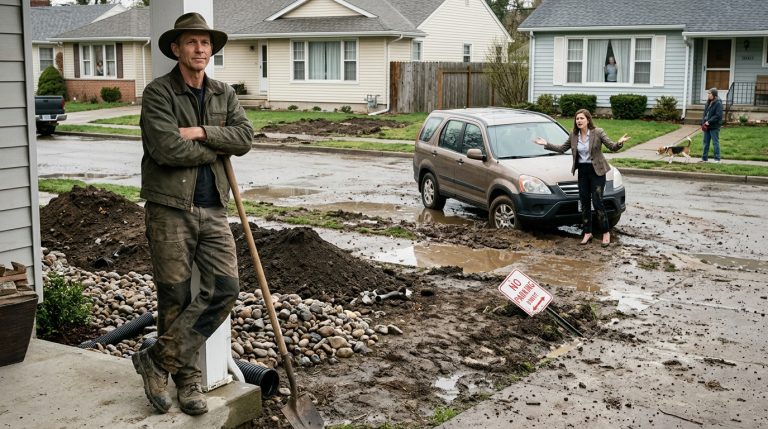
The mud of the orchard floor clung to my boots like a debt that refused to be paid. I stood between two rows of Fuji apples, my fingers wrapped around the cold, weeping leak of a galvanized irrigation pipe. The morning air was thin, smelling of damp silt and the metallic tang of approaching rain.
Then came the white SUV, crawling up the gravel track with the invasive grace of a shark in a garden pond.
Ge Whitmore stepped out. She didn’t walk; she paced, her heels sinking only a fraction into the topsoil, as if she were inspecting a crime scene rather than a farm. Behind her, the deputy trailed, his uniform looking too stiff for the humidity of the foothills.
“Mr. Callaway,” she said. Her voice was thin, sharp, and entirely devoid of warmth. She didn’t look at the trees. She looked at the line of my property as if she were trying to erase it with her gaze. “This is your final notice. The noise, the runoff, the visual degradation—it ends today.”
I didn’t move. I took a slow, deliberate sip of my coffee, feeling the heat bloom in my chest. I watched the way her jaw tightened, a calculated spasm of controlled frustration. She wasn’t here to negotiate; she was here to finalize a script she’d been writing in her head for eighteen months.
“You’re standing on my land, Giddy,” I said, my voice quiet, barely carrying over the rustle of the leaves. I gestured with the dripping pipe. “Technically, you’re about six inches inside the county line that isn’t under your jurisdiction.”
The deputy shifted, his eyes flickering toward the treeline. He looked tired. He was a man who knew the law, and he was beginning to realize he had been brought here to enforce an opinion, not a statute.
Ge didn’t flinch. She pulled a folded sheet of paper from a leather portfolio, her movements precise. “The HOA has the authority to abate nuisances. You have an hour to clear the farm stand.”
I looked down at the pipe, then up at the horizon where the Blue Ridge Mountains cut a jagged, uncompromising line against the gray sky. My grandfather had planted these trees when the land was nothing but stubborn rock and potential. He had left me the survey maps, the plats, and the iron-clad history of every square inch.
I set my coffee mug on a fence post and wiped the mud from my palms onto my jeans. “Before you call for the bulldozer, Ge, take a look at the clubhouse deed again. Not the one you have in your hand, but the one recorded in 1958.”
Her expression flickered—a momentary, microscopic falter in her posture. She blinked, and for a second, the mask of the HOA president slipped, revealing the raw, frantic ambition of someone who realized, perhaps too late, that she had been reading the wrong map all along.
The deputy took a step closer, his focus narrowing on me. “What’s he talking about, Ge?”
“Nothing,” she snapped, though her voice lacked its earlier resonance. “He’s stalling.”
But I wasn’t stalling. I was watching the way the wind caught the edge of her folder, and the way the light hit the property pin buried at the corner of my sight. The ground beneath us was beginning to shift, and for the first time in years, the silence wasn’t heavy with threat—it was heavy with consequence.
CHAPTER 2: THE ARCHIVE OF DUST
The SUV did not pull away immediately. Ge sat behind the wheel, her profile a jagged, colorless silhouette against the windshield. For five seconds—a duration that stretched into an eternity—the only sound was the rhythmic ticking of the cooling engine and the low, distant rumble of thunder rolling over the Blue Ridge foothills. Then, with a sharp, disciplined movement, she put the vehicle in reverse. Gravel crunched under the tires, a harsh, grinding sound that echoed against the silent rows of apple trees.
I watched her go, not with triumph, but with the cold, methodical focus of a man counting his ammunition. My hands were still stained with the dark, iron-rich mud of the orchard. I didn’t return to the house immediately. Instead, I stood by the fence post, watching the dust settle. The deputy had followed her, his cruiser trailing behind the white SUV like a reluctant shadow.
The silence that followed their departure wasn’t peaceful. It was the silence of a held breath.
I walked back toward the farmhouse, my boots sinking into the saturated ground. The orchard was alive with the smell of wet earth and ripening fruit, a scent that usually anchored me. Today, it felt fragile. I entered the house through the mudroom, kicking off my boots and leaving them on the mat. The interior was dim, the air smelling of old paper and the ghost of cedar shavings from my grandfather’s workbench.
My study was a sanctuary of obsolete things. Floor-to-ceiling shelves held rolls of blueprints, leather-bound county records, and brass survey instruments that had seen three generations of mountain winters. I walked to the heavy oak desk and pulled out the file I had labeled Sycamore Bluff.
It wasn’t just a folder; it was a map of an intrusion.
I sat down and pushed aside a mug of cold coffee, clearing a space for the records. My mind, usually a clean, geometric grid of boundary lines and easements, felt clouded by the memory of Ge’s face—that momentary tremor of uncertainty. She was an amateur. She understood rules, but she didn’t understand the land. She thought the world was a set of boxes to be checked, while I knew the world was a series of overlapping rights, buried deep in archives that most people were too busy to ever open.
I spread the 1958 survey plat across the desk, smoothing the brittle edges with my fingertips. The ink was faded, a brownish, sepia-tone script that looked like the veins of a dry leaf. I traced the line—a deliberate, hand-inked trajectory that cut through what was now the manicured lawn of the HOA’s pride and joy.
My grandfather had been a man of terrifying precision. He hadn’t just owned the land; he had conquered it with a transit and a steel chain. He had negotiated the easement when the county road was diverted, a move that gave him perpetual access to the mountain spring that watered these trees. The record was there, plain as day, yet buried under decades of municipal mismanagement and developer shortcuts.
V-2: The Psychological Phantom. A memory drifted in—the smell of my grandfather’s pipe tobacco, the weight of his calloused hand on my shoulder as he taught me how to read the contour lines on a topographic map. “Never trust the fence, Ruben,” he used to say. “Trust the pin. The fence is for the neighbor’s convenience. The pin is the law.”
I reached for a magnifying glass, the lens distorting the grid squares into distorted, shimmering shapes. I needed to see the intersection again. If the easement still stood—and by every definition of Virginia property law, it did—then the HOA’s clubhouse had been built on a foundation of shifting, unverified assumptions. They didn’t just have a nuisance problem; they had a title defect that could ripple through the entire development’s valuation.
The phone on my desk rang, a jarring, mechanical shriek that cut through the silence of the study. I didn’t reach for it immediately. I let it ring twice, my heart rate steady, my mind already calculating the risk. It was an unknown number, likely a burner or an office line.
I picked up the receiver and held it to my ear, keeping my gaze fixed on the map.
“Yes?” I said.
There was a silence on the other end, but it wasn’t the silence of someone waiting to speak. It was the calculated, heavy silence of someone listening to the background.
“Mr. Callaway,” a voice said. It wasn’t Ge. It was deeper, a man’s voice, polished and resonant with the kind of practiced calm that only comes from years of litigation. “This is David Vance. I represent the developers of Sycamore Bluff.”
I leaned back in my chair, the leather creaking under my weight. The developers. The people behind the curtain. “You’re late, Mr. Vance. Your representative was just here, and she left in a hurry.”
“Ge is… enthusiastic,” Vance said, the word dripping with an artificial, patronizing charm. “But we are interested in solutions, not theater. We have a proposal for your orchard. A buyout that would be… significantly above market value. It would save you the trouble of this ongoing conflict.”
I looked at the map again, my finger resting on the exact coordinate where the clubhouse foundations were poured. The air in the study felt suddenly colder.
“Market value is a fluid concept, Mr. Vance,” I said, my voice steady, stripped of all emotion. “Especially when you consider what the land actually contains.”
“Meaning?”
“Meaning I’m currently reading a very interesting story about the history of your clubhouse parcel,” I said, watching the shadows lengthen across the parchment. “And I think we’re only on the first chapter.”
I hung up, the click of the receiver sounding like the cocking of a hammer. The war wasn’t just about my trees anymore. It was about the ground itself, and for the first time, I realized the full scale of the gamble I was about to take.
CHAPTER 3: THE FORGOTTEN LEDGER
The silence that reclaimed the study after Vance’s call wasn’t empty. It was pressurized. I remained seated for a long time, the receiver still in my hand, staring at the map. Vance hadn’t bothered to hide his intent. The “buyout” was a polite term for a tactical surrender, and the fact that he was calling me directly meant he knew the ground beneath the clubhouse wasn’t as solid as his title insurance policy claimed.
I didn’t reach for the phone to call my lawyer yet. Marcus was a good man, but he dealt in law, and I needed to deal in facts. I stood up, my joints protesting the sudden shift, and walked over to the floor-to-ceiling shelves. I began to pull down the cardboard boxes I had consolidated after my father passed. They were filled with tax assessments, utility right-of-ways, and the chaotic, beautiful detritus of a land-holding family that never threw away a scrap of paper.
I needed the lien documents.
I worked with a rhythm born of long practice, my hands sorting through the layers of the past. My grandfather had been a man of obsessive order, and in the 1950s, that order was maintained with black fountain pen ink and heavy, embossed seals. I found the box labeled 1950s—Correspondence and Liens buried behind a stack of irrigation logs. It smelled of dry dust and brittle wood pulp.
As I opened the box, the light from the desk lamp flickered—a surge in the old farmhouse wiring that reminded me of how easily a house can be brought to its knees if the foundation is compromised. I pulled out a thick, legal-sized envelope, the paper heavy and yellowed with age.
There it was. An unrecorded business debt—a secured interest on a parcel of land that predated the very existence of the subdivision. It had been bundled, sold, and forgotten in a series of mid-century banking mergers that had long since folded into history. I remembered the night I found this; I had been reading until 3:00 AM, the coffee cold, the rain lashing against the window, realizing that the developers had performed a cursory title search and missed the deeper, darker roots of the property’s origin. They had built on a foundation they didn’t fully own.
I laid the document on the desk, the edges curled like dried fruit skin. I felt a surge of cold, pragmatic satisfaction. This wasn’t revenge; it was maintenance. If you own a piece of land, you keep the boundaries clear. You pull the weeds. You ensure that when someone tries to build a monument to their own ego on your heritage, they realize they’re standing on borrowed ground.
I grabbed a notebook and began to cross-reference the debt holder’s chain of title. The bank that had held the original lien had merged with a regional firm in the 80s, which had been swallowed by a national conglomerate in the 90s, and eventually, the debt portfolio had been offloaded to a private asset firm that specialized in distressed real estate—a firm I had successfully tracked and bought out through a holding company weeks ago.
Everything was in place. But the deeper I dug into the ledgers, the more I noticed a pattern of irregularities. The developer hadn’t just made a mistake on the lien; they had aggressively fast-tracked the site survey back in 2017. Why? Why risk a multi-million dollar construction project on a property with a clouded title?
I flipped through a stack of county planning commission minutes I had requested months prior. I focused on the dates. Two weeks before the final site plan was approved, a major infrastructure expansion—a new sewer main—had been routed specifically under the clubhouse footprint.
The realization hit me with the force of a physical blow. The clubhouse wasn’t just a community amenity. It was a strategic asset. The developer needed that land to secure the easement for the sewer line that would serve the next three phases of their expansion. They were planning to bulldoze my orchard, yes, but they were also planning to leverage the clubhouse parcel to force the city’s hand on the utility grid.
I leaned back, the chair groaning in the quiet room. My grandfather’s orchard wasn’t just in the way of a few houses. It was the bottleneck for their entire expansion project.
The weight of the situation intensified. Ge wasn’t just a power-hungry HOA president; she was an enforcer for a corporate entity that viewed my land as a logistical liability. They didn’t want to just win a neighborhood argument; they wanted to clear the slate for a multi-million dollar development phase.
I looked at the window. The sky had turned a bruised purple, and the first heavy drops of rain began to pelt the glass, the sound sharp and rhythmic. I didn’t reach for the phone. I reached for my coat. I had spent enough time reading the past; it was time to verify the present. I needed to see if the surveyors had left any marks near the northern boundary, near the old drainage ditch where the land dipped into the ravine. If they were planning to expand, they would have already begun the stake-out.
I stepped out into the mudroom, the cool, damp air hitting my face. I didn’t take a flashlight; I knew every inch of that path by touch, by the slope of the earth and the texture of the gravel. As I opened the back door, the scent of the orchard—wet, dark, and resilient—rushed to meet me. I felt the weight of the legal documents in my pocket, a silent, powerful anchor.
I didn’t know what I would find at the property line, but I knew one thing: if they were on my land, I would know it before they ever set a boot on the soil. My grandfather had built this place to last, and I was going to ensure that the truth stayed buried just long enough for me to sharpen my blade.
CHAPTER 4: THE IRON WITNESS
The rain was not a polite spring mist; it was a cold, driving downpour that turned the orchard’s irrigation paths into slick, treacherous sluices. I didn’t care. I moved with the familiarity of a man who knew the topography of his own bones. The northern boundary of my land was marked by a natural ravine, a scar in the landscape that had been here long before the HOA’s surveyors had ever set foot in the county.
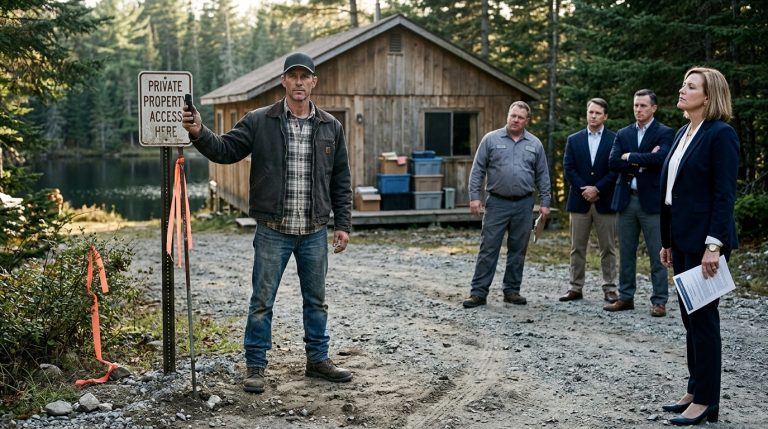
I reached the ravine’s edge, my boots sliding on the heavy, slick clay. The flashlight in my left hand flickered, its beam cutting through the gray curtain of water, illuminating the skeletal branches of an old cherry tree. This was where the property line should have been. This was where my grandfather had set the primary corner pin, a heavy iron rod driven four feet into the hardpan to ensure that no shift in the earth—or the greed of a neighbor—could ever move it.
I dropped to my knees, not minding the mud, and began to scrape away the top layer of silt that the recent heavy rains had deposited. My fingers found the iron before my eyes did. It was cold, biting, and perfectly vertical. But as I swept the mud away, the beam of my light hit something that didn’t belong.
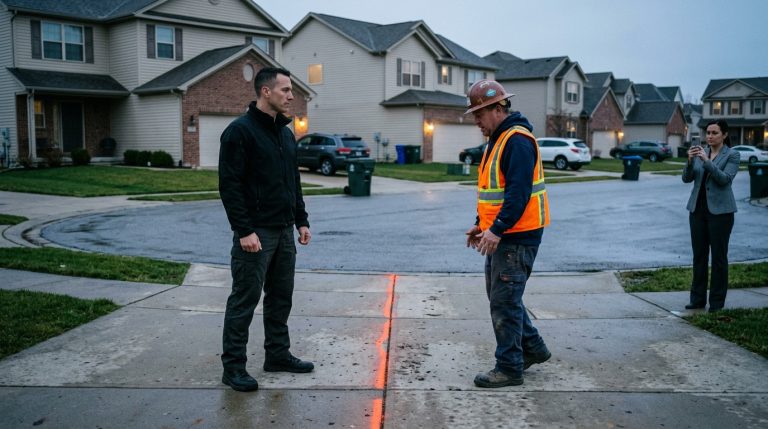
There, just six inches from the original pin, was a new stake. It was wood, painted a bright, fluorescent orange—the universal sign of a recent survey.
I sat back on my heels, the rain soaking through my jacket, and stared at the wood. It was freshly driven. Whoever had put it there hadn’t been measuring the boundary; they had been attempting to redefine it. They were trying to stake a claim that would have pushed the HOA’s property line thirty feet into my orchard, effectively seizing the drainage access that my grandfather had protected for sixty-eight years.
It was a clumsy, desperate move. Only someone who didn’t understand the permanence of the original monument would think a wooden stake could override a deed-certified iron pin. But the desperation was the point. They were testing the line. They were waiting to see if I would notice, or if I was already too tired, too buried in their administrative complaints to check the physical reality of my own perimeter.
I reached out and pulled the wooden stake from the mud. It came up with a wet, sucking sound. I broke it across my knee—the dry cedar snapping with a sharp, satisfying report that was swallowed instantly by the wind.
I didn’t leave it there. I took the shards and shoved them deep into the mud of the ravine, burying the evidence. If they wanted to play games with boundary lines, they could play them with the reality of the map, not the illusion of a survey stake.
As I climbed back up the slope, my heart was a steady, rhythmic thrum in my chest. This was no longer just an attempt to harass me out of my orchard; it was an active land grab. The developer was moving in silence, under the cover of the HOA’s authority, trying to carve out a utility easement by physically shifting the perceived boundary of the development.
I reached the farmhouse and entered through the side door, my clothes dripping puddles onto the hardwood. I didn’t go to the heater. I went back to the study. I stood before the wall-mounted topographical map, the one where I had meticulously charted the drainage flows of the entire mountain slope.
If they moved the boundary thirty feet, they wouldn’t just take my drainage access. They would effectively create the exact slope angle they needed for the new sewer main connection. The clubhouse wasn’t just a building; it was the anchor for their utility scheme.
I looked at the phone on the desk. My next move had to be calculated. If I called the county now, they would send an inspector, and the inspector would see the orange stakes—or, if I were lucky, they would see the hole where I had pulled them out. But a complaint wasn’t enough. I needed to see their official filing. They had to have submitted a revised plat to the planning department if they were going to legally justify the sewer line shift.
I sat at the computer, the screen glowing like a pale, intrusive moon in the darkened room. My login for the county’s property record portal was still active. I navigated to the Sycamore Bluff Subdivision folder. It was a digital labyrinth of PDFs, architectural renderings, and site plans. I opened the most recent filing—a “Minor Boundary Adjustment” submitted by the developer’s engineering firm just three weeks ago.
There it was. A subtle, microscopic alteration of the property lines on the northern parcel. It was buried in the fine print of a massive, multi-page document that any sane person would have skimmed over.
I stared at the screen, my breath catching in my throat. They weren’t just planning for the future. They were already in the process of legalizing the theft. But there was one detail they had overlooked—a requirement for a physical survey verification from the adjoining landowners. My signature.
I hadn’t signed anything. And yet, the document listed my property as verified, boundary adjustments accepted.
Someone had forged my signature.
The weight of the cold air in the study felt heavier now. This wasn’t just an administrative annoyance or a civil dispute. This was a crime. They were trying to steal the land by falsifying public records. I leaned back, my eyes tracking the shadow of the lamp against the bookshelves. The game had just changed. They hadn’t just moved a wooden stake; they had committed a felony to get to my orchard.
I picked up the pen from the desk, its weight feeling like the only real thing in the room. I had a lot of work to do before morning.
CHAPTER 5: THE PRICE OF PAPER
The screen of the monitor reflected in my glasses, a cold, clinical blue that seemed to strip the warmth from the room. I didn’t move. My hand remained gripped around the pen, the plastic body of it slick with a fine sheen of sweat. I looked at the signature on the screen, zoomed in to four hundred percent. It was a good forgery—a near-perfect mimicry of my grandfather’s distinct, angular cursive—but it lacked the tremor, the slight hesitation that occurred at the end of every stroke he made when he was tired.
It was a copy, not a signature. And it was the smoking gun.
I stood up, the chair scraping sharply against the hardwood floor. I had to move, but I had to move with the precision of a surveyor laying out a new baseline. If I went to the police, they would treat it as a civil fraud issue, a matter for the courts to chew on for years while the developer continued to pour concrete. No, this was a land issue, and land issues were settled by the records.
I grabbed my coat—the heavy, waxed-canvas jacket that had survived twenty years of orchard work—and stepped out into the night. The rain had intensified, a relentless drumming against the tin roof of the porch. I didn’t head for the orchard. I headed for the truck.
The drive to the county clerk’s office was a slog through dark, serpentine roads that wound around the foothills like a rusted chain. My mind, stripped of all extraneous noise, was a feedback loop of consequence and causality. If they had forged my signature, it meant they had a connection inside the planning department—someone who was willing to push a forged plat through the system.
I arrived at the county building forty minutes later. The parking lot was empty, save for a lone janitor’s van tucked into a shadow near the side entrance. I didn’t use the front doors; I knew the layout of the building better than most employees, having spent decades in and out of these halls for professional business. I went around the back, through the service alley, and tapped into the keypad I knew was prone to glitches—a remnant of a half-finished security upgrade from three years ago. It took me three tries to get the pulse right, but the lock clicked.
Inside, the air was stagnant, smelling of floor wax and old, climate-controlled silence. I moved toward the land records wing. The darkness was a relief; it matched the clarity of my intent. I navigated to the filing cabinets in the records room, the ones that held the original, ink-on-vellum plats that had yet to be digitized.
My heart hammered against my ribs—not from fear, but from the raw, kinetic energy of the hunt. I found the Sycamore Bluff file, pulled it, and laid it out on the table. My fingers hovered over the documents. There it was. The physical version of the file I had seen on the computer. I pulled out my magnifying glass and compared the physical signature to the digital scan.
The ink was the same shade of blue, but there was a subtle, almost imperceptible difference in the way the ink sat on the vellum—a tiny, microscopic bleed that only happens when a pen is held at the wrong angle by someone trying to copy a stroke they didn’t know.
I wasn’t just holding a piece of paper; I was holding their downfall.
But as I reached for my camera to document the forgery, I heard it. A soft, rhythmic thud against the carpeted floor of the hallway. Someone else was in the building.
I froze, the shadows of the cabinets swallowing me. The light of the janitor’s closet at the end of the hall flickered and died. A pair of silhouettes appeared at the end of the corridor—not the janitor, but men in dark suits, moving with the practiced efficiency of people who were not meant to be seen.
My mind raced. They weren’t here for the records; they were here for the evidence. Someone knew I had accessed the portal, and they had anticipated that I would come to verify the physical documents. The realization sent a sharp, metallic spike of adrenaline through my system. The conflict had moved from the orchard to the halls of the government, and the stakes were no longer about trees; they were about the absolute, hard-nosed preservation of the truth.
I pulled the document from the folder, folding it carefully and sliding it into the waterproof interior pocket of my jacket. I had to leave, and I had to leave without being spotted.
I slipped into the narrow space between the filing cabinets, the metal cold and biting against my shoulder. The two men walked past, their footsteps muffled, their conversation a low, unintelligible murmur. One of them stopped right in front of the unit where I was hidden. He reached out and touched the edge of the shelf, his fingers brushing the very dust I had disturbed minutes before.
I held my breath, the sound of the rain outside now a muffled, distant memory. My perspective began to sharpen, the world narrowing down to the exact gap between the metal units and the sound of the men’s breathing.
V-4 (Unreliable Perception): For a fraction of a second, the light seemed to dance—or maybe it was just my own fatigue playing tricks—but the records themselves seemed to shift. Was the forgery even the final document? What if there were two versions of the plat? My mind began to question everything. Had I missed something in the digital portal that explained the difference in the ink?
The man shifted his weight, his coat brushing against the edge of the cabinet. He didn’t look in. He moved on, joining his partner at the end of the hall.
I didn’t wait. As soon as the sound of their footsteps faded into the distance, I moved, a shadow among shadows, sliding out of the row and slipping through the door leading to the emergency stairwell.
The air in the stairwell was cold, biting, and smelled of iron and damp concrete. I descended, not stopping until I hit the ground level and burst out into the downpour. The rain felt like a baptism. I ran toward my truck, the mud of the parking lot splashing against my legs. I reached the driver’s side, fumbled for my keys, and threw the truck into gear.
As I pulled out of the lot, I caught a glimpse of their car in the rearview—a sleek, dark sedan, no headlights. They were following me.
The hunt had begun. The truth was in my pocket, and the road ahead was as dark and unforgiving as the earth my grandfather had broken in 1958. I didn’t panic. I just accelerated, the engine roaring as I turned onto the main road, the iron-willed resolve of the surveyor guiding my hand.
I would lead them away from the orchard. I would lead them to the only place where the records couldn’t be forged, and the truth was written in the very soil.
CHAPTER 6: THE SETTLEMENT CONFERENCE
The sedan behind me was persistent, its low-slung chassis cutting through the flooded asphalt with a predatory, calculated speed. My truck, weighted down by years of tools and gear, fought the hydroplaning water as I crested the rise toward the county’s secondary arterial road. I didn’t push the engine to its limit; I pushed it to the limits of the friction, feeling the tires struggle for purchase against the slick, oil-stained road.
Behind me, the sedan surged, its headlights cutting through the downpour like twin searchlights. They weren’t trying to pass. They were trying to force me off the road.
I hit the brakes just before the sharp turn toward the old service road, the truck’s back end fishtailing as I swung into the gravel. The sedan swerved, its tires screeching a high, discordant note against the wet pavement. I didn’t look back. I buried the accelerator, the truck’s heavy rear tires churning up a spray of mud and loose stone that rattled against the undercarriage.
The service road was a mess. The storm had washed out a section near the old culvert, a yawning, muddy trench that I knew wasn’t there yesterday. I caught the edge of it with my headlight—a sudden drop-off where the earth had simply dissolved. I hauled the wheel hard to the left, the truck bucking violently as I mounted the embankment, the chassis scraping against the exposed root system of an oak tree.
I hit the clearing of the old logging camp, the mud churning into a thick, clinging paste. The sedan behind me didn’t follow. It slowed, the driver clearly miscalculating the depth of the wash-out, and I watched in the mirror as it ground to a halt, its nose dipping into the trench.
I didn’t stop to gloat. I kept driving until the trees thinned and the familiar silhouette of the farmhouse appeared through the gloom. I killed the lights a quarter-mile out, rolling into the property under the cover of the dense, rain-whipped canopy. I parked the truck, my hands shaking—not from fear, but from the adrenaline dump that followed the near-miss.
I grabbed the folder containing the forged document and headed for the barn. I needed light, I needed a scanner, and I needed to ensure that no matter what happened to me, the truth remained accessible.
I spent the next hour in the barn, the smell of hay and old machinery a grounding, constant presence. I didn’t go to the house. I used the satellite uplink in the workshop, an older system my father had installed for remote monitoring of the irrigation pressure. I scanned the forged document and uploaded it to a secure, encrypted server I had maintained for years. Then, I drafted a quick, precise email to a contact at the state attorney general’s office—a woman I had met during a property line dispute a decade ago who had a distaste for municipal corruption.
I attached the scanned forgery, the original plat, and a detailed, annotated timeline of every interaction with Ge and the developers. I hit send just as the lights in the barn flickered, a direct result of the storm battering the power lines.
The power died, plunging the workshop into a thick, heavy darkness.
I sat there in the silence, listening to the rain hammer against the metal roof. I wasn’t just a farmer anymore. I was a man who had pulled the thread that would unravel the entire development. I knew what would come next: a lawyer’s threat, a legal injunction, maybe even an escalation by the men in the sedan. But the truth was out of my hands now, moving through the digital veins of the state, heading straight for the people who had thought they could rewrite the history of my grandfather’s land with a forged signature.
My phone vibrated. A text from an unknown number. We have the plat. The deal is still on the table. Walk away, or the orchard goes under the blade by sunrise.
I read the message, my face illuminated by the faint glow of the screen. I didn’t reply. I set the phone down on the workbench and picked up the heavy, iron-headed surveyor’s transit from the corner. It was a tool of absolute measurement, a device that didn’t care about opinion or authority—only the reality of the angles.
They thought they could use the law to bully me. They had forgotten that I had spent my entire life learning how to read the landscape. If they wanted a war, they were going to get one that was fought on the exact ground they were trying to steal.
I walked to the barn door and slid it open. The storm was breaking, the rain slowing to a rhythmic, heavy drip. The orchard stood silent, the rows of apple trees dark silhouettes against the gray, pre-dawn sky. I could see the clubhouse from here, a sprawling, incongruous shape in the distance.
They had made a mistake, one that had been etched into the very soil since 1958. They had tried to build on the easement, and now, they were going to find out exactly what happens when you build on a foundation of lies.
The morning was coming. And I was ready.
CHAPTER 7: THE RECKONING AT SYCAMORE BLUFF
The air in the Sycamore Bluff clubhouse was thick enough to chew. It smelled of industrial-strength carpet cleaner and the nervous, sour sweat of two hundred people who had just realized their property values weren’t the only thing at stake. The room was packed. People stood shoulder-to-shoulder, spilling out from the main assembly hall into the foyer, their faces a collage of confusion, anger, and suspicion.
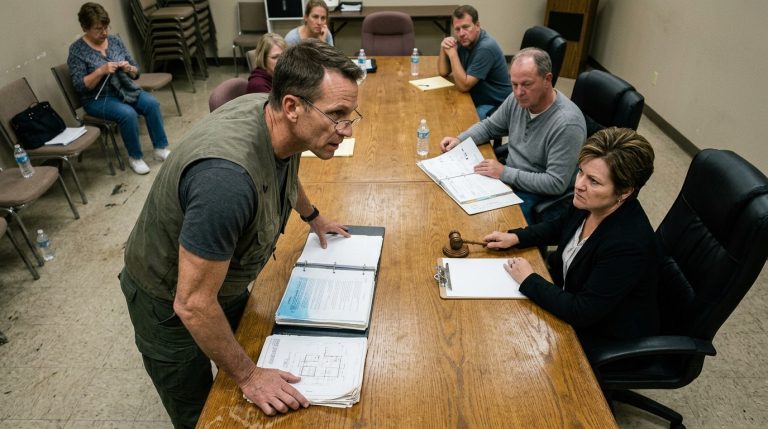
I stood at the back, leaning against the cold drywall, the heavy envelope with the forged plat pressing against my ribs. Ge Whitmore sat at the front table, her posture rigid, her face a carefully constructed mask of administrative indifference. She was trying to conduct the meeting with the same bureaucratic flow she always used—motions, secondings, reports—but the rhythm was off. The room was vibrating with the energy of a swarm.
Wendell Oaks, the retired attorney, stood near the podium. He had been working the room for the last hour, his voice a low, steady murmur that acted as a focal point for the frustration in the room. He looked back at me, his eyes sharp, a brief nod passing between us. He was ready.
Ge hammered her gavel on the desk, the sound flat and hollow. “Order,” she said, her voice strained. “We have a full agenda regarding the reserve fund audits and the proposed landscaping assessments. We will not be sidetracked by hearsay.”
“It’s not hearsay, Ge!” The voice came from a man in the third row—a homeowner I recognized as a local contractor. “We’ve seen the notices for the sewer expansion. We’ve seen the stakes in the ravine. You told us there was no encroachment. You told us the orchard owner was the problem!”
The room erupted. It was a chaotic, discordant wave of sound. Ge’s mask didn’t slip, but her grip on the gavel tightened until her knuckles turned a stark, bloodless white.
I pushed off the wall and started moving through the crowd. I didn’t shout. I didn’t push. I moved with the steady, unavoidable momentum of a surveyor who had found the true line. People parted, the weight of the folder in my pocket making my steps feel heavy, deliberate. As I reached the front of the room, the noise began to taper off, the collective attention of the crowd shifting toward the man who had been the target of their recent, engineered paranoia.
I reached the podium. Wendell stepped aside, giving me the floor. Ge looked up at me, her eyes narrowing. She knew what I had. She had to know. “Mr. Callaway,” she said, her voice dropping to a dangerous, low pitch. “You are not a member of this HOA. You have no standing here.”
“I have standing in the county court, Ge,” I said, my voice steady, carrying clearly across the silent room. “And I have standing as the legal owner of the land this clubhouse sits on.”
A collective gasp rippled through the room. Ge stood up, but she didn’t look at me; she looked at the lawyers sitting to her side—the ones who had stayed silent for the last month. They were looking at each other, their faces pale.
“I’m here to clear up a few misconceptions,” I continued, pulling the folder from my pocket. I didn’t flourish it; I simply placed it on the podium. “About nuisance claims. About property boundaries. And about the forged signature on the minor boundary adjustment that was filed three weeks ago to facilitate a sewer line you don’t legally have the right to construct.”
I looked at the crowd. “Your president didn’t just spend your reserve funds on legal fees to harass a neighbor. She knowingly participated in a process that clouds the title to your own homes. Every deed in this subdivision is now tied to a piece of land that is legally contested because your board prioritized a developer’s expansion over the basic reality of the records.”
The silence that followed was absolute, deeper and colder than the room had felt before.
Ge’s face had finally lost the mask. She looked older, smaller, the sharp edges of her authority dissolving into a frantic, exposed panic. She looked toward the door, then toward the lawyers, but they had already begun to pack their briefcases. They were washing their hands of her.
“The orchard isn’t going anywhere,” I said, my voice quiet, final. “And neither are the records. I’ve already sent the digital copies to the attorney general. The question isn’t whether the orchard is a nuisance. The question is who authorized a forgery to steal it.”
Ge stumbled back, her chair clattering against the wall. She looked out at the room, expecting support, expecting the blind allegiance of the neighbors she had fined for two-degree deviations in mailbox placement. All she found were faces of betrayal.
She turned and ran—a frantic, stumbling exit through the side door. The room didn’t move to stop her. They didn’t need to. Her power had evaporated the second the truth hit the air.
Wendell stepped to the podium, his hand resting on the folder. “I think,” he said, his voice measured, “we have a new order of business to attend to.”
I stepped back, the adrenaline finally beginning to leave my system, leaving behind a profound, hollow exhaustion. I walked out into the cool, damp air of the clubhouse veranda. The rain had stopped, and the clouds were thinning, the first light of dawn beginning to bleed across the horizon in a bruised, beautiful purple.
I looked back at the clubhouse. It looked different now—not a seat of power, but a fragile, temporary structure perched on a piece of land that didn’t belong to the people who had built it. The ground held, as it always did.
The battle wasn’t over—there would be court dates, filings, and months of administrative cleanup—but the war for the orchard had been decided. I took a deep breath of the mountain air, the scent of damp earth and coming growth filling my lungs. I reached into my pocket, found the car keys, and started the long, quiet walk back to the truck. My work here was done.
CHAPTER 8: THE HARVEST OF TRUTH
The weeks following the special meeting were a slow, grinding mechanical process of law and consequence. The developer’s hold on the clubhouse parcel disintegrated not with a bang, but with a series of frantic, panicked filings that ultimately went nowhere. The title insurance company, faced with the irrefutable evidence of the 1958 easement and the unrecorded lien I had secured, moved quickly to settle. They didn’t want a trial; they wanted the problem to disappear.
I sat on the back porch of the farmhouse, the late afternoon sun casting long, golden shadows across the rows of apple trees. The orchard was quiet, save for the hum of late-season bees and the occasional rustle of leaves in the cooling breeze. In my hands, I held the original property survey—the one my grandfather had used to stake out this ground sixty-eight years ago.
The clubhouse was still there, a sprawling monument to an ego that had since been thoroughly dismantled. The HOA had voted to dissolve the old board, and the new leadership, headed by Wendell, was currently in negotiations to turn the common area into a public green space, effectively ending the developer’s plans for the sewer expansion. They had realized, finally, that the land was not a resource to be exploited, but a boundary to be respected.
I felt a quiet, settled weight in my chest. The “5-Pillar Catharsis” of this victory wasn’t found in the courthouse, but here, in the dirt.
The payoff had come when I watched the developer’s lead surveyor—the same man who had sent his team to plant those orange stakes—stand at the ravine’s edge two days ago. He had pulled up the survey tools, closed his digital tablet, and walked away. He knew now. He had seen the iron pin, the original, uncompromising mark that told the truth about the land.
Poetic justice, I realized, was simply the act of allowing reality to reassert itself. They had tried to build on a lie, and the land had simply refused to accommodate them.
I stood up, leaving the survey on the porch chair, and walked toward the north edge of the property. I carried a set of hand tools—a shovel, a level, and a small, heavy hammer. Near the ravine, where the ravine dropped away into the shadows of the woods, I found the spot. I knelt, the soil cool and yielding under my knees, and began to work.
I spent an hour realigning the wooden boundary marker—a simple, honest post that I had carved myself—with the iron pin my grandfather had set so long ago. I didn’t need a transit or a complex map to tell me where it belonged. I knew the line by heart. I drove the post deep, the hammer hitting the wood with a solid, resonant thud that felt like a heartbeat. When I was finished, I took a handful of the rich, dark soil and packed it around the base, securing it.
It was a small act of repair, a symbolic closure that felt more significant than any court ruling. I had fixed the fence, literally and figuratively.
The cooling down of my life had begun. The constant, gnawing anxiety that had defined the last two years—the fear of the inspector’s knock, the sound of an approaching car, the threat of the legal envelope—was gone. The orchard was safe. The trees were heavy with fruit, a harvest that would outlast the ego of any developer.
I heard footsteps behind me. I turned to see Wendell standing there, his hands in his pockets, his posture relaxed. He had changed since the meeting; the sharp, jagged edges of his suspicion had softened into a genuine, quiet respect.
“The new board is formalizing the easement agreement,” he said, nodding toward the clubhouse in the distance. “It’s going to be a park, Ruben. A real one. No more fences, no more private control.”
“Good,” I said, wiping my hands on my jeans. “The land deserves a break.”
We stood there for a long time, watching the sun dip behind the mountains, the light turning the orchard into a sea of amber and bronze. We didn’t talk about the forgery, or the sedan, or the fear of the last few months. We talked about the crop, the specific quality of the season, and the simple, stubborn necessity of roots.
As the dusk settled, I felt a deep, profound connection to the man I had been, the man I was, and the history that had brought us to this quiet, golden moment. I wasn’t just a surveyor, or an orchardist, or a man who had won a fight against an HOA. I was part of the land, a custodian of the truth that lived in the deeds and the dirt.
I walked back to the house, the cool evening air clinging to my skin. I stopped in the doorway, taking one last look at the orchard. It was silent, beautiful, and most importantly, it was mine—not as property, but as a legacy. The fight had left scars, yes, but those scars were just another layer of history, a reminder of the price of standing your ground.
I went inside, closed the door, and for the first time in years, the house was just a house, and the night was just the night.