The Weight of Iron: A Veteran’s Gritty Siege Against a Suburban Tyrant in Harmony Creek
CHAPTER 1: THE CURE FOR CHAOS
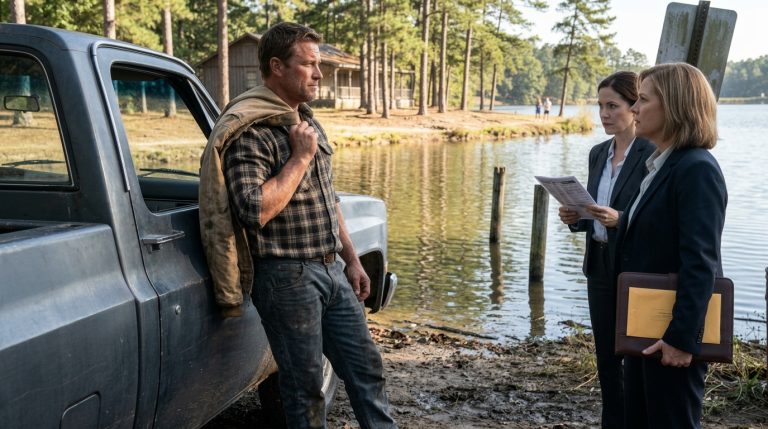
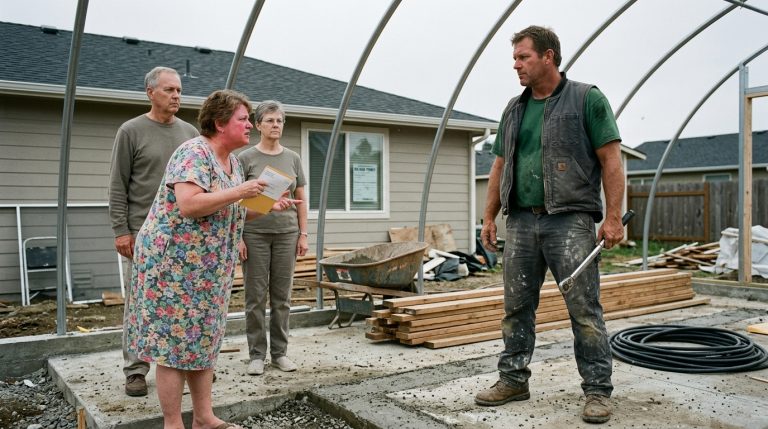
The metal of the silo wall vibrated under my palm, a low, hummed frequency that traveled straight into my marrow. It was a sturdy, unyielding sound. Karen Thompson, standing three feet away, looked like a glitch in the landscape—a splash of violent floral print against the muted, dusty palette of my ten acres.
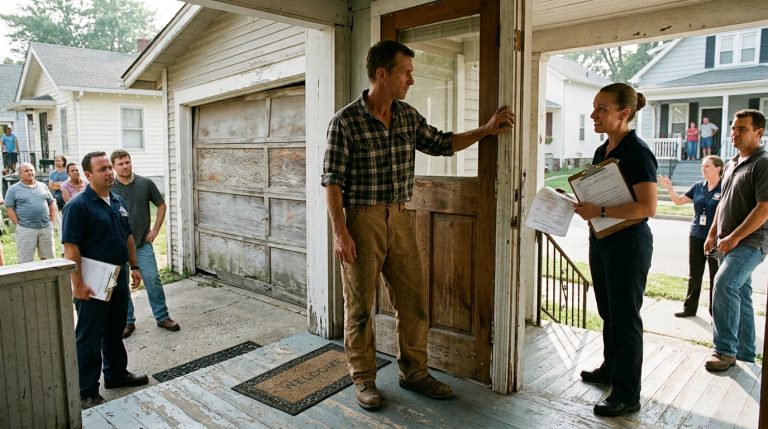
“This is an eyesore, Mr. Thorne,” she said, her voice thin and sharp, cutting through the silence of the pasture like a razor. She held a clipboard against her chest as if it were a shield, her eyes locked onto the towering gray column behind me. “Covenant 7.4. It’s a violation of aesthetic standards. It brings the property value down for everyone in the Meadows.”
I didn’t look at her. I looked at the rivets. Twenty years in the Corps had taught me how to read steel, how to detect the stress fractures that came before the failure. This silo wasn’t failing. It was perfect. A twenty-foot diameter cylinder of corrugated strength, anchored deep into six feet of reinforced concrete.
“It’s a storm shelter, Mrs. Thompson,” I said, keeping my voice low. The air here smelled of dry earth and impending heat. “FEMA-rated. County-approved. It’s not meant to be pretty. It’s meant to be functional.”
“It’s a blight,” she corrected, stepping forward. Her orthopedic sneaker crunched on the gravel, a jarring sound in the quiet. She extended a crisp, cream-colored envelope. It looked alien here, out of place among the rusted tractors and the tall, unkempt grass. “Fourteen days. That’s the grace period. After that, the daily fines begin. And believe me, they are substantial.”
I took the envelope. The paper was heavy, expensive. It felt like a trap.
“You don’t understand the wind out here,” I said, finally turning to meet her gaze. Her eyes were hard, devoid of the fear that usually surfaced when people saw the thickness of the steel. She wasn’t afraid of the storm; she was afraid of anything she couldn’t label, fold, or file away into a neatly categorized drawer.
“I understand bylaws,” she retorted, smoothing her skirt. “I understand what Harmony Creek is supposed to look like. And I understand that you are not going to turn this community into a junkyard.”
She turned on her heel and began the long march back to her golf cart, her movements precise, calculated, and entirely alien to the land. I stayed by the silo, the envelope growing warm in my hand.
I looked at the seams where the steel plates met. I knew every weld. I knew the exact amount of pressure it took to crush a standard residential wall, and I knew how far this steel would hold.
As she pulled away, the golf cart’s electric motor whining in the distance, I felt the familiar weight settle in my chest—the same weight I used to carry through the mountains of Kandahar. It wasn’t just about the silo. It was about the fact that the world had followed me home, and it was demanding I tear down the only thing keeping the chaos at bay.
I looked back at the silo. There was a faint, jagged scratch near the base—a spot where my wrench had slipped during the final installation. A small imperfection in an otherwise perfect machine. I realized then that she was right about one thing: the structure did stand out. It didn’t belong in the beige, manicured world of the Meadows.
And as the wind began to pick up, whistling a low, mournful note through the corrugations, I knew that the battle wasn’t going to be fought with blueprints. It was going to be fought with the cold, hard logic of survival.
CHAPTER 2: THE PAPER WALL
The kitchen table was a massive, scarred slab of oak that had seen two decades of life, but tonight it felt like a battlefield map. I laid the envelope down, the heavy cream-colored card stock contrasting sharply with the dark, grain-worn wood. Beside it, I spread out the county-stamped blueprints for the shelter.
Sarah hovered near the doorway, her hands tucked into the pockets of her apron. She was looking at the envelope as if it were a venomous snake. “She really thinks she can just declare our life a violation, John?”
“She thinks she’s holding the high ground,” I said, my voice sounding flat, steady. I pulled out my own chair and sat, the wood groaning slightly under my weight.
My mind flashed, unbidden, to the dusty, heat-shimmered roads of Al-Anbar. We had been tasked with shoring up a bridge that had been hit by an IED. The locals had been watching us from the shadows, and the air had felt exactly like this—heavy, charged with the static of something about to snap. You didn’t build a stable structure by rushing the foundation. You studied the stress points. You identified where the load was being forced.
I picked up the HOA’s covenant book, a thick binder of legalese that Karen had clearly put together with the same obsessive, performative precision she applied to her front lawn. I opened it, the spine cracking.
“She’s relying on the vagueness,” I muttered, flipping through the pages. I wasn’t just reading the words; I was looking for the architectural failures in her logic. Every code had a limit. Every regulation had a defined jurisdiction. The Meadows at Harmony Creek was a subdivision; my ten acres was agricultural land. There was a buffer there, a legal boundary that wasn’t just a fence line, but a wall of statutes.
“John,” Sarah said, stepping into the room. She reached out and touched my shoulder, her fingers light, a grounding force. “We have the permits. The county director shook your hand, remember? He said he wished more people were this prepared.”
“I know,” I said, looking up at her. Her eyes were bright with a quiet, fierce defiance. That was the thing about Sarah—she didn’t like the conflict, but she didn’t fear it either. “The problem isn’t the law. It’s the enforcement. She’s turned a homeowners association into a fiefdom. If I go to the county, it’ll be a standard dispute. If I fight her on her terms, it becomes a siege.”
I started digging. I pulled out my laptop, the screen’s harsh blue light washing over the table. I began to cross-reference every section of the HOA covenant with the county’s official land-use zoning map.
The friction was constant. Every minute spent pouring over the dense, dry text was a minute spent reinforcing my own perimeter. I felt the old habits returning—the rigid focus, the ability to compartmentalize the fear and the exhaustion. I wasn’t an angry farmer; I was an engineer looking at a compromised structure.
Three hours passed. The coffee in my mug had gone cold, a dark, oily film forming on the surface. My eyes burned, but the pattern was starting to emerge. It was buried in the fine print of the annexing clauses, tucked away in sections that seemed designed to be skipped. The Meadows HOA had been expanding their reach, grabbing up neighboring plots through a process of “administrative consolidation.” It was efficient, quiet, and—if my math was correct—completely unauthorized by the state statutes regarding agricultural land re-zoning.
I felt a ghost of a smile touch my lips. Karen Thompson was a woman who relied on the assumption that no one would ever actually read what she wrote. She assumed everyone would be as superficial as the manicured lawns she demanded.
“Look at this,” I whispered, pointing to a paragraph in the 2022 addendum.
Sarah leaned in, her brow furrowed. “What is it?”
“She’s claiming jurisdiction over land-use permits that were already registered with the county before the annexation,” I said. “She’s bypassing the state board of equalization. She’s effectively taxing property that isn’t under her legal control, and she’s doing it by disguising it as ‘compliance fees.’”
The air in the kitchen felt different now. The weight hadn’t disappeared, but it had shifted. It was no longer a burden; it was a target. I grabbed a yellow legal pad and started a ledger.
Every violation notice she had threatened, every arbitrary fine—they were all tied to this one fraudulent expansion. The “eyesore” of my silo was just the canary in the coal mine. She was using the aesthetic standards as a screen to extract capital from the property owners she’d annexed.
I looked at the silo through the kitchen window. It stood as a dark, monolithic shadow against the moonlight, a silent sentinel that had cost me twenty years of savings and every drop of my engineering expertise.
“She wants a war over aesthetics,” I said, closing the laptop and looking at Sarah. “I’m going to give her a war over jurisdiction.”
The room was silent, save for the rhythmic ticking of the wall clock. I realized then that I wasn’t just protecting my property anymore. I was dismantling the foundation of her power, brick by brick, document by document. And the best part? She wouldn’t even see the collapse coming until the walls were already falling in on her.
I stood up, the chair scraping sharply against the hardwood floor. I felt the familiar, cold clarity of a man who had finally identified the enemy’s structural weakness. There would be no more polite letters. There would be no more appeals to her sense of community.
I picked up the pen. It was time to write a response, but it wouldn’t be a plea for mercy. It would be a technical assessment of the rot at the core of her organization.
CHAPTER 3: THE CLUBHOUSE HEARING
The community clubhouse was a temple of beige and mid-range luxury, smelling faintly of synthetic lemon air freshener and the sterile, muted tension of people who feared losing their property value more than they feared losing their souls. I stood in the entryway, the heavy binder of permits tucked under my arm like a sidearm. Sarah stood beside me, her coat buttoned to the chin, her eyes darting toward the conference room door where the board members were already murmuring.
I walked toward the head of the table. Karen Thompson was there, perched in a high-backed executive chair. She looked up, her expression a masterclass in controlled condescension. The room felt smaller than it had any right to be, the acoustics sharp and unforgiving.
“Mr. Thorne,” Karen said, the name sounding like a smudge on her pristine agenda. “You were told this was a closed session for board business. Your presence here is… irregular.”
“Irregularity is what happens when you annex ten acres of agricultural land without a proper quorum,” I replied. My voice was steady, the cadence calibrated to be just loud enough to reach the back of the room where two other residents—a man I recognized as Gerald and a woman clutching a knitting bag—were seated.
I didn’t wait for her permission. I pulled out the chair opposite her and laid the binder on the table. The plastic cover skidded against the polished wood with a harsh, abrasive sound. I opened it to the first page: the county-stamped blueprints, their edges frayed from weeks of being handled, studied, and reinforced.
“I’m here to formally dispute the notice of violation,” I said, gesturing to the envelope I had brought. “Under the state statutes governing HOAs, I have the right to a public hearing when a grievance involves the status of a property improvement. I’ve submitted my request through the proper channels. You’re currently in the middle of a session. Let’s make it formal.”
Karen’s jaw tightened. She shot a look at the two men sitting to her left, who were currently busy trying to avoid eye contact with anything in the room. “The board has already reviewed your ‘application,’ John. It was denied. The aesthetic impact of that… structure is non-negotiable.”
“Aesthetics aren’t the issue, Karen,” I leaned in. I focused on the way the light glinted off the polished table, the artificiality of the environment. My hands were steady, grounded by the memory of the weight of the shelter’s steel door—real, tangible, life-saving metal. This room felt flimsy by comparison. “Safety is the issue. And since you’ve chosen to ignore the county planning director’s own sign-off, I’m putting it on the record that this board is knowingly disregarding regional emergency protocols.”
Gerald, the treasurer, shifted. He looked down at the agenda in front of him, his fingers tracing a line of text. I noticed, with the observational acuity of a man who’d spent years scanning landscapes for tripwires, that his ledger looked messy—scribbled notes, white-out marks in the margins, and an odd discrepancy in the ‘Maintenance’ line item that didn’t match the current seasonal calendar.
“We don’t need a lecture on safety, Mr. Thorne,” the knitting woman said without looking up from her needles. “We need compliance. This is a residential community, not an engineering testing ground.”
“It’s a community,” I countered, looking at the two other residents in the room. They weren’t board members, just people who’d wandered in looking for information on their own grievances, only to be stifled by the board’s icy efficiency. “And a community is only as strong as its ability to withstand a storm. You’re worried about property values. I’m worried about what happens when the wind hits 150 miles per hour and your beige shingles are scattered across the pasture.”
Karen slammed the gavel—a small, pathetic piece of wood that made no sound against the heavy oak table. “That will be enough! This discussion is concluded. The fines stand. If you don’t begin removal within the next ten days, the board will initiate the liens.”
I stood up, keeping the binder on the table. I didn’t take it back. I left it there, a physical reminder of the facts they were refusing to see.
“You’re making a tactical error, Karen,” I said, my voice quiet, devoid of anger, just pure, cold certainty. “You’re assuming that the bylaws are an impenetrable wall. They’re not. They’re just paper. And paper tears.”
I turned and walked toward the door, Sarah following closely. I didn’t look back at the panic starting to ripple through the board members’ faces, or the way Gerald was suddenly staring at the ledger with an expression of dawning horror. I had set the stage. I had forced them to acknowledge the blueprints in a recorded setting.
As we stepped out into the night, the air was cool, smelling of damp grass and the approaching storm. I took a deep breath, the grit of the confrontation still coating my throat like dust. I knew the next move. It wasn’t in the clubhouse. It was in the archives, in the records, and in the small, jagged inconsistencies in those ledger numbers I had glimpsed.
The siege had officially begun. I walked back toward the farmhouse, the silhouette of the silo rising in the distance like an anchor in the dark. It was solid, deep-rooted, and ready for whatever force of nature—or bureaucracy—tried to tear it down.
CHAPTER 4: THE RECONNAISSANCE
The county archives were located in the basement of a municipal building that felt like it hadn’t seen a fresh coat of paint since the eighties. The air was heavy, tasting of ozone, dust, and the slow, inevitable decay of bureaucratic ink. I spent the first hour simply navigating the labyrinthine filing system, my fingers tracing the cold, metal edges of drawer handles that had likely never been touched in years.
Sarah was at the desk, her face illuminated by the harsh, flickering fluorescent light. She was patient, quiet, her presence a steadying anchor as we dug through the boxes I’d requested. We were looking for the original annexation filings—the documents that supposedly proved the Meadows HOA had the legal right to swallow up the surrounding agricultural tracts.
“Here,” she whispered, pulling a file from a box marked ‘2023 Municipal Expansion.’
I moved over, my boots heavy on the concrete floor. The folder was thin, almost suspiciously so. I opened it, the pages brittle, yellowed at the corners. It was the annexation record, all right. But as I flipped through, the hairs on the back of my neck stood up. There were no signatures from the previous owners of the neighboring plots. No certified mail receipts. Just a single, typed memo claiming that ‘due to logistical constraints,’ the standard notification process had been ‘streamlined’ to a public notice posted at the community clubhouse.
“She didn’t notify anyone,” I said, my voice sounding hollow in the confined space. “She just posted a flyer in her own clubhouse and called it legal process.”
“Can she get away with that?” Sarah asked, her eyes wide.
“She’s been getting away with it for three years,” I replied. I felt the familiar, cold focus setting in—the same mindset I’d used to scan for IEDs in the dirt tracks of the Helmand Valley. It was a search for patterns, for the gaps in the logic where the enemy had failed to secure the perimeter.
I dove deeper. I cross-referenced the annexation dates with the ‘Beautification Fund’ expenditures I’d noted in the clubhouse. I pulled the bank statements for the HOA that the county was required to keep on file for audit purposes. My eyes blurred, scanning lines of dollar signs and vendor names.
And then, I found the butterfly detour.
It wasn’t in the landscaping contracts. It was in the tax filings. Every year, the HOA had reported a ‘Community Land Improvement Tax’ on the annexed properties. But when I checked the county tax assessor’s database, there was no record of these taxes ever being remitted to the state.
They were being collected by the HOA, but they were vanishing into the maw of Thompson Landscaping and Design. It wasn’t just a matter of aesthetic bullying or petty ego; it was a sophisticated, high-volume embezzlement machine disguised as a suburban regulation board.
I sat back on the metal stool, the cold radiating through my denim jeans. I felt a strange, jarring sensation—a sudden, sharp realization that the stakes were much higher than I had initially calculated. I had come here to protect a silo. I was now looking at evidence of a massive, systematic fraud.
“John,” Sarah said, pointing to a ledger entry. “Look at this. The tree removal service. The one we saw in the board minutes?”
“Yeah,” I leaned in.
“The invoice date is November 14th,” she said, tapping the paper. “But that’s the same day the town of Harmony Creek reported a localized flood. The park was closed. The entire maintenance crew was out clearing debris from the main highway. There’s no way they were at the park doing tree work.”
I felt the tension coil tight in my stomach. It was a lie. A brazen, stupid, arrogant lie that she had put into the official records, banking on the fact that no one would ever bother to check.
I looked at the documents, the rust-colored folders, the sheer weight of the greed represented in the ink. Karen Thompson thought the world was a game of appearances, where if you looked the part and spoke with enough authority, no one would dare question the underlying mechanics. She was an amateur. She was playing with paper in a world built on physics, and she had no idea that I spent my life calculating the failure points of systems under stress.
“We need to document this,” I said, my voice low. “Every invoice. Every discrepancy. Every date that doesn’t match the reality of the town records.”
We worked for hours. The fluorescent lights hummed, a monotonous, sleep-depriving drone that seemed to pulsate in time with the growing dossier. By the time we finished, we had a mountain of evidence. It was a roadmap of her deception.
I looked at the stack of photocopies. This was the opening salvo. I had the annexation fraud, the embezzlement, and the evidence of the intimidation tactics. But I knew this was only Layer 1. The decoy secret that would hold her attention, keep her busy, and distract her while I worked on the true objective—the preservation of my home and the protection of the people she’d tried to exploit.
As we packed the files away, the smell of dust and old paper felt like a second skin. I looked at Sarah, her face tired but illuminated by a sudden, defiant spark of purpose. We were deep in the mud now, wading through the corruption, but for the first time in a long time, the path forward felt solid. I knew exactly where the weak point was, and I knew exactly how much pressure it would take to bring the whole structure down.