The Architect of Retribution: How One Man Dismantled a Suburban Tyrant Through Cold, Calculated Engineering Warfare
CHAPTER 1: The Foundation of War
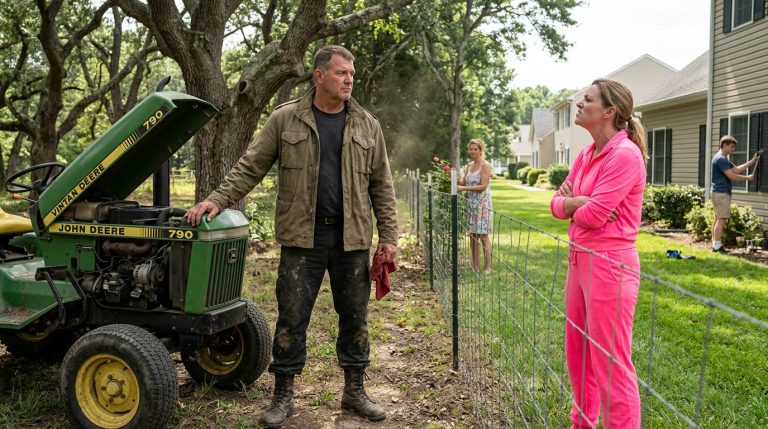
The humidity in Serenity Meadows was thick enough to taste, a damp shroud that clung to the galvanized steel ribs of the greenhouse like a fever. I didn’t look at Karen Miller’s face. I looked at her hands. They were trembling slightly, not with anger, but with the adrenaline of a small god realizing she had finally found something that wouldn’t bow.
“Seventy-two hours, Mr. Davis,” she repeated, her voice dripping with that sickly-sweet authority I’d come to despise. “The aesthetic harmony of our community is not a suggestion. It is a mandate.”
I adjusted my grip on the torque wrench. The tool was cold, heavy, and perfectly balanced—a grounding weight in a world suddenly tilting toward chaos. I didn’t blink. I didn’t offer the apology she clearly expected. Instead, I stood motionless, my shadow stretching long and sharp across the concrete footings I had poured with surgical precision just three days ago.
“The materials were delivered yesterday, Karen,” I said, my voice as level as the slab beneath my boots. “And as of this morning, I am in full compliance with county zoning laws. The permit is in my window. Everything else is just noise.”
She took a sharp step back, the floral print of her mumu swaying like a warning flag. Her two cronies, Bob and Linda, shifted in unison, their presence as stagnant and gray as the concrete they stood upon. They were just secondary structures—supports she used to distribute the weight of her ego.
“County permits have no bearing on the HOA,” she snapped, though her confidence faltered for a fraction of a second. She reached into her bag and produced the certified notice, holding it out like a papal decree. “We have the right to interpret the bylaws as we see fit. And we see your little project as a blight.”
I looked past her, toward her house, where a second-story window held a glint of unnatural light—the tell-tale refraction of a telephoto lens. My pulse didn’t quicken. It slowed. My army years had taught me one fundamental truth: never fight on the ground the enemy chooses. She thought she was ordering an execution; she had no idea she was stepping onto a pressure plate I had buried months ago.
As she turned to leave, her floral hem snagging on a rogue piece of rebar, she paused. “Don’t bother with the legal channels, Mark. The board decides who stays and who goes.”
I didn’t answer. I watched them walk away, the back of Karen’s neck flushed a deep, agitated pink. My eyes locked onto a small, iridescent smear on the polycarbonate panel of the greenhouse frame—an oily smudge that hadn’t been there when I’d checked the panels ten minutes ago. I wiped it away with my thumb, the texture viscous and unfamiliar, a sudden, dissonant detail in an otherwise sterile workspace. It wasn’t just construction dust. It was something else—something that suggested my greenhouse wasn’t the only thing being watched.
CHAPTER 2: The Rebuttal
The smudge on the polycarbonate was gone, but the impression of it remained—a greasy, tactile ghost on my thumb. I stood in the humid silence of the backyard, the skeleton of the greenhouse rising around me like the ribs of a giant, prehistoric beast. The air was still, heavy with the scent of damp soil and the impending rot of a summer afternoon. Somewhere, a cicada buzzed, a sharp, rhythmic rasp that sounded like an alarm.
Karen’s image stayed with me—not the woman, but the threat. I pulled a microfiber cloth from my back pocket and began to methodically clean the steel frame. Every wipe was precise, calculated, the same rhythm I’d used to inspect load-bearing struts in the middle of a war zone. I didn’t care about the aesthetic harmony of the neighborhood. I cared about the integrity of the structure, and more importantly, the integrity of the trap.
I looked down at the concrete footings. They were clean, perfectly square, and undeniably legal. I had the permit in my pocket, the crisp edges of the paper cutting slightly into my thigh through the denim. I remembered the county office—the cool, air-conditioned silence of the building, the way the clerk had pressed the raised seal into the document. That seal was my shield. It was the only barrier between Karen’s petty kingdom and the reality of state law. But as I stared at the steel, the memory of that seal blurred. I felt an intrusive, cold spike of doubt—a psychological phantom. What if the HOA bylaws were built to supersede even the county? What if the gray rock I’d built my fortress on was nothing more than shifting sand?
I shoved the thought away, locking it behind a mental bulkhead. Doubt was a structural failure. I needed to move to the rebuttal.
I walked back into the house, my boots leaving clean, purposeful tracks on the patio. Elena was in the kitchen, her movements slow, the familiar tremor in her hands kept at bay by the quiet concentration of brewing tea. She didn’t look up when I entered, but the tension in her shoulders eased by a fraction. She knew the look on my face—the same expression I’d worn when a dam needed shoring or a supply line was compromised.
“She’s escalating,” Elena said, her voice soft but steady.
“She’s overplaying,” I corrected, sitting at the dining room table. I pulled out my laptop and opened the digital file I’d been keeping on Serenity Meadows. It wasn’t just a collection of notes; it was a blueprint. I began to draft the response.
I didn’t use flowery language. I didn’t plead for understanding. I stripped the argument down to its bare, mechanical components. I cited the specific dates of the permit filing, the exact code sections that rendered their vague covenants null, and the timestamped photos I’d taken of my own work—proof of consistent, active construction that made their claim of “abandonment” a provable lie.
My fingers moved across the keyboard with the same cadence as the torque wrench. I wasn’t writing a letter; I was installing bolts. I cross-referenced their bylaw 17.4 with the state statutes on homeowners associations. I found the loophole I had been looking for, a clause so small it was almost invisible, hidden in the fine print of the HOA’s own founding charter. It effectively stripped the board of the power to enforce “aesthetics” if a structure had received prior county approval. They had overlooked their own history.
As I worked, the house felt smaller. I kept glancing toward the backyard, expecting to see a shadow move, a head peering over the fence. The house had become a bunker, and every notification from my email felt like a shell dropping too close. My skin felt tight, a warning system humming under the surface. I wasn’t just protecting a garden; I was defending the only place where Elena could find peace. If I lost the greenhouse, I lost the air she needed to breathe.
I finished the draft and hit ‘print.’ The printer whirred, a mechanical groan in the quiet room. I watched the paper emerge, the text sharp and black against the cream-colored letterhead. I was ready to send it via certified mail.
But as I reached for the envelope, I paused. A new complication nagged at the back of my mind—that oily smudge on the panel. I had cleaned it, but the feeling of intrusion remained. I stood up and walked to the window, peering through the blinds. The backyard was empty, the greenhouse bathed in the golden, dying light of the sun. It looked perfect. It looked like an innocent, unfinished project.
It was exactly the bait I had intended it to be.
But had they already taken the bite? I realized then that my own counter-offensive had to be as subtle as their surveillance. I couldn’t just fight; I had to wait for them to trip over the very rules they had invented. I sealed the envelope, the adhesive strip making a final, decisive sound. The first strike was ready. I leaned back, looking at the screen, at the map I had started to draw—a map of every weakness, every contradiction, every lie they had woven into the fabric of the neighborhood.
Karen wanted war. She wanted to be the judge, the jury, and the executioner. She didn’t realize that in this neighborhood, the engineer was the one who controlled the gravity. And I was about to let it pull everything down.
CHAPTER 3: Reconnaissance
The morning air was brittle, the kind of dry, biting cold that makes the edges of everything look hyper-real. I walked to the end of the driveway, the white envelope tucked firmly under my arm. It felt heavy—not because of the paper, but because of the intention. Dropping it into the blue collection box felt like triggering a delayed-action fuse. I stood there for a heartbeat, watching the envelope disappear into the dark slot, a piece of my strategy slipping out of my control and into the machinery of the postal service. There was no going back.
I turned back to the house, but my eyes didn’t track to the greenhouse. Instead, I scanned the perimeter of Serenity Meadows. The neighborhood looked the same—neat lawns, manicured hedges, the quiet hum of sprinkler systems—but the architecture of the community now looked different to me. It wasn’t a collection of homes; it was a grid of vulnerabilities.
I didn’t head inside to wait. I headed for the sidewalk. I needed to see the battlefield with my own eyes, to ground my theories in physical reality. I walked the circuit of the neighborhood, a long, rhythmic loop that passed the community entrance and the overgrown flower beds that served as the primary display for our HOA’s “aesthetic harmony.”
Up close, the neglect was glaring. I stopped by a cluster of hydrangeas that looked more like dead wood than flowering shrubs. I reached out and touched a leaf, the texture brittle, scorched by lack of water. This was the work of “Greenscape Solutions.” A professional company would have had irrigation, fertilization, and a maintenance schedule. This was the work of someone doing the bare minimum to collect a check.
I pulled out my phone and snapped three photos—wide angle to show the neglect, close-up to show the withered stems. Every click of the shutter was a piece of ammunition. I wasn’t just observing; I was cataloging. I continued my walk, my boots clicking against the pavement with a steady, military cadence.
My next stop was Tom’s house, a few blocks over. I saw him in the driveway, his young son chasing a soccer ball that was definitely not a basketball hoop. I didn’t announce my presence with a wave. I just kept my pace, my eyes scanning his yard, then the next, and the next. I was mapping the neighborhood’s discontent. I saw Mrs. Gable’s front yard, the patch of disturbed earth where her Japanese maple had been ripped out—a literal scar on the landscape. I stopped, looking at the spot. It was a perfect, contained hole, the edges still uneven where the spade had cut through the sod.
It was a physical manifestation of Karen’s control. She didn’t just enforce rules; she left reminders.
As I walked, I kept coming back to the financial discrepancy. I had spent the night before pouring over the public budget reports I’d downloaded from the Secretary of State’s website. The math didn’t add up. The maintenance costs for Serenity Meadows were nearly 30% higher than those of the neighboring development, Oak Ridge. I had the spreadsheets open on my phone, the numbers glowing against the morning light. Greenscape Solutions wasn’t just overcharging; they were billing for work that didn’t exist, using vague line items like “soil conditioning” and “seasonal horticultural adjustment” to inflate the total.
I paused at a street corner, pretending to tie my shoe, and pulled up the business registry one more time. Gary Miller. The name was there, plain as day, listed as the registered agent for the LLC. It was sloppy. Arrogance had made them lazy. They assumed no one would ever look, that the “aesthetic harmony” was enough to keep everyone else blind.
I caught a movement in the periphery—a silver sedan crawling down the street, slowing as it passed my location. I stood up, my eyes fixed on the pavement, keeping my face neutral, controlled. The car drifted past, the windows tinted, a metallic ghost in the bright morning. I didn’t look at the driver, but I felt the weight of their gaze. They were watching the watcher.
I turned away and began the walk back home, my route taking me past the community pool. The gates were locked, the water a dull, stagnant blue beneath the cover. I walked the length of the perimeter fence, my hand trailing against the chain-link. It was cold, the metal biting into my skin. I checked the latch—the one I had spotted from afar. It was corroded, the spring rusted, failing to snap shut with the force required by the safety codes.
I stopped. I didn’t touch it, but I leaned in, my engineer’s eye tracking the alignment. The hinge was misaligned by a fraction of an inch—a detail that would be completely invisible to a casual observer, but to me, it was a structural failure that shouted negligence.
I took one more photo, the flash catching the rust on the bolt. I had the landscape discrepancy, the financial trail, and now, the physical evidence of safety code violations. My plan was taking shape, a framework of facts that was becoming impossible to ignore. I wasn’t just building a greenhouse anymore; I was building a cage. And I had a feeling that the silver sedan wasn’t the only thing following my movements. The war had moved from the drawing board to the streets, and every step I took was a measured calibration of the final outcome.
I walked back to my driveway, the cold air filling my lungs. I was energized, the tactical fatigue of the last few days sharpening into a singular, unwavering focus. I didn’t look back at the street. I went straight to the greenhouse, checking the frame, the steel, the foundation. Everything was secure. Everything was prepared. I picked up my torque wrench from the workbench and gave a bolt an extra quarter-turn, the metal singing with the tension.
I was ready.
CHAPTER 4: The Financial Dissection
The garage was cold, the concrete floor leaching heat from my boots. I remained standing by the workbench, the torque wrench still in my hand. The metallic click of the fastener seating home echoed in the cramped space, a sound that felt entirely too loud in the stillness. I placed the tool back into its foam-lined cutout, the arrangement of my equipment a silent testament to the order I demanded from the world.
My laptop sat on the secondary bench, the screen casting a pale, bluish light over the stacks of paper I had spent the night reviewing. I didn’t go inside. I couldn’t face the comfort of the house yet. I needed the sterility of the garage, the smell of oil and dry cement, to process what I had found.
I leaned over the screen, my eyes tracking the ledger I’d compiled. The discrepancy wasn’t a mistake. I had cross-referenced the HOA’s annual filing with the municipal landscaping permits for our zip code. Greenscape Solutions LLC hadn’t just been overbilling; they were essentially being paid for labor that was technically being performed by municipal work crews. It was a classic double-dip. Karen wasn’t just pocketing the margin; she was fabricating the existence of a service that was already provided by the city.
The complexity of the fraud was breathtakingly simple. By using a shell company, she created a legal separation between the board and the vendor, a layer of insulation that looked like a standard contract but functioned as a private siphon.
My phone vibrated against the metal surface of the bench, the sound sharp and jarring. A notification from my bank account. Dues withdrawal. $450. I watched the number hit the account, the speed of the transaction a reminder of how quickly the system moved when it was taking from you. I started typing, my fingers dancing across the keys with a rhythmic, measured intensity. I began to build a visual timeline, linking the dates of the “landscape enhancements” in our bylaws with the dates of the municipal maintenance logs I had pulled from the city archives.
The patterns were not just coincidental; they were synchronized. Every time the city scheduled a cleaning or a planting at the community entrance, Karen logged an “emergency maintenance” fee for Greenscape Solutions for the exact same week.
I stopped. My breath hitched in the cold air. It was a trap, or at least it felt like one. The sheer audacity suggested that she didn’t fear discovery—she expected immunity. The psychological weight of it pressed down on me, a heavy, suffocating pressure. I had spent my life building structures designed to withstand the crushing forces of gravity and pressure, but this? This was a structure of lies, and if I didn’t frame the investigation correctly, the entire thing would collapse on top of me.
I pulled up the HOA’s registered agent documents again. Gary Miller. I searched his name in the state’s criminal registry, then in the civil courts. Nothing. He was a ghost, a name on a piece of paper used to legitimize a bank account. I sat back, the chair groaning beneath me. I had the financial evidence, but I lacked the link that would prove Karen’s direct knowledge. Without that, she could blame the vendor, blame Bob, blame a “clerical error.” She would survive, and the rot would simply shift to a new location.
I turned the torque wrench over in my hands, the steel cold and unforgiving. I needed a catalyst. I needed something that would force her to act in a way that couldn’t be dismissed as administrative incompetence.
The garage door rattled in its tracks, a gust of wind shaking the metal. I looked up. The sun was dipping below the horizon, casting long, skeletal shadows across the floor. I saw the greenhouse frame through the open door, a gleaming, metallic cage in the twilight. It looked fragile, almost pathetic against the darkening landscape.
I realized then that the greenhouse was more than just a project for Elena; it was a sensor. If I triggered a safety inspection, if I pushed the legal limit on the bylaws, Karen wouldn’t be able to help herself. She would come for me. And when she did, she would have to use the tools she had hidden away—the threats, the manufactured violations, the board’s “discretionary authority.”
I stood up, my joints popping in the cold. I had a path. It wasn’t about winning a debate; it was about forcing the antagonist to reveal the gears of her own machine. I started to pack the files, tucking them into a heavy-duty folder. I was calm now, the initial spike of adrenaline replaced by the cool, hard logic of the engineer.
I walked out of the garage, the air outside hitting me like a wall of ice. I didn’t go to the house immediately. I stopped at the greenhouse, running my hand along the galvanized steel. It was solid. It was plumb. It was ready. I walked toward the back door, but stopped when I saw a figure standing at the edge of my property line—a dark silhouette against the streetlights. It didn’t move. It didn’t call out. It just stood there, watching.
I didn’t flinch. I kept my stride steady, my head down, and entered the house. I had the evidence, the plan, and now, the opponent had arrived. The game of reconnaissance was over; the confrontation was inevitable. I had laid the bait, and the trap was firmly set.
CHAPTER 5: The Barbecue Council of War
The knock was staccato, rhythmic, and demanding. I didn’t rush. I set my folder of evidence on the dining table, aligning it with the edge of the wood until it was perfectly flush. Elena moved toward the hallway, her face pale, but I caught her arm, a gentle pressure that signaled her to step back. I walked to the door, my boots feeling heavy against the hardwood.
I opened the door to find Tom standing there, but he wasn’t alone. Behind him, standing on the edge of the lawn, were the Patels and Mrs. Gable, their postures guarded, their eyes darting toward the street as if they expected Karen to materialize from the shadows at any moment. Tom looked like he hadn’t slept—his eyes were bloodshot, and he held a crumpled piece of paper in his hand.
“They’re coming, Mark,” he said, skipping any pleasantries. “Karen just sent out a blast notice. ‘Emergency site inspection’ in twenty minutes. She’s claiming an unapproved hazard in the common area, but she’s listed your property as the starting point.”
I felt a cold, jagged edge of satisfaction cut through the anxiety. The trap had closed. She wasn’t just observing me anymore; she was moving to strike, and in doing so, she had violated the exact legal boundary I had set for her.
“Let them come,” I said, my voice steady, stripped of any warmth. I beckoned them inside. The house transformed in seconds. The kitchen table, usually reserved for quiet breakfasts, became a command center. I laid out the financial documents, the printouts of the landscaping invoices, and the maps of the community I’d annotated with red ink.
The Patels looked stunned as they scanned the documents. The wife, Sarah, traced a finger over the line item for ‘soil conditioning.’ “We paid for this? This is our dues money?” she whispered.
“You did,” I said, my voice clinical. “And here is why.” I pointed to the map, showing the overlap between municipal maintenance and the private bills from Greenscape Solutions. The realization in the room was a physical weight—a slow, darkening comprehension. Mrs. Gable reached out, taking a seat at the table. Her hands were still trembling, but she stopped trying to hide them.
“She told me my tree was a hazard,” she said, her voice small but gaining a sudden, sharp edge of steel. “She said it would damage the sidewalk. She made me pay the removal fee.”
“She didn’t just steal your tree, Mrs. Gable,” I said, looking around at each of them. “She stole your agency. She made you pay to destroy your own memorial.”
The room grew dense with a sudden, palpable energy. It wasn’t the heat of anger; it was the cold, pressurized density of an impending strike. I moved to the whiteboard I had set up in the corner, outlining the steps of the audit, the legal requirements for transparency, and the potential for a collective class-action suit. I didn’t lead them with promises; I led them with facts. I gave them the ammunition, and I watched as the fear in their eyes was slowly replaced by something far more dangerous.
Suddenly, the silence was shattered by a low, rhythmic sound from the street—a golf cart, whining as it climbed the driveway. Karen.
I looked at the clock. Five minutes earlier than the notice had promised. She wasn’t following the rules she had set; she was testing the speed of her own authority. I didn’t move toward the door. I looked at the group—Tom, the Patels, Mrs. Gable. They were no longer just neighbors; they were a coalition.
“She thinks she’s walking into an empty house,” I said. “She thinks she’s here to issue another fine, to document another ‘violation’ for her collection.” I walked to the door, feeling the weight of the folder in my hand. “But she’s actually walking into a room full of auditors.”
I opened the door just as Karen pulled the golf cart to a stop. She was wearing a high-visibility yellow vest—a parody of authority—and flanked by her two board members, Bob and Linda. She looked up, her expression a mask of manufactured superiority, ready to deliver a speech.
She saw me standing there. Then, she saw the others behind me, gathered around the table, the documents spread out like a battle map. Her face faltered. The smug set of her jaw flickered, a momentary fissure in the facade. She had expected to find me alone, overwhelmed, and defensive. Instead, she found an entire neighborhood beginning to look back at her with open, analytical eyes.
She didn’t speak. She just sat there, the engine of the golf cart idling, the vibration rattling the plastic frame of the cart. She realized, in that second, that the dynamic had shifted. She was no longer the one documenting violations. She was the one being surveyed. I didn’t say a word. I just waited, my posture rigid, my eyes locked on hers, forcing her to be the one to break the silence of the standoff.
CHAPTER 6: The Pool Investigation
Karen sat motionless in the golf cart, her gloved hands gripping the steering wheel so tightly that the knuckles had turned a ghostly, bloodless white. Bob and Linda were behind her, shifting in their seats, their bravado leaking away with every passing second of my silence. The presence of the other neighbors behind me wasn’t just a physical barrier; it was a psychological wall that Karen clearly hadn’t calculated for.
“We are here to perform an emergency site inspection,” Karen said, her voice strained, the practiced authority sounding frayed and thin. She didn’t look at the group at the table; she stared exclusively at me, as if by locking eyes she could force the world back into her configuration. “Mr. Davis, step aside.”
I didn’t move. I shifted my weight, my boots steady on the concrete. “The bylaws are very clear on emergency inspections, Karen,” I replied, my voice calm, the tone of a technician discussing a structural defect. “They require a documented, objective hazard to be present. I’ve checked the perimeter of my property twice this morning. There is no hazard. Which suggests this isn’t an inspection—it’s an act of harassment.”
Behind me, Tom took a half-step forward. He didn’t say anything, but his presence was a heavy, immovable weight. Karen’s gaze flickered to him, then back to the folder in my hand. Her eyes narrowed. She knew the file. She knew that the leverage she had been wielding like a cudgel for years was suddenly being analyzed under a microscope.
“This is an HOA matter,” Bob interjected, his voice trembling slightly. He tried to reclaim his place as the enforcer, but he lacked the requisite coldness. “You don’t get to decide what constitutes a hazard.”
“The county decides, Bob,” I said, my voice cutting through his protest. “And they’re quite interested in why the pool maintenance logs for CrystalClear don’t match the actual safety inspection reports from the health department.”
The name of the company seemed to hang in the humid air like a toxic mist. Bob’s face drained of color, his jaw slacking in a way that looked almost comical. Karen’s posture shifted, her body snapping rigid as she realized the depth of the reconnaissance I had performed. I hadn’t just been building a greenhouse; I had been mapping the entire architecture of their corruption, from the shell company landscaping contracts down to the literal structural failures of the community pool.
“We have a process,” Karen snapped, but the conviction was gone. She put the cart into reverse, the electric motor whining in protest, then changed her mind, putting it back into drive. She was boxed in by her own manufactured reality.
“The process is over, Karen,” I said, stepping off the porch and walking toward them. I didn’t reach for them; I didn’t need to. I simply occupied the space they wanted to control. “The audit is already in motion. We have the invoices, we have the municipal logs, and we have the safety reports you’ve been burying.”
She stared at me, the sunlight glinting off the gold-embossed logo on her vest. It looked cheap now, a costume for a role that no longer had a stage. She tried to say something—a threat, an order, a dismissal—but no sound came out. She looked at Bob, then at Linda, seeking the support that had been her primary tool for years, but they were looking at the ground, terrified of the scrutiny.
I walked past them, toward the pool area, my eyes tracking the path. The inspection I was performing wasn’t on my property—it was on theirs. I didn’t need a formal notice. I was a homeowner, a shareholder in the corporation they had been milking, and I had every right to inspect the community’s assets.
As I walked away, I felt the heavy, pressurized atmosphere behind me begin to fracture. The neighbors were coming out of their homes now, drawn by the sound of the confrontation. They weren’t cheering; they were observing, their faces etched with the same calculated, analytical hardness I had modeled for them. Karen was no longer presiding over a meeting; she was being audited by the people she had systematically exploited.
I reached the pool gate. I didn’t check the latch; I grabbed the chain-link fence, the cold metal biting into my palms, and shook it. The gate rattled, the sound of failing iron echoing through the neighborhood. Karen shouted something—a final, desperate command—but it was lost in the rising murmur of the crowd. She turned the golf cart around, her movements erratic, and retreated, her reign of absolute, unchallenged order ending in the pathetic whine of a battery-powered motor.
I turned back to the neighbors. I didn’t need to lead them anymore. The truth had done the heavy lifting. I had the physical proof, the structural evidence, and the momentum. The decoy secret—the greenhouse—had served its purpose. It had been the bait that lured the predator out into the open, onto the one piece of ground where they couldn’t survive: the light of objective, documented truth.
CHAPTER 7: The Public Tribunal
The auditorium smelled of floor wax and stale air, a stark, antiseptic environment that suited the purpose of the evening perfectly. I stood behind the podium, the wood grain smooth and cold under my palms. My laptop was connected to the overhead projector, the fan humming a low, steady pitch that seemed to vibrate through the soles of my boots. Two hundred faces were turned toward me—some angry, some bewildered, all waiting for a catalyst.
Karen, Bob, and Linda sat on the stage to my right, their table an island of isolation. They looked diminished, stripped of the environmental control that usually bolstered their presence. Karen kept smoothing her floral mumu, her movements jerky and uncoordinated, her eyes refusing to meet mine. She was no longer a president; she was a defendant waiting for the gavel.
I didn’t start with the anger. I started with the numbers.
“For eight years,” I said, my voice echoing, “we have operated under the assumption that our community’s governance was a service. That the dues we paid were investments in our collective property value.” I clicked the remote. The first slide hit the screen: a bar chart detailing the HOA’s annual expenditures compared to the municipal maintenance records. The disparity was a jagged, undeniable spike. “But the data tells a different story. The data tells us that our community has been treated as a private resource.”
I watched the faces in the audience. The confusion began to transmute into something sharper, more focused. When I projected the business registration for Greenscape Solutions and the side-by-side comparison of the invoices, the silence became absolute. It wasn’t the silence of boredom; it was the silence of a structure undergoing extreme stress, the moment before a bridge fails.
“Gary Miller,” I stated, the name cutting through the room. “Registered agent of the company that has been billing us for nearly half a million dollars of work—work that, according to city records, has been performed by our tax-funded municipal crews.”
A low, guttural sound rose from the rows—not yet a shout, but a gathering roar. Bob Jenkins, the man responsible for the pool, slumped lower in his chair, his hands clasped so tightly they shook. I didn’t let up. I shifted the projector to the inspection reports. I didn’t just read them; I projected the images of the corroded wiring, the non-compliant drain covers, and the hand-written notes from the health department inspectors detailing the risks to public safety.
“These weren’t mistakes,” I continued, my voice steady, stripped of all emotion. “These were calculated, willful decisions to keep the pool operational in direct violation of state law, because shutting it down would have required transparency—and transparency was the one thing this board could not afford.”
I paused, letting the information land, watching the realization dawn on them. The human cost—the risk to their children, the abuse of their trust—was suddenly visceral. A woman in the front row stood up, her face flushed with fury. “You risked my kids? For money?”
The room erupted. It wasn’t a riot, but it was the end of the board’s authority. The shouting was a discordant, overwhelming sound, a physical manifestation of the trust being ripped away. Karen stood up, her face a blotchy, frantic mask. She tried to shout over the din, to invoke the bylaws, to regain control, but her voice was a thin, ineffective thread against the rising tide.
I didn’t shout. I didn’t need to. I simply clicked to the final slide: the $85,000 fine from the county. The room went silent again, a shock-wave of genuine panic rippling through the rows. This wasn’t just a betrayal of their values; it was a ruinous, tangible theft from their own pockets.
“The board is no longer authorized to manage our community,” I said, my voice cutting through the remaining tremors of sound. “Under the terms of our bylaws, we are here tonight to move for an immediate vote of no confidence.”
Tom stood up in the second row, his presence immediate and commanding. “I second the motion.”
The vote didn’t take long. It was a formal, clinical act of destruction. As the hands went up, a sea of arms rising in unison, I watched Karen’s face. The arrogance had been entirely replaced by a hollow, vacant look of shock. She looked around the room, expecting support, expecting an ally, but found only the cold, hard gaze of the people she had viewed as subordinates for years.
The gavel sounded—not from a judge, but from the chair of the assembly—marking the end of the tyranny. As the meeting broke into a chaotic, energized scramble of post-vote planning, I stepped down from the podium. My legs felt heavy, the tactical adrenaline draining away, leaving behind a profound sense of exhaustion. I had won the war, but the structure I had built was now ready to be dismantled. I walked to the back of the auditorium, the air feeling lighter, cleaner. The mission was nearly complete.
CHAPTER 8: Repairing the Foundation
The silence that followed the meeting was not empty; it was heavy with the weight of consequence. I walked out of the middle school, the night air crisp and biting against my heated skin. The parking lot was a scene of hushed conversations, neighbors who had spent years in guarded isolation now standing in small, tight circles, their voices low and urgent. They were no longer subjects of a petty kingdom; they were shareholders in a project of reconstruction.
I didn’t stay for the aftermath of the gossip. I walked to my truck, my movements feeling fluid, almost light, now that the structural tension had been relieved. The greenhouse was no longer a symbol of defiance; it was finally just a structure.
The following weeks were a masterclass in controlled deconstruction. The forensic audit of the HOA’s books, conducted by an independent firm, hit the neighborhood like a scalpel. It stripped away the layers of “aesthetic harmony” to reveal the raw, ugly reality of the fraud. Greenscape Solutions LLC was dismantled, the bank accounts frozen, and the name “Gary Miller” became a permanent entry in the DA’s expanding investigation.
I spent my time in the backyard, working on the greenhouse. It was my denouement. I installed the final polycarbonate panels, the sheets clicking into the aluminum frame with a satisfying, rigid precision. There was no more surveillance, no more glint of telephoto lenses from the second story of Karen’s house. She had packed in a blind, frantic rush, leaving behind a property that felt as hollow as her authority.
Elena joined me one afternoon, the late-summer sun casting long, golden fingers through the panels. The environment inside was already beginning to hold the humidity required for her orchids—a small, artificial climate I had built to protect the things she loved. She walked the length of the interior, touching the steel ribs, her hands no longer trembling.
“You look tired, Mark,” she said, her voice a soft contrast to the crisp, metallic environment.
“It was a complex build,” I replied, setting down my torque wrench. I looked at the wrench—the same tool that had been my primary weapon in the months-long tactical engagement. It was worn now, the handle scuffed, the metal dulled by friction. It had served its purpose.
We stood in the center of the greenhouse, the scent of fresh soil and damp greenery filling the air. It was a space of quiet, atmospheric peace, a stark contrast to the sterile, pressurized environment of the auditorium tribunal. The ultimate truth—that the entire confrontation had been built on a foundation of calculated engineering—remained largely mine, a hidden variable that no one else needed to reconcile. Karen had been defeated by her own methods, her arrogance providing the structural weakness that caused her reign to collapse under the pressure of the very rules she tried to weaponize.
There was no sudden victory parade, no grand apology from the ruins of the board. There was only the slow, methodical process of normalization. The new board, led by Tom and David, operated with a transparency that made the old regime look like a ghost story. We paid our dues, we maintained our properties, and we looked each other in the eye with a sense of shared, earned security.
I picked up the torque wrench one last time, turning it in my hand. I felt a sudden, sharp clarity. The antagonist was gone, the threat was neutralized, and the foundation of the community had been leveled and repoured. The “Poetic Justice”—Karen’s forced exit, her legal exposure, the complete loss of the power she had sacrificed her integrity to maintain—was absolute. She had been ruined by the system she thought she owned.
I placed the wrench back into the foam cutout of my toolbox and latched the lid. The sound was quiet, final.
Elena leaned into me, her head resting on my shoulder as we watched the sun finish its descent below the fence line. The neighborhood beyond was quiet, the lawn lights humming to life along the street. There was no more “Karen’s kingdom.” There was just Serenity Meadows, a place where people lived, worked, and occasionally, looked out for one another.
I took her hand, the skin soft and cool, and we walked out of the greenhouse, leaving the door unlatched. There was no need for walls anymore. The structure was sound, the project was finished, and for the first time in years, the air felt entirely, wonderfully easy to breathe. The mission was complete.