The Stone Wall Covenant: A Retired Colonel’s Siege Against the encroaching Corporate Machine of Suburbia
CHAPTER 1: The Ultimatum at the Wall
The Whispering Pines Homeowners Association did not knock. They arrived in a formation that mimicked a tactical entry, though they lacked the discipline of soldiers. Karen stood at the center, a woman composed entirely of hard angles and soft, expensive fabrics, hovering inches away from the boundary line of my pasture.
Behind her, two men in identical navy blue blazers shifted their weight, their eyes darting toward the stone wall as if it might reach out and trip them.
“The board has voted, Colonel,” Karen said. Her voice was thin, sharpened to a point by self-righteousness. “We’re acquiring the pasture through eminent domain. Community improvement necessitates it. We’ll be sending our appraisers next week.”
I didn’t look at the blazers. I looked at the moss clinging to the stone beneath her feet. It had been there for a century; it would be there long after she was gone. I felt the familiar weight of the earth under my boots, the 50 acres of rolling green that I had spent my final years of active duty planning for. My horses, Samson, Delilah, and Goliath, stood near the creek, tails flicking in a slow, rhythmic defiance of the noise.
“Karen,” I said, keeping my voice in the low register I used when briefing a room full of officers on a failing logistics chain. “You’ve made a mathematical error.”
She stiffened, her hand fluttering to the strap of her handbag. “There is no error. We have the ordinance. The neighborhood demands the golf course. You’re just a holdout standing in the way of progress.”
I took a slow, deliberate breath, drawing in the scent of damp soil and dried hay. It was the smell of a life earned through sweat and long-term planning. I looked past her to the horizon, where the cookie-cutter sprawl of her community sat like a rash on the landscape. She thought she was the predator. She thought she was the one dictating the terms of this encounter.
She didn’t realize she was standing on a pressure plate.
I stepped closer to the wall, not enough to cross the line, but enough to bring her into my personal space. The air between us vibrated with the tension of two different worlds colliding: her world of manicured lies and my world of bedrock truth.
“Progress,” I repeated, the word tasting like iron. “You think you’re holding the leash, Karen. You have no idea what’s buried in the dirt you’re trying to pave over.”
She blinked, her composure cracking for a micro-second, a hairline fracture in a facade of pastel pink. She puffed herself up, the bulldog posture returning, but the silence I left in the wake of my words hung heavy, unnatural, and suffocating.
I looked down at the documents she held—thick, official-looking bundles that carried the weight of her hubris. I knew, with the cold, absolute clarity of a man who has read every line of the fine print, that she hadn’t looked at the county registry in a decade.
“You have ten days,” she snapped, pivoting on her heel with a sharp, ugly movement. “Don’t say you weren’t warned.”
As she marched back toward her car, a flash of something silver caught the light on the dashboard of her idling sedan. I didn’t recognize the local zoning inspector’s vehicle parked two driveways down, tucked behind a hedge, watching the exchange.
My phone vibrated in my pocket—a text from Maria. The papers you sent over are pure fiction, Jack. But they’re filing them.
I watched them drive away, the exhaust lingering in the autumn air like a ghost. I had spent thirty years building defenses that no one could breach. She thought she was starting a fight. She had only started the clock.
CHAPTER 2: The Couriers Packet of Lies
I stood by the edge of the stone wall for a long moment, watching the dust settle on the gravel driveway. The silence of the pasture felt different now; it was no longer just the peace of a Tuesday afternoon, but the stillness of a battlefield before the first mortar lands. My hands, calloused and steady, rested on the cool, weathered surface of the limestone. I didn’t reach for my phone immediately. Instead, I waited. In the Corps, we learned early that the first reaction to an provocation is often the one the enemy has scripted for you.
I turned back toward the farmhouse. The 1840s timber creaked under my boots as I stepped onto the porch. Inside, the air was cool and smelled of cedar and the faint, lingering scent of Sarah’s lavender—a smell I kept trapped in the weave of the curtains. The packet Karen had delivered sat on the heavy oak dining table. It was thick, bound in expensive cardstock, a physical manifestation of suburban entitlement.
I didn’t open it with haste. I pulled a chair out, the wood groaning against the floorboards, and sat. As I stared at the embossed logo of Wittman, Price, and Holloway, the environment shifted. The dining room dimmed, and for a jagged heartbeat, the ceiling was no longer exposed beams, but the scorched, canvas roof of a command tent in a desert that had tried to swallow us whole. I heard the frantic, high-pitched chatter of a radio, the panicked voice of a recruit realizing his coordinates were off. The phantom sensation of grit between my teeth returned, sharp and acidic.
Control, I told myself, the thought a steel rod against the rising tide of memory. Maintain the perimeter.
I pushed the memory back into the dark corner of my mind where it belonged and opened the packet. The language was predictably arrogant—”magnanimous offer,” “betterment of the greater community,” “smooth transition.” $60,000. It was an insult wrapped in legalese, a sum that wouldn’t have covered the tax assessment of a single acre, let alone the legacy of fifty.
They were betting on my age. They were betting on the “dignified old soldier” trope, assuming I’d be too tired or too intimidated by the sheer volume of their expensive letterhead to mount a defense. They saw a man, a tractor, and an empty field. They didn’t see the state-recorded easement, the fortress of ink and registry that rendered their “eminent domain” claim as legally impotent as a child’s tantrum.
I picked up my phone and dialed Marcus. He answered on the first ring, his voice as dry as sun-baked earth.
“Colonel,” he said. No pleasantries. Just the acknowledgment of a situation.
“They made the first move, Marcus. It’s an acquisition offer backed by Ordinance 74B.”
There was a pause, a soft chuckle on the other end of the line. “74B? That’s water and sewer maintenance, sir. They aren’t even trying to be subtle about the fiction.”
“They don’t need to be subtle. They need to be loud enough to scare the neighbors,” I replied, scanning the document for the law firm’s lead partner signature. “I need you to look into the HOA’s relationship with the Petrov construction company. Specifically, check for any pre-selected bidding arrangements regarding the golf course expansion.”
“You think Stan Petrov is the one holding the leash?”
“I think he’s the one holding the shovel, and he’s digging a hole he doesn’t realize he’s already inside,” I said. “Document everything. I’m not playing the game of negotiations. I’m building a kill zone.”
I ended the call and walked over to the window. The late afternoon light was hitting the ancient oaks, casting long, skeletal shadows across the grass. My horses were still grazing, oblivious to the high-stakes game being played over their heads. I watched the perimeter of the property. The stone wall I’d restored, stone by stone, felt less like a boundary and more like the rampart it was always meant to be.
The doorbell rang. It wasn’t the tentative knock of a neighbor, but a firm, repetitive chime.
I didn’t rush. I walked to the front door, checked the deadbolt—a habit from my days in base housing that never truly left me—and opened it. Standing on the porch was a courier in a crisp, synthetic-blend uniform, holding a tablet and a small, rectangular parcel.
“Signature required for the HOA delivery,” he said, his eyes scanning past me into the house with a curiosity that bordered on intrusive.
“Leave it on the table,” I directed, pointing to the foyer. He placed the package down, scanned his device, and turned to leave without a word.
I didn’t need to look at the return address to know it was another volley from the HOA. It was a secondary threat, likely a notice of intent to proceed with a forced appraisal. They were accelerating the timeline, desperate to force a panic. They wanted me to scramble. They wanted me to call them, to argue, to show them where I was vulnerable.
I closed the door and locked it, the metallic thunk of the bolt grounding me. I sat back down at the dining table, the sunlight now filtered through the trees, casting a dim, rust-colored glow over the papers. I wouldn’t open this one yet. Let them wonder if I’d even received it. Let them grow anxious about their own silence. The beauty of this phase was that they were spending their own money to build a fire they would eventually have to walk through.
I stood up and went to the back kitchen window, looking out toward the driveway. A dark sedan—different from Karen’s—was parked down the road, its engine ticking as it cooled. I took a slow, measured breath. The air felt heavy, metallic, charged with the static of an impending storm. My strategy was fixed, the defensive lines were drawn, and for the first time in two years, I felt the sharp, exhilarating focus of a mission.
They had decided to launch a siege. They had no idea they had just walked into the center of a labyrinth. I checked my watch. Time was a luxury, but in this game, it was also a weapon. And I had plenty of both.
CHAPTER 3: The Intelligence Gathering
I didn’t turn on the lights in the dining room. I let the failing afternoon sun drape the room in long, dust-mote-filled ribbons of amber. I sat at the oak table, the unopened packet from the courier sitting to my left, while my laptop hummed with a quiet, persistent electricity that seemed out of place in a house built before the lightbulb was common.
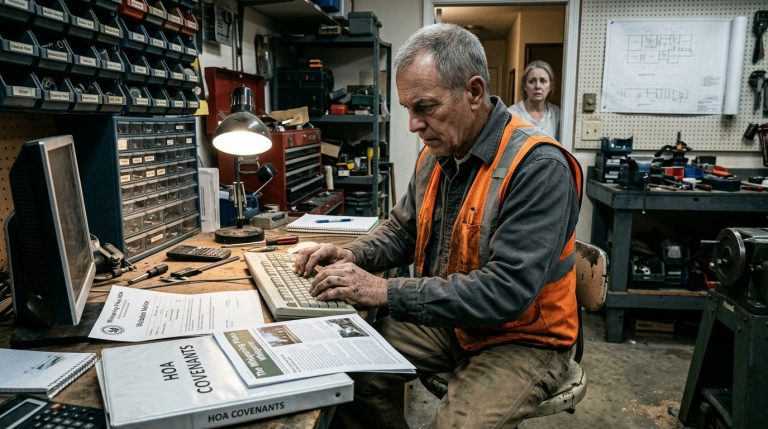
Marcus had sent the encrypted files. They weren’t flashy—no dramatic surveillance photos or wiretapped conversations. Just the dry, rattling bones of corporate filings. I scrolled through the bankruptcy documentation for Petrov Built Commercial, my eyes tracking the descent of a company that had once held the county’s construction contracts in a tight, profitable fist.
The numbers told a story of desperation. The loss of the county contract eighteen months ago had sent them into a downward spiral of high-interest equipment loans. They were leveraged against the very machinery sitting in their yard. If this three-million-dollar golf course project didn’t materialize, the Petrovs wouldn’t just be losing their status in Whispering Pines; they would be losing the foundation of their entire life.
The discrepancy, however, wasn’t in the debt. It was in the bidding timeline. I pulled up the public records for the HOA board minutes—the ones Karen had painstakingly typed up and filed with the county. I cross-referenced the dates with the local construction trade journals. The HOA had “pre-selected” Stan Petrov’s firm for the clubhouse expansion three months before the board had even formally voted to consider the golf course expansion.
Karen hadn’t just been leading a community project. She had been engineering a bailout for her husband’s drowning company, using the neighborhood as a massive, unwilling guarantor for his debt.
The rust-colored light faded to grey, and I stood up, the chair legs scraping against the hardwood with a sound like grinding metal. I didn’t need to pace. I had a clear target.
I grabbed my coat—a heavy, canvas-lined chore jacket that smelled faintly of motor oil and pine—and headed out to the garage. My old John Deere tractor sat in the corner, its paint chipped and its steel frame pitted with age. It was a machine that demanded respect, one that didn’t care for suburban aesthetics or the manufactured vanity of the “Whispering Pines” identity. It just worked. I spent a few minutes tightening a loose bolt on the mower deck, my hands moving with the muscle memory of decades. The physical act of maintenance was a way to ground myself. If I could keep this machine running, I could keep the farm running. And if I could keep the farm running, the easement stood.
My phone chimed—a notification from Maria. The firm is digging into the firm. Wittman, Price, and Holloway don’t know who they’re dealing with. If they push for an eviction, I have enough here to file a motion that will keep them tied up in probate and property court until the next decade. Don’t engage. Let them think you’re isolated.
I leaned against the workbench, the cold concrete floor seeping through my boots. I wasn’t isolated. I was simply holding the high ground.
I walked back toward the house, pausing at the stone wall. The shadows had fully reclaimed the pasture, and the wind was picking up, whispering through the dry, autumn-dead grass. The property felt like a sentinel, patient and unblinking.
Karen thought she was playing a game of chicken. She thought she could rev her engine, shout her threats, and make me blink. But she didn’t understand the nature of a siege. You don’t win a siege by rushing the gates. You win it by controlling the supplies. You win it by letting the enemy starve on their own arrogance.
I looked toward the lights of the McMansions flickering on in the distance, a sprawling, artificial glow that felt fragile compared to the ancient weight of the land beneath me. I didn’t hate them. I didn’t even hate Karen. She was just a mechanism of a system I had spent my life studying—the desire to consume, the impulse to expand, the delusion that anything can be owned if you scream loud enough.
I walked back into the kitchen and made a pot of black coffee, the drip-drip-drip the only sound in the house. I opened the courier’s packet. It was the same threat, just re-worded, with a sharper deadline. They wanted an answer in five business days.
I pulled out a notepad. I didn’t write a reply. Instead, I started a list of homeowners I’d seen walking their dogs or struggling with their own HOA-mandated maintenance. I remembered the man with the wheelchair ramp, Miguel. He looked like a man who was tired of being told what his own home could look like.
The siege wasn’t just about my pasture anymore. It was about exposing the corruption that fueled their daily lives. If I could give them the truth—if I could show them that their dues were funding a three-million-dollar lifeline for the board president’s husband—the fortress Karen had built would start to look a lot like a prison.
I took a sip of the coffee, the bitterness a welcome contrast to the cold air filtering through the door. I had the documents. I had the timeline. I had the motivation. The only thing left was to wait for the right moment to let the information bleed out into the neighborhood.
I looked at the phone again. I didn’t call Miguel. Not yet. I wanted to see if Karen would make the next move. She was desperate, and desperate people always made the mistake of playing their hand too early. I sat back, watching the house, listening to the rhythm of the wind. The pasture was safe for tonight. And for tomorrow.
The fortress was solid. I just had to make sure they knew it was unbreakable before I finally broke them.
CHAPTER 4: Planting the Seeds of Dissent
I didn’t move. I remained seated in the shadows of the dining room, my gaze fixed on the front door. The gravel crunching was rhythmic, purposeful. It stopped at the edge of my porch, followed by the tentative, hesitant knock of someone who was trespassing on their own conscience.
I stood, moving with the slow, deliberate grace of a man who didn’t want to be heard, and stepped toward the hallway. I didn’t reach for the light switch. Through the sidelight of the door, I saw a figure huddled against the porch railing. It was Miguel Garcia. He looked exhausted, his shoulders slumped beneath a thin windbreaker, his eyes darting toward the street as if he expected a surveillance team to be watching from the shadows of the McMansions.
I unlocked the deadbolt and pulled the door open. Miguel jumped, then let out a ragged, shaky breath when he saw it was me.
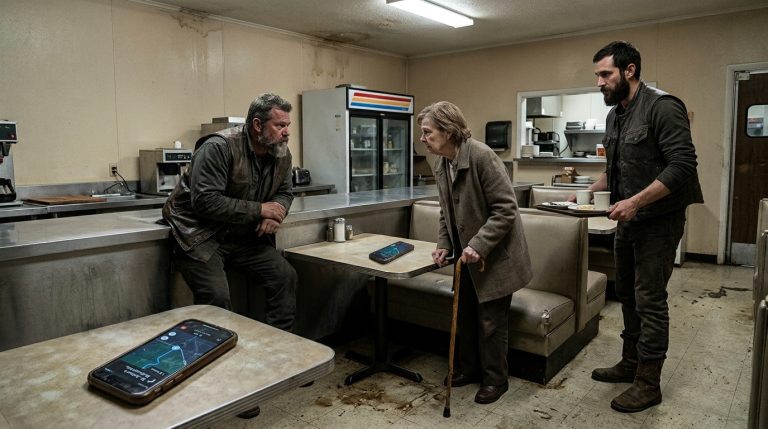
“Colonel,” he whispered, stepping inside before I even invited him. He smelled of nervous sweat and stale cigar smoke. “I think they’re watching my place. Every time I get a package, a car slows down. Every time I leave the driveway, I see someone in an unmarked sedan at the end of the cul-de-sac.”
“Paranoia is the first symptom of an encroaching adversary, Miguel,” I said, my voice low. I gestured toward the kitchen. “Sit. You’re shivering.”
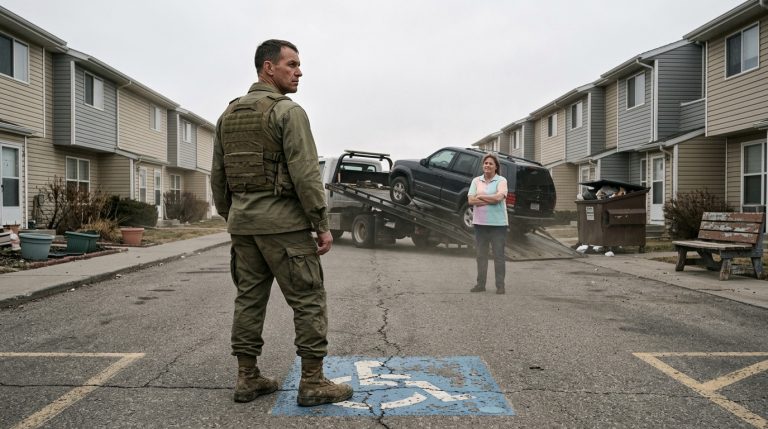
He moved past me, his gait uneven, the slight drag of his left foot a reminder of the barrier that Karen had used as a weapon against his family. He sat at the table, his hands trembling as he gripped the edge of the wood.
“I saw the article,” he said, his voice gaining a hard, brittle edge. “The one by that reporter, Jenkins. It’s circulating in the neighborhood chats. People are starting to ask questions, Colonel. About the dues. About the golf course. But Karen… she’s doubled down. She sent out an email claiming the reporter is a plant and that you’re planning to build a junkyard on this land to devalue their homes.”
I stood by the counter, watching him. “A junkyard? That’s creative. It speaks to her fear, not her competence.”
“She’s calling for a meeting,” Miguel continued, his eyes meeting mine. “A community-wide gathering at the hotel. She wants to hold a vote to ‘solidify our commitment to progress.’ She thinks she can force a consensus through intimidation.”
“Let her,” I said. “A public stage is the best place to perform an autopsy.”
I walked over to the table and slid the documents I’d been analyzing toward him. The bankruptcy files, the bid records, the proof of the three-month discrepancy. Miguel scanned them, his breath hitching as he connected the dots. The anger that flared in his eyes wasn’t the frantic, emotional reaction of the past; it was cold, precise, and dangerous.
“This isn’t about property values,” he murmured, his finger tracing the line of the bid document. “This is a theft. She’s using our money to save her husband’s bankruptcy.”
“Precisely,” I said. “But providing the information isn’t enough. You have to be the one to carry it. I’m an outsider to their HOA. You’re a member. When you speak, it’s not an attack—it’s an internal investigation.”
“They’ll try to sue me,” Miguel said, though he didn’t pull his hand back from the documents. “The cease and desist—she already threatened it once.”
“She can’t sue you for speaking the truth, and she can’t stop you from asking for an audit if you have the votes,” I replied. I leaned over the table, my shadow stretching long and dark across the surface. “We aren’t going to fight her with her own rules. We’re going to expose the game she’s playing. You find the others—the ones she’s fined, the ones she’s threatened. You bring the truth to the meeting. I will provide the foundation.”
“What foundation?” Miguel asked.
I didn’t answer immediately. I looked out the window toward the pasture, the darkness swallowing the stone wall and the history it protected. “A legal reality she’s too arrogant to even look for.”
Miguel nodded, a slow, determined shift in his posture. He wasn’t just a man in a wheelchair anymore; he was a vector for the truth. He stood up, steadying himself, and tucked the photocopies into his jacket. “She thinks we’re just numbers in her ledger, Colonel. She’s going to be surprised when she realizes we’re the ones holding the ledger.”
“Careful on your way out,” I cautioned. “If they’re watching, let them see you. Don’t hide. It makes them nervous when they realize you aren’t afraid.”
As I locked the door behind him, I felt the house settle—a shifting of the foundation that seemed to echo the instability of the neighborhood across the road. The sense of being watched persisted, a prickling on the back of my neck that I hadn’t felt since the desert. But this was a different kind of war. There were no snipers in the hills; only the slow, grinding machinery of bureaucracy and the fragile, rusting hubris of a woman who thought she owned the world because she held a gavel.
I walked to the safe in my office and pulled out the original deed, the thick parchment feeling heavy and immutable in my hands. The seed of dissent was planted in the soil of Whispering Pines. Now, I just had to wait for the rain to make it grow.
CHAPTER 5: The First Crack in the Armor
The knock came at 06:00, just as the first gray light of dawn began to bleed over the horizon. It wasn’t the hesitant tap of a neighbor; it was a rhythmic, authoritative pounding that rattled the frame of my front door. I checked the monitor for the trail cam overlooking the stone wall. A white van, unmarked, was idling in the driveway, and two men in suits—not the bumbling board members, but someone sharper, someone corporate—were waiting on the porch.
I didn’t answer. I stood in the darkened hallway, my hand resting on the smooth, cold wood of a shelf that held a single, small brass compass Sarah had given me years ago. I watched them on the screen. One of them checked his watch, his posture suggesting a level of impatience that hinted at a deadline he had been given by his superiors.
They were testing the perimeter.
I walked into the kitchen, the floorboards groaning under my boots in the still air. I picked up the phone and dialed Maria. She answered on the first ring, her voice already sharp with the caffeine of an early start.
“Jack,” she said. “They’re at your door, aren’t they?”
“Two suits. They aren’t looking for a conversation. They’re looking for a reaction.”
“Don’t give them one. They’re trying to establish ‘refusal of service’ or ‘non-compliance’ for their next filing. Keep the door shut. If they leave any documents, do not touch them until you notify me.”
“Understood.”
I set the phone down and walked back to the foyer, keeping well out of the line of sight from the windows. The pounding started again, louder this time. A voice—thin, reedy, yet carrying the forced authority of a city lawyer—drifted through the wood. “Colonel Miller, we have a court-ordered notification of intent. Your refusal to acknowledge this service is being recorded.”
Recorded. That was the game. They wanted the footage of a ‘stubborn old man’ ignoring due process to take to the county magistrate. I watched them on the monitor as they slapped a neon-orange sticker onto the glass of my front door—a ‘Notice of Inspection’ from the county code enforcement office.
They weren’t just using the law firm anymore. They were leveraging the county’s infrastructure. The code enforcement notice was a classic, heavy-handed bureaucratic wedge. It was designed to trigger an automatic administrative inspection, allowing them to legally cross the property line under the guise of public safety.
I didn’t move until they climbed back into the van and reversed down the driveway. I waited until the sound of their tires faded into the distance before I finally unlocked the door. The air on the porch was sharp and metallic. I peeled the orange sticker off the glass, the adhesive leaving a sticky, stubborn residue on my fingers.
The violation listed was ‘Unsecured hazardous materials,’ with a reference to the John Deere tractor and some stacks of old lumber I had stored under a tarp near the barn. It was absurd. It was also, in the eyes of a busy code enforcement officer, a legitimate reason to force an entry.
I walked out to the barn, the damp earth clinging to my boots. I looked at the lumber. It was stacked neatly, covered in heavy-duty canvas, and braced against the barn wall. It was a classic, manufactured crisis. Karen had clearly been on the phone with someone at the county office, pushing the right levers, trading favors, or perhaps just leveraging the same community-improvement narrative that had brought them to my door in the first place.
I wasn’t angry. Anger was a waste of internal resources. Instead, I felt a familiar, cold clarity. This was the ‘exhale’—the moment when the enemy, sensing their own vulnerability, began to lash out with everything they had. They were losing their grip on the narrative, and in their desperation, they were becoming sloppy.
I pulled out my phone and took high-resolution photos of the stacks, the tarp, and the surrounding area. I sent them to Maria, along with a note: They’re trying to force the inspection through the code enforcement back door. They think I don’t know the difference between a hazard and a farm storage pile.
As I finished, a movement near the creek caught my eye. Samson, my eldest horse, was standing by the water, his head raised, staring toward the Whispering Pines subdivision. Even the animals sensed the tension. The air was heavy, the silence of the pasture no longer a sanctuary but a pressurized chamber waiting for an outlet.
I knew what was coming next. This was only the first wave of the escalation. They would send inspectors, they would file more frivolous claims, and they would try to make the cost of maintaining this land—emotionally and financially—far higher than the cost of simply walking away.
I looked at the stone wall. It remained undisturbed, a silent, grey monument to a promise that was becoming a physical barrier to their ambition. They thought they were the ones applying pressure, but they didn’t realize that by accelerating their efforts, they were the ones who were tiring out. They were forced to maintain a tempo that they couldn’t afford, while I was simply holding the line, letting the friction of their own actions wear them down.
I turned back to the house, the orange sticker crumpled in my pocket. I had a lot of work to do. Not just the physical labor of the farm, but the structural work of a defense that was about to be tested. The armor was cracking, yes, but it wasn’t mine. It was theirs. And when the final weight hit, the cracks were going to shatter everything they had built.
CHAPTER 6: The Medias Infiltration
I walked from the barn to the front gate, my pace steady, my eyes scanning the road. A compact sedan, dust-streaked and worn, had pulled to a stop just shy of the property marker. The driver’s side door opened, and a woman stepped out—young, sharp-featured, with a camera bag slung heavily over one shoulder. She looked like someone who spent more time in the field than in a newsroom.
She caught sight of me and didn’t hesitate, walking directly to the gate with a confidence that made the hair on the back of my neck stand up. This wasn’t a solicitor, and it certainly wasn’t an HOA crony.
“Colonel Miller?” she called out, her voice clear and carrying across the distance. “I’m Sarah Jenkins. I’m an investigative reporter. I’ve been following the Whispering Pines situation, and I think we have a lot to talk about.”
I didn’t open the gate. I stood on my side of the iron bars, watching her. “I have no statement to give to the press, Ms. Jenkins.”
She didn’t retreat. She reached into her bag and pulled out a manila folder, the corners already soft from use. “I’m not looking for a statement. I’m looking for the truth behind the eminent domain claim. I’ve seen the HOA’s filings with the county, and frankly, they don’t pass the smell test. I’ve also been speaking with Miguel Garcia. He mentioned that you’ve been doing more than just waiting for the bulldozers.”
The mention of Miguel’s name made the air between us suddenly feel thin. I didn’t confirm or deny, but the tactical shift was immediate. If she was already talking to Miguel, the dissent was no longer a localized ripple; it was starting to reach the public surface.
“Miguel is a concerned homeowner,” I said, my voice neutral. “That’s all.”
“He’s a man who’s been bullied by a board president with a massive conflict of interest,” she countered, stepping closer to the fence. “I know about the construction firm. I know about the golf course contract. And I know about the financial state of the Petrov business. What I don’t know—and what I think you’re holding—is the reason why you aren’t more worried about this land seizure.”
I leaned against the gatepost. The rusty metal was cold, biting into my palm. “Perhaps because the law is on my side, Ms. Jenkins.”
“The law in this county is often bought by the highest bidder,” she said, her tone hardening. She held up her camera. “If they try to force you off this land, I want to be here to document it. If this is a story about a land grab disguised as community progress, I want the readers to see the human cost. I’m not here to exploit you. I’m here to make sure that if the bulldozers roll in, they do it under the glare of a public spotlight.”
I studied her. She was hungry, ambitious, and possessed the specific kind of tenacity that usually got people into trouble—or into the history books. She wasn’t an ally in the tactical sense; she was a variable. A butterfly whose wings could shift the entire trajectory of the siege.
“You want to help?” I asked, keeping my voice low. “Then document the harassment. Every notice, every ‘code enforcement’ violation, every late-night visit from their people. But if you’re looking for a hero narrative, you’re in the wrong place. This is a story about patience.”
“I don’t need heroes,” she said, a small, knowing smile touching her lips. “I just need the facts. And I think you have plenty of them.”
She turned and began walking back toward her car. “I’ll be in touch, Colonel. I suggest you keep that gate locked.”
I watched her drive away, the dust from her tires settling back onto the road. The arrival of the media felt like a sudden, aggressive escalation. Karen would see this as a direct attack on her reputation, and her reaction—inevitably—would be to strike out blindly. The pressure was mounting. Every day brought a new complication, a new attempt to penetrate the fortress, a new piece of evidence that, if used correctly, would turn the entire neighborhood against the board.
I walked back toward the house. The sun was beginning to dip, casting long, bruised purples and oranges across the sky. The pasture looked more vibrant than ever, a deep, saturated green that seemed to defy the grey, sterile suburban sprawl.
I sat on the porch, the silence returning, but it was no longer the peaceful, waiting silence of the past few weeks. It was a vibrating, pre-combat stillness. The code enforcement officer would be back, the legal threats would intensify, and now, the press was circling.
They thought they were the ones closing the net. They didn’t realize that every move they made was being documented, every violation recorded, every lie tracked. The final movement was approaching. The board was becoming increasingly desperate, their actions more irrational, their public support fracturing under the weight of the questions Miguel and the others were starting to ask.
I looked down at the orange sticker I still held in my hand, the adhesive still tacky. I would need to keep this. It was just another brick in the wall I was building—not a wall of stone, but a wall of irrefutable, undeniable evidence. They wanted to take this land, but they were about to find out that they were taking on a history, a law, and a man who had spent his entire life mastering the art of the stand.
The siege was accelerating. I took a slow breath, grounding myself, and waited for the next move.
CHAPTER 7: The Emergency Ballroom Execution
The ballroom was a sea of pastel-colored polo shirts and forced, artificial smiles. Two hundred residents of Whispering Pines had gathered, their presence choreographed to project a monolithic mandate of progress. In the center, beneath the harsh, unforgiving glare of recessed hotel lights, stood the head table. Karen sat in the middle, her posture stiff, her gaze sweeping the room like a general preparing to review troops.
I moved through the back of the room, my presence a dissonance in their curated symphony. Maria walked beside me, her briefcase held with the casual weight of a weapon. Miguel and Elena Garcia followed, their faces pale but set in lines of grim, newfound resolution. Dr. Evelyn Albright, the executive director of the State Land Trust, walked at my shoulder, looking entirely out of place in her sensible wool coat—a quiet, unassuming anchor in a room filled with drifting, anxious egos.
Karen stood at the podium. “We have a chance to create something truly special,” she declared, her voice bouncing off the high, paneled walls. She spoke of luxury and prestige, weaving a narrative of communal prosperity that hung in the air like perfume over a gravesite. She moved to the vote, the procedural theater of the evening reaching its crescendo. “All in favor of ratifying the acquisition of the Miller parcel for the expansion, please say aye.”
The sound was thunderous, an orchestrated roar from the front rows. Karen smiled, a sharp, triumphant movement that didn’t reach her eyes. She was savoring the performance, the feeling of absolute control she had cultivated over five consecutive terms. She was the architect of their utopia, and she was currently burning the only thing that kept their neighborhood from being just another anonymous patch of asphalt.
“Colonel Miller,” she said, her voice dropping into a register of patronizing courtesy. “I believe you were permitted a few minutes to address the assembly, should you have anything to add to the community’s decision.”
The room went silent. Every head turned. I felt the phantom weight of the desert heat on my shoulders—the same sensation I had when waiting for the first sign of a breach in the lines. I stepped to the podium. The microphone feedback whined, a high-pitched, metallic shriek that mirrored the tension in the room.
“Karen,” I began, my voice steady, cutting through the heavy, recirculated air. “You’ve spent a lot of money on lawyers and PR consultants to build this dream. But a structure built on a false foundation will always collapse.”
Karen’s smile didn’t falter, but her grip on the lectern tightened, her knuckles blanching white. “We are here for progress, Colonel. Not for metaphors.”
“Progress is fine,” I said, leaning in. “But it doesn’t grant you the power of eminent domain. You have spent the last three months trying to exercise a authority that does not exist.”
I gestured to Dr. Albright. She stepped forward, her movements slow and deliberate. She didn’t need to shout to command the space; she carried the weight of the state’s mandate. “My name is Dr. Evelyn Albright. I represent the State Land Trust.”
The room shifted. The confidence in the front rows began to fray, the collective posture of the supporters changing from pride to confusion. I watched Karen—she was staring at the folder in Albright’s hands as if it were a bomb. Her breathing had become shallow, the rhythm of her poise replaced by the jagged, panicked inhale of someone realizing the game was over.
“Twelve years ago,” Albright continued, her voice clear and resonant, “this land was placed under a conservation easement. It is legally, permanently, and irrevocably restricted from all development. It is an agricultural sanctuary in perpetuity. Any attempt to build on it—any attempt to clear it for a golf course—is not just a violation of law, but a triggering event for massive, personal liability.”
The silence in the room was absolute, a thick, suffocating pressure that seemed to squeeze the air out of the ballroom. I watched the faces of the people in the front rows. The confusion was turning to resentment. They weren’t looking at the golf course renderings anymore; they were looking at the woman who had led them into a multi-million-dollar legal trap.
“The documents were recorded, Karen,” I said, my voice quiet, almost conversational. “A ten-minute title search would have told you this. You chose to ignore the law because you were too busy chasing a contract for your husband’s firm.”
Karen’s face drained of color, her skin turning the shade of ash. She turned toward her husband, Stan, who was sitting in the front row, his face twisting in a sudden, violent realization. The unity of the room had vanished, leaving only a fractured, angry assembly of neighbors who realized they had been played.
Maria stepped to the microphone next, her briefcase hitting the lectern with the thud of a closing cell door. “We are amending our pending litigation to include a direct counter-claim for civil conspiracy and the fraudulent use of HOA funds,” she announced, the legal weight of her words sounding like a death knell. “Every board member here is now a named party in this action.”
Bob the accountant and Arthur the dentist, sitting at the head table, looked as though they might collapse. The scene was no longer a meeting; it was a slow-motion wreck. Karen looked around the room, searching for an ally, a defender, a way out, but there was only the sound of chairs scraping against the floor as people stood up, the murmurs turning into a low, angry roar.
I watched her—the absolute, total collapse of her self-made kingdom. It was quiet. It was efficient. It was the result of a siege I had started the moment I bought that land, a long, patient investment in the truth. She had fought me with fire, and she had expected me to burn. She never realized that I was already the ash, and there was nothing left of me for her to consume.
CHAPTER 8: The Quiet Aftermath
The ballroom emptied not with a sudden rush, but with the frantic, disjointed energy of a collective panic. People clutched their phones, whispering into screens, their expressions shifting from the arrogance of the triumphant to the wide-eyed realization of the complicit. I remained at the podium for a moment, the weight of the last few months suddenly evaporating from my shoulders. The air felt thin, almost brittle, as if the room itself were trying to reshape itself after the collapse.
Karen was still at the head table, but she looked diminished, the pastel fabric of her outfit suddenly appearing gaudy and absurd against the backdrop of her ruin. Stan had stopped shouting, his head in his hands, his shoulders heaving with the realization that the golf course project—his only lifeboat—was now a sinking weight. The board members, Bob and Arthur, had already vanished into the corridors, their abandonment of the president complete and instantaneous.
I walked down the steps, my boots making no sound on the carpeted aisle. I didn’t approach them. There was nothing left to say. The law had done its work; the conservation easement was the immovable object against which their hubris had shattered.
Outside, the cool autumn air hit me like a tonic. The stars were brilliant, cold points of light pinned against a black sky. Miguel and Elena were waiting by the edge of the parking lot, their faces illuminated by the dim orange glow of the security lights. Miguel didn’t smile, but the tension in his jaw had relaxed.
“It’s over,” he said, his voice barely audible over the distant rumble of the city.
“The legal machinery will grind on for a while,” I replied, “but the threat to the land is gone.”
We drove back to the farm in silence, the rhythm of the road a soothing counterpoint to the chaotic noise of the ballroom. When I pulled into the driveway, the house sat dark and quiet, a sturdy, defiant shape against the hills. I walked out to the pasture, the grass damp with the early evening dew. The horses were huddled near the creek, their breathing soft and rhythmic in the dark.
I reached out and touched the stone wall. The surface was rough, cold, and coated in a thin layer of moss that had survived centuries. It had stood through wars, through storms, through the slow creep of the subdivisions, and it would be here long after the memory of the Whispering Pines HOA had faded into the dust of local history.
The next few months were a quiet process of restoration. The legal settlement was processed with the cold, sterile efficiency of the courts, and the funds were redistributed to the families whose lives had been disrupted by the previous board’s vindictiveness. The Garcías built their permanent, compliant ramp; the memorial garden for the widow was replanted with new stones and vibrant, native wildflowers.
One Saturday, I spent the entire afternoon repairing a section of the wooden fence near the southern boundary—the part that had been damaged during the height of the harassment campaign. I didn’t use power tools. I used a hammer, nails, and the raw, physical labor of re-setting the post into the earth. It was a meditative process, the rhythmic thump-thump of the hammer a heartbeat for the farm.
Sarah Jenkins called once, asking for a final quote for her follow-up article on the criminal investigation into the Petrovs, but I declined. The story wasn’t mine to tell anymore; it belonged to the neighborhood.
I finished the fence just as the sun began to dip behind the oaks, casting the long, familiar shadows across the pasture. I leaned against the rail, my muscles aching in the deep, satisfying way that comes from a day of honest work. The land was silent, the hum of the nearby suburb no longer an encroachment, but just a distant, fading backdrop.
I walked back to the house, the smell of damp earth and coming rain filling the air. I opened the front door, the hinges silent, and stepped into the quiet, cool interior. I sat on the porch, watching the last sliver of light disappear. The war was over. The peace I had fought for wasn’t a static, finished thing; it was something that had to be maintained, something that had to be protected by constant, quiet vigilance.
I felt a deep, resonant calm. The promise I had made to Sarah—to keep this place, to hold the roots of this history against the storm—had been kept. The pasture, the farmhouse, the stone wall—they were all safe. As I sat there, watching the first of the night stars appear, I realized that the strength of the fortress hadn’t been in the law, or the lawyers, or even the evidence. It was in the act of standing still when everything around you was trying to make you move.
The house was dark, the world was quiet, and for the first time in a long time, the future felt as solid as the stone beneath my boots. The siege had been long, but the land had endured. And as I closed my eyes, listening to the soft rustle of the leaves in the night air, I knew the peace was finally home.