A War of Sediment and Silence: Reclaiming the Silverthorn Cove Legacy Through Cold, Hard Logic
CHAPTER 1: The Weight of Steel
The lake was supposed to be silent at seven in the morning. Instead, it was filled with the hydraulic grind of a winch and the mocking chatter of the tow-truck operator. I didn’t look at the driver; he was just a man with a contract, a cog in a machine he didn’t understand. I looked at the dock.
The wood beneath my feet was weathered, grayed by decades of water and wind. My grandfather had built these pilings with the same obsessive care he applied to his conservation logs. They weren’t just structural; they were a boundary. Now, they were a crime scene.
Karen Bloom took a step closer, the neon sash straining against her windbreaker. She was smiling, that tight, performative expression that suggested she was doing me a favor by relieving me of my property. “Article 19, Eli,” she called out, her voice pitching up to carry over the water. “Non-registered watercraft are a liability to the community.”
I looked at the water. It was low today, the waterline stained with a dark, oily ring of sediment that hadn’t been there a month ago. I didn’t answer her. I didn’t even acknowledge the legal jargon. I was too busy staring at the hook dangling from the truck’s crane. It was rusted—not the clean, salt-air rust of age, but the jagged, orange corrosion of industrial chemicals hitting the water too quickly.
My pulse wasn’t racing. It was steady, rhythmic, a clock ticking down to a deadline she didn’t know existed.
“I’ll need a formal letter, Karen,” I said, my voice barely audible over the receding engine noise.
She blinked, surprised by the lack of vitriol. “The notices were sent to your mailbox weeks ago, Eli. If you chose not to read them, that’s hardly the board’s concern.”
I turned away from her, my focus shifting to the valve shed at the edge of the property. The padlock was missing. I hadn’t touched it since my grandfather died, but it was gone now—snapped clean off, leaving behind a sliver of raw, exposed metal.
She wasn’t just managing the lake. She was tinkering with the foundation.
As the truck pulled away, tires spitting gravel onto the manicured HOA lawn, I didn’t follow it. I walked back toward the cabin, every step grounded, my eyes tracing the path of the receding water. There was a hollow sound coming from beneath the dock’s primary piling, a sound that shouldn’t exist unless someone had been moving the concrete blocks meant to stabilize the shore.
I reached my porch and leaned against the railing, feeling the vibration of the lake through the wood. I thought about the files inside, the heavy, dust-caked boxes my grandfather had left in the crawlspace, marked only with the dates of the original land grant.
I hadn’t just lost two kayaks. I had just found the first crack in her kingdom. And as I looked down at my hands, I realized they weren’t shaking. They were ready to go back to work.
CHAPTER 2: The Archive of Dust
The wind coming off Silverthorn Cove didn’t carry the fresh scent of pine today. It smelled of stagnant water and exposed silt, a raw, metallic odor that stung the back of my throat. I stood on the porch, my boots crunching on a layer of grit that the lake hadn’t deposited—it was dust from the dredging project, kicked up by the HOA’s heavy machinery.
The silence of the house behind me felt heavy, pressing against my back. I pushed the door open, the brass knob cool and unyielding under my palm. Inside, the cabin was exactly as my grandfather had left it: cluttered, ordered, and smelling of old paper and woodsmoke. It was a library of a life spent watching the water. I didn’t go to the kitchen for more coffee. I went to the crawlspace hatch in the hallway, the one hidden beneath a heavy, hand-woven rug.
Lifting the hatch required a grunt of effort. The hinges, lubricated with years of neglect, groaned in protest. I climbed down, the darkness enveloping me like a familiar coat.
This was where he kept the “bones” of the property. Metal trunks stacked against the foundation, their edges oxidized and rough. I didn’t need a light; I knew the sequence of these files by heart, even if I hadn’t touched them in years. My hand brushed over the top of a trunk labeled 1974-1980: Maintenance & Regulation.
As I pulled the trunk toward me, the memory of him hit me with the force of a physical blow—the way he used to tap his pipe against the metal of this very box, his voice a low, gravelly hum. “Eli,” he’d said, his eyes scanning the horizon of the cove, “never mistake a calm surface for a quiet lake. The water doesn’t keep secrets, it just waits for you to learn how to read the bottom.”
I opened the lid. The smell of trapped time—musty, dry, and ancient—billowed out.
I sifted through the layers. Topographical maps, hand-drawn drainage diagrams, and permit applications that spanned decades. I bypassed the obvious ones. I was looking for the blue-ribboned file he had once mentioned in passing, something he’d called the “Anchor Agreement.”
My fingers traced the spine of a folder tucked into the very back of the trunk, protected by a moisture-wicking wrap he’d fashioned from old oilcloth. I pulled it out. The paper was thick, almost like cardstock, and the ink was crisp, black, and permanent.
It wasn’t just a conservation agreement.
I sat there on the dirt floor of the crawlspace, the damp earth cooling my knees, and started to read. The terminology was dense, legalistic, and perfectly weaponized. It granted the state oversight, yes, but it delegated the enforcement of sediment management—the absolute right to control the water level for the purposes of “ecological equilibrium”—to the owner of this specific acreage.
It was a bypass. If the lake’s sediment levels were deemed “dangerously imbalanced” by the owner, the owner had the legal mandate to lower the basin to facilitate repairs. And the kicker? The HOA was liable for any infrastructure failure that occurred during a “Regulated Reset.”
I looked at the text, my mind cataloging the consequences. Karen Bloom had spent months installing floating docks, decorative bridges, and that brunch patio—all anchored in the shallows. All of it was currently sitting on ground that, by law, I could technically turn into a mudflat.
I heard a sound from above—the soft, rhythmic thud of feet on the porch. Someone was here.
I didn’t move. I tucked the file into the inner pocket of my jacket, the corner of the folder pressing against my ribs like a warning. I climbed out of the crawlspace, my movements measured and silent, every muscle coiled. I smoothed the rug over the hatch and walked into the living room just as a sharp, insistent knock rattled the front door.
It was Ron. He was standing on my porch, his face flushed, holding a clipboard like a shield. He didn’t look like an enforcer; he looked like a man who was terrified that the ground beneath him might stop being solid.
“Eli,” he started, his voice cracking. “We… we have a situation. Karen wants to know why the water level at the south inlet is already dropping.”
I leaned against the doorframe, crossing my arms over the file hidden against my chest. I watched the way he shifted his weight, his eyes darting toward the lake. He wasn’t here to threaten me. He was here to see if I was the one pulling the lever.
“I’m just enjoying the morning, Ron,” I said, my tone flat, devoid of any attempt to pacify him. “Why don’t you go back to the board and ask them what the depth sensors are reading? Maybe you’ll find your answer there.”
He stared at me, his mouth opening and closing. The silence stretched, filled only by the distant, rhythmic ticking of a clock in the kitchen. He knew. Or, at the very least, he was beginning to suspect that the rules had changed, and he was standing on the wrong side of the divide.
He turned on his heel and walked away, his steps heavy, uncertain. I watched him go, then locked the door and walked to the window. The lake was still, but there was a tremor in the reflection of the pines—a subtle, growing instability that meant the water was already moving.
CHAPTER 3: The Archive of Dust
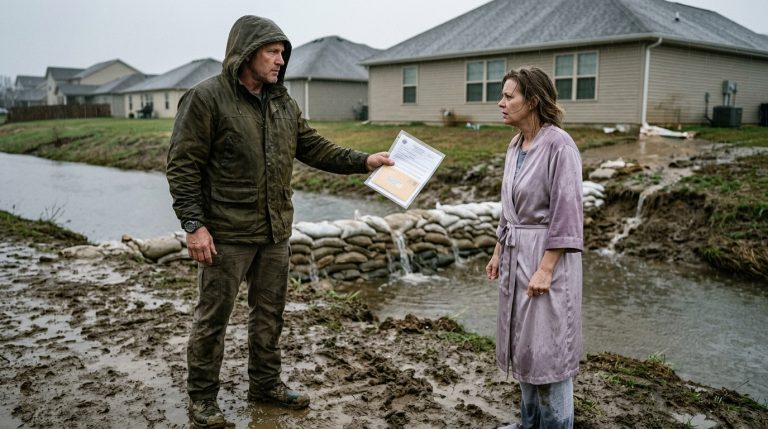
The windowpane was cold against my forehead. Outside, the morning mist was beginning to burn off, revealing the true extent of the damage. Six inches of water had retreated, exposing a shoreline that looked less like a beach and more like a wound. The muck was gray, streaked with iridescent patches of runoff—likely from the unauthorized dredging I’d seen on my own monitoring cameras weeks ago.
I pulled away from the glass and paced the length of the living room, the floorboards groaning underfoot. Ron’s visit hadn’t been about the HOA’s sudden concern for the environment; it was a reconnaissance mission. He’d been sent to see if I was rattled, or worse, if I was backing down. But he hadn’t seen the folder. He hadn’t seen the specific language my grandfather had insisted on inserting into the original grant—a clause regarding “emergency remediation” that effectively neutralized the board’s jurisdictional authority over the southern shoreline.
I moved to the hallway desk and cleared aside a stack of overdue utility bills, replacing them with a yellow legal pad. I needed Lupe. I needed a clear, defenseless path through the bureaucracy before Karen Bloom could spin this as an act of sabotage.
The phone felt heavy as I dialed. Lupe answered on the second ring, her voice crisp, professional, and entirely devoid of the morning lethargy I usually felt.
“I’ve got the documentation,” I said, skipping the pleasantries. “My grandfather’s agreement. The enforcement section is absolute. If we frame the water level shift as an emergency ecological restoration, their permit—or lack thereof—for that marina expansion becomes the primary legal focus.”
“And the dredging?” Lupe asked.
“That’s the leverage,” I said. I looked out at the lake again. “They’ve been dumping gravel and concrete blocks into the basin to create a base for their floating structures. Without a permit, that’s a violation of state-level sediment control regulations. If I file the report, they aren’t just looking at an HOA fine. They’re looking at a state investigation.”
“That will take time, Eli,” she warned. “They’ll move to freeze your maintenance rights the moment the report hits the county desk. You need to be prepared for a fight over the physical property.”
“I am.”
I hung up and paced again. The physical reality of the situation began to settle in. My grandfather hadn’t just built a system; he’d built a trap. And it was a trap that required me to be present, to be vigilant, and to be absolutely, coldly efficient.
I left the cabin and walked toward the water’s edge. The air smelled of wet silt and iron. As I reached the shoreline, I noticed something that hadn’t been there before: a string of plastic flags staked into the mud, marking a perimeter for the next phase of the HOA’s marina project. They were bright, artificial, and utterly out of place against the raw, exposed landscape.
I walked over to the nearest one and knelt in the sludge. The stake wasn’t driven into natural soil; it had been hammered into a layer of crushed limestone—the same industrial fill the contractors had been hauling in at night. I reached down and pulled the stake up. It came out easily, the end coated in a thick, dark slime that smelled faintly of chemical additives.
This was the discrepancy. The HOA wasn’t just building a marina; they were reclaiming the lake bed, inch by inch, creating “new” property to sell off or develop. The marina was just the decoy, a way to justify the massive influx of fill material while keeping their residents distracted with petty rules about mailbox paint and trash cans.
I stood there, the plastic flag limp in my hand, staring at the line of markers stretching toward the center of the cove. If I pulled them, I was declaring war. If I left them, I was complicit in the slow, systematic destruction of the one thing I’d been left to protect.
I reached into my pocket, pulled out the pocketknife my grandfather had given me, and began to systematically unscrew the base of each stake. I didn’t rip them out; I dismantled them, leaving the holes behind, keeping the stakes themselves as physical evidence.
I worked with a mechanical precision, my mind already running through the next forty-eight hours. By the time I reached the fifth stake, I heard the faint, rhythmic sound of a boat motor approaching from the north. It wasn’t the erratic drone of a resident’s jet ski; it was the steady, low-frequency hum of a professional craft—likely the contractor, coming back to check on their progress.
I didn’t panic. I didn’t hide. I stood up, wiped the silt from my hands onto my jeans, and walked toward the edge of the dock, waiting. If they wanted to play the role of developers, they were about to realize that they were trespassing on an active, legally regulated restoration zone. The game was no longer about kayaks and rules. It was about who held the deed to the truth, and for the first time in years, the balance of power was shifting back to the water.
CHAPTER 4: The Calculus of Trespass
The boat didn’t cut its engine. It surged forward, a sleek, white-hulled vessel that looked far too expensive for the shallow, muck-choked waters of Silverthorn Cove. It slowed, churning the water into a frothy, sediment-heavy wake that slapped rhythmically against the barnacle-encrusted pilings of my dock. The operator—a man in a crisp blue uniform, holding a tablet—leaned over the console, his eyes narrowing as he spotted me standing at the water’s edge with the disassembled stakes in my grip.
He didn’t kill the motor. He just pulled alongside, the fiberglass hull scraping against the wood with a sound like a jagged fingernail across a chalkboard.
“You’re standing on private work property, friend,” he called out. His voice was practiced, devoid of true authority but heavy with the threat of it. “Those stakes were placed for survey. You’re tampering with active development zones.”
I looked down at the handful of stakes. They were heavy, coated in that same industrial sludge. I didn’t offer a smile. I didn’t step back. I looked at the boat’s hull, then at the water line, noticing how the wake was carrying a thick, grayish plume of silt away from his propeller.
“This isn’t a development zone,” I said, my voice low and steady. I let the words hang in the air, weighted by the quiet of the cove. “This is a regulated ecological maintenance site. You’re discharging unauthorized fill material into a state-protected basin. I’d suggest you cut the engine before the sediment sensors in the channel pick up your wake.”
The man scoffed, though his confidence faltered. He looked at his tablet, then at the shoreline where the neat line of markers had been severed. “Karen Bloom authorized this dredging. She’s the president of the HOA. She has the permits.”
“Karen Bloom has a clipboard and a sash,” I replied. “She doesn’t have the deed to the lake bed. And she certainly doesn’t have the state-approved environmental impact report required for this much displacement.”
I walked to the edge of the dock and dropped the stakes onto the weathered wood with a clatter. The sound was sharp, final. “Take your boat out of the cove. You’re already over the threshold for a secondary fine. If you drag that hull through the shallow channel again, I won’t be the one calling the county. The sensors will.”
He stared at me, his face turning a dull, frustrated red. He reached for the throttle, intending to pivot the boat, but as he shifted gears, the motor emitted a violent, grinding shriek. A plume of black, acrid smoke blossomed from the stern. The engine stuttered, gasped, and died completely, leaving the boat drifting, trapped by the very sediment he’d been churning up.
He cursed, frantically hitting the starter. Nothing.
“It’s not the engine,” I said, my voice barely above a whisper. “It’s the intake. You’ve been running through the muck I’ve been redirecting all day. Your filters are clogged with the exact same industrial runoff you’re dumping into the cove. It’s a closed system, in case you hadn’t noticed.”
He looked at me, panic finally replacing his irritation. He was dead in the water, trapped in the center of the zone I controlled.
“Call for a tow,” I told him, turning my back on the boat. “And tell them to bring a permit if they want to retrieve it. I have the right to impound any vessel interfering with the restoration process.”
I walked back toward the cabin, leaving him to drift in the deepening silence of the cove. My heart was thumping, but it was a rhythmic, controlled beat. I had planted the seed of doubt. If the contractors couldn’t operate, the marina project would stall. And if the project stalled, Karen would have to escalate. She would have to come down here herself.
That was the move I needed. I needed her to show her hand, to prove that she was the one directing the unauthorized dredging.
When I reached the cabin, I sat at the kitchen table and pulled out the legal pad again. I started drafting the notice for the county. I didn’t write it as an appeal; I wrote it as a formal complaint, detailing the exact time and location of the boat, the lack of permit markers, and the environmental damage caused by the runoff.
I was playing the long game now, and the silence of the lake, once a source of peace, had become my most potent weapon. I could hear the wind catching the pines, the gentle, rhythmic lap of the water against the rocks, and the distant, muffled shouting of the contractor as he realized he was truly stuck.
I picked up the phone again and dialed Lupe.
“The first boat is grounded,” I said when she answered. “And I have the photographic evidence of the dredging equipment on board. What’s the next step?”
“The next step,” she said, her voice dropping into a register of calculated, cold focus, “is the town hall tomorrow night. Karen is planning to push for a total ban on all private water access during ‘maintenance.’ If we show up with the county notice in hand, we don’t just stop her. We expose the entire marina project for what it is—a massive, unlicensed real estate play.”
I looked out the window. The sun was dipping below the ridge, casting long, bruised shadows across the water. The boat was still drifting, a white speck in the middle of a dark, rising tide. Everything was moving exactly according to the logic of the land.
“I’ll be there,” I said. “And I’ll bring the evidence.”
I hung up the phone and sat in the dark, the weight of the folder on the table feeling like a physical presence. The house was quiet, but the air outside was thick with the coming storm. I had forced the first failure. The real fight was just beginning.
CHAPTER 5: The Valve Shed
The darkness in the cabin was total, save for the blue-white glow of the laptop screen where Lupe’s latest email flickered. She’d sent over the county’s official response to the dredging complaint: a generic, bureaucratic dismissal. ‘Insufficient evidence of environmental impact.’ The words felt like a slap. Karen hadn’t just ignored the warning; she had successfully buried the report within the county’s administrative machinery.
I stood up, the chair scraping sharply against the hardwood floor. My nerves were hummed taut, vibrating with a low-frequency anxiety that I couldn’t seem to shake. The cabin felt smaller than it had that morning, the walls pressing in with an almost physical weight. I had assumed that truth and documentation would be enough, but I had underestimated the depth of the rot. Karen wasn’t just managing the HOA; she was manipulating the people who held the levers of local power.
I walked to the front window. Outside, the lake was a dark, obsidian mirror. I caught a flicker of movement near the reeds—a flashlight, its beam sweeping low over the mud, searching for something. My pulse spiked. I didn’t reach for a light. I moved to the wall, pressing my back against the cool plaster, my breath shallow.
They were looking for the valve shed.
I moved through the shadows of the living room, grabbing my heavy field jacket and the master key that had been on my grandfather’s keychain for thirty years. I needed to reach the shed before they did. If they sabotaged the regulators, the legal “emergency” status I’d relied on would be invalidated by my own “failure” to maintain the equipment. It was a classic pincer move.
I stepped out the back door, moving with the practiced silence of a man who knew every root and stone on the property. The air was frigid, smelling of ozone and damp earth. I kept to the tree line, my boots making no sound on the pine needles. As I approached the clearing, the beam of the flashlight cut through the darkness again, illuminating the concrete hut.
It was Ron. He was kneeling in front of the reinforced steel door, his hands trembling as he fumbled with a set of bolt cutters. He wasn’t working alone; a second figure—someone taller, wearing a dark hoodie—was standing watch, pacing the shoreline.
My mind raced. If I intervened directly, it would be an assault. If I waited, they would destroy the regulators. I needed a distraction, something that would force them to move without exposing myself to the confrontation.
I looked at the water. My grandfather’s system was designed with a fail-safe: an atmospheric pressure relief valve, located twenty feet away, partially hidden by the dense wall of reeds. It was the only part of the system that made a distinct, pressurized hiss when engaged.
I crouched, grabbed a heavy, rusted iron pipe—a relic of the original piping installation—and hurled it into the reeds near the relief valve.
The sound was thunderous. The pipe hit the metal casing with a resonance that carried across the cove, followed by the high-pitched, screeching hiss of released air.
Ron shrieked, dropping the bolt cutters. His accomplice spun around, flashlight beam darting wildly into the trees.
“What was that?” Ron’s voice was a panicked whisper. “I thought you said he was inside!”
“Shut up,” the taller figure hissed. “Just get the door open!”
I didn’t wait. I moved silently through the underbrush, circling behind the shed. I needed to trigger the secondary, internal safety lock—a mechanical deadbolt that would freeze the valves in their current position, making them impossible to open from the outside, even with heavy equipment.
I reached the rear of the shed, my fingers finding the small, recessed lever beneath the concrete overhang. My breath hitched in my throat as I pulled it. A heavy, metallic thunk echoed from inside. The regulators were locked.
I turned to slip away, but my foot caught on a submerged rock. I stumbled, the noise sharp and intrusive in the quiet. The flashlight beam swung toward the rear of the shed, cutting a bright, blinding path through the night.
“Who’s there?” the voice roared.
I dove behind a large pine, my heart hammering against my ribs. The light scoured the area, passing inches from my face. I could hear their footsteps now—heavy, aggressive, closing the distance. They weren’t just here to sabotage the valves anymore. They were hunting.
I gripped the pocketknife in my hand, my knuckles white. I was no longer the one playing the legal game. The board had moved to physical interference, and the standoff had finally, irrevocably, shattered. I waited for the next step, every sense tuned to the sound of their approach, knowing that in the next few seconds, I would have to decide between the law I was trying to uphold and the survival of the legacy I was defending.
The light stopped directly on my hiding spot. I held my breath, the scent of rusted iron and damp soil filling my lungs, waiting for the final, inevitable clash.
CHAPTER 6: The Muddy Exposure
The light was a physical weight against my eyes, blinding and white. I didn’t think; I moved. I lunged to the left, crashing through the brittle, dead stalks of the reeds just as the beam cut through the air where my head had been a second before. My boots slipped on the slick, water-logged mud of the shoreline, and I went down hard on one knee, the impact jarring through my hip.
“There! By the pine!”
I scrambled back to my feet, my chest heaving, the air tasting of sulfur and wet pine needles. I wasn’t just running; I was retreating into the environment I knew better than they ever would. I ducked behind a row of cedar trees, the branches clawing at my jacket, and veered toward the old drainage ditch that snaked behind the shed. It was narrow, choked with debris, and deep enough to offer total cover.
I dropped into the trench, the muck rising above my ankles, cold and viscous. I could hear them crashing through the undergrowth above me, their heavy, uncoordinated steps sounding like a stampede. They were loud, arrogant, and entirely focused on the path of least resistance.
“Check the shed again,” the tall one barked. “He can’t have gone far. The gate to the main road is locked.”
I reached the far end of the ditch, where the outflow pipe met the cove. This was the heart of the system—the place where my grandfather had hidden the true purpose of the regulator. I pressed my palm against the cool, wet metal of the pipe, my fingers brushing over the hidden catch I had used to lock the valves hours ago.
As I crouched in the dark, a memory flickered, sharp and unbidden: my grandfather, his hands calloused and stained with black grease, pointing to this exact spot in his final ledger. ‘The dredging isn’t for a marina, Eli. It’s for the sediment removal. They need the deep channel clear so they can access the old mineral rights buried under the north basin. They don’t want the lake; they want what’s underneath it.’
The realization hit me harder than the fall. The marina was a lie—a beautiful, simple decoy to get the permits. The dredging was the objective. If they cleared the north basin, the entire ecological stability of the cove would collapse, turning the water into a stagnant, industrial waste pit.
A flashlight beam cut through the darkness above, tracking the line of the drainage ditch. I huddled deeper into the mud, holding my breath until my lungs burned. The light passed over my head, illuminating the rusted iron grate, and continued toward the shed.
They were going to force the valves. If they did, the sudden pressure surge would not only destroy the regulator housing but would likely rupture the intake pipe, creating a permanent, irreversible leak that would drain the cove until it was nothing but a toxic sludge pit. They were willing to kill the lake to get to the mining rights.
I waited until their footsteps receded, the sound fading toward the shed, and then I crawled out of the trench. I didn’t go back to the cabin. I moved toward the town hall access trail. If I couldn’t stop them physically, I would stop them legally—by using the town hall meeting as the staging ground for a public intervention.
My clothes were caked in mud, my hands shaking with a mixture of adrenaline and righteous, cold fury. I felt the folder in my pocket, the paper damp but still intact. I reached the edge of the trail, the lights of the gazebo glowing in the distance like a beacon of false order.
Neighbors were already beginning to gather, their voices drifting over the lawn, calm and unsuspecting. They were coming to hear about noise ordinances and mailbox standards, unaware that the ground they stood on was being prepared for industrial strip-mining.
I stepped out onto the path, my presence a ghost of mud and shadows against the manicured grass. I didn’t belong in that room, not in this state. But as I watched Karen Bloom approach the microphone on the gazebo stage, her neon sash bright against the dark night, I felt the resolve settle into my bones.
She began to speak, her voice smooth and practiced, explaining the “temporary” nature of the maintenance. I walked closer, my boots silent on the gravel. I had the truth, I had the proof of their illegal dredging, and by the time I was finished, the entire board of the HOA would be exposed for exactly what they were.
The game had moved from the shoreline to the public square, and I was holding all the cards. I stepped into the light, my shadow falling long and sharp across the stage, and waited for the moment when she would look down and finally see the consequences of her ambition standing in the front row.
CHAPTER 7: The Surveillance Trap
The grass under my feet felt like a tightrope. I moved through the periphery of the crowd, a disheveled silhouette against the warm glow of the string lights overhead. Karen Bloom was center stage, her voice a polished, rhythmic cadence that lulled the gathered neighbors into a false sense of security. She held a document aloft—a glossy, multi-paged permit she claimed was the state-approved environmental clearance for the marina project.
The people nodded. They were tired, frustrated by the low water levels, and more than ready to believe that the solution was as simple as Karen’s paperwork.
I didn’t try to push through the front. I circled toward the side of the gazebo, where the shadows were deep and the speaker wires snaked across the floorboards. I was caked in the dried mud of the drainage ditch, my jacket torn, a smear of silt across my jaw. I knew how I looked: the local agitator, the man who had supposedly sabotaged the lake.
“As you can see,” Karen continued, her smile thin and unwavering, “the recent fluctuation in water levels is merely a byproduct of the necessary structural reinforcements. We are building a secure future for Silverthorn Cove.”
I reached the base of the wooden steps. Ron was standing there, his eyes scanning the crowd, his face pale and blotchy. He spotted me, and for a heartbeat, he froze. He didn’t move toward me; he simply gripped his phone, his thumb hovering over the dial button. He was terrified of what I was carrying in the pocket of my jacket.
I didn’t give him the chance to react. I walked up the steps, my heavy boots thudding against the wood, the sound silencing the murmurs in the front row.
Karen stopped. Her eyes widened, not in fear, but in a flicker of sharp, tactical calculation. “Eli? This is a private meeting for residents. You’ve already violated the restraining order by—”
“I’m not here to talk about the order, Karen,” I interrupted, my voice cutting through the space with the jagged edge of the truth. I pulled the folder from my pocket and laid it on the speaker’s podium. It was damp, the edges frayed, but the seal of the county land commission was unmistakable.
“I’m here to talk about what’s actually under the north basin,” I said, turning to face the crowd. The neighbors were silent now, sensing the gravity of the shift. “The marina isn’t for boats. It’s an extraction point for the mineral rights your grandfather sold back in the seventies, which the current HOA board has been trying to claim as abandoned land.”
Karen laughed, a hollow, brittle sound. “He’s delusional. Look at him—he’s covered in mud, he’s been trespassing on our equipment all night. He’s trying to sabotage the property value of every single home here.”
“The equipment,” I corrected, my gaze locking onto hers, “is sitting on top of an unlicensed dredging operation that’s currently violating three state sediment codes. I have the drone footage, Karen. I have the time-stamped logs of every truck that brought in the industrial fill after midnight. And I have the original grant, which gives me—not this board—the absolute authority to regulate the basin.”
I pulled a small, silver flash drive from my pocket and held it up. “Ron has a copy too. Don’t you, Ron?”
The silence that followed was suffocating. Ron looked at the flash drive, then at Karen. The power dynamic, once anchored in her false authority, was dissolving in real-time. The neighbors began to shift, whispers erupting like static.
“It’s a lie,” Karen insisted, but her voice was beginning to fray at the edges. She gestured to the side of the stage. “Security! Get him out of here!”
“There is no security, Karen,” I said, my voice dropping, heavy with the weight of the moment. “There’s just the lake. And it’s finished with you.”
The tall figure in the hoodie—the one who had been hunting me at the shed—stepped out from behind the curtain, but he hesitated, looking at the growing hostility in the crowd. They weren’t looking at me with suspicion anymore; they were looking at the gazebo, at the glossy permit that suddenly looked like nothing more than a piece of printed plastic.
Karen’s hands were shaking as she gripped the podium. She looked for an exit, but the crowd had closed in, a circle of tired, angry people who had finally realized they had been played.
She turned to walk away, to retreat into the shadows of the woods, but she tripped on the microphone cable, the same one I had felt under my feet minutes earlier. She stumbled, her heel catching on the uneven wood of the stage, and she fell hard, her neon sash tangled around her arm, her face twisting in a moment of pure, unvarnished panic.
She looked up at me from the floor, her eyes wide, her confidence shattered. This was the moment—the collapse of her private kingdom. I didn’t reach down to help her up. I simply stood there, waiting for the reality of her defeat to sink in. She had tried to own the water, but she had forgotten the one rule of the cove: you don’t own the lake; you only earn the right to look after it.
CHAPTER 8: The Resettling
The gazebo was a riot of confused movement. Neighbors were standing up, their voices a discordant chorus of shock and accusation, while Karen Bloom remained on the floor, her neon sash tangled around her arm, staring at the ceiling with a vacant, shattered expression. The confidence that had once defined her—the clipboard, the laminated rules, the curated authority—had evaporated, leaving behind a woman who looked suddenly, painfully ordinary.
I didn’t linger. The truth was out; it didn’t need me to amplify it anymore. I turned and stepped off the stage, my boots hitting the gravel with a sound that felt like the final gavel strike. Ron was still standing near the steps, his face drained of all color, clutching his phone as if it were a life raft. He looked at me, his gaze flickering between the folder on the podium and the angry, surging crowd behind him. He didn’t try to stop me. He stepped aside, his shoulders sagging, the weight of his own complicity finally settling in.
I walked away from the light, back into the cooling darkness of the path that led down to the cove. My movements were slow, deliberate. The adrenaline that had carried me through the last forty-eight hours was receding, replaced by a profound, hollow exhaustion. Every muscle in my body ached, but for the first time in months, the air didn’t feel heavy.
When I reached the valve shed, I didn’t stop. I walked past it, down to the water’s edge. The lake was still, a dark expanse reflecting the distant, uncaring stars. I knelt in the mud, the same place where I had dismantled the stakes hours earlier, and ran my hand along the rusted iron pilings of the dock.
It was quiet. Not the oppressive, tense silence of a battlefield, but the deep, resonant stillness of a place that had finally exhaled.
The next few weeks were a blur of cold, mechanical efficiency. The county investigation moved with the heavy, grinding pace of a machine that had finally been forced into gear. The marina project was officially shuttered, the industrial fill hauled away, and the north basin restored to its natural, silt-laden state. Greg, the retired librarian who had quietly watched the collapse from the back of the town hall, was voted in as the interim president.
Our meeting in his garage was brief, devoid of the performative nonsense that had defined Karen’s era. He sat on a folding chair, sipping lukewarm lemonade, and looked at the copy of the conservation agreement I’d laid out on his workbench.
“It’s not about owning the water, Eli,” Greg said, his voice soft, contemplative. “It’s about making sure nobody else thinks they can buy it.”
I nodded, feeling a quiet satisfaction in the statement. He understood. It wasn’t a complex truth, but it was the one that had kept my grandfather awake at night for twenty years.
Once the dust settled, I went back to the valve shed one last time before dawn. I spent hours at the regulators, turning the wheels with a gentle, calculated touch, feeling the tension in the iron, the slow, rhythmic pulse of the water as it began to reclaim the shoreline. I was reversing the “Regulated Reset,” bringing the water levels back up, inch by patient inch.
As the sun began to bleed over the ridge, the water crept back to the old, familiar mark. The mud vanished. The reeds, which had been bent and broken by the dredging, started to straighten, their roots drinking in the rising moisture.
I walked back to the dock and found Walter waiting for me. He was standing there with his grandkids, just as he had promised. I pulled the two new kayaks I’d purchased from the shed and slid them into the water. They moved with a silent, graceful fluidity, the orange hulls catching the first light of the morning.
Walter watched them for a long moment, his hand resting on the shoulder of his youngest grandson. He didn’t say anything, but the look he gave me—a simple, tired acknowledgment of a debt paid in full—was enough.
I watched them paddle out toward the center of the cove, their silhouettes cut out in gold light. The water was glass-still, the ripples from their paddles spreading outward in perfect, concentric circles that eventually smoothed back into nothingness. The lake was itself again. No whistles, no laminated rules, no sashes. Just the water, the wind in the pines, and the long, slow, necessary work of balance.
I walked back up to the porch and sat down, the wood beneath me warm with the sun. I closed my eyes, listening to the sound of a child laughing somewhere across the cove, a sound that finally felt like it belonged. The mess had cost me everything I had in the way of patience, but as I looked out at the water, I knew it had been worth every scar. My grandfather had known: the kingdom wasn’t built of rules and paper; it was built of the things you were willing to protect, in silence, until the very end.