The Static Beneath the Lawn: A Story of Suburban Insulation and Buried Consequences
CHAPTER 1: THE HUM OF THE BURIED
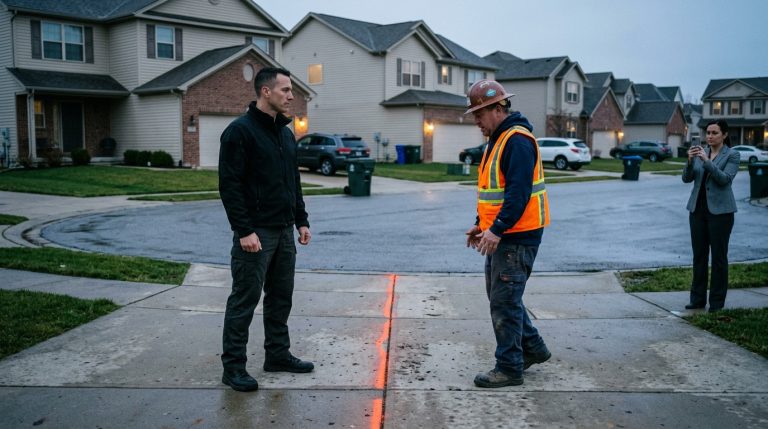
The morning sun didn’t just light the lawn; it interrogated it. I watched from the window, my mug of lukewarm coffee forgotten in my hand, as Brenda stood precisely three inches inside the common area, her eyes tracing the line where the grass looked a little too lush, a little too uniform.
She wasn’t looking for weeds. She was looking for the ghost of my work.
Beneath the manicured fescue, the geothermal loop hummed. It was a rhythmic, subterranean pulse that vibrated through the floor joists of my home. It was the sound of victory, but this morning, it felt less like triumph and more like a warning. The ground was settling. I watched a small patch of dirt, no larger than a dinner plate, sink nearly two inches, leaving a jagged fissure in the pristine, HOA-approved topsoil.
I took a slow sip of my coffee. The metal mug felt cold against my palm, a stark contrast to the stifling humidity beginning to build against the glass outside. In the basement, the heat pump clicked, a heavy, mechanical heartbeat that sent a shudder through the floorboards.
My golden retriever, Barnaby, sat by the basement door, his ears pricked. He didn’t bark; he just leaned his weight against the wood, listening to the grinding metallic protest of the pipes below. He knew, just as I did, that the earth didn’t like being hollowed out.
There was a rap at the door. Not neighborly, not friendly—the official, staccato rhythm of a woman who viewed the world as a spreadsheet of infractions.
I opened the door before she could knock again. Brenda didn’t say hello. She just looked at my shoes, then up at my eyes, her floral blazer buttoned to the collar despite the climbing temperature.
“The grass is dying, David,” she said. Her voice was flat, devoid of the usual performative outrage. She gestured with a perfectly manicured hand toward the common area. “It’s a different shade of green. Almost like it’s being fed from underneath.”
I leaned against the doorframe, keeping my posture relaxed, calculated. “Irrigation issues, Brenda. You know how the heat affects the local water table.”
“Don’t,” she whispered. The word carried a sharp, jagged edge. She took a step closer, invading the personal space of the threshold. “I have a crew coming at noon. Soil testing. Not for weeds. For structural integrity.”
She turned and walked away, her heels punching holes into the soft, compromised earth. I watched her go, my heart hammering a rhythm that matched the hum of the machine in my basement.
Then I looked down at the porch, where I had left a spare coupling from the drill rig. It was gone. In its place was a fine, powdery gray dust that hadn’t been there when the sun came up—a residue that smelled faintly, sickeningly, of chemical waste.
CHAPTER 2: THE GEOLOGISTS LENS
The front door clicked shut, the sound unnervingly loud in the quiet house. I stood in the entryway for a long moment, my pulse settling into a steady, methodical rhythm. Brenda’s parting words weren’t a threat; they were a schedule. Noon. She had given me precisely three hours and fifteen minutes before the neighborhood turned into a crime scene.
I looked down at the gray, powdery dust on the porch—the residue of my “invisible infrastructure.” It was unmistakable. It wasn’t just common topsoil or the clay of Pennsylvania; it was fine, metallic-flecked grit that didn’t belong in a residential subdivision. My stomach tightened, not with the familiar heat of anger, but with a cold, creeping realization of logistics. If the soil analysis detected heavy metals, the HOA wouldn’t just be looking for an illegal heat pump; they’d be looking for a reason to keep the entire block condemned.
I stepped off the porch and walked to the backyard. The morning air was already baking, the humidity beginning its daily climb, but my focus was entirely on the common area. The sinkhole was still there, a jagged, weeping wound in the lawn that looked like a slow-motion explosion of fescue.
I needed to move, but I couldn’t just fill it. That would be an admission of guilt. I had to stabilize it—to make the earth look like it was merely resting, not collapsing.
I headed to the garage, my boots crunching on the dry, scorched driveway. Inside, it was a sanctuary of mechanical order: half-empty cans of industrial-grade epoxy, coils of high-pressure tubing, and a stack of landscape fabric I had kept from the initial install. I grabbed a bag of lime-stabilized sand—heavy, coarse, and designed for load-bearing—and a compact, handheld soil compactor.
As I lugged the materials toward the property line, a sound cut through the suburban silence: the rumble of a heavy-duty truck engine.
I stopped behind the massive oak tree that marked the boundary of my lot. At the far end of the cul-de-sac, a white truck with a drilling rig mounted to the flatbed was pulling in. The door bore a logo I didn’t recognize: Sub-Surface Diagnostics.
My plan to manually patch the sinkhole disintegrated in real-time. I couldn’t be seen digging near the fault line; it would be interpreted as destroying evidence. I dropped the bag of sand behind the oak tree and stepped into the open, forced to pivot.
I walked toward the common area with my hands shoved into my pockets, my expression practiced—a mix of feigned annoyance and casual neighborliness. I needed to know how much they knew, and I needed to delay them long enough for the subsurface temperature to equalize. If the pipes were still running hot, the thermal cameras would highlight the loop like a beacon in the night.
“Morning!” I called out to the driver, who was unhooking a tripod-mounted sensor.
The man looked up. He wore a high-visibility vest that looked brand new and glasses that caught the glare of the morning sun. He didn’t smile. He just stared at the ground near the sinkhole, his mouth set in a thin, professional line.
“David, right?” he asked, not looking at me. “Brenda said there was some seismic activity in this sector. You the one who keeps reporting the low-frequency humming?”
The question caught me off guard. Brenda hadn’t mentioned a complaint. She had framed this as an inspection.
“Humming?” I repeated, my voice steady. “I hadn’t noticed. I just know the ground here has been shifting since the last rainstorm.”
The man clicked a button on his sensor, and a high-pitched, electronic chirp emanated from the device. He moved it slowly across the grass, tracking the invisible path of my geothermal loop. My skin pricked with sweat. He wasn’t looking for sinkholes. He was sweeping for electromagnetic signatures.
He paused near the deepest part of the fissure. The sensor chirped again, faster, a frantic, rhythmic sound that mirrored the beating of my own heart.
“Odd,” he muttered, crouching down. He pulled a trowel from his belt and pushed aside a clump of grass. He didn’t find dirt. He found a piece of the black, high-density polyethylene pipe I had buried just forty-eight hours ago.
He turned to look at me, and for the first time, I saw the weariness in his eyes—a tired, cynical look that suggested he had seen far too many “surprises” buried under manicured lawns.
“This isn’t an irrigation line, David,” he said, his voice dropping to a conversational, dangerous register. “And if you’re pulling hot water from a depth of two hundred feet in a zone marked for structural stabilization, you’re not just breaking an HOA rule. You’re playing with a pressure vacuum that this neighborhood’s foundation isn’t built to sustain.”
I looked at the pipe, then back at him. My mind raced through the options. I couldn’t bully him, and I couldn’t lie about the physical reality staring back at us. I had to change the terrain of the argument.
“If the neighborhood isn’t built for it,” I said, leaning in closer, lowering my voice to match his, “then maybe the problem isn’t my loop. Maybe the problem is why this particular strip of land is so sensitive in the first place.”
He paused, the trowel hovering over the pipe. He looked at me, really looked at me, and I saw a flicker of something in his expression—not judgment, but a grim, professional recognition.
“You have no idea what’s really under this dirt, do you?” he asked, his voice barely audible over the distant drone of a lawnmower.
CHAPTER 3: THE STRATA OF DECEIT
The silence between us grew heavy, pressurized by the heat of the Pennsylvania noon. I watched the geologist—whose name tag simply read Miller—as he tapped his sensor against his palm. He wasn’t waiting for a confession; he was waiting to see if I was a liability or a potential co-conspirator.
“I bought this house because it was supposed to be a quiet place to disappear,” I said, choosing my words with the surgical precision of someone trying to avoid a landslide. “If there’s something under this soil that makes the ground behave like a liquid, I haven’t seen it. I just wanted to keep my living room from turning into an oven.”
Miller sighed, a sound that seemed to pull the very air out of the small circle of shade created by his truck. He turned his attention back to the sensor, his fingers flying over the keypad with a mechanical, practiced fluidity. “You didn’t just bury pipes, David. You tapped into a thermal chimney. When you pulled that mud up at seven this morning, you didn’t just hit clay. You broke the seal on a pressurized layer of silt that’s been sitting stagnant since the late eighties.”
He pointed toward the common area, where the earth looked bruised—dull, desaturated, and porous. “This isn’t an HOA property issue. This is an environmental containment issue. If that pipe continues to circulate, you’re not just cooling your house. You’re circulating heavy metals directly through your HVAC intake.”
My blood went cold, far colder than the sixty-eight degrees of my living room. I looked at the vent in the side of my house, the sleek, modern intake I’d installed with such pride. I had been so focused on winning the war against Brenda that I hadn’t bothered to look at the chemistry of the earth I was mining.
“Why tell me?” I asked, my voice barely a rasp. “Why not call the state inspectors and be done with it?”
Miller stood up, his knees cracking in the dry heat. He wiped his hands on a rag that was stained a deep, rusty brown. “Because the state inspectors are the ones who filed the report that classified this entire development as ‘reclaimed woodland’ back in ninety-four. If they come out here now and find those pipes, they won’t just fine you. They’ll raze the block. And I have a mortgage, and a boss who likes the kickbacks from the HOA’s ‘maintenance’ contracts.”
He looked at me, his expression hardening. “I can calibrate this report to show nothing but minor seismic settling due to extreme heat expansion. It’ll stop Brenda’s ‘structural’ investigation in its tracks. But you pull those lines, you decommission that loop, and you bury the entrance to that basement manifold behind a permanent concrete seal. Tonight.”
He was offering me a deal, but the texture of it felt wrong—too clean, too pragmatic. My mind flickered to the surveyor’s stake I’d moved three days ago. Had he seen it? Was he observing me, or was he genuinely trying to keep a lid on a catastrophe that would ruin us both? I felt a sudden, sharp spike of paranoia. Maybe Miller wasn’t a geologist at all. Maybe he was the cleanup crew.
“Why tonight?” I asked, narrowing my eyes. “If it’s so unstable, why wait until the sun goes down?”
“Because,” Miller said, reaching into his truck and pulling out a heavy, steel-toed boot, “that’s when the methane monitors for the neighboring landfill typically spike. If I log your ‘seismic’ repair during that window, it’ll look like background noise. Nobody looks at the data, David. They only look at the summaries.”
He turned his back on me to stow his gear, leaving me standing on the edge of the common area. I looked at the ground, the grass looking thin and artificial, and I realized that my entire victory—the cold air, the quiet house, the triumph over Brenda—was built on a foundation of toxic, shifting garbage.
I started walking back toward my house, my boots sinking into the soft, treacherous turf. As I reached my porch, I glanced back. Miller was standing by his truck, speaking into a radio. He wasn’t looking at the sensors anymore. He was watching me.
I locked the front door behind me, the sound of the deadbolt echoing through the house. I retreated to the basement, the air still crisp and artificial, and knelt before the manifold. The pipes hummed—a rhythmic, grinding vibration that suddenly sounded less like an engine and more like a warning.
I reached for the main shut-off valve, my hand shaking. If I turned it, I’d be back to sweating on a leather couch, trapped by the heat. If I left it on, I might be breathing whatever had been buried under this subdivision thirty years ago.
I stared at the valve, the rusted metal cold against my skin, and wondered who was more dangerous: the woman in the floral blazer or the man in the high-visibility vest.
I turned the valve, and for the first time in three days, the house fell truly silent.
CHAPTER 4: THE NIGHT OF THE BURIED ECHO
I sat on the cold concrete floor of the basement, the main shut-off valve within reach, though I had no intention of turning it. My hands were stained with a mixture of grease and that fine, sulfurous dust I’d found on the porch—the telltale calling card of the ground beneath us. Every time I breathed, the air felt thick, heavy with the phantom weight of everything that had been suppressed by layers of fescue and civic regulation.
Without the geothermal loop running, the house became a tomb. The artificial climate I had built, my expensive, self-imposed isolation, felt fragile now. I watched the manifold—a intricate series of copper loops and plastic veins—and realized how little I truly understood about the mechanics of my own home. I had treated it like a closed system, a private domain where I could exert control, but the earth didn’t recognize property lines. It didn’t recognize HOA bylaws.
A sharp, metallic clink echoed from the floorboards above. Barnaby, my golden retriever, let out a low, mournful whine from the top of the basement stairs.
I stood up, my knees popping, and walked to the base of the stairs. The house was settling—not the normal, thermal-expansion groans of a wood-frame structure, but a deep, tectonic protest. I gripped the handrail, the wood cool and solid under my palm, and looked up into the darkness of the main floor. The light from the basement door spilled across the hallway, illuminating a thin, spiderweb crack crawling across the ceiling plaster.
Miller had been right. The ground wasn’t just soft; it was hollow.
I climbed the stairs, moving slowly, listening to the house breathe. As I reached the living room, I stopped. The temperature had already spiked, the humidity beginning to pool in the corners like rising water. I looked at the window unit I had ripped out—the unit that had sparked the entire conflict—and then at the common area through the glass.
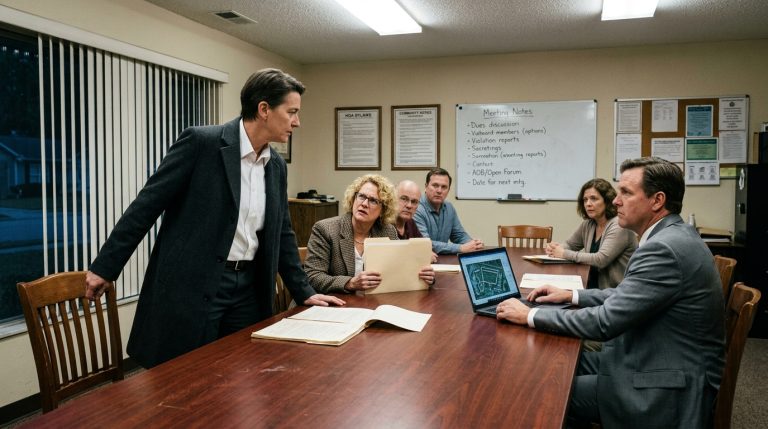
The HOA floodlights were on. Brenda’s car was parked on the lawn, the headlights cutting through the night like searchlights. She wasn’t alone. Two figures were standing by the sinkhole, their shadows elongated and distorted against the fescue. They weren’t using shovels. They were using high-frequency ground-penetrating radar, the kind that didn’t just look for pipes, but for the density of what lay beneath them.
The realization hit me with the force of a physical blow: Miller hadn’t come here to help me hide the evidence. He had come here to mark the site.
I backed away from the window, my heart hammering. I needed to see what they were finding, but I couldn’t be seen. I moved to the kitchen and grabbed a tactical flashlight, the heavy casing comforting and solid. I didn’t head for the back door; I knew they’d be watching it. Instead, I moved toward the crawlspace access in the hallway—a small, narrow door that led to the foundation slab I had been so careful not to disturb.
I shoved the rug aside and pried open the hatch. The smell hit me instantly—not the damp, earthy scent of a crawlspace, but a chemical, biting tang that made my eyes water. It smelled of industrial solvent and old, forgotten industry.
I squeezed inside, the space cramped and claustrophobic. I crawled toward the center of the house, my knees scraping against the jagged concrete. As I reached the point directly beneath the center of my living room, I stopped.
There, embedded in the foundation, was a series of concrete plugs—circular, uniform, and dated with the imprint of a construction firm I didn’t recognize. These weren’t parts of my house. These were part of a containment cap, a seal placed over a void that had been here long before the development, long before Brenda’s HOA, and long before I ever thought about drilling.
I reached out to touch one, my fingers trembling, and felt a vibration. Not a mechanical hum from a heat pump, but a deep, subterranean thrum, as if something, somewhere, was still trying to leak through the earth.
A voice cut through the silence of the crawlspace, muffled by the concrete floor above me. Brenda.
“It’s not just a pipe, Miller. Look at the read-out. The anomaly is radiating. If this is what I think it is, we don’t need a fine. We need an exclusion zone.”
I froze. I was sitting on top of a secret that hadn’t been meant for a homeowner to find. I was no longer fighting for my right to stay cool. I was fighting for the truth of why this land had been cleared, paved, and sold as a pristine suburban dream.
I scrambled backward, my lungs burning, the chemical tang turning into a sickening, metallic taste in my mouth. I had to get out, but as I reached the crawlspace hatch, I saw the beams of their flashlights sweep across the kitchen floor.
They were inside.
CHAPTER 5: THE PRICE OF SURRENDER
The beams of the flashlights danced across the kitchen tile, rhythmic and clinical. I pressed myself back against the foundation wall of the crawlspace, the damp, chemical-smelling earth soaking into my shirt. My breath came in shallow, controlled hitches. I was inches away from the containment plugs, and if they bent down to check the floorboards above, they would see the hatch standing open.
“He was just here, Brenda,” Miller’s voice sounded distorted, filtered through the thick concrete slab that separated us. “His tools are still by the basement door. He didn’t just walk out.”
“Check the exterior perimeter,” Brenda commanded. Her voice lacked its usual performative polish; it was clipped, hurried, and dangerous. “If he’s seen the containment seals, we can’t let him leave the development. This isn’t just about bylaws anymore.”
The realization settled over me with a crushing weight: they weren’t just covering up a mistake. They were managing a liability. My “geothermal” project had been the catalyst that caused the ground to shift, exposing a decades-old burial ground of industrial waste—the same waste that this subdivision had been constructed over as part of a clandestine developer’s tax write-off. My rebellion hadn’t just broken a rule; it had broken a tomb.
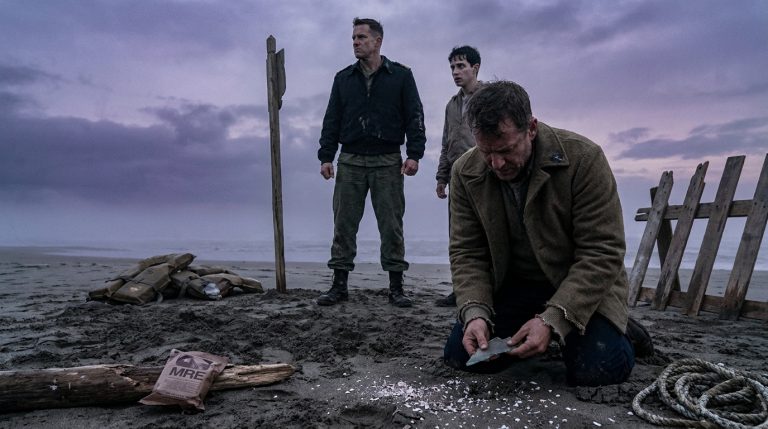
I felt a small, hard object against my palm. I looked down. One of the containment plugs, loosened by the recent seismic shifting, had a small, corroded brass key fused into the concrete seal. It was an old key, the kind that opened a safety deposit box or a service panel to the original drainage system. It was the physical proof that this entire area was never meant to be residential.
I needed to move, but the footsteps in the kitchen were getting closer. I could see the tip of Miller’s boots through the gap in the floorboards.
I had to be the driver of this moment, not the victim. If I stayed, I was a trapped animal. If I moved, I had to create a distraction that forced their hand. I reached into my pocket, pulled out the heavy tactical flashlight, and wedged it against the support beam of the crawlspace hatch. I timed it with the next set of footsteps.
As Miller walked over the hatch, I pushed the flashlight, snapping the plastic catch of the door. The sound—a sharp, violent crack—echoed like a gunshot in the basement.
“There!” Miller shouted.
The kitchen floorboards vibrated as they sprinted toward the hallway. I didn’t wait. I shoved the hatch open and scrambled out, but instead of heading for the back door, I ducked behind the furnace in the basement.
I watched as Miller threw open the crawlspace hatch, his flashlight beam cutting into the darkness I had just vacated. “He’s gone,” he cursed, his voice echoing off the concrete walls. “He went through the sub-floor drainage system. Brenda, he’s headed for the common area.”
I held my breath, gripping the brass key so hard it left an impression in my palm. The drainage system. Of course. It was the only way out that wouldn’t put me on the street where they could corner me. It was a dark, narrow pipe that ran beneath the entire common area—the very same ground they were currently radar-scanning.
I waited until their flashlights moved toward the back door, then I slipped into the shadows of the utility room. The house felt alien to me now, no longer a home, but a trap. I grabbed the only things I could: a heavy-duty wrench and the brass key.
I didn’t head for the drainage hatch yet. Instead, I moved to the main power panel. If I wanted to force their hand, I didn’t need to fight them; I needed to illuminate what they were trying to hide. I gripped the master breaker and waited. If they were looking for me in the common area, they would be standing right on top of the main underground junction box—the primary sensor hub for the entire development.
I pulled the breaker.
The house plunged into total, absolute darkness. Outside, the roar of the backup generators kicked in, but I was already moving, sliding out through the basement window into the humid, night air. I didn’t run toward the trees. I ran toward the center of the common area, the sinkhole a dark, gaping mouth in the earth, and I prepared to dig.
CHAPTER 6: THE FINAL SETTLEMENT
I didn’t need to dig far. The ground was already soft, pulverized by the rig’s earlier, reckless exploration. My hands were raw, caked in a slurry of mud and chemical-laced gray dust, but I didn’t stop until I felt the cold, unyielding resistance of the reinforced concrete cap. The brass key I’d found in the crawlspace fit perfectly into the service housing I had unearthed. It wasn’t a key for a door; it was a key for a pressure-release valve.
“David! Move away from the site!”
Brenda’s voice rang out from the edge of the cul-de-sac, thin and hysterical. The flashlight beam from her hand swung wildly, catching the edges of the sinkhole. She wasn’t alone; the faint, blue-and-red pulse of a patrol car’s lights began to wash over the pristine, fescue-covered lawn.
I didn’t answer. I slammed the wrench into the valve head and threw my entire weight against it. The metal groaned—a high, piercing shriek of oxidized iron yielding to force—and then, with a sound like a long-held breath escaping, a hiss of pressurized, sulfurous gas vented into the night air.
The ground shuddered. It wasn’t an earthquake; it was the settling of the voids Brenda and her predecessors had spent thirty years trying to hide.
Miller was there, emerging from the shadows of my house, his hand hovering near his belt. But as the vent cleared, he stopped dead. The smell was unmistakable—the pungent, chemical stench of an industrial dumping ground that no amount of landscaping could ever fully mask.
“It’s open, Brenda,” I shouted, my voice raw. “The whole neighborhood is built on a leaking lung of chemical waste. No amount of fine-print bylaws is going to fix the soil toxicity under this lawn.”
Brenda stepped forward, her floral blazer now stained with mud, her hair finally coming undone. She looked at the vent, then at the police officer who had stepped out of the cruiser, his hand resting on his radio. She didn’t look like a president of an association anymore. She looked like a woman who had spent half a lifetime holding back a tide with a clipboard.
She looked at Miller. “Tell them it’s a gas line,” she whispered. “Tell them he damaged the municipal main.”
Miller didn’t move. He was looking at the brass key in my hand, then at the seal I had exposed. The professional facade had vanished, replaced by a dull, hollow fatigue. “It’s too late for that,” he said quietly. “The radar readings are already uploading to the state environmental database. Your hub was connected to my terminal, Brenda. I didn’t come here to clean up the mess. I came here to verify the site for the state acquisition.”
The silence that followed was heavy, a suffocating weight that seemed to settle over the entire subdivision. The police officer approached the sinkhole, his flashlight beam illuminating the exposed concrete and the rusted, warning-labeled seals. He didn’t ask questions. He didn’t issue citations. He simply backed away, his face turning pale.
The payoff was immediate. The system Brenda had built to protect the ‘value’ of the neighborhood collapsed under the weight of its own deception. By morning, the street was filled not with irate dads or HOA board members, but with environmental remediation crews in white suits and heavy machinery that actually belonged here.
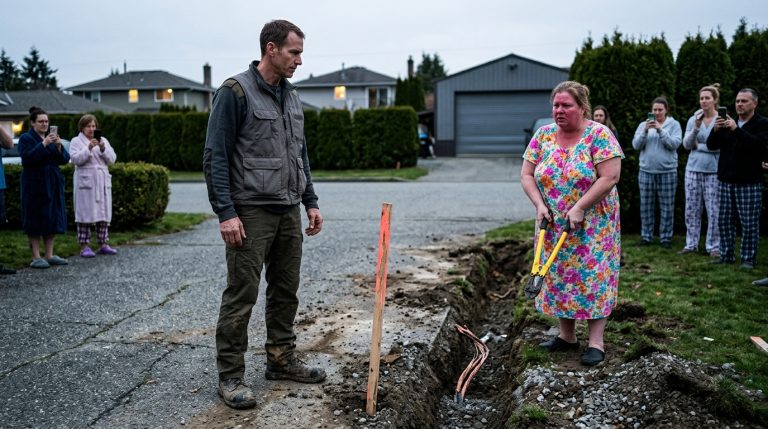
Brenda sat on the curb of the common area, her slippers ruined, her clipboard discarded in the dirt. I didn’t gloat. I watched as the crews began the slow, methodical process of excavating the site, the yellow tape cordoning off the very land she had fought so hard to keep ‘pristine.’
Justice was not a dramatic confrontation; it was the slow, inevitable grinding of bureaucracy finally turning on its architects.
In the days that followed, the subdivision was emptied. The quiet, artificial calm I had curated in my living room was gone, replaced by the constant hum of industrial pumps and the steady, rhythmic clatter of dirt being cleared away. I spent my final afternoon there sitting on my back porch, watching the fescue be stripped away to reveal the scarred, metallic reality of what lay beneath.
I picked up the brass key from the porch railing—the last piece of the puzzle I had accidentally solved—and walked over to the edge of the common area. I knelt down and placed it in the center of the excavated pit, a small, symbolic marker for the truth we had been trying to outrun.
The house was quiet, truly silent for the first time since I moved in. I didn’t need the heat pump anymore. I didn’t need the window unit. I didn’t need the HOA.
As I walked to my car, leaving the key to be buried under the remediated earth, I felt a strange, lingering peace. The ground was finally stable. The truth was out in the open, and for once, the air smelled only of the coming rain.