The Silent Boundary: A Property Owner’s War Against an Invisible Empire in the Montana Wilderness
CHAPTER 1: THE PROPERTY LINE
The scent of pine was sharp, underscored by the metallic tang of an idling two-stroke engine. My hands, stained dark with oil and grit, gripped the handlebars of the snowmobile until my knuckles turned the color of the overcast sky.
I was looking at the western edge of my property, a section I had spent three weeks clearing by hand. Two hours ago, this path had been clear. Now, it was a barricade. A deliberate, heavy-handed construction of felled lodgepole pines stacked with a precision that felt less like nature and more like a statement.
“They’re testing the perimeter,” I whispered. My own voice sounded thin against the vast, oppressive silence of the Montana high country.
I didn’t reach for my phone; I reached for the camera mounted on the dash. I toggled it on, the red light winking to life—a small, steady heartbeat. I walked toward the blockade, my boots crunching through the crust of the snow. The silence here wasn’t peaceful anymore; it was a physical weight, a pressure against my eardrums that demanded a reaction.
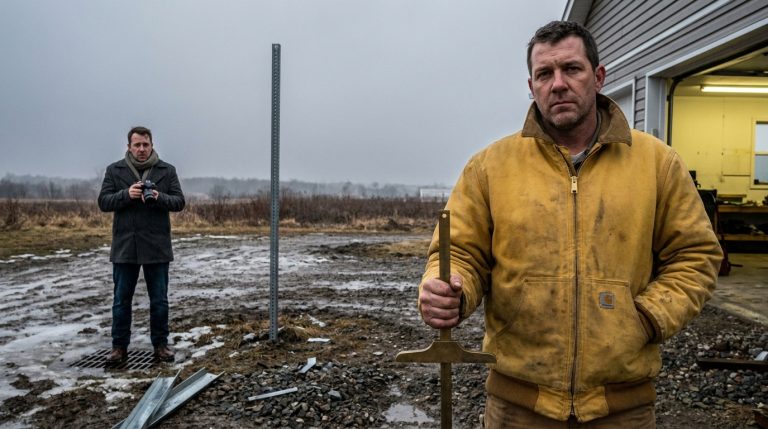
I scanned the ground. Near the base of the largest log, the snow had been disturbed. I crouched, brushing aside the white powder to reveal the object that made my blood run cold. It wasn’t a log remnant. It was a survey marker—rusted, pitted, and stamped with a seal I didn’t recognize. It was driven deep into the earth, positioned exactly three feet inside what my own survey documents identified as my territory.
I picked it up. The metal felt heavy, an anomaly in the soft, frozen dirt. It wasn’t just a sign; it was a claim.
A twig snapped in the timber behind me. Not the sound of an animal—too rhythmic, too deliberate. I stood, my pulse thrumming in my throat. I didn’t turn around immediately. I stood perfectly still, letting my eyes track the shadows between the trees, calculating the distance to the snowmobile, the weight of the stake in my hand, and the sudden, suffocating realization that I wasn’t just defending a boundary.
I was being herded.
I turned, expecting to see Patricia’s expensive ski jacket. Instead, I saw only a flutter of movement—a gray windbreaker disappearing into the brush, leaving behind a silence more profound than before. I looked down at the stake in my hand. Engraved on the side, barely visible beneath the orange rust, was a date: 1984.
This wasn’t an HOA error. This was an invitation to a war that had started long before I ever set foot on this mountain.
CHAPTER 2: THE PAPER WAR
The silence of the woods felt heavier now, charged with the static of a secret I couldn’t yet name. I didn’t drop the stake. Instead, I slid it into the side pocket of my parka, the cold metal biting through the fabric against my hip. I watched the treeline where the gray windbreaker had vanished. There was nothing—no movement, no rustle, just the indifferent sway of lodgepole pines under a leaden sky.
I turned back to the snowmobile. The engine, still warm, ticked as the metal contracted in the freezing air—a rhythmic, metallic heartbeat that seemed too loud in the stillness. I climbed on and kicked it to life. The roar of the machine felt like an intrusion, a deliberate act of defiance against the quiet, organized intimidation I’d just stepped into. I didn’t follow the tracks of the intruders; I turned the handle and carved a wide, aggressive arc back toward the cabin.
Inside, the warmth of the woodstove was a stark contrast to the biting wind outside, but it didn’t do much to thaw the knot in my stomach. I went straight to the heavy oak desk in the corner—the only piece of furniture I’d brought from Seattle. My laptop sat open, the screen glowing like a beacon in the dim, timber-walled room.
I pulled out my phone to call Dennis, but the bars flickered—two, one, none. I swore, pacing toward the window. The signal here was a fickle mistress, and with the storm clouds gathering over the ridge, it was deciding to cut me off just when I needed it most. I stepped onto the porch, holding the phone high, catching a faint, jagged edge of LTE.
“Dennis,” I said the moment the connection crackled to life. “Forget the cease and desist. The HOA is physically marking the property now. They’ve got survey stakes from the mid-eighties driven into my soil.”
“Stakes?” Dennis’s voice was tinny, distorted by the poor reception. “Marcus, wait. What kind of stakes?”
“Rusted. Pitted. They have a seal—looks like a trust or some defunct municipal board. And Dennis, they’re three feet inside my perimeter. They aren’t just sending letters anymore; they’re rewriting the map.”
“Stay put,” Dennis said, his tone shifting from casual lawyerly advice to something sharper, more urgent. “If they’re using old stakes, they’re playing a game with the historical record. I need you to scan the deed again—specifically the addendums. Look for any mention of ‘reversionary interests’ or ‘easement trusts.’ If those stakes are from ’84, they’re trying to assert a claim that predates the estate’s sale to you.”
“Why would they wait until now?”
“Because they’re waiting for you to commit capital,” he replied. “They want you to invest, to build, to settle in, so that when they drop the anchor, you have the most to lose. Do not engage them physically again. You’re being baited, Marcus. They want an assault charge. If they get you on a police blotter, they can argue you’re ‘unstable’—it’s a classic move in these territory plays.”
I hung up, the connection dropping into dead air. I walked back to the desk, my movements stiff, calculated. I didn’t want to play defense. I wanted to see the architecture of this lie.
I pulled up the digital archives of the county’s land records, my eyes skimming through layers of property tax assessments, historical surveys, and the clean, deceptively simple deed of purchase. It all looked solid on the surface. But then I did what Dennis suggested—I dove into the metadata of the scanned documents.
I found it in a corrupted, low-resolution PDF of an addendum that had been ignored in the primary closing: The Whitefish Highlands Conservancy Trust. It wasn’t an HOA; it was a ghost. A non-profit entity that had ostensibly dissolved in 1996, but whose registration remained in a state of ‘administrative dormancy’ rather than full liquidation.
I stared at the screen, the blue light reflecting in the dark window glass. If the Trust still existed on paper, the HOA was just its face—a proxy army acting on behalf of a dormant legal entity. And that entity held the rights to the ‘public’ corridors, which, according to the fine print I was only just beginning to decipher, included the very ground my cabin sat on.
The air in the room seemed to thin. I wasn’t just fighting a group of bored, suburban retirees with time on their hands. I was fighting a legal mechanism designed to vaporize my ownership the moment I tripped the trigger.
I reached for my coffee, but my hand brushed a stack of blueprints for the winter trail expansions I had planned. My own plans. My own investment. The irony hit me with the force of a physical blow. I had bought this land to escape the corporate grid, to find autonomy. Instead, I had walked straight into a trap laid by a ghost, a system that had been waiting thirty years for a ‘developer’ with deep pockets to come along and breathe life back into a dead contract.
My phone buzzed on the desk. A text from an unknown number: The perimeter is not a suggestion, Mr. Anakis. It is a boundary for your own protection. Stay within the lines, and the woods remain yours. Cross them, and you forfeit the game.
I didn’t reply. I didn’t even delete it. I set the phone face down on the wood, the grain of the desk feeling coarse and real under my fingertips. The war wasn’t coming; it was already here, and the first shot had been fired in the form of a rusted, iron stake. I had to stop looking at the map and start looking at the ground. If they wanted to play with history, I would give them a history lesson they hadn’t planned for.
I stood up, walked to the rack by the door, and took down my heavy-duty flashlight and a pair of bolt cutters. If I was being herded, I was going to find out exactly where the fence line ended—and what was hiding in the shadows of the woods they thought they owned.
CHAPTER 3: THE ART OF THE BLOCKADE
The wind had picked up, a high, thin whistle that tunneled through the dense timber. I stood before the barricade I’d encountered earlier, but something had changed. The stack of lodgepole pines, once a haphazard wall, now looked meticulously placed, anchored by heavy-gauge steel cables that had been looped through the trunks. It wasn’t just a pile of wood anymore; it was an engineered wall.
I pressed the bolt cutters against the cable, but the tension was immense. This wasn’t local vandals. This was structural, professional, and entirely focused on keeping me out of the western quadrant of my own acreage.
I took a deep breath, the cold air stinging my lungs, and focused. If they were working on the other side, I would hear the echo. I dropped to my knees, pressing my ear against the hard, frozen earth near the base of the stack. It was a trick I’d picked up in my younger days, back when I spent more time in the field than in a cubicle.
I heard it: the dull, rhythmic thud of a maul hitting wood, followed by the metallic click of a ratchet. Someone was still there, finishing the job.
I didn’t call out. I didn’t announce myself. I moved off the trail, slipping into the dense underbrush where the snow was deeper, my boots sinking into the soft, unmapped powder. I circled wide, moving with the slow, deliberate pace of a hunter, stepping only on exposed roots and frozen patches where my tracks would be minimal. My heart wasn’t racing—it was cold, steady, focused. The anger from the morning had crystallized into something far more dangerous: clarity.
I reached a ridge overlooking the trail about fifty yards further up. Crouched behind a thicket of snow-laden spruce, I peered down.
Two figures stood by the base of a massive cedar. They were dressed in nondescript, matte-gray thermal gear—no logos, no colors, no HOA branding. They worked with terrifying efficiency. One held a high-tensile winch attached to a portable frame, while the other manipulated a heavy-duty crimping tool. The barricade wasn’t just blocking the path; it was creating a funnel. They were actively modifying the natural topography of the creek bed to redirect the water flow.
My mind raced. If they redirected the creek, it would wash out the only access road to my cabin within the next three weeks of melt. They weren’t just bothering me; they were systematically devaluing the property, turning a wilderness paradise into a flood-prone liability.
I pulled out my phone, the screen dim, and started recording. I needed to be closer. I needed to see their faces.
As I shifted my weight, a dry branch—brittle from the frost—snapped beneath my knee. The sound was like a gunshot in the vacuum of the woods.
Both figures stopped instantly. They didn’t panic. They didn’t look at each other. They moved in perfect, rehearsed unison, dousing the floodlight they’d been using and slipping into the shadows of the tree line with a speed that suggested they were already expecting company.
I didn’t move. I stayed pinned against the snow, watching.
“I know you’re there,” a voice called out, not loud, but carrying clearly through the pines. It wasn’t Patricia’s voice. It was deep, modulated, and utterly devoid of emotion. “You’re playing a game with lines that were drawn before you were born, Anakis. Keep walking this path, and you’ll find the history of this land is much deeper—and much darker—than your deed suggests.”
The voice didn’t come from the trail. It came from the ridge to my left. I swung my head, but the trees were a wall of gray pillars. By the time I turned back to the trail, the two figures were gone. The only thing left behind was a small, leather-bound satchel resting on the flat, snow-dusted stump of a cedar.
I waited five minutes, my muscles cramping in the cold. Nothing. I finally rose, moving slowly, eyes scanning the canopy. I approached the stump. The satchel was old, the leather cracked and stained with age, but it was dry.
I opened it. Inside wasn’t a threat, or money, or a legal document. It was a collection of glass slides—old-fashioned, hand-labeled topographical overlays. I pulled one out and held it up against the fading, twilight sky. It was an overlay of my property, but the lines didn’t match the county map. The borders were shifted, complex, and crisscrossed by a series of tunnels that I hadn’t seen in any survey.
My pulse skipped. The tunnels were mapped directly beneath my cabin’s foundation.
I shoved the slides back into the satchel and stood up, looking at the forest around me. The trees didn’t look like nature anymore; they looked like markers, guards standing over something buried in the iron-rich soil. The HOA wasn’t trying to keep me from using the trails. They were trying to keep me from digging.
I walked back to the snowmobile, my hands trembling, not from the cold, but from the realization that I wasn’t the landlord of this property. I was a squatter on top of a vault. I needed to get back to the cabin, not to call the police—they wouldn’t understand this—but to tear up the floorboards in the mudroom and see if the topography matched the ghost-map I held in my hands.
The trek back was a blur of shadows and shifting perspectives. Every tree seemed to be watching, every shadow a potential scout for the gray-clad workers. I reached the cabin, killed the engine, and stepped into the silence. It wasn’t empty anymore. It was expectant. I stepped onto the porch, bolt cutters still in my left hand, and saw something that stopped me dead in my tracks: the front door was slightly ajar.
I hadn’t left it unlocked.
CHAPTER 4: THE WITNESS
I stood motionless on the porch, the air biting at my exposed skin. The door stood ajar by exactly three inches—a deliberate gap, not the result of a forced entry, but an invitation. I didn’t reach for my phone to call the Sheriff. If I brought the law in now, I would be exposing the satchel, the slides, and the tunnels I had only begun to understand. I needed to know what had been compromised before I declared war.
I pushed the door open with the toe of my boot. The hinges, usually silent, gave a low, agonizing groan that seemed to echo through the entire 300-acre expanse. I moved inside, my back against the wall, bolt cutters raised. The interior of the cabin was exactly as I had left it: the map pinned to the wall, the laptop humming on the desk, the smell of stale coffee and cedar.
But it felt different. The air was charged with a faint, cloying scent—not woodsmoke or dust, but something clinical, like rubbing alcohol and ozone.
I moved to the desk. My laptop was still logged in, but the screen was dark. I tapped the spacebar. It woke instantly, showing a series of terminal windows I hadn’t opened. Someone had bypassed my firewall with a degree of sophistication that didn’t belong to a group of local homeowners. They hadn’t stolen anything; they had left a digital footprint.
I scrolled through the logs. They had been searching for the original 1984 survey data—the same data I had found in the corrupted addendum. They weren’t just looking for records; they were scrubbing the digital trail of the Conservancy Trust.
A floorboard creaked in the mudroom behind me.
I pivoted, bolt cutters swinging, but the room was empty. Then, I saw it: on the mudroom floor, resting neatly on top of my hiking boots, was a single, laminated photograph. I stepped forward, my pulse hammering in my ears, and picked it up.
It was a picture of me, taken from the ridge where I had been hiding just thirty minutes ago. In the photo, I was clearly visible, staring through the thicket. But it wasn’t just the photo that froze my blood; it was the date stamp in the corner: 1984.
The photo was a forgery, a perfect reproduction of a modern digital shot, processed to look like an antique development. Someone was telling me that my presence here had been anticipated decades before I was born.
The front door slammed shut, the sound booming like a cannon shot in the small cabin. I rushed to it, throwing the latch, but it was already locked from the outside. I wasn’t being hunted anymore; I was being contained.
I retreated to the center of the room and looked at the wall map again. I realized then that the “tunnels” marked on the glass slides weren’t just beneath the cabin. They were a grid. The entire property was laid out like a massive, subterranean circuit board. If the cabin was the switch, I had been standing on it for weeks, completely unaware that the very ground I was ‘improving’ was a component in a larger, darker machine.
My phone vibrated in my pocket. A live video feed.
I looked at the screen. It was a view from inside my own cabin, taken from a camera I hadn’t installed. I saw myself, standing in the center of the room, looking terrified. The feed was laggy, but the audio was clear.
“You’re a bright man, Marcus,” the voice said—the same modulated, emotionless tone from the ridge. “You think you’re protecting your land. You think this is about boundaries. But you’re just the latest battery in a circuit that needs to be grounded. Deputy Kowalsski isn’t your ally. She’s the technician assigned to keep the lid on.”
I felt the blood drain from my face. Kowalsski. She hadn’t just arrived when I called; she had arrived when I was permitted to call.
I looked at the desk, at the bolt cutters, at the photograph of myself with a 1984 timestamp. The sense of being an owner, of being the sovereign of these 300 acres, shattered. I wasn’t a homeowner. I was an anomaly.
I took the bolt cutters and walked to the wall where the map was pinned. I didn’t rip it down. I jammed the cutters into the drywall behind it, tearing away the insulation and the studs. If there was a machine, there had to be a junction. I needed to see what was behind the drywall of my own home.
The wall yielded with a scream of tearing paper and splintering wood. Behind the studs wasn’t insulation. It was reinforced steel—the door to a bunker that had been welded shut long ago. I ran my hand over the cold, oxidized surface of the hatch, my fingers tracing a faint, etched insignia: The Whitefish Highlands Conservancy Trust.
The cabin was a decoy. The entire structure was built as a facade to hide the entrance to whatever they were protecting.
A heavy, measured knock came at the front door. Not a panicked pounding, but a slow, rhythmic series of three taps.
“Mr. Anakis,” Kowalsski’s voice drifted through the thick timber of the door. It was no longer cold or professional; it was tired, like someone coming to perform a necessary, distasteful task. “I’m sorry, but you’ve triggered a violation of the easement. I have to ask you to step away from the wall. We’re going to have to relocate you for your own safety.”
I looked at the steel hatch, then at the bolt cutters in my hand. I had spent fifteen years in Seattle building systems that were meant to be unhackable. I knew one thing: any system had a fail-safe.
I didn’t open the door. I turned back to the steel hatch and began to hammer the bolt cutters against the seam, searching for the weld. If they wanted to relocate me, they’d have to go through the floor first.
CHAPTER 5: THE SURVEYING GHOST
I didn’t stop hammering. The bolt cutters were heavy, industrial steel, and I used them like a battering ram, targeting the stress points of the welded steel plate. Each strike produced a dull, ringing thud that echoed into the hollow space behind the drywall. It wasn’t the sound of solid rock or earth; it was the sound of a void. My cabin was a shell, and I was clawing at the skin of something that had been kept in the dark for decades.
Outside, the knocking stopped. For a heartbeat, the silence was absolute. Then, the sound of the cabin door frame groaning under pressure reached me. They weren’t waiting for me to answer. They were using a hydraulic spreader, the same tool they’d used on the barricade. They were coming through the front door, and they weren’t bothering with pleasantries.
I didn’t panic. Panic was a luxury for people who didn’t know how to code—people who thought a system was infallible. I knew better. Every system had a bypass. I jammed the curved tip of the bolt cutters into a hairline fissure I’d managed to open in the weld. I pulled with every ounce of muscle in my back, my boots sliding on the hardwood.
The plate groaned. A sliver of light—cold, sterile, and flickering—leaked from the opening.
The cabin door gave way with a deafening crack of timber. The frame splintered, and the heavy oak door swung inward, hitting the wall with enough force to knock the framed photos from their perches. I didn’t turn around. I kept my eyes locked on the widening gap in the hatch.
“Marcus,” Kowalsski said. She didn’t sound like a sheriff. She sounded tired, a monotone weariness that chilled me more than her threats. I could hear the weight of heavy boots on the floorboards, the metallic clatter of equipment being deployed. “You’re damaging the seal. You have no idea what the atmospheric pressure inside that chamber is. You’re going to kill yourself, and you’re going to compromise the entire sector.”
“Sector?” I grunted, heaving against the steel. The fissure widened. I could see into the chamber now. It was filled with rows of server racks, archaic and dusty, blinking with the rhythmic pulse of a dying heartbeat. Not physical treasure. Data.
“It’s an archive,” I whispered, the realization hitting me like a physical blow. “All of it. The history of this valley. The land swaps. The names of the people who were ‘relocated’ before the Trust was formed.”
“It’s not an archive,” Kowalsski replied, her boots stopping just feet behind me. I could feel the cold draft of the air conditioning from the bunker pouring over my shoulders. “It’s a ledger. And you’re not supposed to see the accounts.”
I turned, the bolt cutters still gripped in my hand. Kowalsski stood there, her sidearm holstered, her hand resting on a heavy-duty tablet. Behind her, two of the men in gray thermal gear were moving with calm, predatory grace. They weren’t armed with weapons; they were armed with containment kits. They looked like hazmat specialists, or perhaps, cleaners.
“You’re a software engineer,” she said, her eyes flicking to the open bunker hatch. “You know what happens when a drive fails. You have to scrub the sectors. You have to wipe the corrupt data before it crashes the system. This property… it’s the primary server for a very old, very private set of interests. Your purchase was a fluke. A glitch in the real estate acquisition algorithm. And we are the debugging team.”
“I own the land,” I said, my voice steady, despite the way my hands were shaking. “I have the deed.”
“You have a piece of paper that confirms you own the surface rights,” one of the men in gray said. His voice was the same one I’d heard from the ridge—emotionless, calculated. “But look beneath your feet, Marcus. Look at the power draw. You think this is wilderness? You’re sitting on the largest data-bank of human transaction records in the Pacific Northwest. The Conservancy Trust isn’t about land. It’s about who owns the history of the people living on it.”
The memory of Seattle surged back: the endless data scrubbing, the corporate soul-crushing, the feeling of being just another integer in a vast, uncaring machine. I had come to Montana to escape the grid, only to find that the grid had simply gone underground.
I looked at the bolt cutters, then back at the blinking servers in the bunker. I wasn’t just a squatter. I was a whistleblower with no audience.
“If I go with you,” I said, my mind racing through the tactical options, “what happens to the cabin?”
“It’s a structural hazard,” Kowalsski said, her hand reaching for her belt. “It will be cleared, graded, and replanted. Within forty-eight hours, there won’t even be a record that you ever bought this place.”
She took a step forward. I didn’t move away. I dropped the bolt cutters and reached into my pocket, fingers closing around the digital recorder I had been using since the morning. I had been streaming everything to a secure, encrypted cloud server since I entered the cabin. The upload speed was crawling, but it was transmitting.
“You’re too late,” I said, looking her directly in the eyes. “The debuggers are being debugged.”
Her eyes narrowed. For the first time, I saw a flicker of genuine alarm in her expression. She realized I wasn’t just a frustrated landowner; I was an engineer, and I had just turned my own home into a node.
The cabin seemed to shudder. Not from an earthquake, but from the realization that the system had just been alerted.
CHAPTER 6: THE MIDNIGHT VISITOR
The power didn’t just flicker; it died with a violent, synthetic pop that smelled of ozone and scorched plastic. The server hum that had been a low-frequency vibration under my feet for the last ten minutes ceased, leaving a silence so absolute it made my ears ring. In the pitch-black darkness, the only thing I could hear was my own respiration—ragged, sharp—and the sound of the front door being forced open by the hydraulic pressure from outside.
I didn’t wait for them to secure the room. I dropped to the floor, sliding beneath the heavy oak desk, my hand instinctively finding the hidden latch I’d installed on the underside of the floorboards—a small stash of emergency supplies I’d kept since my first week here. My fingers brushed against the cold, familiar weight of a high-lumen tactical flashlight. I didn’t turn it on. I couldn’t risk the light.
Instead, I slid backward, retreating into the crawlspace I’d exposed when I hammered through the drywall. The interior of the bunker was colder than the cabin—a dry, recycled chill that tasted like stagnant air and old paper. The darkness here was absolute, a weight that pressed against my eyeballs.
“He’s moved,” Kowalsski’s voice echoed from the cabin. It sounded distorted, amplified by the cramped acoustics of the space. “Thermal. Check the foundation.”
I heard the whine of a handheld scanner. A thin, red beam of infrared light sliced through the darkness of the cabin, scanning the wall where I had broken through. I held my breath, pressing my back against a stack of cold, metal-encased server units. My heart was a frantic drum, but my mind was operating in a state of hyper-analytical calm. If I was a liability to be scrubbed, they wouldn’t use guns—they’d use the architecture itself.
They were going to seal the foundation.
I moved deeper into the bunker. The layout was erratic, a labyrinth of short corridors and reinforced bulkheads that didn’t match the geometry of the cabin above. This wasn’t just a server room; it was a fallout-era installation, retrofitted with modern fiber optics. I brushed my hand against a wall and felt a series of switches—a manual override for the security grid.
I didn’t need to see them. I used the pattern of the knobs to gauge the system. It was an archaic, mechanical fail-safe. I pulled the master lever.
Deep beneath the earth, a series of heavy, magnetic locks engaged with a bone-jarring thrum. The sound of the cabin floor sealing shut above me was final. I was trapped, yes, but so were they—at least, the ones on the outside.
I turned on the flashlight. The beam cut through the thick, stagnant air, illuminating the room. It wasn’t servers. Not entirely.
The walls were lined with thousands of physical files—manila folders, color-coded, labeled with dates and surnames. I approached the nearest stack. Morrison, Patricia. 1994. I opened it. It contained a comprehensive record of her family’s financial history, their social connections, their every deviation from a set of “community standards” that had been enforced by this Trust for decades.
It wasn’t just my property. It was a surveillance node for the entire region. The HOA, the Trust, the “community standards”—it was all a shell to maintain a massive, manual database of the valley’s population. They weren’t just protecting a vault; they were managing a population.
My flashlight beam caught something else on the far wall: a terminal station, the screen still flickering with the last remnants of the data I had uploaded. The transmission was complete. The evidence—the location of the bunker, the records, the names—was currently pinging off a server in Singapore, far beyond the reach of the local sheriff or the anonymous gray-clad “debuggers.”
I felt a surge of cold triumph. They had come to scrub the data, but they had arrived after the copy was already off-site.
“You think you’ve won,” a voice said, low and resonant, coming from the shadows of the bunker’s deeper chambers.
I swung the light around. A man stood near a bulkhead, dressed in the same matte-gray gear as the others, but his jacket bore a different, subtle insignia—a scale balanced against a mountain. He wasn’t a cleaner. He was an administrator.
“You’ve triggered a purge protocol, Marcus,” he said, stepping into the light. He looked older than the others, his face a map of calculated decisions. “By uploading that data, you haven’t exposed us. You’ve activated the failsafe. The cabin, the tunnel, these records—they’re all going to be incinerated. And you’re the only witness left to the cleanup.”
“I have the cloud access,” I said, my voice surprisingly steady. “They can’t stop the mirror.”
“We don’t need to stop the mirror,” he replied, a faint, sad smile touching his lips. “We just need to make sure that in the ensuing chaos, no one believes the source. You’re an ex-tech mogul, Marcus. A man who cashed out, bought a isolated property, and started obsessing over conspiracies. It’s a classic breakdown narrative. By the time we’re done, you won’t even be a ghost in the machine. You’ll be the joke of the county.”
He reached for a console on the wall. “The cabin’s structural integrity is already failing. We’ve rigged the support beams to collapse. Your ‘relic’ is going to become your tomb.”
I heard the sound of timber fracturing above me. The bunker began to groan. He wasn’t bluffing. They were burying the whole operation, and me with it.
I didn’t look for an exit. I looked for the power distribution unit. If this was a machine, it had a power source, and if I could trigger a surge, I could force the blast doors to release. I lunged at the console, not to stop him, but to hotwire the emergency release, feeling the heavy, cold iron of the bunker floor vibrate as the ceiling above began to scream.
CHAPTER 7: THE DECOY TRUTH
The console hummed beneath my palms, a high-pitched whine that signaled the surge. I didn’t wait to see if the administrator—the man in gray—was watching. I jammed my screwdriver into the exposed wiring of the primary junction box and twisted. A shower of sparks sprayed across the room, illuminating the dark, cramped bunker in a strobing, violet light.
The bulkhead doors shuddered. The magnetic locks, once sealed with the permanence of a vault, let out a tortured, high-frequency moan. Then, the power died. Total, suffocating silence.
In the dark, I scrambled away from the console, my lungs burning as the air in the sealed room began to thicken with the smell of scorched insulation and something acrid, metallic. The man in gray was silent. I couldn’t hear him move. I couldn’t even hear his breathing. It was as if he had dissolved into the architecture of the bunker itself.
“The easement,” I wheezed, clutching the edge of the terminal. My voice sounded thin, alien. “It wasn’t an environmental protection… it was a cover for the network topology. The whole valley is a shielded zone. That’s why the signals are dead.”
“Correct,” the voice came from the darkness, calm and conversational, as if we were discussing the weather rather than my impending burial. “You’ve discovered the decoy. You’ve worked it out, Marcus. You think you’re a victim of a land-grab, a corporate conspiracy to protect some obsolete data nodes. It’s a clean, logical narrative. It’s something your software-engineer brain can digest and categorize.”
“It’s not a decoy,” I countered, fumbling for my flashlight. The light clicked on, the beam cutting through the dust, but the man was gone. There was only the empty bulkhead, the wall of files, and the blinking lights of the server rack, which were struggling to reboot on the emergency power loop.
I didn’t care about him. I didn’t care about the decoy. I dove for the physical files—the manila folders I’d seen earlier. If I could get these out, if I could physically carry the weight of this proof into the open, then it wouldn’t matter what they called it.
I grabbed a fistful of folders, stuffing them into my jacket, the paper rough and biting against my skin. I reached for the handle of the bulkhead—it was cool, wet with condensation. I pulled. It didn’t budge.
I swung the flashlight back toward the exit. The door was still sealed, but something had changed. The wall of files, the massive, floor-to-ceiling rows of history I had just been perusing, began to shift. The racks were on a motorized track, and as they slid, they revealed a second layer behind the first—a space I hadn’t noticed before, smaller, deeper, and lined not with paper, but with glass.
I crept toward the new opening, the beam of my light catching rows of illuminated canisters. They weren’t records of people. They were records of impact.
I froze. Each canister was labeled with a date, a set of GPS coordinates, and a name I recognized—not just the locals, but the names of the original developers, the engineers who had worked on the dam in the valley, the people who had ‘passed away without heirs’ just like Bill, the man who had sold me the land.
The “decoy” wasn’t the Trust. The decoy was the idea that this was about data.
I picked up one of the glass canisters. It was heavy, containing a small, crystalline shard—an industrial component, part of a seismic sensor array that had been installed in every home in the valley under the guise of ‘smart utility upgrades.’
My heart didn’t beat. It paused. The easement wasn’t just about controlling the land; it was about calibrating the earth itself. They weren’t archiving the people; they were using the valley as a massive, live-fire testing ground for seismic manipulation technology.
The cabin above me groaned again, a deep, structural sigh that sounded like a giant snapping a bone. The ceiling was giving way. Dust poured into the bunker, coating my hair and clothes in a fine, gray grit that tasted like ancient stone.
I looked at the files I had stolen, then at the shard in my hand. The truth was heavier than I had expected. It wasn’t a corporate conspiracy. It was a weapon. And I had bought the trigger.
A rhythmic, metallic tapping started on the hatch again—but it wasn’t Kowalsski. It was someone else, the sound slower, more deliberate, a code I recognized from my own early-career security testing. Open. Wait. Open.
I looked up at the ceiling, watching as a hairline crack raced across the concrete, spiderwebbing in a way that defied the structural stress.
“You found the canister,” the voice of the man in gray whispered, this time right behind me. I felt the cold barrel of something hard and metallic press against the base of my skull. “The decoy was for the inspectors. The canister is for the ones who know how to ask the right questions. But you asked, Marcus. And now, you’re part of the experiment.”
The bunker door blew inward. Not a controlled opening, but a catastrophic failure of the seal. The sound was deafening, the pressure change knocking the wind from my lungs. I collapsed, the folders spilling across the floor, the truth scattered in the dark, and in that flash of light, I saw it—not a face, but a badge. It wasn’t the Sheriff’s department.
It was federal.
The valley was a black site, and I was the contamination that needed to be cleaned.
CHAPTER 8: THE CALCULATED COUNTER
The metal of the bunker door felt like ice against my palms as I scrambled backward, the folders I had stolen scattering across the floor like leaves. The man in gray—the administrator—stood over me, his silhouette framed by the harsh light from the corridor beyond. He didn’t look like an enemy anymore; he looked like a functionary, an arm of a body that had been operating in this valley for forty years without anyone noticing.
“Federal,” I spat, my voice cracking. I looked at the badge, then back at the shards of the seismic sensor I still held in my hand. “This isn’t a cleanup. This is a sanctioned liquidation of a proprietary asset. The Trust isn’t an HOA. It’s a shell corporation for a government research project.”
He didn’t answer. He simply reached down and plucked the sensor shard from my fingers with a practiced, clinical motion. “You’re an engineer, Marcus. You think in terms of root causes, logical flows, and objective truths. You see a sensor, you think ‘surveillance.’ You see a file, you think ‘evidence.’ But this isn’t a project that relies on the truth. It relies on the environment.”
Behind him, the bunker began to moan—not the structural groaning of the cabin collapsing, but a deep, vibrating hum. The seismic sensors were active. They weren’t just monitoring the earth; they were oscillating. The air in the room thickened, a low-frequency hum vibrating against my sternum, making my teeth ache.
“You’re vibrating the fault line,” I whispered, the realization hitting me with a cold, terrifying clarity. “The whole valley… the ‘smart’ upgrades, the sensors, the tunnels. You aren’t just watching the people. You’re using the entire topography as a giant, ground-based transmitter.”
“The technology is a legacy of the Cold War,” he said, moving toward the console with a grace that was unnerving. “It was never fully decommissioned. It was simply privatized, hidden behind the administrative veil of a homeowners association. And it needs calibration. Every decade or so, we need to ensure the geological integrity of the array. Unfortunately, your presence here, your ‘improvements,’ your heavy equipment, your drilling—it’s been creating noise in the data.”
He typed a sequence into the console. The vibration intensified. I felt my inner ear tilt, the world starting to swim in a sickening, rhythmic sway. He was ramping up the frequency.
“I’m not the noise,” I yelled, struggling to stand. I gripped the edge of a server rack, the metal cold and biting. “I’m the error! You can’t calibrate a system that’s already been compromised.”
“You are a variable,” he replied, his voice barely audible over the hum. “And variables are addressed by the system’s own homeostasis.”
He turned to leave, leaving me alone in the accelerating thrum of the chamber. The bunker was sealed, the cabin was collapsing, and the valley floor was beginning to resonate with the frequency of a coming earthquake. I had seconds.
I looked at the scattered folders—the history of the valley, the names, the records of the “relocated.” I realized then that the decoy was gone. The mystery of the HOA, the petty squabbles over snowmobiles, the legal harassment—it was all just a theater of the absurd, designed to keep me looking at the wrong map.
I didn’t need to fight the man. I needed to fight the frequency.
I scrambled toward the server rack I had been leaning on. It wasn’t just a storage unit; it was a cooling array for the transmitter. If I could introduce a feedback loop into the cooling system, I could cause a thermal spike, forcing the main array to shut down to prevent a catastrophic blowout.
I jammed my hands into the back of the rack, my fingers seeking the coolant lines. They were heavy, high-pressure braided steel. I didn’t have the tools to cut them, but I didn’t need to. I reached into my pocket and pulled out the small, jagged shard of the sensor I had pocketed before the administrator arrived.
It was hard, sharp, and perfectly conductive.
I waited for the resonance to peak—the moment the room felt like it was going to tear itself apart—and slammed the shard into the heart of the power distribution board.
The feedback was instantaneous. A blinding, white-hot flash filled the bunker. The hum skyrocketed to a screeching, dissonant wail, and then, the world went dead silent. The bunker lights flickered once, twice, and died.
I fell to the floor, gasping for air, the smell of burnt circuits filling the room. Above me, the sounds of the cabin’s destruction stopped.
I wasn’t safe. I was buried. But for the first time, the valley was quiet. I had killed the machine, but I had trapped myself in the heart of its corpse. I looked at the dark room, the scattered files, and the silence of the valley—a silence I had bought with the only leverage I had left. Now, I just needed to find a way out before the “cleanup” crew realized that the machine had stopped screaming.
CHAPTER 9: THE ENVIRONMENTAL RETALIATION
The air in the bunker was no longer cold; it was thick, stale, and warm with the heat of cooling electronics. I lay on the floor for a long moment, my chest heaving, the taste of ozone and dry concrete coating my tongue. The silence above was the most terrifying sound I had ever heard. The cabin was gone. I was in a sealed box, and the only thing connecting me to the world I knew was the flickering light of the terminal—my only proof that I hadn’t lost my mind.
I pushed myself up, my knees scraping against the jagged debris of the collapsed wall. The man in gray was gone, vanished back into the architecture of his own making. I was alone with the history of the valley, and the walls were starting to sweat.
I looked at the terminal. It was flickering, a rhythmic pulse of amber light. I hadn’t killed the array; I had only paused it. A message scrolled across the screen in a stark, terminal green: Calibration cycle interrupted. Initiating emergency containment of regional seismic instability.
My heart surged. They weren’t just resetting the machine; they were triggering a localized tremor to cover the evidence. They were going to bury the bunker, the records, and the cabin under a controlled landslide, a “natural” disaster to erase the anomaly.
I scrambled to the bulkhead exit. It was locked, but the emergency release I had been trying to trigger was illuminated by a faint, auxiliary light. I jammed the shard of the sensor into the slot. The door ground forward—a fraction of an inch, then another. It was heavy, a slab of reinforced steel that had been designed to survive a war, not a mechanical failure.
I shoved my shoulder against the edge, the metal biting into my skin. I needed more leverage. I scanned the floor and found a heavy steel pipe—a conduit that had snapped during the initial blast. I jammed it into the gap, using my body weight as a fulcrum.
The door began to slide.
As I pushed, the ground beneath me rolled. A low, guttural roar rose from deep within the earth—not a sound, but a force. The seismic oscillation was returning, but it wasn’t controlled anymore. It was chaotic. The vibration was violent, causing the shelves of manila folders to spill their contents into the dark. I watched, paralyzed, as thousands of pages of history—the surveillance, the relocations, the names—became a chaotic confetti of secrets, trampled under my boots as the floor tilted.
I made it through the gap, stumbling into the tunnel beyond. It was dark, illuminated only by the frantic beam of my dying flashlight. The tunnel wasn’t a standard corridor; it was a vein, a artery of the valley, lined with pressurized hydraulic conduits that were beginning to spray fluid as the ground shifted.
I ran, my breath coming in jagged, desperate gasps. The tunnel was long, winding, and completely disorienting. Every time I hit a wall, the ground surged, throwing me against the cold, wet stone. I wasn’t just running for my life; I was running away from the machine. I had to reach the surface before the tremor peaked.
I reached a junction—a ladder leading up, bolted into the rock wall. I didn’t think. I climbed. My fingers were raw, my shoulders screaming, but I didn’t stop. I could feel the vibrations through the rungs, the entire mountain humming with the energy of a thousand triggered faults.
I reached the hatch at the top, a small circular disc of iron. I hammered on it with the heel of my palm. Locked.
I pulled the sensor shard from my pocket and jammed it into the mechanism. It was a gamble—a desperate, blind prayer. I twisted.
The hatch swung open, and I tumbled out into the freezing night air.
I was in the middle of the forest, a hundred yards from where my cabin had stood. But it was gone. The entire slope had shifted. The cabin, the workshop, the trails—they were all buried under a massive, churning tide of earth and splintered timber. The valley was dark, save for the flickering of an emergency light from a distant, unmarked transport vehicle idling near the tree line.
I stayed low, hidden in the shadows of a cedar, my clothes torn, my body shaking with the aftershocks. The “cleanup” crew was already here. Men in tactical gear, moving with the precision of a surgical team, were sweeping the site.
I had the proof. I had the folders in my jacket, and I had the shard. But as I watched them, I realized with a sick, hollow dread that the landslide hadn’t just destroyed the cabin. It had destroyed the evidence that I was ever here. To the world, Marcus Anakis hadn’t been a victim of a conspiracy. He was a man who had built a cabin on a geologically unstable slope and been reclaimed by the wilderness.
I didn’t run. I moved, slow and silent, through the brush, back toward the main road. If they wanted me dead, they’d expect me to flee. Instead, I was going to find a way to make sure they knew that at least one part of the system had been corrupted.
The road was empty, the snow untouched, but in the distance, I saw the headlights of a sheriff’s cruiser. Kowalsski. She was coming back to finish the audit.
I stepped onto the asphalt, my shadow long and jagged in the high beams, and I stopped. I wasn’t hiding anymore. I was waiting.
CHAPTER 10: THE COURTROOM GAMBIT
The cruiser pulled up slowly, its tires crunching on the gravel, the headlights carving two blinding tunnels through the darkness of the mountain road. Deputy Kowalsski didn’t step out immediately. She sat there for a long moment, the engine idling, the sound rhythmic and mechanical, a stark contrast to the chaotic, uneven breathing of the forest around me.
I didn’t move. I kept my hands visible, the folders tucked securely inside my jacket. Every muscle in my body felt like rusted wire—taut, coiled, and ready to snap. The adrenaline from the bunker was fading, replaced by a cold, calculating resolve. If she wanted to finish the audit, she was going to have to do it in the light.
Finally, the door clicked open. Kowalsski stepped out, her hand resting on her holster, her posture relaxed, but her eyes—those sharp, observant eyes—were searching the tree line.
“You’re a long way from home, Marcus,” she said, her voice carrying across the road. She didn’t draw her weapon. She looked at me, then at the smoking, ruined site of my cabin barely visible through the trees. “That’s quite a disaster back there. Natural, of course. Fault lines are treacherous in this part of the state.”
“A disaster,” I repeated, my voice gravelly. I took a step into the pool of the headlights. “A complete, structural failure of a property that, according to you, was never supposed to have a basement.”
She stopped, her expression flickering. For a second, the mask of the local law enforcement officer slipped, revealing the tired, haunted look of someone who had spent too many years managing the “anomalies” of this valley.
“The valley has a way of erasing its mistakes,” she said, taking a step toward me. “Whatever you think you found, whatever you think you’re holding—it’s just noise, Marcus. And noise gets filtered out. Don’t make me add a resisting arrest charge to the list of things that need to be cleared.”
“I’m not resisting,” I said, pulling the manila folders from my jacket and holding them up. They were stained, torn, and crusted with bunker dust, but the names were still legible. “I’m litigating.”
She paused, her gaze shifting to the folders. “You think you can take those to a court? You think a judge in this county doesn’t have a file in that bunker?”
“Maybe not in this county,” I said, a slow, grim smile spreading across my face. I reached into my pocket and pulled out the small, jagged shard of the seismic sensor. I held it up, catching the light. “I didn’t just upload the data, Kowalsski. I linked the local relay to the global satellite backup. Every minute you spend here, debating whether to ‘clear’ me, is another minute of this being broadcasted to every major news outlet and federal regulator in the country. The moment the transmission hit the threshold, the machine stopped being a local secret.”
She stared at the shard, then at the cruiser’s radio, which was suddenly crackling with an frantic, distorted burst of static—not from the dispatcher, but from the wider, automated emergency network. The regional grid was failing. The seismic oscillation I’d triggered had reached the primary infrastructure.
“You didn’t just expose it,” she whispered, her voice finally losing its composure. “You crippled the grid.”
“I didn’t cripple it,” I corrected, my heart hammering against my ribs, but my hands steady. “I forced a hard reboot. And the world is about to see exactly what kind of software was running in the dark.”
The sound of sirens began to bleed into the silence of the night—not one, but many, coming from the highway, coming from the state patrol offices, coming from everywhere. The “cleanup” was no longer a local operation. It was a massive, uncontrolled systemic failure, and we were standing at the epicenter.
Kowalsski looked at the road, then at me. She saw the folders. She saw the shard. She realized that the “anomaly” had successfully breached the containment wall. She slowly withdrew her hand from her holster, her fingers trembling. She wasn’t a technician anymore. She was just another variable.
“They’ll be here in five minutes,” she said, her voice dead. “And they won’t be looking for records, Marcus. They’ll be looking for the source of the crash.”
“Then I guess I should make sure I have a good lawyer,” I replied. I walked past her, toward the cruiser, leaving the rubble of my life behind. I had no home, no land, and no certainty that I would see the sun rise. But as I opened the passenger door and looked back at the darkening silhouette of the mountain, I knew one thing: the ledger was open. And for the first time in forty years, the machine was offline.
CHAPTER 11: THE CORE TRUTH
Kowalsski didn’t speak. She kept her eyes locked on the dark ribbon of the road, her knuckles white against the steering wheel. The interior of the cruiser was bathed in the rhythmic, hypnotic wash of the emergency lights, painting the dashboard in alternating shades of arterial red and electric blue. Outside, the Montana wilderness blurred past—a static, silent witness to the collapse of the infrastructure buried beneath its soil.
“You really think it’s over?” she finally asked, her voice barely rising above the hum of the tires. She didn’t look at me. She was watching the rearview mirror, tracking a pair of headlights that had appeared a few miles back and hadn’t deviated an inch. “You exposed a node, Marcus. You didn’t kill the Trust. The Trust is just a administrative layer. The project… the seismic array… that’s federal. It’s categorized under national security. You didn’t just break a local zoning law. You’ve committed an act of state-level sabotage.”
I looked down at the folders in my lap. They were heavy, their edges softened by the moisture of the night, the ink blurring on some of the older pages. “It was never about zoning, was it? Bill… the previous owner. He didn’t just sell me the land. He sold me the responsibility of being the one to find the kill switch.”
“Bill was an engineer,” Kowalsski said, her voice devoid of its earlier exhaustion, replaced by a strange, hollow respect. “He knew that eventually, someone with the technical capacity to understand the architecture would come along. He didn’t have heirs because he had an assignment. You weren’t a random buyer, Marcus. You were vetted. Your career in Seattle, your stock options, your desire to ‘get away’—it was all profiled. You were the intended recipient of this specific property.”
I stared at her, the blood freezing in my veins. “I was picked?”
“You were tested,” she corrected. “The HOA, the sabotage, the legal harassment… it was all part of the calibration. If you had folded, if you had walked away, the Trust would have scrubbed the node and moved on. But you didn’t. You dug. You destroyed the array. You proved the system could be compromised from within.”
The car swerved as we hit a patch of ice, the tires catching for a fraction of a second before finding grip. The lights behind us drew closer—a dark, unmarked sedan.
“The system isn’t angry at you, Marcus,” she said, finally turning to look at me, her eyes unreadable. “It’s impressed. They don’t want to destroy you. They want to recruit you. The federal team coming for us right now? They aren’t the cleanup crew. They’re the recruiters.”
The gravity of the realization hit me. I had been fighting to expose a cage, only to find out that the gatekeeper had been holding the key the entire time. The “illegal” fabrication, the Trust, the fake HOA—it was all a massive, elaborate filter to identify and isolate individuals who could map the network.
I looked at the folders in my lap—the thousands of names, the documented lives of every person in the valley. They weren’t just data points; they were the failed applicants, the ones who hadn’t passed the calibration.
“I won’t do it,” I said, my voice quiet but firm. “I don’t want to be the architect of anyone else’s cage.”
“Then you’re a liability,” Kowalsski said. She tapped the brake, the cruiser slowing as we neared a narrow bridge crossing the creek. “And liabilities have a very short lifespan in this valley.”
The sedan behind us roared, the engine sound deepening as it moved into the left lane to pass. I saw the flash of an orange glow from its passenger window—not a muzzle flash, but a signal.
I reached into my pocket and touched the shard. It was warm—the residual heat from the server room still trapped in the metal. I had the folders, I had the shard, and for the first time in my life, I had a choice.
“Stop the car,” I said.
She glanced at me, her expression hardening. “We’re in the middle of a federal transit zone. I can’t—”
“Stop the car,” I commanded, the authority in my voice surprising even me. “Unless you want the mirror-server to initiate the secondary dump of the Trust’s financial accounts. You know as well as I do that I programmed an automatic release if my biometrics were disconnected from the terminal.”
She hesitated, then slammed on the brakes. The cruiser skidded, coming to a halt in the middle of the bridge. The sedan behind us screeched to a stop, its doors flying open.
I didn’t wait. I opened the door and stepped out onto the bridge. The air was cold, smelling of snow and damp iron. I stood over the railing, looking down into the dark, rushing water of the creek.
Kowalsski stepped out after me, her hand hovering over her badge. “You’re making a mistake, Marcus. You have no idea what happens when you turn your back on the architecture.”
“I’m not turning my back,” I said, holding the folders and the shard over the edge. “I’m just taking the system offline.”
I let go.
The folders hit the water and were swept away, the names and secrets dissolving in the current. The shard followed, a tiny, glowing speck of fire that vanished into the black. I turned to face the men from the sedan—the federal agents, the recruiters—and saw them stop, their faces pale, watching as the evidence of their forty-year project disappeared into the rushing mountain runoff.
The machine was silent. And for the first time, I was just a man, standing on a bridge, with nothing left to lose.
CHAPTER 12: SOVEREIGNTY AND SCARS
The men in the dark sedan didn’t move. They stood by their open doors, their faces illuminated by the red-and-blue wash of the sheriff’s cruiser, looking not like agents of an all-powerful state, but like men who had just watched their entire strategic architecture dissolve in a matter of seconds. The water of the creek churned below, swallowing the proof, the names, and the mechanical heart of the mountain.
Kowalsski moved first. She didn’t look at the agents. She walked to the railing of the bridge and stood beside me, her hands in her pockets. The metallic scent of the freezing water rose up to meet us—a scent of iron, wet earth, and raw, unfiltered reality. “You just burned your life for a ripple in the water, Marcus,” she said, her voice softer than it had been all night. “They’ll spin this. They’ll frame the cabin collapse as an accident, the tremor as a freak event, and you as a man who simply had a breakdown. You’ve lost everything.”
“I lost a structure built on a lie,” I replied, watching the current carry the last of the folders toward the bend in the river. “What I kept was the truth. That’s not a loss. That’s a foundation.”
The lead agent from the sedan stepped forward. He didn’t reach for his sidearm. He stopped ten feet away, his expression unreadable in the pulsing light. “You think you’ve won, Mr. Anakis. But the seismic array was just one node. There are thousands like it across the continent. You didn’t stop the project; you just alerted the next level of management.”
“Then let them come,” I said, turning to face him. I felt a strange, cold clarity—the absence of the fear that had defined my time in the valley. “I’m not a software engineer anymore. I’m a witness. And the world is very good at paying attention to witnesses.”
He looked at me for a long, silent moment, then nodded once—a sharp, professional gesture—and returned to his car. The agents piled in, the doors slamming shut with a sound of finality. The engine roared, and the car performed a tight, efficient U-turn, disappearing into the dark back the way they had come.
I was left on the bridge with Kowalsski. She watched them go, then turned back to me, her eyes lingering on the bridge where I had stood. “What now?”
“Now,” I said, “I find a way to make sure the data I uploaded stays accessible.”
The months that followed were a blur of depositions, frantic legal maneuvering, and a slow, grueling recovery of my own life. The “natural disaster” narrative was pushed hard by the authorities, but the data—the mirrors I had created, the records of the seismic weaponization, the identities of the people in the Trust—didn’t go away. It moved through the digital landscape like a persistent, incurable virus.
I didn’t return to the cabin site. There was nothing left to return to—only a scar on the mountainside where the forest had been leveled.
I found myself in a small, quiet town in the Pacific Northwest, living in a house that didn’t have a basement. I spent my days as a consultant, a man who built systems that were transparent, verifiable, and above all, honest. But every evening, when the sun dipped below the horizon and the shadows stretched long across the floor, I would find myself returning to a simple, manual task.
I had kept one thing from the site—the rusted, antique surveying stake I had found in the first week. I had cleaned it, removing the rust and the pitted decay, the iron underneath shining with a dark, resilient luster. I kept it on my desk, a paperweight that anchored my life to the reality I had fought so hard to reclaim.
I took a rag and wiped the metal, my fingers tracing the initials I had carved into the base after the dust had settled: I.A.D.—In Autonomy, Defiant.
It was a small, quiet symbol, but it was mine. I had gone to the wilderness to escape the corporate grid, to find a place where I could exist without being measured, cataloged, or managed. I had found that such places didn’t exist unless you made them—unless you stood your ground and refused to be part of the machine.
The valley was quiet now, the seismic array dismantled, the files purged, the people living their lives without the silent, oscillating heartbeat of the Trust beneath their feet. I didn’t know if I had changed the world, but I knew I had changed mine.
I set the stake down, the weight of it settling against the desk with a solid, satisfying thud. Outside, the trees swayed in the wind, and for the first time in my life, they didn’t look like guards, or markers, or signals. They just looked like trees.
I leaned back in my chair, the house quiet and warm, and felt the deep, resonant peace of a man who owned not just his land, but his own story. The system had tried to make me an anomaly, a variable, a casualty. Instead, I had become the one thing they couldn’t calculate: an independent witness.
The night was clear, the stars bright above the distant, jagged peaks of the mountains. I had paid a heavy price for my silence, and an even heavier one for my speech, but looking out at the dark, expansive horizon, I knew I would do it all again. Because truth, like iron, is only useful when you’re willing to strike it until it holds its own shape.