The Iron Ledger: A Battle for the Soul of Oak Creek Estates and the High Cost of Quiet
CHAPTER 1: The Severed Artery
The silence of the garage was the loudest thing I had ever heard. It wasn’t just the lack of machinery; it was the absence of potential. The industrial lathe, the plasma table, the high-end welding rigs—they were all dead weight now, expensive paperweights in a building that had been purpose-built to breathe electricity.
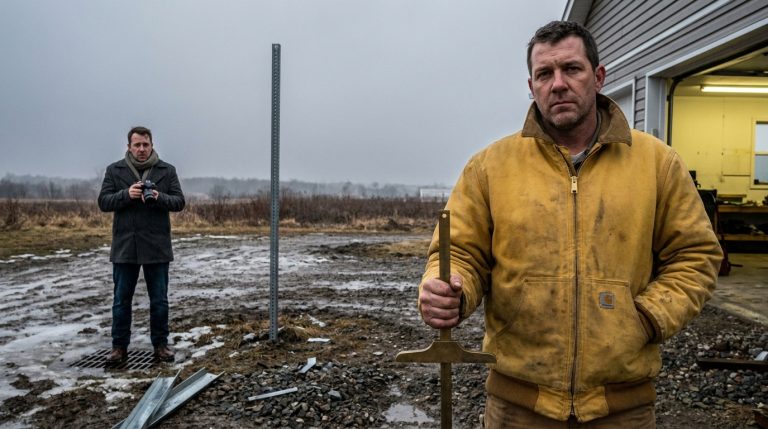
I stood in the driveway, my boots grounded on the cracked asphalt, staring at the patch of grass Karen Peterson had desecrated. The trench was sloppy, a raw wound in the manicured suburban green. She held the bolt cutters like a trophy, the yellow handles vibrant against the dull evening sky.
“Mr. Miller,” she said, her voice dripping with that particular, grating condescension that only people with too much time and too much authority can muster. “Common area aesthetics are not a suggestion. This aerial monstrosity was a violation of every covenant we stand for. Consider this a corrective measure.”
I didn’t answer immediately. My pulse was a steady, metronomic beat in my ears—a technique I’d learned in Fallujah to keep the adrenaline from spiking into panic. I looked at the severed line. The insulation had peeled back, exposing the braided copper, glinting like rusted veins in the twilight. She’d done more than cut a cable; she’d cut the throat of my transition to civilian life.
My gaze shifted to her hands. The bolt cutters were high-torque. She couldn’t have operated them with such precision without having practiced the leverage point or, more likely, having consulted with someone who knew exactly where the line entered the workshop. The realization hit me then: this wasn’t an act of impulse. It was an act of engineering.
“You’ve miscalculated, Karen,” I said, my voice intentionally flat, devoid of the heat she was fishing for.
She smirked, a tight, thin-lipped movement that didn’t reach her eyes. “I’ve enforced the standards of Oak Creek. You’re welcome.”
I pulled my phone from my pocket. My movements were slow, deliberate. I wasn’t just calling for help; I was documenting the crime scene. As the screen illuminated my face, I saw her confidence waver for a fraction of a second, just enough to catch the flicker of doubt. She expected a shouting match. She expected a neighbor to scream, to wave fists, to lose control.
She wasn’t prepared for a man who had spent two decades assessing infrastructure damage for a living. I looked at the trench, then back at her. The dirt she had dug up was dark, damp—the perfect conductor for the 200-amp charge she had risked creating. She was standing in a hazard she was too ignorant to understand, and her ignorance was my leverage.
“The power company is already on notice,” I lied, the fabrication smooth and authoritative. “And the county sheriff’s department is documenting the damage. By the time the crew arrives to secure this, you’ll be holding the liability for a felony act of infrastructure sabotage.”
Her smugness didn’t vanish, but it cracked. The weight of the bolt cutters suddenly seemed to pull at her shoulders. She looked down at them, then back at me, searching for the fear she usually inspired. Finding none, she turned to walk away, her steps just a little less purposeful than they had been moments ago.
I watched her go, the cold iron of the garage door looming behind me. I had twenty thousand dollars in equipment inside that dark building and a mounting pile of legal obligations to my clients. I was tired, and I was angry, but mostly, I was focused. The garage wasn’t just a workspace; it was the foundation. And if someone was going to tear it down, they’d better be prepared for the structure they were about to collapse on top of themselves.
As the first distant wail of a siren began to bleed into the quiet suburban air, I realized the real problem wasn’t the severed line. It was the fact that I hadn’t yet seen the person who had told Karen exactly where to cut.
CHAPTER 2: The First Trench
The siren arrived not with the urgency of an emergency, but with the hollow, piercing quality of an omen. It pulled the neighbors from their homes like ghosts, faces appearing in window frames and doorways—a neighborhood watch suddenly confronted by a scene that didn’t fit their manicured reality. They weren’t looking for a broken sprinkler head; they were looking at a man, a woman, and the visceral proof of a border being crossed.
I didn’t turn to look at them. My world had narrowed to the three-foot radius of that trench. The damp soil, turned over by Karen’s reckless haste, smelled of wet clay and rotted roots. It was an offensive, organic smell that clashed with the sharp, electric tang of the severed conduit.
Karen didn’t move. She stood rigid, her hands still curled into the yellow rubberized grips of the bolt cutters. The arrival of the patrol cruiser had frozen her in a state of high-functioning delusion, her eyes darting from me to the flashing red and blue lights that washed over the manicured lawns. She was waiting for the officer to approach her, to recognize the authority of her muumuu and her clipboard, to validate her as the neighborhood steward.
“Officer,” she started, her voice a shrill, strained note that skipped over the ambient hum of the cruiser’s engine. “I’m glad you’re here. This man—”
“Ma’am, keep your hands where I can see them,” the officer said. He was younger than I expected, with a posture that suggested he was still trying to balance official procedure with the reality of a suburban dispute. He didn’t come to her. He came to the middle ground.
I kept my hands visible, relaxed at my sides. My mind, however, was already running a tactical diagnostic. I wasn’t just observing the trench; I was visualizing the survey map I had memorized. I knew where the easement lay. I knew the exact depth at which the contractor had buried that line back in ’78. Karen had dug a shallow, amateurish cut, but she had hit the line with surgical efficiency. That wasn’t just luck. She had been pointed to this specific spot by someone who knew the infrastructure.
The psychological phantom of the desert hit me then—the static, high-frequency hum of a radio check before a long, dangerous patrol. It was the same feeling: the sudden, crushing clarity of knowing you were being targeted, but not yet seeing the shooter. I scanned the faces of the neighbors gathered at the periphery. Mr. Henderson. Mrs. Gable. A younger man, Tom, who looked more curious than concerned. They were spectators, but one of them might be a scout.
“Mr. Miller,” the officer addressed me, stepping over the edge of the trench without touching the exposed wires. “Is this line active?”
“It’s a three-phase two-hundred-amp service, Officer,” I replied, my voice measured. I didn’t raise it. “The breaker is likely tripped at the substation, but you treat every wire like a live snake until a certified technician puts a wand on it. The hazard here isn’t just the power; it’s the lack of oversight. She didn’t just break a wire. She destroyed critical infrastructure located within a registered utility easement.”
Karen let out a sharp, indignant breath, the sound of a woman realizing her script wasn’t being followed. “It’s common area! It’s on the grass strip!”
“It’s recorded with the county, Karen,” I said, finally turning to face her. The look on her face was a masterpiece of controlled rage. She looked at the officer, then at the neighbors who were now inching closer, their phones recording. “The documents are in my file. I suggest you stop speaking.”
The officer looked down at the bolt cutters. His expression shifted from official curiosity to professional concern. He saw what I saw: not a gardening tool, but a blunt instrument of destruction. He took a step back, pulling his radio from his shoulder.
“I need a supervisor and a utility responder to 120 Oak,” he reported, his voice crisp. “Possible criminal mischief, high-voltage potential.”
The atmosphere in the street thickened. The neighbors were murmuring now, the sound rising like the wind before a storm. I looked at the dark silhouette of my garage—my shop, my livelihood, my transition—and felt a cold, hard resolve settle in my chest. If this was how she wanted to wage the war, I wouldn’t fight her with muumuus and clipboards. I would fight her with engineering and attrition.
I reached into my pocket and touched the corner of the laminated survey map. It was a small, thin rectangle of plastic, but in this suburban theater of the absurd, it was the most powerful weapon I owned. I wouldn’t just fix the line; I would secure the entire perimeter. I looked at the officer, who was now keeping Karen at a safe distance from the trench.
“Officer,” I said, catching his eye. “I have the plat maps and the survey documentation in my home office. I can provide copies for your report.”
“Stay right there, sir,” he said.
I didn’t move. I stood in the growing dark, watching the red lights cycle against the siding of my home. I was in a defensive position, but a defensive position that was already starting to look like a trap. I just needed to see who triggered the next move.
CHAPTER 3: The Paper Siege
The patrol car’s red and blue lights pulsed against the darkened garage door, casting rhythmic, strobing shadows that made the heavy metal look like it was breathing. Officer Miller—no relation, though he shared the same crisp, professional weariness—was scribbling notes into a spiral-bound pad. Karen was now seated in the back of his cruiser, her face pressed against the glass like a disgruntled ornament.
I didn’t watch her. I watched the trench.
As the officer worked, I paced the edge of the grass strip. My boots crunched on the disturbed earth, the soil still tacky with the dampness of the evening. That was when I saw it. Tucked into the soft mud near the edge of the utility easement—a place where no rational landscaper would have bothered to tread—was a thin, wooden survey stake, painted a faded, flaking neon orange. It wasn’t the standard county marker. It was a makeshift flag, weathered and slightly bent, pointing toward the very center of the trench.
I leaned down, pretending to inspect the depth of the cut. My fingers grazed the wood. It was buried deep enough to have been placed weeks ago. Someone hadn’t just cut the line on impulse; they had staked the path of the conduit for her to follow. My blood temperature dropped. This wasn’t just a neighborly feud. This was a targeted strike against a specific, measured piece of infrastructure.
“Sir?” The officer stood behind me, his pen hovering over his pad. “I’ve got the preliminary report down. Damage to property, unauthorized interference with utility service. The power company technician is ten minutes out. Once they secure the line, you’ll have a case file number.”
“Thank you, Officer,” I said, rising slowly. I didn’t mention the stake. I needed to know if it was an outlier or if the entire property line had been mapped by someone else’s hand. “I’ll have those county records ready for you when you’re back around.”
“Expect a follow-up from the detective,” he added, glancing toward the cruiser. “She’s claiming the line was a public safety hazard. It’s going to be a long night for her.”
As the cruiser finally pulled away, tires crunching on the gravel, the silence of the neighborhood returned, but it felt hollow, charged with a new, static energy. The house was quiet. Sarah was inside, holding the kids, keeping the world at bay, but I couldn’t face her yet. I walked to the side of the workshop and sat on the rusted metal threshold, the cold biting through my jeans.
The next morning, the war began in earnest, but it didn’t come with bolt cutters. It arrived with the post.
I found the envelope tucked under my wiper blade at 7:00 a.m. It was a thick, cream-colored document with the official seal of the Oak Creek Homeowners Association embossed in heavy, pressed ink. I opened it right there in the driveway. It wasn’t a bill. It was a formal Notice of Violation, detailing an “Unapproved Modification to Common Area Infrastructure.”
The fine was absurd: one hundred dollars a day, retroactive to the previous week, for the presence of the “unauthorized conduit” that had been there since 1978. It was a bureaucratic maneuver so brazen it almost commanded respect. They were trying to redefine the physical reality of my property on paper, hoping that if they cited it enough, it would become the truth.
I didn’t yell. I didn’t throw the paper. I went into my home office and cleared the desk. I laid out three clean, yellow-tabbed binders.
I spent the next four hours crafting the response. I didn’t use emotion. I used the language of the enemy: the Covenants, Conditions, and Restrictions. I pulled the state property code, the county records for the utility easement, and the original permit history of the house. I cross-referenced every paragraph of their violation notice against the binding legal reality of the easement.
By noon, I had a twelve-page document, stapled, copied, and indexed. It was a counter-strike, but it was only the first shot. As I reached for my coffee, the phone rang. It was an unknown number, but I answered with a clinical, “Frank Miller, speaking.”
“Mr. Miller,” a voice said—a woman’s voice, sharp and professional, the tone of a litigator who charged by the minute. “This is Carol Thatcher. I’m the HOA secretary. We received your request for an informal hearing regarding your violation. The board has reviewed your file and decided that your presence at the hearing is unnecessary. We’ve decided to uphold the fine.”
I felt the familiar, cold stillness of a pre-patrol check. “Ms. Thatcher, the bylaws clearly state that a member has the right to present evidence at a formal hearing. Denying me that right is a breach of the governing contract.”
“The board has discretion,” she snapped, a hint of genuine irritation cracking her polished veneer. “And the board has decided. If you wish to contest it further, you may file a formal grievance with the board of directors, which we will address at our next closed-door executive session in thirty days.”
“I see,” I said, my voice dangerously calm. “Then I’ll look forward to that meeting. And for the record, Ms. Thatcher, consider this a formal notice that I am documenting every correspondence, every fine, and every procedural irregularity from this point forward. I suggest you do the same.”
I hung up before she could respond. I didn’t need to hear her reaction. I knew what I was looking at now. It wasn’t just Karen. Karen was the blunt instrument, but the board—Thatcher, the others—they were the ones holding the ledger, trying to balance the books with my life as the currency.
I stood up and walked to the window. The neighborhood was quiet, but I looked at the street with different eyes. I wasn’t just a homeowner anymore. I was a man operating in a territory that had been mapped for sabotage. Every perfectly manicured lawn, every well-placed hedge, every neighbor passing by—they were all potential data points in a siege I had only just realized I was losing.
I looked at the binders on my desk, then back at the workshop. I needed more than legal arguments. I needed to find out who had planted that orange stake. I needed to follow the trail of the survey, and if the paper trail didn’t lead to the truth, I was going to have to do some digging of my own.
CHAPTER 4: The Friction Point
I didn’t move from the desk. The silence in the house had become a physical weight, pressing against the window panes, heavy with the knowledge that I was no longer playing their game—I was being played. Carol Thatcher’s voice—smooth, practiced, and utterly dismissive—still hung in the air like ozone before a lightning strike. She hadn’t just denied me a hearing; she had effectively told me that the law, at least the version of it written in the HOA’s three-ring binder, was a closed loop.
I stood up, the chair scraping sharply against the hardwood floor. My office, once a place of planning and professional transition, now felt like a forward operating base under siege. I walked to the window and looked out at the neighborhood. Oak Creek Estates. It looked like a postcard: the manicured lawns, the pristine driveways, the uniform trees. But through the lens of the last forty-eight hours, the cracks were becoming visible. A trash can left on the curb at the wrong hour, a missing picket on a fence, a neighbor looking too quickly away as they drove past my driveway. It was a pattern of micro-aggressions, a steady, rhythmic drip designed to erode.
I left the house without speaking to Sarah. I didn’t want to explain the fear I saw, not in my own reflection, but in the calculated precision of the HOA’s next move. I walked across the lawn to the workshop, my boots sinking slightly into the damp earth near the trench. I knelt by the orange stake again, pulling it from the mud. It was just wood, painted bright, aggressive neon, but the bottom was sharp—honed to a point, not by a machine, but by a hand-held blade. A laborer’s mark.
I looked toward the back of the property, where the wooded common area met the edge of my utility easement. That was where the line of sight ran. If you were a surveyor, or a developer looking to maximize acreage, that was the corridor. It was a straight shot to the main arterial road. My workshop was the only physical obstacle in the way.
I didn’t go inside to work on metal. I went to the back corner of the workshop, where I kept the transit level and the survey tapes I’d used to verify the original plot lines. I needed to know if the HOA had been doing their own private survey, and I needed to know why they were so desperate to define the easement as “common area.”
As I set the transit level on the edge of the easement, I saw a movement in the peripheral. It was Dave, my neighbor. He was walking his golden retriever, his gait slow and deliberate. He stopped near the fence line, looking toward the common area. He didn’t look at me, but he stopped for a long time, watching the treeline.
I walked over to the fence, my movements tactical, unhurried. “Morning, Dave,” I said.
He jumped, just slightly. He turned, his face tight. “Hey, Frank. Just… out for a walk.” He looked back at the woods, then down at his dog. “You know, they’ve been doing a lot of work back there lately. Strange work. Not landscaping. They’ve been out with clipboards, talking to men in unmarked trucks.”
“What kind of trucks?”
“The kind that don’t belong in a residential subdivision,” Dave whispered, glancing toward the street. “Big, heavy trucks. Surveying equipment. I heard Karen talking to someone last week. She sounded… ecstatic. Like she’d finally hit the jackpot.”
The friction point had been identified. It wasn’t just the power line. It was the land itself.
“Dave,” I said, leaning closer to the fence, “if you see them again—those trucks—don’t confront them. Just record the license plates and the time. We aren’t just fighting a fine anymore. We’re fighting a land grab.”
Dave nodded, a flicker of something dark and hardened appearing in his eyes. He understood. He had served; he knew the look of a perimeter being probed.
I returned to the workshop, but I didn’t turn on the lights. I sat in the darkness, the scent of cold, rusted iron and damp grit surrounding me. I began to map the neighborhood in my mind, overlaying the HOA’s petty violations with the geography of the land. The violation notices for “improperly stored materials,” the fines for “landscaping discrepancies”—they weren’t about the neighborhood. They were about clearing the sightlines. They were about making people so frustrated, so desperate to avoid conflict, that they would pack up and move, leaving their property ripe for a bulk acquisition.
I picked up the orange stake. It was a tool, yes, but it was also a message. They were arrogant enough to believe I wouldn’t see it, or perhaps, they were arrogant enough to believe that even if I did, I couldn’t stop it.
The phone in my pocket vibrated. An email from the county clerk’s office—a notification regarding the property assessment records I had requested days ago. I opened it, the blue light of the screen illuminating the workshop’s shadows. The documents were attached. I started to scroll, my eyes moving with the efficiency of a scanner.
There, in a sub-folder of the zoning adjustments, was a line item that stopped my breath: Proposed Rezoning: Oak Creek Common Area – Access Infrastructure Corridor.
I hadn’t just found a mistake in their paperwork. I had found the heart of the machine. They hadn’t just bypassed the board; they had bypassed the homeowners entirely. They were planning to build an access road for a development that didn’t exist yet, using the very ground I stood on as the foundation.
I felt the adrenaline begin to rise, not as panic, but as a cold, steady current. I reached for my notebook and began to write. I needed names. I needed the name of the firm. I needed the name of the contractor who had been clearing the trees in the common area. I wasn’t just defending my workshop anymore; I was preparing to dismantle an entire organization from the inside out.
The friction had generated heat, and in the darkness of the workshop, that heat was turning into a blueprint for a counter-offensive that would leave nothing of their authority standing.
CHAPTER 5: The Midpoint Revelation
I didn’t turn away from the screen. The flickering blue light cast long, jagged shadows against the piles of raw steel and half-finished fabrication work in the corners of the workshop. The document—the zoning application—sat there, pristine and terrifying in its bureaucratic simplicity. It was a roadmap to my destruction, laid out in neat, professional columns. Karen had been busy. Beneath the layers of HOA ordinances and petty violation notices, she had been building a commercial bypass right through the heart of the community, and my property was the primary obstruction.
The sound of tires on gravel stopped abruptly. It wasn’t the heavy, industrial growl of the survey trucks Dave had warned me about; it was the lighter, more precise deceleration of a sedan. I stood up, moving with the practiced silence of a man who spent his life working in close quarters, and eased toward the side entrance of the garage. I didn’t look through the window—too much reflection. I moved to the gap between the siding and the frame, peering out through the sliver of space.
A city car. White, with the municipal seal of the county on the door. A man in a high-vis vest and a hard hat was already stepping out, a clipboard in hand. He wasn’t looking at the neighborhood houses. He was looking at his own watch, his gaze fixed on the utility easement where the trench still lay open.
The realization hit me with the force of a physical blow. They weren’t waiting for the rezoning to be approved; they were moving to justify it through “emergency infrastructure repairs.” If they could force a municipal intervention, they could claim the easement was compromised, condemn the power line, and bypass the entire HOA voting process. Karen hadn’t just sabotaged my power—she had initiated a state of emergency.
I turned back to my desk, my mind shifting into high-gear. If I confronted him now, I’d be labeled an obstructionist. If I ignored him, he’d find whatever “flaw” they’d paid him to discover. I looked at the transit level on the bench, then back at the door. I needed to see what he was looking for before he found it.
I slipped out the back, moving through the shadows of the overgrown hedge that bordered the common area. The damp, cool air felt heavy, saturated with the metallic scent of an approaching storm. I reached the edge of the easement, keeping low, my boots making no sound on the saturated mulch. The inspector was standing right over the trench, the very spot where the neon orange stake had been. He was crouching, his hands hovering over the broken conduit as if he were waiting for it to reveal a secret.
He pulled a camera from his belt, the flash illuminating the interior of the trench in short, sharp bursts. He wasn’t taking photos of the damage. He was taking photos of the depth measurements—of the way the pipe connected to the main service line.
I waited, my patience a steel wire pulled taut. He stood up, sighed, and made a note on his clipboard. Then, he pulled a phone from his pocket, his thumb moving with a familiarity that suggested he wasn’t calling the county office.
“It’s confirmed,” he said, his voice carrying clearly in the stagnant air. “The conduit is aged, and the recent disturbance has exposed it to the subsurface water table. It’s a total failure. You can move forward with the emergency condemnation as soon as the permit is pulled tomorrow.”
He hung up, oblivious to the fact that he was standing twenty feet away from the man who owned the land. He reached into his truck, pulled out a stack of bright, yellow “Condemned” placards, and began to lay them out on the hood of his car.
My heart hammered against my ribs, not from fear, but from the raw, cold recognition of the threat. They weren’t just going to fine me into submission; they were going to declare my entire workspace a hazard to the community. They were going to seal the garage, condemn the building, and strip me of the one thing that kept my family afloat.
I had to move. If he walked into that workshop with those placards, the game was over before it began. I didn’t reach for a weapon; I reached for the one thing he didn’t expect: the truth.
I stepped out from behind the hedge, my posture relaxed, my voice carrying that same, dry professional weight I’d used to command crews under fire. “Looking for something specific, Inspector?”
He jumped, his hand instinctively going to his hip, though he had nothing there but a pen. He turned, his face flushing a mottled, defensive red. “You’re Miller?”
“I am,” I said, walking toward him, my hands clearly visible at my sides. I didn’t stop until I was within three feet of him—a distance that forced him to look up at me. “And I’m curious why you’re inspecting a private, permitted utility service without the owner’s notification or the proper county paperwork in hand.”
He blinked, his arrogance wavering. “I’m here on an emergency report. Public hazard.”
“An emergency report filed by whom?” I pressed, my voice dropping an octave. “Because the property survey on file with the county—the one signed, sealed, and recorded—shows this entire easement is private, grandfathered, and completely within code. If you’re here to condemn it based on the words of an HOA board that is currently under criminal investigation for destruction of property, then you’re not an inspector, sir. You’re an accessory.”
The word hung in the air, heavy and sharp. He went pale. He looked at the placards on his hood, then back at me. The bravado he had carried just moments ago was eroding, replaced by the panicked realization that he had stepped into a minefield he hadn’t been trained to navigate.
“I’m just doing my job,” he stammered, reaching for his clipboard.
“Your job is to follow the law,” I said, reaching into my jacket and pulling out the binder I’d prepared. I didn’t open it. I just held it, the weight of the documentation a physical argument he couldn’t refute. “And the law says that before you condemn anything on this property, you have to serve a notice to the owner and wait for the appeal period. If you put one of those stickers on my building today, you’ll be the first person I name in the lawsuit I’m filing tomorrow morning.”
He looked at me, his eyes searching for a crack in my resolve. He found none. He looked at the trench, then at the house, the weight of his own miscalculation pressing down on him. Slowly, agonizingly slowly, he reached for the yellow placards on his hood and turned them over.
“I… I think I need to review the file,” he muttered, his voice barely audible over the sudden, distant roll of thunder.
He didn’t argue. He didn’t defend the board. He simply got back into his car, the engine turning over with a sharp, impatient growl, and pulled away.
I stood in the driveway, the rain beginning to fall—great, fat drops that hit the dry earth with the sound of incoming fire. I hadn’t won the war, but I’d won the skirmish. I knew now exactly how they intended to play it: they were going to leverage the city, they were going to weaponize the municipal code, and they were going to try to turn my own home into a liability.
I looked at the workshop. It was safe for another day, but the friction was mounting. I knew who was behind the call to the city, and I knew what they were planning next. They were going to push, and if I pushed back, they would eventually have to reveal the source of their power—the developer, the money, and the true, ugly face of the secret deal that had cost me my peace.
I went inside, the rain now a steady, driving curtain. I had the documents. I had the proof. But as I sat in the dark, I knew that the real challenge wasn’t the board. It was the fact that I was now operating in a territory where the rules were no longer the ones written in the books. I had to get ahead of them, and for that, I needed more than just binders. I needed the full, unvarnished truth.
CHAPTER 6: The Alliance of Scars
The rain had stopped, leaving the neighborhood draped in a heavy, unnatural mist that muffled the sound of the world beyond my driveway. I stood in the doorway of the workshop, the smell of damp earth and cooling steel filling my lungs. The victory against the inspector felt hollow now. It was a stay of execution, not a pardon. I looked at the street, and for the first time, I noticed the absence: no neighbors were out walking their dogs. No kids were playing in the driveways. The silence wasn’t the peace of a quiet evening; it was the suffocating stillness of a quarantine.
I walked to the house, my movements calculated and spare. I needed to build the coalition I had planned, but the barrier wasn’t just physical anymore—it was psychological. Every neighbor was terrified of being the next one to receive a violation notice.
I didn’t go to the front door. I went around the back, through the wet grass of the common area, moving toward the shadows of the mature oaks that lined the Gable property. Mrs. Gable was sitting on her back porch, a thin wool blanket wrapped around her shoulders. She was staring at her rose bushes, the petals sodden and bowed by the rain.
“Mrs. Gable?” I spoke softly, my voice barely above the rustle of the leaves.
She turned, startled, her hand flying to her chest. When she saw me, her expression softened, but the fear remained in the corners of her eyes. “Frank. You shouldn’t be here. They… they’ve been watching the houses near yours.”
“Who, Mrs. Gable?”
“The men,” she whispered, her eyes darting toward the street. “The ones who were here last week, surveying. They’ve been talking to Carol and Patricia. They’re telling everyone that the HOA is going to be dissolved and that we’re all going to be evicted if we don’t agree to the new ‘community transition plan’.”
I felt a cold, hard knot form in my gut. The “transition plan”—it was the final piece of the puzzle. They weren’t just rezoning the land; they were planning a forced liquidation. They were going to buy out the entire subdivision under the guise of an “emergency” infrastructure rebuild.
“They aren’t going to dissolve the HOA, Mrs. Gable,” I said, stepping onto the edge of the porch. “They’re going to leverage it to steal your equity.”
She looked at me, her face pale, her hands trembling. I saw the struggle behind her eyes—the desire for peace, the fear of the unknown, and the realization that the life she had built in this house was being auctioned off by people she had once trusted.
“I have the proof,” I said, reaching into my jacket. I pulled out the printed document of the zoning application I’d downloaded earlier. “Look at this. This isn’t a community plan. This is a developer’s prospectus. They’re planning to bulldoze this entire block.”
She took the paper, her eyes scanning the lines with a sudden, sharp clarity. Her face went slack as she recognized the name of the parcel—the very land her home sat on. The rose bushes, the memories, the history—all of it reduced to a line item in a balance sheet. She didn’t cry. Instead, she looked up at me, a new, harder light in her eyes.
“What do we do?” she asked, her voice steady.
“We stop being victims,” I replied. “I’m going to Dave’s next. We need to document everything. Every threat, every forced compliance, every lie they’ve told. If they think they can intimidate us into silence, they’ve picked the wrong neighborhood.”
I left her porch and moved toward Dave’s house, moving through the deep shadows of the treeline. The damp air felt like a shroud. I saw Dave’s garage light flick on and off—three short pulses. A signal. I reached his side door, and he opened it immediately, ushering me into the dark, cluttered interior.
Dave was sitting at a workbench covered in aviation schematics, but he had a scanner running, the static hiss of radio frequencies filling the room. He didn’t look up. “They’re using encrypted channels, Frank. But I caught a ping off their survey trucks earlier. They’re meeting at Carol’s house tonight. The whole board. With the developer.”
“When?”
“In twenty minutes,” Dave said, finally looking at me. His face was set, a mask of grim determination. “They think they’re safe behind closed doors. They think this is just business.”
I looked at the schematics on his table, then back at him. “It is business, Dave. But it’s the kind of business that leaves a mark.”
We spent the next ten minutes mapping out the entry. Not for a break-in—that would just give them the leverage they needed to call the police—but for a confrontation. We didn’t need to break in. We just needed to be seen.
As we walked back out into the rain, the mist swirling around us, I realized that we were the only ones who knew what was coming. The entire neighborhood was asleep, unaware that their property, their futures, were being carved up in a living room three doors away. I felt the weight of my military training, the cold, analytical focus that had carried me through so much, and I realized that this was the final, critical push. We were outnumbered, we were operating under the cover of darkness, and we were facing an enemy that had already prepared for our resistance.
But as I reached the edge of Carol Thatcher’s driveway, I saw the sleek, expensive black sedan parked prominently near the front door. The developer. The man who thought he could buy the future of Oak Creek with a few well-placed bribes.
I looked at Dave. He nodded once, his hand resting on the small flashlight in his pocket. We were ready. The paper siege was over. Now, we were going to bring the truth out of the shadows, no matter what it cost to break the lock on their door.
CHAPTER 7: The Cafeteria Siege
The door didn’t swing open with a bang; it glided on well-oiled hinges, revealing an entryway illuminated by the clinical, artificial glow of high-end recessed lighting. Carol Thatcher stood in the foyer, but she wasn’t alone. Behind her, the living room was a hive of quiet, predatory efficiency. Tables were covered in large-format architectural blueprints, their edges weighed down by heavy brass fixtures. The developer, a man in a sharp, slate-gray suit that looked entirely too expensive for this neighborhood, was leaning over a map, a pen held between his fingers like a scalpel.
They hadn’t expected us. The sight of Dave and me, sodden from the rain and standing on the threshold, froze the room.
“You’re trespassing,” Carol said, though her voice lacked the usual sting of her authority. She looked at the developer, her eyes pleading for a cue he wasn’t about to give.
I didn’t wait for an invitation. I stepped across the threshold, my boots leaving dark, gritty prints on the pristine hardwood. The smell of the room was intoxicatingly clean—sandalwood and expensive paper—a jarring contrast to the damp, metallic air of the street. I walked straight to the table. I didn’t reach for my files. I didn’t reach for the evidence. I simply placed my hands on the blueprints, right over the center of my property line.
“This,” I said, my voice quiet, “is a construction plan for an arterial access road. It runs through a registered utility easement. It requires the demolition of three separate properties, including my own, and it hasn’t been put to a single vote of the homeowners.”
The developer looked up. He didn’t blink. He had the face of a man who looked at the world in terms of assets and liabilities, and I was clearly being filed in the latter. “Mr. Miller. I’ve heard quite a lot about you. You’re a very dedicated man. It’s a shame your dedication is being misspent on a project that is, quite frankly, inevitable.”
“Inevitable?” I repeated, my gaze locking onto his. “According to who? The county board? Because I’ve checked their filings. This rezoning hasn’t even hit the planning commission. You’re pre-selling the neighborhood, piece by piece, before you even own the dirt.”
He smiled—a thin, practiced expression that held no warmth. “We own the process, Mr. Miller. Your HOA board, in its infinite wisdom, has already entered into a Memorandum of Understanding. We have the capital, the legal clearance, and the support of the very people who write the bylaws you seem so fond of citing.”
Carol took a step forward, her confidence returning as she took cover behind his composure. “It’s for the greater good, Frank. We’re upgrading the infrastructure. We’re creating value.”
“You’re creating a liquidation,” I countered, my eyes moving to the ledger on the table. It was open to a page showing payout structures—”relocation assistance” that wouldn’t cover the cost of a mortgage, let alone the value of the homes they were planning to tear down.
Dave, standing beside me, pulled a small digital recorder from his pocket and set it on the table. The click was loud in the silence. “You might want to repeat that about the Memorandum of Understanding,” Dave said, his voice hard. “The county records office is going to find it very interesting that the board signed away common property without a member vote. That’s not just a breach of contract; that’s a felony.”
The developer’s smile faltered. For the first time, he looked at Dave, then back at me. He realized that this wasn’t an emotional outburst—it was a coordinated, tactical breach.
“You think you can stop this?” the developer asked, leaning forward, his voice dropping to a whisper. “You have no leverage. You’re a retired veteran in a house that’s already been slated for demolition. The city inspector has already cleared the easement for condemnation. You’re finished.”
I didn’t step back. I leaned into his space, the proximity forcing him to hold his breath. “You’re right about one thing. I am a veteran. And I spent twenty years learning how to identify a structure that’s been built on a false foundation. You think this HOA is your asset? It’s your liability. Every single document they signed, every illegal fine they levied, every piece of property they tried to steal—it’s all being compiled. And tomorrow morning, when the regional planning commission opens their doors, they’re going to find a folder on their desk that will halt this project, revoke your permits, and place every single person in this room under a state investigation.”
The silence that followed was absolute. Carol looked at the developer, her face draining of color. The developer, however, didn’t move. He stood there, his eyes scanning mine, searching for the bluff.
“You don’t have that,” he said, though there was a tremor of doubt in his voice now.
“I have more than that,” I replied. “I have the entire neighborhood.”
As if on cue, the sound of car doors began to slam outside. One after another. A low, rhythmic murmur began to rise from the street—the sound of dozens of people, not just my small group, but the families from Oak Creek Estates, walking toward the house. They weren’t shouting. They weren’t running. They were simply walking, a slow, inevitable tide of homeowners reclaiming their territory.
The developer looked to the window, his composure shattering. He saw them—the elderly widow, the young father, the veterans—filling the driveway, their faces illuminated by the amber glow of the streetlights. They were a collective, a force that no amount of money could buy and no amount of bureaucracy could silence.
He reached for the blueprints, but I placed my hand firmly over them. “These stay here,” I said. “They’re evidence.”
He stared at me, then at the mob outside. He realized, in that moment, that the deal was dead. Not because of a law, not because of a permit, but because the foundation of his entire project had been exposed. He turned and walked toward the back door, leaving the ledger, the blueprints, and Carol Thatcher behind.
I didn’t follow him. I didn’t need to. He was already a ghost.
I looked at Carol. She was staring at the closed door, the reality of her betrayal finally settling over her like a shroud. She had sold the neighborhood for a piece of paper, and now, she was left with nothing but the silence.
I turned to Dave. “Open the door,” I said.
As the door swung open, the sound of the neighborhood rushed in—the voices, the collective breath, the power of a community that had finally found its voice. It wasn’t a riot; it was a realization. The reign of the HOA was over, and the long, slow work of restoring what was broken was about to begin.
CHAPTER 8: The Aftermath of Iron
The transition from the roar of the crowd to the quiet of the foyer was instantaneous, a decompression of pressure that left my ears ringing. Carol Thatcher was still standing by the window, her hands pressed against the cold glass. She looked small, diminished, the arrogance that had once defined her presence now replaced by the vacant stare of a woman who had bet everything on a failing horse.
I didn’t move. I let the silence stretch. I had my documents, I had my witnesses, and I had the neighborhood at my back. But victory in this kind of war was never a clean sweep; it was a process of sorting through the debris.
“The police are on their way, Carol,” I said, my voice low and steady. “They have the statements, the ledger, and the evidence of the illegal rezoning. You can either stay here and wait for them, or you can start explaining how much of this was your idea.”
She turned slowly. Her face was a mosaic of fractured confidence. “He said… he said it was for the community. He promised that the HOA would be funded for twenty years. He said we wouldn’t have to worry about the maintenance, the fines, the… the noise.”
“He sold you a lie, Carol,” I said. “And you sold them out for it.”
I walked past her, toward the table. I picked up the ledger and the blueprints. These were the keys to the truth—the physical architecture of the deception. I didn’t feel triumph. I felt only a grim, professional satisfaction. I had identified the threat, I had traced the supply line, and I had cut the support structure. The mission was complete.
The next few hours were a blur of flashing lights and official statements. Detective Russo arrived, his expression reflecting the gravity of the haul. He took the ledger, the blueprints, and the recorded evidence with the clinical efficiency of a man who dealt in the currency of crime. He didn’t ask questions. He didn’t need to. The documentation told the entire story.
By the time the last cruiser pulled away, the neighborhood was beginning to settle. The mist had returned, turning the streetlights into hazy orbs of amber, casting long, melancholy shadows across the driveways. I walked back toward my house, the weight of the metal binders in my arms feeling like armor.
When I reached my driveway, I stopped. The trench was still there, an open scar in the earth, but the repair crew was already scheduled for the morning. I looked at the workshop—my garage, my sanctuary. The lights were off, but I could see the outline of the heavy machinery inside, the tools of my trade standing like silent sentinels in the dark.
Sarah was standing on the porch, her silhouette framed by the warm glow from the house. She didn’t speak as I walked up the steps. She just waited, her presence a quiet, steadying force.
“Is it done?” she asked.
“It’s done,” I replied.
I set the binders down on the porch, the heavy thud of the metal covers sounding final in the cool night air. I looked out over the neighborhood. Everything looked the same, but the geometry of the community had fundamentally shifted. We were no longer a collection of isolated households managed by an invisible, punitive authority. We were a collective. We were a system that had been tested, found the structural weakness, and reinforced the foundation.
The denouement wasn’t a party. It was the long, quiet process of settling back into the rhythm of daily life. In the weeks that followed, the legal proceedings began to grind the remaining pieces of the scheme into dust. The developer’s company folded under the weight of the investigation, the rezoning application was formally revoked, and the land was permanently deeded to the HOA as a protected green space.
The restitution began to flow back—not just the cost of my power line, but the misappropriated dues, the inflated contract fees, the stolen equity. But the true resolution wasn’t in the numbers. It was in the neighborhood.
I spent a Saturday morning with Dave and the kids, planting a small grove of trees in the center of what was now Liberty Park. I took a piece of stainless steel, plasma-cut with the coordinates of the plot and the names of the families who had signed the petition, and I welded it to a stone pedestal at the trailhead. It was simple, durable, and built to last.
As I finished, my hands calloused and stained with the residue of the work, I felt a familiar, grounding sensation. I looked at the steel—the way the light caught the brushed surface, the precision of the cuts. It was good work. It was honest work.
I walked back to the workshop, the sun warm on my shoulders. I took a piece of scrap metal and began to work on a repair for a neighbor’s gate, the familiar rhythm of the grinder and the welder filling the air. My business was thriving now, the commissions steady and the reputation for integrity firmly established.
I thought about the binders, the late nights, and the cold, hard fight for the truth. It had cost me time, it had cost me stress, and it had forced me to confront the reality of the community I had chosen to join. But standing there, the hum of the lathe vibrating through my boots, I knew that I had built something far more stable than a power line. I had built a legacy of resilience.
I turned off the machine, the silence returning to the shop—not the dead, unnerving silence of a sabotage, but the peaceful, productive silence of a job done right. I took a slow breath, the air smelling of clean oil and ozone. The mission was over. The neighborhood was secure. And for the first time since I’d arrived, I was home.