A Calculated Descent: The Cold Physics of Gravity, Legal Warfare, and the Price of Vanity
CHAPTER 1: THE WEIGHT OF PAPER
The kitchen in my cedar home was quiet, save for the rhythmic drumming of Pacific Northwest rain against the windowpane—a sound I had spent twenty years listening to, interpreting like a heartbeat. In my hand, the letter from Vanessa Caldwell felt like a piece of grit in a gear.
“Visually inconsistent,” I whispered, the words tasting like copper.
I looked through the kitchen window. Beyond the glass, the retaining wall stood firm, a dark, jagged rib of railroad ties holding back eighteen tons of saturated clay. To her, it was an offense to her infinity pool’s horizon line. To the land, it was the only thing stopping a catastrophe.
I set the letter down on the scarred wood of the table. I didn’t reach for the phone to call her, and I didn’t storm outside to shout at the fence. My mind moved to the filing cabinet in the corner of my shop. Every permit, every engineering survey, every document detailing the stability of this specific grade was filed away with surgical precision.
The silence in the room was absolute, save for the rain. My wife was already asleep, oblivious to the fact that our neighbor was currently drafting a blueprint for disaster.
I stood up, the chair scraping sharply against the linoleum. My hands felt steady. If Vanessa wanted to play a game of aesthetics versus gravity, I wouldn’t stop her. I would simply facilitate the lesson. I walked to the counter, pulled out a fresh notepad, and began to draft a response—not a defense, but a receipt. I wasn’t just going to answer her; I was going to ensure that every word she wrote from this point forward was a nail in her own coffin.
I checked the clock. 2:14 AM. The rain picked up, a sudden, violent surge that rattled the roof. I leaned against the counter, closing my eyes, listening to the soil groan against the pressure. It was time to start documenting the slow motion of a collapse that hadn’t even begun yet. I wasn’t fighting for the wall anymore; I was preparing for the aftermath.
My phone buzzed on the counter—a notification from the HOA portal. Another demand, this one cc’d to the board. I didn’t even open it. I knew exactly what it said. I picked up my pen, the weight of the moment pressing down with the same crushing force as the hillside.
The game had started, and she had already made the first move toward the edge.
CHAPTER 2: THE ARCHITECTURE OF COMPLIANCE
The next morning, the sun didn’t bring warmth; it brought a flat, clinical light that made the dust motes dancing in my office look like debris suspended in a vacuum. I didn’t head to the job site. Instead, I drove to the city, the heavy, oily smell of the railroad ties still clinging to my truck’s upholstery.
Greg Foster’s office was located in a brick building that smelled of expensive espresso and old paper. The walls were lined with law books that had likely never been cracked, and the air conditioning was set to a temperature that felt like a surgical theater. Greg sat behind a mahogany desk, his face a mask of practiced indifference. He was a man who understood that in this town, the loudest person usually lost, while the person with the most organized paperwork held the keys to the kingdom.
“She’s pushing,” I said, placing the folder on his desk. It was thick, containing the engineer’s report from David Morales and the printed threads of my previous communications with the HOA.
Greg opened the folder, his fingers moving with a slow, rhythmic grace. He didn’t look at me. He looked at the paper, his eyes tracing the lines as if he were reading a blueprint for a demolition. “She’s not just pushing, Luke. She’s assuming you’re the kind of person who fears the threat of a fine more than the threat of a landslide.”
“She thinks the view from her infinity pool is a constitutional right,” I replied, my voice steady.
“And she has the HOA charter to back up her aesthetic crusade,” Greg added, leaning back. The leather of his chair creaked—a dry, sharp sound. “You want to fight? We fight. But we don’t fight by shouting. We fight by giving her exactly what she’s demanding, provided she signs the liability waiver that shifts the gravity of this entire situation onto the association’s ledger.”
I watched his face. He wasn’t talking about winning a skirmish. He was talking about engineering a failure. I realized then that my attorney and I were cut from the same cloth; we viewed the world as a system of pressures, and we knew exactly where to place the fulcrum.
“If we give her the order to remove it,” I asked, “does she have to acknowledge the engineering report?”
“She has to acknowledge receipt,” Greg said, tapping his fountain pen against the blotter. “Once she’s been formally warned by a licensed engineer, and she proceeds to authorize the removal anyway, she is no longer an HOA president exercising design authority. She becomes the primary architect of the subsequent property damage. The logic is as cold as the law itself.”
I looked at the window. Outside, a woman in a suit walked briskly toward a sleek, black sedan. She was focused on her phone, entirely unaware of the chaos that could be unleashed by a single, unchecked calculation. For a moment, my own reflection in the glass looked like a stranger—sharpened, narrowed, stripped of the neighborhood-friendly facade I’d worn for decades. I felt the weight of my tools in the truck outside, but they felt different now. They weren’t just instruments for landscaping; they were variables in a grander equation of cause and effect.
“Do it,” I said.
Greg nodded and began to type. The rhythmic clack of the keys sounded like a ticking clock. I watched the screen, seeing the words form the trap. It was clean. It was professional. It was entirely, devastatingly legal.
When he finished, he printed the document. It was a formal request for the HOA to confirm the order of removal, citing the specific design aesthetic of the community over the structural concerns of the hillside.
“Send this,” Greg said, sliding it across the mahogany. “When she signs this, she’s not just approving a construction project. She’s signing a confession.”
I walked out of the office and into the sterile, bright air of the city street. The world looked different through the lens of the last twenty-four hours. Every structure I passed—the tall glass towers, the retaining walls holding back the highway embankments, the foundations of the homes—seemed fragile. I realized that my own life had been built on a series of tacit agreements: you keep the land stable, and I’ll ignore the aesthetics. Vanessa Caldwell had broken that agreement.
I reached my truck and sat behind the wheel, staring at the document in my hand. It was just paper, but it felt heavy, vibrating with the potential energy of a thousand tons of sliding earth. I didn’t feel guilty. I felt the cold, hard satisfaction of a technician who has finally identified the flaw in the design. I turned the key, the engine roaring to life, and drove back toward the hills. I had to make sure the trap was set exactly right before the first rains of autumn arrived.
CHAPTER 3: THE MIRROR MATCH
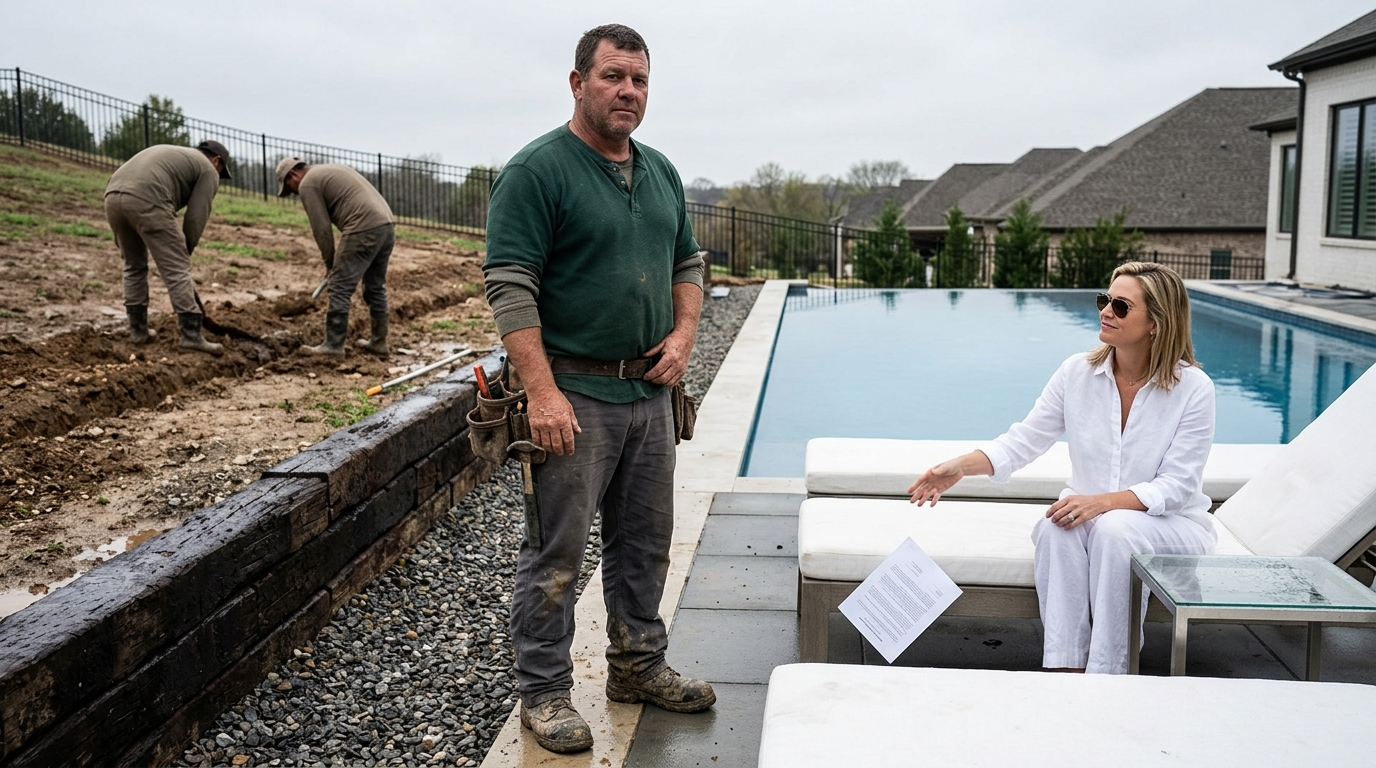
I pulled the truck to the curb at the end of the cul-de-sac. The air was crisp, carrying the scent of damp earth and the faint, chemical bite of chlorinated water—a smell that had become synonymous with Vanessa’s presence in the neighborhood. Down the street, the infinity pool shimmered, its water a crystalline blue that seemed entirely alien against the darkening, sloped earth of the hillside.
I didn’t step out of the truck immediately. I watched. Vanessa was out on the deck again, dressed in crisp white linen that looked impossible to maintain in a place surrounded by red clay and pine needles. She was directing two men who were installing a new row of landscape lighting along the edge of her property—right where the slope met the patio. They were digging shallow trenches, slicing through the root systems of the native ground cover that held the hillside together.
Every movement they made was a breach. Every shovel of dirt removed was a subtraction from the stability of the entire grade.
I stepped out of the truck, the gravel crunching under my boots—a sound that was lost in the whir of the drill. As I walked down the driveway, I felt the familiar weight of the folder tucked under my arm. It was the same folder I had sat with in Greg’s office, the same folder that turned this landscape project into a legal minefield.
Vanessa saw me. She didn’t flinch. She adjusted her sunglasses, a small, practiced motion, and waved the workers to pause. She walked toward me with that same smooth, gliding pace, her posture radiating an absolute, unshakeable confidence in her own authority.
“Luke,” she said, her voice bright, almost musical. “I hope you’re here to tell me you’ve finally found a contractor who can provide something more… contemporary than those railroad ties.”
I stopped a few feet from the edge of her patio. The blue water of the pool was perfectly still, reflecting the sky like a mirror. “I’m here because you’re disturbing the grade, Vanessa. You’re cutting into the toe of the slope.”
She let out a small, indulgent laugh. “It’s a light fixture, Luke. Not a foundation.” She gestured toward the hill. “And that wall… it’s an eyesore. It belongs in a scrapyard, not in a residential neighborhood. I’ve already filed the formal request with the HOA. You’ll be receiving the notice to vacate the structure within forty-eight hours.”
I held her gaze. I didn’t get angry. I didn’t raise my voice. I looked at the men working, then back at her. The contrast was startling: she was worried about light placement; I was looking at the way the mud was beginning to weep from the slope above us, even on a day as dry as this.
“You’re an architect, Vanessa,” I said, keeping my voice low, transactional. “You know that a slope isn’t just a surface. It’s a dynamic, moving system.”
“I know that I don’t pay association dues to look at rotting black timber,” she countered, her smile tightening. “I want a landscape that reflects the value of the homes here. If you can’t provide that, then the association will find someone who can.”
I reached into the folder and pulled out the document Greg had prepared. I didn’t hand it to her yet. I held it between us, a thin, white barrier of paper. “This document clarifies the responsibility for the wall. It’s an acknowledgment of the existing structural engineering and a formal waiver of liability. If you move forward with the forced removal of the wall, the HOA—and you, as the board president—are assuming full responsibility for the structural integrity of this hillside.”
She looked at the paper, then back at me. She didn’t take it. She just flicked her wrist, dismissing it as if it were a bill for something she’d already paid. “I don’t need to sign anything to uphold design standards. The bylaws are very clear.”
“They are,” I said, “but the physics of a landslide aren’t governed by bylaws.”
I stepped forward and placed the document on the small glass table next to her pool lounger. It looked stark against the expensive, modern furniture. “Read it, Vanessa. Before you start digging any more trenches. I’m not saying no. I’m saying if you want it gone, you need to sign off on the fact that you were warned of the consequences.”
She looked at the document, a flicker of irritation crossing her face. For the first time, her confidence wavered, if only for a fraction of a second. She reached out, not to take the paper, but to brush it off the table with a flick of her hand. It fluttered to the patio stones.
“You’re trying to scare me with engineering jargon, Luke. It’s beneath you,” she said, her voice dropping a register, becoming colder, sharper. “Remove the wall, or expect a lien on your property by the end of the month.”
She turned her back to me and gestured for the workers to continue. As I walked back to my truck, I didn’t look back at the pool or the beautiful, terrifyingly fragile slope. I had the confirmation I needed. She hadn’t read the paper, but she had dismissed the warning in front of witnesses.
The trap wasn’t just set; it had been double-locked. I climbed into my truck, the silence of the engine now punctuated only by the distant, rhythmic drill of the workers cutting into the hill. I started the engine and drove away, leaving her to her lights, her pool, and her vanity, perfectly oblivious to the weight of the mountain waiting for permission to move.
CHAPTER 4: THE EXCAVATION OF EGO
The hydraulic arm of the excavator shuddered, a long, metallic whine that vibrated through the frame of the machine and up into my teeth. I sat in the cab, the smell of diesel and damp pine needles thick in the air. Below me, the hillside was already beginning to look like a surgical site. Three railroad ties were out, stacked neatly on the grass like tombstones for a landscape that no longer existed.
Marty, my neighbor, was standing near the property line, his arms crossed over his chest, watching the work with a look of seasoned concern. He didn’t speak—he didn’t have to. The look on his face said everything. He knew what that wall did. He knew why I had spent two decades keeping it reinforced.
“You really going through with this, Luke?” he called out, his voice barely audible over the idling engine.
I didn’t answer him immediately. I shifted the control, nudging the bucket of the excavator into the soft, yielding soil behind the fourth timber. The machine bucked, the weight of the hill pressing against the bucket with a force that was almost alive. This wasn’t just dirt; it was the accumulated pressure of twenty years of rainfall, captured in the dark, peaty depths of this specific Oregon grade.
“It’s not my wall anymore, Marty,” I said, my voice tight. “It’s hers. The board approved it. Everything is on record.”
I pulled the lever, and with a sickening, wet crack, the fourth railroad tie broke free from the earth. The soil behind it shifted instantly, a small, controlled cascade of dark brown silt spilling into the gap I had just created. It was the first breath of the hill, a slow, inevitable exhalation of pressure.
Vanessa was there. I saw her silhouette through the glass of the cab. She had stepped out onto her patio again, a glass of something clear and sparkling in her hand. She stood there, watching, and for a moment, our eyes met. She wasn’t just watching the work; she was savoring the demolition. She thought she was watching a craftsman remove an eyesore. She didn’t realize she was watching the removal of the only thing keeping the world from collapsing on top of her.
Suddenly, the excavator’s boom shuddered. The hydraulic line hissed, a sharp, piercing sound, and the arm dipped, losing pressure for a heartbeat. I slammed the emergency kill switch, the engine dying instantly. The silence that rushed into the gap was heavy, immediate.
I climbed out of the cab, my boots sinking into the soft, unstable earth. My gloves were caked in thick, red clay—the same clay that would, in less than a week, reclaim the lower lot. I walked over to the hydraulic coupling. A seal had blown. It was a failure of the machine, a minor, irritating setback, but in the grand, chaotic architecture of this moment, it felt like an omen.
Vanessa had moved closer to the edge of her property. She called out, “Is there a problem? We’re on a schedule, Luke.”
I looked up at her, my face a mask of deliberate, studied calm. I was covered in the very filth she found so offensive. I held up the torn hydraulic seal, letting the black fluid drip onto the grass. “The machine is tired, Vanessa. It’s been pushed too hard, too long.”
“Then fix it,” she said, her tone devoid of any empathy. “I’ve cleared my calendar for the rest of the week. I want the wall gone by Friday.”
I didn’t argue. I didn’t offer an excuse. I simply looked at the hill—at the way the earth was already sagging into the void where the ties used to be. The instability was visible now, a gentle, downward slope that hadn’t been there an hour ago. To her, it was just progress. To me, it was a countdown.
I went back to my truck and pulled out my tool kit. My hands were steady. Every movement was calculated, precise. I wasn’t just fixing a machine; I was preparing for the final act. I realized then that I didn’t need to hurry. The weather forecast was clear—heavy, sustained rain starting in less than five days. The physics were already in motion. All I had to do was stand back and let the hill finish the work she had started.
I looked at the house below. The neighbors were beginning to notice, their curtains twitching, lights flickering on in mid-afternoon. They felt the tension, too—the uneasy, creeping sensation that the stability of the entire hillside had just been compromised. I grabbed a wrench and turned back to the excavator. The work was only halfway done, and the most important, most dangerous phase of the demolition was about to begin.
CHAPTER 5: THE RAINS JUDGMENT
The storm didn’t arrive with a flourish; it arrived with a low, oppressive bruise of a sky that seemed to settle directly onto the roof of my house. I sat in my shop, staring at the blueprints of the yard, the rain drumming against the cedar shingles above. It was 2:00 AM. The kind of hour where the world stops lying to itself.
The excavator sat idling in the driveway, a dark, hulking shadow against the wet pavement. I had completed the work. The wall was gone. The slope, stripped of its skeletal support of old railroad ties, was now nothing more than a saturated, exposed throat of clay and topsoil. It was waiting.
I walked to the back window. The yard was a black void, the rain turning the ground into a slick, treacherous mirror. I could feel the vibration of the earth before I heard it—a deep, seismic groan that resonated through the floorboards of the house. It was a sound I had feared for twenty years, and yet, standing there in the dark, I felt an almost transcendental calm.
I didn’t reach for my coat or my boots. I didn’t need to be out there. The outcome was no longer a matter of my labor or my intervention. It was a matter of basic, immutable physics.
The rumble grew, shifting from a low vibration to a heavy, tearing sound. It was the sound of a hillside losing its grip on reality. I watched through the window, my face illuminated by a sudden, jagged flash of lightning that cut across the sky.
The entire face of the slope gave way.
It wasn’t a landslide in the cinematic sense; it was a deluge. A massive, brown, heaving surge of mud, debris, and torn root systems. It moved with a slow, grinding inevitability, sweeping down toward the cul-de-sac. I watched as it reached the bottom, a wall of earth that slammed into the back of the homes below.
The sound was immense—a chaotic roar of breaking timber, shattered glass, and the dull, wet impact of sludge against foundation walls. I saw the lights in Vanessa’s home flicker and then vanish, plunging her carefully curated backyard into the absolute, drowning darkness of the slide.
I didn’t turn away. I didn’t look at my wife, who had appeared in the doorway behind me, her hand over her mouth. I watched the destruction with the detached, analytical focus of an engineer observing a load-bearing test.
The mud hit her pool with the force of a battering ram. The sleek, blue tiles, the expensive lighting fixtures, the pristine patio furniture—all of it was swallowed in a single, thick, brown wave. It looked like the earth was reclaiming what had been stolen from it.
The neighborhood went silent. The power grid must have gone down, the hum of the transformer at the end of the street dying with a final, sparking pop. Then, slowly, the human noise began: the sound of doors opening, the frantic, terrified shouts of neighbors, the erratic beams of flashlights cutting through the driving rain.
I walked to the kitchen and poured a glass of water. My hands were perfectly steady. I knew exactly what would happen next. The insurance adjusters would arrive. The liability waivers, signed by the HOA president, would be pulled from the files. The structural reality—the warnings I had documented, the permits I had secured—would become the narrative.
I looked at the kitchen table, where a single, final copy of the liability waiver lay undisturbed. It was just paper, but it held the weight of a ruined infinity pool and the shattered pride of a woman who thought she could redesign gravity.
The phone on the wall started to ring. I let it ring. I walked to the front door and opened it, stepping out into the cold, driving rain. The air smelled of wet stone and pulverized wood. It smelled like the end of a long, cold war. I looked down the hill toward the darkness where Vanessa’s property used to be. The slope was gone. The wall was gone. Everything was gone, and for the first time in twenty years, I felt like the land beneath my feet was finally at peace.
CHAPTER 6: THE ARCHITECTURE OF ACCOUNTABILITY
The morning after the slide was strangely, unnaturally bright. The sun pierced through the thin, shredded remains of the storm clouds, illuminating a landscape that looked like a surgical wound across the neighborhood. I walked down toward the cul-de-sac, my boots sinking into the semi-liquid mud that had buried the lower properties.
Vanessa was standing in the middle of what used to be her backyard. She was wearing a heavy, mud-caked raincoat, her designer sunglasses nowhere to be seen. Her face was pale, her expression stripped of its usual curated confidence, replaced by the hollow shock of a woman looking at the utter erasure of her investment. The infinity pool was a memory, filled with tons of wet, grey clay and shattered stone.
She saw me walking toward her. For a moment, the old flash of rage flickered in her eyes, but it died quickly. It didn’t have the fuel to burn anymore. She pointed a shaking finger at the ruin, then at me. “You knew,” she whispered, her voice cracking. “You knew this was going to happen.”
I didn’t answer with heat. I stood on the edge of the debris field, looking at the structural reality we had both created. I pulled the legal file from my jacket—the one containing the engineer’s warning and her signed demand for removal. It was still dry, protected by a waterproof sleeve.
“I didn’t know,” I said, my voice steady, stripped of any malice. “I warned you. There is a difference.”
“I’m going to sue you for every penny you have,” she said, though the threat lacked any real weight. It was a reflex, a desperate attempt to regain control in a situation that had entirely transcended her authority.
“Look at the paperwork, Vanessa,” I said, holding out the file. “The HOA board signed off on the removal. You personally signed the directive. You bypassed the engineer’s report. This wasn’t a tragedy of nature; it was a decision of the board.”
She stared at the file, then slowly reached out and took it. Her hands were trembling. As she leafed through the pages, the final reality of her situation began to sink in. She had tried to project an image of power, using the HOA as a blunt instrument to enforce her aesthetic, but she had failed to realize that power is only as strong as the foundation it rests upon. She hadn’t been fighting the neighbors; she had been fighting gravity, and she had ignored the experts who told her she couldn’t win.
She didn’t speak. She just sank down onto the edge of a shattered patio slab, the reality of the liability finally crushing her spirit. She was facing the absolute, inescapable downfall of her project, defeated not by my actions, but by the very documents she had forced me to produce.
The denouement came not in a shout, but in the arrival of the insurance adjusters and the county inspectors. They moved with the clinical indifference of professionals, marking the damage, photographing the slope, and asking for the permit history. When they saw the documentation I provided, their expressions shifted. They didn’t see a victim and a villain; they saw a liability trail that led directly back to the HOA’s boardroom.
I left her there, a broken figure in the mud, and walked back up the slope to my own property. I picked up a shovel—the same one I had used for decades—and began to clear the small drainage ditch that had been clogged by the slide’s runoff.
I worked for hours. The rhythmic, repetitive motion of the shovel was soothing, a meditation on the permanence of labor. By late afternoon, the water was flowing freely again, diverted away from the house, channeled into the stone culverts I had built years ago. It was a small, necessary repair, a symbolic closure to the chaos that had nearly swallowed the neighborhood.
I felt a presence behind me and turned to see my wife standing in the doorway, holding two cups of coffee. She didn’t say anything, she just walked over and handed me one. We stood together on the back porch, watching the sun set behind the trees. The hillside looked raw and scarred, a jagged gap in the landscape, but it was stable. It was holding.
“Is it over?” she asked quietly.
“For now,” I said, taking a sip of the coffee. It was hot, grounding.
I looked at the repaired drainage ditch, then back at the house below. The chaos of the slide was being managed, the legal machinery was grinding into gear, and the long, slow process of recovery was underway. I hadn’t sought this out. I had simply held the line, maintained the structure, and allowed the truth to reveal itself in the only language that mattered: the cold, hard weight of reality.
I reached out and took my wife’s hand. The air grew cold as the sun dipped below the horizon, but for the first time in months, the air felt clean. The vanity was gone. The fake, polished exterior of the neighborhood had been scrubbed away by the rain. What remained was the raw, honest, and utterly stubborn truth of the land itself. And that was enough.