The Rust and the Rulebook: A Calculated Dismantling of a Suburban Empire
CHAPTER 1: THE WALL
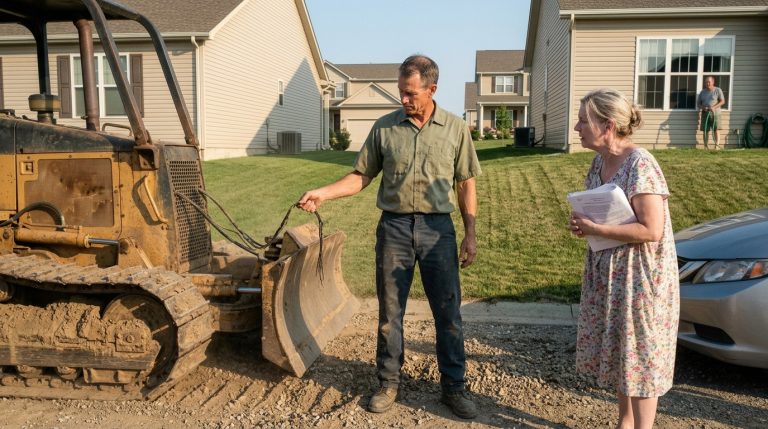
The Texas heat didn’t just sit on the landscape; it hammered it into submission. I sat in the cab of my F250, the leather seat sticky against my jeans, staring at the gray mound that now occupied the throat of my easement. It was twenty tons of industrial-grade gravel, dumped with such precision it blocked the five-foot wide entrance to my thirty acres as effectively as a barricade.
I watched Karen Peterson through the windshield. She was a woman constructed of beige polyester and iron-clad self-importance. She stopped ten feet from my bumper, the sunlight catching the harsh, violent pink of her lipstick. She held her clipboard against her chest, a shield of laminated rules and manufactured authority.
I killed the engine. The sudden silence was heavy, vibrating with the dry, rasping sound of cicadas hidden in the post oaks. I climbed down, my boots crunching on the loose edge of the gravel pile. The air smelled of hot diesel and dust—the smell of a project that had been bought, paid for, and intended to cause maximum friction.
“This is an official HOA sanctioned beautification project, Mr. Warren,” she said, her voice a grating symphony of condescension. She didn’t look at me; she looked past me, at the land she couldn’t control. “You should be thanking us for improving the aesthetic of your approach.”
I didn’t answer immediately. I walked to the edge of the pile and knelt, picking up a handful of the gray stone. It was sharp, freshly crushed, the kind of material used for heavy-duty industrial foundations, not residential landscaping. I rubbed it between my calloused thumb and forefinger, feeling the jagged edges, the cold, stubborn weight of it.
“This isn’t landscaping, Karen,” I said, my voice unnervingly quiet, stripped of the reflexive anger that usually surged in these moments. I looked up at her. She was waiting for a reaction—a shout, a surge of adrenaline, a mistake. “This is a blockade.”
She tightened her grip on the clipboard. Her eyes flickered toward the beige labyrinth of Oak Hollow behind her, a quick, almost nervous darting of the gaze that didn’t match her smug posture. She was waiting for someone to see, someone to applaud.
“The board has decided that this area needed… organization,” she countered, her voice rising to a shrill pitch. “Your unapproved traffic was damaging the visual integrity of the common area.”
I looked down at the gravel again, then up at the entrance of my property. I wasn’t fighting a neighbor; I was fighting an architect of petty chaos. I could feel the plan forming, a slow, methodical cooling of the blood. I wouldn’t move this pile with a shovel. I would move it with the law, piece by piece, until the structure she had built for herself didn’t just fall—it disintegrated.
I stood up, dusting the rock shards from my palms. I saw it then, tucked away in the shadows of the gravel pile’s base: a scrap of paper, likely blown from a dump truck’s work order, stuck to a piece of limestone. It bore a faded, unrecognizable insignia—not the local landscape company, but something else. A shell.
“The board has its own set of rules, Mr. Warren,” Karen said, tapping her clipboard with a manicured nail. “And it seems you’ve finally reached the end of them.”
“No, Karen,” I said, my gaze shifting from the scrap of paper to the horizon. “I think you’ve just provided the foundation for a much larger project.”
I turned my back on her, walking toward the cab of my truck to pull out the mobile documentation unit. I could hear her sputtering behind me, but the sound was already becoming background noise. The game hadn’t started yet, but the first move was already etched in the dust at my feet.
CHAPTER 2: THE PAPER TRAIL
The silence of the Texas plains always feels heavy, but today it was suffocating. I stood by the hood of my F250, the metal radiating a heat that blurred the horizon. Karen’s SUV was a white blot in the distance, shrinking as she retreated into the beige safety of her kingdom, but my focus remained locked on the scrap of paper in my hand.
The insignia wasn’t a local landscaper. It was a stylized, jagged letter—a ‘K’ intertwined with a geometric shape that looked suspiciously like a trowel. It was the mark of ‘K&P Contracting’, a name I’d never seen on any local registry, yet it appeared on a piece of paper meant to be nothing more than construction debris.
My mind suddenly pulled a sharp turn, a ghost from my time with the Corps. I was back in the dust of a site inspection, staring at a failed cantilever bridge. We’d found the same kind of discrepancy then—material specs that didn’t match the load-bearing requirements, all documented with forged signatures. The physical sensation of that failure—the way the concrete had shattered like glass—rattled through my nerves. The gravel at my feet was meant to block my road, but like that bridge, it was a structural lie.
I didn’t climb into the truck. I walked to the edge of the easement, my boots grinding into the parched earth. My property—the thirty acres I had bled to buy—was just past the pile. To anyone else, it was just land. To me, it was a precise, measured reality, a map I knew down to the last square inch of post oak and prairie grass.
I pulled my phone from my pocket and opened the county records portal. The screen was difficult to read under the glare of the noon sun, the light bouncing off the glass and into my eyes. I navigated to the Property Tax and Deed registry, my fingers moving with a rhythm born of habit. I started with the Oak Hollow development maps.
The data loaded, a cascade of dense, gray text and sprawling, digitized blue-line surveys. I began to pull the original land grant filings. The 1950s federal records were archived as high-resolution scans of yellowed, brittle paper. I zoomed in on the notary stamps, the surveyor’s signatures, the boundary markers defined by limestone cairns that likely hadn’t existed for sixty years.
I wasn’t looking for the road. I was looking for the chain of title.
The HOA’s authority depended on a clear, unbroken line of legal ownership over the common areas. They claimed the easement was theirs. But as I flipped through the digitized pages, the legal narrative began to fray. There was an amendment filed in 1964, a hastily scribbled note about a boundary adjustment that didn’t match the original coordinates in the federal grant. It was a slight shift, a matter of a few degrees, but in land law, that was the difference between a pristine border and a fatal flaw.
If the original grant was misfiled, the current survey maps were effectively built on top of a legal fiction. If the HOA didn’t legally own the ground beneath the common area they claimed to regulate, then their power to enforce ‘aesthetic covenants’ was a house of cards waiting for a breeze.
I felt a cold, jagged spike of satisfaction. I didn’t need to fight them in the court of public opinion. I needed to let their own legal foundation rot.
I moved to the next step, a calculated necessity. I needed to know if the gravel was just a nuisance or a symptom. I keyed in the name I’d seen on the scrap of paper: K&P Contracting. The search returned nothing in the active business directory. I widened the search to dormant or dissolved entities.
K&P Contracting popped up, a defunct LLC dissolved three years ago. The registered agent was Karen Peterson.
The logic of the blockade shifted. It wasn’t just spite. It was a transaction. She wasn’t just bullying me; she was funneling HOA “beautification” funds into her own pocket through a company that didn’t exist, using the gravel as a high-cost receipt. She was skimming, and she was doing it right in front of everyone.
I stood there for a long time, the heat shimmering off the gravel pile, looking at the screen. The dust of the road felt like grit in my throat. I had the initial thread. Now, I needed the spool.
I looked back at the beige houses, at the compliant, muted color scheme that defined the neighborhood. It all looked different now. It didn’t look like a community; it looked like a bank account. I tucked my phone away, my movements steady and deliberate. I had enough for the first round, but if I wanted to dismantle the structure, I needed to see how the rest of the board responded to the pressure.
I walked back to my truck. The engine turned over with a deep, authoritative roar that felt like a pulse in the quiet afternoon. I didn’t need to clear the gravel today. Today was for gathering, for measuring, and for letting the weight of her mistake settle into the foundations she thought she owned.
As I pulled the truck away from the blockade, I caught a glimpse of movement in one of the houses bordering the easement. A curtain fell back, a sliver of light vanishing as someone retreated from the window. They were watching. And the war was just beginning to find its rhythm.
CHAPTER 3: THE ARCHIVE OF ABUSE
I didn’t head home. I pulled the F250 into a secluded turnout about a mile down the county road, a spot where the heavy canopy of oaks obscured the truck from the main thoroughfare. The interior was cramped, the air thick with the smell of hot plastic and the faint, lingering scent of the diesel exhaust. I opened the laptop again, the screen’s light illuminating the interior of the cab in an eerie, pale blue.
The Oak Hollow board minutes were a slog—hundreds of pages of mind-numbing administrative minutia. Motions to approve mulch, votes on the frequency of street sweeping, complaints about the color of porch lights. To an outsider, it was a chronicle of nothing. To me, it was a record of escalation.
I started at the current year and began to scroll backward. I was looking for the inflection point, the moment the community’s governance curdled into a tool of personal dominion. The minutes were standard for the first two years. Then, I hit a meeting from thirty-six months ago. Karen Peterson was listed as the board secretary. There was a motion to increase the ‘compliance enforcement budget’ by four hundred percent.
I stopped, the cursor blinking at the edge of the line. The justification was vague: “To protect community aesthetic standards and property valuations.”
I continued to scroll. The budget wasn’t just for maintenance; it was for a new auditing process. They were hiring ‘external consultants’ to walk the neighborhood. I cross-referenced the consultant fees with the dates the violation notices spiked. The correlation was absolute. Every time a new audit was commissioned, the violation notices issued the following week jumped by forty percent.
I leaned back, the leather of the seat creaking in the stillness. I wasn’t reading minutes; I was reading a logistics report for a protection racket.
I pulled up the bank records I’d scraped earlier. The payments to ‘K&P Contracting’ mirrored the spikes in the enforcement budget almost perfectly. It was a closed loop. The HOA would levy fines for trivial infractions, the revenue would be allocated to ‘beautification,’ and the funds would be funneled through Karen’s shell company to pay for non-existent projects like the gravel I was currently facing.
The realization didn’t come with a shout, but with a dull, heavy thud in my chest. She wasn’t just a petty tyrant. She was a scavenger. She was feeding on the insecurity of her neighbors, and she was doing it with a level of bureaucratic efficiency that commanded a twisted sort of respect.
My stomach growled, a sharp, sudden reminder that I hadn’t eaten since dawn. I grabbed a canteen from the passenger seat, the metal cold and sweating condensation against my palm. I drank, the water tepid but refreshing. I needed to move. Staying in the truck was making me stagnant, and the stillness of the woods was starting to feel like a trap.
I knew the location of the community clubhouse—a small, nondescript building near the main entrance of Oak Hollow. It was where the board met, where the files were kept, and where the paper trail likely ended. If I wanted to prove the embezzlement, I needed more than just digitized bank transfers. I needed the physical receipts, the ones they were too arrogant to encrypt.
I packed the laptop, my movements practiced and silent. I didn’t reach for my keys immediately. I sat for a moment, letting my eyes adjust to the darkness outside the cab. The moonlight filtered through the leaves, casting long, fractured shadows across the dashboard.
The strategy was evolving. The gravel pile had been the hook, the bait that had forced her to reveal her hand. Now, I was moving into the structural demolition phase. I needed to know exactly how deep the corruption went. Was it just Karen, or had she infected the entire board?
I stepped out of the truck, the night air cooler, smelling of dry earth and impending rain. My boots hit the dirt with a muffled crunch. I started the trek toward the main road. I wouldn’t be walking through the front door of the clubhouse, but I would be visiting the perimeter.
Every step was a calculation. I avoided the asphalt, keeping to the shadows of the tree line where the rustle of leaves would mask my presence. My senses were dialed in—the distant, rhythmic chirp of crickets, the faint hum of a streetlamp down the road, the metallic tang of the distant drainage ditch.
I reached the edge of the Oak Hollow development and crouched behind a dense hedge of boxwood. From here, I had a clear view of the clubhouse. It was a quiet, unassuming structure, its beige exterior blending into the night. There were no lights on inside, but a single, security motion-sensor floodlight bathed the side entrance in a harsh, clinical glow.
I watched. And as I waited, I saw a light flicker in the window of a house across the street. The curtain moved. Someone was watching the clubhouse, too.
The neighborhood wasn’t as asleep as it looked. And someone else, somewhere behind those beige walls, was starting to realize that the empire wasn’t nearly as solid as it claimed to be. I took a deep breath, the air filling my lungs with the scent of mowed grass and the heavy, metallic promise of the truth I was about to unearth. The rust on the gears of this machine was finally starting to show.
CHAPTER 4: THE ARCHITECT OF DISSENT
George’s home, once I reached it, was a portrait of forced compliance. The exterior was manicured to the point of sterility, the lawn trimmed to a uniform height that suggested a resident obsessed with avoiding the next violation notice. I approached the side door—the one we’d used during the meeting—avoiding the front path where the motion-sensor light could catch me in its cold, unflattering glare.
I knocked in the cadence we’d agreed upon: two sharp taps, a pause, one long, firm thud.
The door opened almost instantly, George’s face a pale blur in the gloom of the kitchen. He was jittery, his hand shaking slightly as he gestured for me to enter. I slipped inside, the sudden drop in the temperature as I crossed the threshold into the air-conditioned interior making my skin prickle. He locked the door behind me with a series of clicks—a deadbolt, a chain, and a slide-bolt—that sounded too much like the closing of a cell door.
“You shouldn’t be here, Jack,” he whispered, his voice thin. “She’s got people watching. Not just the board members, but others. Neighbors who think they’re doing the right thing by reporting any ‘suspicious activity’.”
“I’m not here for a social call, George,” I said, my voice steady, grounding the frantic energy in the room. I walked to the kitchen island, placing my laptop down. “I found the link between the enforcement budget and K&P Contracting. It’s an embezzlement loop. She’s not just policing the neighborhood; she’s bleeding it.”
George leaned back against the counter, his breath hitching. He looked like a man who had been waiting for the other shoe to drop, and now that it had, he wasn’t sure he could handle the weight. He moved to the small breakfast nook and began to root through a stack of papers, his hands trembling. “I found something too. Something I didn’t understand until now.”
He pulled a small, heavy wooden box from beneath a pile of mail. It was a lockbox, the kind people use for passports or jewelry, but the lid was slightly warped, as if someone had tried to pry it open without the key. He set it on the table between us.
“I was doing some renovations,” George said, his eyes avoiding mine. “Pulling up the old parquet in the study. I found this tucked into the joists. It was left by the previous owner, the guy who sold to me just before the board tightened the grip.”
He flipped the lid. Inside wasn’t money or gold. It was a survey map. It was an original, un-redacted architectural survey from the 1950s, the paper thick, cream-colored, and brittle with age. I pulled it onto the table, my fingers tracing the ink. It was the same site plan I had scrutinized on the screen, but this one contained a series of hand-drawn annotations in red—a notation about the original boundary survey that contradicted the official county record.
It was the misfiling I had hypothesized, but here it was, documented in the surveyor’s own hand. The original developers had pushed the boundary of the Oak Hollow tract three hundred feet over the line, encompassing the roadbed that was rightfully part of the federal land grant. They had effectively built the entire neighborhood on a foundation of stolen dirt.
“If this is real,” George whispered, “then the entire HOA doesn’t just have a gravel problem. They have a land-rights problem.”
I looked at him, the gravity of it sinking in. “If this map is verified, the board doesn’t just lose the common areas. They could lose the neighborhood. It wouldn’t just be a civil issue. It would be a total title collapse.”
“She knows, doesn’t she?” George asked, his voice barely audible. “That’s why she’s so obsessed with ‘protecting’ the aesthetic. She’s not trying to keep the neighborhood nice; she’s trying to keep people from looking too closely at the survey lines. She’s keeping the community in a state of high-stress compliance so no one ever thinks to ask why their deeds aren’t matching the state records.”
I looked down at the map, then up at George. The air in the kitchen felt heavy, filled with the dust-mote weight of decades of lies. The embezzlement was just the tip of the spear; the structural flaw in the development itself was the core truth Karen was desperately burying.
“She’s terrified, George,” I said, my voice cold. “She’s protecting a fiction, and she’s used every penny she’s skimmed to keep that fiction afloat. But a fiction like this—it doesn’t need to be destroyed. It just needs to be seen.”
I reached out and placed my hand over the map. My pulse was a steady, rhythmic thrumming in my fingertips. I didn’t need to do anything illegal. I didn’t need to break into her house or expose her life in the streets. I just needed to let the truth do the work. The system was rigged, yes, but even a rigged system has to obey the laws of physics. And once the foundation begins to shift, the structure is guaranteed to follow.
George stared at the map, his fear slowly being replaced by a grim, hard-edged resolve. The tapping of his fingers on the table slowed, then stopped. “What’s the next move?”
“We don’t take it to the board,” I said, pulling my phone out to begin documenting the map. “We take it to the county clerk. And then, we let the federal inspectors see exactly what they’re actually standing on.”
I could see it now. The beige houses, the off-white doors, the manicured lawns—all of it perched precariously on a lie that was about to be corrected. The rust was already working its way through the gears. I was just there to make sure the machine eventually stopped.
CHAPTER 5: THE WEIGHT OF THE STORM
The rain didn’t start with a drizzle. It arrived like a physical weight, a curtain of gray water that hammered the earth and turned the dry, baked soil of the outskirts into a slick, treacherous slurry. I navigated the F250 down the county road, my headlights struggling to cut through the deluge. The wipers were working at maximum capacity, a frantic, rhythmic scraping that couldn’t keep up with the volume of water sheeting over the glass.
I had the map. It was tucked into a heavy-duty document tube on the passenger seat, protected from the moisture that now threatened to turn the entire region into a basin. My goal was the county courthouse in the heart of the district, but the storm was turning the rural roads into navigational hazards. Every low-lying spot had already pooled into a potential trap.
I hit a patch of water on a bend near the creek—the same creek that fed the protected watershed I’d reported earlier—and the truck lurched, the tires losing their bite on the saturated asphalt for a fraction of a second. I corrected, my hands gripping the wheel with practiced, military discipline, feeling the vehicle stabilize. The hydroplaning was a sharp, metallic reminder: the system wasn’t just built on a lie; it was physically fragile.
My phone buzzed in the cradle—a notification from the weather service, a flash flood warning for the entire county. The creek was rising.
The irony wasn’t lost on me. Karen’s illegal gravel pile had been a direct threat to the local ecosystem, and now the very environment she had been tampering with was turning against the roads themselves. If the county access roads washed out, I’d be effectively trapped. I pressed the accelerator, pushing the truck through the rising mist. I needed to reach the clerk’s office before the administrative gears ground to a halt.
As I drove, my thoughts shifted back to the embezzlement loop. The map was the final nail, but I needed the bureaucratic seal to make it stick. I had to ensure that the document reached the records office, that it was stamped, filed, and effectively made public record. Once it was in the system, it couldn’t be ‘lost’ or ‘misplaced’ by someone on the board.
The road ahead was partially obscured by a downed oak branch, its leaves shivering in the wind. I slowed, the truck’s engine grumbling as I maneuvered around the debris. The storm was intensifying, the lightning flashing in long, jagged arcs that lit up the sodden fields in a stark, blinding white. In those brief flashes, I saw the subdivision of Oak Hollow in the distance, its beige houses looking like tombstones in the deluge.
I felt a sudden, sharp spike of apprehension. If the storm hit hard enough, if the infrastructure failed, the board would have the perfect excuse to lock down the area. They’d claim ’emergency maintenance’ to block off the roads entirely, citing public safety. It was exactly the kind of move Karen would make—using a natural disaster to fortify her bureaucratic defenses.
I reached the turnoff for the county seat. The intersection was flooded, the water creeping over the curb, but it was still navigable. I pushed the F250 through, the water splashing high against the undercarriage, the scent of churned-up sediment and wet iron filling the cab.
My tactical advantage was closing, the window of opportunity shrinking with every minute of rainfall. The plan had been to coordinate the move, but the storm was forcing my hand. I had to reach the clerk’s office now. If I waited, I’d lose the chance to present the evidence while the authorities were still reacting to the initial reports from the EPA and DOT.
The courthouse appeared through the mist, a solid, stone-and-brick structure that had survived a century of these storms. I pulled into the lot, the asphalt slick and mirroring the dark, bruised sky. I didn’t rush out of the truck. I sat for a moment, the rain drumming a chaotic, thunderous beat on the roof.
I was about to change everything. I wasn’t just a homeowner in a dispute anymore; I was an agent of systemic correction. I grabbed the tube, my coat collar turned up against the wind, and stepped out. The water was already ankle-deep in the parking lot. The storm was relentless, a force of nature that cared nothing for HOA covenants or property values.
I walked toward the side entrance of the clerk’s office, the weight of the tube in my hand feeling substantial, a heavy, cold anchor of reality. I wasn’t scared of the storm. I was the one who had brought the lightning. And as I reached the heavy glass doors, I knew that whatever happened inside, the myth of Oak Hollow was about to be washed away, layer by layer, until there was nothing left but the truth beneath the dirt.
CHAPTER 6: THE PETERSON PARK TRAP
The clerk was an older man with spectacles perched precariously on the end of his nose and a demeanor that suggested he had seen every kind of disaster this county had to offer. He watched as I crossed the lobby, my boots leaving dark, gritty trails of sediment on the polished floor. I didn’t stop for an apology. I walked straight to the counter, pulled the tube from my soaked coat, and extracted the original survey.
The paper was damp, but the ink remained sharp. I laid it out, flattening the edges with a firm, decisive stroke of my palm.
“I need this filed and cross-referenced with the 1950s federal land grant,” I said, my voice cutting through the hum of the office’s air conditioning. “It’s a corrective filing. It invalidates the current boundary markers for the Oak Hollow development.”
The clerk looked at the map, then at me. He didn’t move. “Sir, that’s a complex request. You’d need an attorney’s signature, a formal survey stamp, and a formal petition to the board of equalization.”
“I have the documentation,” I said, sliding the copies of the bank transfers and the K&P Contracting shell entity profile across the counter. “And I think you’ll find that the board of equalization might be interested in why the current boundaries were established by a now-defunct entity registered to the president of the HOA.”
He hesitated, his gaze lingering on the red-inked annotations on the map. He recognized the significance—the handwriting of the original surveyor was distinct, a legacy marker that couldn’t be forged. He pulled a pair of tweezers from his desk and carefully turned a corner of the map to check the watermark.
Outside, the storm shrieked, a gust of wind rattling the heavy exterior glass, but inside, the only sound was the slow, rhythmic ticking of a wall clock. The clerk’s expression shifted from bureaucratic boredom to a quiet, wary alertness. He knew he was looking at the end of a long-standing suburban legend.
“If I process this,” he said quietly, his voice barely rising above the hum of the office lights, “it triggers an automatic title audit. It freezes all property transactions and construction permits in that tract until the boundary dispute is resolved.”
“That’s exactly what I’m asking for,” I replied.
As he began to type, I stood back and scanned the lobby. Every shadow cast by the fluorescent fixtures seemed to lengthen, taking on the shape of a threat. I couldn’t shake the feeling that Karen wouldn’t let this go without a counter-move. She had leveraged the HOA to build her empire; she wouldn’t let the county clerk dismantle it with a few keystrokes.
Then, my phone vibrated. It was a text from George: They’re at the clubhouse. Peterson and two others. They’re tearing down the ‘Peterson Park’ sign and burning files in the parking lot.
I felt a surge of cold, calculated clarity. She wasn’t fighting back; she was purging the records. She knew the title audit was coming, and she was destroying the remaining paper trail before the agents could arrive. The ‘beautification’ project had been a front, and now the front was being incinerated in the rain.
“Keep going,” I told the clerk, my voice hard. “Don’t let them stall you. File it now.”
He nodded, his keystrokes quickening. He wasn’t just filing a document; he was pulling the floorboards out from under the entire Oak Hollow HOA. I walked to the glass door, watching the storm swirl in the parking lot. The destruction of the records was an admission of guilt, a desperate, final act of a woman who realized the rules had shifted.
I checked the time. The federal agents were scheduled for the morning. If I could get the county to lock the title before then, she wouldn’t just be facing fines; she would be facing the forfeiture of the land itself.
The clerk spun the monitor around. “It’s logged. The audit starts at sunrise.”
I turned away from the glass. The storm had done its job—it had cleared the way, forcing everyone to act before they were ready. I headed for the exit. I still had one more stop to make: the clubhouse, to see what else was being fed into the fire. I wouldn’t stop her from burning her past, but I wanted to be there when she realized she’d burned the only bridge she had left to the future.
CHAPTER 7: THE COLLAPSE
The drive from the courthouse to the Oak Hollow clubhouse was a race against the inevitable. I didn’t hold back; the F250 cut through the standing water like a wake, the tires throwing arcs of dirty spray that obscured the streetlights. My mind was a steel-trap of causality: the filing of the audit meant the records had to disappear now. Karen wasn’t just burning files; she was burning the evidence of the shell company transfers and the ARC approval forgeries.
As I pulled onto the access road, the scene in the clubhouse parking lot was frantic. The orange glow I’d seen from the courthouse was a literal bonfire—a trashcan-sized pit fueled by reams of paper, the wind whipping embers across the wet pavement. Karen stood by the edge of the pit, her floral pantsuit stained with soot, her movements jagged and uncoordinated as she shoved thick folders into the flames.
She looked small, diminished, the arrogance of the board president stripped away by the raw, primitive need to destroy. She wasn’t holding her clipboard anymore. Her hands were raw, red from the heat and the struggle.
I pulled the truck onto the grass, the headlights cutting through the smoke. The heavy roar of the diesel engine, idling at high revs, caused her to freeze. She looked up, her face a mask of panic, the smoke smearing black lines across her cheeks. She didn’t try to run. She simply stood there, a folder half-thrust into the fire, the corner of it curling and blackening.
I stepped out of the truck, the rain-slicked air hitting me with a wall of acrid, chemical-laden smoke. I didn’t run. I walked, my pace slow and deliberate, the heavy, measured cadence of a man who knew exactly how this ended.
“It’s already done, Karen,” I said, my voice cutting through the hiss of the rain against the flames. “The title audit is filed. The county has everything. That fire isn’t destroying anything but your own history.”
She stared at me, her eyes wide, glassy with the intensity of her breakdown. She dropped the folder, her fingers trembling as she pulled them back from the heat. The flames licked up, consuming the remaining pages, the history of her enforcement actions, the fake ARC approvals, the records of the shell company payments—all of it turning into gray, weightless ash that the storm swirled into the dark.
“You don’t understand,” she shrieked, the sound cracking, a desperate, pathetic noise that was lost in the thunder. “I had to keep the standards! I had to! They didn’t know what they were buying! They were destroying the value with their… their lack of discipline!”
“You weren’t keeping standards,” I replied, standing only a few feet from the pit. “You were stealing a future that wasn’t yours to sell. You were building on stolen land, Karen. Even if you burned every page in that clubhouse, the deeds in the county archives remain.”
She collapsed then, sinking to her knees on the wet, oily pavement near the fire. The rain hit the asphalt, steam rising in ghostly plumes around her. She looked broken, the fight leaking out of her like blood from a wound. The arrogance, the clipboard, the sense of absolute dominion—it had all evaporated. She was just a woman in a ruined suit, huddled in the rain, watching the smoke of her own downfall.
Behind her, the clubhouse doors stood open, the interior dark and emptied of its records. The entire edifice of her authority was gone. I stood over her, not with triumph, but with the cold, clear exhaustion of a mission concluded. I had expected a fight, a final, clever counter-move, but this—this pathetic, burning collapse—was the only way it could ever end. She had fought reality, and reality had broken her.
“The agents will be here in the morning,” I said, my voice flat. I didn’t feel the need for words of consolation. There were none. “You should start thinking about what you’re going to tell them.”
I turned back to the truck. The fire was dying down, the rain finally overpowering the heat. The parking lot was silent, save for the patter of the storm and the ragged, sobbing breaths of the woman on the ground. I felt no satisfaction, only a quiet, heavy relief. The foundation was exposed, the audit was locked, and the machine that had been crushing the neighborhood was finally, irrevocably dead. I left her there in the dark, the smoldering ash of her empire the only thing left of the Oak Hollow HOA’s absolute power.
CHAPTER 8: THE QUIET AFTER
The dawn didn’t break; it bled across the horizon, a slow, gray light that washed the landscape in neutral tones. I stood at the edge of the Oak Hollow tract, the ground beneath my boots saturated and heavy. The storm had left behind a world that felt scrubbed clean, stripped of the manicured artifice that had defined the last several months.
I walked toward the gate of my own property, the place where it all began—the blockade, the gravel, the manufactured conflict. The gate was a heavy, wrought-iron structure I had built myself, its hinges rusted from the humidity and neglect. It had been twisted by the dump truck that had dropped the gravel, the steel warped just enough to make the latch grind against the post.
I reached into my truck and pulled out a heavy-duty wrench and a tub of lithium grease. I began the work. It was slow, manual labor—the kind that demanded nothing but focus and muscle. I adjusted the hinges, the metal groaning under the pressure of the wrench, the resistance of the steel a satisfying, physical manifestation of the order I was restoring.
As I worked, I watched the neighborhood stir. People were coming out onto their porches, looking at the clubhouse, at the soot-stained parking lot, at the empty space where the ‘Peterson Park’ sign had stood only a day ago. They weren’t looking at me. They were looking at their own homes, seeing them for the first time without the lens of the covenants.
Frank, the CPA, walked out to his driveway. He saw me, hesitated, and then nodded—a small, almost imperceptible gesture of acknowledgment. I returned it. The neighborhood was in a state of shock, a collective waking from a fever dream. The federal agents and county investigators would arrive in a few hours, and the formal process of the title audit would begin. They would discover the misfiled 1950s grant, the systematic encroachment on the federal right-of-way, and the fundamental invalidity of the HOA’s claim to the land. The beige labyrinth was going to be pulled apart, survey by survey.
I tightened the final bolt on the hinge. The gate swung shut with a solid, resonant thud—the sound of something clicking into its rightful place. I wiped the grease from my hands with a rag, the thick, dark residue staining the fabric. It was honest work. It was the only kind of work that mattered.
My workshop slab was cured, the concrete strong and unyielding. It was time to start building the structure itself. My future wasn’t in the bureaucracy or the legal battles; it was in the craft. I looked back at the house George Maxwell lived in, the front door a defiant, brilliant shade of cobalt blue against the beige siding. It was a small detail, but it was enough. The rebellion had started with the paint, but it had been won by the truth.
Karen was gone, the state authorities having already processed her for the felony lean filing, and the board members had dissolved into the woodwork. The association was now just a shell, its power over me and my neighbors neutralized. The land, however, remained. It was raw, wild, and indifferent to the humans who had tried to define it with lines on a map.
I walked to the center of my property, where the old post oaks stood tall against the pale morning sky. The air was cool and sharp. I took a deep, steadying breath, the scent of wet pine and rich, dark soil filling my lungs. I hadn’t set out to be a revolutionary or a crusader. I had just wanted to build a workshop and live on my land.
I stood there, the silence of the prairie settling around me like a shroud. I had earned this peace. I had paid for it with documentation, with sleepless nights in a truck cab, and with the relentless, grinding application of a system designed to be impenetrable. I had navigated the gears until they snapped.
I reached into my pocket and pulled out the iron-clad deed I had carried since the beginning. It was crinkled, stained with moisture, and worn at the edges, but the text was clear. It was mine. The boundary was marked, the title was audited, and the path was open.
I turned back toward the workshop site. There was work to be done, and for the first time in months, there was nothing standing in my way. The morning sun finally crested the trees, a sharp, golden light that banished the last of the gray. The world was honest, the ground was solid, and I was finally home.