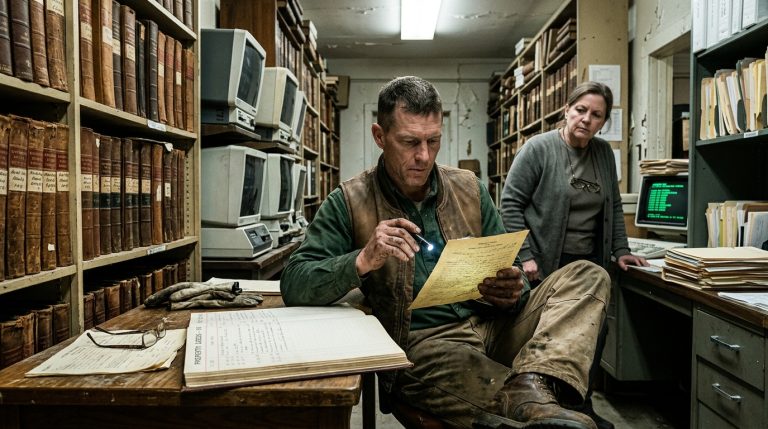
The Price of Quiet Ground: How an Uninvited Knock Triggered the Fall of Willow Creek
CHAPTER 1: THE THRESHOLD VIOLATION
The front door didn’t knock. It shuddered.
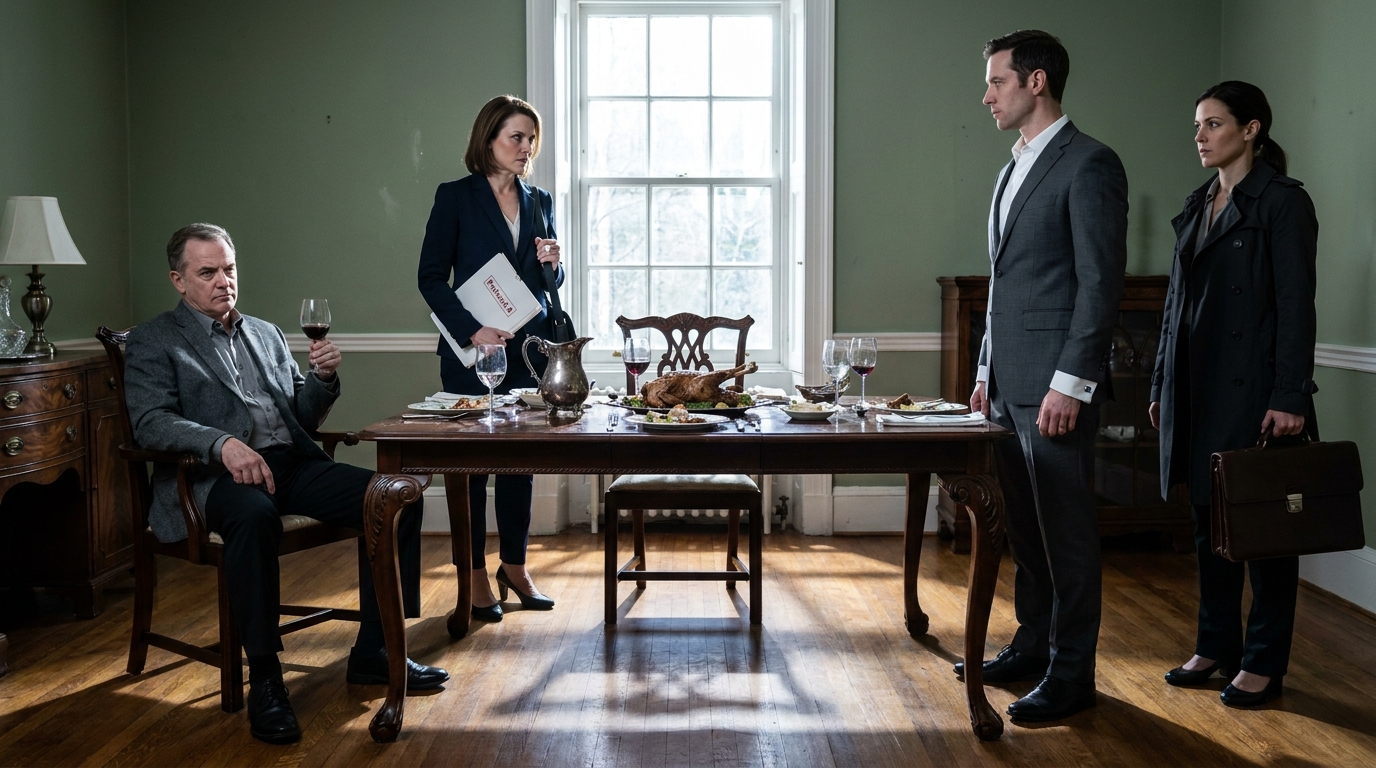
High heels struck the white-oak floorboards in a sharp, rhythmic click that sounded like slide-actions cycling in an empty room. I didn’t drop the silver carving knife, but my thumb pressed hard against the spine until the skin went pale.
“Darren. This is unacceptable,” Karen Whitmore said.
She didn’t wait in the foyer. She stood in the frame of the dining archway, her tailored navy blazer smelling faintly of cold rain and expensive hairspray. Her eyes swept the table—the roasted lamb, the crystal glasses, the heavy silver pitcher—and settled on the man sitting at my right.
Senator Arthur Hverson didn’t move. He held a glass of dark Pinot Noir two inches off the linen napkin, his gray eyebrows drawn into a flat, judgment line.
“Six cars,” Karen said. Her voice had the dry, clipped tone of a magistrate reading a sentence. “Parallel parked along the north curb of Willow Way. Subsection 12. Paragraph B. Off-street parking only after 1800 hours.”
I set the knife on the oak board. Beside my plate lay a vintage brass postage scale—three ounces of solid, unpolished metal I’d picked up at an estate sale years ago. My fingers found the cold balance arm, feeling the tiny brass screw beneath the weight.
“It’s a dinner party, Karen,” I said.
“I don’t care if it’s the second coming,” she replied. She stepped further onto the rug, her polished shoe overlapping the edge of the Iranian wool. “The Willow Creek Homeowners Association does not grant exemptions for private socials. You have twenty minutes to clear the curb before the tow rigs arrive.”
Hverson set his glass down. The heavy crystal base hit the mahogany with a dull, resonant thud.
“Excuse me, ma’am,” Hverson said. His voice dropped an octave, rich with the quiet authority of twenty-two years on committee benches. “You just crossed a locked threshold into a private residence without an invitation. Do you make a habit of breaking state trespass statutes before sunset?”
Karen’s chin twitched upward. Her eyes narrowed as she cataloged the gray blazer, the crisp white collar, the silver cuff links.
“This is official HOA business,” she said. Her hands clamped over the leather strap of her shoulder bag. “I have every right to enforce the covenant. You, whoever you are, are an unauthorized guest in a restricted residential district.”
“United States Senate,” Hverson said. He didn’t stand up. He didn’t smile. “And you are currently interfering with a federal briefing on regional housing infrastructure.”
A thin red line bloomed across Karen’s neck, rising from her collar toward her jaw. She didn’t retreat.
“I don’t care about your title,” she said. “Rules are rules. If Darren thinks he can run an illegal political office out of a residential zone, he’s mistaken. Section 4 bans commercial operations.”
“She’s lying,” a voice called from the kitchen corridor.
Kaye Anderson walked out, a linen dish towel in one hand, her black glass phone in the other. The screen was still glowing green—active recording.
“Section 4 applies to retail trade and heavy foot traffic, Karen,” Kaye said, stopping beside my chair. Her voice was flat, devoid of heat. “Private gatherings of under twelve persons are explicitly protected under State Statute 404. And I’ve got forty-eight seconds of audio showing you entering this house without consent.”
Karen’s gaze snapped to the phone. For a fraction of a second, her thumb rubbed a raw, red blister on the side of her index finger—a violent, involuntary hitch in her icy composure.
“Delete that,” she hissed.
“No,” I said. I picked up the brass scale, turning the heavy base over in my palm. “She won’t. And you’re going to step back out through that door before I call the county sheriff to process the break-in.”
“You think this is a joke, Darren?” Karen took half a step backward, but her hand dipped into her tote bag, her fingers wrapping around a thick white folder stamped with a red ledger code: Protocol-9. “You have three unpaid citations on your property file. By Monday morning, the board attaches a lean to this title.”
Hverson’s eyes locked on the white folder in her hand. His fingers tapped once against the table.
“Protocol-9?” Hverson murmured, his tone shifting from dismissive to deadly sharp. “Where did you get that code?”
Karen froze. Her jaw clicked shut. She didn’t answer. She turned on her heel, her shoes cracking against the hardwood as she retreated through the foyer and slammed the front door behind her.
The silence in the room stretched until the brass scale in my hand felt cold again.
Hverson turned to Kaye, his face hard as granite. “Show me the rest of that file.”
CHAPTER 2: THE WIRE AND THE LEDGER
The brass scale in my right palm felt heavier than three ounces. I set it down on the edge of the mahogany table, exactly parallel to the silver butter knife, feeling the metallic chill leave my skin.
Senator Hverson didn’t reach for his wine. His eyes remained locked on the spot where Karen had stood three seconds prior, his gray eyebrows drawn into a sharp, calculated line.
“Protocol-9,” Hverson repeated. The voice was low, stripped of its public resonance, replaced by the dry tone of an investigator reading an indictment. “That’s not municipal housing code. That’s a developer’s asset-liquidation tag.”
Kaye tapped the glass face of her phone, unlocking a local cloud folder. She slid the device across the linen tablecloth until it stopped directly against Hverson’s thumb.
“We’ve compiled ninety-four distinct compliance notices issued over the last eight months,” Kaye said, her fingers tracing a column on her notepad. “Every single one targets properties along the northern perimeter—what the board secretly designated as the ‘Maple-Cluster’ zone.”
I sat back down, the leather of the dining chair creaking under my weight. “Every home on Maple Drive has received at least two citations since November. Unapproved lawn edging. Non-conforming mailbox stain. Minor roof shingle color variance. Fines that double every fourteen days if not cured.”
“And when they can’t cure them?” Hverson asked, his gaze scanning the scrolling PDF on Kaye’s screen.
“They get hit with special assessments,” Kaye replied flatly. “Four thousand dollars for emergency culvert repairs that never happen. Six thousand for tree-canopy maintenance handled by a private vendor registered out of a P.O. Box in Tallahassee. When an elderly resident living on fixed income can’t liquidate cash in thirty days, the board files a summary lien.”
Hverson’s thumb stopped on the screen. “Who holds the right of first refusal on the liens?”
“Vanguard,” I said.
The word hung in the air, heavy and uninvited, mixing with the smell of roasted lamb and cold candle wax.
Hverson looked up, his jaw tightening by a fraction of a millimeter. “Vanguard Asset Management? The industrial logistics group?”
“They’re buying the paper,” Kaye said. “Not through public sheriff sales, but through private quitclaim transfers brokered by Mark Reic’s cousin at Apex Realty. They acquire the debt for forty cents on the dollar, pay off the HOA’s bogus balance, and force a private buyout before the homeowner even realizes they’re in foreclosure.”
A sharp knock rattled the front door. Three short taps, then silence.
I didn’t reach for the brass scale this time. I stood up, walked across the oak floorboards, and pulled the door open six inches.
Miguel Ortega stood on the porch in a oil-stained canvas jacket, holding a tiny, unbranded black USB flash drive between his calloused thumb and forefinger. He didn’t come inside. He didn’t look at the luxury sedans parked along the curb.
“I saw her pull up,” Miguel said softly, his voice gravelly from forty years in heavy construction. “Karen. She sat in her SUV at the corner for ten minutes before she walked up your drive. Her window was down.”
“Did she talk to anyone?” I asked.
Miguel held out the drive. “I installed a high-gain mic on my front soffit last week after someone dumped weedkiller across my boxwoods. She was on speakerphone with Reic.”
I took the drive. The plastic was cool and slightly greasy from his fingers. “What did he say?”
“He told her to execute the Protocol-9 citation tonight no matter who was sitting at your table,” Miguel said. His eyes flicked past my shoulder toward Hverson sitting in the illuminated dining room. “He said the Vanguard closing date for the Maple-Cluster parcel is set for the thirty-first, and if your property isn’t encumbered by then, the whole tranche loses its clearing price.”
I gripped the small piece of plastic until the edges bit into my skin. “Thanks, Miguel.”
“Don’t thank me,” he said, turning back toward the dark lawn. “Just make sure they don’t take my house.”
I closed the door, walked back into the dining room, and dropped the drive onto the table next to Kaye’s phone.
“Audio recording,” I said to Hverson. “HOA President Mark Reic directing a board officer to falsify encumbrances to meet a corporate closing deadline for Vanguard.”
Hverson looked at the black drive, then at Kaye, then at me. For five seconds, the room was entirely silent except for the faint hum of the refrigerator in the kitchen.
“This isn’t a petty neighborhood dispute,” Hverson said quietly, leaning back into his chair. “This is structured real estate fraud executing an illegal land-grab for an unannounced commercial transit route. And they just tried to strong-arm a sitting member of the Senate Committee on Housing.”
He reached into his blazer, pulled out a fountain pen, and uncapped it with a precise, metallic click.
“Kaye,” Hverson said, his tone turning dangerously calm. “Draft a formal preservation-of-evidence order tonight. I’m calling the State Attorney General at seven in the morning.”
CHAPTER 3: STRATEGIC INTERCEPTION
The click of Senator Hverson’s fountain pen capping shut echoed through the quiet foyer like a vault door latching into place. Dawn had barely scraped the tree line, casting a cold, slate-gray light across the damp asphalt of Willow Way.
I stood beside Kaye at the edge of the clubhouse parking lot, the autumn air smelling of wet pine needles and faint diesel exhaust from two idling municipal sedans.
Near the back service entrance of the clubhouse, a metal roll-waste container rattled.
Mark Reic stepped through the narrow doorway carrying a galvanized steel ash bucket. His beige trench coat was unbuttoned, the hem dragging slightly against the wet concrete steps. He didn’t see us yet. His right arm moved in a hasty, jerky rhythm as he tipped the bucket into the dumpster. A thick plume of gray smoke drifted upward into the morning fog, carrying the unmistakable acrid stench of scorched paper and burning plastic binder sleeves.
“He’s incinerating the physical ledgers,” Kaye whispered, her hand tightening around the strap of her leather briefcase.
“Not all of them,” I said.
I cut across the damp grass, my boots sinking half an inch into the lawn. The sudden crunch of my soles on the gravel perimeter strip made Reic freeze. His shoulders hitched toward his ears. He turned slowly, the heavy metal bucket held like a shield against his chest, his knuckles white around the handle.
“Darren,” Reic said. His voice was raw, raspy, stripped of its smooth corporate polish. A smudge of black soot streaked his right cheek, running from his cheekbone down to his jawline. “This is private property. You’re trespassing before business hours.”
“It’s six forty-five, Mark,” I said, stopping six feet from the bottom step. “And the state housing oversight committee placed an administrative freeze on this facility at midnight.”
Reic’s eyes darted past my shoulder toward the street, where two plainclothes investigators from the district attorney’s office were stepping out of an unmarked sedan. Detective Lanier led them, a thick man in a dark canvas coat, holding a folded white document stamped with a blue judicial seal.
“You think you’re clever, don’t you?” Reic spat. He set the ash bucket down on the top step with a loud, metallic clang. His left index finger twitched violently against his seam—an involuntary, desperate micro-action that contradicted the venomous glare in his eyes. “You think you can just march in here with a washed-up senator and tear down ten years of neighborhood governance?”
“You’re not governing, Mark,” I said, pointing at the wisps of smoke still curling from the dumpster behind him. “You’re shredding paper trails because the Maple-Cluster debt transfers close in three days.”
Reic’s jaw twitched. He took a single step back toward the open doorway, his shoe sliding slightly on the slick concrete. “You don’t know what you’re talking about.”
“We know about Apex Realty,” Kaye said, coming up beside me, her voice cutting through the damp chill with surgical precision. “We know about the three hundred thousand dollars routed through the Tallahassee holding account. And we know that Protocol-9 isn’t an HOA code—it’s an acquisition clearance code for Vanguard Asset Management.”
Reic’s face drained of color so fast it looked like chalk under the harsh LED security light above the door. He didn’t offer a denial. He didn’t utter a word of defense. His hand reached blindly behind him, searching for the door handle.
“Don’t touch the latch, Mr. Reic,” Detective Lanier said, his voice flat and unhurried as he stepped onto the concrete pad. He held up the court order. “State Attorney General’s office. We have a search warrant for all physical server towers, financial ledgers, and communication logs on these premises.”
“You have no authority,” Reic whispered, though his hand dropped away from the handle. “This is a private residential corporation.”
“And you just executed a document destruction protocol while under a formal preservation order,” Lanier replied. He motioned to the officer behind him. “Bag the ash bucket. Take the temperature of the embers. That’s evidence of spoliation.”
Reic watched in rigid silence as the officer stepped past him, plunging a steel probe into the smoldering debris inside the container.
“It’s just old event flyers,” Reic lied, his voice cracking on the final syllable. His gaze flicked to me, filled with a cold, desperate hatred. “You ruined this community, Darren. You opened the door to government interference. You have no idea what’s coming down that road once Vanguard walks away.”
“Vanguard isn’t walking away, Mark,” I said softly, stepping closer until I could smell the burnt ink on his coat. “They’re going to be answering subpoenas.”
Reic’s mouth opened, but no sound came out. Lanier placed a firm hand on Reic’s shoulder, guiding him gently but decisively away from the entrance while the forensic team moved past with heavy plastic transit cases.
Midway across the parking lot, Reic stopped and turned his head back toward us. “You think I was the one who signed off on the buyout?” he yelled over the hum of the idling sedans. “Ask Karen whose name is on the Vanguard master contract! Ask her about the secondary parcel clearing!”
Lanier nudged him forward into the rear seat of the unmarked car, slamming the door shut.
I turned to Kaye. Her face was grim under the overcast sky. “Did you hear that?” she asked. “Secondary parcel?”
“I heard it,” I said, looking down at the wet grass where Reic’s footprints had flattened the turf. “Layer 1 just broke. He was never the sole architect—he was the shield.”
CHAPTER 4: THE DEPOSITION TRAP
The tail lights of Detective Lanier’s cruiser faded into the morning fog, but Reic’s final words stayed locked in my chest like a cold stone.
“Ask Karen whose name is on the Vanguard master contract.”
Three hours later, Kaye and I stood in the living room of 114 Maple Drive. The house smelled of stale chamomile tea and damp wool. Outside, a deputy sat in a parked squad car at the curb; inside, Karen Whitmore sat in a high-backed armchair, a heavy black ankle monitor strapped around her right leg above a thick wool sock.
She didn’t look up when we entered. Her thumb picked compulsively at a loose thread on her sofa cushion—a jagged, repetitive motion that betrayed the rigid posture of her neck.
“You’re trespassing,” Karen said, her voice thin and dry as dead leaves.
“We have a third-party audit authorization signed by Judge Miller,” Kaye said, stepping forward and laying a two-page order onto the glass coffee table. The paper hit the surface with a crisp snap. “Reic is currently being processed at the county facility. He gave up the server keys ten minutes after the door locked.”
Karen’s picking hand froze. Her eyes flicked to the court seal on the paper, then back to the window where the squad car sat idling.
“Mark is a coward,” she whispered. “He took twenty percent on every forced transfer and thought he was running an empire.”
“He said you signed the master contract,” I said, leaning against the doorframe, my hand buried in my coat pocket where my fingers closed over the solid brass postage scale I’d brought from home. “He said Protocol-9 wasn’t just for the Maple-Cluster.”
Karen let out a single, bitter laugh that ended in a rasp. “Mark didn’t have the stomach for what comes next. He thought we were just flipping thirty suburban lots to buy new cars. He didn’t even read the land-use appendices.”
Kaye reached into her briefcase and pulled out a manila folder stamped with a red file code. She opened it, turning a laminated document toward Karen. “This map was pulled from Reic’s desk before he burned the rest. It shows a sixty-foot right-of-way cutting straight through Willow Creek, straight across Miguel’s parcel, straight through Darren’s back lawn.”
Karen glanced at the map, then looked away toward the cold hearth. “You think you stopped something today because you put Mark in a jumpsuit? You didn’t stop a thing.”
“Explain the map, Karen,” I said, stepping closer until my shadow fell across her chair. “Who paid for the survey?”
“Vanguard,” she said flatly. “They don’t want houses. They never wanted houses. The residential zoning for Willow Creek was quietly altered during a county commission session three years ago under a municipal easement variance. They’re running a six-lane commercial freight bypass directly from the interstate through this valley. Protocol-9 wasn’t an HOA code—it was the industrial clearance designation to clear the land before eminent domain even gets filed.”
Kaye’s hand drifted off the table. The silence in the room stretched until the ticking of the kitchen clock sounded like hammer blows against dry drywall.
“An industrial bypass,” Kaye murmured. “They weren’t trying to manage the neighborhood. They were intentionally depressing property values with bogus fines and liens so Vanguard could acquire sixty contiguous titles for pennies on the dollar before the bypass plan went public.”
“If residents held out until the county announcement,” I said, the cold truth locking into place, “the land values would have quadrupled. Vanguard would have paid fifty million for the corridor instead of three.”
Karen finally looked up at me. Her eyes were sunken, dark circles bruised into the skin beneath her lashes, but her stare remained viciously cold.
“I signed the contract because Vanguard gave me ten percent equity in the logistics terminal at the interchange,” she said, her voice dropping to an icy whisper. “And every single homeowner who signed a voluntary quitclaim to clear their HOA debt waived their rights to future municipal compensation. It’s done, Darren. The contracts are recorded in Tallahassee. You can lock me up, but the land rights are already assigned.”
“Not all of them,” I said.
I pulled my hand from my pocket, setting the brass scale on the glass table directly beside the court order.
“My title isn’t encumbered,” I said. “Miguel’s isn’t encumbered. And without our two central parcels, Vanguard’s six-lane bypass stops dead in a marsh.”
Karen looked down at the brass scale, her chest heaving once in a ragged breath. “They won’t negotiate with you, Darren. They’ll steamroll you.”
“Let them try,” I said. “Kaye, call Senator Hverson. Tell him we need the state housing oversight committee at the town hall tonight. It’s time to show the rest of the neighborhood what their signatures were actually worth.”
CHAPTER 5: CHECKMATE AT HVERSON HALL
I scooped the brass scale off Karen’s coffee table, its cold weight settling against my palm as Kaye already had her cell phone pressed to her ear.
By seven-thirty that evening, the overhead halogen fixtures inside the community center hall hummed with a sharp, high-pitched vibration. Rain slapped rhythmically against the tall, uncurtained windows, but inside, every metal folding chair was occupied. Over eighty residents sat shoulder-to-shoulder, their coat sleeves damp, their murmurs creating a dense wall of acoustic tension.
I stood at the side podium. Beside me, Senator Hverson adjusted a thick stack of blue-stamped affidavits on the wooden dais. On the far side of the stage sat an corporate attorney representing Vanguard Asset Management—a man in a gray three-piece suit whose thumb incessantly flicked the latch of his silver leather briefcase, a sharp, metallic clack-clack-clack that cut through the room’s noise.
“The meeting will come to order,” Hverson said, his voice instantly deadening the chatter. He didn’t use a gavel. He simply laid his heavy palm flat against the timber. “We are here to review the structural legality of all covenants executed under Protocol-9 over the preceding thirty-six months.”
The Vanguard attorney, whose silver nameplate read E. Vance, stood up slowly. He didn’t look at the crowd. He looked strictly at Hverson.
“Senator,” Vance said, his voice smooth, dripping with unyielding corporate composure. “This forum has no jurisdictional standing to review private contract assignments. Vanguard Asset Management holds recorded deeds and quitclaims for forty-two contiguous parcels in the Maple-Cluster sector. Those transfers were executed under valid HOA enforcement remedies for delinquent assessments.”
A low rumble surged through the audience. Miguel Ortega stood up from the third row, his work boots heavy against the floorboards. “Delinquent?” Miguel shouted. “You billed me six thousand dollars for a drainage ditch your own contractor dug up!”
“Sit down, sir,” Vance said without turning his head. “The redemption window closed on the fifteenth. The titles have cleared escrow.”
“They haven’t cleared mine,” I stepped up to the primary microphone. The feedback whistled once before I cut the gain. I held up a thick white ledger—the exact duplicate Kaye and I had secured from the clubhouse server before Reic tried to burn it. “And they haven’t cleared Miguel’s.”
Vance’s thumb stopped its rhythmic flick against his briefcase latch. His posture stiffened by a fraction of an inch. “Mr. Darren, your individual parcel status is irrelevant to the commercial easement.”
“It’s entirely relevant,” Kaye said, standing up beside me and tapping a large digital projector remote.
Behind us, a high-resolution land survey flashed onto the white wall. Red lines carved a wide, straight path through Willow Creek, wiping out forty homes. But right in the dead center of the map, two glaring blue squares blocked the corridor entirely: my property and Miguel’s workshop.
“Section 14-B of the state transportation code,” Kaye stated, her voice slicing through the silent hall like a scalpel. “An industrial freight corridor requiring private right-of-way cannot exercise municipal quick-take domain if the acquiring entity used fraudulent civil encumbrances to secure adjacent parcels. That is a felony under the State Land Protection Act.”
Vance didn’t flinch. He leaned forward, resting both hands on the table, projecting an aura of absolute legal untouchability. “You have no proof of fraudulent encumbrance. The HOA board issued valid citations under municipal bylaws.”
“We have the audio, Mr. Vance,” I said.
I pulled the black USB drive Miguel had delivered out of my pocket and set it down next to the brass scale on the wooden podium.
“We have two hours of recorded phone calls between Mark Reic and Karen Whitmore,” I said, looking Vance dead in the eye. “We have the original, un-edited meeting minutes showing that the Protocol-9 assessment clause was added unilaterally three weeks after the corporate variance was filed in Tallahassee. And we have Karen Whitmore’s signed state deposition from four hours ago, naming Vanguard as the primary instigator of the predatory foreclosures.”
A collective gasp echoed across the metal chairs.
Vance’s face didn’t go pale like Reic’s had; instead, his eyes narrowed into cold, calculating slits. He didn’t offer an impassioned speech. He slowly reached down, clicked his briefcase shut with a final, decisive sound, and slid his silver nameplate into his coat pocket.
“This deposition will be challenged in federal court,” Vance said, his voice dangerously low as he gathered his papers. “Vanguard will tie every title in this valley up in litigation for the next decade. None of you will be able to sell, refinance, or alter a single square foot of your property while the injunctions hold.”
He thought that was his threat—his final, bitter leverage to force a settlement. He turned on his heel to walk down the center aisle.
“You won’t be filing injunctions, Vance,” Senator Hverson said, standing up to his full height. He held up a second document, bearing the gold emblem of the State Attorney General. “Because ten minutes ago, the AG’s office filed an emergency petition freezing all Vanguard asset transfers within this district pending a criminal racketeering indictment.”
Vance froze mid-step in the center aisle. For three long seconds, the smooth corporate lawyer looked completely paralyzed, surrounded on all sides by the quiet, resolute stares of eighty homeowners.
He didn’t say another word. He adjusted his jacket with a single jerky motion and walked swiftly through the double doors out into the rain.
The room remained motionless, the shock of the sudden shift holding everyone in place. Then Miguel raised his hands, and the applause hit the ceiling like thunder.
I looked down at the podium, my fingers brushing the cool brass of the postage scale. The line had been held, but as Kaye looked at me with a tired, knowing smile, we both knew the true work—rebuilding what had been broken—was just beginning.
CHAPTER 6: THE CLEAN SLATE
My fingers slowly relaxed their grip on the brass postage scale as the last echoes of applause settled into the rafters of Hverson Hall.
The air inside the room no longer smelled of wet wool and anxious sweat; it smelled of damp oak leaves drifting through the opened rear doors and the sharp, clean scent of fresh ink from the petitions spread across the front table.
Kaye stood at my right, her pen moving smoothly across a newly drafted interim charter. Across the room, Senator Hverson leaned against the wooden railing, watching as three staff members organized the sworn affidavits into heavy black binders.
“The injunction papers cleared the registrar’s office twenty minutes ago,” Kaye said softly, setting her pen down with a quiet, solid click. “The State Housing Oversight Committee took jurisdiction over the entire Willow Creek corporate filing. Vanguard’s Protocol-9 acquisition tranche is legally nullified.”
“And the Maple-Cluster zone?” I asked, turning the heavy brass scale over in my hand one last time.
“Re-zoned back to residential preservation,” she said, offering a rare, unburdened smile. “The county commission ratified the variance override during an emergency closed session. Vanguard can’t lay a single inch of asphalt through this valley.”
Three weeks passed, but the narrative didn’t move in a blur—it settled into the physical details of a community taking back its soil step by step.
I sat on the front porch of my house as the afternoon sun warmed the white-oak floorboards where Karen’s high heels had clicked so aggressively a month prior. Beside me on the small cedar side table sat the vintage postage scale. Its brass surface had been tarnished by decades of dust, but that morning I had taken a coarse rag and fine polishing compound to it, rubbing away the dull oxidation until the bare, bright metal reflected the autumn sky.
Down at the curb, Miguel Ortega was adjusting a new cedar mailbox post. His heavy hammer struck the wooden peg with three solid, rhythmic thuds, securing the base deep into the earth. There were no white pickup trucks idling nearby. No clipboards measuring the angle of the post. No threat of a four-thousand-dollar special assessment lurking in the Monday mail.
Miguel wiped his brow with the back of his forearm and looked up toward my porch. He didn’t say anything, but he raised a hand in a short, firm nod before picking up his tool bag and walking back toward his workshop.
Around four o’clock, a blue sedan pulled into the driveway. Senator Hverson stepped out, carrying a single, thick leather-bound document stamped with the state seal in gold leaf. He walked up the steps with a measured, easy stride and set the binder on the table next to my scale.
“The Willow Creek Act passed the state senate floor this morning,” Hverson said, leaning his hands on the porch rail and looking out over the quiet street. “Unanimously.”
“What does it do?” I asked, looking down at the gold lettering on the leather cover.
“It outlaws secret corporate assessments, mandates independent annual audits for every residential board in the state, and makes it a class-three felony for board officers to hold undisclosed financial ties to commercial buyers,” Hverson said. His voice was low, devoid of political grandstanding, carrying the simple weight of a promise kept. “You gave them a template, Darren. Other neighborhoods across three counties are already using the court filings to break similar encumbrances.”
“Mark Reic?”
“Pled out to wire fraud and document falsification this morning,” Hverson replied flatly. “Three years active sentence, plus full restitution to every homeowner forced into a quitclaim. Karen Whitmore’s house arrest was extended through trial—her equity share in Vanguard was seized as proceeds of crime.”
He turned back toward his car, stopping at the top step to look down at the polished brass scale sitting on the table.
“You kept your balance,” Hverson said softly.
“It takes weight to hold a line,” I said.
He nodded once, turned, and drove down the quiet, tree-lined curve of Willow Way.
I picked up the scale, feeling the solid, unyielding brass in my grip. The house behind me was quiet. The street ahead was open. The ground beneath my feet belonged to the people who lived on it, and for the first time in three years, the air smelled entirely clean.
——Caption——
🟦 OPTION 1
🏠 Targeted by an overbearing HOA president—a homeowner uses a hidden recording and a visiting US Senator to destroy a corrupt syndicate.
The front door didn’t knock. It shuddered.
High heels struck the white-oak floorboards in a sharp, rhythmic click that sounded like slide-actions cycling in an empty room. I didn’t drop the silver carving knife, but my thumb pressed hard against the spine until the skin went pale.
“Darren. This is unacceptable,” Karen Whitmore said.
She didn’t wait in the foyer. She stood in the frame of the dining archway, her tailored navy blazer smelling faintly of cold rain and expensive hairspray. Her eyes swept the table—the roasted lamb, the crystal glasses, the heavy silver pitcher—and settled on the man sitting at my right.
Senator Arthur Hverson didn’t move. He held a glass of dark Pinot Noir two inches off the linen napkin, his gray eyebrows drawn into a flat, judgment line.
“Six cars,” Karen said. Her voice had the dry, clipped tone of a magistrate reading a sentence. “Parallel parked along the north curb of Willow Way. Subsection 12. Paragraph B. Off-street parking only after 1800 hours.”
I set the knife on the oak board. Beside my plate lay a vintage brass postage scale—three ounces of solid, unpolished metal I’d picked up at an estate sale years ago. My fingers found the cold balance arm, feeling the tiny brass screw beneath the weight.
“It’s a dinner party, Karen,” I said.
“I don’t care if it’s the second coming,” she replied. She stepped further onto the rug, her polished shoe overlapping the edge of the Iranian wool. “The Willow Creek Homeowners Association does not grant exemptions for private socials. You have twenty minutes to clear the curb before the tow rigs arrive.”
Hverson set his glass down. The heavy crystal base hit the mahogany with a dull, resonant thud.
“Excuse me, ma’am,” Hverson said. His voice dropped an octave, rich with the quiet authority of twenty-two years on committee benches. “You just crossed a locked threshold into a private residence without an invitation. Do you make a habit of breaking state trespass statutes before sunset?”
Karen’s chin twitched upward. Her eyes narrowed as she cataloged the gray blazer, the crisp white collar, the silver cuff links.
“This is official HOA business,” she said. Her hands clamped over the leather strap of her shoulder bag. “I have every right to enforce the covenant. You, whoever you are, are an unauthorized guest in a restricted residential district.”
“United States Senate,” Hverson said. He didn’t stand up. He didn’t smile. “And you are currently interfering with a federal briefing on regional housing infrastructure.”
A thin red line bloomed across Karen’s neck, rising from her collar toward her jaw. She didn’t retreat.
“I don’t care about your title,” she said. “Rules are rules. If Darren thinks he can run an illegal political office out of a residential zone, he’s mistaken. Section 4 bans commercial operations.”
“She’s lying,” a voice called from the kitchen corridor.
Kaye Anderson walked out, a linen dish towel in one hand, her black glass phone in the other. The screen was still glowing green—active recording.
“Section 4 applies to retail trade and heavy foot traffic, Karen,” Kaye said, stopping beside my chair. Her voice was flat, devoid of heat. “Private gatherings of under twelve persons are explicitly protected under State Statute 404. And I’ve got forty-eight seconds of audio showing you entering this house without consent.”
Karen’s gaze snapped to the phone. For a fraction of a second, her thumb rubbed a raw, red blister on the side of her index finger—a violent, involuntary hitch in her icy composure.
“Delete that,” she hissed.
“No,” I said. I picked up the brass scale, turning the heavy base over in my palm. “She won’t. And you’re going to step back out through that door before I call the county sheriff to process the break-in.”
“You think this is a joke, Darren?” Karen took half a step backward, but her hand dipped into her tote bag, her fingers wrapping around a thick white folder stamped with a red ledger code: Protocol-9. “You have three unpaid citations on your property file. By Monday morning, the board attaches a lean to this title.”
Hverson’s eyes locked on the white folder in her hand. His fingers tapped once against the table.
“Protocol-9?” Hverson murmured, his tone shifting from dismissive to deadly sharp. “Where did you get that code?”
Karen froze. Her jaw clicked shut. She didn’t answer. She turned on her heel, her shoes cracking against the hardwood as she retreated through the foyer and slammed the front door behind her.
The silence in the room stretched until the brass scale in my hand felt cold again.
Hverson turned to Kaye, his face hard as granite. “Show me the rest of that file.”
→ Chapter 2: “THE WIRE AND THE LEDGER” 👇
#StoryTime #Thriller #HOAHorror
🟦 OPTION 2
⚖️ Cornered by predatory fines and bogus citations—a neighborhood fights back against a corporate land grab to protect their homes.
The front door didn’t knock. It shuddered.
High heels struck the white-oak floorboards in a sharp, rhythmic click that sounded like slide-actions cycling in an empty room. I didn’t drop the silver carving knife, but my thumb pressed hard against the spine until the skin went pale.
“Darren. This is unacceptable,” Karen Whitmore said.
She didn’t wait in the foyer. She stood in the frame of the dining archway, her tailored navy blazer smelling faintly of cold rain and expensive hairspray. Her eyes swept the table—the roasted lamb, the crystal glasses, the heavy silver pitcher—and settled on the man sitting at my right.
Senator Arthur Hverson didn’t move. He held a glass of dark Pinot Noir two inches off the linen napkin, his gray eyebrows drawn into a flat, judgment line.
“Six cars,” Karen said. Her voice had the dry, clipped tone of a magistrate reading a sentence. “Parallel parked along the north curb of Willow Way. Subsection 12. Paragraph B. Off-street parking only after 1800 hours.”
I set the knife on the oak board. Beside my plate lay a vintage brass postage scale—three ounces of solid, unpolished metal I’d picked up at an estate sale years ago. My fingers found the cold balance arm, feeling the tiny brass screw beneath the weight.
“It’s a dinner party, Karen,” I said.
“I don’t care if it’s the second coming,” she replied. She stepped further onto the rug, her polished shoe overlapping the edge of the Iranian wool. “The Willow Creek Homeowners Association does not grant exemptions for private socials. You have twenty minutes to clear the curb before the tow rigs arrive.”
Hverson set his glass down. The heavy crystal base hit the mahogany with a dull, resonant thud.
“Excuse me, ma’am,” Hverson said. His voice dropped an octave, rich with the quiet authority of twenty-two years on committee benches. “You just crossed a locked threshold into a private residence without an invitation. Do you make a habit of breaking state trespass statutes before sunset?”
Karen’s chin twitched upward. Her eyes narrowed as she cataloged the gray blazer, the crisp white collar, the silver cuff links.
“This is official HOA business,” she said. Her hands clamped over the leather strap of her shoulder bag. “I have every right to enforce the covenant. You, whoever you are, are an unauthorized guest in a restricted residential district.”
“United States Senate,” Hverson said. He didn’t stand up. He didn’t smile. “And you are currently interfering with a federal briefing on regional housing infrastructure.”
A thin red line bloomed across Karen’s neck, rising from her collar toward her jaw. She didn’t retreat.
“I don’t care about your title,” she said. “Rules are rules. If Darren thinks he can run an illegal political office out of a residential zone, he’s mistaken. Section 4 bans commercial operations.”
“She’s lying,” a voice called from the kitchen corridor.
Kaye Anderson walked out, a linen dish towel in one hand, her black glass phone in the other. The screen was still glowing green—active recording.
“Section 4 applies to retail trade and heavy foot traffic, Karen,” Kaye said, stopping beside my chair. Her voice was flat, devoid of heat. “Private gatherings of under twelve persons are explicitly protected under State Statute 404. And I’ve got forty-eight seconds of audio showing you entering this house without consent.”
Karen’s gaze snapped to the phone. For a fraction of a second, her thumb rubbed a raw, red blister on the side of her index finger—a violent, involuntary hitch in her icy composure.
“Delete that,” she hissed.
“No,” I said. I picked up the brass scale, turning the heavy base over in my palm. “She won’t. And you’re going to step back out through that door before I call the county sheriff to process the break-in.”
“You think this is a joke, Darren?” Karen took half a step backward, but her hand dipped into her tote bag, her fingers wrapping around a thick white folder stamped with a red ledger code: Protocol-9. “You have three unpaid citations on your property file. By Monday morning, the board attaches a lean to this title.”
Hverson’s eyes locked on the white folder in her hand. His fingers tapped once against the table.
“Protocol-9?” Hverson murmured, his tone shifting from dismissive to deadly sharp. “Where did you get that code?”
Karen froze. Her jaw clicked shut. She didn’t answer. She turned on her heel, her shoes cracking against the hardwood as she retreated through the foyer and slammed the front door behind her.
The silence in the room stretched until the brass scale in my hand felt cold again.
Hverson turned to Kaye, his face hard as granite. “Show me the rest of that file.”
→ Chapter 2: “THE WIRE AND THE LEDGER” 👇
#Fiction #Drama #JusticeServed
💬 ENGAGEMENT KIT
📍 Pinned Comment:
The story gets wilder in the next chapter. 👇
🪝 Curiosity Hooks 1:
She barged into a dinner party expecting an easy target, but she had no idea a U.S. Senator was sitting at the table.
🪝 Curiosity Hooks 2:
A single folder stamped “Protocol-9” was supposed to ruin a homeowner, but it actually exposed a multi-million dollar conspiracy.