The Frost On The Fence Line Whispers Of Blood And Iron
CHAPTER 1: THE FROST BREAKS FIRST
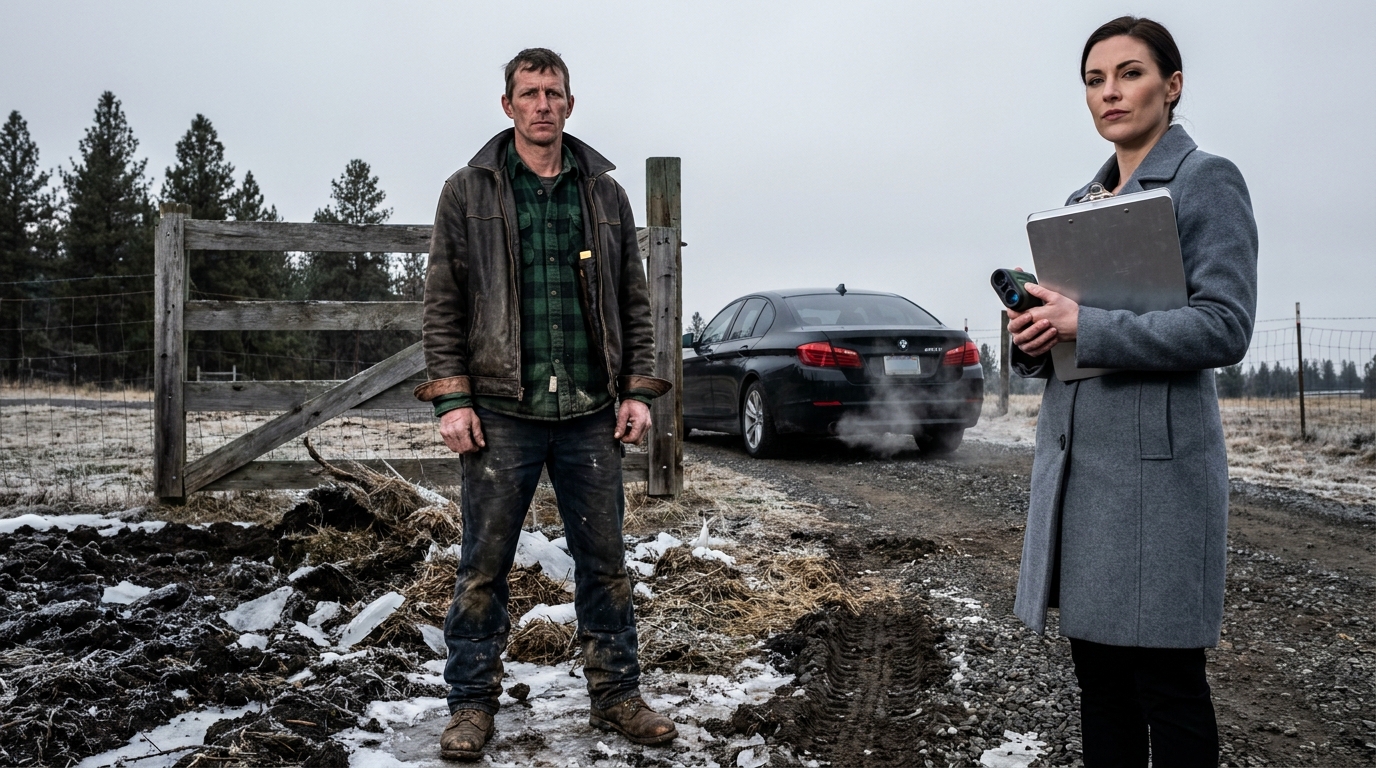
The depth of the tread mark in the slush was wrong. Three inches deep, wide-gauge performance rubber, tearing straight through the frozen crust into the black dirt of the east bed.
I didn’t move from the porch post. The brass casing of my old Zippo clicked shut in my palm—once, twice. Cold metal against calloused skin.
A black BMW 7-Series sat idling fifty feet past my splintered entry gate. Exhaust curled thick and white into the sub-zero air, smelling of high-octane fuel and scorched wintergreen leaves. Underneath the front bumper, crushed stalks of winter ginseng bled pale sap into the mud.
The driver’s door popped open. Leather boots hit the frozen gravel with a sharp, hollow thud.
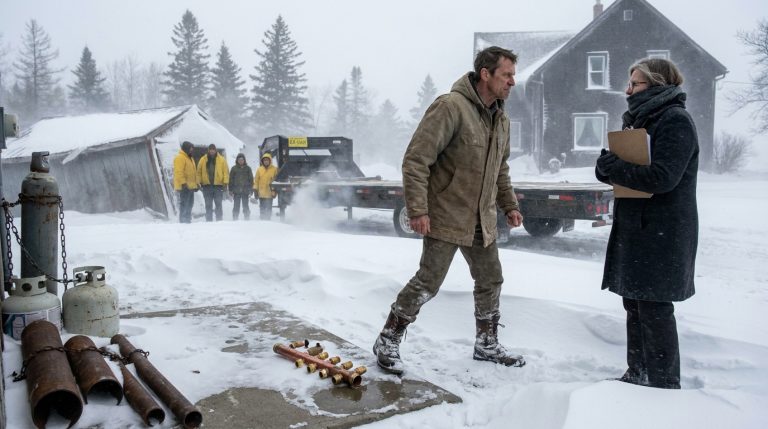
Melissa Hart didn’t glance down at the garden bed she’d just pulverized. Her slate-gray wool coat was spotless. In her right hand, she held a heavy clipboard backed with anodized aluminum; in her left, a handheld laser rangefinder.
“You’re thirty feet out of compliance, Clayton,” she said. Her voice carried over the idle of the engine, dry and clipped. No greeting. No hesitation. “The Meadowbrook Heights HOA charter grants broad emergency infrastructure access during severe weather events. Your perimeter gate constitutes an unauthorized barrier.”
I thumbed the Zippo open. Click.
“That gate sits four feet inside a county-recorded survey pin,” I said. My voice stayed low, flat, stripped of inflection. “And those plants were forty-five days out from Sarah’s third cycle.”
Melissa didn’t blink. She raised the laser sight, its red dot painting a bright, trembling needle on the pine post beside my shoulder.
“Your private gardens sit atop the secondary easement vector for the neighborhood’s winter drainage run,” she said, tapping a red pen against the aluminum board. “We’ve sent three notices. You ignored all three. Effective six o’clock this morning, the board authorized direct physical inspection of all obstructions.”
Behind her vehicle, down at the mouth of the lane, two more engines hummed in the mist—a pair of late-model silver SUVs, idling in formation.
A low, guttural snort echoed from the pasture behind the barn. Thunder, my five-year-old Angus bull, hit the secondary wire fence hard enough to make the rusted staples groan in the cedar posts. The herd behind him shifted, hooves clacking against the icy mud like dry bones.
“You’re scaring the stock, Melissa,” I said.
“Then move the stock,” she replied. She stepped forward, her heel grinding a cluster of frozen echinacea roots directly into the ruts. “Or the county sheriff will move them for you when we file the injunction tomorrow at noon.”
She turned her back to me—a calculated display of complete invulnerability—and pointed the laser device toward the wellhouse fifty yards back.
I didn’t argue. I didn’t raise my voice. I closed the Zippo with a final, heavy snap and slid it into my coat pocket.
Under the floorboards of the porch, the silent relay for the newly laid driveway sensors clicked into an active standby state.
CHAPTER 2: BOUNDARIES IN FROZEN DIRT
The red dot from Melissa’s laser ranger pulsed once against the rough cypress siding of the wellhouse, holding still for three seconds before snapping off as she lowered her arm.
She didn’t look back as she climbed into the BMW. The heavy door shut with a muffled, airtight seal. Her tires churned through the ruined medicinal bed again, throwing dark, frozen clumps against my fence posts as the three vehicles reversed in unison down the lane.
I stayed on the porch until the tail lights faded into the gray mist at the county road.
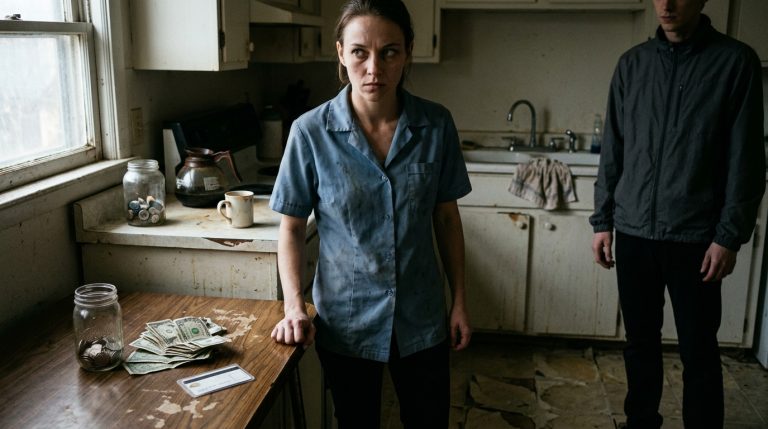
Inside the kitchen, the oxygen concentrator hummed its rhythmic, mechanical breath—two seconds in, two seconds out. Sarah was at the table, a cup of nettle tea cooling between her hands. Her knuckles were swollen, red from the cold air that leaked through the door frame.
“She brought three cars today,” Sarah said. Her voice was thin, but her eyes held steady on mine.
“She brought a laser,” I replied. I walked to the woodstove and dropped two splits of seasoned oak into the iron firebox. Heat radiated back against my face, dry and sharp. “Means she’s measuring for a paper record. She wants a judge to sign an emergency order before Friday.”
“The ginseng won’t take another hit, Clayton. The roots are exposed.”
“I’m fixing it.”
A heavy diesel rumble shook the glass in the eastern window. Pete’s rusty F-250 pulled into the drive, his tires crunching slowly over the crushed ice. A yellow strobe light flashed on his roof rack, casting amber pulses across the frozen snow.
I pulled my leather work gloves on, snapping the wrists tight, and walked out to meet him.
Pete slammed his door, his grizzled beard dusted with frost. He reached into the truck bed and hauled out a heavy tripod fitted with a top-tier RTK GPS receiver.
“Cold enough to freeze the grease in a hub,” Pete spat into the slush. He set the tripod down with a metallic clatter. “Got your message. You sound like you’re preparing for an artillery barrage.”
“Just a boundary dispute,” I said, holding the base of the staff as he leveled the bubble vials. “HOA president thinks the county easement extends forty feet past the culvert.”
Pete chuckled, a low rasp, and unrolled a stiff, laminated county plat map across the hood of his truck. He held it down against the wind with a brass plumb bob and a pair of rusty pliers.
“Plat says she’s full of it,” Pete said, pointing a grease-stained thumb at the red boundary line. “Pin 4-B sits right where your cedar post is. Always has. But look here.”
He tapped a faint, blue-shaded overlay near the western edge of my pasture.
“State water board updated the GIS layers last month,” he said. “There’s a provisional easement application filed under a private commercial tag—Vanguard Hydrology. They’re trying to reclassify the whole run from the ridge down to your wellhouse.”
I leaned over the hood. The paper smelled of damp ink and old engine oil. Vanguard Hydrology was printed in fine, blocky text along the margin, flanked by a preliminary filing code.
“Why would an HOA care about a commercial water tag?” I asked.
“Don’t know,” Pete said, tightening the clamp on his GPS rod. “All I know is my satellite link is drifting two feet to the east. High solar flare activity, or somebody’s running a signal jammer down near the sub-station. Gives me a soft lock.”
“Fix the lock,” I said. “I need millimeter precision.”
“I’ll burn twenty minutes re-calibrating the base station,” Pete grunted, pulling a handheld controller from his coat. “Cost you an extra fifty.”
“Just get the numbers certified,” I said.
While Pete worked the satellite receiver, I walked the perimeter behind the herb garden. My boots sank three inches into the mud where the BMW’s rear differential had dragged across the soil.
I pulled a camouflaged trail camera from my coat pocket. It was a compact unit—infrared night vision, cellular uplink, thermal motion trigger. I mounted it four feet up the trunk of a mature white pine, angling the lens down toward the gate posts.
Two more went into the hollows of the fence line, hidden inside weathered birdhouses I’d cleared out the night before.
The trail camera clicked silently as I passed its field of view. Five seconds later, my phone vibrated in my pocket with a test frame: a high-contrast image of my own boots in the mud, timestamped down to the fraction of a second.
“Got a solid satellite fix!” Pete yelled from the truck, his voice cutting through the wind. “Pin 4-B is locked in! She’s three yards inside your property line, Clayton! Absolute trespass!”
I walked back toward the F-250 as Pete printed the raw survey log onto a narrow strip of thermal paper.
“Sign it,” I said. “Stamp it with your county seal.”
Pete looked at me, his brow furrowing under his wool cap. “You’re going to war over four feet of slush?”
I looked back at the house. Through the kitchen window, I could see Sarah setting her teacup down, her hand trembling slightly as she reached for her pill organizer.
“It’s not about the slush,” I said.
I took the certified paper from Pete’s hand, folded it once, and slid it into my breast pocket next to my brass Zippo.
Down at the end of the lane, where the county road met the property line, a black SUV slowed to a crawl, its dark tinted windows reflecting the gray sky before accelerating away.
CHAPTER 3: THE WEIGHT OF COLD STEEL
The black SUV’s rear bumper dissolved into the gray mist at the end of the lane, its brake lights casting a faint pink smear against the frozen sleet before vanishing entirely.
I slid Pete’s certified survey report into my coat pocket. The thermal paper felt thin and brittle against my chest, but the red ink stamp was dry.
“I’m clearing out before the sleet turns to sheet ice,” Pete called out over the idle of his Ford. He hauled his survey tripod into the bed, metal legs clattering against the rusted steel lining. “Keep your eyes on that lower gate post, Clayton. If they come back with heavy equipment, that paper won’t stop a five-ton blade.”
“It’ll stop them in court,” I said.
Pete let out a dry, rattling cough, spat onto the frozen gravel, and pulled his door shut. The F-250’s exhaust blew a thick plume of black smoke into the freeze as he backed down the incline, his chains clicking rhythmically against the ice-crusted tires.
When the tail lights cleared the ridge, the ranch went dead quiet. Only the high, thin whine of the wind through the barbed wire remained.
I didn’t head back to the warmth of the kitchen. Instead, I walked to the tool shed behind the tractor bay. The padlock was stiff, white frost caked into the keyway. I hit the brass body twice with the heel of my glove to break the ice inside, turned the key until the shackle popped, and pulled the heavy slide door back on its rollers.
The shed smelled of old gear oil, cold iron, and dried sawdust.
In the far corner, buried beneath two heavy canvas tarps, sat the custom steel snowgate mechanism I’d fabricated three winters ago. Two three-inch solid steel drop-bars, counterweighted with lead slag, mounted to a pair of recessed box-tubing frames. When triggered via a low-voltage solenoid, the bars dropped flat into twin concrete-lined trenches across the drive—invisible under two inches of pack snow, but rigid enough to catch a vehicle’s front axle like an anchor hook.
I picked up an oil can and a wire brush.
For forty minutes, I worked in silence. The metal was so cold it bit through the grain of my leather work gloves, but I brushed away the surface oxide until the locking pins shone dull and silver in the gloom. I coated the trip switches in low-temp silicone grease, ensuring the cold wouldn’t freeze the magnetic latching contacts.
My phone vibrated against my ribs. I pulled it out with my teeth on the glove thumb, stripping the leather off.
It was an automated alert from the trail camera I’d hidden in the pine three hours ago.
I swiped the screen open. The image showed a late-model white pickup idling near the lower culvert—outside the fence line, but well past the public turnaround. On the driver’s door, partially obscured by a magnetic blanking sheet, was a faint stencil outline: Strata-7 Wellheads.
A man in a hi-vis yellow parka stood by the rear bumper, holding a long stainless-steel sampling rod lowered into the drainage ditch that ran off my property.
I zoomed in on the photo. He wasn’t measuring road elevation or inspecting storm runoff. He was drawing fluid samples into a sealed glass tube, wrapping the top in a red hazard seal before sliding it into an insulated case.
I locked the phone screen.
They were digging deeper than an HOA access route. The HOA was just the crowbar being used to pry open the gate.
I walked out of the shed, carrying a twenty-pound tub of grease and a torque wrench. The wind had shifted out of the north, driving fine, needle-like sleet sideways across the pasture. Down by the eastern fence, Thunder stood with his back to the gale, steam rising off his dark hide as he stomped the frozen dirt.
I reached the drive’s primary choke point—a narrow pinch between two granite boulders thirty feet inside my boundary line.
I dropped to one knee on the frozen gravel. Using a short steel pry bar, I cleared the ice out of the subterranean box framing, revealing the flush-mounted steel plates of the snowgate trap. I tested the manual release lever. The linkage moved with a sharp, heavy clack, the counterweight dropping smoothly into its underground pocket.
My knee joints throbbed against the ice. A dark stain of hydraulic fluid from Pete’s truck sat frozen in the slush next to my boot, irreducible and black.
“Clayton!”
I looked up. Sarah stood on the porch, wrapped in her heavy wool blanket, her hand braced against the door frame to steady her breathing. The thin clear plastic tubing of her oxygen cannula caught the gray afternoon light.
“Inside,” I called back, pushing myself up from the stone. The torque wrench felt cold and heavy in my grip. “It’s dropping past twenty.”
“There’s an email,” she said, her voice barely carrying over the wind. “From the county clerk’s office. A notice of emergency hearing.”
I wiped my boots on the iron scraper at the bottom step and followed her into the warm, quiet kitchen.
The laptop screen sat open on the wood table, illuminated by a single amber lamp. The message was crisp, formal, and stamped with an expedited docket number for Friday morning at eight.
Motion for Temporary Injunction and Ex Parte Right-of-Way Access: Meadowbrook Heights Homeowners Association v. Clayton Vance.
Attached to the motion was a signed affidavit from Melissa Hart, along with a provisional engineering schematic stamped with a corporate logo: Vanguard Hydrology.
I scrolled down to the third page. In the lower corner, buried under forty lines of legal boilerplate, was a secondary request: Authorization for immediate subsurface structural testing along the primary easement corridor.
I rested my hand on the back of Sarah’s chair. Her shoulder felt small, fragile under the thick weave of the blanket, but her posture didn’t yield an inch.
“They think they can speed-run a judge before we can file Pete’s certified survey,” she said softly.
“They think I’m going to wait for the judge,” I replied.
I took my brass Zippo from my pocket, flipped the top open, and let the small yellow flame reflect off the dark glass of the laptop screen.
CHAPTER 4: THE SUBTERRANEAN DRIFT
The tiny yellow flame of the brass Zippo flickered across the glass of the laptop screen, casting a dancing reflection over the blocky corporate header of the Vanguard Hydrology affidavit before snapping dark under my thumb.
I lowered the lid of the computer. The kitchen went back to the dim amber glow of the single desk lamp and the rhythmic hum of Sarah’s oxygen unit.
“The hearing is set for Friday morning,” Sarah said quietly, her hand sliding over mine where it rested on the wooden tabletop. “Can we prove the survey numbers before then?”
“Pete’s stamp is already digitized,” I said. “I’m sending it to the county clerk’s office tonight. But they aren’t pushing for a simple right-of-way. Vanguard Hydrology is paying the HOA’s legal retainer.”
I stood up, the chair legs scraping against the pine floorboards. “I need to check the wellhouse.”
“Clayton.” She looked up, her fingers tightening slightly against my wrist. “It’s eighteen below out there.”
“The pressure tank is rattling,” I said softly. “I’ll be five minutes.”
I pulled my wool coat back on, zipped the collar tight against my jaw, and stepped down into the dark yard.
The sleet had stopped, replaced by a bitter, motionless freeze that made the pine trunks crack like distant rifle shots in the timber. My boots crunched over the hard crust toward the small stone building housing our wellhead.
Inside, the warm smell of damp concrete and electric insulation hung heavy in the air. The pump motor hummed on its concrete pad, vibrating through the iron fittings.
I knelt beside the primary intake pipe where it emerged from the floor slab.
Beside the copper pressure switch sat a small, transparent sediment filter casing I’d replaced two months ago. The glass cylinder was supposed to hold a clean white polypropylene element. Instead, the pleats were caked in a dark, oily gray silt that smelled faintly of sulfur and industrial solvent.
I pulled a pair of clean brass pliers from my coat pocket and loosened the drain valve at the base of the housing.
A quarter-cup of heavy, discolored water trickled out into an empty glass jar I pulled off the shelf. Floating near the bottom was a dense, metallic sludge that didn’t settle like organic dirt.
My phone vibrated in my chest pocket. An encrypted PDF file had just landed in my inbox—a leaked land transfer document forwarded from Jake, an old logistics contractor I’d served with who now ran a private title research firm in town.
I opened the file under the bare bulb of the wellhouse.
The document wasn’t a standard suburban easement agreement. It was an option contract between Meadowbrook Heights HOA and a subsidiary of Vanguard Hydrology. The HOA board had agreed to grant structural access to my property in exchange for a half-million-dollar “infrastructure modernization grant.”
Layer 1 was plain as day: Melissa Hart was taking corporate kickbacks under the guise of winter road safety to force a pipe corridor across my land.
But as I scrolled past the financial signatures, a sub-contractor annex caught my eye.
The easement wasn’t designed for a storm drain or a public water main. The blueprint called for high-pressure extraction lines running directly into the deep rock layer—specifically referencing Strata-7 Wellheads and an old, red-lined environmental report labeled Aquifer-9 Test Logs.
I stared at the jar of discolored water sitting on the concrete floor.
Vanguard Hydrology wasn’t trying to build a municipal easement for the suburban neighborhood. They were trying to reach the deep aquifer before a state environmental audit went public—and my property sat directly above the test site.
A sharp metallic snap echoed from the driveway outside.
I killed the wellhouse light instantly.
Through the narrow glass transom above the door, I saw a single beam of light sweeping slowly across the snow toward the herb garden. A man in a dark parka was walking along my fence line, carrying a handheld electronic sensor connected to a flexible steel probe.
He wasn’t from the HOA. He moved with the quiet, methodical speed of a commercial surveyor clearing a site before a drill rig arrives.
I slipped my hand into my coat pocket, feeling the cold, rectangular edge of my brass Zippo and the hard steel of the torque wrench hanging from my belt loop.
I didn’t call out. I didn’t turn on the yard lights.
I stepped out of the wellhouse into the shadow of the woodpile, watching the man lower his probe directly into the frozen soil where Sarah’s medicinal herbs lay buried under the ice.
CHAPTER 5: THE COLLISION AT PIN 4B
The cold weight of the heavy steel torque wrench pressed hard against my palm as I stood motionless in the deep shadow of the woodpile, watching the narrow blue beam of the surveyor’s probe trace across the frozen ginseng roots.
The man in the dark parka didn’t hear me approach. He jammed the stainless-steel probe two inches into the frost, tapped a handheld digital logger, and muttered a quick string of coordinates under his breath.
“You’re off your sector,” I said. My voice didn’t rise above the low hum of the wind.
He jumped, the blue light jerking wildly across the ice before washing over my work boots. He reached instinctively for his belt, but I stepped into his space, my chest inches from his shoulder, the torque wrench resting plain and heavy across my forearm.
“Private property,” I said, pointing the steel head toward the fence line. “Walk.”
He didn’t argue. He pulled his probe from the mud with a wet pop, backed away three steps without turning his eyes off my hands, and cut through the tree line toward the county road.
I didn’t chase him. I walked straight to the subterranean snowgate control box between the granite boulders.
The frost was thick over the manual engagement lever. I brushed it clear with my bare hand, skin stinging against the cold iron, and flipped the safety toggle into the armed notch. Beneath the snow-covered gravel, the magnetic latches clicked into place with a dull, subterranean thump.
The trap was hot.
By seven forty-five the next morning, the sky was the color of slate. Fine, icy dust blew flat across the pastures, stinging the skin.
From the kitchen window, Sarah held her warm mug in both hands, her posture rigid. Behind her, the oxygen concentrator gave its steady, two-second hiss.
“They’re coming,” she said softly.
Down at the turn of the lane, the gray mist broke open.
A lead vehicle—Melissa’s black BMW—nosed past the county signpost. Behind it came a line of vehicles moving in tight, military formation: two white crew-cab trucks bearing the Strata-7 Wellheads crest, three silver HOA board SUVs, and a heavy flatbed towing a skid-mounted drilling rig. Ten vehicles in total, their headlights cutting bright white funnels through the blowing ice.
“Call Pete,” I told Sarah. “Tell him to push his certified survey log straight to the state environmental prosecutor.”
“It’s already in their queue,” she said, her voice steady. “He sent it at seven.”
I walked out onto the porch, pulling my work gloves on tight. I didn’t take a coat.
The BMW hit the driveway incline at twenty miles an hour, tires throwing slush against my lower fence posts. Melissa was at the wheel, her hands locked at ten and two, her face set in a hard, pale mask behind the glass. Beside her sat a man in a dark tailored overcoat holding an accordion folder.
She wasn’t stopping for a verbal warning. She was planning to roll the entire convoy fifty yards past my gate, set the drill rig over the herb bed, and establish physical possession before any county deputy could intervene.
The BMW passed the first hidden camera pine. Thirty feet. Twenty feet.
The front tires crossed the narrow choke point between the granite boulders.
I pulled the remote transmitter from my pocket and thumbed the switch.
The counterweight dropped.
Beneath the two-inch crust of pack snow, the twin three-inch solid steel bars slammed upward, locking at a forty-five-degree angle into their reinforced frame slots with a violent, metallic CRACK.
The BMW’s front bumper hit the steel at speed.
The impact sounded like a structural beam snapping in a quarry. The front suspension collapsed instantly, the steel bars catching the lower frame crossmember and shearing the front axle off its mounts. Aluminum skid plates crumpled like foil. The car’s rear wheels lifted two feet into the air, spinning uselessly against the gray sky before slamming back down onto the frozen gravel.
Sparks showered from the undercarriage, igniting a spray of atomized steering fluid that hissed against the hot exhaust manifold.
Behind her, the convoy erupted into pure panic.
The first Strata-7 crew cab slammed on its brakes, fishtailing sideways on the ice. The heavy flatbed behind it couldn’t stop—its steel bumper plowed into the pickup’s tailgate with a deafening crunch of sheet metal, forcing the whole rig onto the shoulder where the tires sank axle-deep into the frozen drainage ditch. SUV horns blared continuously, drivers shouting over the roar of idling diesels and steam escaping from crushed radiators.
Melissa popped her driver’s door open and stumbled out into the slush, her wool coat smeared with dark hydraulic grease from the deployed bar. Her clipboard was gone, her hair wild in the freezing wind.
“This is an emergency infrastructure corridor!” she screamed, her voice cracking as she pointed a trembling finger at me. “You disabled a vehicle on a public access route! This is a felony, Clayton!”
I stepped down from the porch, my boots crunching rhythmically on the gravel as I walked toward the wrecked BMW.
“You’re past Pin 4-B, Melissa,” I said, stopping five feet from her crumpled hood.
The man in the tailored coat scrambled out of the passenger side, clutching his folder. “We have an ex parte easement filing under Vanguard Hydrology!” he yelled, trying to push past her. “We have legal authorization for subsurface testing!”
“You have a forged access permit,” I said flatly.
I pulled my phone out and turned the screen toward them.
The display wasn’t showing a survey map. It was showing a live digital transmission from the state attorney general’s environmental division, displaying three specific documents Jake had pulled from the state registry twenty minutes ago: Aquifer-9 Test Logs, the Strata-7 Wellheads illegal dump site report, and the secret corporate indemnity clause signed by Melissa Hart six months prior.
The man in the coat stopped mid-step. His eyes shifted from the screen to the steam rising off the ruined BMW, his mouth opening, then shutting tight.
“Vanguard didn’t want an emergency drain,” I said, my voice cutting through the noise of the idling engines. “They dumped industrial solvents into the deep limestone three miles up-ridge ten years ago. Aquifer-9 recorded the plume moving south straight toward my wellhead. You took five hundred thousand dollars from Vanguard to force this easement so they could cap those wellheads and seal the test logs before the state EPA audit hit the county ledger.”
Melissa’s face drained of color. She looked back at the HOA board members climbing out of their SUVs, their faces twisted in shock as they heard the corporate name read aloud in the open air.
“That’s… that’s board-approved infrastructure funding,” she stammered, her hand dropping to her side.
“That’s federal wire fraud,” a voice called out from the lane.
A state police cruiser, followed by two unmarked black sedans, backed slowly through the bottleneck created by the jackknifed flatbed, their blue lights flashing silently against the snow.
CHAPTER 6: THE SILENCE AT THE LINE
The blue emergency lights flickered in silent, rhythmic sweeps across the crushed aluminum hood of the BMW and the pale, frozen mud where Melissa Hart stood frozen beside her corporate attorney.
A state investigator stepped over the deployed steel drop-bar of the snowgate, his heavy winter boots crunching through the icy slush. He carried a sealed evidence bag and a thick leather folder stamped with the seal of the State Attorney General’s Environmental Crimes Division.
“Melissa Hart?” the investigator asked, his voice calm, flat, and completely devoid of inflection.
Melissa’s mouth moved, but no sound came out. Her thumb rubbed obsessively against the edge of her empty clipboard, her nails raw and red from the freezing wind.
“We have a primary arrest warrant for federal wire fraud, conspiracy, and environmental obstruction,” the officer continued, unfastening a pair of steel cuffs from his tactical belt. “Along with a subpoena for all financial records pertaining to Meadowbrook Heights HOA, Vanguard Hydrology, and the drilling logs filed under Strata-7 Wellheads.”
The attorney in the tailored overcoat backed up two steps, raising his hands palms-out. “I am legal counsel for Vanguard’s regional operations. My client has zero knowledge of any localized trespass—”
“Save it for the grand jury,” the investigator snapped. “Your name is on the secondary access petition filed under the Aquifer-9 Test Logs. Step over to the cruiser.”
Two state troopers moved in smoothly, taking Melissa by the arms. She didn’t scream. She didn’t wave her forged access papers or invoke community safety. Her eyes stayed locked on the ground, watching her designer boots drag through the very mud where her tires had crushed Sarah’s winter herbs twenty-four hours ago.
Behind them, the convoy began a slow, clumsy retreat. The flatbed operator worked his winch, hauling the wrecked crew-cab back onto the road, while the remaining HOA board members turned their SUVs around in the narrow lane, avoiding my gaze as they backed out toward the county highway.
By noon, the flashing lights were gone. The lane was empty.
The tow truck had dragged the black BMW away, leaving only a dark, frozen stain of steering fluid and sheared steel bolts lying in the gravel where my property line met Pin 4-B.
I walked back up the drive toward the house.
The wind had died down, leaving the pasture in a stillness so deep you could hear the pine needles dropping onto the crust of the snow. Thunder stood by the cedar fence post, his dark head lowered, calmly chewing his cud while the rest of the herd settled near the hay ring.
I stepped onto the porch and pulled off my leather work gloves. My hands were stiff, the knuckles lined with grease and gray dirt, but my pulse was steady at sixty beats a minute.
Inside, the kitchen was warm. The woodstove creaked as the iron expanded, radiating a dry, clean heat that smelled of cured oak.
Sarah sat at the table. The oxygen concentrator was turned off, its clear plastic tubing coiled neatly beside her tea mug. Pete’s certified survey map lay unrolled on the pine boards, held down at the corners by two smooth river stones.
“They’re impounding the Vanguard drilling rigs at the highway junction,” she said. Her voice was quiet, but the tremor that had been there for three weeks was entirely gone. “Jake called. The state EPA issued a permanent seal on the deep well site up-ridge.”
“It’s over,” I said.
I walked over to the corner bench, picked up my toolbox, and pulled out a small brass screwdriver, a file, and a fresh tube of silicone sealant.
I sat down across from her and pulled the wooden frame of her herbal drying rack toward me. The lower cedar support rail had split when the gate post gave way three days ago.
I didn’t rush. I cleaned the splintered edge with the file, applied a thin, even bead of adhesive along the grain, and clamped the joint tight with a pair of brass screws, turning them down until the metal sat flush with the wood.
“The soil in the east bed will need two years to leach out the diesel,” I said, watching the glue bead up along the seam. “I’ll dig out the top four inches this afternoon and haul in fresh compost from the south barn.”
Sarah reached across the table and placed her hand over mine. Her palm was warm, her skin soft against my calloused knuckles.
“We have time,” she whispered.
I looked out the kitchen window. Beyond the glass, the winter sun broke through the gray deck of clouds, casting long, sharp shadows across the snow. Underneath the frozen crust of the garden bed, buried deep in the dark earth, the roots of the lavender and echinacea sat untouched, holding their ground, waiting for the thaw.
I pulled my brass Zippo from my pocket, set it flat on the center of Pete’s survey map, and let the quiet fill the room.