The Shadow of the Reaper: A Chronicle of the Ghost of Coringal Valley
CHAPTER 1: THE INCURSION OF THE M65
The scent of industrial floor wax and stale beer always belonged to the living. Nancy stood three inches inside the double doors of the Fort Harrison Community Center, her back finding the cold, unyielding reassurance of a steel door frame. The acoustics of the gymnasium were hostile, gathering the loud, performative confidence of two hundred active-duty soldiers and bouncing it off the high rafters until it sounded like artillery fire in a closed canyon.
Every surface in her immediate vision had a sharp, aggressive edge. The dress blues of the officers were pressed to a razor finish; the gold buttons caught the harsh fluorescent glare like tactical flares. They were pristine. They were untouched by the gray grit of the high desert.
Nancy tightened her fingers around a flimsy plastic cup of lukewarm water, the plastic groaning under the sudden, calculated pressure of her knuckles. She wasn’t wearing their polished fabric. She wore her jeans, her scuffed boots, and the M65 field jacket. The jacket was heavy, too dense for the stifling heat of the crowded room, but she kept the metal ring—the one she had used to replace the broken zipper pull—hitched firmly to her sternum.
To her left, a cluster of young soldiers stood near a concrete pillar. They were twenty-two, thick-necked, and radiating the specific physical arrogance that comes from a clean record and a perfect physical fitness score. In the center was the squad star, Adam. His uniform was an advertisement for regulations, every ribbon aligned to the millimeter.
Nancy didn’t turn her head, but her peripheral vision locked onto him as his laughter hitched. He had spotted the outsider.
“Seriously, they’re letting anyone in off the street now,” Adam’s voice cut through the ambient din, calculated to carry just far enough to strike her. “I thought they checked IDs at the door. Standards are really slipping.”
Nancy didn’t flinch. Her internal monologue didn’t spin into anger; it ran through the old protocol: Assess the terrain. Identify the exits. Suppress the noise. Her mission was sixty yards away, past the buffet tables and the loud, clinking glasses—the quiet slate wall where Specialist Evans’s laminated face was pinned. Today was the anniversary. She had promised him she would stand there for one minute. Just one.
She took a step forward, her boots sliding without a sound on the waxed linoleum.
“Maybe she’s here to collect the recycling,” one of Adam’s peers muttered, his shoulders shaking with performative amusement. “Adam, check her pockets for cans.”
A tactical error. Adam took the bait of his own crowd’s validation. His polished shoes clicked sharply as he stepped into her path, cutting off her trajectory toward the far wall. The synthetic scent of his cologne invaded her perimeter, sharp and unnatural. He put his hand up, palm out.
“Woah there, ma’am,” Adam said, his smile rigid, empty of warmth. “This event is for service members and their families. I think you might have the wrong building. You’re disrespecting the soldiers here by… well, by looking like that.”
Nancy stopped. She looked up, her gray eyes settling on his face with a stillness that made his smile falter for a microsecond. She made no move to speak. Silence was a tool; it forced the adversary to overextend.
Adam’s judgment hardened, fueled by the beers and the eyes of his squad. He reached out, his fingers flicking the faded lapel of her M65 jacket with a sneer. “This thing. It’s filthy. You should really show some—”
He didn’t finish the word.
Nancy’s hand shot up, a motion born of pure, mechanical muscle memory. Her fingers locked onto the pressure points of his wrist with the speed of a closing trap. She didn’t throw a punch; she simply applied a hard, precise leverage that twisted his radius bone just enough to drop his center of gravity.
Adam’s breath caught in his throat, his face instantly turning the color of skim milk. The sudden, absolute iron in her grip contradicted everything his eyes had told him about her thin, tired frame.
“Don’t,” Nancy whispered. The sound was like sandpaper on zinc. It wasn’t angry; it was a flat, operational command from a world he had never seen.
Adam wrenched his wrist free, stumbling back a half-step as his squad’s laughter died instantly. “What the hell? You can’t touch me. I’m a soldier,” he sputtered, his voice rising, drawing the attention of the surrounding tables. “Take off that ridiculous piece of garbage and get out before I call the MPs.”
“Is there a problem here, specialist?”
The voice came from behind them, quiet but possessed of a terrifying, absolute weight. The entire quadrant of the room went cold. Adam snapped his spine straight, his chin tucking into his chest as his face drained of residual color.
“General Dominic, sir,” Adam barked, his voice cracking against the ceiling.
Nancy didn’t move. Her hand slowly returned to her lapel, her fingers closing around the fabric, shielding the small, frayed, subdued patch hidden just beneath the fold of her collar—a dagger overlaid with a single lightning bolt. A ghost that wasn’t supposed to exist.
CHAPTER 2: THE WEIGHT OF THE RIBBON
“Stand easy, Specialist Adam,” General Dominic said. The words didn’t carry the volume of a drill sergeant, but they possessed a density that seemed to drop the room’s temperature by ten degrees.
The silence that followed was heavy, absolute, and razor-sharp. Two hundred active-duty soldiers remained frozen, their breath caught in the stifling air of the community center. Adam’s boots remained locked together, his chin pressed so hard into his throat that the tendons in his neck looked like taut wires. A single drop of sweat broke from his hairline, tracing a slow path down the pale expanse of his cheek. He didn’t dare blink.
Nancy didn’t release her hold on the faded canvas of her jacket lapel. Her knuckles remained white, her thumb pressed against the frayed edge of the subdued Reaper patch. Her gaze shifted from the paralyzed specialist to the man standing before her.
General Dominic looked different up close. The ribbons on his chest—four neat rows of silver stars, bronze stars, and campaign medals—were a wall of sharp, colorful geometric shapes against the deep blue of his dress uniform. But his face was aged by a gray, weathered exhaustion that no amount of starch could hide. His eyes were fixed on the downward-pointing dagger and the single stylized lightning bolt under her fingers. His right hand, calloused and thick, remained suspended in the space between them, trembling with a microscopic vibration.
Nancy noticed a small detail on the general’s right sleeve: three small, parallel threads pulled loose from the golden cuff braid, frayed into tiny loops. A minor structural failure in an otherwise flawless presentation.
“Sir,” Adam stammered, his teeth clicking together as he forced the words out. “The civilian was… she was out of uniform, sir. A violation of base protocol for formal events. I was merely enforcing—”
“Quiet, Specialist,” Dominic said. He didn’t look at Adam. His eyes remained locked onto Nancy’s face, tracing the faint, jagged scar that ran from the corner of her jawline down into the collar of the M65. “You are dismissed from this detail. Leave the hall. Now.”
Adam didn’t ask questions. He didn’t look at his squad. He executed a clumsy, rigid about-face, his polished shoes squeaking against the waxed linoleum with a sound that felt like a laceration in the quiet room. The crowd of young specialists parted for him like water around a sinking stone, their bright, confident energy completely evaporated.
Dominic took a half-step closer to Nancy. The sharp, synthetic scent of the room’s catered food and cheap beer seemed to fade, replaced by the heavy, dry smell of the wool on the general’s uniform.
“Vetinara,” the general breathed, his voice a low, gravelly rasp that barely cleared the space between them. “We processed the casualty reports twelve years ago. I signed the letters to the families myself. Every name on that manifest was logged under static-zero conditions in the valley.”
“The radios went out before the perimeter collapsed, sir,” Nancy said. Her voice was flat, devoid of the cadence of the living. It was the tone of someone who had spent more time talking to ghosts than people. “Evans stayed on the horn until the lead took the transmitter. I didn’t leave him. I just couldn’t carry the weight of the plates.”
Dominic’s jaw tightened, the muscles bunching under his weathered skin. His eyes dropped back to the patch, then shifted to the thick, dark, rust-colored stain on the left pocket of her jacket—the one that had permanently altered the texture of the fabric, turning it stiff and brittle. He knew whose blood that was. Everyone who had watched the satellite feeds that night knew.
“Come with me,” Dominic said, turning his shoulder to shield her from the staring eyes of the remaining officers. “The wall is at the rear, but we aren’t doing this under these lights.”
Nancy didn’t answer with words. She adjusted the heavy strap of her invisible burden, her shoulders hunching slightly as she followed the general’s broad, decorated back through the sea of dress blues. The crowd didn’t just move; they recoiled, their eyes tracking the gray, silent figure moving alongside their highest-ranking officer. Nobody spoke. Nobody laughed. The music from the speakers sounded small and hollow now, an empty rhythm bouncing off empty walls.
As they neared the dark corridor leading to the administrative offices behind the gymnasium, Nancy’s eyes caught a glare from the glass cases lining the hallway. Inside were historical displays—polished brass shell casings, old unit guidelines, and photographs of men who had died forty years before. Everything was behind glass. Everything was contained, cataloged, and dead.
Dominic pushed open a heavy fire door, leading her into the desaturated gray twilight of the back corridor. The air here was cooler, smelling of dry paper and old ventilation filters. The noise of the main hall died behind the heavy latch of the door.
The general stopped beneath a flickering fluorescent tube that cast long, sharp shadows down the concrete floor. He turned to face her, his hands coming down to rest on his belt, his posture shifting from authoritative commander to a man confronting a monument he thought had been demolished.
“You’ve been off the grid for over a decade, Nancy,” Dominic said, using her first name for the first time. The formality was gone, replaced by something guarded, something calculated. “The military doesn’t just lose a Tier-1 operator in the system. Not unless someone cleans the ledger. Where have you been hiding that jacket?”
Nancy looked at the flickering light above his head, her eyes calculating the pulse of the current. “In the dirt, sir. Where the Reapers were left.”
Dominic reached into his breast pocket, his fingers extracting a small, silver key ring. He didn’t look at her as he unlocked the door to his private office, but Nancy noticed his left hand remained pressed against the door frame, his knuckles white against the metal.
“There’s something you need to see before we reach the slate,” Dominic whispered, his voice dropping into a register that made her spine go rigid. “Something that isn’t on the public wall.”
CHAPTER 3: THE SANCTUARY OF SLATE
The heavy oak door clicked shut, severing the residual hum of the corridor. General Dominic’s office was small, sterile, and cold. Shadows pooled in the sharp corners of the room, held at bay only by a single brass desk lamp that cast a direct cone of harsh yellow light across a steel filing cabinet and a polished mahogany desk. There were no comfortable chairs, no soft surfaces. Every object possessed an operational stiffness. On the center of the dark wood sat a vintage brass cipher key wheel, its concentric rings mismatched and dusty, a dead tool of an era defined by broken transmissions.
Nancy stood perfectly still by the wall, her boots planted on the thin industrial carpet. Her gaze tracked the general as he moved past the light. He didn’t sit. He bypassed the desk entirely and walked toward a locked metal cabinet bolted directly into the concrete wall behind his chair.
“The public wall out there keeps the peace,” Dominic said, his back turned as he slotted a small brass key into the cabinet lock. The mechanism turned with a heavy, metallic scrape that echoed in the small room. “It gives the brass a clean narrative, and it gives the families a place to leave their flowers. But the ledger I keep in here doesn’t care about morale.”
He pulled open the steel door. Inside sat three thick, red-bound folders, each secured with an operational verification seal. He didn’t pull the folders out. Instead, his fingers reached further back, into the narrow gap between the cabinet lining and the steel framework, extracting a single sheet of laminated cardstock. The paper was crisp, free of the grease stains and grit that coated every piece of gear Nancy had carried out of the Coringal Valley.
Nancy’s eyes narrowed. She watched his hand, noting the steady calculation in his movements. The defensive posture she had adopted against Specialist Adam hadn’t melted away; it had sharpened. In the silence of the office, her internal clock ticked down the seconds, analyzing the structural layout, checking the heavy iron bolt on the window, mapping the distance between herself and the desk.
“Twelve years ago, your team went to static,” Dominic said, turning slowly to face her. He held the cardstock under the direct beam of the desk lamp. “We logged the casualties based on the tactical recovery team’s assessment. They found the crater, the burned plates, and the remains that matched the manifest. But three months after the file was sealed, an internal logistics audit flagged a recurring expenditure code tied directly to Task Force 11’s tactical black-budget account.”
He laid the paper flat on the desk, his palm smoothing the surface with a heavy, scraping friction.
“Look at the roster, Vetinara.”
Nancy took two measured steps forward, her boots hitting the floor with deliberate weight. The fabric of her M65 jacket brushed against the edge of the mahogany desk, the metal ring of her zipper clicking against the wood with a sharp, clear note. She looked down into the circle of light.
The document was a standardized personnel allocation sheet, dated six months after the valley ambush. At the top, the header read Task Force 11: Active-Diverted Status. Her eyes ran down the short list of names until they hit the third entry.
Specialist Evans, Marcus E. Status: Assigned / Non-Localized Procurement.
Authorization Sign-off: Variable Group 7.
The text was clear, the ink sharp and unsmudged. There was no mistake. The operational code next to his name belonged to a high-brass tier that bypassed standard base commands entirely.
“He died in the trench,” Nancy said, her voice dropping into a flat, dangerous register. The coldness in her chest expanded, pressing against her ribs. “I held the tourniquet until the pulse failed. I know the depth of the shadow he left behind. This paper is a ghost.”
“This paper is an active payroll manifest from the Pentagon’s logistics branch,” Dominic countered, his voice remaining low, transactional, and steady. He leaned over the desk, his shadow cutting off half the light on the page. “Someone kept his clearance active. Someone used his signature matrix to authorize three cross-border container transfers out of the Khost province long after his tags were supposed to be sitting in a vault in Delaware. If Evans is dead, someone is trading on his bones.”
The room grew tighter. Nancy didn’t look up from the name. The psychological logic of her training took over, filtering out the emotional shock and replacing it with a cold, tactical risk assessment. The decoy was logical; it covered the reality of the blood she had watched pour onto her own sleeves. If the hierarchy had faked his survival to run black-market operations under a dead man’s authority, the entire chain of command at Fort Harrison was compromised.
“Who signed the diversion order?” she asked, her thumb tracing the stiff fabric over her left pocket, where the dark stain remained.
“The signature was encrypted through an institutional routing block,” Dominic said, his eyes tracking her hand. “But the destination code matches the base logistics office right here. The same office that handles the procurement for the ceremonial events. The same office that handles the Wall of Heroes.”
Nancy stood in the gray mask of her own stillness. The information didn’t offer comfort; it raised the stakes to an impossible height. The very wall she had come to visit—the sanctuary where she intended to spend a quiet minute of remembrance—was connected to the mechanism that had erased her unit’s existence.
Before Dominic could slide the paper back into the darkness of the cabinet, a muffled vibration rattled from the desk. The general’s operational radio clicked onto an active command frequency, the static cutting through the silence of the office with a sudden, violent hiss.
“General Dominic, this is Base Detail Security,” a voice crackled through the small speaker, sharp and strained. “We have a structural breach at the rear entrance of the main hall. Specialist Adam has bypassed the cordon, and he’s not alone. Sir, they’re clearing the corridor toward your location.”
Dominic didn’t hesitate. His hand slammed down on the laminated roster, pulling it from the desk and sliding it flat beneath the blotter just as the sound of running boots echoed from the outer hallway, the rhythmic click of polished heels turning into a heavy, fast-paced threat.
CHAPTER 4: THE PARADIGM SHIFT
The frosted glass panel of the office door exploded inward, raining jagged, translucent needles over the steel filing cabinets. Nancy moved before the first shard bit into the carpet. Her muscle memory calculated the trajectory of the breach—three bodies moving with aggressive, untrained velocity. It wasn’t the military police. It was Specialist Adam, his face twisted into a desperate, feral mask of ruined career pride, backed by two heavily built men in uninsigniaed tactical windbreakers.
“Get her out of here! She’s an unregistered breach!” Adam shouted, his fingers clawing for the shoulder straps of Nancy’s jacket.
Nancy didn’t give him an anatomical target. She pivoted on her scuffed heel, her elbow dropping like a lead weight onto the bridge of the first tactical guard’s forearm. The bone popped under the sudden friction, a dull, wet crack that signaled instant mechanical failure. She didn’t stay to finish the engagement. The general’s desk blotter had already been upended; Dominic himself was a wall of broad shoulders obscuring the metal cabinet, his hand reaching toward an under-desk emergency latch.
“Go, Vetinara!” Dominic roared, his voice cutting through the sound of tearing fabric and heavy boots. “The wall!”
She didn’t run; she surged, utilizing the momentum of the second guard’s overextended swing to launch herself through the side emergency exit. The steel door gave way with a screech of unlubricated hinges, dumping her back into the rear perimeter of the main gymnasium.
Time dilated, entering a cold, crystalline slow-motion. The noise of the two hundred active-duty soldiers was a distant, underwater murmur. Her vision narrowed exclusively to the far end of the room—the Wall of Heroes. It was a massive, detached monolith of black slate, its sharp, geometric corners cutting into the soft, patriotic bunting of the ceiling.
Her boots beat a rhythmic, metal-hard cadence against the linoleum. Fifty yards. Thirty yards. The crowd began to blur into a smear of blue fabric and gold buttons, a sea of irrelevant witnesses. She reached the monument just as the heavy thud of pursuing footsteps sounded from the corridor behind her.
She stopped. Her chest heaved, her breath catching on the dry, conditioned air. There he was. Specialist Marcus E. Evans.
His face looked out from a cheap, plastic-laminated square, pinned between rows of men who had returned in boxes. His smile was fixed, frozen in the permanent confidence of a nineteen-year-old who believed the manuals. Nancy’s hand came up, her fingertips brushing the cold, brittle edge of the laminate. Her thumb rubbed against the rust-colored stain on her own pocket, matching the phantom weight of his final moments to the physical space of his memorial.
But as her fingers pressed the lower right corner of the frame, the backing didn’t meet the slate. There was a millimeter of artificial clearance.
Her mind, calibrated for trap detection, noted the structural anomaly instantly. She slipped her thumbnail beneath the plastic edge. With a sharp, sudden pull, the frame popped free from its magnetic anchor. A small, circular black surveillance disk—rendered in the desaturated, non-reflective matte of specialized intelligence hardware—was glued directly behind his photograph. Embedded into the center of the disk was a tiny, pulsing optical lens that had been tracking her coordinates from the exact moment she entered the room.
The physical reality of Layer 1—the idea that the base logistics branch was using a dead man’s identity to run black-market weapons—shattered like the glass in the general’s office. It was a decoy, an institutional blind meant to satisfy anyone who dug too deep into the payroll anomalies.
The true reality was etched into the microscopic serial number stamped across the face of the tracker: Project Crucible – Variable 01.
Nancy stared into the unblinking glass eye of the device. The weight of twelve years of isolation, the freezing nights in the high desert where she had starved, the deliberate lack of rescue, and the systematic erasure of her service records weren’t errors of an indifferent bureaucracy. They were the parameters of an ongoing project. Task Force 11 hadn’t been lost to an unexpected ambush; they had been dropped into an enclosed tactical crucible to see which component would break last. And she was still being measured.
Behind her, the entire gymnasium fell into a dead, unnatural silence. The pursuing footsteps stopped ten paces away. Nancy didn’t turn around. She slowly pulled the photograph of Evans away from the surveillance disk, holding his face in her palm. The absolute truth was locked into the plastic square, and for the first time in twelve years, the ghost wasn’t the one haunting the room. She was.
CHAPTER 5: THE TACTICAL DISCONNECTION
The surveillance disk didn’t stay on the stone. Nancy’s thumbnail jammed into the seam behind the housing, tearing the adhesive free from the slate with a dry, snapping pop. The tiny optical lens flared once—a brilliant, microscopic needle of blue light—before she crushed it beneath the heel of her boot. The glass crunched into a dead powder against the linoleum.
The silence in the gymnasium broke instantly. From the rear exit corridor, the distinct, rhythmic clack-click of short-wave radio handshakes cut through the stale air. They weren’t using the base’s standard security frequencies; the static had a tight, encrypted hiss that Nancy recognized from the black-budget deployments in the high desert.
“Variable One has terminated the feed,” a flat voice barked from a hidden earpiece twenty yards to her left. “Deploy the containment net. Non-lethal parameters are secondary. Secure the jacket.”
Nancy didn’t look back to see if General Dominic was still holding the line in his office. Her focus was entirely on the architecture of the space. The main entrance was compromised; two men in desaturated gray windbreakers had already occupied the threshold, their right hands buried inside their coats where the telltale bulge of suppressed submachine guns sat against their ribs. They didn’t look like soldiers. They moved like researchers with a clean clinical mandate.
She turned toward the kitchen service elevators behind the banquet tables. Her boots hit the floor in three long, skimming strides, her center of gravity low to minimize her silhouette against the bright fluorescent lights.
“Left side! Intercept!”
The second guard lunged over a row of folding chairs, his hand reaching for the stiff canvas of her right sleeve. Nancy didn’t try to block. She weaponized the momentum of her M65 jacket. Twisting her torso, she allowed the heavy, brass-ringed zipper to swing outward like a pendulum, catching the guard squarely across the bridge of his nose. The metal ring struck with a dull, wet impact. The man staggered backward, his hands flying to his face as blood welled between his fingers, staining his pristine gray sleeve.
She slammed her shoulder into the service elevator’s stainless-steel door. The interior was dark, smelling of cold grease and old aluminum. A manual lever sat on the wall. She yanked it downward, the cable system groaning as the compartment dropped into the desaturated dark of the basement level, cutting off the shouts from above.
The elevator hit the sub-floor with a heavy, mechanical shudder. Nancy stepped out into a corridor of raw, unpainted cinder blocks. The air down here was thick with the scent of ozone and cooling transformers. Every ten feet, a bare bulb hung from a rusted conduit, throwing long, skeletal shadows down the concrete path toward the base’s central utility vault.
She reached into the left pocket of her jacket, her fingers finding the small laminated photograph of Specialist Evans. It was undamaged, but as she held it under the dim yellow light of a passing bulb, she noticed a faint, regular vibration pulsing against her thumb. It wasn’t the building’s machinery.
It was coming from the lining of her own collar.
A microscopic click—the exact frequency oscillation of a passive biometric transmitter—was vibrating against the skin of her neck. The M65 jacket wasn’t just a relic given to her by a dying soldier to keep her warm in the desert. It was the test environment itself. Every drop of sweat, every elevated heartbeat, and every hour of survival over the last twelve years had been transmitted back to the facility through the very threads she had sworn to protect.
Nancy’s jaw tightened until her teeth ground together. The psychological structure of her identity didn’t collapse under the realization; it hardened into a single, sharp edge. They wanted the data. They wanted to see how long the variable could run before the friction wore her down to the bone.
She reached into her waistband, her fingers drawing a short, serrated survival knife she had kept hidden beneath the heavy denim of her belt. She didn’t hesitate. She drove the blade upward into the interior lining of the jacket’s right shoulder, slicing through the insulation until her steel tip struck a thin, flexible strand of copper-woven fiber that ran like a hidden nervous system through the seams of the coat.
With a hard, twisting pull, she severed the wire. The microscopic vibration against her neck stopped instantly.
At the far end of the basement corridor, the heavy iron door leading to the main logistics vault groaned on its tracks. A shape moved in the dim light—a tall silhouette holding an active thermal scanner that cast a desaturated green glare across the concrete walls.
Nancy pressed her back into the deep shadow of a junction box, her knife held low against her thigh, her eyes tracking the precise, rhythmic movement of the scanner’s beam as it searched for the heat signature she had just cut off.
CHAPTER 6: THE LOGISTICS VAULT
The silhouette with the thermal scanner didn’t turn toward the junction box. It moved with a rigid, calculated precision, the green light of the screen projecting geometric slivers across the cold concrete floor. Nancy waited until the beam swept forty-five degrees to the left, tracking the path where the heat from her severed biometric cable was slowly dissipating against the damp stone.
She stepped out of the shadow without a sound. Her boots found the exact micro-inch of concrete free from grit. She closed the distance in two steps, her body weight leaning forward, shifting like a pendulum. Her left hand clamped over the scanner’s lens while the serrated edge of her survival knife pressed flat against the operator’s throat, forcing his jaw upward.
“Don’t click the transmitter,” Nancy whispered. Her voice was an sub-vocal rasp, a vibration that barely traveled past the collar of his tactical windbreaker. “Tell me where the terminal routes the biometric telemetry loop.”
The man went entirely rigid, his breathing shallow against the cold steel of the blade. He didn’t drop his scanner; his fingers tightened on the molded plastic grip, a physical tell that he was calculating a counter-move. Nancy applied a fraction of an inch of leverage, the sharp edge of the blade catching the collar of his shirt.
“The central terminal,” he squeezed the words through his teeth, his pulse racing against the metal. “Section Four. The cage behind the bulk dry goods. But you’re too late. The data stream has already nested into the local network hub.”
Nancy didn’t give him an opening to negotiate. She shifted her grip, striking the base of his skull with the heavy, reinforced nylon pommel of her knife. He went limp instantly, his weight dropping into her arms with the heavy, dead inertia of a sandbag. She dragged his body back into the junction alcove, sliding the thermal scanner beneath his hip to obscure its green glare.
She moved quickly toward Section Four. The architecture of the logistics vault was a massive, low-ceilinged maze of rusted steel cages and heavy zinc storage crates. The smell of cold grease, iron dust, and preserved rations hung thick in the air, creating a desaturated, industrial suffocating weight. This was the base’s underbelly, the place where everything left over from thirty years of deployments came to rust in the dark.
She found the cage behind the stacks of wooden crates. A single monitor hummed on a steel workspace table, its screen throwing a stark, blue-white light over a heavy brass-rimmed shipping manifest clipboard. The clip was securing a stack of distribution receipts, each stamped with an inverted, three-digit code that didn’t match any standard army logistical format.
Nancy reached the terminal, her fingers flying across the industrial mechanical keyboard. The keys clicked with a loud, metallic resonance that felt dangerously clear in the hollow room. She opened the active directory, her eyes scanning the system architecture.
The terminal wasn’t just pulling data from her jacket; it was analyzing the telemetry in real-time. A graphic display showed a structural schematic of her own M65 field jacket, broken down into twelve thermal and kinetic sectors. Every time her heart rate spiked, every time her shoulder rotated, the system logged the stress threshold. Next to the data window, an unencrypted log file showed historical entries dating back twelve years.
Subject 01: Endurance Threshold Phase 4. Location: High Desert.
Subject 01: Social Isolation Protocol. Location: Fort Harrison Perimeter.
The realization was a sharp needle behind her eyes. It hadn’t been a black-market logistics scam. The decoy secret—the payroll anomaly General Dominic had found—was a calculated trail left in the files to divert anyone who noticed the funding for Task Force 11. The true operation wasn’t about missing equipment or stolen signatures. The entire unit had been a variable, and she had been monitored like an animal in a maze since the day the radios went dead in the valley.
A soft, mechanical click sounded from the dark corridor behind the cage.
Nancy didn’t turn toward the console. She reached out and snatched the brass-rimmed clipboard, jamming it beneath the arm of her jacket, her eyes locking onto the exit route. The computer screen suddenly flashed crimson, a system-wide override locking down the interface.
“The telemetry line is dead, Variable One,” a voice echoed through the speaker grill above the terminal. It wasn’t the guard from before. It was a voice that possessed a cold, professional familiarity—a voice she had heard through the static of her tactical headset twelve years ago, right before the mortar fire leveled the trench. “The parameters of the test have just changed. Collect the asset.”
The metal mesh doors of the logistics cage slammed shut with a heavy, motorized bang, the iron bolts locking into place with a definitive, ringing finality. From the ventilation ducts above, the hiss of pressurized gas began to leak into the room, smelling faintly of bitter almonds and dry ozone.
CHAPTER 7: THE CONFRONTATION AT THE THRESHOLD
“Twelve years is a long time to keep running, Sergeant,” the voice from the speaker grill stated, its modulation striping away any warmth.
The hiss of the pressurized gas grew louder, a cold plume expanding from the upper vent corners. The sweet, sharp scent of bitter almonds began to bite at the edges of Nancy’s throat. Her internal operational protocol kicked in automatically: Exhale fully. Restrict breathing volume. Identify physical vent leverage. She tucked the heavy brass-rimmed clipboard tightly into the inner fold of her M65 jacket, using her left arm to seal the fabric against her torso. Her right hand remained locked on the grip of her survival knife.
The motorized iron bolts on the cage door were reinforced, three-inch cylinders of solid galvanized steel. They were built to contain physical equipment, not atmospheric variables. Nancy didn’t waste kinetic energy striking the mesh. Instead, she pivoted toward the terminal desk. The heavy zinc-alloy legs of the workspace were bolted into the floor, but the top surface was a separate sheet of unpolished cold-rolled iron.
She jammed the serrated blade of her knife into the seam beneath the terminal table’s monitor mount, using her body weight as a physical lever. With a harsh, screaming screech of tearing metal, the mount gave way, leaving a jagged, exposed iron rod. She didn’t pause to breathe. She gripped the heavy iron chassis of the computer tower itself and slammed it down onto the electronic keypad housing on the inner wall of the cage.
The plastic cover shattered, exposing a nest of thin, colored circuits. Sparks showered across her boots, bright needles of blue and white cutting through the dimming vault light. The internal motor clicked once, a short-circuit fault forcing the primary bolt to retract two inches.
Nancy shoved her shoulder against the iron mesh. The gap was narrow, a sharp edge of steel that caught the shoulder of her coat, tearing a new line through the faded canvas. She squeezed through into the outer corridor just as the cold vapor behind her grew thick enough to obscure the screen.
The basement aisle was dead silent, save for the rhythmic thumping of her own heart against her ribs. She kept her stride low, her boots skimming the concrete floor as she tracked the origin of the radio signal. The voice hadn’t come from a remote station; the acoustic decay on the transmission had the distinct, immediate resonance of the adjoining storage bay.
She rounded the corner into the threshold of Section Five.
A single figure stood under the glare of a bare, hanging bulb. He wasn’t wearing a uniform or a tactical windbreaker. He wore a crisp, dark civilian suit, its clean lines completely alien to the dust and rust of the sub-floor. His posture was impeccably straight, his hands clasped loosely behind his back. As the light shifted, Nancy caught the glint of a silver signet ring on his right hand, its face notched with three deep, deliberate vertical lines.
The face was older, lined with the institutional gravity of someone who spent decades assigning numbers to operations, but the set of the jaw was unmistakable. It was Captain Vance. The officer who had supposedly coordinated the air evacuation manifest from the command bunker twelve years ago. The officer who had officially logged her team as unrecoverable.
“You cut the telemetry line,” Vance said, his eyes dropping to the freshly sliced shoulder seam of her jacket. His tone held no anger, only the flat, analytical curiosity of a technician reviewing a broken diagnostic tool. “That disrupts the baseline data for the third quarter. We had two more tracking cycles scheduled for your environment.”
Nancy stopped five paces out, her feet planted, her center of gravity balanced. Her knife was held in a reverse grip, the blade hidden behind the line of her forearm. “The ambush in the valley wasn’t a failure of intelligence,” she said, her voice dropping below the hiss of the distant vents. “You set the coordinates. You left the loop open.”
“We created an optimal stress environment,” Vance corrected smoothly, his hands remaining behind his back. “Standard field encounters do not yield accurate data on long-term psychological endurance under isolation. Task Force 11 was selected because your baseline resilience metrics were abnormally high. We needed to see how the human variable adapts when the institutional support structure is completely erased. The jacket was simply the data interface.”
Nancy looked at the notched ring on his hand. The psychological logic of her survival didn’t shatter; it locked into place around a singular target. Every hour of starvation, every ghost she had carried, every silent room she had occupied since the valley hadn’t been an accident of war. It was a ledger entry on his clipboard.
“The experiment is over, Captain,” Nancy said, the word coming out with the heavy, final friction of a closing bolt.
“The experiment is an ongoing asset of Variable Group 7,” Vance replied, his chin tilting up slightly as the sound of multiple heavy boots echoed from the stairs behind him. “You are a singular component, Sergeant. You don’t have the leverage to clear the board.”
Nancy didn’t answer with a speech. She stepped forward, her movement direct, kinetic, and entirely deliberate, her eyes tracking the sharp, cold light of the bulb reflecting off his silver ring as the outer perimeter began to close in.
CHAPTER 8: THE BREACH PROTOCOL
The first guard came through the threshold low, his weight forward, the short barrel of an uninsigniaed submachine gun clearing the frame before his boots touched the concrete. Nancy didn’t wait for his vision to adjust to the dim yellow glare of the hanging bulb. She used the vertical line of the heavy cinder-block corner as a pivot point, throwing her shoulder weight into the side of his tactical chest rig.
The air left his lungs in a sharp, wet grunt. The impact shifted his trajectory by three inches—just enough to send his first burst of suppressed fire into the raw concrete floor, chipping out a spray of white dust and jagged stone fragments.
Nancy didn’t try to wrestle the weapon away. Her fingers, slick with the cold moisture of the sub-floor, found the heavy brass edge of the shipping manifest clipboard jammed beneath her arm. She drove the metal corner of the frame directly into the plastic lens of his tactical goggles. The polycarbonate shattered with a clear, crystalline snap. The man reeled backward, his hands flying to his face as his boots slipped on the spent shell casings littering the floor.
“Secure the asset! Don’t damage the cortex!” Vance’s voice cut through the narrow space, unchanged in its cadence, a calm observer watching a diagnostic run.
The second guard was larger, moving with a slower, more deliberate momentum. He ignored his partner’s collapse and stepped into the aisle, his hands extending to form a lateral containment bracket. He was aiming for the fabric of her M65 jacket—the primary structural variable.
Nancy didn’t give him the surface area. She dropped her center of gravity, her boots skidding through a pool of dark machine oil on the concrete. As she went down, her right hand drove the serrated survival knife upward into the exposed gap beneath his heavy body armor, slicing through the heavy nylon webbing of his utility belt. The weight of his sidearm, radios, and loose gear dropped to the floor with a heavy, clattering metal crash.
The distraction lasted a microsecond, but it was the only clearance she needed. She lunged past his flank, her left hand reaching out to rip the primary electrical conduit cover off the wall panel behind the terminal table.
The wires inside were thick, copper-core strands vibrating with forty-amp current. She didn’t use her bare hands; she wrapped the thick canvas hem of her sleeve around the main line and yanked it downward with the full weight of her torso.
The connection tore free in a spectacular, blinding arc of blue-white electrical fire. The hanging bulb exploded overhead, showering the corridor with thousands of microscopic glass needles. The main breaker kicked with a deep, echoing thud, plunging Section Five into an absolute, pitch-black dark that belonged to the dead.
In the sudden blindness, the security detail’s tactical advantage evaporated. They were wearing standard-issue night-vision optics, now completely fried by the sudden, massive thermal bloom of the short circuit. Shouts of sensory disorientation echoed off the stone walls as the guards tore at their ruined headgear.
Nancy didn’t need light. She had lived in the dark of the Coringal Valley for twelve years, tracking variables by the texture of the wind and the friction of the stone beneath her feet. She slipped through the black space like a shadow passing through a lattice, her fingers keeping a constant, light touch against the cold concrete line of the left wall as she moved toward the stairs.
Captain Vance didn’t move. Even in the absolute dark, the faint, metallic scent of his clean civilian clothes remained fixed five paces away, a stationary marker in the middle of the chaos.
“You’re only expanding the field parameters, Sergeant,” Vance called out into the blackness, his voice tracking her movement with an unsettling, precise accuracy. “The base gates are already locked down. You can’t carry that ledger into the light.”
Nancy didn’t answer. She reached the first step of the iron staircase, her fingers closing tightly around the brass-rimmed clipboard, her eyes already looking upward toward the gray, rainy dusk bleeding through the upper exit seams.
CHAPTER 9: THE SOVEREIGN EXTRICATION
“She’s crossing the threshold into the north motor pool,” a voice rasped through a dropped radio unit spinning on the wet asphalt.
Nancy didn’t stop to look at the plastic shell of the broken communicator. She vaulted the last three steps of the rusted iron fire escape, her boots meeting the gravel perimeter with a heavy, muted thud. The transition from the stale, chemical air of Section Five to the freezing downpour of the motor pool was immediate, striking her face like a handful of needles. The rain washed the gray concrete dust from the front of her M65 field jacket, turning the faded canvas into a dark, heavy skin that clung to her shoulders.
She kept her left forearm locked over her ribcage, securing the sharp metal edges of the brass-rimmed clipboard inside her coat. The hard surface of the document pressed uncomfortably against her chest, a constant, physical reminder of the tracking logs she had torn from the terminal.
The perimeter was a desert of asphalt and chain-link fences, desaturated under the midnight storm. Rows of standard-issue utility trucks sat like sleeping iron beasts in the downpour. There were no bright dress uniforms here, no polished gold buttons—only the sharp, rigid corners of shipping containers and the slick, black mirrors of pooling water.
Nancy ran with a low, tactical gait, her gaze cutting through the sheets of rain toward the northern security gate. The high-intensity floodlights at the perimeter fence were sweeping the yard, their beams cutting wide, brilliant paths through the dark. She noticed a detail on the primary exit latch of the service gate—a unique, non-regulation serial number engraved into the heavy iron plate. It was the same coding format she had seen on the inverted stamps down in the vault. The test facility wasn’t just hidden under the floorboards; it had consumed the physical infrastructure of the entire base.
A low, mechanical growl sounded behind the row of utility vehicles.
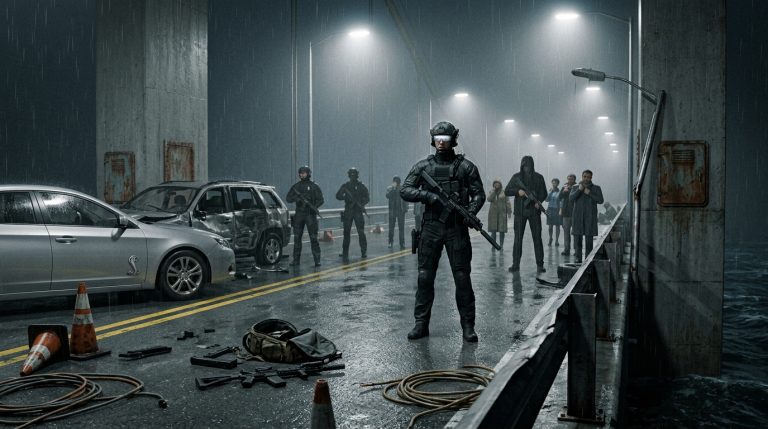
Two tactical intervention cruisers, their headlights blacked out to prevent visual detection, accelerated across the wet lot. Their tires hissed violently against the asphalt, throwing long plumes of gray spray into the air. They weren’t using sirens. They moved with the silent, methodical efficiency of a clean-up detail dispatched to collect a stray piece of equipment.
Nancy didn’t turn back toward the main building. Her internal calculations ran through the remaining structural variables of the base map. The main gates were locked down by Vance’s remote command, but the logistics transit line—the old rail spur used for moving heavy munitions before the automation upgrades—lay seventy yards past the perimeter fence.
She reached the base of the chain-link barrier. The zinc-coated wire was freezing against her fingers, the sharp barbs at the top glistening with drops of oil-slick water. She shoved the clipboard deeper into her jacket pocket, her boots finding leverage in the mesh as she climbed with rapid, mechanical precision.
“Hold your position, Variable One!” a megaphone boomed from the leading cruiser, the sound warped and distorted by the wind.
A heavy spotlights beam hit her square in the back, tracing the outline of her huddling frame against the wire. Nancy didn’t look into the light. She reached the top rail, her hands clearing the rusted barbs with a fraction of an inch to spare, and dropped down into the dark mud of the drainage ditch outside the fort’s official perimeter.
The impact was heavy, the wet earth absorbing the shock but driving a cold shock of pain through her left knee. She rolled once, her hands checking the integrity of the clipboard through the fabric of her coat. The brass frame was intact. The paper was dry.
She scrambled to her feet, her breathing restricted, her chest burning from the sudden burst of exertion. The rain was heavier out here, away from the shelter of the motor pool structures. The wind howled through the open grassland surrounding the rail line, a wide, empty expanse that offered no cover from the tracking arrays Vance possessed.
A shape materialized from the shadow of the concrete rail platform ahead. It wasn’t one of Vance’s tactical guards. It was a single man, his tall figure draped in a dark, saturated trench coat that looked completely black under the rain. He stood perfectly still by the steel tracks, an old-model military signal lantern unlit in his left hand.
Nancy stopped ten paces away, her hand dropping automatically to the reverse grip of her survival knife, her eyes calculating the distance between his stance and the shadow of the platform support pillars.
“The general didn’t stay in the office, Nancy,” General Dominic said, his voice carrying clearly over the sound of the storm as he lifted his right hand. He wasn’t pointing a weapon. He held a weathered, olive-drab logbook—the original manual manifest of Task Force 11 from twelve years ago. “The ledger Vance showed you down there isn’t the only file that survived the valley. But you need to know who wrote the parameters before you try to break the cage.”
Nancy’s grip on the knife didn’t loosen. The rain ran down her jaw, tracing the old scar line as she stared at the general’s face through the dark, cold downpour.
CHAPTER 10: THE LEDGER SETTLEMENT
“You knew the grid went black before the mortar lines were drawn,” Nancy said. Her voice didn’t rise to meet the howling wind; it remained a low, flat rasp that sliced through the rhythmic pelting of the rain.
General Dominic stood unmoving against the iron framework of the platform. The freezing water ran down the brim of his field cap, dripping onto the heavy olive-drab logbook in his hand. Under the harsh illumination of the distant perimeter floodlights, Nancy noticed a microscopic flaw on the book’s binding—a clean, circular void where a brass rivet had been intentionally sheared away, leaving a jagged metal edge.
“I was given a closed tactical loop, Sergeant,” Dominic said. His voice carried the dense weight of structural fatigue. He didn’t reach for a sidearm. His fingers simply tightened against the wet canvas of the manifest. “Command told us the transmission line was destroyed by enemy intercept. We built the memorial wall because the ledger was verified by Variable Group 7. But Vance didn’t write the project authorization code alone.”
He held the logbook out into the space between them, the white pages catching the desaturated glare of the storm.
Nancy took a slow, calculated step forward. Her boots sunk into the freezing mud of the rail bed, her right hand maintaining its absolute reverse lock on the survival knife behind her forearm. Her left arm pressed the stolen brass-rimmed clipboard against her chest, the cold zinc frame biting through her layers of soaked denim and canvas. She looked down at the exposed pages.
The ink was old, faded by twelve years of atmospheric decay, but the structural signatures at the bottom of the operational order were completely unblurred. There were two sign-offs. The first belonged to Captain Vance. The second, rendered in a thick, precise bureaucratic script, bore the validation code of the major who had controlled the command center that exact night.
Dominic, Marcus A.
The physical reality of the trap crystallized in her mind with the sharp, agonizing clarity of an absolute tactical failure. The general wasn’t her witness; he was the primary anchor of the laboratory. The decoy secret—Vance’s black-market logistics ring—was designed to be found if an operator ever broke the primary perimeter, giving them a false target to eliminate while the true architecture remained completely hidden behind a veil of old military grief.
Time dilated, slowing to a mechanical crawl. Every individual drop of rain became a cold, transparent needle suspended in the air. The internal shock didn’t cause her hand to shake. The psychological logic of the Reaper protocol suppressed the betrayal, turning the emotional devastation into pure, kinetic friction.
“You signed the erasure,” Nancy whispered. The words were devoid of anger, carrying only the freezing finality of a operational assessment.
“I signed an allocation order for an undocumented endurance variable,” Dominic said, his gaze fixed on her gray, exhausted eyes. He didn’t try to justify the action, his face a hard mask of weathered stone under the downpour. “We were told the data would save the next deployment tier. They needed a control subject who wouldn’t stop running. If I let you cross this track tonight, Nancy, they terminate the project files completely. The names on that wall disappear from the institutional memory. Evans becomes a ghost with no record.”
“He’s already a ghost,” Nancy said.
She surged forward, her body weight driving through the mud as her scuffed boot struck the iron rail with a sharp, ringing note of metal-on-metal friction. She didn’t aim for his throat. Her knife hand zipped upward in a short, blinding arc, the serrated tip catching the heavy canvas cover of the logbook, slicing the binding completely in half. The white pages tore away in the wind, scattered instantly into the black rain across the tracks.
Before Dominic could react to the mechanical speed of the strike, the headlight beams of the tactical intervention cruisers cut over the top of the drainage ditch. The vehicles roared onto the gravel parallel to the tracks, their doors flying open as Vance’s containment team deployed with their weapons raised.
Nancy didn’t look back at the lights. She pivoted on her heel, her fingers ripping the brass-rimmed clipboard from her coat and hurling it directly into the iron grid of the rail terminal’s automated electrical transformer box twenty feet away. The metal frame jammed between the high-voltage busbars.
A massive, blinding blue-white explosion shattered the darkness of the north gate. The transformer erupted in a cascade of molten copper and sparks, the systemic short-circuit instantly blowing the primary power grid for the entire northern sector of Fort Harrison. The floodlights died. The surveillance trackers went black. The base was plunged into a total, absolute darkness.
In the blinding void, Nancy didn’t hesitate. She turned away from the general and the closing tactical team, her boots hitting the sharp gravel of the rail bed as she ran into the open, unmonitored dark of the grassland beyond the fence line, her M65 jacket heavy with rain, her profile finally wiped from the ledger.