The Iron Chief: Cold Retribution and the Fall of the Suburban Empire
CHAPTER 1: SILENT BREACH
The glow of the smartphone screen burned hot against the dark hospital room.
On the live feed, the shadows near the tree line moved wrong. A flatbed tow truck sat idling without its warning strokes turned on. That was the first anomaly. Professional operators run lights. Scrappers operating in the dark don’t.
Marcus Vance clicked the solid-brass tire pressure gauge between his knuckles. Click. Snap. The metal was cold. It anchored the throb in his cracked ribs.
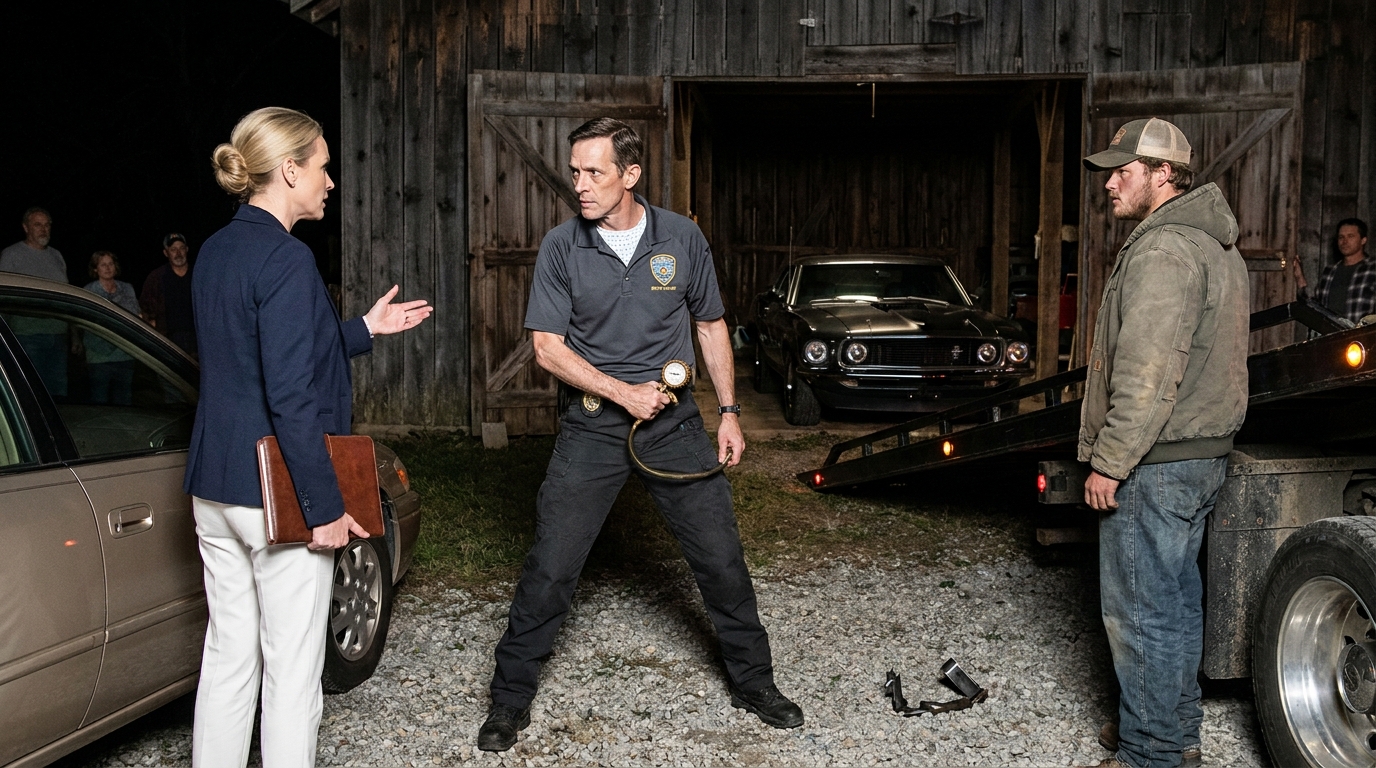
Two men stepped into the camera’s night-vision arc outside his storage barn three miles past the township line. One wore a heavy canvas jacket. The other was younger, wearing an oversized baseball cap.
Tyler Caldwell. The HOA president’s son.
Tyler pointed a yellow battery-powered angle grinder at the heavy steel door clasp of Barn Four. Beside him, leaning against the fender of a beige sedan, stood Lena Caldwell herself. She held a clipboard, her manicured thumb tapping against the aluminum edge in a rhythmic, impatient beat.
They were cutting the hardened lock on private land outside the association’s jurisdiction.
Marcus didn’t call the dispatcher on duty. He didn’t yell. He pulled the brass gauge down, checking the digital timestamp on the bottom left corner of the video. 02:14:09 AM.
The sparks jumped on screen—a bright, white spray against the monochrome feed.
Marcus’s thumb moved across the screen, zooming in on the truck’s rear bumper. No commercial plates. Just a dealer tag hanging crookedly from a single bolt. He tapped the record button, locking the clip into a encrypted local partition labeled Parcel-88.
Lena Caldwell knew he was lying in Ward 3B with two broken ribs and a concussion from an off-duty T-bone impact. She had sent flowers that afternoon. Pink carnations with a card signed: The Community Prays for Your Swift Recovery.
On screen, the heavy chain hit the gravel. The barn doors swung wide.
Inside sat a pristine 1969 Mustang Mach 1 and a restored Chevy C10. Five years of frame-off restoration work. Three hundred thousand dollars in steel, muscle, and memory.
Tyler backed the flatbed up to the threshold. He didn’t use winch straps. He used a heavy log chain, wrapping it straight around the Mustang’s front control arm. Metal scraped on metal—a sound Marcus could practically feel through his teeth.
“Keep going,” Marcus whispered to the empty room. “Take the truck too.”
Lena didn’t look at the cameras. She thought the barn was dark property. She thought a bedridden neighbor was just a quiet guy who worked night shifts for the city. She didn’t know the quiet guy was Chief of Police. She didn’t know every inch of that perimeter was hardwired directly to a private server.
The Mustang rolled onto the tilt-bed. The truck’s hydraulics groaned under the weight.
Marcus set the phone face down on the swinging tray table beside his cold tea cup. He picked up his personal cell, dialing his private legal counsel.
“David,” Marcus said when the line picked up on the third ring. His voice didn’t rise. It stayed flat, heavy, and level. “She took the Mustang.”
“Are you sure it’s her?” David’s voice was thick with sleep.
“I have her on feed holding the clipboard while her boy runs the grinder,” Marcus said, his eyes tracking the silent, flashing monitor on his chest. “File the emergency hold on Parcel-88. Don’t touch the township court. Go straight to the county judge.”
“She’s going to claim it was an abandoned property abatement,” David warned. “She’s been laying paper trail in the neighborhood newsletter for two weeks.”
“Let her lay it,” Marcus said. “The deeper the hole, the harder the dirt hits her when we fill it.”
He hung up.
On the screen, the tow truck pulled away, its tail lights disappearing down the unlit gravel lane. The storage barn stood open, its broken lock glinting in the dirt like a dropped shell casing.
Marcus reached out, picked up the brass gauge, and clicked it once more against his palm.
CHAPTER 2: THE PAPER TRAP
The fluorescent bulb in Ward 3B hummed at sixty cycles, a low, maddening vibration that rattled the glass water pitcher on my bedside table. I kept my fingers wrapped tight around the brass gauge, pressing the knurled edge into my palm until the dull sting offset the fire in my cracked ribs.
On the nightstand, my phone vibrated twice against the Formica top.
I didn’t reach for it right away. I let it buzz out, then picked it up with a slow, deliberate movement. The notification header read: NEW MESSAGE – OFFICIAL NOTICE.
The sender address was framed in clean, corporate lettering: [email protected]. A domain I had never seen in six years of living in the subdivision.
I opened the message. Attached was a single PDF document titled NOTICE_OF_ABATEMENT_PARCEL88.pdf. The body text was typed in cold, bureaucratic prose:
Mr. Vance,
Pursuant to Article 4, Section 12 of the HOA Bylaws, unauthorized storage of non-operational mechanical equipment on designated residential or adjacent agricultural easements constitutes a public hazard. Attached is the formal authorization to remove abandoned assets from your property at Parcel-88. Please sign and return within 24 hours to avoid secondary administrative fees.
I stared at the screen, my breath catching against the tight elastic wrap binding my chest.
Parcel-88. There it was.
The barn didn’t sit inside the association’s boundary map. The township land registry had marked that four-acre plot as unincorporated agricultural real estate twenty years before Lena Caldwell ever bought her brick colonial down the street. She had taken a parcel code from the county GIS portal and slapped it onto an official-looking letterhead to give her son a shred of cover for cutting my lock with an angle grinder.
I didn’t hit reply. I didn’t type out a furious warning. In law enforcement, when an amateur hands you a forged instrument, you don’t correct their spelling—you archive the file.
I long-pressed the attachment, saved the raw document to my local drive, and pulled up the embedded metadata properties.
I let out a slow, shallow breath. The timestamp on the file modification was one hour before her son pulled his flatbed up to my barn. She had drafted the “notice” after she had already dispatched the truck, then edited the file name after the Mustang was already on the chains to match the county land code.
A soft knock sounded at the door frame.
David walked in, his rain-dampened trench coat smelling of wet wool and cheap coffee. He carried a battered leather briefcase under his arm. He didn’t take off his coat. He just pulled the vinyl visitor’s chair closer to the bed, his wingtip shoes squeaking softly on the linoleum floor.
“You look like hell, Marcus,” he said, dropping the briefcase onto the end of my mattress.
“I’ve got full mobility in my right arm,” I said, my voice gravel-rough. I turned the phone toward him, showing him the metadata summary. “Read the author line.”
David leaned forward, squinting through his bifocals. His eyebrows twitched once. “She didn’t even bother spoofing the user profile. She generated this on her personal machine.”
“She thinks she’s running a neighborhood committee,” I said. “She thinks rules are things you type up in Word and print on heavy paper to scare retired accountants. She doesn’t understand chain of custody.”
David unbuckled his briefcase and pulled out a manila folder. “It gets worse. I checked the clerk’s office on my way over. Lena filed an administrative hold with the county sheriff’s civil division at 8:00 AM under a local ordinance clause called The Apex Lien.”
I paused, the brass gauge frozen between my thumb and forefinger. “The Apex Lien? That’s a commercial scrap protocol for industrial yards. It doesn’t apply to private titled vehicles.”
“It does if the applicant signs an affidavit stating the property owner is deceased, missing, or unresponsive,” David said, dropping a stamped copy of the filing onto my blanket. “Look at line four.”
I flipped the page open. There, in shaky, hurried blue ink, was Lena Caldwell’s signature under the line marked AUTHORIZED LAND AGENT. Plastered across the top corner was a rubber stamp reading: PENDING SCRAP PROCESSING – INTAKE-9.
My fingers went rigid against the paper. Intake-9. A county impound code used exclusively by specialized salvage yards across the river.
She wasn’t just trying to tow my cars to a municipal lot to collect a two-hundred-dollar HOA fine. She was pushing them through an accelerated salvage pipeline before I could get out of this hospital bed with a signed discharge order.
“She’s moving fast because she knows I’m trapped in this room,” I said, the words coming out cold and flat. “She thinks if the cars are crushed or stripped by Friday, the evidence disappears into a scrap manifest.”
“What do you want to do?” David asked. “I can file an emergency injunction right now, but the magistrate won’t review it until Thursday morning.”
“No,” I said, reaching over to tap the PDF on my phone screen. “Don’t file the injunction yet. If we file now, her lawyer tells her to stall the scrap yard, and she buries the paper trail. I want her to think her filing went through cleanly.”
“Marcus, that Mustang is worth eighty grand. The truck is worth fifty. If they hit the shear—”
“They won’t hit the shear,” I interrupted. “A salvage buyer paying scrap prices for a hand-restored 1969 Mach 1 isn’t going to crush it. They’re going to clean the VIN, print a fraudulent bill of sale, and ship it out of state.”
I pulled up my private contact list, scrolled down past the department supervisors, and stopped on a line marked County Registry – Direct.
“I’m sending an official email from my Chief account,” I said softly, the screen casting a pale blue light across the hospital sheets. “Not a cease-and-desist. A formal evidence preservation order directly to the yard holding Intake-9.”
“And Lena?” David asked, watching me closely.
“I’m going to reply to her email,” I said.
I clicked the reply button on the [email protected] thread. I kept the response down to six words:
Received. I am reviewing the boundary maps.
I hit send.
“That’s it?” David frowned. “You’re giving her green light confidence?”
“I’m giving her rope,” I said, laying the phone back down on the tray table. The brass tire gauge clicked one final time against my palm. “When a predator thinks the prey can’t move, they stop watching their back.”
CHAPTER 3: THE PUBLIC STIGMATIZATION
The six words hit her inbox like a dull stone dropping into stagnant water.
David left Ward 3B twenty minutes later, his leather briefcase tucked under his arm, leaving me alone with the steady thump-thump of my pulse monitor. I didn’t sleep. Every time I shifted my shoulders, the elastic rib binder bit into my side, reminding me that moving fast was out of the question for another forty-eight hours.
By three o’clock that afternoon, Lena made her counter-move.
She didn’t write back to my email. She bypassed my inbox entirely and blasted a neighborhood-wide bulletin through the HOA’s digital community portal.
My phone buzzed on the tray table. A push notification popped up: COMMUNITY SAFETY ALERT: UNPERMITTED BLIGHT & HAZARD ABATEMENT.
I pulled the screen close.
Dear Neighbors,
As part of our ongoing effort to protect property values and maintain safety across all adjacent tracts, the Board has initiated formal nuisance abatement proceedings regarding several unregistered, non-operational vehicles stored at an unapproved off-site facility.
Regrettably, the property occupant has chosen a hostile posture, ignoring multiple courteous compliance notices. To prevent further devaluation of nearby homes, the Association has exercised its statutory rights under county environmental guidelines. The assets are currently undergoing administrative processing under Intake-9 protocol.
Thank you for your continued cooperation in keeping our neighborhood beautiful.
— Lena Caldwell, HOA Board President
I stared at the black-and-white lettering. She was building a public wall around herself. By framing a grand theft as a civic service, she was betting that none of the retired accountants or weekend gardeners in Oakridge Manor would ever ask to see the physical land registry maps for Parcel-88. She was turning my silence into proof of guilt.
A shadow crossed the frosted glass panel of my room door.
It opened without a knock.
Lena stood in the doorway. She was dressed in a tailored navy blazer and crisp white trousers, carrying a leather binder tucked against her ribcage. Her blonde hair was pinned back in a tight, motionless bun. On her face was the serene, practiced smile she used when presenting monthly financial reports to fifty anxious homeowners.
“Marcus,” she said smoothly, stepping into the room. She didn’t close the door behind her. She kept it cracked open—a calculated posture to ensure any raised voice would carry down the hallway. “I saw the police cruiser parked downstairs. I thought I’d bring you your mail in person.”
She dropped a thick, manila envelope onto the edge of my blanket.
I didn’t reach for it. My right hand stayed flat on the mattress, my thumb resting against the cool brass cylinder of the tire pressure gauge tucked beneath the sheet.
“You shouldn’t be walking around on those ribs,” she continued, her tone dripping with maternal concern. “The board was very distressed to hear about your accident.”
“The board didn’t cut the lock on Barn Four, Lena,” I said. My voice was low, devoid of volume, carrying only the hard edge of a sworn officer holding a recorded confession. “Tyler did.”
Her smile didn’t break, but her eyes narrowed by a fraction of a millimeter. Her thumb tapped once—a sharp, plastic clack—against the binder’s edge.
“Tyler was acting as an authorized contractor for the association,” she said quietly, leaning over the foot of the bed. Her voice dropped, stripping away the public warmth. “That structure sits on an easement that impacts the drainage profile for the whole south ridge. Unregistered iron leaking oil into the water table isn’t something I can ignore just because you happen to wear a badge during the day.”
“Parcel-88 sits outside the township line,” I said. “You pulled a tax ID off the county portal, attached it to a commercial scrap form under The Apex Lien, and forged the land agent line.”
Lena’s posture didn’t falter. She took a half-step closer, her eyes locked on mine with cold, absolute certainty. She believed her own structure. She had spent ten years dictating grass heights and mailbox paint codes to people who lacked the spine or the money to fight her. To her, a law was simply whatever paper she stamped first.
“You’re confused, Marcus,” she whispered. “The medication must be heavy. The county clerk accepted the filing at eight this morning. The vehicles are already logged under Intake-9 at the river processing facility. By the time your lawyer gets a motion in front of a circuit magistrate on Thursday, those titles will be cleared and closed.”
“You think the yard is going to process a 1969 Mustang Mach 1 as scrap metal,” I said.
“I think a non-operational vehicle without a valid local registration on an abated tract becomes county property after seventy-two hours,” she replied, her voice smooth as glass. “And as the designated agent, the association receives the salvage dividend to cover our legal fees. It’s all in the bylaws. Page forty-two.”
She reached out, patted the edge of my mattress with a manicured hand, and straightened her blazer.
“Get some rest, Chief,” she said, emphasizing the title with a faint, mocking tilt of her head. “Don’t stress over a couple of old cars. The neighborhood is taking care of it.”
She turned and walked out, her heels clicking softly on the linoleum until the sound faded down the corridor.
I lay in the quiet room for three long seconds.
Then I pulled my phone from under the pillow and tapped the screen. The recorder app had been running since the door first opened. The waveform sat frozen, a crisp series of spikes capturing every word, every whisper, and the exact moment she acknowledged placing the vehicles under Intake-9.
I forwarded the raw audio file straight to David’s secure drive.
I pulled myself upright, my chest muscles screaming as the rib binder strained against my ribs. I swung my legs over the edge of the mattress. My feet hit the cold floor tiles.
The trap was set. She had publicly committed to the theft. She had placed her signature on a forged county document, bragged about it in a community bulletin, and confessed her intent on tape in Ward 3B.
I reached for my street clothes hanging in the small corner closet. It was time to leave the hospital.
CHAPTER 4: THE INTERROGATION ROOM TRAP
The fabric of my wool uniform trousers scraped over the bandage wrapping my ribs as I pulled my belt tight. The pain in my side was sharp, a dull needle driving deeper with every intake of air, but I didn’t slow down. I laced my boots, grabbed my badge case, and checked out of Ward 3B against medical advice.
An hour later, the rain was smearing the double-paned glass of my corner office at the municipal station.
Rainwater dripped off the brim of my cover onto the dark oak desk. I didn’t sit down. Standing kept the ribs straight. In my right hand, I held a blue manila application folder labeled CALDWELL, TYLER – CANDIDATE FILE #409.
Tyler had applied for an auxiliary reserve spot three months ago. The board had scheduled his interview for four o’clock today. He thought he was walking into a routine background review with a low-tier desk sergeant. He didn’t know I had taken over the panel forty minutes prior.
A knock rattled the frosted glass door.
“Come in,” I said.
Tyler stepped inside. He wore a crisp navy blazer over a light blue Oxford shirt, his hair combed flat and damp from the parking lot. He carried himself with the easy, slouched arrogance of a kid who had spent his whole life watching his mother make problems disappear with a single phone call.
He stopped three feet from the desk, his eyes dropping to the brass nameplate sitting beside my blotter: CHIEF MARCUS VANCE.
His posture froze. The casual smirk on his lips flickered, then collapsed into a flat, rigid line. His right hand, extended for a handshake, hovered mid-air before dropping back to his seam.
“Chief Vance,” he said, his voice cracking slightly on the second syllable. “I… I thought I was meeting with Sergeant Miller.”
“Miller is on road patrol,” I said. My voice didn’t carry warmth. It sounded like gravel tumbling down a iron chute. “Sit.”
He pulled out the heavy oak armchair, his leather-soled shoes slipping slightly on the waxed floor. He sat on the front edge, his knees locked together, his knuckles white as he gripped his own kneecaps.
I opened the manila folder. I didn’t look at his resume. I pulled out a three-page printout of high-resolution video stills captured from the infrared camera outside Barn Four on Parcel-88.
I slid the first sheet across the desk. It caught the light—a crisp, black-and-white frame showing a young man in an oversized baseball cap aiming a cordless angle grinder at a hardened steel door clasp.
Tyler’s eyes dropped to the paper. His chest hitched in a single, shallow gasp. He pulled his hands back from his knees, his thumbs nervously rubbing the raw skin beside his nails.
“That’s a nice grinder, Tyler,” I said softly. “DeWalt 20-volt. High torque. Takes about ninety seconds to bite through a three-quarter-inch shackle if you keep the blade wet.”
“Chief, look—”
“Don’t interrupt,” I said. I slid the second sheet across.
This one showed the flatbed tow truck backed up to the opened bay, the log chain wrapped directly around the front control arm of the 1969 Mustang Mach 1. The dealer tag on the rear bumper was fully visible: COMMERCIAL TRANSIENT #88-B.
“You didn’t use a rubber-coated sling,” I continued, leaning over the desk until my face was eighteen inches from his. “You used a tow chain on a painted control arm. You scratched forty hours of custom lacquer down to the bare primer.”
Tyler’s mouth opened, then shut. The color was draining out of his cheeks, leaving his skin a pale, sallow gray under the fluorescent tubes.
“My… my mom said the property was abandoned,” he stammered, his fingers twitching against his blazer pocket. “She had the paperwork. She had the municipal abatement order from the HOA board. She said we were clear under The Apex Lien.”
“Your mom is an HOA president, Tyler. She doesn’t hold municipal authority, she doesn’t own the agricultural easement on Parcel-88, and she can’t authorize a trespass on private property three miles outside her subdivision.”
I pulled out the third sheet. It was a copy of the intake receipt from the scrap yard across the river, stamped INTAKE-9. The signature at the bottom was written in heavy, blue ballpoint ink: TYLER CALDWELL – SELLER OF RECORD.
“You signed the bill of sale as the authorized agent,” I said. “You took a fifteen-hundred-dollar earnest check from an unlicensed scrap buyer for an eighty-thousand-dollar automobile.”
“I didn’t take the money!” Tyler blurted, his voice spiking into a frantic tenor. He leaned forward, his hands slamming down onto the edge of my desk before he caught himself and yanked them back. “I didn’t touch the check! The buyer gave it directly to her! She said we had to move the cars before Thursday because the buyer had a transport flatbed coming from out of state!”
I stopped. The room went dead quiet except for the rain hammering against the glass.
A transport flatbed coming from out of state.
This wasn’t a local spite move by a bitter neighborhood dictator trying to clear a visual nuisance. Lena hadn’t arranged a scrap crush under Intake-9 to collect a three-hundred-dollar HOA violation fee. She was flipping high-value classic titles directly to an organized interstate transport network, using her position on the board to generate false paper trails for stolen iron.
“What transport line, Tyler?” I asked, my voice dropping an octave lower.
He swallowed hard, his throat moving against his collar. “I… I don’t know the company name. Some outfit running out of the industrial park near the rail line. She had three other VIN clearances on her desk yesterday stamped with the same code.”
He reached into his inner jacket pocket, his hands trembling so violently he nearly dropped his wallet, and pulled out a folded yellow carbon receipt.
“She told me to keep the gate pass in the truck,” he whispered, looking up at me with wide, terrified eyes. “She said if anyone asked, we were just clearing municipal junk.”
I took the carbon receipt from his hand.
Across the top line, typed in purple ink from a dot-matrix printer, was the buyer’s corporate destination: VANGUARD AUTO LOGISTICS – INTERSTATE MANIFEST #09.
The decoy secret was gone. Lena wasn’t a petty bureaucrat misusing local codes. She was the front face for a commercial car-jacking ring operating behind the shield of suburban property enforcement.
I folded the yellow receipt, placed it inside my pocket beside my brass tire gauge, and picked up the desk phone.
“Sergeant Miller,” I said when the line picked up. “Bring a transport unit to my office. We have a suspect in custody for grand larceny auto.”
CHAPTER 5: THE INJUNCTION EXECUTION
Sergeant Miller’s hand closed over Tyler Caldwell’s shoulder, turning him toward the holding cell door. Tyler’s boots dragged across the floorboards, leaving gray scuff marks on the wax.
Eighteen hours later, the humidity in Circuit Courtroom 4B tasted like old paper and stale wool.
Outside the high arched windows, a steady rain beat against the glass. Inside, Lena Caldwell sat at the primary defense table, flanked by a high-priced civil litigator who kept tapping his gold fountain pen against an unopened leather brief. Lena wore a pearl necklace over a cream wool dress. Her posture was flawless, her hands clasped loosely over a fresh copy of the HOA bylaws. She looked like a woman attending a charity gala, not a respondent named in an emergency injunction.
David sat beside me, spreading our exhibits across the oak surface: three high-resolution security stills, the metadata analysis, the audio file transcript from Ward 3B, and the yellow carbon receipt marked VANGUARD AUTO LOGISTICS.
My chest binder bit hard into my ribs every time I shifted my weight, but I sat straight, my uniform jacket buttoned tight.
Judge Aris Thorne clicked his reading glasses into place and looked over the bench.
“Counsel,” Judge Thorne said, his voice a low rumble. “This is an emergency hearing for a temporary restraining order and asset preservation writ filed by Chief Marcus Vance against the Oakridge Manor Homeowners Association and Lena Caldwell personally. Petitioner, proceed.”
David stood up. He didn’t use florid rhetoric. He walked to the center rail, carrying a single manila folder.
“Your Honor,” David said. “The respondent claims she exercised municipal hazard abatement rights over non-operational vehicles stored at Parcel-88. She generated a forged notice using an administrative account on her personal laptop, filed a fraudulent affidavit under The Apex Lien, and routed titled personal property into a commercial salvage pipeline under Intake-9.”
Lena’s attorney stood up smoothly, adjusting his cuff links. “Objection, Your Honor. The association acted strictly within its fiduciary duty to protect community drainage and property values. Mr. Vance’s equipment was untagged, hazardous, and abandoned.”
“It was locked inside a private barn three miles outside your association’s geographic boundary map,” David countered flatly. He placed the first exhibit onto the clerk’s bench. “This is the certified GIS parcel map from the county land registry. Parcel-88 is unincorporated agricultural property. The HOA holds zero jurisdiction.”
Judge Thorne adjusted his glasses, scanning the map. He turned his eyes toward Lena. “Ms. Caldwell, did you verify the parcel boundary before issuing the abatement directive?”
Lena leaned toward her attorney’s microphone, her voice smooth, poised, and unbothered. “Your Honor, as board president, I relied on county GIS portal prints provided during our annual drainage review. If there was a technical boundary overlap, it was a clerical misinterpretation, not a willful trespass.”
She was still fighting. She was offering a soft, bureaucratic defense—treating grand larceny as an honest administrative error.
I reached into my pocket, pulled out the yellow carbon gate pass, and handed it to David.
“Your Honor,” David said, stepping forward. “If this were a simple boundary error, Ms. Caldwell would have routed the vehicles to the municipal impound lot on Fifth Street. Instead, forty-eight hours ago, her son delivered the petitioner’s 1969 Mustang Mach 1 to a private yard under Intake-9.”
David dropped the yellow carbon pass onto the clerk’s desk alongside the recorded audio transcript from my hospital room.
“Furthermore,” David continued, “we have sworn testimony from Tyler Caldwell, taken yesterday at the municipal station. Ms. Caldwell didn’t file for salvage abatement to clean a drainage easement. She brokered a direct private sale to Vanguard Auto Logistics—an unlicensed interstate vehicle transport network operating out of the rail corridor.”
Lena’s attorney froze. The gold pen slipped from his fingers, clattering loudly against the mahogany table.
Lena’s head snapped toward our table. The serene, practiced composure on her face fractured. Her cheeks flushed dark red, her jaw tightening until the tendons in her neck stood out like cords.
“That’s an absurd accusation!” she snapped, forgetting the microphone in front of her. Her voice cracked, losing its polished cadence. “Tyler was simply assisting with contractor logistics! He doesn’t know anything about transport filings!”
“Sit down, Ms. Caldwell,” Judge Thorne warned, his tone dropping into dangerous territory.
“He’s lying!” Lena insisted, her hand slamming onto the table, rattling her attorney’s water glass. “Marcus Vance is using his badge to intimidate a volunteer board! The cars were a public blight!”
“Ms. Caldwell,” Judge Thorne repeated, his voice sharp as a razor. “One more outburst and I will hold you in summary contempt.”
The courtroom fell dead silent.
Judge Thorne picked up the yellow gate pass, comparing the serial number to the clerk’s stamp on The Apex Lien filing. He read the metadata analysis showing the file creation on her personal laptop at 11:42 PM, followed by the recorded transcript where she explicitly confirmed the Intake-9 placement.
He set the papers down slowly, folded his hands, and looked straight at Lena.
“This court finds clear and convincing evidence of bad faith, systemic overreach, and fraudulent execution under color of private authority,” Judge Thorne declared. “The petition for an emergency restraining order is granted in full.”
He picked up his pen and signed the order with three heavy strokes.
“Effective immediately,” Thorne continued, “all abatement proceedings tied to Parcel-88 are nullified. A writ of replevin is issued for the immediate release of all seized property held under Intake-9. Furthermore, this court refers the record of these proceedings—including the filings under Vanguard Auto Logistics—to the State Attorney’s Office for criminal investigation into grand theft and document forgery.”
Gavel slam.
The sharp crack of hard oak resonated through the room.
Lena sat frozen in her leather chair. Her breath came in short, shallow hitches. The pearls around her neck shifted as her chest rose and fell. She looked down at her hands, which were trembling violently against the polished wood.
Her attorney leaned over, whispering frantically in her ear, but she didn’t answer him. Her eyes were fixed on the yellow carbon receipt sitting on the clerk’s bench.
I stood up slowly, my hand resting flat against my ribs to brace against the ache. I didn’t smile. I didn’t speak to her as she sat defeated between her legal team. I simply picked up my coat, turned my back on the defense table, and walked out of the courtroom beside David into the cool, rain-washed corridor.
CHAPTER 6: THE RECLAIMED STEEL
The heavy rain had slacked to a fine mist by the time David and I reached the county impound lot on the edge of the rail corridor.
Water dripped from the brim of my cap as the yard manager—a burly man in a grease-stained canvas jacket—scanned the signed court order resting on his clipboard. He looked at the judicial seal, then at my badge, and handed over the master gate key without uttering a word.
“Bay Four,” the manager said, pointing toward a corrugated steel barn at the back of the lot. “They were marked under Intake-9 for transfer to Vanguard Auto Logistics at six tonight. Transport flatbed was already idling at the spur.”
I took the key. “Not anymore.”
We walked down the gravel lane, our boots crunching against the wet stone. Inside Bay Four, the 1969 Mustang Mach 1 and the Chevy C10 sat side-by-side beneath the overhead sodium lights. The body lines were intact. The custom paint on the Mustang’s fender bore a long, thin scrape near the lower control arm—the physical mark left by Tyler Caldwell’s log chain—but the iron was home.
David stood by the bumper, running a finger along the chrome trim. “State Attorney’s office called while we were driving over. They served Lena at her house an hour ago. Forgery, grand larceny, and conspiracy to traffic stolen property through municipal filings. Her lawyer is already trying to cut a plea for Tyler.”
“Tyler signed the bill of sale under The Apex Lien,” I said, stepping up to the driver’s door. “He’s going to serve time.”
“And Lena?” David asked.
“The HOA board held an emergency meeting at three,” I said, pulling the Mustang’s heavy door open. The familiar scent of aged leather and high-octane fuel filled the damp air. “They voted unanimously to strip her position, audit six years of financial records, and retain outside counsel. Her house is going on the market to cover the association’s legal exposure.”
I sat in the driver’s seat. The engine turned over on the first crank, a deep, rumbling roar vibrating through the floorboards and echoing off the tin walls of the bay. The vibration rattled against my sore ribs, but the pain felt different now—grounded, finite, and earned.
Twenty minutes later, the flatbed transport I hired backed into the gravel lane outside Barn Four on Parcel-88.
The afternoon sun broke through the gray clouds, casting long, sharp shadows across the four-acre agricultural plot. The broken shackle from Tyler’s angle grinder still lay in the dirt near the doorway, rusting in the damp grass.
I unbolted the damaged door clasp using a heavy socket wrench, my movements slow and methodical. I replaced the sheared plate with a five-eighths-inch hardened steel bracket, drilling three fresh anchor holes straight into the oak frame.
David stood by the rear bumper of his sedan, watching me work. “You could have let the township road crew handle the lock replacement.”
“My land,” I said flatly, tightening the final nut until the steel plate locked flush against the timber. “My lock.”
I backed the Mustang inside, guiding the tires over the concrete sill until the car rested in its original spot. The C10 followed, its dual exhaust humming quietly before I cut the ignition and pulled the key from the barrel.
I stepped back out onto the threshold, pulled a brand-new, weather-sealed brass padlock from my coat pocket, and looped it through the heavy bracket.
I didn’t think about the HOA bulletins, the forged metadata, or the quiet hostility of the neighborhood portal. The suburban empire Lena Caldwell had built out of petty fines and forged paper had collapsed against the hard edge of real law.
I pressed the shackle home. Snap. The lock engaged with a clean, solid thud.
I turned the brass key, slipped it into my pocket alongside my tire pressure gauge, and looked out over the quiet boundary line of Parcel-88. The air was clean, cold, and still.