The Frozen Fence Line and the Price of Unyielding Iron
CHAPTER 1: THE SHATTERED BARRIER
The six-gauge wire didn’t just snap. It sheared clean under forty tons of hydraulic momentum.
I stood five paces back from the corner post, my glove resting on the frozen top rail. The yellow plow blade hit the cedar timber at twenty miles an hour. The crack sounded like a rifle shot in the dead air. Splinters sprayed across the ice, pinning a section of woven mesh flat into the frozen mud.
Before the snow settles, the air fills with blue diesel exhaust. Behind the lead truck, two tandem-axle dumps reverse in tight formation. Beep. Beep. Beep. The backup alarms cut through the howling gale with mechanical rhythm.
Their tailgates unlatch with a heavy iron clatter. A gray avalanche slides out—crusted road slush, rock salt, and dark engine oil scraped from five miles of suburban asphalt. It hits the pasture floor with a wet, heavy thud, burying forty feet of winter rye in three seconds flat.
My fingers slide into my coat pocket. They wrap around a heavy, rusted iron fence staple. The sharp, jagged points bite through the thin leather of my work glove, anchoring my palm. Cold metal against burning skin.
The lead bull, a twelve-hundred-pound Angus cross, slams his flank against the barn gate. Wood groans. His nostrils flare, blowing white plumes of steam as his hooves slide out on the crusted ice near the feed trough. Behind him, three young steers crowd into the corner, eyes wide, rolling back until the whites catch the yellow floodlights of the idling trucks.
“Get them back!” I shout. My voice gets swallowed whole by the turbochargers spooling up for another dump.
A red BMW 7-Series rolls through the gap where the corner post used to sit. Its low-profile tires crunch over the crushed cedar splinters. It stops precisely three feet short of the mud line.
The driver’s door opens. Clean leather smell cuts through the stench of burnt diesel.
Evelyn Vance steps onto the ice. Her black calfskin boots don’t slip. Her coat is double-breasted wool, bone-white, completely untouched by the horizontal snow. She holds a single sheet of paper in a clear plastic sleeve.
“You’re in the way, Thomas,” she says. Her tone carries no heat. It’s the flat, rehearsed cadence of a county auditor reading a foreclosure notice.
“This is active pasture,” I say. I don’t raise my hands. I don’t close the gap between us. I keep my thumb pressed against the sharp point of the iron staple in my pocket. “That’s road salt. My stock drinks from that ditch.”
She doesn’t look at the ditch. She doesn’t look at the bull currently bleeding from a four-inch scrape on his hip where he hit the gate latch. She raises the plastic sleeve.
“Emergency Winter Safety Authority,” she reads, her eyes scanning over the top of the paper. “Temporary land seizure for municipal hazard mitigation. Section 4, Paragraph B.”
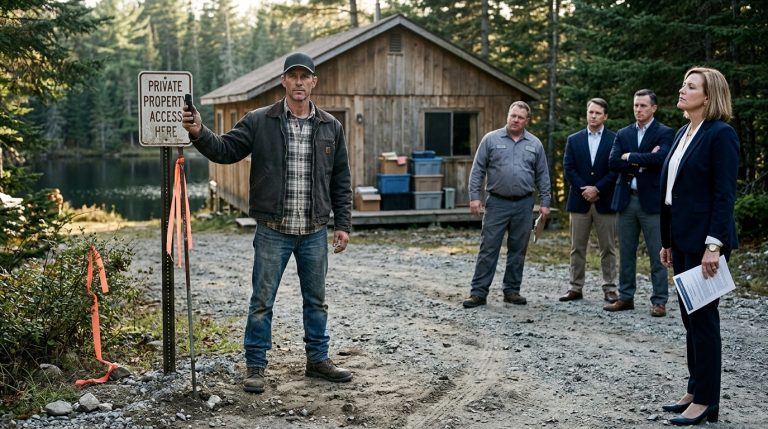
“This is private deeded ground,” I say. “Parcel 409-B. It’s been in my family for sixty years.”
“It’s an operational necessity,” she corrects softly. She folds the paper with two crisp, measured flips. “The subdivision roads must remain clear. We don’t have another designated staging area within three miles.”
Behind her, the second dump truck lifts its bed. Ten tons of filthy, chemical-laden slush cascade directly over the foundation wall of my winter shelter. Inside the dark doorway, my wife stands wrapped in three layers of canvas, her hands trembling as she pulls a rope lead around a panicking calf.
“You have ten minutes to clear your livestock from the primary drop zone,” Evelyn says. She turns back toward the BMW. Her hand rests on the door handle, her fingernails painted a dark, dry crimson. “Or the county contractors will clear them for you.”
“Who signed this?” I ask.
She pauses. A slight shift in her shoulders—less than an inch—before she looks back over her collar.
“The board,” she says. “Consensus was unanimous.”
She slips into the heated cabin. The heavy door seals with a soft, airtight thud. The red taillights flare, reflecting off the rising wall of dirty snow as the car reverses back toward the road.
I stand in the gap of the shattered fence. The iron staple in my palm feels hot now. I don’t pull my hand out of my coat. I just watch the rear tires of the lead truck spin against the ice, grinding deeper into my soil.
CHAPTER 2: POISON IN THE SOIL
The exhaust hits my throat first—a sour, heavy cloud of unburnt diesel that hangs thick in the sub-zero air.
I don’t move out of the gap. My boots are sunk three inches into the slurry where the road salt is already melting the frozen topsoil into black, oily muck. The third dump truck, a ten-ton tri-axle with rust eating through its wheel wells, grinds its reverse gear. The twin chrome stacks blast another plume straight into the icy wind.
On the driver’s door, under a thick layer of road grime, a clean magnetic decal catches the glare of the work lights: Vanguard Mutual Staging & Logistics. No phone number. No dot-number printed along the rocker panel. Just the corporate stencil pressed over fresh paint.
The driver doesn’t look at the rear mirrors. He relies purely on the high-pitched beep-beep-beep of his warning horn.
“Hold!” I yell, stepping two inches deeper into the ditch line.
The truck doesn’t slow. The driver’s side mirror is frosted over with road spray, but through the side glass I catch the silhouette of a kid no older than twenty-two, one hand on the wheel, a lit cigarette dangling from his mouth, his eyes glued to the glowing screen of his smartphone resting against the dash.
I pull my right hand out of my coat pocket. The rusted fence staple stays clutched in my left palm, but my right hand comes up hard, palm out, slamming flat against the passenger-side tailgate as the steel bumper clears my chest by six inches.
The thud rattles through the tailgate hinge. The truck jerks to a stop, air brakes releasing with a sharp, deafening hiss.
The kid rolls down the hand-crank window three inches. Cold air rushes into his cab. “Get out of the blind spot, old man! You want to get folded under a tire?”
“You’re twenty feet past the easement line,” I say. My voice is level, flat, scraped raw by the cold. “That ditch feeds the lower pond. You dump that road sludge there, and the chemical runoff sits in the water table until spring.”
“I don’t know nothing about a ditch,” the kid spits out the window, his cigarette ember glowing bright red. “I got thirty tons of salt-scrapings from the commercial strip on my bed, and the dispatcher said dump it on the open parcel. Move your ass.”
“Who’s your dispatcher?”
“Vanguard,” he says, flicking ash onto my boot. “Now step back before I let the bed up.”
I don’t step back. I walk around the front bumper, my hand dragging along the ice-crusted grill, until I’m standing directly beneath his cab door. “You’re dumping industrial waste on agricultural deeded land. Parcel 409-B. If one head of cattle touches that runoff, the civil liability doesn’t stop at the HOA board. It follows the driver who pulled the lever.”
The kid hesitates. His thumb hovers over his phone screen. He looks past me, toward the barn where my wife is still struggling with the latch on the calf pen. The wind shifts, blowing a spray of liquid calcium chloride straight off his bed into my face. It stings the open scratch on my cheek.
“I’m just following the ticket,” he mutters, but he doesn’t touch the hydraulic PTO lever. He shifts the transmission into neutral and pulls the yellow parking brake knob with a loud pop.
Before I can take another breath, a sharp metallic click echoes from the main gate forty yards behind us.
A man in a bright yellow neon parka is standing on my fence post. He isn’t a truck driver. He carries a heavy ratcheting tool in one hand and a stack of stiff yellow plastic boards under his arm.
I leave the truck idling in the mud and walk toward the gate. The snow is coming down harder now, huge wet flakes that stick to the wool of my collar and turn to water against my neck.
He doesn’t look at me as I approach. He’s already wrapping a thick, heavy zip-tie around the main gate hinge, locking the steel chain flat against the post.
“Cut that off,” I say.
He finishes cinching the zip-tie with a sharp plastic click, then pulls a pair of side-cutters from his belt and snips the excess tail. He slaps a neon-orange placard onto the center of the gate.
The bold black lettering is visible even through the swirling snow:
NOTICE OF VIOLATION: INTERFERENCE WITH EMERGENCY WINTER OPERATIONS. PENALTY: $500 DAILY FINE PENDING FULL COMPLIANCE. PRIVATE ENTRY STRICTLY PROHIBITED BEYOND THIS POINT.
“HOA order,” the worker says flatly. He doesn’t have an accent. He moves like a guy paid by the hour who wants to get back to his heated truck. “You cut that tie, it’s an automatic obstruction charge logged to your property tax assessment.”
“This gate belongs to me,” I say, my hand tightening in my coat pocket until the point of the iron staple pierces the skin of my thumb. A tiny drop of blood welted against the rusted metal. “The HOA doesn’t own this fence line.”
“Tell it to the board,” he says, stepping off the fence rail. “I got six more of these to post along the perimeter.”
He turns his back on me, taking three steps toward his white pickup truck parked on the shoulder.
I reach out, grab the edge of the orange placard, and rip it off the gate. The heavy plastic snaps along the mounting holes, leaving a jagged strip under the zip-tie. I don’t throw it down. I fold it in half, the sharp plastic edge digging into my knuckles, and slide it into my coat next to the staple.
The worker stops at his truck door, looks over his shoulder, and shakes his head once. “Your funeral, old man. They’re logging every minute that truck stays idling on the road.”
He climbs in and slams his door.
Across the pasture, the lead bull gives a long, low bellow. It isn’t a territorial roar; it’s the hollow, stressed sound an animal makes when its footing is gone and the cold is settling into its joints. He’s standing knee-deep in the salt-slurry near the ditch, his front legs trembling as he tries to keep his balance on the slick mud.
I turn back toward the barn. My wife, Sarah, meets me halfway across the yard. Her gloves are soaked through, dark with frozen mud, and her breath comes in ragged, shallow gasps.
“The lower trough is frozen solid, Thomas,” she says, her voice tight, hovering right on the edge of panic she’s spent forty years learning to suppress. “And the salt… it’s running straight down the alleyway into the hay storage. If that hay gets wet with chemical road melt, we lose the entire winter supply.”
“We won’t lose it,” I say. I take her hand, pulling her frozen fingers into the warmth of my coat sleeve. “Get inside the house. Turn the stove up.”
“What are you going to do?”
“I’m going to look at the county records,” I say, looking back at the idling Vanguard truck. “Evelyn Vance didn’t get a unanimous board vote for a temporary dump site in forty-eight hours without leaving a trail.”
“Thomas,” she whispers, her eyes locking onto mine. “Look at the gate.”
I turn around.
Two bright orange surveyor flags are already staked into the snowbank twenty feet inside my property line, cutting a diagonal swath straight across the winter feeding path. A fresh tire track runs between them.
My phone vibrates in my pocket. A automated text notification from the county land portal pops up on the cracked screen:
Alert: Temporary Code Compliance Lien Registered – Parcel 409-B. Unpaid Non-Compliance Penalty logged.
They aren’t just dumping snow. They are building an administrative cage around the ranch, one automated fine at a time.
CHAPTER 3: PAPERWORK AND GRAVES
The glow of the cracked phone screen flickers against the falling snow, casting a cold blue tint across Sarah’s frozen knuckles.
“Get inside,” I say again, my thumb pressing hard against the screen until the blue glass darkens under my grip. “Take the truck key from the coat hook. Keep the stove feed open.”
Sarah doesn’t pull her hand back right away. Her eyes drop to the yellow surveyor flags flapping in the wind, then to the dark line of road sludge creeping toward the ditch. “Where are you going, Thomas?”
“To check an old record,” I say.
I don’t wait for her to ask which one. I step past the gate post, the heavy iron staple sitting deep in my left pocket, its sharp point rubbing against a worn leather key fob—the one with the brass shield imprint where my son’s deputy badge used to clip.
The starter on the ’98 Ford groans three times before the V8 catches, blowing a cloud of condensation against the frosted windshield. I slide the gear lever into drive and head down the ridge toward the township seat. Shadows stretch across the dashboard, and twenty minutes of heavy engine hum break when the tires finally crunch onto the salted gravel of the county building parking lot.
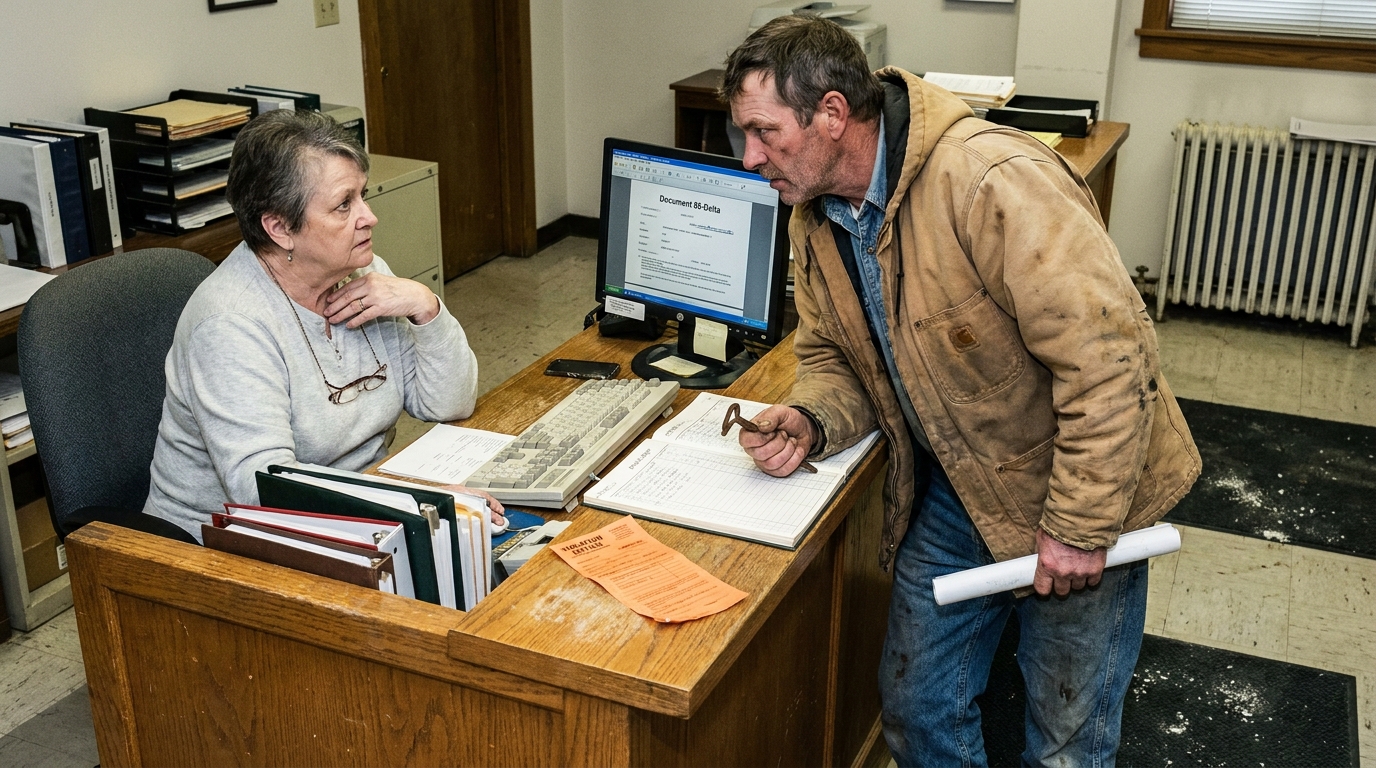
The clerk’s office smells of stale coffee and damp floor mats. A radiator clinks rhythmically in the corner, throwing off a dry, oppressive heat that stings my wind-burned cheeks.
Behind the low oak counter, Clara Vance—no relation to Evelyn, though they share a grandfather from the old timber days—doesn’t look up when the heavy brass door latch clicks shut. She’s sixty-five, her reading glasses chained around her neck, her thumbs clicking methodically across a mechanical keyboard.
“Road’s bad out by the creek,” she says, her voice as dry as the paper files stacked in three-ring binders along the back shelf.
“It’s worse on my pasture,” I say.
I walk up to the counter, my boots leaving two dark, salt-crusted ovals on the linoleum. I pull the folded orange violation notice from my coat pocket and smooth it flat against the worn wood surface.
“I need the physical parcel ledger for 409-B,” I say. “Specifically the land-use modifications filed in the last seven days.”
Clara stops typing. Her glasses drop onto the bridge of her nose. She looks at the torn plastic notice, then at the blood dried around my thumb line. Without a word, she swivels her monitor forty-five degrees and taps a function key.
“There shouldn’t be anything new on 409-B,” she says softly. “That’s agricultural deeded, class one. Unrestricted family conveyance since fifty-eight.”
“Check the emergency annex,” I say. “Document 88-Delta.”
Her fingers pause over the keys. The blue light of the terminal screen reflects in her lenses. “Where’d you get that document code, Thomas?”
“On the side of a Vanguard truck.”
She types six characters, hits enter, and waits. The hard drive inside the desktop tower clicks and whirs.
“That’s strange,” she mutters under her breath. She leans closer to the glass. “There’s an emergency winter access easement attached to the parcel master file. Timestamped six days ago, four-thirty in the afternoon.”
“Who submitted it?”
“It came through the online portal under a public utility exemption,” she says, her brow furrowing. “It bypassed the board of commissioners’ review queue because it was flagged as an active hazard response.”
“Show me the signature block.”
Clara hesitates, her hand hovering over the mouse. “Thomas, these digital scans aren’t public until—”
“Show me the block, Clara.”
She clicks the PDF link. A scanned image of a county land authorization form expands across the screen. The header reads Temporary Agricultural Conversion & Staging Authorization. Halfway down the page, in the space designated for property owner approval, a line of blue ink stretches across the dotted line.
It says Thomas Miller.
I lean over the counter, my face six inches from the glass.
The loops on the ‘T’ are round and open. The ‘M’ slants to the left, clean and fluid. I’ve signed my name with a flat, broken right wrist since a bull pinned me against a trailer panel in ninety-two. My ‘M’ is two jagged vertical spikes that don’t connect at the bottom.
Whoever signed that document copied my name from a tax receipt. They drew it carefully, like a child tracing a pattern, confident no one would ever bring up the physical page.
“Did you sign this?” Clara asks quietly. Her voice has lost its bureaucratic edge.
“No,” I say.
“Thomas… this is a recorded county document. If this signature isn’t yours, that means—”
“It means Document 88-Delta is a felony,” I say. My voice doesn’t rise. It stays flat, cold, heavy as a cedar fence post. “Print it.”
“I can’t just hand out unverified—”
“Print the page, Clara.”
She looks at my eyes, then down at my left hand where my thumb is still pressed against the rusted staple inside my pocket. She hits Control-P. The laser printer behind her hums to life, spitting out a single warm page.
I grab the paper before the tray stops moving. I don’t fold it. I roll it carefully into a tight cylinder and walk out of the office without saying another word.
The wind has shifted out of the north by the time I reach the lower county road. Instead of heading back toward the ridge, I turn the Ford left onto the narrow gravel lane that leads to the old township cemetery.
The iron gates are buried two feet deep in fresh drifts. The wind howls through the bare branches of the white oaks, whipping snow across the headstones until the carved dates disappear under a smooth sheet of white.
I park on the shoulder, leave the engine running, and step over the snowbank. My boots sink to the knee with every step.
Thirty yards inside the tree line, near the back fence where the ground slopes toward the creek, my son’s headstone stands small and sharp against the white.
The snow around the base has been churned up. Deep boot tracks—work boots with deep, aggressive treads—lead from the access road straight to the granite marker.
Beside the stone, the small oak cross I carved three years ago after the memorial service isn’t standing.
It lies snapped in two pieces, half-buried in a dirty drift where a snowplow blade backed up to clear the cemetery turn-around. The top arm of the cross is splintered, the raw, unweathered wood underneath exposed to the freezing air.
I kneel down in the snow. My knees hit the frozen turf beneath the drift.
I pick up the two pieces of wood. The grain is dry, cold, brittle. Beside the marker, fresh tire tracks from a heavy utility truck run less than eighteen inches from the foot of the grave.
I don’t feel the cold in my legs. I don’t feel the wind cutting through my wool coat.
I sit back on my heels, the broken pieces of my son’s cross resting in my lap, the forged county document rolled tight in my right hand, and the rusted fence staple pressed against my palm.
Evelyn Vance didn’t just need a place to dump snow. She didn’t just want a multi-million-dollar contract for her shell company.
Four years ago, my boy filed a thirty-page report on township budget discrepancies before his shift ended on a rainy Tuesday night. Three weeks later, he was gone, and the report disappeared from the sheriff’s evidence locker.
She isn’t trying to clear the roads. She’s trying to erase the ground he stood on.
I stand up, slide the broken pieces of the cross into my deep coat pocket alongside the staple, and walk back to the truck.
The engine vibrates against the steering wheel. I pull out onto the road, the headlights cutting two yellow channels through the storm, heading straight back toward the ridge.
CHAPTER 4: THE PAPER TRAP
The heater core in the Ford rattles as I turn back onto the county ridge line. In the passenger seat, the paper cylinder containing Document 88-Delta rolls against the glovebox latch every time the tires catch a rut.
I don’t head straight to the house. I swing the truck down Old Mill Road, where the properties stretch wide and the driveways are marked by unpainted cedar posts.
Arnie Kopek’s place sits a half-mile past the creek bridge. He’s seventy-two, thirty years retired from the state highway department, and still wears the canvas barn coat with the oil-stained cuffs. When I pull into his yard, he’s standing under the overhang of his machine shed, greasing the auger on a small three-point snowblower.
He doesn’t wipe his hands when I get out of the truck. He just watches my boots crush the snow pack.
“Heard the plows were running heavy on your south line, Thomas,” Arnie says. His voice sounds like gravel sliding down an iron chute.
I reach into the cab, grab the rolled paper, and step under the shed roof. Cold wind whistles through the gaps in the corrugated tin siding. I unroll the page flat against the hood of his Massey Ferguson tractor.
“Read the signature block,” I say.
Arnie squinted, pulling a pair of scratched plastic reading glasses from his breast pocket. His greasy thumb rests on the edge of the sheet, leaving a dark smudge over the county seal.
“That’s your name,” he says.
“It’s my name. It isn’t my handwriting.” I point to the top margin. “Document 88-Delta. Emergency land-use conversion. Vanguard Mutual holds the operational ticket. They’re dumping salt-sludge on Parcel 409-B under a municipal safety exemption.”
Arnie’s eyes move down the line items. He knows road codes better than anyone in the township. He knows what a Class-A runoff violation looks like because he spent twenty years writing them for the county road commission.
“Vanguard,” Arnie mutters, his thumb dragging over the vendor code. “They billed the township eighty grand last month for hazard clearing. The board approved the warrant without an itemized invoice.”
“Who signed the payout?”
“Evelyn,” he says flatly. “She’s got sole authorization on emergency winter contracts under five hundred thousand.” He looks up from the paper, his eyes hard under his frayed cap. “If this signature is cold, Thomas, every dump ticket they dropped on your pasture is an illegal deposit. That’s five hundred dollars a load in civil penalties, payable directly by the contractor.”
“And the shell company behind the contractor?”
Arnie looks toward the open field where the snow is drifting against his fence line. “They’re running three crews. If Vanguard is taking the disposal fee and dumping on private deeded ground without a valid easement, the audit trails don’t stop at the road commission. It goes straight to the bank accounts receiving the municipal wire transfers.”
“I need three names,” I say. “Board members who didn’t sign the conversion.”
” You want Miller, Henderson, and young Dave Vance,” Arnie says. He reaches for a greasy rag on the tractor fender and wipes his fingers. “Dave’s her nephew, but he’s been asking about the line-item variances since November. He knows the township reserve account shouldn’t be dropping fifty grand a week in a dry winter.”
“Call them,” I say. “Tell them to meet at the community center at six.”
“She called an emergency session for seven,” Arnie says, dropping the rag. “She’s putting the permanent annexation vote on the agenda. Says your interference is costing the subdivision twenty thousand a day in private road clearance.”
“Then six gives us an hour.”
I roll the paper back up, slide it into my coat, and walk back to the Ford.
When I pull into my driveway twenty minutes later, a white state vehicle with green door decals is idling by the pasture gate. A man in a yellow high-visibility parka stands near the drainage ditch, a long aluminum sampling rod in his gloved hand. He’s dipping a clear plastic bottle directly into the dark liquid pooling beneath the snow pile.
I stop the truck ten feet behind his bumper and step out into the wind.
He seals the bottle with a blue cap, writes a string of numbers on the side with a permanent marker, and drops it into an insulated cooler in the back of his vehicle.
“State Department of Environmental Protection,” he says before I can speak. He pulls a clipboard from under his arm. “Got an anonymous tip about chemical runoff entering a tributary of Black Creek.”
“It’s road salt and calcium chloride,” I say. “Dumped by Vanguard trucks.”
“I can smell the petroleum solvent from here,” the inspector says, pointing his pen at the dark ring around the pasture ditch. “This isn’t just road clearings. This is commercial parking lot scrape. Oils, heavy metals, industrial de-icer. On agricultural ground, this is an immediate cease-and-desist order.”
“Does that stop the trucks today?” I ask.
“It gives me grounds to issue a notice of violation,” he says, signing his name at the bottom of a carbon form. “I’ll serve it to the township board tonight. But if they’re operating under an emergency safety declaration, they can legally delay compliance by forty-eight hours while they file an appeal.”
“Forty-eight hours buries my stock,” I say.
“That’s the law, mister,” he says, sliding the clipboard into his cab door. “Unless you’ve got proof the emergency declaration itself was fraudulent.”
I touch the rolled page inside my coat pocket. “I have the proof.”
“Then don’t lose it,” the inspector says. He climbs into his truck, slams the door, and turns the vehicle around in the narrow lane.
I stand in the drive as the state truck disappears over the rise. Across the pasture, the lead bull is standing motionless by the barn wall, his head hanging low, his breath coming in short, icy puffs.
Behind me, the door to the house opens. Sarah stands on the porch, wrapped in her heavy woolen shawl, holding a fresh thermos of black coffee.
“They sent another notice by courier,” she says as I walk up the steps. Her voice is steady now, cold and quiet. “A formal demand for asset access. They’re bringing two more crews at dusk.”
I take the thermos from her hand. My thumb brushes hers—cold skin against cold skin.
“Let them bring them,” I say. “We’re going to town.”
CHAPTER 5: THE EMERGENCY SESSION
The heavy oak doors of the township community center swing shut behind us, cutting off the howl of the storm.
Inside, the air smells of wet coats, pine floor wax, and cheap coffee scorching in a fifty-cup urn. Four rows of metal folding chairs scrape against the floorboards as sixty neighbors turn their heads.
At the front of the room, behind a long folding table, sits the board. Evelyn Vance occupies the center seat. Her bone-white coat hangs neatly over the back of her chair. Her leather-bound agenda binder lies open before her, a gold cross pen balanced across the top margin.
Beside her, Arnie Kopek sits with his grease-stained hands resting flat on his knees. Dave Vance—Evelyn’s nephew— sits two chairs down, his face pale under the harsh overhead fluorescent tubes, staring intently at a manila folder in his lap.
“This meeting is officially called to order at six-fifteen,” Evelyn says. Her voice carries clearly across the room without an amplifier. Sharp, clean, entirely unbothered. “We have a single item on the emergency docket before the public hearing: the immediate ratification of Parcel 409-B as a municipal winter safety zone.”
“There’s no emergency, Evelyn,” Arnie says, his voice cutting through her opening line like a dry saw blade. “There’s just a pile of illegal road salt sitting on Thomas Miller’s pasture.”
Evelyn doesn’t look at Arnie. She clicks her gold pen once. “The township experienced an unprecedented weather event. Emergency powers permit the board president to secure critical logistics staging without prior public notice. The civil code is unambiguous.”
“The civil code requires a valid signature from the deed holder,” I say.
My voice isn’t loud, but I walk down the center aisle, my boots leaving dark, wet tracks on the aisle runner. Sarah walks three paces behind me, holding her shawl tight across her chest.
Evelyn finally raises her eyes. Her expression doesn’t break. “Mr. Miller. You’re out of order. Public comment is reserved for the seven o’clock session.”
I reach the wooden railing separating the gallery from the board table. I pull the rolled sheet of paper from my coat pocket and lay Document 88-Delta flat on the table, directly over her open leather binder.
“That’s the digital filing for Parcel 409-B,” I say. “Document 88-Delta. Timestamped six days ago.”
Dave Vance leans forward, his hand reaching for the page. Evelyn’s hand shoots out, her manicured nails pinning the paper flat before he can touch it.
“This is an administrative copy,” Evelyn says softly. “It has no bearing on board proceedings.”
“Look at the signature block, Dave,” I say, looking past her straight at her nephew. “Look at the ‘M’ in Miller.”
Dave pulls the page out from under his aunt’s fingers. He pulls a magnifying loupe from his shirt pocket—the kind he uses at his survey job—and presses it to the paper.
“The loops are continuous,” Dave says, his voice cracking slightly in the quiet room. “Thomas doesn’t sign with continuous loops. He’s got a fused joint in his wrist.” He looks up at Evelyn, his jaw tightening. “This was generated by an auto-pen template from the county clerk’s public database.”
Murmurs ripple through the rows of folding chairs. Someone in the third row stands up to see over the shoulders in front of them.
“An administrative oversight by the filing clerk,” Evelyn says without missing a beat. Her voice remains smooth, ice-cold, devoid of panic. “A clerical error does not invalidate an emergency safety declaration executed for the protection of three hundred homes.”
“What about the payment schedule?” Arnie asks. He pulls a printed bank ledger from his coat. “Vanguard Mutual received forty-two thousand dollars on Tuesday. Wire transfer cleared through a commercial escrow account registered under an offshore holding group. The authorization code matches your private board key, Evelyn.”
The room goes dead silent. The only sound is the rhythmic clatter of the heating pipes against the baseboards.
Evelyn clicks her pen again. Snap. Snap.
“Vanguard Mutual is an authorized third-party contractor,” she says, her eyes narrowing as she looks at Arnie, then at me. “They provide high-capacity equipment the township does not own. Every dollar spent is accounted for under the winter infrastructure budget.”
“Two point eight million,” I say.
Evelyn stops clicking her pen.
“Two point eight million dollars,” I repeat, leaning over the wooden railing until I’m three feet from her face. “That’s the multi-year capacity deal tied to Vanguard Mutual if Parcel 409-B is permanently reclassified as non-agricultural. It wasn’t a temporary dump site. It was a land-use conversion scheme designed to force a tax sale when the salt ruined the topsoil.”
“That’s an absurd conspiracy,” she says, her voice dropping an octave, losing its polished edge. “You’re an uneducated rancher trying to stall municipal services because you refuse to adapt to subdivision expansion.”
“Four years ago, my boy showed me a draft of an audit,” I say quietly. My left hand reaches into my pocket, my fingers wrapping around the two broken pieces of the oak cross. “He found sixty thousand dollars missing from the road culvert fund. He put the file in his locker on a Tuesday. On Wednesday, you petitioned the county to dissolve his deputy position.”
Evelyn’s lips press into a thin, colorless line. “Your son was inefficient.”
Behind us, the heavy back doors swing open again.
Two men in dark green uniforms step into the hall. Behind them stands the state environmental inspector holding a sealed aluminum clip case, accompanied by a county sheriff’s deputy with his coat unbuttoned over his duty belt.
“Evelyn Vance?” the deputy calls out, his boots loud against the floorboards as he walks down the aisle. “We have a state cease-and-desist order for Parcel 409-B, along with a county grand jury subpoena for the municipal wire records of Vanguard Mutual.”
The room erupts into shouts. Two board members stand up, backing away from the table as if it were on fire.
Evelyn doesn’t panic. She doesn’t cry out. She slow-closes her leather agenda binder, stacks her gold pen neatly on top, and turns her head toward the side exit leading to the parking lot.
“This meeting is adjourned,” she says flatly.
She grabs her white wool coat, steps around the board table, and moves toward the side door before the deputy can reach the rail.
“Evelyn!” Dave shouts, standing up so fast his chair clatters to the floor. “Stop!”
She doesn’t stop. She hits the crash-bar of the emergency exit with her hip, bursting out into the howling blizzard as the alarm bell above the door begins to ring.
CHAPTER 6: THE UNYIELDING GROUND
The emergency exit crash-bar snaps back with a harsh, metallic bang, letting the freezing gale sweep straight into the corridor.
I don’t run. I walk through the open doorway, my boots cutting clean steps into the four-inch drift accumulating against the concrete threshold.
Evelyn is ten yards ahead, her white wool coat flapping in the crosswind. Her heels sink into the unplowed slush of the parking lot, but she doesn’t slip. She reaches her red BMW parked broadside across the pasture fence line, her gloved fingers jamming a key fob against the door sensor.
The car horn screams—a loud, piercing panic alarm that slices through the whiteout like a circular saw.
The sound hits the pasture wall. Across the property line, thirty yards beyond the shattered corner post, the herd reacts instantly. Heads throw up in unison. Steam shoots from twelve pairs of nostrils. The lead bull doesn’t back away; he turns his twelve-hundred-pound frame directly toward the red car, his hooves tearing through the frozen mud crust.
“Evelyn!” the deputy shouts behind me, his boots crunching heavy through the drift as he rounds the building corner. “Stay where you are!”
She doesn’t look back. She yanks the driver’s door open, but her heel catches on the jagged lip of a cedar post buried in the snow—the same fence post her plow smashed forty-eight hours ago. She stumbles hard against the driver’s seat frame.
Before she can pull her legs into the cabin, the lead bull hits the front quarter-panel.
The impact sounds like a structural beam snapping under tension. Steel buckles inwards six inches. The front radiator cracks, spraying a cloud of hot, sweet-smelling glycol across the snow bank. The BMW’s alarm cuts out instantly as the battery cables shear.
Evelyn screams—not a loud, heroic cry, but a short, sharp gasp of pure shock.
The deputy reaches the car, his gloved hand catching her coat collar, pulling her backward out of the crushed doorway two seconds before the bull’s shoulder slams the driver’s window frame into a cobweb of shattered glass.
“Get back!” the deputy grunts, dragging her six feet through the slush away from the fence line.
Evelyn sits on the frozen ground, her white wool coat soaked dark with slush and yellow engine coolant. Her hair is plastered across her forehead, her manicured nails caked with black dirt from the driveway ditch. She looks up at the deputy, then at the state environmental inspector standing beside the sheriff’s cruiser with his clipboard held tight against his chest.
Her mouth opens. “You can’t… this is a municipal emergency… Document 88-Delta gives the township—”
“Document 88-Delta is a forged public record, ma’am,” the deputy says, his voice flat, professional, and entirely drained of warmth. He pulls a pair of steel handcuffs from his belt pouch with a dull, cold click. “And Vanguard Mutual’s escrow accounts were frozen by the state attorney general’s office twenty minutes ago. Hands behind your back.”
She doesn’t fight the steel. She doesn’t scream again. As the cuffs ratchet tight over her wrists, she looks past the deputy’s shoulder, her eyes locking onto mine.
I stand ten feet away in the falling snow. My hands stay deep in my coat pockets—my left hand still holding the two broken pieces of the carved oak cross, my right hand resting flat against the paper copy of Parcel 409-B’s original deed.
I don’t say a word to her. I don’t give her a speech. I just look at her until her eyes drop to the mud on her boots.
The deputy guides her into the back seat of the cruiser. The heavy door shuts with a solid, sealed thud. The red and blue strobe lights wash across the dirty snow banks, turning the gray slush to purple as the cruiser rolls slowly down the ridge toward the county seat.
By midnight, the storm calms to a slow, steady drift of fine, dry flakes.
The community center parking lot is empty, save for Arnie Kopek’s old Massey Ferguson tractor and my Ford. Down along the fence line of Parcel 409-B, two heavy yellow municipal flatbeds—sent by the county court receiver—are already winch-loading the dirty salt piles out of the pasture ditch, hauling the chemical waste off to an approved industrial containment site.
The diesel engines roar, but they move with slow, methodical precision, their floodlights turned down away from the cattle barn.
I stand near the broken corner post. The air is clear now, cold enough to freeze the breath in my beard, but the wind has lost its edge.
Sarah steps up beside me. She’s holding a wooden tool box she brought from the machine shed, along with a bottle of boiled linseed oil and a fresh box of three-inch galvanized fence staples.
She doesn’t speak. She hands me a hand-drilled oak joining brace and two brass screws.
I kneel down in the snow beside my son’s headstone. The snow around the base has been swept clean. I place the two broken pieces of the carved oak cross together on the wooden toolbox lid, lining up the raw grain where the wood split three days ago.
I set the oak brace across the back of the break, set a brass screw into the pilot hole, and drive it home with an old wooden-handled screwdriver. The metal turns firm and smooth, pulling the two halves of the cross back into a single, unbroken line.
I rub a coat of linseed oil over the raw seam with my thumb. The dark grain drinks the oil, sealing the wood against the freezing air.
I stand the cross back in the earth beside the stone, pressing the base deep into the soil until it rests firm and plumb against the frozen turf.
“The lower ditch is clear,” Sarah says softly, her hand coming to rest on my arm. Her breath forms a small, warm cloud between us. “Arnie says the county board cleared the lien against Parcel 409-B at eight tonight. The deed stands clean.”
“I know,” I say.
Across the pasture, the lead bull steps slowly out of the shadows of the barn overhang. He walks down the feeding lane, his hooves crunching softly on the clean snow, and lowers his head to the dry hay in the lower trough. The rest of the herd follows him, stringing out along the fence line in a quiet, steady rhythm.
I reach into my pocket, pull out the rusted iron staple I’ve carried since the first plow hit the wire, and drop it into the toolbox beside the screwdriver.
I close the lid. The iron latch catches with a clean, quiet click.
Out on the ridge, the snow keeps falling, filling the deep ruts left by the trucks, softening the hard edges of the broken ground, covering the tracks until the pasture is just wide, open, and silent under the dark winter sky.