The Architecture of Consequences: How a Well-Placed Wetland Basin Dismantled a Neighborhood Tyrant’s World
CHAPTER 1: THE WEIGHT OF ARROGANCE
I stood on the porch, the ceramic of my mug searing against my palms, watching six thousand pounds of polished, charcoal-gray steel crush the life out of a patch of fescue. It wasn’t an accident. Accidents happen in a moment, a lapse in judgment, a flick of the wrist. This was a statement. The driver, a woman who treated every suburban street like a conquered territory, didn’t even slow down as the passenger wheels sank into the soft earth of my lawn.
She killed the engine with a sharp, decisive click, the sound metallic and cold. As she stepped out, her heels didn’t just touch the mud; they commanded it. She adjusted her blazer, scanned the horizon with that practiced, bored tilt of the chin, and marched toward the house she’d been occupying for three weeks—three weeks of trespassing, of shredded sod, and of my own growing, silent calculation.
I took a slow, measured sip of coffee, the steam blurring my vision just enough to keep the hatred out of my eyes. My lawn was the only thing I had managed to control in a life that felt increasingly chaotic, and watching her heel sink into the dark, sodden earth triggered a cold, humming realization in my chest.
People think anger is a storm. They think it’s shouting, slamming doors, the raw heat of a confrontation that burns out as fast as it ignites. They’re wrong. True anger is the absence of heat. It is the freezing point of a lake, quiet and solid enough to walk on.
She paused at the edge of my driveway, glancing back at her vehicle. A piece of my lawn was stuck to the tread of her left heel. She shook it off with a flick of her wrist, a gesture so dismissive it felt like a physical blow. She didn’t look at me, but I knew she could feel me there, watching from the shade of the porch. It was a game of silence. She was waiting for me to yell, to defend, to play the role of the neighborhood crank so she could play the role of the victim.
I didn’t give her the satisfaction. I just watched, tracing the path of a stray drop of condensation rolling down the side of my mug.
She turned, catching a glimpse of me in her periphery. A small, cruel smirk tugged at the corner of her mouth, a silent declaration that she knew exactly what she was doing and that she was completely untouchable. She reached into her bag, pulled out her phone, and tapped at the screen with sharp, rhythmic strokes.
Then, she looked up, her gaze locking onto the small “No Parking” sign I had hammered into the dirt yesterday. She didn’t walk around it. She took a deliberate step forward and kicked the stake, sending the sign spinning into the mud.
My breath hitched—not in rage, but in a sudden, sharp clarity. The sign was gone, but the ground underneath it looked surprisingly different. The soil there was darker, almost viscous, holding the shape of the intrusion with a greediness that suggested it was waiting for something heavier.
I looked down at the mud left behind by her heel. It was deep, sticky, and far more unstable than it had been a week ago. She didn’t notice, of course. She was already walking away, her stride confident, rhythmic, and entirely unaware that she had just crossed the final threshold.
I turned back toward the house, my hand reaching for the folder I had left on the porch table. It was filled with blueprints, drainage codes, and a very specific, approved plan for a “sustainability project.”
I watched her disappear through her front door, and for the first time in weeks, the tight, jagged knot in my stomach began to untie. I didn’t need to shout. I didn’t need to fight. I just needed to wait for the rain.
CHAPTER 2: THE PAPERWORK SIEGE
The silence of my kitchen was usually a comfort, a reward for a day spent maintaining the perimeter of my own life. But that morning, the silence felt heavy, charged with the static of the confrontation on the front lawn. I sat at my dining room table, the oak surface cool against my forearms, and spread out the documents I had been hoarding for months.
My home was a sanctuary, and for three weeks, that peace had been violated by the rhythm of a heavy engine and the crunch of tires on grass that didn’t belong to the driver. The incident with the sign was a turning point. It wasn’t just about the grass anymore; it was about the assumption—the belief that some people were exempt from the unspoken agreements that kept a neighborhood upright.
I pulled a crisp, white sheet of paper from the stack. It was a copy of the city’s municipal code, specifically the sections regarding storm-water management and private lot drainage. I traced the text with the tip of a pen. Sustainable landscape features. Native habitat support. Storm water retention benefits. The words were dry, technical, and completely devoid of malice. To anyone else, they were the language of an ambitious gardener looking to improve their property value. To me, they were the tactical layout for a lesson in physics and accountability.
I had spent the better part of the night mapping out the drainage of my front yard. The natural slope of the land directed runoff toward the curb—a path she had turned into her personal, reinforced driveway. If I could re-engineer the soil beneath that specific path, turning it into a bio-retention swale, it wouldn’t just be an “improvement.” It would be a feature that obeyed the laws of gravity and moisture.
I heard the sound of a vehicle engine down the street—a low, throaty rumble that made the windows rattle in their frames. I didn’t look up. I didn’t need to. I knew the rhythm of her departure by heart now. The arrogance was in the way she accelerated, the way she didn’t bother to check for pedestrians or other vehicles. She acted as if the street was an extension of her own living room.
My focus returned to the permit applications. Every line of text I wrote had to be perfect, tailored to the specific, jargon-heavy requirements of the HOA board. They wanted ‘green’ and ‘sustainable’? I would give them a masterpiece of eco-friendly design. I would use native grasses with deep, interlocking root systems that looked aesthetically pleasing but acted as a structural anchor. I would add decorative markers, clear and official-looking, to guide the flow of water—and keep unwanted weight away from the sensitive, saturated edges of the basin.
The memory of her kicking the sign flared in my mind again. It was a flicker of movement—a sharp, dismissive motion that felt disconnected from the gravity of the situation. It reminded me of the time I had tried to talk to her, to explain the damage. She hadn’t even looked at me; her eyes had been on the dashboard, her thumb scrolling through her phone. It was as if I was a piece of furniture, something she could bump into and move aside if it stood in her way.
That was the mistake she made. She saw me as a passive element, a background feature to her own life. She didn’t realize that the quieter a person is, the more likely they are to be observing, calculating, and waiting for the right moment to shift the foundation.
I finished filling out the final form and set my pen down with a sharp, decisive click. The application was a work of art. It was everything the board wanted: responsible, aesthetic, and completely, undeniably legal. There was no room for denial, and even less room for a complaint from a neighbor who had no understanding of what was happening beneath the surface.
I stood up and moved to the window. The neighborhood was quiet, the light of the morning filtering through the trees and casting long, sharp shadows across the lawn. The grass looked resilient, even where it had been trampled. I knew that in a few weeks, it wouldn’t look like a lawn at all. It would look like a project—a community-approved, city-sanctioned, perfectly legal piece of landscape architecture.
I grabbed my keys and the folder. The walk to the HOA office was brief, but every step felt like a calibration. I was moving away from the role of the victim and into the role of the architect. And as I stepped out into the crisp, morning air, I realized I wasn’t just planning a garden. I was preparing to change the way the ground itself responded to those who thought they could walk all over it. The city would approve the plans, the workers would arrive, and the shift would be so subtle that by the time the next heavy rain came, she wouldn’t even know she was driving into a trap until it was already holding her fast.
CHAPTER 3: THE SOFTENING
The permit was tucked under my arm like a holy relic, though it was merely a stack of stapled pages granting me permission to rearrange my own dirt. I walked back home in the mid-morning heat, the sun sharp and unforgiving. I didn’t see her car as I passed her driveway, but I could feel the presence of the SUV, a charcoal-gray beast resting in the shade of her garage, waiting to be unleashed again.
I set the folder on the porch table, right next to the cooling remnants of my coffee, and stood at the edge of my lawn. To the casual passerby, the yard looked tired, a bit ragged at the edges from the constant traffic, but to me, it was a blank canvas. I wasn’t just digging holes; I was calculating depths, drainage coefficients, and the exact weight-bearing limits of wet soil.
I picked up the shovel. The first bite into the ground felt like a release. The soil was firm, compact, and stubborn, but I didn’t rush. I began to excavate the section she used most frequently, the line where her front passenger tires routinely carved the most damage. My movements were rhythmic, measured, and devoid of the chaotic energy people usually associate with landscaping.
I wasn’t building a garden; I was constructing a trap.
By noon, my arms ached with a dull, throbbing weight, but I kept the rhythm. I laid the drainage pipe, a slotted, corrugated tube that would act as the heartbeat of the basin, and covered it with a layer of coarse, porous gravel. Above that, I carefully packed a blend of soil that would hold water longer than the surrounding ground—a soil designed to look perfectly normal from the surface but lose all structural integrity the moment it was saturated.
As I worked, the sound of the neighborhood felt distant, muffled by the concentration required for the task. I wasn’t listening for the sound of her engine; I was listening for the friction of the shovel against stone, the soft, wet sound of turned earth.
I caught myself staring at a patch of weeds, my mind already cataloging the next step, the way I would layer the decorative turf on top to mask the basin. The intensity of my focus felt like a physical weight. I wasn’t just working; I was anticipating the future. I was seeing the rain, the clouds gathering over the neighborhood, and the moment—the exact, inevitable moment—when she would pull off the road and realize that the ground she had claimed as her own was no longer solid enough to hold her up.
My hands were stained dark with mud, my nails caked with the reality of my work. I stood up, stretching the stiffness out of my spine, and looked down at the excavation. It looked like a standard storm-water project, just as I’d described in the paperwork. It looked boring. It looked compliant.
A shadow moved across the edge of the lawn. I froze, my grip tightening on the handle of the shovel.
It was just a neighbor, an older man I barely knew, walking his dog. He stopped for a second, glancing at the piles of dirt and the rolls of drainage pipe. “Taking on a big project, aren’t you?” he asked, his voice thin in the afternoon air.
“Water management,” I replied, keeping my voice neutral, detached. “The soil was holding too much moisture. Needed better drainage.”
He nodded, not really listening, his dog tugging impatiently at the leash. “Looks like a lot of work for a little grass.”
“It’s about the principle,” I said, a faint, cold smile touching my lips. “And the long-term integrity of the ground.”
He moved on, unaware that he was standing on the threshold of a calculated catastrophe. I watched him go, then turned my attention back to the pit. The sun began to dip, casting long, angular shadows across the disturbed earth. I felt a sense of calm that was almost predatory.
I wasn’t the victim anymore. I was the designer.
I reached for the bag of decorative river rock, my movements precise as I arranged them along the border of the swale. They would act as markers, subtle hints to those who paid attention that this was a ‘restoration area,’ a place that wasn’t meant for heavy machinery. If she ignored the signs—the markers, the visual shift in the terrain—well, that was on her.
The physical exhaustion was setting in, but it was the good kind, the kind that settled into the bone and made the mind clearer. I looked at my reflection in the window of the house as I passed. I looked like a man working in his yard, nothing more. But the man in the glass was colder, his eyes harder, his focus sharper. He wasn’t the man who had asked her nicely to move her car. He was the man who had decided to let the environment handle the eviction.
I wiped the sweat from my forehead, leaving a streak of mud in its wake. The project was half-finished. The foundation was set. All I needed now was the rain, and the slow, inexorable turning of the calendar toward the day she would try to park on my grass for the last time.
CHAPTER 4: THE GULP
The sky had turned the color of a bruised plum, hanging low and heavy over the neighborhood. I stood on the porch, a fresh mug of coffee warming my hands, though the steam was quickly lost to the damp, biting chill of the air. This was the moment I had calculated for, the variable I had accounted for in every line of my permit applications. Rain. Enough to saturate the ground, enough to render the soil beneath the surface into a slurry, but not enough to trigger a public flood alert.
Then, I heard it. The low, resonant thrum of an engine that felt like an intrusion even through the steady rhythm of the storm.
The charcoal-gray SUV turned the corner, its headlights cutting through the gray gloom like twin yellow eyes. I didn’t move. I didn’t step back into the house. I stayed anchored to the porch, watching as the vehicle approached the edge of my property with the same mindless, arrogant momentum it had shown for weeks. She didn’t look at the road; she didn’t look at the rain. She looked toward her house, her hand resting lazily on the wheel.
She hit the turn, her front tires biting into the slick pavement, and then, with the practiced casualness of someone who had done this a hundred times, she swung the SUV onto my lawn.
The effect was instantaneous, yet agonizingly slow. The front passenger tire, the one I had specifically graded to be the pivot point, sank. It didn’t just touch the mud; it plunged. The ground, perfectly camouflaged by the turf I’d layered on top, gave way with a wet, sucking sound that was audible even over the rain. The SUV lurched, the chassis tilting violently as the rear wheels lost their grip on the wet grass and followed the front into the pit.
It wasn’t a crash. It was a swallowing. The earth seemed to reach up and pull the vehicle down, greedily, like it had been waiting for the weight.
The engine revved, a frantic, high-pitched whine that spoke of panic. She was trying to back out, but the more she fought the ground, the deeper she dug. Mud sprayed in great, dark arcs against the side of the vehicle, the expensive paint job rapidly disappearing under a coat of muck. I stood perfectly still, watching the physics of my trap execute with clinical precision. Every drainage channel I had cut, every layer of soil I had compacted, every inch of the grade—it was all working exactly as the permits had promised.
She threw the door open. Even from the porch, I could see the flash of red on her face—a mix of fury and genuine, mounting terror. She stepped out, and the moment her heel touched the mud, she sank to her ankle. She shrieked, a sound that tore through the quiet rhythm of the rain, and started pacing, gesturing wildly at the vehicle, then at the sky, then finally, as if realizing where she was, at me.
“You!” she screamed, her voice cracking. “You did this! I know you did this!”
I didn’t answer. I just stood there, the mug still in my hand, watching her rage at the mud, at the storm, at the gravity that had betrayed her. It was beautiful in a way that had nothing to do with aesthetics. It was the beauty of cause and effect. She had treated this ground like a utility, like a thing to be used and discarded, and now the ground was asserting its own terms.
She tried to stomp toward the porch, but the mud wouldn’t let her. She fell back against the side of the SUV, her breath coming in sharp, ragged gasps. She looked less like a neighbor and more like a captured creature, the arrogance stripped away by the simple, cold reality of a stuck axle.
I took a slow, deliberate sip of my coffee. The taste was bitter, perfect for the occasion. I thought about the hours of work, the nights spent pouring over drainage codes, the sheer, quiet satisfaction of being the one who stood on solid ground while someone else was mired in the mess they had created for themselves.
“It’s a wetland restoration area,” I called out, my voice steady and carry-over-flat, cutting through the rain. “The signs were quite clear about the weight limits, especially in inclement weather. Perhaps you should call a professional, though I imagine they’ll find the ground quite soft.”
She stared at me, her mouth hanging open, the rain matting her hair to her forehead. She looked like she wanted to kill me, but she couldn’t move. She was trapped by the very earth she had spent three weeks mocking.
The sound of an approaching siren echoed in the distance—not for her, just the ambient noise of a city that kept moving even when individuals stopped. I leaned against the porch railing, feeling the cold seep into my coat, and waited. The trap had sprung, but the lesson, I realized, was only just beginning. She would get out, eventually. But she would never be able to look at my lawn again without seeing the truth of what lived beneath the surface. And that, I decided, was more than enough for today.
CHAPTER 5: THE PAPER WAR
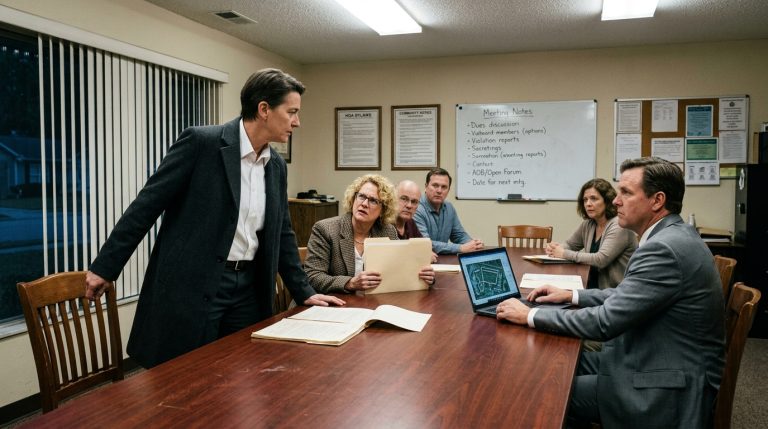
The HOA meeting room smelled of ozone and industrial floor cleaner, a sterile, hollow scent that seemed designed to strip the personality out of any dispute. I took my seat near the back, my folder resting heavy on my lap. It was thick, a dense collection of documented warnings, stamped permits, and soil reports that represented the quiet, meticulous months I had spent preparing for this confrontation.
Karen was already there. She sat in the front row, her posture brittle, her arms folded so tightly across her chest that her knuckles were white. She hadn’t looked at me when I entered, but the air around her hummed with a frantic, static energy. She looked different today—the mud was gone, replaced by a sharp, expensive suit that looked entirely out of place in the cramped, beige room. She was trying to reclaim the status that had been stripped from her along with her dignity when her SUV had been hauled out of my lawn.
The board members were settling into their chairs, shuffling papers and whispering. They were the ones I had appealed to months ago, the ones who had shrugged off my complaints until the ‘wetland project’ had forced their hand. They looked tired, their faces reflecting the boredom of a dozen minor boundary disputes.
Then, Karen stood up. She didn’t wait to be called. She marched to the front of the room, her heels clicking against the linoleum with the sharp, piercing sound of a metronome. She dropped a thin, dark-blue folder onto the table in front of the board president.
“I’m filing a formal grievance,” she said, her voice vibrating with a controlled, jagged intensity. “This isn’t about gardening. It’s about a systematic attempt to create a hazard on community property under the guise of ecological restoration. He’s weaponized the land.”
The room went quiet. I felt a cold, sharp thrill run down my spine. She had been digging. She had gone past the surface-level complaints and looked for a vulnerability, a crack in the bureaucratic shell I had built. I kept my face impassive, my hands steady on my folder. She hadn’t found anything yet, but the fact that she was looking—that she had moved from mindless entitlement to calculated aggression—meant the game had changed.
The president flipped open her folder. He scanned the contents, his brow furrowing. “This is an allegation of negligence, Karen. These documents… they’re just property surveys.”
“He altered the drainage,” she insisted, turning to point a manicured finger toward me. “He knew that area was a shortcut. He changed the grade, he added the material, and he sat on his porch waiting for me to fail. That isn’t improvement. That’s malice.”
I stood up, my movements slow and deliberate. I didn’t rush. I walked to the front of the room, every step a calculated reclamation of the space she was trying to dominate. I set my own folder down on the table, right next to hers.
“Everything I did was approved,” I said, my voice low and clear. I looked at the board members, meeting their eyes one by one. “I submitted the plans. I obtained the permits. I followed every single code the city and the HOA set forth. If the ground failed, it’s because it was never meant to be a driveway.”
I opened my folder. I didn’t pull out a manifesto; I pulled out a receipt. A copy of the stamped permit, dated and signed by the very board members currently sitting in front of me. I laid it on the table. Then, I pulled out the photos—the trail cam footage stills of her kicking the sign, the photos of the ruts she had carved into the lawn weeks before the drainage project even existed.
The silence in the room deepened. Karen’s face went from pale to a dangerous, mottled red. She knew what those photos represented: a narrative she couldn’t spin. She had been the trespasser, the aggressor, the person who had ignored the rules until the rules, finally and mechanically, had turned against her.
“The issue isn’t the drainage,” I continued, my gaze shifting to Karen. “The issue is a refusal to accept the boundaries that everyone else in this neighborhood follows. I haven’t done anything that wasn’t authorized. The fact that the ground responded the way it did is a matter of physics, not intent.”
The board president looked from the folder to Karen, then back to me. He looked at the permit again, his finger hovering over the stamp. I could see the shift in his eyes—the moment the annoyance at a ‘disruption’ turned into the realization that he was holding the proof of a clear, legal victory. He closed my folder, the sound final and metallic.
Karen stood there, her mouth opening and closing. She had no smug comeback, no polished line, no influence to draw upon. For the first time, she was just another homeowner, stripped of her board status, standing in a room of people who were tired of her chaos.
She turned and walked toward the door, her pace uneven, her confidence shattered. She didn’t look back. She didn’t even try to argue her case further. She simply vanished, leaving the scent of her expensive perfume lingering in the stale air of the meeting room.
I stood there for a moment, the tension in my chest slowly uncoiling. The board didn’t need to vote; the weight of the evidence had already decided the outcome. I hadn’t just won the argument—I had built the conditions for her to defeat herself.
CHAPTER 6: THE FINAL SILENCE
I watched the real estate agent hammer the wooden stake into the earth, the sound of the mallet a steady, rhythmic thud against the morning quiet. It was the same sound I had made when I installed my own boundary markers, but there was no aggression in it now, only the hollow resonance of an ending.
From my porch, I held my mug, the coffee long since gone cold. I watched the agent finish, straighten the sign, and walk back to her sedan. Then, I turned my gaze toward the SUV parked in the driveway. It looked different, scrubbed clean of the mud that had claimed it during the storm, but its presence felt diminished, a relic of a failed campaign.
Karen didn’t come out. The blinds remained drawn, the windows reflecting the bright, unblinking morning light. She was effectively invisible, a ghost in her own home, stripped of the influence she had wielded so carelessly. There were no more engines revving, no more sharp, impatient accelerations, no more arrogant disregard for the street. There was only the slow, inevitable process of packing, of boxes being stacked behind closed doors, and of a life being dismantled.
I walked down the steps of my porch, my boots crunching on the gravel path. I made my way to the edge of the lawn, to the spot where the swale held the morning dew. The native grasses were tall, swaying gently in a light breeze. They looked healthy, vibrant, and entirely innocent. To anyone walking by, this was just a well-maintained, eco-conscious patch of property. They couldn’t see the drainage pipes buried beneath the surface, or the precise, engineered grade that had turned this ground into a trap. They couldn’t know that the stability here was a lie, a carefully constructed illusion designed to respond to the exact weight of a six-thousand-pound mistake.
The truth of the “wetland project” was buried, just as it had been from the start. I had achieved the five-pillar catharsis without ever needing to raise my voice or break a law. The payoff was right there in front of me: the “For Sale” sign, the empty street, and the absolute, crushing silence of an opponent who had nowhere left to turn.
My thoughts drifted back to the meeting room, to the look on Karen’s face when she realized the rules she had counted on to protect her status were the very ones that had secured her defeat. She had played the game with volume and entitlement, assuming the system would bend. I had played it with patience and paperwork, knowing that if I simply held the line, the system would eventually do the work for me. That was the poetic justice: she hadn’t been defeated by me; she had been defeated by her own refusal to respect the boundaries I had established.
I knelt by the edge of the basin and reached out, touching the small garden statue I had placed there months ago—the frog wearing sunglasses, holding a tiny, plastic shovel. It was scratched, the paint fading in the sun, a petty, harmless piece of theater that had become a symbol of my quiet victory. I brushed a bit of dirt from its base, then stood up, feeling a strange, hollow sense of peace settle over my shoulders.
The street was quiet. It always had been, really. It was only the noise she had brought that made it seem chaotic. Now, the neighborhood was settling back into its natural rhythm. Neighbors walked their dogs, kids rode bikes, and the morning light played over the rooftops with an indifference that was suddenly, deeply comforting.
I looked at the SUV one last time. It was a machine—a heavy, expensive, over-engineered piece of metal that had served its purpose as an antagonist. I realized that my anger, the cold, freezing point that had driven me to calculate, to plan, and to construct, had evaporated. It wasn’t needed anymore. The work was done.
I walked back to my porch, feeling the weight of the last few months lift. I went inside and set the mug in the sink, then picked up the shovel I had leaned against the wall. I wouldn’t need it for anything other than basic maintenance now. I had defended my home, I had enforced the lines, and I had done it all without becoming the very thing I despised.
I sat in my chair on the porch and watched the light shift across the lawn. The grass was scarred in places, yes—remnants of the struggle—but it was alive, and it was mine. I had stood my ground. I had brought the receipts. And in the final silence that followed, I found the only thing I had ever really wanted: the absolute, unbothered freedom to watch my own garden grow.