The Iron Easement: A Veteran’s Cold Precision Against Local Corruption and Unlawful Seizure
CHAPTER 1: THE COLD REMOVAL
Metal shrieked against steel as the tow chain snapped taut.
The rear dual-tires of my military truck skidded across the concrete driveway, leaving dark rubber ribbons in the dust. The frame lurched backward under raw hydraulic force.
“Tow it now!” Beverly Caldwell screamed, jabbing her metal clipboard toward my front door. “It blocks the sightline. It is a total safety hazard!”
Red and blue light splashed across my garage door. Neighbors crowded the sidewalks, phones raised like weapons.
Concrete chipped with a sharp crack. Beneath the bumper, the brass memorial plate sheared off its mounting bracket, clattered onto the drive, and skidded into a plastic trash bin.
I didn’t yell. I didn’t take a step toward her.
My thumb ran along the sharp, bent edge of my phone screen. When an official labels a machine a safety hazard, the law stops being an argument. It becomes a checklist.
Beverly planted her heels at the edge of my lawn, scanning the crowd. She adjusted her glasses, holding her clipboard like a shield of state authority.
“You didn’t post a warning,” I said. My voice barely carried over the tow truck’s diesel clatter. “You didn’t notify the board.”
She flipped a page without looking at me. “Military equipment isn’t permitted to obstruct sightlines in Ridgecrest Mesa. Community safety overrides personal property.”
She finally met my eyes, her thin lips curling into a tight line. “You veterans think a uniform makes you untouchable. This isn’t a base. This is my neighborhood.”
She gestured toward the truck’s muted paint and unit markings.
“It drags property values down,” she added, her tone dropping into a tight whisper. “People don’t want reminders of war.”
Behind her, Tom from across the street shifted his weight, eyes locked on the ground. Nobody spoke.
“Finish the job,” Beverly barked at the driver. “Bill him the fine daily until the driveway stays clear.”
The driver yanked the lever. The winches groaned, dragging the five-ton axle over the curb. Concrete dust drifted over her polished shoes.
I didn’t tear down the fluorescent violation notice she slapped onto my mailbox. I folded the paper in half, creasing the edge with my thumbnail, and slid it into my back pocket.
“You’ll get the bill tonight,” she called out, already tapping her screen. “Tow fee, emergency enforcement fee, administrative processing.”
“How much?” I asked.
Her smile was thin, razor-sharp. “Enough.”
She walked away, her heels clicking on the street. I waited until her front door slammed shut before I unlocked my phone.
I tapped three numbers, bringing up the regional dispatch protocol for heavy transport assets.
“Recovery request,” I said into the receiver. “Unlawful seizure of military property. Urban access required.”
“Copy,” the voice replied instantly. “Heavy unit available. Fifty-ton class. State parameters.”
“Dispatch it,” I said, staring at the empty, tire-marked concrete. “Run it through Easement 04-B.”
CHAPTER 2: PAPER TRAILS HEAVY METALS
The plastic trash bin smelled of sour grass clippings and sun-baked polyethylene.
I reached down into the dark, my fingers brushing past crumpled junk mail until they hit cold, heavy brass. I pulled the memorial plate out. The bottom left mounting ear was sheared flush, the metal torn in a ragged jagged lip where the tow chain had whipped across the mounting frame. Dirt smeared the engraved lettering—names of three men from my old unit who never made it back from the Panjshai Valley.
My thumb dragged across the grit, wiping the brass clean until the metal stung against a raw blister on my palm.
I didn’t carry it inside like a relic. I set it flat on the hood of my daily driver in the garage, picked up a pair of needle-nose pliers, and bent the warped corner back into line. One sharp clack. The brass straightened. Imperfect, but functional.
The house was dark except for the blue wash of my desk monitor.
I unfolded Beverly’s fluorescent notice on the blotter. The ink was fresh, the signature a hasty, aggressive scribble in blue ballpoint. No municipal citation number. No county seal. Just the letterhead of the Ridgecrest Mesa Homeowners Association and a demand for $4,200 in “emergency abatement fees,” escalating daily.
I opened the official HOA bylaws in one window and the county public records database in another.
Beverly had cited Section 4.12: Unilateral Nuisance Removal. But Section 4.12 required a two-thirds majority vote from the elected board, a certified ten-day written notice delivered via registered mail, and a formal safety assessment signed by a licensed civil engineer.
None of those existed.
Instead, I pulled up the county land recorder’s map for our subdivision, cross-referencing my parcel number with recent municipal filings from the past thirty days.
That was where the discrepancy surfaced.
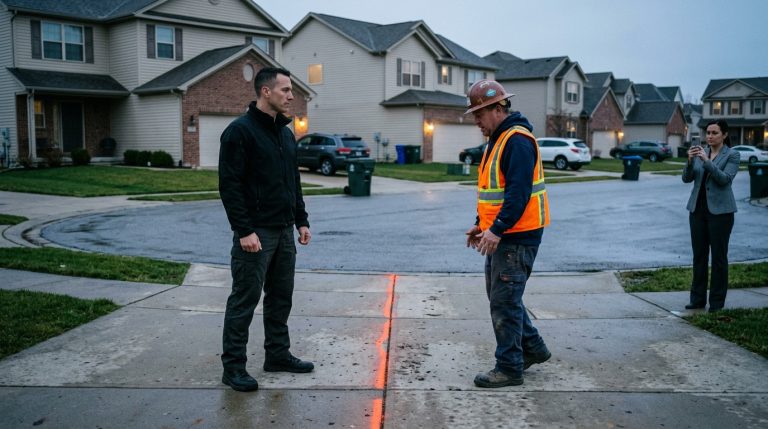
Two weeks ago, an amendment had been quietly uploaded to the county clerk’s portal. It was titled Easement 04-B. It carved out a twelve-foot visibility corridor directly through the front radius of my corner lot—the exact square footage where my military transport had been parked for three years without a single complaint.
The document wasn’t signed by the board. It was signed solely by Beverly Caldwell, acting under a dormant “acting management” proxy.
Attached to Easement 04-B was a preliminary site survey for a $1.8 million traffic-flow modification project at the entrance of Ridgecrest Mesa. The designated prime contractor listed on the municipal permit was an entity called Vanguard Development LLC.
I queried the state business registry for Vanguard Development.
The entity had been incorporated six months ago. The registered agent address belonged to a suburban mail drop three miles away. The principal manager listed on the filing was Marcus Caldwell—Beverly’s younger brother.
A quiet, cold clarity settled into my chest.
This wasn’t about a five-ton truck blocking a sightline. It wasn’t about property values or suburban aesthetics. My truck wasn’t an eyesore to Beverly; it was a physical obstacle sitting directly on top of a fraudulent land-grab designed to trigger a county infrastructure payout.
My phone buzzed against the wooden desk.
“Transport update,” the operator’s voice was crisp, backgrounded by the low hydraulic hum of a heavy staging yard. “Unit 50-Alpha has cleared county transit permits. Oversized transport routing approved under municipal recovery codes. Arrival window locked for 0900 tomorrow.”
“Understood,” I said. “Run the staging line straight down the cul-de-sac. Do not stop at the gate.”
“Copy that. The driver has the state recovery order on his dash. We don’t stop for clipboards.”
I disconnected, saved the land registry PDFs to an encrypted drive, and printed three hard copies.
Outside, the street was dead silent. I walked to the edge of my driveway, stepping into the dark where the tow truck’s tires had gouged deep, ugly trenches into the grass. The smell of torn roots and damp earth rose in the cool air.
Across the street, a curtain twitched in Beverly’s upstairs window. A faint silhouette stood behind the glass, phone held up to her ear, her shadow cast long against the interior light.
She thought she had pushed a tired veteran into a corner. She thought I would calculate the cost of a lawyer, measure it against the fine, and pay up to avoid the headache.
She didn’t realize that when you try to use the law as a blunt instrument, you’d better make sure you own the anvil.
I slid the printed easement file into a manila folder, placed it beside the straightened brass plate on my desk, and set my alarm for sunrise.
CHAPTER 3: THE LOW FREQUENCY
The morning air smelled of wet pine needles and cold exhaust.
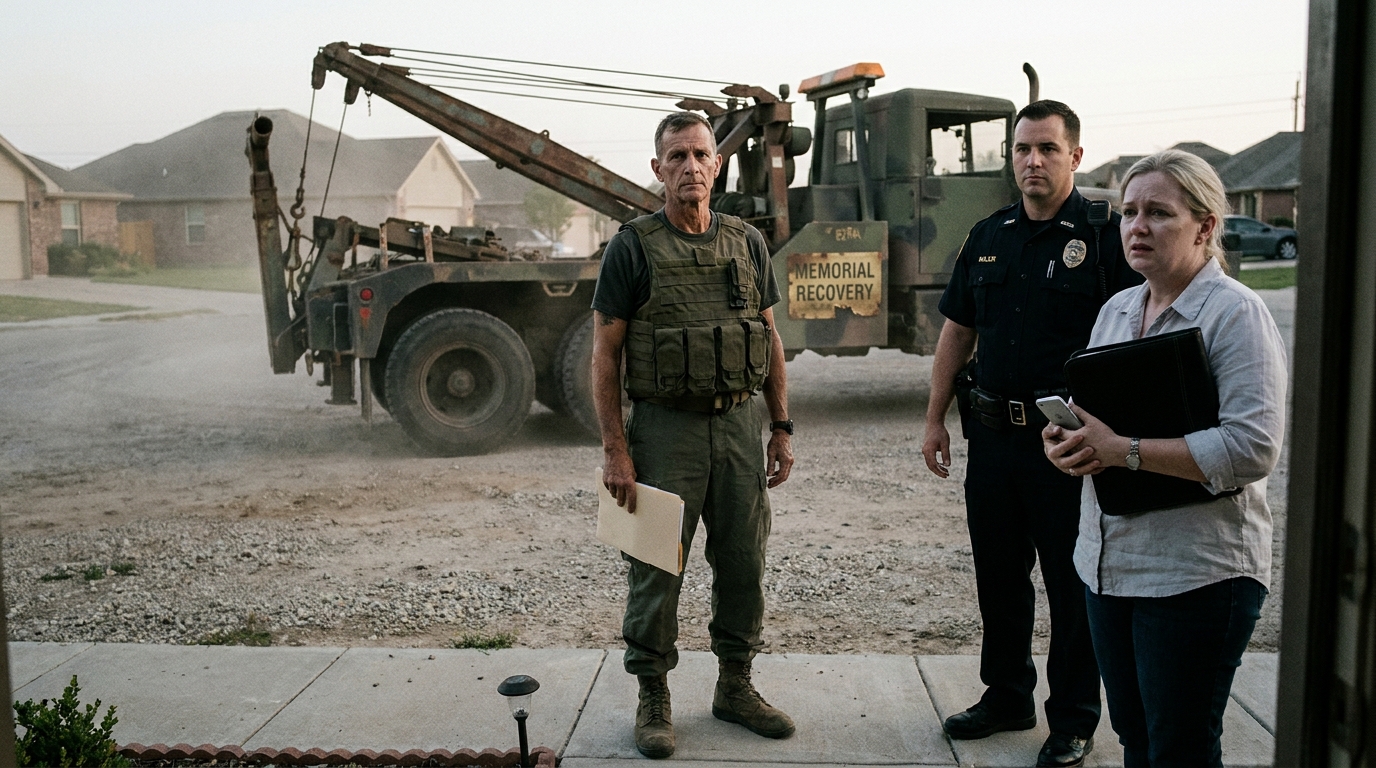
At 08:48 a.m., the first police cruiser rolled into the cul-de-sac. Its tires crunched slowly over the loose gravel near my driveway apron. The white-and-blue doors bore the county crest. The officer didn’t activate his overheads, but the strobe bar on his roof flickered once in the dim morning light before dying out.
I stood on the concrete porch, the manila folder held flat against my thigh.
Officer Miller stepped out, adjusting his duty belt. He glanced down at the fresh rubber gouges in my turf, then at the two fluorescent yellow violation notices still taped to my front door.
“You the property owner?” Miller asked.
“I am.”
“We got a call about an ongoing civil disturbance and an unauthorized heavy vehicle response,” he said, taking out a small notepad. “Complainant claims you’re threatening community safety.”
“Officer!”
Beverly Caldwell marched down her front walkway, her heels striking the pavement with the cadence of a hammer on stone. She held her silver smartphone high, screen glowing with an active call. A black leather binder was tucked tightly under her left arm.
“I called dispatch,” Beverly said, stopping three feet from Miller. She didn’t look at me. “This resident is actively escalating an HOA enforcement action. He has summoned unauthorized commercial machinery into a residential zone without board approval. I am demanding a formal trespass citation.”
Miller looked between us, his jaw setting into a hard line. “Ma’am, did the HOA tow a vehicle off this pad yesterday?”
“Under emergency board authority,” Beverly snapped. She opened her binder, thumbing past dividers labeled Ridgecrest Mesa Bylaws. “Section 4.12 gives the executive committee immediate jurisdiction over visibility hazards.”
I didn’t raise my voice. I opened the manila folder and handed Miller a single sheet.
“That’s the state land registry record for this parcel,” I said. “And that’s the certified copy of Section 4.12. Emergency authority requires a recorded board vote and a certified engineering assessment. Neither was conducted.”
Miller took the sheet. His eyes scanned the text, dropping to the signature line at the bottom. “This isn’t an enforcement order, ma’am. This is a unilateral filing.”
“It is a binding community standard!” Beverly’s voice cracked, rising an octave. “He is obstructing a municipal safety improvement! He has no right to—”
She stopped.
The ground began to vibrate.
It wasn’t a sudden noise. It was a low, rolling sub-audible frequency that traveled through the soles of our boots, rattling the glass panes in my garage door before any engine note reached the street.
Down at the bend of the cul-de-sac, amber warning beacons crested the rise. Two flashing yellow strobes swept across the white vinyl fences of Ridgecrest Mesa.
Then came the iron.
A fifty-ton military recovery wrecker eased around the corner, taking up the entire width of the lane. Its triple rear axles rolled over the pavement with heavy, deliberate weight. Dual steel booms folded over the cab like massive rusted arms. The diesel engine hummed—a deep, hydraulic throat-clear that drowned out the morning birds.
Miller took half a step back, his eyes widening as the machine slowed to a crawl ten yards from my property line.
“What in the world is that?” Miller muttered.
“Unit 50-Alpha,” I said quietly. “Private recovery asset operating under state transit clearance. Dispatched to recover unlawfully seized equipment.”
Beverly turned pale, her thumb freezing over her phone screen. “You… you can’t bring a war machine into my cul-de-sac!”
The wrecker came to a complete halt. The driver’s side door swung open, and a man in steel-toed boots and a high-visibility vest stepped down onto the asphalt. He carried a heavy leather clip-board with a stack of state-stamped permits pinned to the top.
He walked straight past Beverly, nodding once to Miller.
“Officer,” the driver said, handing over the top sheet. “Oversized transport permit 88-B, issued by the Department of Transportation. Active recovery contract for an obstructed military asset. We have clearance to occupy this roadway for thirty minutes.”
Miller looked at the official DOT watermark, then at Beverly, whose hands were beginning to tremble against her leather binder.
“Ma’am,” Miller said, his tone dropping into a flat, professional chill. “These permits are state-level. Your HOA doesn’t have the jurisdiction to stop this vehicle.”
Beverly glared at the officer, her chest heaving as she gripped her phone so tightly her knuckles turned white. “I am the president of this association! I will have your supervisor on the line in five seconds!”
“Call him,” Miller replied. “Because right now, you’re the one obstructing a state-cleared operation.”
From inside the wrecker’s cab, a shortwave radio squawked to life, the static cutting through the tension on the curb: Dispatch to Unit 50-Alpha. County investigator is en route to your location. Hold position for site verification.
Beverly’s eyes darted toward the entrance of the subdivision. The confidence in her posture fractured, her fingers frantically tapping at her screen as she backed toward her driveway.
CHAPTER 4: THE AUDIT UNVEILED
A dark grey SUV with a silver county seal stamped on the front door turned into the cul-de-sac.
It rolled to a quiet halt behind Officer Miller’s patrol car, its tires kicking up a fine spray of damp gravel. The radio static from the fifty-ton wrecker died down as the driver killed the shortwave feed, leaving only the steady, rhythmic thrum of the idling diesel engine.
Beverly took two quick steps back toward her porch, her fingers twitching against her black binder.
The SUV door opened. Investigator Karen Vance stepped onto the street, pulling a thick manila case file from her passenger seat. She wore a dark wool coat against the morning dampness, her silver-rimmed glasses catching the flashing amber lights of the wrecker.
“Beverly Caldwell?” Vance asked. Her voice was flat, carrying no anger, only the weight of administrative authority.
Beverly straightened her spine, her heels clicking on her driveway. “Investigator. I wasn’t informed county personnel were needed. This is an internal HOA enforcement matter regarding an obstruction on Easement 04-B.”
“It was an internal matter,” Vance said, unhinging the metal clasp of her file. “Until three hours ago, when your recorded filings crossed the county auditor’s desk.”
Vance didn’t glance at the idling wrecker or the three neighbors hovering near Tom’s fence across the street. She walked directly to the hood of Miller’s patrol car, laying out three distinct sets of documents.
“Officer Miller,” Vance said, turning her head slightly. “Ensure no one leaves the immediate area.”
Miller nodded once, stepping sideways to block the path toward Beverly’s front walkway.
“This is absurd!” Beverly snapped, though her thumb repeatedly scraped against the plastic edge of her clipboard—a tiny, involuntary rhythm of panic. “I am an elected community representative. We are clearing a documented visibility hazard to protect property values in Ridgecrest Mesa.”
“You filed an emergency easement rider on parcel 114-A two weeks ago,” Vance said, tapping a red-inked stamp on the first page. “You cited municipal safety statutes. But the county engineering office has no record of a safety assessment.”
I stepped forward, placing my own printed land registry records on the hood beside Vance’s file. The paper crinkled under the damp morning air.
“And Vanguard Development LLC?” I asked softly.
Beverly’s jaw clenched. A faint, red splotch rose on the side of her neck. “Vanguard is an approved contractor for regional infrastructure work. Their bids are matters of private board record.”
“Vanguard Development was registered six months ago,” Vance countered, pulling a second sheet from the stack. “Their sole managing member is Marcus Caldwell. Your brother. And forty-eight hours after you filed Easement 04-B without a board vote, a preliminary draw of one hundred and twenty thousand dollars was authorized from the Ridgecrest Mesa reserve account to Vanguard for ‘preliminary site clearance.'”
Across the street, Tom took two steps closer to the curb. “Wait… she took a hundred and twenty grand from the neighborhood reserve?”
“That was a consulting retainer!” Beverly shouted, her composure snapping like dry pine. She jabbed a finger toward Vance’s chest. “It was fully within my discretionary budget for capital improvement! We needed the land cleared before the county grant expired!”
“There is no county grant,” Vance said simply. She turned the final page face-up. “The infrastructure project was rejected by the county board in March. You knew that. You filed the easement anyway, created a fake hazard, and used an emergency tow order to force physical access so your brother’s crew could bill the association for earth-moving work.”
Beverly stared at the paper. The blue ballpoint pen she held slipped from her fingers, clattering loudly against the cold asphalt before rolling into the gutter.
“You didn’t tow my truck because it was blocking a sightline,” I said, running my hand along the edge of the manila file. “You towed it because it was parked over the exact patch of ground your brother needed to break open to justify the invoice.”
Two more board members—a husband and wife who lived three doors down—walked briskly up the sidewalk, their faces dark with sudden realization.
“Beverly,” the husband said, his voice tight with anger. “Is this where our roof-repair assessments went?”
Beverly didn’t answer them. She looked at Vance, then at Miller, her lips pressed into a bloodless line as the legal net tightened around her ankles.
CHAPTER 5: UNANIMOUS VOTE
The pen settled into the iron grate with a dull, hollow metallic ring.
No one moved for three full seconds. The diesel idle of Unit 50-Alpha vibrated through the damp asphalt, shaking tiny droplets of fog from the low-hanging oak branches along the curb.
“A consulting retainer?” the board member repeated, his knuckles white as he held Vance’s document copy. He turned to his wife, then looked back at Beverly, his mouth set in a hard, bitter line. “We paid three thousand dollars last month for storm-drain maintenance that never happened. The reserve account is down forty percent.”
“Arthur, listen to me—” Beverly started, stepping toward him, her hands raised in a sharp gesture of defense.
“Don’t,” Arthur said. He pulled a small black notebook from his jacket pocket and flicked it open. “We have four board members present on this sidewalk right now. That constitutes an executive quorum under Article Six of the Ridgecrest Mesa charter.”
Beverly’s head snapped toward him. Her eyes widened, the sharp, calculated composure she had worn for years dissolving into raw, frantic desperation. “You cannot hold an impromptu vote on a public street! That violates parliamentary procedure!”
“Under Section 8.2 of the HOA bylaws,” I said, my voice low and steady as I took a step off my driveway, “an emergency board session may be convened immediately in the presence of municipal law enforcement if financial malfeasance is formally alleged.”
Investigator Vance didn’t look up from her file, but she nodded once to Officer Miller. “The county auditor’s office will recognize any administrative action taken by the board on this record.”
Arthur looked at his wife, then at the second board member standing beside him. “I make a motion to suspend Beverly Caldwell from all executive duties, freeze all HOA bank access, and appoint an interim treasurer pending a full forensic audit.”
“Second,” his wife said without hesitation.
“All in favor?” Arthur asked.
Three hands went up immediately.
“Motion passes,” Arthur said, writing the time down in his notebook with a short, jagged stroke of his pencil. “Unanimous.”
Beverly stood frozen on the concrete. Her chin trembled once before she locked her jaw, her fingers curling into tight, helpless fists against her sides. She looked at Officer Miller, then at the neighbors who had gathered along the sidewalk—people who had nodded at her citations for years out of quiet, exhausted fear.
Not a single person looked away. Not a single person spoke in her defense.
“Officer Miller,” Vance said quietly, closing her folder with a crisp, final snap. “Please escort Miss Caldwell to her residence so she can surrender all association records, keys, and banking tokens to the interim board.”
Miller stepped forward, his hand resting casually near his duty belt. “Ma’am. Let’s walk.”
Beverly didn’t say a word. She turned on her heel, her posture stiff as iron, and walked up her front path without looking back. Miller followed two paces behind, his heavy boots measuring out a slow, deliberate rhythm on her manicured lawn.
The driver of Unit 50-Alpha stepped down from his cab, holding a heavy steel winch hook in his gloved hands. He looked at me, then at the empty space on my driveway where my truck had sat twenty-four hours ago.
“We have clearance from the county,” the driver said, his voice deep and gravelly against the quiet morning air. “Escort vehicle is three minutes out with your truck. We’ll drop the rear axle right back onto your pad.”
I pulled the straightened brass memorial plate from my manila folder, feeling the cool, solid weight of the metal against my palm.
“Set it down easy,” I said. “We’ve got work to do.”
CHAPTER 6: RESTORED BOUNDARIES
The escort transport rounded the corner three minutes later, its low-bed trailer carrying my five-ton military truck.
The hydraulic ramps hissed as they kissed the asphalt. The driver of Unit 50-Alpha unhooked the tie-down chains with deliberate, rhythmic clangs that echoed through the quiet cul-de-sac.
Across the street, Beverly’s front door closed with a muted click. Officer Miller stood on her porch, holding two thick white ring binders and a stack of financial ledgers, loading them into his cruiser trunk. The illusion of her unilateral control over Ridgecrest Mesa had dissolved into official evidence bags and court dates.
I stepped off the porch and walked to the edge of my driveway pad. The tire gouges in the grass were raw, exposing dark damp soil, but the concrete pad itself remained unchanged—a solid slab of stone anchored into the earth.
The transport winch groaned as the five-ton axle rolled down the steel ramp, settling precisely onto the driveway pad. The heavy dual tires compressed against the concrete, matching the old tread marks down to the fraction of an inch.
The transport driver unclipped the main tow cable and wiped his grease-stained hands on a rag. “She’s backed in solid. Brakes set.”
“Appreciate it,” I said, handing him the signed state clearance form.
Arthur and his wife walked over from the sidewalk, stopping near my passenger door. The interim board president looked older in the morning light, his face lined with the quiet exhaustion of a man realizing how much had been stolen under his nose.
“The county auditor freeze is already active,” Arthur said, holding his black notebook in both hands. “Investigator Vance confirmed Vanguard Development’s account has been locked. The hundred and twenty thousand dollar draw on Easement 04-B is being clawed back today.”
“And the easement filing?” I asked.
“Stricken from county records by noon,” Arthur replied. He looked at the heavy truck, then down at the tire marks in the soil. “We’ll have a crew out tomorrow to repair your turf and replace the curb concrete. Association’s expense.”
“Just fix the curb,” I said. “I’ll handle the grass.”
They nodded once, a gesture of quiet respect, before turning to walk back down the street to begin auditing six years of compromised ledger entries.
I walked to the front grill of the truck.
The mounting bracket where the brass plate belonged was still bent, the lower steel eyelet twisted out of alignment from where the tow chain had yanked it free. I pulled my socket wrench and a fresh grade-8 bolt from my pocket—the hardware I had picked up at the supply yard three weeks ago.
I knelt on the cool, damp concrete.
The brass memorial plate felt cold against my palm. The bottom corner, where I had straightened the warped lip with pliers the night before, bore a faint grey scar in the metal—a mark of the strain, but the metal held true. I aligned the mounting hole with the bracket on the steel bumper.
I set the bolt into the socket, set the threads, and turned the ratchet.
Click. Click. Click.
The steel bolt bit into the frame, pulling the brass plate tight against the bumper. The names engraved across the face—men who had stood their ground when everything around them gave way—caught the pale morning sunlight.
The diesel smell of Unit 50-Alpha slowly faded as the heavy wrecker pulled out of the neighborhood, its amber strobes shutting off at the main gate. The cul-de-sac returned to its normal, quiet rhythm. No sirens. No shouting. Just the wind rustling through the pines and the steady, solid reality of things returned to their rightful place.
I stood up, wiping the concrete dust from my knees. I ran my fingers along the top edge of the plate, feeling the cold, flush seam where brass met iron.
The boundary was drawn. The rules had been tested, followed through to the sharp end, and enforced. And my ground remained my own.