The Frozen Line: A Cold Reckoning on Pinecrest Ridge
CHAPTER 1: THE CRACKED RIDGE
The warning stakes hadn’t fallen. They’d been sheared off at the frost line.
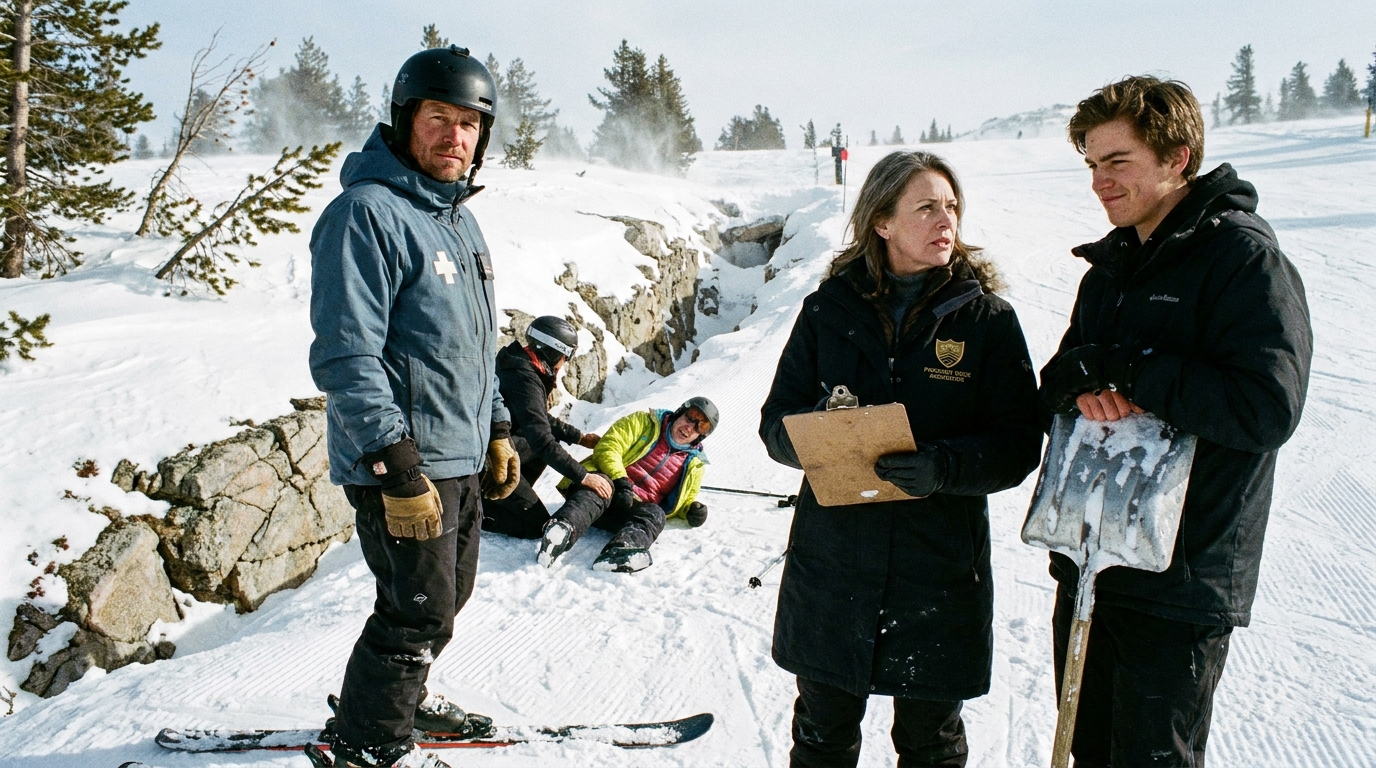
I stopped my skis five feet short of the drop, the cold air hitting my throat like broken glass. Below me, the groomed run was trash. Deep, angled grooves cut straight across the fall line—the exact trajectory where a skier picked up twenty knots before the tree curve. Someone had driven heavy iron shovels into the packed base, peeling back snow slabs to expose jagged granite underneath.
Down slope, five figures stood near the treeline.
Logan Mercer held a steel flat-head shovel. His breath bloomed white in the freezing sun. He didn’t run. He didn’t hide the tool. He just leaned on the handle, his boots grinding into the ruined snow powder.
“Look at that, boys,” Logan yelled, his voice echoing off the frozen pine canopy. “The safety inspector is here.”
I didn’t answer. I reached into my coat pocket, my gloved thumb clicking the brass bezel of my pocket barometer. Seven hundred feet above sea level. Dropping fast.
“You’re thirty yards onto private property, Logan,” I said. My voice was level. Cold. “Pack your gear and clear out.”
“Private property?” Logan laughed, taking two steps up the slope. He drove the shovel blade into a pristine snow berm, levering a fifty-pound chunk down the hill. “Trail’s a hazard, Rowan. We’re just helping you decommission it.”
Behind me, the sound of scraping edge metal cut through the wind. A tourist from the upper lodge carved around the bend, going too fast for the ruined conditions. He hit the first angled groove, his left ski binding snapping free with a sharp report. He slammed side-first into the hardpack, sliding twenty feet before rolling to a stop against a timber fence post.
He didn’t get up. He just clutched his knee, gasping into the snow.
Logan didn’t look at the downed skier. He smirked, wiping frost from his nose with the back of his leather glove. “Told you. Dangerous.”
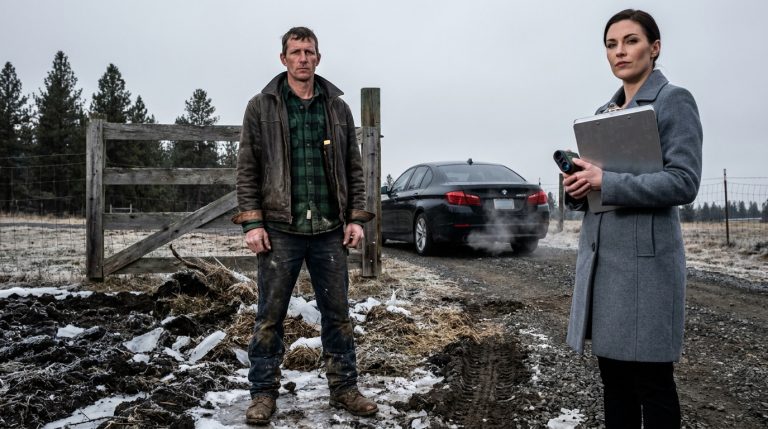
An engine idle rattled from the access gate near the highway. A black SUV idled beside the barrier. The door slammed shut, and Diane Mercer stepped into the snow. She carried a stiff leather clipboard under her arm, her heavy winter coat unbuttoned just enough to show the official Pinecrest Ridge Association brass crest on her lapel.
She didn’t glance at the injured man groaning ten yards away. Her eyes locked onto mine.
“That’s enough, Caleb,” she said, her boots crunching through the crust as she halted at the boundary line. “The HOA is locking this slope down. As of noon today, access is revoked.”
I unclicked my bindings and stepped out of my skis, planting them tail-first into the hardpack. “You don’t have jurisdiction here, Diane. This parcel was severed from the township grid in 1984. It’s fee-simple private land.”
“Ownership doesn’t override public endangerment,” Diane replied. She didn’t raise her voice. She used the practiced, deadpan cadence of a bureaucrat issuing a parking ticket. She tapped a pen against her clipboard. “Multiple safety complaints have been logged. You’re operating an uninspected recreational hazard that borders Association common grounds.”
“Your son dug those trenches ten minutes ago,” I said, pointing down the hill.
Logan didn’t flinch. He just rolled his shoulders, resting the shovel across his nape like an ox yoke. “Prove it, Rowan.”
Diane didn’t look back at her son. She didn’t need to. The play was already rehearsed.
“Anyone caught crossing this line faces a five-thousand-dollar Association assessment per incident,” she said, leaning in just enough for the thermal draft to carry her words strictly to me. “We’re done asking, Caleb. You either sign the maintenance easement over to the board, or we bleed you out in legal compliance fees before the thaw.”
I reached down and picked up a piece of the snapped orange warning stake from the snow. The wood grain was fresh, bright, and splintered by an axe-blade impact. I turned it over in my hand, feeling the rough pine bite through my glove.
“The snow melts in April, Diane,” I said softly. “The land stays right here.”
She turned on her heel, her boots carving deliberate, heavy tracks back toward her SUV. “Barricades arrive at three. Try moving them, and the county sheriff handles the trespass.”
Logan grinned, tossed his shovel to one of his friends, and melted into the timber line.
I stood alone on the slope, the cold settling heavy into my boots, holding the broken stake in my grip while the wind whistled through the ruined snow.
CHAPTER 2: SHADOWS ON THE RUN
The pine splinters bit through my glove, cold and sharp enough to draw a thread of heat against my palm.
Diane’s black SUV vanished past the tree line, leaving behind the blue stink of diesel exhaust that hung suspended in the sub-zero air. Down slope, the tourist who had taken the fall was sitting up, his face gray as wet salt, holding his knee while his friend helped him slide toward the access road.
I didn’t offer a shoulder. Out here, moving a guy with a torn MCL before the sled arrived just turned a bad sprain into a surgical repair.
“Stay flat,” I called down, my voice flat, unhurried. “Patrol’s three minutes out from the lower hut.”
I turned my back on him and walked toward the tree line where Logan had disappeared. The snow off the groomed line wasn’t packed; it was sugar powder over a layer of rotten crust. My boots sank six inches with every step, the leather groaning against the frozen brass eyelets.
Near a cluster of stunted white pines, a strip of neon-pink surveyor’s plastic fluttered against a low branch. It wasn’t the standard orange reflective tape I used to mark the property boundary. I leaned down, my thumb clicking the brass bezel of my pocket barometer out of reflex. Seven hundred and ten feet.
I snagged the pink ribbon and pulled. It was tied to a freshly driven wooden hub—not a property pin, but a survey stake marked in black grease pencil: Project Apex – S-09.
Project Apex. The name didn’t belong to any township zoning filing I’d reviewed at the county office last spring.
I shoved the plastic strip into my jacket pocket beside the splintered stake. The sun was dipping behind the ridge, throwing long, violet shadows across the slope. The thermal inversion was setting in, dropping the temperature ten degrees in five minutes. If I didn’t get the snowcat out to smooth the ruts Logan had carved, the midnight freeze would turn those trenches into concrete walls by morning. Anyone hitting them at dawn would break an ankle or an axle.
The snowcat shed sat three hundred yards back, nestled in a notch of granite that blocked the north wind. The steel door gave a high, metallic shriek as I kicked the ice clear of the frame and hauled it open. Inside smelled of cold hydraulic fluid, stale coffee, and diesel paste.
I didn’t turn on the overhead lights. Instead, I reached under the workbench and pulled out a small black plastic case. Inside were two cellular trail cameras—rugged, wide-angle units with black-IR flash arrays that didn’t throw a visible light beam when triggered.
If Diane was coming back at three with barricades, Logan would be coming back before that to make sure the slope stayed un-skiable.
I loaded fresh lithium batteries into both units, the cold steel of the casings numbing my fingertips. On the back of the second camera, a white inventory sticker caught the dim light from the open door: Hydrology Audit – Sec 4. It was an old surplus unit I’d bought off a county land surveyor two years ago when the water board checked the upper creek basins.
Ten minutes later, I was back on the trail. I mounted the first camera six feet up a lodgepole pine overlooking the main fall line, disguising the casing behind a clump of frozen lichen. The second went lower, hidden inside the hollow base of a lightning-struck fir, pointing directly at the boundary hub where I’d found the pink survey ribbon.
As I tightened the ratcheting strap on the second tree, the crunch of heavy tires sounded from the gravel turnaround near the gate.
I stayed low behind the fir, watching through the lower branches.
A yellow township flatbed idling at the gate wasn’t county maintenance. It was a commercial contractor’s rig. Two men in high-vis vests hopped out and began dragging heavy orange plastic barricades across my driveway—not the road, but the private gravel apron that led to my staging hut.
Diane Mercer stood beside the cab, her clipboard tucked under one arm, holding a battery-powered drill in the other. She stepped onto the gravel, picked up a steel-backed sign, and slammed it against my cedar gatepost. The whine of the impact driver tore through the quiet valley as she drove a three-inch lag screw straight through my timber and into the grain.
The sign read: UNSAFE CONDITIONS – NO TRESPASS – PINECREST RIDGE HOA ENFORCEMENT.
I stepped out from the shadow of the fir, my boots making no sound in the soft powder along the shoulder.
“You’re screwing hardware into private cedar, Diane,” I said from fifteen feet away.
The contractor with the drill jumped, dropping his spare screws into the snow. Diane didn’t flinch. She set the driver on the hood of the flatbed, turned around slowly, and pulled an envelope from her coat.
“Certified notice, Caleb,” she said, her voice dry as dead leaves. “Emergency board resolution passed at four o’clock. Unauthorized commercial operation on residential adjacent parcels.”
I didn’t take the envelope. “This isn’t an HOA parcel. And it’s not a commercial operation. I don’t sell tickets.”
“You accept ‘donations’ for trail grooming from the lodge guests,” she replied, stepping closer until I could smell the sharp, artificial mint on her breath. “That constitutes a commercial impact under Section 12-B. The fines start at five thousand. They double every twenty-four hours the barricades are bypassed.”
She set the envelope on the hood of my snowcat shed’s utility vehicle, weighed it down with a chunk of road salt, and turned toward the truck.
“Take ’em down, Caleb,” she added over her shoulder, her hand on the truck door handle. “Go ahead. The deputy is parked at the bottom of the hill waiting for my call. The moment you touch those plastic barriers, it’s criminal mischief on an active public safety perimeter.”
The truck engine roared, the driver throwing it into reverse and spraying gravel against my wooden fence.
I stood in the dusk, watching the red taillights bleed into the fog settling along the road.
My phone buzzed in my inner pocket. A single vibration.
I pulled it out. The trail camera I’d mounted five minutes ago had just transmitted its first image.
The frame was grainy, shot in high-contrast black-and-white infrared. It showed the hollow fir tree at the boundary line. Logan Mercer was in the shot, hunched over the snow, holding a cordless auger with a two-inch masonry bit. Beside him on the ground lay a yellow steel canister marked Borehole-9.
He wasn’t just wrecking the snow. He was drilling into the frozen earth beneath it.
CHAPTER 3: THE BROKEN GUEST
The cold screen illuminated my thumb as I stared at the high-contrast photo. Logan’s jaw was set, his mouth slightly open, eyes glinting in the dark infrared flash as he pressed the cordless auger down into the frozen soil near the Borehole-9 marker.
Before the image could fade to black, a distant siren whined from the valley floor.
It wasn’t county maintenance. The sharp, double-tone pulse echoed off the granite cliffs, climbing the winding switchbacks toward my lower lot.
I shoved the phone into my jacket, turned on my heel, and cut down the slope through the dense timber. The snow was hard packed where the wind had scoured the ridge, my boots snapping dry pine twigs beneath the crust. By the time I cleared the tree line at the base station, red strobes were already painting the white banks around the access road.
A private ambulance idled beside the orange barricades Diane’s crew had erected two hours ago. The driver’s side door swung open, but no gurney rolled out.
Instead, a man sat on the tailgate of my parked pickup, his dark winter coat folded neatly across his lap, one arm bound tightly against his chest in a temporary sling. His jaw was square, his graying hair cropped tight to his scalp. He didn’t look like a tourist who’d panicked on a steep drop. His posture was rigid, almost military, despite the sweat sheen glinting on his forehead in the strobe light.
Elliot Ward. My guest at the upper cabin. A man who’d rented the cottage three weeks ago, asking for nothing except quiet, internet access, and a key to the perimeter gate.
“Caleb,” he said. His voice was low, clipped, completely stripped of panic. “Your lower run has been altered.”
“I know,” I said, stopping three feet away. I looked at his right shoulder. The collarbone was visibly asymmetric beneath his sweater. “You hit the rut near the boundary line?”
“A five-inch trench disguised with loose powder,” Elliot replied. He reached into his coat pocket with his left hand, his thumb rubbing a worn brass coin with methodical, rhythmic pressure. “I carved in at speed. The tip caught the exposed granite lip beneath the drift. Binding didn’t release.”
The paramedic stepped out from the rear doors, holding a clipboard. “He refused the transport to the county medical center. Signed the liability release.”
“I don’t need a gurney,” Elliot said calmly, addressing the medic without looking at him. “I need ice and forty minutes of rest.”
I looked down the road. The red lights were reflecting off the chrome bumper of a township sheriff’s cruiser parked fifty yards down the lane, idling silently. Diane Mercer stood beside the driver’s door, talking through the open window, her clipboard tucked under her left arm like a shield. She didn’t look toward the ambulance. She was directing the officer’s attention toward my gate.
“She’s framing this as an uninspected commercial nuisance,” I said softly, keeping my back to the cruiser. “She brought the township in to issue an administrative freeze.”
Elliot followed my glance, his dark eyes narrowing slightly as he took in the scene—the barricades, the township officer, Diane’s rehearsed hand gestures.
“She wants the easement,” Elliot said. It wasn’t a question.
“She wants the land,” I corrected. “Or she wants me financially choked by five-figure daily assessments until I abandon the deed.”
I pulled my phone out and tilted the screen toward him. I opened the trail camera feed and brought up the image from twenty minutes ago. Logan Mercer kneeling over the yellow steel canister labeled Borehole-9, the auger driven six inches into the subsoil behind the lightning-struck fir.
Elliot didn’t flinch. He leaned in slightly, his eyes tracking across the frame, taking in the timestamp, the GPS coordinates stamped in the corner, and the yellow marker.
“This isn’t an HOA property dispute,” Elliot murmured. His thumb paused on the brass coin. “The Mercer family is manufacturing a public hazard to force a land condemnation. If the township declares this parcel an unsafe nuisance, the Association gets first right of refusal on the lien.”
“A land-grab,” I said, the words heavy and cold in my throat.
“Layer one,” Elliot corrected softly. He looked up from the screen, his gaze locking onto mine with the weight of an anvil. “They don’t want your ski run, Caleb. They want what’s underneath it before someone files an official land record.”
“Who are you, Elliot?” I asked quietly.
He reached into his inner breast pocket with his uninjured left hand and pulled out a leather pass-case. He flipped it open just enough for me to see the silver seal etched into the heavy cardstock beneath the plastic window.
Senior Circuit Judge — United States District Court.
“I came up here to write an opinion on a regional land-rights appeal,” Elliot said, closing the case with a faint click. “I don’t like my work interrupted. And I particularly dislike manufactured negligence.”
“Diane has the sheriff waiting to cite me if I touch those barricades,” I said.
“Then don’t touch them,” Elliot replied. He stood up slowly from the tailgate, wincing once as his shoulder settled against the sling, but his frame remained straight as an iron bar. “Let her run the meeting tonight. Let her put every word of her accusation on the public record.”
He pointed his left index finger toward the phone in my hand.
“Save that file to two separate hard drives,” he added, his voice dropping into a register that sounded less like a tenant and more like an executioner. “And make sure the camera stays hot. If her son goes back to that hole tonight, we won’t just have a civil nuisance. We’ll have a federal chain of custody.”
Across the lot, Diane turned away from the cruiser, her eyes sweeping over to where Elliot and I stood in the dark. She gave a single, dismissive nod before stepping into her SUV and pulling away into the falling snow.
CHAPTER 4: THE BOARDROOM TRAP
Shadows stretched across the snowcat windshield, and two hours of bitter cold broke when my boots finally crunched on the salt-crusted asphalt outside the Pinecrest Community Center.
The air inside the hall tasted like scorched dust and damp polyester. Fluorescent tubes hummed overhead, casting a flat, institutional glare over eighty folding chairs packed shoulder-to-shoulder. Half the town had crammed into the room—homeowners in insulated parkas, local lodge staff, and three township deputies standing back-to-back against the rear fire doors.
Diane Mercer sat at the center of the oak head-table, flanked by two Association board members who looked anywhere except at the audience. Her hair was pulled back into a tight coil, her leather-bound clipboard resting squarely between two microphones. To her left, Logan sat with his arms crossed over a grease-stained hoodie, his thumb flicking the plastic clip of a pocketknife over and over.
The gavel struck the pine podium with a dry, hollow snap.
“This emergency session of the Pinecrest Ridge Board is now in order,” Diane announced. Her voice was amplified, smooth, and stripped of any tremor. “Item one on the agenda: immediate administrative condemnation and easement seizure of Parcel 4-B under public safety ordinance 11.”
A murmur rippled through the back rows. I stayed near the side aisle, my back against a cinderblock pillar, my thumb clicking the brass bezel of my pocket barometer. Seven hundred and five feet. The atmospheric pressure in the room felt heavy enough to bruise.
“We have documented three separate physical incidents on the uninspected ski run within forty-eight hours,” Diane continued, tapping a thick stack of paper. “We have received written notices from township risk management. The parcel owner, Caleb Rowan, has repeatedly refused to install compliant safety infrastructure or submit to Association oversight.”
She leaned closer to the microphone, her eyes locking onto mine across the sea of winter coats.
“Pursuant to our charter, the Association is exercising its right of emergency lien. We will take temporary possession of the corridor at eight o’clock tomorrow morning to begin full site remediation.”
A homeowner three rows down raised his hand. “Remediation? You’re shutting the run down permanently?”
“We are securing a lethal hazard,” Diane cut in smoothly. “If Mr. Rowan cannot maintain his boundaries, the board will do it for him. The financial penalties assessed against his deed currently exceed fifty-four thousand dollars. The lien is legally enforceable.”
Logan let out a quiet, audible breath, his mouth curving into that familiar, crooked tilt.
“Is the parcel owner present to make a statement?” the board treasurer asked softly, glancing toward the rear.
I didn’t reach for the microphone at the center aisle. I pulled a compact black hard drive from my canvas jacket and stepped into the aisle, the rubber soles of my work boots squeaking against the linoleum.
“I don’t need a statement,” I said. My voice wasn’t loud, but it cut through the hum of the overhead lights. “I need the projector cable.”
Diane’s jaw tightened. “This isn’t an open presentation, Caleb. Procedure dictates—”
“Procedure dictates that any evidence supporting an administrative lien must be entered into the public record before a vote,” a voice interrupted from the doorway.
The rear doors swung open. Elliot Ward stepped into the room.
His coat was draped over his left shoulder, his right arm pinned immovably against his chest by the white canvas sling. He walked with an unhurried, measured stride, his dark eyes scanning the room like a magistrate surveying a minor magistrate’s court. Two men in dark wool overcoats stepped in behind him, remaining silently by the threshold.
Diane’s hand froze over her clipboard. “Sir, this meeting is restricted to voting Association members.”
“I am a guest residing on Parcel 4-B,” Elliot said smoothly, taking a seat in the empty front row. “And as the victim of the ‘physical incident’ you logged at four-fifteen today, I have a direct material interest in this record.”
I reached the AV cart near the front wall, unplugged the township’s slide deck cable, and snapped it into my hard drive.
The white motorized screen behind the board table shuddered and dropped six feet.
“This is out of order!” Diane snapped, reaching for her gavel.
The screen flickered, then bloomed into high-definition, infrared clarity.
The room went dead silent.
The footage wasn’t a grainy cell phone clip. It was crisp 4K black-and-white infrared, stamped with an atomic clock timestamp from three hours ago. The frame showed the hollow fir tree at my property boundary.
On the wall behind Diane, her son Logan appeared twice his normal size. He was on his knees in the snow, operating a heavy cordless auger. The camera caught the sweat on his jaw, the yellow steel canister marked Borehole-9 sitting beside his knee, and his hands deliberately snapping my orange fiberglass warning stakes in half before throwing the pieces into the brush.
Gasps rattled the back row. Someone in the middle aisle stood up to see better.
“That’s… that’s altered footage,” Logan blurted out, his face flushing dark red as he straightened in his chair. “That’s fake!”
I hit the spacebar on the laptop. The video paused on a crystal-clear close-up of Logan’s face as he pulled a secondary marker from his pocket—a wooden survey hub wrapped in neon-pink ribbon stamped Project Apex.
“The damage to the fall line wasn’t an operational failure,” I said, looking directly at the two board members flanking Diane. “It was deliberate sabotage executed by the HOA president’s son to create the illusion of an unsafe hazard.”
Diane slammed her hand onto the table, her pen snapping clean in half beneath her palm. “This is an unverified video recorded without consent! It has no standing—”
“It was recorded by a fixed environmental sensor mounted on private fee-simple land,” Elliot said, his voice dropping into that chilling, authoritative register. He stood up slowly, reaching into his pocket with his left hand to lay a heavy white card onto the table in front of Diane. “And as a Senior United States Circuit Judge, I assure you, Mrs. Mercer, the chain of custody has already been certified.”
The gavel slipped from Diane’s hand, clattering against the laminate floor with a heavy, final sound.
Logan’s head snapped toward his mother, his confidence evaporating in an instant. “Mom… what is this?”
Before Diane could answer, the two men who had entered behind Elliot walked down the center aisle. One of them pulled a leather badge holder from his coat, opening it toward the board table.
“Diane Mercer? Logan Mercer?” the officer said calmly. “State Police Criminal Investigation Division. We have a warrant regarding the intentional destruction of property and reckless endangerment on private land.”
The room erupted into noise, but for me, the sound faded into the hum of the cold air coming through the floorboards. I stood by the projector, watching Diane’s hands tremble as she stared at the paused frame of her son on the wall.
CHAPTER 5: CHECKMATE ON PINECREST
Logan took two steps backward, his heels catching on the chrome leg of an empty folding chair. The chair clattered across the linoleum, the metal screech cutting straight through the stunned murmur of the hall.
“Don’t touch him!” Diane’s voice hit a pitch I hadn’t heard before—thin, brittle, stripped of every ounce of administrative composure. She slammed both palms onto the head table, leaning over her split pen and clipboard. “This is an internal Association administrative hearing! You have no standing to execute a detention on private HOA residential assets without a municipal warrant!”
The lead investigator didn’t argue. He didn’t raise his voice. He reached into his inner jacket pocket, pulled out a tri-folded white document stamped with a red state seal, and laid it flat over Diane’s cracked clipboard.
“State Supreme Court preliminary injunction,” the investigator said. His voice was a flat, clinical drone. “Issued thirty minutes ago out of the district magistrate’s office. It covers all active boundaries of Parcel 4-B, including all unauthorized subsoil drilling, environmental interference, and fraudulent enforcement actions executed under the name of the Pinecrest Ridge Association.”
Diane’s eyes darted across the header text. Her left hand twitched, her fingers clawing reflexively at the edge of the paper, crumpling the margin into a tight ball of pulp. “This is an administrative error… a jurisdictional misunderstanding…”
“It’s an environmental felony,” I said, stepping past the AV cart until I stood three feet from the head table.
I reached into my canvas coat and pulled out the yellow steel canister Logan had abandoned near the hollow fir three hours ago—the one stamped Borehole-9. I set it onto the oak table with a dull, heavy thud that rattled Diane’s microphone.
“Layer one was the land-grab,” I said, my thumb clicking the brass bezel of my barometer. Six hundred and ninety-eight feet. The pressure was equalizing. “You wanted the county to declare Parcel 4-B an unsafe nuisance so the HOA could seize the access corridor through a forced lien. You thought if you squeezed me hard enough with five-figure fines, I’d hand over the deed.”
Diane glared at the canister, her mouth pressed into a line so tight her lips turned white. She didn’t speak. She knew better than to offer a single syllable on a recorded line.
“But you weren’t trying to build a new ski lift,” I continued, leaning in until I could see the cold beads of sweat forming along her hairline. “Your son wasn’t just messing up my groomed runs. He was drilling six-inch monitoring shafts to tap into the bedrock drainage line.”
I pointed toward the screen behind her, where the paused frame of the pink survey tape still glowed in high-definition black-and-white.
“Project Apex,” I said, reciting the marker text from the hub in my pocket. “The illegal expansion project three hundred yards above my property boundary. The one your resort development group started last spring without filing a state Hydrology Audit.”
The room went dead silent. The board members on either side of Diane slid their chairs back, physical space opening up between them and their president like they were clearing out from a toxic spill.
“The runoff from those upper cuts didn’t drain into the township storm grid,” I said, looking back at the lead investigator. “It leached straight down into the subsoil right above my run. Logan wasn’t digging to ruin my snow. He was trying to capped Borehole-9 before the state water board picked up the chemical trace in my spring line.”
Logan looked at his mother, his jaw working silently, his face completely drained of color. “Mom… you said the township wouldn’t inspect the lower lot…”
“Shut up, Logan!” Diane hissed, her voice dropping into a desperate, razor-sharp whisper. She spun on the investigator, her hands gripping the table edge so hard her knuckles turned yellow. “This footage is inadmissible. The canister was removed from private ground without a search authorization. Any environmental filing based on this evidence is completely void!”
Elliot Ward stepped forward from the front row. He didn’t look at Diane. He turned his head toward the two state troopers waiting by the aisle.
“The physical evidence was secured under an emergency preservation order issued under my direct judicial authority as a federal officer witnessing an active hazard,” Elliot said quietly. He adjusted his sling with his left hand, his face calm, unreadable, and absolute. “The chain of custody began the moment your son drove an iron auger into a protected watershed boundary.”
The lead investigator reached out, his hand settling firmly on Logan’s shoulder. The metal click of the handcuffs was small, crisp, and echoed off the cinderblock walls with absolute finality.
Logan didn’t fight. He let the trooper turn him toward the side exit, his head hanging low, his boots dragging along the linoleum.
Diane stood frozen behind the table. She didn’t follow her son. She didn’t look at the crowd of neighbors staring at her from the folding chairs. She just stared at the yellow canister sitting on her clipboard, her authority, her position, and her empire dissolving into the hum of the fluorescent lights.
The officer held the side door open, and as the cold night air rushed into the sweltering hall, the heavy oak gavel on the table sat cold and untouched.
CHAPTER 6: CLEAN SNOW
The cold mountain air cut through the open doorway, carrying away the lingering stench of hot polyester and stale coffee.
Diane Mercer didn’t move as the last of the homeowners filed out past the deputies. She sat rigid behind the oak table, her hands flat on either side of her ruined clipboard, staring at the yellow steel cylinder sitting on her enforcement papers.
The two remaining board members picked up their folders without saying a word. Neither offered her a hand. Neither looked her in the eye. They walked out into the crisp night, their shoes clicking against the linoleum until the double doors swung shut behind them, leaving only the steady hum of the overhead lights.
Elliot Ward pulled his coat tighter over his shoulder, his left hand easing the sling into a more comfortable position. “The state attorney general’s office will serve the formal injunction on the resort syndicate by dawn,” he said softly, his voice echoing in the empty hall. “They’re freezing every asset tied to Project Apex.”
I picked up the black hard drive from the AV cart and slid it into my canvas coat. “What about the HOA?”
“The board’s emergency powers are suspended,” Elliot said. “A court-appointed compliance monitor takes over operations on Monday. The fines assessed against your deed are nullified.”
I looked over at Diane one last time. Her chest rose and fell in shallow, rapid breaths, but her face remained carved from ice. She didn’t look up when I turned toward the exit. She was already invisible in the very room she had tried to rule.
Outside, four hours of snowfall had blanketed the parking lot in four inches of untracked powder. The night sky had cleared, leaving a sharp canopy of stars burning cold over the jagged spine of Pinecrest Ridge.
We drove back to the base station in silence. The heater in my truck kicked on, blowing warm air against my boots, but my hands stayed cold on the steering wheel until I pulled into the apron of my driveway.
The orange plastic barricades Diane’s contractors had set up were gone. A state police cruiser was parked near the gate, its driver giving us a single, brief flash of his headlights before rolling down the lane to maintain the court-ordered perimeter.
By morning, the sun broke clear over the ridge, bleaching the white slopes in blinding light.
I walked up to the boundary fir where Logan had driven his auger into the subsoil. A team from the state environmental protection division was already there, wearing blue parkas and setting up a professional sampling rig around Borehole-9. They had staked off the area with yellow caution tape, marking the exact coordinates where the illegal runoff had been tapped.
The lead tech—a woman with a heavy clipboard and insulated work boots—nodded as I approached. “The plume didn’t reach your lower spring, Mr. Rowan. You caught it in time. Another forty-eight hours of drilling and they would have cracked the shale layer.”
I reached into my pocket, pulled out the piece of the orange warning stake Logan had snapped on day one, and tossed it into the back of my utility sled.
Two hours later, I was inside the snowcat shed. The air smelled of cold grease and cedar shavings. I set my broken timber gatepost onto the workbench, clamped it into the vise, and pulled out my hand plane.
I worked the steel blade across the scarred wood, shaving away the gouges left by Diane’s three-inch lag screws until the raw, fragrant cedar grain showed clean underneath. My thumb clicked the brass bezel of my pocket barometer out of habit. Seven hundred and ten feet. The atmospheric pressure was rock solid.
A shadow crossed the shed doorway. Elliot stood in the sunlight, his arm still bound in the canvas sling, carrying a small leather duffel bag in his left hand. A black sedan was idling near the lower gate.
“The driver’s here,” Elliot said.
I set the hand plane down on the bench. “Your shoulder?”
“Fractured head of the humerus,” he replied, a faint, dry smile touching the corner of his mouth. “The orthopedic surgeon in town says six weeks in the cast. He recommended quiet rest.”
“You could stay at the upper cabin,” I said. “The run’s open.”
Elliot looked up the slope. The groomed fall line stretched clean and undisturbed between the pine trees, gleaming white under the midday sun. Two local skiers were already carving sweeping turns through the upper powder, their laughter carrying faintly on the thermal draft.
“I’ll be back before the thaw, Caleb,” Elliot said, extending his left hand. “Keep your perimeter clear.”
I shook his hand—a solid, unyielding grip. “It’s cleared.”
I watched his sedan wind down the mountain road until the red taillights disappeared beyond the timber curve.
I walked back out onto the snow, stepping onto the edge of the trail. The wind came off the upper ridge, fresh and cold, carrying the clean scent of pine resin and crushed ice.
There were no barricades at the gate. No certified notices pinned to the fence posts. Just thirty acres of open mountain land, cold, quiet, and mine.