The Architect of Silence: A Veteran’s Measured War Against the Suburban Machine
CHAPTER 1: The Scepter of Conformity
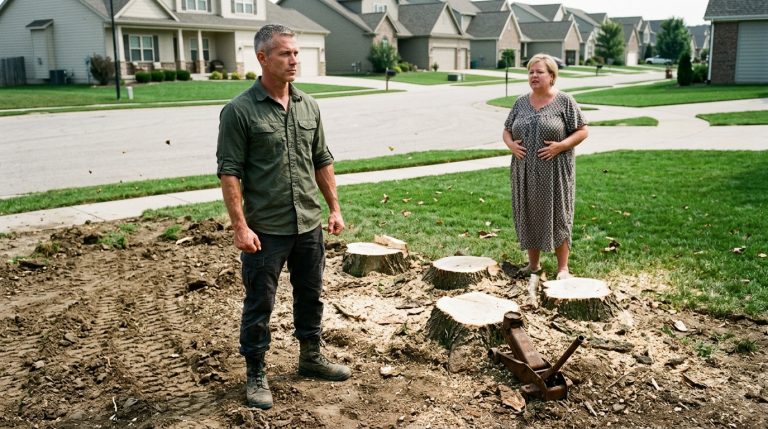
The heat in the Virginia afternoon was heavy, a wet blanket draped over the five acres of my property that still defied the encroaching beige sprawl of Liberty Crossing. I stood motionless, my boots planted on the dry earth, watching Karen Miller. She was encased in a pastel pink tracksuit that strained at the seams, a garment clearly designed for a life of curated leisure that she had weaponized into a uniform of suburban warfare.
“Your little dirt hole is a public nuisance and a structural liability, Mr. Caldwell,” she declared. Her voice had that specific, piercing register of someone who had never been told ‘no’ by someone who didn’t fear her. “We’re having it filled with concrete by Friday. The five-thousand-dollar special assessment will be added to your dues. Consider this your final notice.”
She held her clipboard like a sacred relic, a scepter of the Homeowners Association that served as the backbone of her self-appointed kingdom. Behind her, the McMansions of the Meadows stood in silent, vinyl-sided unison, their lawns so manicured they looked synthetic.
I didn’t answer immediately. I took a breath, feeling the familiar, cold detachment slide into place—a reflex honed in high-stakes environments where an emotional response was a tactical error. My eyes flicked to the root cellar. To her, it was an eyesore, a jagged fieldstone scar in a landscape of uniform perfection. To me, it was solid, honest, and grounded—a structure that had survived over a century of Virginia winters.
“That cellar predates your entire development by a hundred and thirty years, Karen,” I said, my voice deliberately flat. I didn’t raise it. I didn’t need to. “It is not a ‘dirt hole.’ It is part of the original Caldwell homestead.”
“History is no excuse for violating the covenants, Mr. Caldwell.” She waved a hand dismissively, the sunlight glinting off a gold bracelet that looked like a shackle. “Section Four, Subsection B. All detached structures require ARC approval. Your structure is unapproved, unsafe, and frankly, it is dragging down the property values of every home on this street.”
Property values. The two words she uttered with the reverence of a prayer. She thought she was winning, that the weight of her bureaucratic machine was already crushing me. She didn’t see the way I was already mapping the perimeter of the trap. She wasn’t dealing with a stubborn retiree; she was dealing with a man who had built forward operating bases in active conflict zones.
“You’re going to fill it with concrete,” I repeated, confirming the order to ensure it was etched into the record.
“By Friday,” she confirmed, her smug certainty radiating off her like heat waves from the asphalt. She turned on her heel, her white sneakers pristine and jarring against the dusty edge of my property, and marched toward her SUV.
I watched her go, the silence returning to the yard like a physical weight. She was walking away, fully convinced that her authority was absolute, completely unaware that the ground she just stood on was no longer a piece of land to her—it was the first marker of her own demolition.
My phone vibrated in my pocket, but I didn’t reach for it. Instead, I looked back at the heavy timber door of the root cellar. I didn’t know yet what was buried inside, but as I watched Karen pull away, I knew one thing for certain: she had just made the mistake of triggering a response she was entirely unequipped to survive.
CHAPTER 2: The Paper War Begins
The dust motes dancing in the late afternoon light of the study seemed to mock the urgency humming in my veins. I stood at my grandfather’s oak desk, the very surface where he had managed five acres of Virginia soil for decades. The wood was scarred, worn smooth by heavy ledgers and callous-hardened palms, and it felt like a command post.
Karen’s departure had left a vacuum, a lingering tension that tasted like ozone before a storm. She thought she was leaving me with a ticking clock—a fourteen-day countdown to her “forced remediation.” She didn’t know she had just handed me the one thing I needed to initiate a tactical overhaul: a defined timeline and a clear objective.
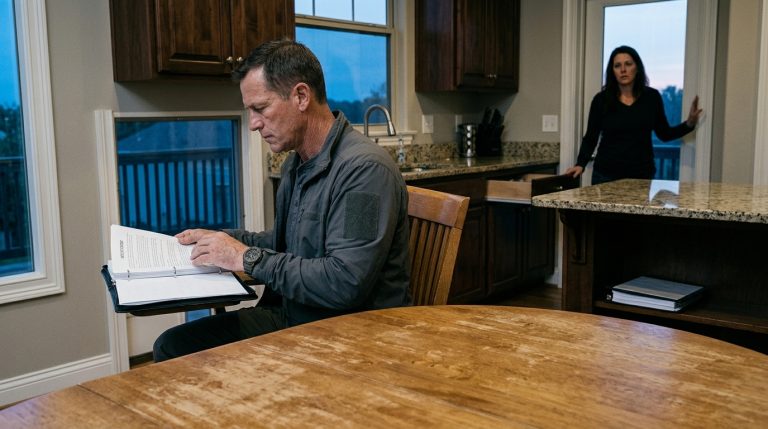
I didn’t pace. I didn’t drink. I opened the center drawer of the desk and pulled out a fresh, three-ring binder. The plastic cover was unnervingly clear, a stark contrast to the grit of the world outside. I laid it flat, the snap of the metal rings punctuating the silence like a gunshot.
My training with the Corps of Engineers hadn’t just been about laying concrete and driving piles; it was about the logistics of infrastructure. To build, you needed plans. To dismantle, you needed vulnerabilities. Karen had weaponized the HOA’s bylaws against me, using Section 4, Subsection B like a jagged blade. If she wanted to play by the book, I would bury her in it.
I pulled my laptop forward, the screen blooming with the blue-light glare of professional CAD software. I opened the file I’d started months ago when the first rumblings of the “aesthetic harmony” complaints began. It was a complete architectural survey of the property, including the barn, the smokehouse, and the root cellar.
My fingers moved with the practiced rhythm of a man who had spent years drafting blueprints in the back of a humvee. I began to pull the metadata for the root cellar—not just as an auxiliary structure, but as a masterpiece of 19th-century German immigrant masonry. I didn’t need to lie. I didn’t need to inflate. I just needed to present the raw, cold data of its structural integrity.
The air in the room felt different now. It was cool, stale, and smelled of old paper and wood stain. It was a space of logic, removed from the petty, emotional theatrics of Karen’s pastel tracksuit world. I pulled the county development plan from a stack of documents—the one that had allowed me to win the barn-painting battle a year ago.
I found the clause. Architectural oversight on any property bordering their community.
I began to map out the strategy, the “Malicious Compliance” protocol. If they wanted an application, I would give them one so dense, so legally and architecturally air-tight, that it would require them to consult a panel of experts just to understand the table of contents. I wasn’t going to argue the morality of my shed. I was going to force them to prove their claim of “structural liability” against a mountain of engineering certifications, soil stability reports, and pest-control affidavits.
I paused, looking at the door. I could hear the faint, muffled hum of a mower in the distance—one of the neighbors following the HOA’s rigid schedule. It sounded thin, artificial.
I turned back to the screen, my jaw tight. I wasn’t just defending a hole in the ground. I was defending the last island of authentic history in a sea of cookie-cutter vinyl. I knew that by the time I walked through those clubhouse doors with this binder, Karen Miller wouldn’t just be dealing with a nuisance; she would be staring down a weaponized, bureaucratic nightmare of her own design.
Every click of the mouse felt like loading a round into a chamber. I wasn’t rushing. Rushers make mistakes. I was measuring. I was calibrating. I was preparing to turn their own holy scripture—their precious bylaws—into a leash that would eventually pull them to their knees.
The sun began to dip behind the treeline, casting long, sharp shadows across the property. I didn’t turn on the lamp. I worked in the cooling twilight, the only light the steady, clinical glow of the monitor, documenting the history of the land that had survived long before their plastic vision of paradise existed, and would be here long after they were gone.
CHAPTER 3: The Show Trial
The clubhouse conference room was a beige box, a space so aggressively neutral that it seemed to actively repel character. The walls were adorned with framed motivational posters—a sunrise over a mountain range, a row of synchronized rowers—that looked like they had been purchased in bulk to suppress dissent. The air smelled of lavender-scented potpourri, a cloying, synthetic perfume that tried and failed to mask the scent of stale coffee and suburban anxiety.
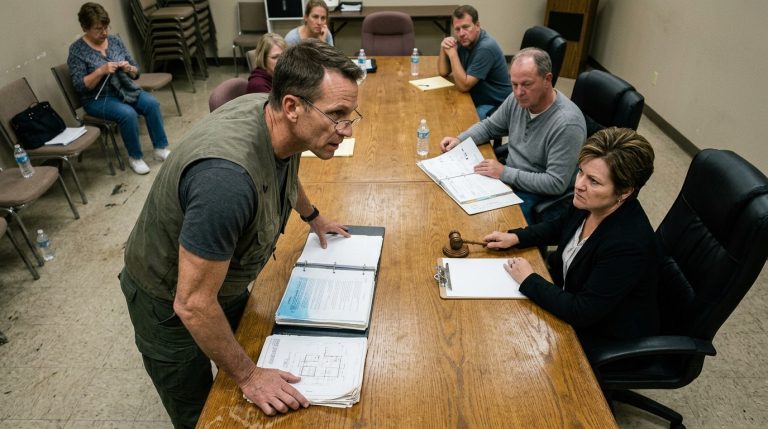
I stepped inside, the weight of the binder in my hand serving as my ballast. Karen Miller sat at the head of the laminate table, her posture rigid, her clipboard already positioned like a shield. Flanking her were her lieutenants: Gary, who was busy realigning a pen on the table with obsessive-compulsive precision, and Brenda, a woman whose face seemed perpetually set in a mask of anxious compliance. They were the tribunal, convinced they were holding court. They didn’t realize they were already sitting on a platform designed to collapse under them.
“Mr. Caldwell,” Karen said, not inviting me to sit. Her voice was thin, sharp enough to cut through the quiet. “You’ve made us wait an entire week for this. I assume you have the demolition plan?”
I didn’t answer immediately. I walked to the far end of the table—the end furthest from her—and placed the binder on the laminate. The thud it made was significant, a hollow, resonant sound that momentarily froze Gary’s fidgeting. It was three inches of paper, engineering diagrams, soil reports, and historical data, bound in cold, clear plastic.
“This is the application for the root cellar,” I said, my voice steady. I pulled out a chair and sat down, the metal screeching against the carpet. I didn’t reach for the binder. I let it sit there, an unexploded ordinance at the center of their beige sanctuary.
Karen glanced at the binder, then back at me, her eyes narrowing. She didn’t touch it. She didn’t even look at the index tabs. “We have a strict agenda, Mr. Caldwell. We’ve already discussed the mailbox modifications and the deck stain palette. We don’t have time to wade through whatever… documents you’ve collected.”
Gary shifted, his eyes flickering toward the binder. He seemed tempted to reach out, to see why it was so heavy, but a sharp look from Karen kept him in check.
“The bylaws require a fair and impartial review,” I said, leaning back. I kept my hands on the table, visible and relaxed. “I’ve provided everything the committee needs to evaluate the structural integrity of the site. If you refuse to look at the materials, you’re not enforcing the bylaws. You’re ignoring them.”
Brenda leaned forward, her expression flickering with a momentary, genuine curiosity before she caught herself and looked toward Karen for instruction. The air in the room grew tighter, a vacuum formed by their collective refusal to engage with the reality in front of them.
“The structure is an eyesore,” Karen declared, her voice rising slightly. “It doesn’t conform. That is a clear violation of Section 7.9. We don’t need a soil report to tell us that a dilapidated hole in the ground lowers property values.”
“Property values are a concern,” I conceded, my tone dry. “But facts are a requirement. If you’re going to condemn a structure based on an aesthetic judgment, you’d better be prepared to defend that decision when the evidence is presented.”
I watched them. I was calculating the risk of every word. They were terrified of the documentation, not because they thought it was wrong, but because they knew that looking at it would force them to acknowledge that I was a peer, not a subject. They were so busy trying to maintain the facade of their suburban kingdom that they hadn’t realized the foundation was already cracked.
Gary finally spoke, his voice cracking slightly. “Karen, maybe… maybe we should at least look at the engineering diagrams? If the report says it’s stable, the insurance liability—”
“The liability is on the homeowner for failing to maintain the property!” Karen snapped, cutting him off before he could complete the thought. She didn’t look at him; her eyes were locked on me, a predator trying to hold its gaze through a screen of frustration. “We are here to maintain the standard of the Meadows at Liberty Crossing. Mr. Caldwell’s property is a blight. The application is denied.”
She hadn’t even opened the binder. The finality of her voice was absolute, a gavel blow that resonated in the small, beige room. She expected me to react. She expected anger, or perhaps the pleading tone of a man trying to save his home.
I didn’t give it to her. I sat in the silence, letting the weight of her arbitrary dismissal settle over the table. I had already achieved what I came for. I had forced them to record their refusal to look at the evidence. I had documented their bad faith.
“So noted,” I said, my voice quiet. I stood up, the chair moving back with a controlled, rhythmic scrape. I didn’t touch the binder. I left it there, an unexploded shell sitting in the middle of their perfect, beige box. “I’ll expect the formal denial in writing, with the specific justifications for ignoring the submitted engineering and historical data.”
I turned toward the door. As I reached for the handle, I looked back once. They were all staring at the binder now, their faces pale, the arrogance replaced by a creeping, dawning sense of unease. They were sitting in a room of their own making, terrified of the information they had just explicitly chosen to ignore.
CHAPTER 4: The Gathering Storm
The walk from the clubhouse to my front porch felt like crossing a demilitarized zone. The manicured lawns of Liberty Crossing stretched out on either side of the road, each one a testament to the rigid, soul-crushing uniformity that Karen Miller worshiped. My boots crunched against the pavement, the sound sharp and defiant in the quiet suburban afternoon. Every house looked the same—the same beige siding, the same ornamental shrubs, the same forced stillness. It was a neighborhood designed to eliminate friction, but as I turned onto my driveway, I felt the familiar grit of my own five acres, an island of history and disorder that Karen viewed as a terminal infection.
I reached the porch and sat down, the wooden steps groaning under my weight. My coffee, cold now, sat in a ceramic mug on the railing. I stared out at the root cellar, its weathered fieldstone entrance framed by a patch of unruly wild clover. The sight of it usually brought me peace, a mental anchor that smoothed out the jagged edges of my mind, but today, it was different. Today, it was a target.
The memory hit me with the force of a physical blow—the sterile, fluorescent hum of a briefing room in Khost, the smell of damp concrete and recycled air. We had been discussing a forward operating base’s structural integrity, the math of load-bearing walls and blast resistance. I shook it off, grounding myself in the present. This wasn’t Afghanistan, but the tactical principle remained: you don’t fight a battle on ground chosen by the enemy. If I wanted to win, I had to stop acting like a lone insurgent and start acting like a commander.
The gravel crunched. Arthur Abernathy appeared at the edge of the property, walking with a steady, measured gait. Behind him, the Garcias—Miguel and Maria—followed, their faces tight with the kind of contained frustration that only an HOA fine could produce.
“I heard the meeting didn’t go as planned,” Arthur said, stopping at the base of the porch. He was a man of long winters and deep history, and his concern was a welcome change from the performative hostility of the HOA board.
“They didn’t even look at the binder,” I replied, gesturing to the empty space beside me on the porch. They climbed the steps, their presence changing the atmosphere. They weren’t soldiers, but they were the people who lived under the shadow of the same tyranny.
“It was a show trial,” Miguel said, his jaw locked. He sat on the railing, looking toward the cellar. “They didn’t want a plan. They wanted a submission.”
“Exactly,” I said. I looked at each of them in turn. “They’re counting on me to be an outlier. They’re counting on the fact that I’m the only one who doesn’t fit the ‘harmony’ of their neighborhood. They think if they crush me, the rest of you will just fall in line.”
Maria sat on the edge of the porch, her hands clasped tightly in her lap. “They fined us again, Mark. Two hundred dollars. For the slide. They said it wasn’t ‘harmonious’ with the exterior color palette of the community.”
“It’s a plastic slide,” Miguel added, his voice low. “It’s for our kids. They’re turning a neighborhood into a prison.”
I took a sip of the cold coffee, the bitterness a welcome contrast to the sweet, cloying perfume of the clubhouse. “They operate on fear, and they operate on the idea that they’re the only ones who know the rules. But they’re not fighting a war, and they’re not as organized as they think. They’re bullies with a clipboard.”
I stood up and walked to the porch railing, looking out over the five acres. “I’m going to keep playing their game, but I’m changing the arena. They want compliance? I’ll give them so much compliance they’ll drown in it. But I need to know something. How many of you are tired of the fines? How many of you are tired of the fear?”
Arthur stood, his eyes fixed on the root cellar. “I’ve lived here for twenty years, Mark. I’ve watched this place lose its soul. If there’s a way to push back, I’m in.”
“Me too,” Miguel said, standing beside me.
“The question,” I said, my voice low and deliberate, “is whether you’re willing to see it through when the pressure really starts. They’re going to come after us. They’re going to use every bylaw, every fine, and every legal threat they have. This isn’t just about my cellar anymore. It’s about who owns this neighborhood—the residents or a corrupt board that uses its power for personal vendettas.”
I looked at them, measuring the resolve in their eyes. This was the first brick of the coalition. I wasn’t just building a defense; I was building a force. I didn’t need to tell them about the federal protections yet, or the deeper, darker history that lay beneath the dirt. That would come later, when the timing was right, and when the impact would be the most devastating. For now, I needed the alliance, and I needed to plant the seeds of a rebellion that would spread far beyond the borders of my five acres.
“We start by documenting everything,” I said, a grim, tactical edge to my voice. “Every fine, every interaction, every time they cross the line. We build a record. And then, when they think they’ve won, we release it all at once.”
The sun hit the treeline, casting long, bruised shadows over the lawn. We sat there for a long time, talking not about the history of the homestead, but about the future of the neighborhood. The atmosphere was no longer one of quiet resignation; it was the sharp, charged energy of a resistance being formed. Karen Miller thought she was in control, but as the night descended, the real war was only just beginning.
CHAPTER 5: The Attic Excavation
The air in the attic was thick, stagnant, and scorched by the Virginia sun beating against the slate roof. It tasted of dry pine, dust, and the slow, inevitable decay of paper. I stood at the top of the pull-down stairs, my flashlight cutting a steady, clinical beam through the gloom. Everything was exactly where it had been for years—neatly labeled boxes, wrapped furniture, the ghosts of a life lived with disciplined frugality.
I didn’t waste time on the nostalgia. I moved with a singular, mission-oriented focus. The HOA was already plotting their next move, and my defensive posture was no longer sufficient. I needed leverage.
My flashlight swept across the rafters, landing on the far corner where the light seemed to die against the shadows. I moved forward, stepping carefully over floor joists, my movements deliberate. My target wasn’t the boxes of Christmas ornaments or the stacks of outdated tax returns. It was the steamer trunk I’d seen in the periphery of my memory since I was a child.
It sat in the deepest corner, a hulking presence of iron-bound wood. As I approached, the scent of the space shifted. The dry, sweet rot of old wood was punctuated by a sharp, metallic tang—the smell of oxidized brass and forgotten secrets. I knelt before it, the floorboards groaning in protest. The trunk was locked, but the mechanism was simple, an antique latch that had surrendered to the humidity of a century. I worked it with my thumbs, the iron snapping back with a dull, heavy clatter that felt unnervingly loud in the quiet house.
The lid resisted, heavy and stubborn, until I braced my shoulder against it. As it creaked open, a cloud of fine, grey dust motes rose into the flashlight beam like a swarm of silent insects. Inside, the contents were a graveyard of intention. There were bundles of letters tied with fraying ribbon, ledgers with spines cracked from decades of use, and boxes of brittle, yellowed documents that looked like they might disintegrate if I touched them.
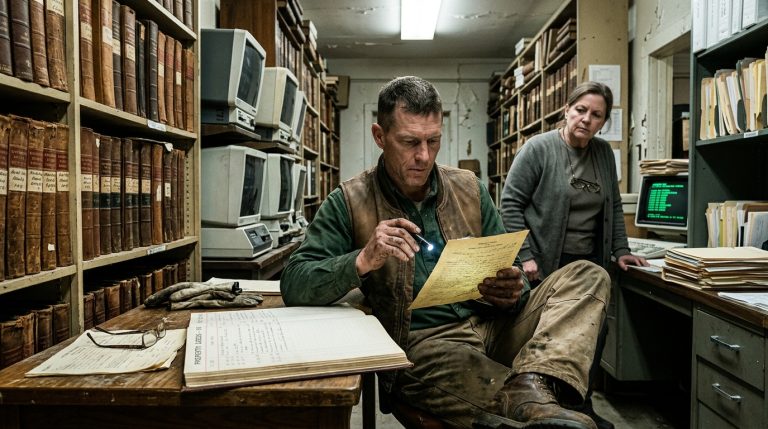
I pulled out a leather-bound ledger first, its pages filled with my great-grandfather’s precise, looping script. He had been a farmer, a man of few words and precise geometry, and his logs were masterpieces of efficiency. I flipped through the dates—the 1880s, the 1890s, the turn of the century—looking for an anomaly. But there was nothing there, just the rhythm of crops and the fluctuating prices of grain.
My frustration began to mount, a cold, sharp itch at the base of my neck. I tossed the ledger back and reached for a thicker bundle of documents at the bottom of the trunk. They were wrapped in oilcloth, protected from the ravages of time. I unwrapped them, the fabric stiff and smelling faintly of machine oil.
It was a collection of maps—land surveys of the surrounding county, detailed drawings of property lines, and notes on topographical features that didn’t match the current suburban sprawl. I leaned closer, my flashlight trembling slightly. Among the maps was a manila folder, its edges softened by age. It wasn’t labeled with a date or a crop. It was labeled in my grandfather’s hand: The Cellar.
The air in the attic felt suddenly thin. I opened the folder, my movements careful, calculated. Inside, the documents were an odd assortment: sketches of the root cellar’s interior, cross-sections that revealed a depth I hadn’t realized existed, and letters—dozens of them—addressed to an “Alistair Finch, Department of History, University of Virginia.”
The first letter was dated 1974. I began to read, my eyes tracing the lines, my brain processing the implications. Dr. Finch wasn’t writing about agriculture or storage. He was writing about “clandestine routes,” “safe passage,” and “the structural modifications required for human occupancy.”
My heart hammered against my ribs, a rhythmic, frantic sound. I reached deeper into the folder, pulling out a document that felt thicker, heavier than the rest. It was card stock, embossed with a seal that caught the flashlight beam with a dull, golden reflection: National Park Service.
I unfolded it slowly, the paper crackling like dry leaves. This is to certify that the Caldwell Homestead Root Seller has been entered on the National Register of Historic Places.
The date was 1978. October 12th.
I sat there in the sweltering heat, the weight of the document sinking into me. My grandfather, the quiet, unassuming man who had taught me the value of a straight fence line, had kept this secret for forty years. He hadn’t just saved a cellar; he had guarded a monument to the darkest and brightest moments of our collective history. And he had done it with the quiet, bureaucratic efficiency of a man who knew exactly how to hold his ground.
A sudden sound—the floorboards of the attic stairs creaking—sent a surge of adrenaline through my system. I froze, my light snapping off, the darkness rushing back in to swallow the trunk, the letters, and the weight of the revelation. I didn’t breathe. I listened, my pulse a frantic, muted drum in my ears. The sound didn’t repeat, just the slow, rhythmic settling of the old farmhouse, but the threat felt real, immediate. I was no longer just digging through the past; I was excavating a truth that was dangerous enough to change everything.
CHAPTER 6: The Killing Ground
The morning was brittle, the air possessing that sharp, thin quality that precedes a major atmospheric shift. I stood on my porch, the ceramic mug of coffee still warm in my hand, but I didn’t drink. I watched the canary-yellow concrete truck turn off the main road and onto my driveway. Its tires crunched through the gravel with a sound like grinding teeth, the weight of the massive, rotating drum causing the truck to sway with a heavy, dangerous momentum.
Karen Miller’s white SUV followed it, pulling up to the curb with the precise, practiced elegance of a funeral director. She emerged before the truck had even fully come to a halt, her fuchsia power suit a jarring, unnatural splash of color against the desaturated grey of the gravel and the stone of the house. She looked triumphant, her chin tilted at an angle that signaled she had already won the war. Gary and Brenda followed, their movements hesitant, their eyes flickering toward the root cellar as if they expected it to grow teeth.
I walked down the steps, my movements deliberate. I felt the paper-thin edge of the National Register certificate against my ribs, a weightless contrast to the literal weight of the cement looming just feet away. The truck driver, a man whose face was a map of cynical weariness, climbed down from the cab and unhooked a heavy, reinforced rubber shoot.
“Mr. Caldwell,” Karen said, her voice piercing the rumble of the idling truck. She didn’t walk all the way to me; she stopped exactly at the edge of the property line, as if there were a literal, electrified wire stretched across the driveway. “You had your chance. We’re done with the games. Today, the liability is corrected.”
She nodded at the driver, a gesture of absolute, detached authority. The driver began to maneuver the heavy, articulating metal arm of the shoot, aiming it directly at the century-old timber door of the root cellar.
I didn’t run. I didn’t yell. I stopped ten feet from them, letting the space between us become a vacuum of tension. I felt that strange, irrational sense of paranoia—the walls of the house, the fence, the trees—they all seemed to be leaning inward, a physical manifestation of the pressure the board had been exerting for months. I shook it off. This was the moment. The trap wasn’t just set; it was ready to be triggered.
“Sir,” I said, my voice carrying over the idling engine. The driver paused, his gloved hand on the clamp. He looked at me, then at Karen, his expression caught between boredom and irritation. “I’m the property owner. You’re currently positioning your equipment to commit a felony.”
Karen let out a sharp, dismissive laugh that cracked in the thin air. “He’s doing his job, Mr. Caldwell. A job authorized by the Homeowners Association board. If you interfere, I’ve already spoken to the police. They’re on their way to deal with the obstruction.”
“Then let them come,” I said, my voice dropping an octave, becoming colder, more precise. I stepped forward, not toward her, but toward the driver. I reached into my jacket and pulled out the binder, the snap of the metal rings audible in the sudden silence as I flipped it open to the certificate. “This is a registered National Historic Place. Title 54, U.S. Code. Willful destruction of such a site is a federal crime.”
I held the document out. The sunlight caught the embossed gold seal, the official weight of it visible even from ten feet away. “You dump that concrete, and you are not just an employee doing a job. You are an accessory to a felony. I hope your company has better legal counsel than the HOA.”
The driver froze. He didn’t look at Karen. He looked at the paper. He knew what a federal seal looked like, and he knew the difference between a neighborhood dispute and a prison sentence. He slowly pulled his hand back from the lever, his posture shifting from one of lazy compliance to sudden, sharp caution.
Karen moved forward, her face curdling into a mask of pure, unadulterated rage. “He’s lying! It’s a trick! It’s a piece of paper he printed from the internet! Do your job!”
“It’s not a trick, Karen,” I said, my eyes fixed on hers. I saw the tremor in her hands now—the fine, involuntary shaking of someone whose entire reality was beginning to fracture. “It’s a reality check. And you’re the one who’s about to break.”
Behind her, Gary and Brenda were retreating, their faces the color of wet chalk. They weren’t looking at the cellar anymore; they were looking at the certificate as if it were a bomb, their allegiance to Karen dissolving in the face of the stark, clinical threat of federal prosecution.
The driver had already dropped the shoot, the metal clanging against the gravel with a sound of finality. He was climbing back into the cab, his face turned away from the confrontation. The standoff held for a heartbeat—a fragile, electrified moment where the entire neighborhood seemed to hold its breath. I stood my ground, my hands at my sides, my pulse steady. I had stripped away their authority, and now, I was watching them realize that they had absolutely nothing left to stand on.
CHAPTER 7: The Collapse
The arrival of the sheriff’s cruisers wasn’t a sudden event; it was a rhythmic, inevitable progression of flashing blue lights and the muted crunch of tires on gravel. Two cruisers pulled to a stop at the edge of my property, the light bars strobing against the morning sky, casting long, distorted shadows across the driveway. Sergeant Miller, an officer whose face bore the weathered, unamused lines of a career spent navigating neighborhood disputes and domestic volatility, stepped out first.
Karen didn’t wait for him to approach. She practically lunged toward him, her fuchsia suit a blur of frantic motion. She was breathless, her hands waving with a chaotic, uncoordinated energy. “Officer! Thank god. He’s been threatening me, he’s been threatening the contractor—he has some kind of weaponized, forged documentation!”
I stayed where I was, my boots planted firmly in the gravel. I kept my hands visible, relaxed, and open. I watched Sergeant Miller’s eyes—they weren’t on Karen. They were scanning the scene, taking in the retreating concrete truck, the silent, huddled board members, and the growing crowd of neighbors peering from behind their manicured fences.
“Ma’am, take a breath,” Miller said, his voice flat, professional, and entirely devoid of the deference Karen was clearly expecting. He walked toward me, his partner—a younger, sharper-eyed deputy—staying a few paces back to maintain a wider tactical view.
“Sir,” Miller said, stopping a respectful distance away. “We got a call regarding a disturbance and a physical threat. What’s the situation?”
I reached into my jacket, my movements slow and deliberate, and pulled out the binder one final time. I didn’t hold it up; I simply held it by its side, the weight of the document acting as a physical anchor. “Sergeant, there’s no threat. There’s a dispute over property modifications, which the Homeowners Association has attempted to resolve through unauthorized demolition. I’ve attempted to resolve this through proper channels—ARC applications, engineering reports, and historical documentation—all of which were ignored.”
I opened the binder to the National Register certificate and handed it to him. “This root cellar is a federally protected historic site. The structure is part of the Caldwell Homestead, documented as a stop on the Underground Railroad. I tried to inform the contractor of these protections before he attempted to pour concrete into the entrance, which would have constituted a federal felony.”
Miller took the binder. As he read, his expression didn’t change, but I saw his eyes sharpen. He began to flip through the pages, his thumb tracing the embossed seal of the National Park Service. Beside him, the younger deputy leaned in, his own expression shifting from neutral to one of intense, surprised focus.
Karen was still talking, her voice reaching a shrill, hysterical register. “It’s a lie! He’s a veteran, he’s using his training to intimidate us—it’s not a historic site, it’s a hole! He’s trying to drag down the entire community!”
Miller held up a hand, a single, decisive gesture that silenced her instantly. He finished reading the documentation and handed the binder back to me. He turned to face Karen, and for the first time, the full, crushing weight of his authority was visible.
“Ma’am,” he said, his voice dropping to that low, quiet tone that officers use when they are about to end a career. “You’ve ordered the destruction of a federally registered historic site. Are you aware that under Title 54 of the U.S. Code, you are potentially looking at criminal charges, not just for yourself, but for every member of the board who authorized this?”
The silence that followed was total. Even the birds in the trees seemed to have gone quiet. Karen’s face went white, the fuchsia of her suit suddenly looking like a garish, misplaced costume in the harsh morning light. She opened her mouth to speak, but the words died in her throat. She looked at Gary and Brenda, who had drifted further back, their posture clearly indicating they wanted nothing to do with her or the conversation.
“I…” Karen started, then stopped. She seemed to collapse inward, the rigidity of her posture vanishing. She looked small, vulnerable, and profoundly lost. “I didn’t… we didn’t know.”
“Ignorance of the law, especially when it involves federal monuments, is not a defense,” Miller said. He turned back to me. “Sir, I’m advising you to keep this evidence secure. I’m also going to advise the HOA board to cease all operations regarding this property until this can be resolved through the proper legal channels.”
He turned to his partner and gave a brief, sharp nod. The younger deputy walked over to the concrete truck driver, who was still waiting in his cab, and gave him a clear, dismissive wave. The driver immediately put the truck in gear, the engine roaring to life as he turned the massive vehicle around, the heavy tires crunching through the gravel one last time.
Karen stood there, isolated on the edge of the driveway, watching the only real power she had ever wielded disappear down the road. She didn’t look at me. She didn’t look at the sergeant. She looked at the root cellar, a dark, stony opening in the earth that had just become the tomb of her suburban kingdom. I didn’t feel a sense of triumph, not yet. I felt the cold, clear clarity of an operation successfully concluded. The threat was gone, the truth was documented, and the regime had effectively dismantled itself.
CHAPTER 8: The Monument
The dedication ceremony was a study in contrasts. The late autumn air was sharp, biting at the edges of the crowd, while the light—a low, golden sun—bathed the homestead in a warmth that felt like an apology from the world. The neighbors were there, a sprawling, organic assembly that filled the space where only weeks ago I had stood alone against a concrete truck. Arthur Abernathy stood to my left, his presence a steadying influence, his eyes bright with a kind of intellectual fervor I hadn’t seen in him before.
“It’s not just a cellar, Mark,” he whispered as the mayor adjusted the microphone. “It’s a anchor. People need things that stay. Things that have survived the noise.”
I didn’t answer. I looked out over the crowd. I saw the Garcías, their children quiet and contained, standing near the front. I saw the faces of the people who had been fined for trivialities—the widow with the shrubs, the mother with the bicycle—their expressions no longer hardened by resentment, but softened by a shared, hard-won victory. They were a community now, bound by the discovery of a history they hadn’t known they possessed.
When the mayor finished his remarks, he gestured for me to step forward. I didn’t have a speech prepared. I had the handwritten notes I’d been refining in my head for six months. I stood before the small, hand-built path that led to the stone-lined entrance, the bronze plaque mounted firmly on a granite block, waiting under a heavy, rough-hewn burlap cover.
“My grandfather lived on this land for fifty years,” I began, my voice steady, carrying clearly across the lawn. “He taught me that you don’t just own property. You hold it in trust. You hold it for the people who walked it before you, and for the people who will walk it when you’re gone.”
I reached out and gripped the burlap. The fabric was coarse and cold under my palm. “We almost lost this. Not just the stone and the mortar, but the truth of what happened here. The Caldwell Station wasn’t just a place to store food; it was a sanctuary for those who had nothing left but their hope for freedom. And when we tried to pave it over, we weren’t just destroying a structure. We were destroying the evidence of our own capacity for courage.”
I pulled the burlap back. The bronze plaque glinted in the dying light, the cast letters deep and permanent. I looked at the crowd, at the genuine, resonant silence, and then at the root cellar itself. The fieldstone was glowing, the natural textures of the earth and the hand-carved history finally visible for what they were.
The aftermath was a slow, deliberate settling. The news crews packed their vans and left, their artificial lights fading. The mayor, the VFW guard, and the lawyers departed, leaving the property to return to its natural state. Dave Martinez, who had stayed behind to watch the final pieces of the settlement fall into place, came over to the root cellar as I was locking the timber door for the evening.
“It’s a solid piece of work, Mark,” Dave said, his voice unusually quiet. “Poetic justice. The HOA didn’t just pay for the defense; they paid for the monument that marks their own defeat. You couldn’t have planned that better if you’d written the script yourself.”
“I didn’t plan it,” I said, my hand resting on the cool, solid oak of the door. “I just ensured that when the system tried to break, it did so on its own terms.”
We stood there for a while as the sun finished its descent. The property was quiet, a silence that felt different than the oppressive stillness of the HOA’s manufactured paradise. This was a silence that had density, a weight born of endurance.
“What now?” Dave asked, looking at the plaque. “The lawsuits are settled, the board is gone, the amnesty is in place. You’re done.”
“I’m never done with the land,” I said, a small, genuine smile forming for the first time in months. “But the fight? Yeah. The fight is over. It’s time to start the restoration of the barn. Properly, this time. With the historical society’s blessing.”
Dave nodded, clapping me on the shoulder before he walked toward his car. I stayed by the cellar, the late-autumn wind tugging at my jacket. I thought about Karen Miller, somewhere out there, dealing with the permanent stain of her own overreach. She had been the engine of my distress, but as Arthur had said, she had been the catalyst for everything that followed.
I looked at the stone again. It was solid. It was real. It was an Abolitionist sanctuary, a place where people had once hidden from the terrors of their time, and it was still standing, untouched by the modern obsession with control. I felt a deep, quiet sense of peace. The Jagged edges in my mind, the echoes of Khost, the cold, military detachment I had been forced to adopt—they were receding. I wasn’t just a veteran, and I wasn’t just a combatant. I was a steward. And for the first time since returning home, I felt as grounded as the stones under my feet.