A Fragile Sanctuary: The Cost of Peace and the Lingering Echoes of a Suburban War
CHAPTER 1: THE UNINVITED STILLNESS
The steam rose in lazy, curling ribbons against the twilight, catching the dying amber light of the setting sun. I stood at the edge of my own back deck, my hand gripped so tightly around a cold ceramic mug of chamomile that my knuckles ached. Below me, in the hollow of my backyard, the hot tub was a vibrant, chaotic eye of light in the dimming garden.
It wasn’t supposed to be like this.
Three weeks ago, this space had been a sanctuary of silence. I had chosen Woodpine Ridge for the way the shadows stretched across the sidewalks in the afternoon—long, predictable, and quiet. I was a man who lived in the binary, a coder who found comfort in the predictable structure of logic and the clean, definitive closing of a script. My backyard was my final commit, the last bit of private code I’d written for myself.
Now, the Bluetooth speakers were still murmuring a low, thumping bass—some early 2000s anthem that felt jarringly out of place among my carefully pruned hydrangeas. Plastic cups were scattered across the flagstone like dropped confetti, and a stray towel, neon green and damp, was draped over the fence where I had spent hours securing the latch.
The gate, that simple, iron-wrought piece of security, swung slightly on its hinge. It wasn’t broken, just unlatched. It had been opened with the casual indifference of someone who didn’t believe in boundaries.
I took a breath, the air tasting of chlorine and lingering, synthetic perfume. This wasn’t just a violation of property; it was a fundamental shift in the atmosphere of my life. I had walked home from the office, expecting the hum of the spa’s heater and the solace of solitude. Instead, I had found the ghost of a neighborhood party, the silence of the aftermath louder than the music that had preceded it.
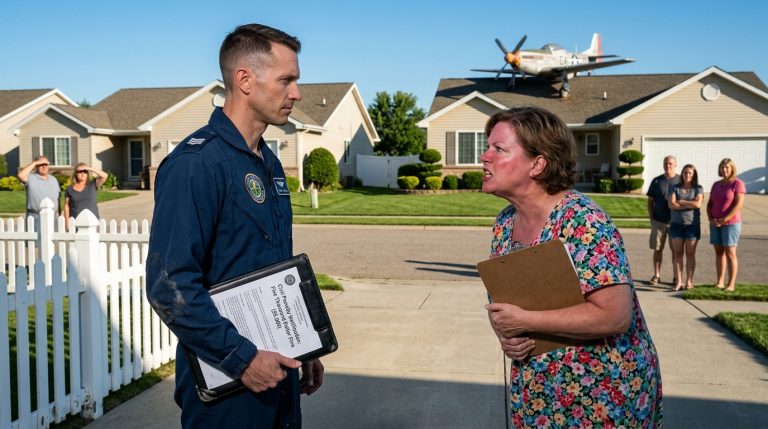
My gaze drifted to the fence. I remembered the day Karen had stood there, her clipboard held like a badge of office, her smile tight enough to snap. She had talked about community, about the sanctity of the HOA, but looking at the mess left behind—the half-empty bottles, the soggy napkins—I realized she hadn’t been protecting a community. She had been colonizing it.
I stepped down from the deck, my boots crunching softly on the grass. The grass felt thin here, worn down by footsteps that didn’t belong to me. My eyes scanned the area, cataloging the small, stinging details of the invasion: a dropped earring near the drain, the way the water in the tub was slightly murky, the smell of something sweet and artificial that clung to the air.
As I reached the edge of the tub, I noticed something that made the fine hairs on my arms stand up. A small, laminated card was propped up on the side of the tub—a “Reserved for HOA Board” sign, hand-lettered in sharp, black marker.
It was then I realized that the silence wasn’t just quiet; it was expectant. The neighborhood was watching. And beneath the floorboards of the deck, I heard a sound that didn’t belong to the wind—a faint, rhythmic clicking, as if someone were testing the lock I had already changed.
CHAPTER 2: THE ANATOMY OF A FRACTURE
The sound was sharp, brittle, and undeniably mechanical. My thumb hovered over the metal of the gate latch, my heart pacing in a rhythm that felt disconnected from my own pulse. I hadn’t moved since noticing the “Reserved” sign, but the environment around me had shifted. The evening light was no longer amber; it was a bruised, sickly violet, bleeding into the corners of the yard.
I pulled my hand back as if the gate were electrified. I didn’t enter the house. To go inside would be to retreat, and the code of this situation—the logic of the intrusion—demanded that I remain in the space where the boundaries had been tested. I looked down at my hand. The chamomile tea in the mug had gone lukewarm, a film forming on the surface, its scent suddenly cloying and overly floral.
A memory surfaced, unbidden, like a dark silt stirred from the bottom of a pond. I was ten, watching my father sit at a kitchen table covered in stacks of legal documents, the house we lived in being reclaimed by a bank that didn’t care about the height of our fences. The sound of that gate—that specific, metallic click—was the sound of the world deciding that your space was no longer yours.
I pushed the memory down, locking it behind the cold, analytical part of my brain. This wasn’t about childhood. This was about a hot tub, a property survey, and an HOA president who treated communal living like a feudal state. I looked at the “Reserved” sign again. It wasn’t just tacky; it was an act of aggressive cartography. Karen was drawing borders on land she didn’t own, reclaiming territory with the arrogance of the entitled.
I walked to the edge of the fence, my boots dragging slightly through the lawn. The grass here was matted, bent under the weight of the party-goers who had claimed my yard as their own. I crouched, running my fingers over the sod. It felt cold, damp with the lingering moisture of the evening.
There was no sense in yelling. There was no sense in calling the police over a trespass that would be dismissed as a “neighborhood misunderstanding.” Karen didn’t play by the rules of the law; she played by the rules of social momentum. She was banking on the fact that I would be too tired, too isolated, or too polite to actually push back.
I walked toward the side of the house, my gaze lingering on the security camera I had installed—the one that had captured Cheryl and Doug moving like suburban ninjas. The lens was slightly dusty, a smudge of grease marring the view. I realized then that my “sanctuary” had been monitored as closely as I had been monitoring them. I wasn’t just being invaded; I was being analyzed.
I reached the porch and set the mug down on the wooden railing. The wood was splintering, a fraying edge of the life I’d built here. I needed a strategy. If this was a system, it had a vulnerability. Every architecture, no matter how imposing, had a point of failure—a place where the load was too great, where the foundation began to crack.
I went inside, the house feeling strangely vast and empty. I didn’t turn on the lights. I walked to my desk, the glow of my monitor reflecting against the glass of the window, casting a faint, ghostly pallor over my own face. I opened a new file, the cursor blinking in the darkness like a heartbeat.
I didn’t start with the hot tub. I started with the HOA itself. I began to search through the public records I had saved months ago, the ones that had seemed so boring at the time—bylaws, meeting minutes, financial disclosures. The documents were dry, static, and utterly unrevealing on the surface. But as I read, I began to notice patterns. A sudden spike in “maintenance expenses” that didn’t align with the neighborhood’s upkeep. A series of vendors that didn’t appear to exist outside of a P.O. Box.
The logic began to emerge. Karen wasn’t just managing the neighborhood; she was maintaining a facade. The social events, the “community building,” the invasion of my backyard—they were all part of a performance, a distraction to keep anyone from looking too closely at the numbers.
I leaned back in my chair, the silence of the house pressing against my eardrums. My hands weren’t shaking now. They were steady, the cold precision of a developer finding a bug in the code. I had the foundation of her vulnerability. Now, I just had to figure out how to exploit it without becoming the very thing I despised.
I looked out the window toward the backyard. The LED lights of the tub flickered on, a soft, inviting blue that looked beautiful and completely hollow. I realized that if I acted now, I would be entering a war. But if I did nothing, the boundaries of my life would continue to erode until there was nothing left of the sanctuary I had worked so hard to build.
I reached for my phone and dialed a number I hadn’t used in years. Devon answered on the third ring, his voice gruff and tired. “Sam? It’s three in the morning.”
“I have a problem, Dev,” I said, my voice sounding strange to my own ears—sharp, transactional, and devoid of the fatigue I felt. “And I need something that can make a very specific, very visible point about boundaries.”
He was silent for a long moment, the hum of the phone line the only sound between us. Then, he sighed—a sound of resignation and curiosity. “What kind of point, Sam?”
“The kind,” I said, watching the shadows stretch across my floor, “that you can’t wash away.”
CHAPTER 3: THE CHEMICAL CATALYST
The anticipation of the package from Devon felt like a physical weight, a dense, metallic knot in the center of my chest. I didn’t sleep that night. I sat in the dim glow of my monitor, the blue light washing out the room, making everything feel like a wireframe model of reality. I wasn’t just a software developer anymore; I was a man dismantling a machine.
The next morning, the package arrived—a nondescript brown box, taped with industrial-grade efficiency. No return address, just a weight that felt heavier than its size warranted. I brought it inside, the air outside still holding that humid, expectant stillness of Woodpine Ridge. I didn’t open it in the living room, where the light was too bright, too revealing. I took it down to the basement, to my workbench, where the tools of my trade—the soldering irons, the diagnostic arrays, the half-disassembled hardware—offered a kind of protective armor.
I sliced the tape with a utility knife, the sound sharp and final. Inside, nestled in protective foam, was the compound. It looked mundane—a small, dark vial of liquid, clear as water, and a specialized delivery nozzle designed to integrate into the spa’s fragrance pod. It was a piece of industrial-grade engineering, a tool for testing leakage in high-pressure hydraulic systems.
I held the vial up to the light of my desk lamp. It was innocent enough. It was safe, stable, and entirely invisible. But once the heat of the hot tub’s jets moved past the threshold, the reaction would be absolute. It was a binary outcome: pass or fail, clear or purple.
I didn’t rush the installation. I took my time, the scent of dust and old concrete steadying my hands. I disassembled the fragrance pod with the same care I used for a delicate server board, checking the connections, ensuring the seal was airtight. The logic was sound. If Karen wanted a “communal amenity,” she was going to get one that left a lasting impression—not on the neighborhood’s reputation, but on her own skin.
As I finished reassembling the unit, a piece of paper slipped from the bottom of the packaging. It was an old HOA flyer, crumpled and yellowed, probably used by Devon as filler. I picked it up, intending to toss it in the bin, but a line of ink near the edge caught my eye. It was a receipt, tucked into the crease of the paper, dated six months prior.
Payment to: ‘Evergreen Landscaping & Consulting’.
The name felt hollow. I’d never seen a truck from Evergreen in the neighborhood. The amount was significant—several thousand dollars for ‘Drainage Optimization.’ I looked at the flyer, then at the receipt. It was a fragment, a loose thread in the tapestry of the HOA’s financials. I carefully flattened it out, the paper rasping like dry skin under my fingers. It wasn’t the proof I needed, but it was a clue, a physical discrepancy that didn’t fit into the story Karen was telling the board.
My phone buzzed on the workbench, a notification from the HOA portal. A reminder: Upcoming Poolside Social. Your backyard is the designated space for ‘Unity through Proximity.’
I stared at the screen. The audacity of it—the assumption that I was a passive element in their design. I stood up, the chair scraping harshly against the concrete floor. My mind wasn’t just running the code anymore; it was rewriting the entire system.
I walked upstairs, the house silent around me. I needed to move, to act, to finish the installation before the weekend arrived. I moved through my own home like a ghost, taking in the frayed edges of the curtains, the dust gathering on the bookshelves—all these things that had once been my life were now just the backdrop to this confrontation.
When I reached the backyard, the afternoon sun was turning the sky a pale, bleached white. The hot tub waited, a centerpiece of unwanted luxury. I knelt beside it, the plastic rim cool beneath my palms. I felt no guilt. Only a cold, clinical sense of justice.
I slotted the delivery nozzle into the fragrance pod, the click of the plastic fitting into place satisfyingly firm. It was done. The mechanism was primed. I stood up and wiped my hands on my jeans, the grit of the yard clinging to me. I looked at the fence, at the spot where Karen had stood with her clipboard. She would come back. She would bring her music and her sparkling cider and her loyalists. And when she did, she would discover that the rules of this space had changed.
I turned back to the house, but stopped when I saw a figure standing at the edge of the property line. It was Rick from the HOA board, his expression unreadable, his eyes darting from my face to the hot tub and back again. He looked tired, the skin around his eyes sagging like old fabric.
“Everything alright, Sam?” he asked, his voice thin in the open air.
“Everything’s under control, Rick,” I said, my voice steady, perfectly calibrated. “Just doing some routine maintenance. You know how it is—if you don’t keep an eye on things, the system starts to fail.”
He lingered for a second, a flicker of something like concern—or was it fear?—crossing his face. Then he nodded, turning away to walk back down the street. I watched him go, the realization hitting me that the fracture was spreading. I wasn’t the only one who felt the instability of the foundation. But I was the only one with the tools to fix it.
CHAPTER 4: THE VIOLET REVELATION
The sky above Woodpine Ridge had turned the color of an old bruise, a deep, heavy indigo that promised more than just rain. I stood at my kitchen window, a digital thermometer in my hand, watching the first of the HOA loyalists arrive. They moved with the same entitled, fluid grace as before, carrying towels and chilled bottles, their laughter muffled by the low roll of thunder.
Then, the clouds broke. It wasn’t a gentle summer rain; it was a deluge, a sudden, violent downpour that transformed my pristine backyard into a slick, shimmering stage.
Karen was at the forefront, her visor slick with rain, her clipboard held over her head like a primitive umbrella. She didn’t retreat. She marched toward the hot tub, her followers trailing behind like ducks in a storm. I watched from the safety of my kitchen, the window cool against my forehead. I saw the moment they reached the tub. I saw the moment they turned the jets on.
I waited for the reaction. I counted the seconds—one, two, three—the rhythm of the timer in my head perfectly synchronized with the cycle of the pump.
“Is this normal?”
The voice was faint, carried on a gust of wind that slammed against the glass of my kitchen door. Jason, that younger man who always seemed to be trailing in Karen’s wake, was standing by the edge of the tub, his hand held out into the driving rain. His arm, usually a healthy, pale tone, was shifting. It was subtle at first, a faint, translucent indigo blossoming beneath the skin, then darkening into a deep, unapologetic royal purple.
Karen was in the water, her back to him, her head tilted back as if to catch the rain. She didn’t see the transformation until Cheryl screamed.
The sound was jagged, a high-pitched spike of pure, unadulterated shock that cut through the thunder. I didn’t move. I watched, my heart thumping against my ribs, as the chaos detonated. It was beautiful in its precision. The purple dye, activated by the heat of the jets and the chemical composition of the water, had turned the spa into a bubbling, violet cauldron.
“What is this?” Karen’s voice was a shriek, high and thin. She looked down at her own legs, glowing like something out of a neon nightmare. She scrambled to climb out, her hands slipping on the rain-slicked rim of the tub, her movements frantic and graceless.
It was the end of the performance. The “community” dissolved in an instant. Doug was the first to bolt, his bathrobe flapping behind him like a wet sail as he ran toward the gate, slipping on the sodden grass and sprawling into the mud. Cheryl was behind him, her hands clamped over her face, shouting something about “chemical burns” and “legal action.”
Karen stood there, alone in the center of the yard, the violet water dripping from her turtleneck and soaking into the beige slacks she wore as if to emphasize her professional status. She turned toward my house, her eyes wide, her face a pale, distorted mask of confusion and mounting rage. She pointed a trembling finger at the hot tub, her hand stained a deep, permanent-looking shade of grape.
“Sabotage!” she screamed, the word swallowed by a fresh crack of thunder.
I stayed where I was, my reflection in the window showing a man who remained perfectly, terrifyingly still. I didn’t feel the rush of victory. I felt the cold, hard reality of the shift. The barrier had been broken. The illusion of her authority, the carefully curated facade of her neighborhood management, was washing away in the rain.
I turned from the window and walked to my desk, sitting down in the darkness. I opened the file I had started the night before. My cursor blinked at the bottom of the document: Financial Discrepancies – EverGreen Landscaping. I typed in a new line: Incident Report: Unpermitted Use of Private Property – [Date/Time].
I could hear the frantic shouting outside, the sound of cars door slamming, the muffled, hysterical arguments of people who didn’t know whether to sue me or run home and scrub their skin raw. They were panicking. They were lost. And Karen, the architect of this entire farce, was standing in the rain, looking at her purple hands as if they were the ruins of an empire.
The phone on my desk buzzed. It was a message from the HOA portal. A notification of an ‘Emergency Meeting.’ I didn’t open it. I simply watched the rain, the water now pooling on my back deck, the reflection of the tub’s LED lights—now a murky, dark violet—flickering like a dying star.
The decoy was gone. The purple dye was just the surface, the visible manifestation of a rot that went much deeper. I stood up and walked to the closet, pulling out a heavy, rain-resistant jacket. I was going to need to be ready for the morning. The meeting would be the place where the real structure of the HOA would be put to the test, and I needed to ensure the facts—the receipts, the fake vendors, the inflated costs—were in the right hands.
I checked the window one last time. Karen was gone. The yard was empty, save for the abandoned towels and the steaming, violet water that continued to bubble, unobserved and uncaring, into the storm. I took a deep breath, the air in the room smelling of ozone and the quiet, metallic scent of my own resolve. The game had shifted. I wasn’t playing defense anymore.
CHAPTER 5: THE PAPER TRAIL
The clubhouse was a cavernous space, smelling of industrial floor polish and the stale, lingering scent of a meeting that had ended in disaster. I stood in the doorway, the moonlight casting long, skeletal shadows across the rows of folding chairs. My heart was a steady, rhythmic thud against my ribs, a metronome for the work that lay ahead.
I moved to the board where the community announcements were usually pinned—the lost cats, the garage sale notices, the stern reminders about lawn height. Now, it was a tombstone for Karen’s authority. I reached into my bag and pulled out the pages I had printed earlier: the spreadsheets, the invoices, the records of the ‘Evergreen Landscaping’ phantom vendor.
My fingers felt clumsy, the paper thin and brittle. I taped them to the board, my movements deliberate. Each piece of tape was a seal, a commitment to the truth. The figures stood out in harsh, black ink—thousands of dollars diverted into accounts that didn’t exist, projects that were never completed, maintenance that was never performed. It was all there, the architecture of her greed laid bare.
The office lights flickered as I turned them on, the hum of the ballast a grating sound that made my skin crawl. I sat at the administrative desk, the chair creaking under my weight. I started the audit, my hands moving across the keyboard with a speed born of pure, cold focus.
The deeper I dug, the more the decoy secret—the embezzlement—began to feel like a distraction. It was a symptom, not the disease. As I traced the digital breadcrumbs, I noticed something else. The funds weren’t just being spent; they were being used to pay for ‘counseling services,’ ‘community outreach’ seminars, and ‘social enrichment’ retreats—all managed by companies that shared the same registration address as Karen’s home.
She wasn’t just stealing the money to live in luxury; she was buying herself a community that was legally bound to her. She was paying people to be her friends, paying for their attendance at her events, paying for the loyalty that she couldn’t earn through human connection.
I looked at the screen, the data points blinking back at me like stars in a dead sky. The realization hit me with the force of a physical blow. Karen wasn’t a mastermind; she was a woman drowning in a profound, terrifying obsolescence. She had realized that the world was moving on without her, that the neighborhood didn’t need a president, that the people around her didn’t need a savior, and she had decided that if she couldn’t have a life, she would purchase a stage.
I felt a sudden, sharp pang of something that wasn’t anger. It was pity—a dry, hollow sensation that settled in the base of my throat. It didn’t change what I had to do, but it changed the texture of it.
The door behind me creaked.
I didn’t turn around immediately. I finished the last few keystrokes, saving the file to the drive that was currently sitting in my pocket. Only then did I spin the chair around.
Rick was standing in the doorway, his silhouette framed by the harsh, unflattering light of the streetlamp outside. He wasn’t wearing his usual casual jacket. He looked rigid, his shoulders held with an effort that made him seem older, more fragile.
“I saw the lights,” he said, his voice quiet, lacking its usual performative boom. “I saw what you put on the board.”
“It’s all there, Rick,” I said, pointing to the screen. “The money, the fake vendors, the ‘outreach’ programs. It’s not just a budget error. It’s a total failure of the board’s oversight.”
He walked further into the room, his gaze settling on the documents pinned to the board. He read them in silence, the only sound the rhythmic ticking of the wall clock. When he looked back at me, his eyes were clouded with a dull, heavy regret.
“She told us she was keeping the neighborhood together,” he whispered. “She told us the funds were necessary to maintain the ‘standards’ of Woodpine Ridge. We trusted her, Sam. We just wanted to live in a place where things were quiet.”
“Quiet is a luxury, Rick,” I said, standing up. The paper in my pocket felt heavy, a burden I was ready to hand off. “But integrity is a requirement. You can’t have one without the other.”
“What happens tomorrow?” he asked.
“Tomorrow, the meeting happens,” I said, moving past him toward the exit. “And then, the audit.”
I walked out into the cool, damp air of the night, the rain having stopped, leaving the world feeling scrubbed and raw. I left him there, alone in the flickering light of the clubhouse office, staring at the evidence of a collapse he had helped enable. I didn’t look back. I had the truth, and for the first time since the day I had moved in, the air felt thin, clear, and entirely my own.
CHAPTER 6: THE STILL WATER
The courtroom air was thin, recycled through vents that hummed with a clinical, detached rhythm. It smelled of floor wax and the faint, dusty scent of records that had been sitting in dark boxes for too long. I sat on the hard wooden bench, my coat across my lap, watching the sunlight slant through the high windows. It was a sterile, unforgiving light that revealed everything.
Karen sat at the defendant’s table. She wasn’t wearing her visor or her clipboard. She was dressed in a beige suit that looked too large for her, her hair pulled back into a severe, tight bun. She looked smaller than she had in my backyard, stripped of the manic energy that had defined our war. When she looked toward the gallery, her gaze didn’t fix on me; it drifted, aimless and hollow, as if she were searching for a community that had already ceased to exist.
The judge—a man with deep lines etched around his mouth—looked down at the files before him. The audit report, the affidavits from the health inspector, the copies of the fake vendor invoices I had so carefully gathered—they were all there, a mountain of paper that spelled the end of the Woodpine Ridge HOA.
“The evidence presented,” the judge began, his voice flat and devoid of judgment, “indicates a sustained and deliberate misappropriation of community funds. Furthermore, the reports of unpermitted gatherings and the subsequent disruption of private property confirm a pattern of administrative overreach.”
He didn’t need to say more. The silence that followed was heavy, a physical weight that pressed against the walls of the room.
I looked at Karen. The moment the judge confirmed the findings, her shoulders slumped, not in a dramatic collapse, but in a quiet, devastating resignation. It was then that the truth of her Layer 2 surfaced. She didn’t look angry. She didn’t look like a villain caught in the act. She looked like a woman who had finally been relieved of the terrible, crushing burden of pretending to be necessary. The embezzlement, the parties, the obsession with my backyard—it had all been a desperate, clawing attempt to anchor herself to a world that was moving on, to prove that her life still had a function.
She looked toward the front of the room, and for the first time, our eyes met. There was no hatred in her expression. Just a profound, bleak emptiness. I saw it then: the absolute, terrifying isolation of someone who had traded their humanity for the title of ‘President.’ She had sought to control the world because she could no longer feel a part of it.
The judge issued his ruling: the HOA board was to be dissolved, new elections to be held under external oversight, and restitution was to be paid in full from the sale of her assets. As the bailiff moved to escort her out, I stood up. I didn’t cheer. I didn’t feel a surge of triumph. I felt a strange, cooling sense of closure.
The walk back to my car was quiet. The courthouse plaza was bathed in the soft, golden light of the late afternoon. I stopped at the edge of the parking lot, looking up at the trees, their leaves a vibrant, unbothered green. The war was over. The neighborhood would change—it was already changing—but the quiet I had fought for was finally within reach.
When I arrived home, the house was silent. I didn’t go to my desk. I didn’t check the HOA portal. I walked into the backyard, the late-day sun filtering through the trees in long, amber shafts. The hot tub was there, the water perfectly still, the surface reflecting the blue of the sky.
I walked over to the fence, to the spot where I had spent so much time calculating, planning, and worrying. I reached out and touched the gate latch. It was cool, sturdy, and for the first time, it felt like an actual boundary instead of a fragile suggestion. I took a screwdriver from my pocket—the one I’d used to install the mechanism in the fragrance pod—and I set to work.
I dismantled the device, the metal components clicking softly as they came apart. I cleared away the last traces of the purple compound, cleaning the pod until it was as clear as the day I’d bought it. It was a simple act, a small, rhythmic repair that allowed the tension of the last few weeks to drain out of me.
Once the tub was back to its original state, I turned it on. The water began to churn, a soft, bubbling hum that filled the yard with a gentle, consistent sound. I sat on the deck, the wood grain rough and familiar against my skin, and listened. No music. No strangers. No aggressive requests for ‘community.’
I thought about the receipt, the fake vendors, the empty clubhouse office. The rot was gone. The vacuum left behind was already beginning to fill with something else—the mundane, quiet rhythm of people just trying to live their own lives.
A bird landed on the fence, its chirping sharp and clear in the stillness. I closed my eyes, the warmth of the sun on my face a stark contrast to the cold, sterile air of the courtroom. I hadn’t set out to destroy anyone; I had only wanted to protect the boundary of my own existence. And in doing so, I had learned that the most important space to guard wasn’t the backyard or the property line. It was the interior, the part of myself that stayed quiet, steady, and entirely, unmistakably mine.
The sun finally dipped below the horizon, leaving the world in a wash of deep, peaceful violet—not the chaotic purple of the dye, but the soft, natural color of a twilight that promised a long, undisturbed night. I stood up, the water still bubbling behind me, and walked toward my home. The door was unlocked, and as I stepped inside, the silence greeted me like an old, trusted friend. I was home.