The Iron Perimeter: How One Veteran’s Calculated Strategy Dismantled a Suburban Tyrant’s Illegal Domain
CHAPTER 1: THE FIRST SALVO
The morning air in central Virginia was supposed to be a sanctuary, a quiet expanse of rolling hills and ancient oak trees that buffered my thirty acres from the relentless, beige predictability of the Oakidge Estates. I was tucked into the open hood of my vintage John Deere 790, my knuckles raw and coated in the thick, black grease of a twenty-five-year career spent silencing larger, more lethal engines. The tractor was my anchor, a relic of honest labor in a world that seemed to be drowning in ornamental shrubbery and manufactured outrage.
Then came the voice, sharp and brittle as shattered glass.
“That machine is a public nuisance, and if I see you start it one more time, I will have it seized and sold for scrap.”
I didn’t rush. I didn’t even look up immediately. I finished tightening the tension on the alternator belt, the metal of the wrench biting into my palm with a familiar, cold comfort. Only when the task was done did I rise, wiping my hands on a red rag that had seen better decades.
Standing at the property line was a woman who looked like she had been manufactured in a board meeting. A plus-sized figure in a neon-pink tracksuit that seemed to be actively protesting her movement, her face a mask of pucoled indignation. This was Karen—the self-appointed queen of the beige kingdom, the president of the Oakidge HOA. She stood with her arms crossed so tightly they threatened to cut off her own circulation.
“You’re idling on a private access route, Sergeant Major,” she continued, her voice rising to a shrill, rhythmic pitch. “And the noise levels are in direct violation of Section 7.4b of our community standards. I’ve already contacted the county office.”
I looked at her, really looked at her. I’d faced down insurgent fighters in the desert who carried more poise than this woman possessed while complaining about a tractor. Her entitlement was a heatwave, radiating from her in waves of distorted logic. She didn’t want peace; she wanted a subject.
“This land is zoned for agriculture, ma’am,” I said, my voice low and steady. I didn’t raise it. I didn’t offer an excuse. I simply stated the fact as if I were giving a sit-rep to a superior officer. “My deed is recorded. I am not under your jurisdiction.”
“The deed doesn’t matter when you’re a blight on our values,” she snapped, her eyes narrowing until they were mere slits of genuine venom. “You’ll see. I’ve already drafted the notice. Expect the courier by noon.”
She turned on her heel and marched away, her pink tracksuit flashing against the manicured green of her lawn like a warning flare. I watched her go, a slow, methodical calculation forming in the back of my mind. She was counting on me to be a solitary, frustrated man who would rather pay a fine than deal with the bureaucratic headache of a fight.
She had no idea that I had spent my life studying the terrain before making a move. As she retreated into her beige fortress, I looked down at the grease-smeared rag in my hand. The quiet was gone, replaced by the humming tension of a war I hadn’t asked for but was suddenly, and very clearly, expected to win.
CHAPTER 2: RECONNAISSANCE
The red rag in my hand felt heavy, soaked through with the weight of grease and the sudden, sharp tension that had descended upon the property. Karen was gone, retreating into the beige safety of her neighborhood like a defensive line pulling back to regroup, but the air she had left behind remained stagnant and charged. I didn’t watch her retreat. Watching her would have been a waste of bandwidth. Instead, I turned my attention back to the John Deere. The engine block, once a source of simple mechanical satisfaction, now felt like a liability—a target painted in green and yellow.
I spent the next twenty minutes finishing the assembly of the alternator. My movements were automatic, the muscle memory of decades in the Corps overriding the irritation prickling at my skin. I worked with the precision of a man who understood that a machine is only as reliable as the effort invested in its smallest component. Every bolt was torqued to spec; every wire was checked for wear. When I finally slid the wrench back into my tool roll, the silence of the farm returned, but it wasn’t the same. It was the silence of a forward operating base.
My mind, conditioned to identify tactical threats, began to map the battlefield. The Oakidge Estates wasn’t just a group of houses; it was an organization with a defined hierarchy, rules of engagement, and a central command. My thirty acres were an island of autonomy in an ocean of restrictive covenants. Karen didn’t just dislike me; she feared the variable I represented. To her, a man who didn’t subscribe to the beige doctrine was an existential threat to the order she curated.
I walked to the barn and pulled out my digital logbook. It was a sturdy, leather-bound affair, the kind I’d used to track maintenance cycles for platoon vehicles. I opened to a fresh page and began to input the data. Date: July 19th. Time: 05:15 hours. Subject: Karen Miller. Intent: Assertion of authority over non-HOA property.
I didn’t feel anger. Anger was a corrosive, inefficient emotion that clouded judgment. I felt a cold, surgical curiosity. I needed to know the parameters of the enemy’s power. How deep did their reach go? Was this truly about property values, or was it a proxy for something else? I looked out toward the property line, toward the thin wire fence that separated my life from theirs. The ancient oaks, their branches thick and gnarled, seemed to hold the secrets of two centuries of land use, indifferent to the plastic-wrapped lives developing just beyond their shade.
The thought of the courier Karen had promised gnawed at me. She was a woman who relied on official-looking paperwork to do her heavy lifting. That was a vulnerability. People who rely on paper assume that everyone else is terrified of the stamp of authority. I needed to go to the source—the county clerk’s office. I needed to see the original plats, the zoning ordinances, and the easements that governed this strip of land.
I moved to the house, the gravel crunching beneath my boots with a rhythmic, steady sound. Inside, the kitchen was cool and shadowed. I poured a cup of black coffee, letting the heat seep into my hands. My wife, Sarah, was still asleep, a luxury I wouldn’t interrupt. The isolation of this place was why we’d moved here, and I wouldn’t let a woman in a tracksuit turn my sanctuary into a combat zone. But the reality was that the line had already been crossed.
I sat down at the table and laid out the map I had kept from the purchase of the property. It was a beautiful, complex document of lines and measurements. I traced the perimeter with a calloused finger. Oakidge Estates was a master-planned community, governed by a rigid framework, but they were also bound by the laws of the county. Every document filed by an HOA was a public record.
I stood up, the chair scraping against the floor, and grabbed my truck keys. I needed more than just a map. I needed the full history of the boundary. I needed to understand the legal architecture of my opposition. I was a Sergeant Major who had learned that the most effective way to win a fight was to ensure, before the first shot was fired, that the rules were entirely on your side.
As I drove toward the town, the morning mist clinging to the fields, I realized the transition was complete. The tractor was no longer just a machine; it was an instrument of defense. The land was no longer just an acreage; it was a contested perimeter. Karen wanted a war of attrition, a battle fought with fines and intimidation. She was going to get a war of intelligence, a battle fought with the cold, hard precision of facts. And by the time the county clerk opened those doors, I would have everything I needed to begin the dismantling.
CHAPTER 3: THE POISONED WELL
The pavement of Oakidge Estates felt different under my boots—too clean, too smooth, lacking the honest resistance of the gravel and dirt I was accustomed to. I walked past houses that mirrored one another with uncanny precision, each trimmed with the same government-approved hedges and accented by mailboxes that looked like they had been mass-produced on an assembly line. My presence here was an anomaly. I was a man in work-worn denim and a tactical field jacket, walking through a museum of beige perfection.
I kept my head down, observing. A woman in a floral sundress was pruning a rosebush near the sidewalk. She didn’t look up as I approached, her focus entirely on the aesthetic geometry of her garden. I slowed my pace, stopping a few feet away.
“Morning,” I said, my voice cutting through the artificial silence of the street. “Your roses look well-maintained.”
She looked up, startled. Her eyes flickered toward my face, then down to my boots, and finally toward the direction of my property line. The recognition was instantaneous. The neighborhood rumor mill had clearly been churning. Her smile, which had started as a polite, habitual reflex, tightened into something defensive.
“Oh,” she said, her voice dropping a register. “You’re… the neighbor. With the equipment.”
“Jack Callahan,” I said, offering a curt nod. I didn’t push, didn’t try to force a conversation. I wanted to see how the name resonated. “I’m just getting a feel for the area. There’s been some talk about property standards lately, and I wanted to see what the expectation was.”
She glanced nervously over her shoulder, toward a house two lots down—a two-story structure with a perfectly manicured lawn and an oversized, double-wide driveway. “Karen is very particular,” she whispered, leaning in slightly as if the very hedges might be recording us. “She runs the compliance committee. If you’re having trouble with her… I’d suggest just paying the fine. It’s easier than being the focus of her next newsletter.”
I thanked her and kept moving. It was a pattern, just as I’d suspected. A climate of soft, pervasive fear. Karen hadn’t built a community; she had built a system of psychological confinement.
A few streets over, I spotted a younger man, probably in his late thirties, wrestling with a set of new shutters in his driveway. His frustration was palpable; he was struggling to align the brackets, the metal clattering against the house siding with each failed attempt. I walked over, my movements practiced and unhurried.
“Need a second set of eyes on that?” I asked.
The man looked up, wiping sweat from his forehead with the back of a grime-streaked hand. He looked exhausted, the kind of exhaustion that comes from fighting a war on two fronts—the work itself and the scrutiny of the world outside his door. “Thanks,” he muttered, stepping back. “The alignment is off by a hair, and I’m about to lose my mind.”
I stepped in, using my hands to guide the bracket into place, feeling the weight and the tension. It was simple, mechanical work—something I knew how to navigate. Once the screw caught, I gave it a firm, final turn. “There,” I said. “Should hold.”
“Appreciate it,” he said, breathing a sigh of relief. “I’m Tom. Dealing with this house is a full-time job. Especially with the HOA president breathing down my neck.”
I paused, looking at him. Tom was the kind of guy who probably valued logic over performance. “Karen?”
Tom’s face darkened. “She’s been on me for months. Fines for the wrong shade of trim, warnings about the lawn height, even a complaint about the color of these shutters. It’s Chantilly lace, for heaven’s sake. The approved color. But she’s decided it’s ‘too bright’.” He looked at the house, then back at me. “You’re the one she’s been ranting about in the newsletters, aren’t you? The ‘industrial equipment’ guy.”
“Guilty,” I said. “I’m just trying to farm my land, Tom. I’m not interested in her beige boundaries.”
“Careful,” Tom said, his voice lowering. “She doesn’t just want order. She wants total submission. I’ve heard she keeps a three-ring binder on every resident—paint chips, fence heights, the works. If you aren’t part of her vision, you’re the enemy.”
As I walked away from Tom’s house, I felt the cold, hard reality of the situation settling into my bones. The ‘poisoned well’ wasn’t just a metaphor; it was a strategy. By controlling the small details, Karen had established a culture where residents were too preoccupied with their own survival to notice the bigger picture. She had them playing a game of defensive geometry so they wouldn’t ask why the rules were changing or where their fines were actually going.
I reached the end of the cul-de-sac and paused, looking back toward the fire road that skirted the edge of my property. I knew, with a certainty born of long experience, that she wasn’t finished. This wasn’t just about my tractor; it was about the fact that I was the only thing in her sphere of influence that she hadn’t yet forced to conform. And people like Karen, when they find a crack in their perfect, beige foundation, don’t try to fix it—they try to bury it. I had the knowledge of the neighbors, the history of the deeds, and the patience of a man who knew that if you wait long enough, the truth eventually forces its way through the cracks. My next move had to be about the physical boundary. I needed to see that road—the fire access—and find the discrepancy in the records that would shatter the illusion of her absolute domain.
CHAPTER 4: THE FLIMSY CHAIN
The air was still, thick with the damp, earthy scent of a Virginia morning, when I pulled my truck to a stop at the edge of the gravel fire road. The road had always been a neutral zone, a twenty-foot-wide artery designed for emergency access, separating the wild, overgrown edges of my property from the manicured, beige conformity of Oakidge Estates. It was meant to be open, a requirement for safety, a necessity for public access. But as I killed the ignition, the metallic click of the silence was broken by something entirely out of place.
Two flimsy metal posts had been driven into the gravel, and stretched between them was a length of rusty, link-style chain. It was an amateurish attempt at a barricade, a pathetic effort at enforcing a boundary that didn’t exist, but the “No Trespassing” sign wired to the center of it was printed with a professional coldness. The boldness of the text—Property of Oakidge HOA—seemed to mock the very ground it stood on.
I stepped out of the truck, my boots grounding me on the uneven surface. My gaze tracked the chain, then moved to the posts. They were shallow, poorly set, and entirely illegal. This wasn’t just a neighborly annoyance; it was a physical manifestation of Karen’s deteriorating grip on reality. She was trying to rewrite the geography of the land, one post at a time. I walked forward, my pace deliberate, my eyes scanning the perimeter. There were no cameras, but I didn’t need them to know she was watching. She had likely seen the truck turn into the lane from her living room window, her hand hovering over a phone or a notepad.
I reached out and touched the chain. The metal was cold, vibrating slightly with the tension of the improperly set posts. It was a flimsy, superficial barrier—the kind of obstacle that existed only to prove a point. A single, focused exertion would have snapped it, sent the posts toppling, and cleared the road in seconds. But I didn’t snap it. I stood there, letting the silence settle, observing the way the chain sagged under its own cheap construction.
Every action has a reaction, and I was looking at a tactical blunder of the highest order. By obstructing a fire access road, she had stepped out of the realm of neighborhood politics and into the territory of public safety violations. This wasn’t a zoning issue; this was a liability that now belonged to the county, to the state, and to anyone who understood the gravity of emergency access.
I pulled out my phone and began to document. I started with a wide, panning shot that framed the road against the background of both properties, ensuring the context was indisputable. I moved in closer, the camera lens capturing the rust on the links, the cheap, hardware-store padlock, and the aggressive tone of the sign. I didn’t rush. I took photos of the post depth, the way they had disturbed the gravel, and the lack of any reflective warning markings—a violation in itself. Each click of the shutter was a brick in the wall I was building, a record of the arrogance that would eventually serve as the evidence for her downfall.
While I worked, a movement in the distance caught my eye. A curtain in the house bordering the road—Karen’s house—had been drawn back, then snapped shut. She was there, monitoring the situation, waiting for me to react, waiting for me to get angry, to shout, or to lash out. She wanted the confrontation because, in a confrontation, she could paint me as the aggressor, the “hostile neighbor” she had been warning everyone about in her newsletters.
I didn’t give her the satisfaction. I remained calm, my breathing steady, my focus singular. I treated the scene as if I were a surveyor conducting a final audit. Once the photos were complete, I stood back and looked at the road again. This was the moment where the “Decoy Secret” of the HOA’s absolute power began to unravel. She thought this chain was a claim of ownership; in reality, it was a physical confession of a safety violation.
I climbed back into my truck, the door closing with a solid, definitive thud. I hadn’t touched the chain, hadn’t spoken a word, and hadn’t acknowledged her gaze. I simply backed the truck out and turned toward the main road. I had the images, I had the location, and I had the precise legal argument I needed to leverage. I drove slowly, the gravel spraying from the tires, marking the transition from the site of the crime back to the world of cold, calculated legal preparation. The fire road was blocked, but for the first time, I felt the path forward was clearer than it had ever been.
CHAPTER 5: THE JAGS GAMBIT
The air in my home office was stagnant, filled with the scent of old paper and the sharp, metallic tang of cold coffee. I spread the certified documents across the desk: the master plat maps, the zoning ordinances, and the easement agreement I’d spent hours pulling from the county clerk’s archives. These were not just pages; they were the terrain of the war. Outside, the sun was beginning to dip, casting long, fractured shadows across the gravel lane, but inside, the only light came from the desk lamp, illuminating the brutal, indisputable reality of my position.
I picked up the phone. It had been five years since I’d last dialed this number, but the muscle memory of the contact was absolute. Dave Jensen answered on the third ring, his voice still carrying that rhythmic, measured cadence of a man who spent his life translating chaos into legal strategy.
“Callahan,” he said, the familiarity hitting the line like an old handshake. “It’s been a while. You’re calling from the middle of nowhere, and by the tone of your voice, you’re not just calling to catch up.”
I didn’t waste time. I laid out the situation: the unauthorized barricade, the aggressive violation notices, and the escalating absurdity of a neighborhood president who believed her bylaws superseded state fire code. I kept it brief, professional, and entirely focused on the tactical facts. As I spoke, I could hear Dave’s pen scratching against a notepad—a sound I remembered from our time in the Jag Corps.
“Let me get this straight,” Dave said, his voice dropping into a register that suggested he was already mapping the court filing. “She’s tried to levy fines against a parcel outside her jurisdiction, and she’s physically obstructed a designated emergency easement? Jack, you haven’t just stumbled into a neighbor dispute. You’ve walked into a target-rich environment.”
He asked for the details, and I fed them to him, one by one. The timeline of her harassment, the specific articles of the HOA bylaws she’d invoked, and finally, the cherry on top: the recent Intent to Lien notice. I had the copy of it right in front of me. I scanned the letterhead, the heavy, expensive-looking font, and the signature of the attorney.
“Wait,” Dave said, stopping me mid-sentence. “Spell that name for me again? The firm?”
I did. There was a pause on the line—a long, deliberate silence that I knew signaled a shift in the investigation.
“Jack, I’m looking at the state bar database right now,” Dave said, his voice hardening. “That name doesn’t exist. There’s no firm, there’s no bar number, and there’s no registered address in the state that matches that letterhead. This isn’t just an aggressive HOA; this is fraud. She’s paying someone to impersonate legal counsel.”
The revelation hit me not with a shock, but with a cold, sharpening clarity. The entire edifice of her authority was built on a series of lies—the fake fines, the fake jurisdiction, and now, a fake legal representative. She was playing a game of smoke and mirrors, counting on the fact that most people would see the threat of a lien and just write a check to make the “lawyer” go away.
“We don’t need to play by the rules of a neighborhood meeting,” Dave said, the predatory glee evident in his tone. “We draft a cease and desist, but we don’t send it to her. We send it to every member of the board, individually. We tell them that their president is exposing them to personal liability for a fraudulent scheme that violates state and county law. We make the board realize that they aren’t protecting their community; they’re accessories to a crime.”
“What about the fire road?” I asked.
“The county fire marshal is the final word on that,” Dave replied. “We don’t even need to sue for that. We just need to ensure the marshal gets a clear, objective report on the obstruction. Once they have a file number, they’ll be out there with bolt cutters before the ink on your complaint is dry.”
I looked down at the documents. The rust on the barricade chain, the way Karen had retreated into her beige house—it all made sense now. She wasn’t an administrator; she was a criminal who had spent years convincing her neighbors that the law was her own personal plaything. The “pincer movement” Dave was proposing felt like the right strategy. We would hit them with the legal reality of the easement and the regulatory reality of the fire code, forcing the board to choose between Karen’s ego and their own financial survival.
I felt the weight of the day—the friction of the gravel, the cold metal of the chain, the narrow, stifling vision of the woman in the pink tracksuit. But for the first time, the pressure had shifted. It wasn’t on me. It was on her. I took a final look at the “lawyer’s” letter. It was a paper tiger, and it was about to be torn to shreds.
“Draft the notices, Dave,” I said, my voice steady. “I’ll have the photos and the plat maps in your inbox by morning. Let’s see how their ‘Chantilly lace’ standards hold up under the scrutiny of the state prosecutor.”
The plan was set. I hung up the phone and stepped out onto the porch. The sun was gone, leaving the land in a deep, hushed indigo. I looked toward the Oakidge Estates, toward the cluster of beige houses that now felt less like a neighborhood and more like a besieged fortress. The war was no longer just about my tractor. It was about the truth, and I was holding all the cards.
CHAPTER 6: PUBLIC WATERLOO
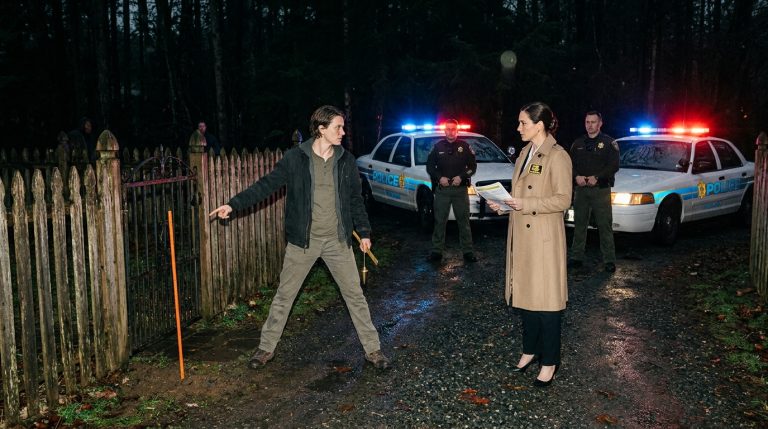
I stood near the property line, the morning air crisp and tasting of impending change. The chain still sagged across the road, a rusty testament to Karen’s stubbornness. I hadn’t moved it, hadn’t touched it; I had waited, just as Dave had advised, for the machine to do its work. The white SUV with the county seal rolled to a stop twenty feet from the barrier, the dust settling slowly around its tires. Chief Miller stepped out. He was a man who moved with the deliberate, heavy grace of someone who understood that when he arrived, the situation was no longer a matter of opinion.
I walked over, my stride easy, my hands tucked into the pockets of my jacket. “Morning, Chief,” I said, offering a curt, respectful nod.
“Mr. Callahan,” Miller replied, his eyes moving immediately to the chain. He didn’t look like a man who enjoyed neighborhood squabbles, but he did look like a man who held a deep, professional disdain for anyone who ignored the fire code. “Anonymous report came in about an obstruction on the fire lane. Seems someone didn’t get the memo about emergency access.”
“It’s been a recurring issue,” I said, keeping my voice neutral. “I believe the Homeowners Association has some… unconventional ideas about who owns this easement.”
Miller didn’t respond immediately. He pulled a digital tablet from his door pocket and began to cross-reference the site against his GIS map. The silence was absolute, save for the distant, rhythmic chirping of birds and the occasional low rumble of a lawn mower somewhere deep in the Oakidge development. Then, the front door of the beige house swung open.
Karen marched across her lawn, her pink tracksuit standing out like a neon target. Her gait was hurried, her face a flushed, blotchy red. She didn’t look like a president; she looked like a woman who had realized, far too late, that the perimeter of her kingdom had just been breached.
“You!” she snapped, aiming a trembling finger toward me, ignoring the Chief entirely. “You’ve been stirring up trouble again! This is private property, and that chain is there for security!”
Chief Miller didn’t turn. He remained focused on the tablet until he’d logged the GPS coordinates, and only then did he pivot. He was a head taller than her, his uniform crisp and pressed, providing a stark contrast to her disheveled, frantic appearance. “Ma’am,” he said, his voice dropping into that deep, steady tone that commanded instant obedience. “I’m Chief Miller with the County Fire Marshal’s Office. Are you the individual responsible for this obstruction?”
Karen stumbled to a halt, the momentum of her anger hitting a wall of bureaucratic reality. “I am the president of the Oakidge HOA. This is a private community, and we have the right to secure our assets from outsiders.”
“You have the right to secure your property,” Miller said, his tone clinical. “You do not have the right to violate state fire code, section 4-2b, which mandates clear access for emergency vehicles on all recorded easements. This isn’t a suggestion, and it isn’t an HOA matter. It’s a public safety issue. That chain is a misdemeanor violation, punishable by fines of up to twenty-five hundred dollars.”
“That’s… that’s ridiculous!” Karen’s voice cracked, the shrillness returning. She looked around, desperately seeking the support of her neighborhood, but the street was quiet. Curtains were twitching in the houses opposite ours, neighbors watching from the safety of their breakfast tables, witnessing the public unraveling of the woman who had spent years dictating the color of their shutters. “I have a lawyer! I’ll have your job for this!”
“My job is ensuring that when a fire truck needs to get to the back of this subdivision, it isn’t stopped by a rusty chain and a misunderstanding of property law,” Miller said, his patience visibly wearing thin. He turned to me, then back to her. “You have twenty-four hours to remove this, or my department will return with the equipment to clear it ourselves, and the bill for every man-hour spent doing your job will be sent directly to your board. And I’ll be filing a report with the prosecutor’s office regarding the safety hazard.”
He closed his tablet and turned back to his SUV. “Twenty-four hours, ma’am. Don’t test me on this.”
As he drove away, the gravel crunching under his tires, Karen stood alone in the middle of the road. She looked smaller than she had moments ago, the pink fabric of her suit sagging as if the very air had been let out of her. She looked toward my porch, then toward her own house, the realization clearly dawning that the “absolute authority” she had curated was nothing more than a fiction that couldn’t survive the scrutiny of a single county official. I didn’t say a word. I simply turned and walked back toward my barn, the feeling of victory not in the defeat of a person, but in the restoration of a truth that had been buried under years of petty, manufactured rules. The road was as good as cleared.
CHAPTER 7: THE AUDITS SHADOW
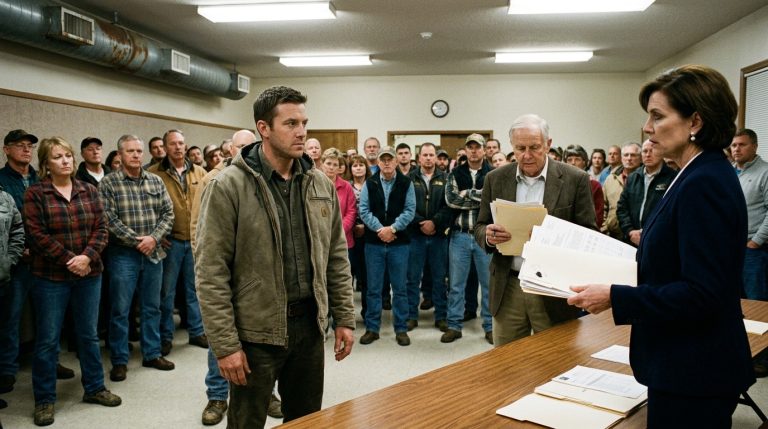
The community clubhouse was usually a place of quiet neighborhood meetings and potluck dinners, but that evening, it felt more like a bunker. A thick, oppressive atmosphere of suspicion hung over the room. The forensic accountants—men in muted grey suits who looked entirely out of place against the backdrop of pastel wall hangings—had arrived earlier that day. They had cleared off the main table, transforming it into a command center of laptops, ledgers, and stacks of documents that had been hauled out of Karen’s garage in cardboard boxes.
I stood near the back, my arms crossed, watching as the residents of Oakidge filtered into the room. They weren’t the same people I’d met in Tom’s living room weeks ago. Then, they had been cautious, fearful. Now, they were agitated, driven by the cold knowledge that their money—their hard-earned community dues—had been treated like a personal piggy bank.
George, the treasurer, looked as though he hadn’t slept in forty-eight hours. He stood at the front of the room, his hand trembling slightly as he gestured toward the accountants. “We requested this audit because of discrepancies in the maintenance contracts,” he said, his voice straining to be heard over the low murmur of the crowd. “What we’ve found… it goes far deeper than anyone expected.”
One of the lead auditors stepped forward. He didn’t offer a preamble; he didn’t try to soften the blow. He opened a laptop and projected a spreadsheet onto the wall. “We analyzed the last thirty-six months of HOA expenditures,” he began, his voice flat and monotone. “We cross-referenced the landscaping contract with market rates and state business registrations.”
The first slide showed a contract with ‘Prestige Lawn Care LLC,’ a company that had been collecting nearly double the industry standard for months. I watched as the auditor clicked to the next slide, revealing the business registry records for the LLC. The owner was listed as one David Miller—Karen’s cousin. A collective gasp rippled through the room, followed by a sharp, jagged silence. It was amateurish, blatant, and utterly devastating.
But the accountant wasn’t finished. “We also reviewed the special assessment for the park gazebo,” he continued. “The HOA collected ten thousand dollars from residents for construction. The contractor’s invoices totaled six thousand dollars.” He highlighted the remaining four thousand. “That remainder was diverted to ‘Suburban Solutions,’ a shell corporation registered to the president’s home address.”
I stood in the shadows, my gaze fixed on the back door where Karen would eventually have to enter. The ‘fire road’ dispute had been the tip of the spear, but this—this was the heart of the rot. She hadn’t just been a tyrant; she had been a thief. The realization transformed the room. The fear that had defined the community under her rule was being incinerated by a surge of collective, righteous fury. People weren’t looking at each other with suspicion anymore; they were looking at the screen, then at each other, comparing their own losses to the numbers projected on the wall.
I thought back to the ‘lawyer’s’ letter I’d received, the one drafted by a disgraced paralegal in a basement. It was all of a piece: the fake legal threats, the inflated contracts, the shell games. It was the frantic, desperate behavior of someone who knew the walls were closing in and had decided to extract as much as possible before the structure collapsed.
The auditor moved on to the final slide: a summary of missing funds, a total that made several people in the front row audibly groan. It was enough to cause significant financial damage to the association’s reserve funds, enough to ensure that the community would be paying for her ‘management’ for years to come.
Just then, the clubhouse door swung open. Karen stepped in, dressed in a sharp, navy blue suit that looked like a desperate attempt to reclaim the authority she had lost. She stopped when she saw the projected spreadsheets, her face going a shade of white that stood out starkly against her hair. She looked at the room, expecting the usual silence, the usual heads bowing in deference. Instead, she was met with a wall of cold, unforgiving eyes.
I took a step forward, my presence suddenly making the room feel tighter. I didn’t say a word, didn’t have to. The truth was vibrating in the air, a physical weight that pushed against the very edges of the room. She stood there, frozen, the reality of her unraveling empire finally, irrevocably visible. The audit had stripped away the last layer of her protection, and as I watched her hand reach out to steady herself against the doorframe, I knew that the climax we had been marching toward was no longer in the future. It was happening right now.
CHAPTER 8: THE SETTLEMENT
I didn’t move toward her. I didn’t need to. The room was doing the work for me. The murmur of the residents had hardened into a singular, focused intent, and Karen, standing in the doorway, looked smaller, less like the personification of ‘Suburban Authority’ and more like a ghost being exorcised. She tried to speak, her mouth moving in a dry, soundless rhythm, but the reality of the numbers projected on the wall—the undeniable, mathematical proof of her betrayal—made her efforts look like a pantomime.
“It’s not… you don’t understand,” she started, the words landing flat and hollow in the cavernous room. “I was protecting the value of this community. I was doing what the board didn’t have the stomach for.”
Tom, standing near the front, stepped forward. He didn’t raise his voice; he didn’t need to. “Protecting us? By stealing from us? By paying your cousin to mow grass we didn’t need cut, and filing fake liens against the neighbor who had the guts to actually stand up to you? You weren’t a protector, Karen. You were a parasite.”
She recoiled as if he had struck her, the color drained entirely from her face. She looked toward the door, then back at the gathered crowd, the realization dawning that there was no exit strategy. The board members—George and Maria included—sat at the table with their heads bowed, looking at their own hands as if they were trying to scrub away the stain of their complicity. The tribunal had concluded, and the verdict wasn’t being delivered by a judge; it was being delivered by the people she had systematically exploited.
I walked to the front of the room, my presence heavy, grounding. I held the county contract for the fire road maintenance—the document that had served as the final tactical maneuver. I placed it on the table in front of George. “The fire road is no longer a tool for your agenda,” I said, my voice steady, carrying clearly across the room. “The county has officially assumed maintenance oversight, and my contract is now the primary mechanism for its upkeep. The obstruction is removed, the road is clear, and the safety of this community is no longer a bargaining chip.”
Karen looked at me, her eyes brimming with a mixture of terror and unadulterated hatred. She realized, in that final, quiet moment, that her defeat hadn’t come from a grand, dramatic confrontation, but from the slow, persistent application of the truth. She had lost because she had assumed I would operate on her level—that I would be motivated by petty grievances and emotional volatility. She had failed to understand that a man who has learned to operate in the face of true chaos isn’t easily swayed by the noise of a suburban HOA.
She turned, her movements jerky and uncoordinated, and pushed her way through the back door. There was no grand exit, no final dramatic statement. Just the sound of the heavy door closing behind her, a finality that rippled through the clubhouse like a sigh of relief.
The aftermath was not a rush of jubilation, but a profound, settled calm. The forensic accountants continued their work, but the atmosphere had shifted; it was now the methodical, cold processing of a closed case. I left the clubhouse and walked back toward my property, the night sky clear and expansive, the stars bright over the rolling hills of my farm.
The peace I had come here for felt different now—it was a earned peace, not a given one. The following week was a blur of restitution and renewal. Karen sold her house, vanishing into the gray anonymity of a life elsewhere, leaving behind a community that had been forced to wake up and look at the foundation of its own existence. Mrs. Gable, elected as the new president, began the slow, essential work of scrubbing the bylaws clean of the “Chantilly lace” tyranny, replacing the weaponized rules with a common-sense code of respect.
My John Deere sat in the center of the barn, its green paint catching the morning light. I spent the afternoon cleaning the grease from the engine block, a task that no longer felt like a duty or a defense, but a quiet, rhythmic act of maintenance. The tractor was no longer just a project; it was the instrument that had cleared the path, the literal and figurative bridge back to the life I had wanted to build.
I walked out to the fence line, where the gravel road now stretched out smooth and well-maintained. The oak trees, their ancient branches swaying in the soft breeze, seemed to stand guard over the land. I took the red rag I’d kept in my pocket for weeks and tucked it into the shed, a silent marker of the work finished. I stood there, listening to the silence of the farm, and realized that the war had never been about the tractor or the road. It had been about the resilience of the quiet, the enduring strength of the truth when it’s allowed to stand unburdened by the lies of those who mistake control for authority. I was home, the perimeter was secure, and for the first time in a long time, there was nothing left to fight.