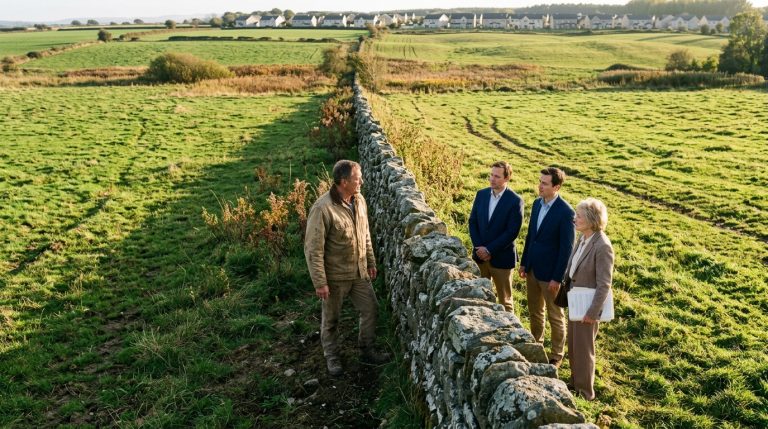
A Sovereign Ridge, A Dead Easement, And The Unyielding Iron Of Land Rights
CHAPTER 1: THE FIRST SHOT ACROSS THE RIDGE
The timestamp on the JPEG said 07:14 AM on Tuesday. The shadow cast by my Douglas fir framing headers in that same image proved it was taken last Friday at noon.
I rolled the cold, pointed tip of my matte-black brass plumb bob between my thumb and index finger, feeling the crisp edge of its steel thread. Someone had been standing in the wet clover on my south lot line before the concrete trucks even cleared the grade.
The email sat open on the ruggedized laptop resting on a sawhorse. It bore the crest of Golden Summit Estates—a subdivision two hundred feet down the ridge, sitting in a neat, gated grid of matching asphalt and manicured lawns.
“Courtesy outreach regarding your framing line…”
Karen Holloway’s name was signed at the bottom. President, HOA Board.
“She copied your builder,” my attorney, Sarah, said over the speakerphone. Her voice was flat, dry as cured cedar. “She copied your lender’s compliance desk. And she copied the county building official.”
“She’s poisoning the water before I drink it,” I said.
My thumb rubbed the brass point. Outside, the ridge was quiet save for the wind pushing through the ponderosa pines and the dull thud of a diesel generator idling on the lower deck. My parcel sat outside their jurisdiction. Different deed chain. Different access road. Different world.
“She’s asking for voluntary compliance,” Sarah noted. “Lower the roof pitch four feet. Push the west deck back into the slope. Use dark matte finishes so the structure integrates.”
“She’s asking for a surrender,” I said. “Read line four again.”
“‘To preserve the long-established western panorama enjoyed by Golden Summit residents.’”
I clicked the attachment properties. Camera Serial Number: 40912-B. The file was titled Site_Incursion_Draft_1.jpg.
I saved the raw header, exported the EXIF data to two external drives, and archived the inbound server log. She hadn’t sent a neighborly concern. She had filed a pre-litigation dossier using a file created three days before my foundation inspection was logged.
“Don’t reply,” Sarah advised. “I’m pulling the county planning file for Golden Summit.”
“I’m already in my truck.”
Twenty minutes later, my boots hit the worn linoleum of the County Records Department. The air smelled of wet wool and decaying paper. I pulled the master file for Golden Summit Estates, Parcel Map 408.
The hypocrisy didn’t just smell bad—it had a paper trail.
Three years ago, Karen’s HOA had applied for and received a county variance for a two-story stone pavilion on their own ridge overlook. Eight months after that, they added two timber pergolas that jabbed six feet higher into the exact same western horizon line she was currently calling sacred ground. They built amenities into the skyline and wanted to charge me for the shadow.
I paid forty-two dollars for certified copies with the red foil seal, photographed the variance map on the counter, and walked back out into the mountain rain.
My phone buzzed in my coat pocket. A notification from my lender’s portal.
Compliance Flag: Unverified Property Boundary Dispute.
Karen hadn’t waited for my answer. The seed was planted. The machine was moving.
I stood beside my truck, the rain dripping off the brim of my canvas hat, and pulled the brass plumb bob from my pocket. I let it hang by its line, watching it swing until it hung dead plumb against the tire track in the mud.
The line was straight. The land was mine. Now I just had to build the cage to put her in.
CHAPTER 2: STAKES IN THE DIRT
The certified papers sat heavy on my passenger seat, the red foil seal from the county clerk cold against my knuckle. Rain rattled against the windshield like thrown gravel.
I turned the ignition key. The diesel V8 turned over with a sharp, metallic clatter that shook the steering column, and I shoved the transfer case into low range.
I didn’t head back down the mountain. I drove straight up the spine of the ridge toward my lot.
My mind pulled backward four years—to the day I signed the deed in a dark title office, buying six acres of unplatted granite because I wanted a border nobody could cross without a warrant or a surveyor’s transit. I remembered the exact words of the old rancher who sold it: The lower valley is full of men who think they own the clouds because they bought a house on a slab. He wasn’t wrong. Golden Summit Estates had swallowed the meadows below, but they hadn’t bought the mountain.
When I rounded the final switchback, my headlights caught something that didn’t belong on my dirt spur.
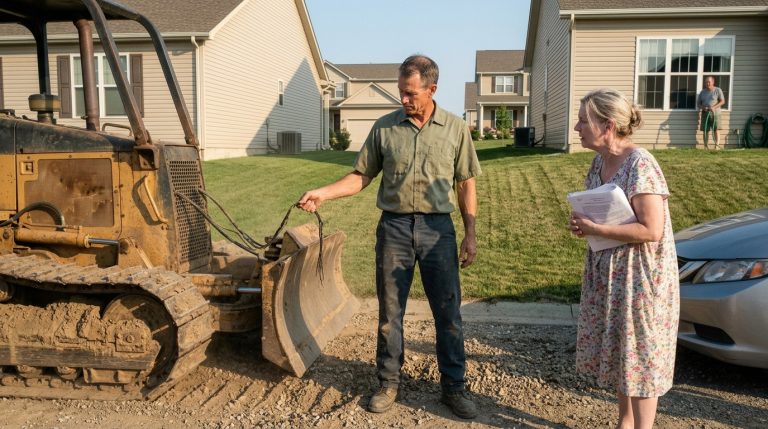
A white flatbed truck was backed onto my upper grade, its rear wheels churning deep, dark ruts into the wet clay I’d spent six thousand dollars leveling. Two men in neon vests were moving along my south patio line with wooden measuring rods. A third man was unloading bundles of orange-topped wooden stakes from the back of the flatbed.
And standing ten feet inside my property line, wearing a cream wool jacket and oversized black sunglasses despite the rain, was Karen Holloway.
She held a rolled set of blueprints under one arm, her other hand extended, pointing up toward my framing headers like an officer directing a ditch-digging crew.
I pulled the truck across the access road, blocking the flatbed’s exit. I left the high beams burning, pinning her against the wall of wet timber, and grabbed my phone from the dash. I hit the video record button before my boots hit the mud.
The mountain air hit my lungs—sharp, smelling of wet pine needles and raw diesel exhaust.
“What exactly are you doing on my land?” I asked. My voice was low, flat, carrying over the idle of my engine.
The nearest survey tech froze, his measuring rod held midway against a timber post. He looked past me toward Karen first.
Bad move. The body language told the whole story.
“We’re staking the view buffer,” the tech said. He wiped rain from his forehead with the back of a mud-streaked glove, glancing down at a metal clipboard tucked under his arm. “Per the instructions on the sheet.”
“Read the sheet to me,” I said, stepping closer. I kept the phone level, framing his face, his badge, and the logo on his vest: Apex Land Surveying.
“Instruction from Golden Summit Estates Scenic Committee,” he muttered, reading off the paper. “Buffer overlay zone.”
“There is no buffer overlay zone,” I said. “You’re standing on private property. Parcel 109-B. Different deed chain. You didn’t pull a county permit to stake this, and you didn’t notify the owner.”
Karen took two steps forward, her heels sinking an inch into the soft mud. She didn’t look at the camera. She looked straight at my chin.
“You were notified by email this morning,” she said. Her tone was smooth, measured, crafted for a board meeting room. “Your current placement is incompatible with established sightlines. We are establishing the field baseline for the injunction.”
“You don’t get to establish a baseline on my parcel,” I said. I swung the camera four inches to the left, catching her face, her cream jacket, the flatbed’s license plate, and the company name on the door: High Country Fencing LLC. “This is trespass.”
“It’s a boundary verification,” she replied without blinking. “That’s not your decision to make while litigation is pending.”
“It’s my land,” I said. “Which means it’s my decision.”
I didn’t argue. I didn’t raise my voice. Arguing gives people like Karen something to react to, something to reframe as a mutual dispute. Instead, I pulled the matte-black brass plumb bob from my pocket with my free hand, letting the heavy point dangle on its string against my thigh. The cold metal tapped against my knee.
“I’m giving you three minutes to reload those stakes and get off my grade,” I said, looking at the lead tech. “If those stakes are still in my dirt when the deputy arrives, I’m pressing criminal trespass charges against Apex Surveying and High Country Fencing individually.”
The tech looked at Karen, then at the camera, then down at the mud on his boots.
“He’s recording,” the tech whispered to her.
“Let him record,” Karen said softly, her chin lifting half an inch. “We have an easement claim under the scenic preservation clause.”
She was bluffing, relying on the sheer weight of authority that usually worked on subcontractors and passive homeowners. But I saw the micro-twitch in her jaw—the slight tightening of the skin around her eyes as she noticed the red foil seal on the folder sticking out of my coat pocket.
I tapped the screen on my phone, switched to the dial pad without breaking the video stream, and hit the speed-dial for the county sheriff’s non-emergency dispatch line. I put it on speaker.
“County Sheriff Dispatch, state your emergency.”
“This is Marcus Vance at 410 Ridgecrest Road,” I said clearly. “I have an active criminal trespass in progress on my private build site. Three unauthorized contractors and a private citizen are driving physical stakes into my foundation grade. I am requesting a deputy on scene immediately to file an incident report.”
Karen didn’t move, but her hand tightened around the rolled blueprints until the paper creaked.
“A unit is en route, Mr. Vance. ETA ten minutes.”
“Thank you,” I said, and disconnected.
I looked at the fence contractor standing by the flatbed. He looked at the phone in my hand, then at Karen, then threw his hands up in the air.
“I’m not getting my rig impounded over an HOA squabble,” the driver muttered. He turned back to the flatbed and started unhooking the tie-down straps. “Load the rods, Gary. We’re waiting at the turnout below.”
“Stay right where you are,” Karen commanded, her voice dropping its polite sheen for a split second, revealing the iron core underneath. “We are finishing the layout.”
Nobody moved. The survey tech took a slow step backward toward the road.
I didn’t say another word. I walked to the edge of my grade, stood next to the wooden stake they had just driven eight inches into my soil, and held the phone close enough to record the fresh tear in the earth. I reached down, pulled the stake out with a sharp tug, and laid it flat on the hood of my truck.
I didn’t break it. I didn’t throw it. I cataloged it.
Down the winding dirt road, the faint sound of a siren echoed through the wet timber. Karen stood her ground in the rain, but her hands were tucked deep into her coat pockets now, hiding the shake in her fingers.
The war had crossed the fence line. And every inch she took was going on the bill.
CHAPTER 3: ADMINISTRATIVE FRICTION
The strobe lights of Deputy Miller’s patrol SUV cut red and blue swaths through the rain, turning the wet timber headers into bleeding ribs against the mountain night.
Karen didn’t run. She didn’t flinch when the cruiser’s door swung open and Miller stepped into the mud, his yellow slicker rustling over his tactical belt. Instead, she smoothed the front of her cream coat—now ruined at the hem with reddish clay—and smiled with terrifying, practiced composure.
“Deputy,” she said smoothly, her voice pitched just high enough to cut under the engine idle. “I’m glad you’re here. We have a boundary dispute that’s threatening neighborhood safety.”
Miller looked at her. He looked at the pulled stake sitting on the hood of my truck, rain streaming off its sharpened tip. Then he looked at me.
“Marcus,” Miller said, resting a gloved hand on his belt. “Who called?”
“I called,” I said. I handed him my phone with the video still loaded. “Criminal trespass. Three survey workers and an HOA officer driving stakes past my recorded south boundary without a county permit or owner consent.”
Miller took the phone, squinting at the screen while the rain bounced off his wide-brimmed hat. He scrubbed a thumb across the glass, watching the clear recording of the survey tech reading off the sheet and Karen declaring the field baseline.
“Ma’am,” Miller said, turning back to Karen. “Is this your crew?”
“It’s a designated committee enforcement team for Golden Summit Estates,” she replied, her chin lifted. “We are preserving a recorded scenic easement under our charter.”
“His parcel isn’t in your charter,” Miller said flatly. He had worked this county seven years; he knew where the subdivision line ended and where the old mountain deeds began. “You got a court order or a county building official with you?”
“We are in the process of filing the emergency injunction,” she said.
“Then you don’t have a court order,” Miller said. He turned to the two techs huddled near the flatbed. “You two. Pack the rods. Leave the stakes on the truck bed. You step back on this grade tonight, you’re sleeping in county lockup.”
The driver didn’t wait for a second warning. He slammed his cab door, fired the engine, and pulled the flatbed out into the mud, leaving deep, torn tracks as he retreated down the spur.
Miller wrote down the incident number on a yellow carbon slip, tore it off, and pressed it into my hand. The paper was instantly damp, smelling of ink and salt.
“Incident Report 4409-B,” Miller said. “Nobody comes back without a signed order from Judge Vance. Got it?”
Karen took the yellow copy Miller handed her without a word. She didn’t look at me as she turned and walked down the mud track toward her Mercedes parked at the turnout, her expensive leather shoes ruined, her posture as stiff as a fence post.
By 08:00 AM the next morning, my builder, Miller, wasn’t framing. He was standing on the subfloor with his hands shoved into his heavy canvas jacket, staring at his tablet screen.
“Framing inspection just got flagged,” he said, not looking up. “Not failed. Suspended pending administrative review.”
I wiped grease off my thumb with an old shop rag. “What’s the reason code?”
“Code 14,” he read off the screen. “Overlap complaint filed with county engineering. Claims private road spur encroaches on a public scenic trail corridor and interferes with fire access.”
“The trail corridor dies three hundred feet downhill,” I said. “It doesn’t touch this ridge.”
“Doesn’t matter what it touches,” my builder said grimly. “When an administrative flag lands on the portal, county inspectors can’t sign off on structural timber until engineering clears the file. It stops my crew dead. Every day we sit here is eight hundred bucks in crane rentals and crew retainers.”
I walked over to my ruggedized laptop resting on the stack of OSB sheathings. I logged directly into the County Land Management portal using my owner-builder credentials.
I opened the public audit trail for Permit 994-A.
There it was: Complaint Submitted: 08:25 AM. Eleven minutes after Karen had sent her ‘courtesy’ email the previous morning.
The submission hadn’t come from a concerned citizen. It had been routed through an internal system credential tagged Permit Portal Log 084—a specialized review account granted to Golden Summit Estates for submitting internal subdivision variance notices. She had used an administrative portal clearance meant for her own neighborhood to directly inject a red flag into my county build file.
My thumb went straight to my pocket, finding the cold, heavy tip of my brass plumb bob. I rolled the brass between my fingers, feeling the hard, mechanical truth of its geometry.
I called Sarah immediately.
“She used their internal portal access to file an administrative block,” I told her, my voice low and quiet. “It took her eleven minutes.”
“That’s misuse of a municipal design portal,” Sarah said over the line, the sound of her turning pages sharp in my ear. “That’s not a neighbor complaining. That’s unauthorized administrative interference under color of authority.”
“I’m going down to the board vice president’s house,” I said.
“Keep your phone recording,” Sarah warned. “Don’t ask questions he can dodge. Ask questions about the paper.”
Twenty minutes later, I stood on the pristine flagstone porch of Arthur Pendelton—former county commissioner, current HOA vice president, and a man whose signature sat on forty years of local road deeds. He opened the solid mahogany door wearing a wool cardigan, holding a steaming mug of coffee.
He looked at my muddy work boots, then up at my face. His eyes narrowed slightly, but he didn’t close the door.
“Mr. Vance,” Arthur said slowly. “If this is about the framing, the board hasn’t taken a formal vote.”
“I know you haven’t,” I said. I didn’t step onto his porch carpet. I stayed on the stone step, holding a printed copy of the board’s last meeting agenda in my hand. “Because your agenda from Tuesday lists ‘Landscape Continuity Review,’ not litigation authorization against Parcel 109-B.”
Arthur took a slow sip of his coffee. The steam rose between us, smelling of cinnamon and dark roast. His hand didn’t shake, but his throat moved as he swallowed.
“Karen is handling the scenic corridor oversight,” Arthur said carefully.
“Karen used Permit Portal Log 084 to flag my framing inspection eleven minutes after emailing me,” I said, holding his gaze. “She told your board she had legal backing. But your minutes show no legal retainer vote, no authorization for survey work, and no board resolution.”
Arthur lowered his mug. He looked past me toward the mountain ridge where my exposed timber framing stood against the gray sky.
“She told us it was a placeholder,” Arthur muttered, his voice dropping an octave, losing its polished neighborhood cadence. “She said she was securing a draft map revision to protect the view corridor before your roof went up. She said she’d backfill the board approval once the county confirmed the easement overlap.”
“There is no easement overlap, Arthur,” I said. “And if your board pays for that Apex survey invoice, every member of this executive committee is personally named in a tortious interference lawsuit by Friday morning.”
Arthur stood silent for three long seconds. He looked down at the coffee in his cup, then back at me. A deep, tired line cut across his forehead.
“I signed forty years of county deeds, Mr. Vance,” he said quietly. “I told her last month that the old trail easement was dead wood. She didn’t want to hear it.”
“Put that in a statement,” I said. “Not for the court. For my file.”
Arthur set his mug down on the porch table with a soft clink. “Give me a pen.”
I handed him my clipboard. He signed his name across the bottom of the witness declaration without reading it twice, his cursive script heavy and bold.
I took the paper back, snapped a photo of it on the clipboard before the ink was dry, and walked back to my truck.
One link at a time, the chain was wrapping around her neck. And she was the one pulling it tight.
CHAPTER 4: THE INACTIVE SHEET
The ink from Arthur Pendelton’s signature was still a dark, wet blue against the white grid of the clipboard. I slid the paper into a clear plastic sleeve, pulled the seal tight, and placed it inside the heavy binder beside the county variance copies.
Shadows stretched across the dashboard, and twenty minutes of mountain silence broke when the tires finally crunched on the gravel of Sarah’s office lot in town.
Inside, the low hum of a dehumidifier filled the room. Sarah’s desk was covered in subpoena returns—stacks of white bond paper held down by brass paperweights. A single desk lamp threw a sharp cone of yellow light over a printout of an email chain subpoenaed from Apex Land Surveying.
“We got the internal communication logs,” Sarah said, not greeting me, her hand pointing a red pen at paragraph three of a printed thread. “Look at the time stamp from two nights ago.”
I leaned over the desk, the canvas of my work jacket creaking as I rested my knuckles on the oak edge.
The email was sent at 9:42 PM from Karen’s personal address to the lead field technician at Apex.
From: [email protected]
Subject: Re: Boundary Stake Protocol – Ridge Line
“Do you want us to use the older scenic easement sheet?” the contractor asked. “County recorder says Draft Map Revision C is inactive and retired.”
Karen’s reply came four minutes later:
“Use the older one for field purposes. We just need enough to pause him.”
The room seemed to grow two degrees colder. The sentence sat there on the paper—black ink on white pulp, void of interpretation, void of ambiguity.
“‘Use the older one for field purposes,’” I read out loud. My voice sounded stripped of timber, purely mechanical. “‘We just need enough to pause him.’”
“Draft Map Revision C was officially vacated by the county board of commissioners two years ago during the road straightening project,” Sarah explained, tapping her pen against the page. “It has no legal standing. It bestows zero easement rights. It is, for all legal intents and purposes, a piece of scrap paper.”
“And she knew it,” I said.
“She knew it, the surveyor warned her, and she gave a direct written order to deploy an inactive document to physically obstruct a lawful build,” Sarah said. She pulled a second document from a blue folder. “That’s bad-faith enforcement. But it gets worse.”
She turned her monitor toward me. On the screen was the PDF file attached to the HOA’s formal court filing from this afternoon—a scenic impact assessment meant to convince Judge Vance to issue a temporary restraining order freezing my framing.
“I ran the document properties through a metadata reader,” Sarah said. “Look at the document history.”
I focused on the raw text window.
Creation Date: Yesterday, 11:14 PM.
Author: Karen Holloway.
CHAPTER 5: THE GAVEL DROPS
The air in Department 4 smelled of floor wax, old leather, and air conditioning pushed two degrees too low.
I sat at the petitioner’s table, my dark grey jacket buttoned over a clean work shirt. My hands rested flat on the polished oak finish, right beside Sarah’s leather briefcase. Inside my coat pocket, my thumb remained resting against the cold, matte-black brass plumb bob, anchoring my posture while the gallery doors swung shut behind us.
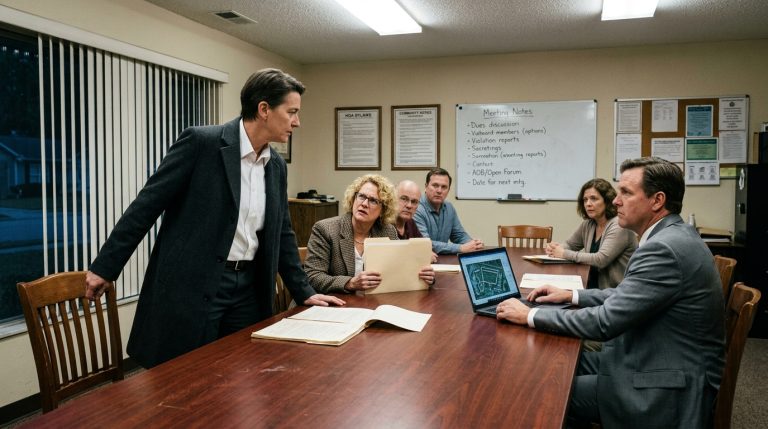
To our right, Karen Holloway sat at the respondent’s table. She wore a tailored charcoal suit, her dark hair pulled back into a tight bun. Her attorney, a tall man with silver hair and an expensive pinstriped coat, was spreading three oversized foam boards across the easel in front of the bench.
The boards showed rendered elevation angles of Golden Summit Estates, with red translucent shaded zones sweeping across the slope toward my ridge.
Judge Vance stepped up to the bench, his dark robes rustling as he adjusted his wire-rimmed glasses. He didn’t look at the foam boards. He pulled the court file open, scanned the cover sheet, and looked down over his bench.
“Injunction motion,” Judge Vance declared, his voice a dry rasp that filled the cavernous room. “Golden Summit Estates versus Vance. Council, state your appearances.”
Karen’s attorney stepped forward immediately, buttoning his coat with practiced elegance.
“Julian Thorne for the applicant, Your Honor,” he said smoothly. “We are seeking an immediate temporary injunction to halt all framing and structural assembly on Parcel 109-B. My clients represent forty-two homeowners who purchased property in reliance on an unbroken western panorama. The structure currently under construction imposes a material, irreversible intrusion upon established view corridors long maintained under community authority.”
Judge Vance leaned back in his leather chair. He tilted his head slightly, his eyes cold behind his lenses.
“Counsel,” Vance said, his tone razor thin. “Are you asking this court to recognize property rights over what your clients happen to see from their patio furniture?”
A brief, suffocating silence dropped over the gallery. Karen’s posture snapped straight, her hands locking together on top of her notepad.
“Your Honor,” Thorne tried again, shifting his weight. “The established character of Golden Summit Estates—”
“Is a private residential subdivision,” Vance cut in sharply. “It is not a municipal zoning board, nor does it own the sky above neighboring parcels. That is not a property interest, Counsel. That is disappointment dressed up as doctrine.”
The judge let out one short, sharp laugh—a single burst of air that died instantly against the tall plaster walls.
Thorne swallowed, his throat moving against his stiff collar. “Your Honor, the applicant relies on the scenic easement corridor recorded under Draft Map Revision C—”
“Sarah,” I whispered softly.
Sarah didn’t stand up with theatrical flair. She unlatched her briefcase with two distinct metal snaps, stepped to the podium, and plugged a black USB drive directly into the digital evidence terminal.
“Your Honor,” Sarah said, her voice completely level. “The defense moves to dismiss the injunction and requests an immediate hearing on bad-faith administrative filing. We submit Defense Exhibit A.”
The overhead projector hummed to life. High on the courtroom wall, a crisp image of the Apex Land Surveying email thread flickered into view.
Sarah read the text directly off the screen, her voice echoing clearly off the wood paneling:
“Use the older one for field purposes. We just need enough to pause him.”
Karen’s attorney turned his head so fast his collar creaked. “Objection, Your Honor—unauthenticated—”
“The foundation is laid by subpoena return, Counsel,” Vance snapped, leaning over his bench to stare directly at the screen. “Is that an email from your client to a contracted survey firm?”
Thorne looked at Karen. Karen was staring at the wall, her face drained of every drop of color, her jaw clenched so hard the muscles stood out like wire under her skin.
“We also offer Defense Exhibit B,” Sarah continued calmly, tapping the laptop spacebar.
The screen shifted to the county audit log.
“Permit Portal Log 084,” Sarah stated. “Used at 08:25 AM on Tuesday to inject an administrative complaint into Mr. Vance’s county framing file. The timestamp matches the exact minute Mrs. Holloway sent her initial demand email. The credential belongs exclusively to Golden Summit Estates for internal subdivision matters. It was weaponized to simulate official county oversight.”
“And Exhibit C,” Sarah added, placing Arthur Pendelton’s signed witness statement directly on the bench clerk’s tray. “A notarized statement from the Vice President of the HOA board confirming no board authorization vote was ever taken to initiate this action.”
Judge Vance didn’t speak for a full minute. The only sound in the room was the soft, rhythmic hum of the digital projector.
He looked down at the paper, then at the audit log, then directly at Karen Holloway.
“Mrs. Holloway,” Vance said softly. His voice had dropped to a quiet, dangerous register. “Did you direct a contractor to deploy an inactive, retired map sheet to physically enter Parcel 109-B?”
Karen opened her mouth. Her hand moved involuntarily, her thumb nervously picking at a loose thread on her sleeve—a sharp, desperate micro-action that shattered her icy composure.
“We were protecting the community’s—” she began.
“You were using retired documents to execute unauthorized field enforcement,” Vance interrupted, his hand bringing the wooden gavel down with a deafening CRACK that made the entire gallery jump. “Injunction denied!”
He didn’t pause. He didn’t take the matter under advisement.
“The administrative flag on Permit 994-A is ordered removed immediately by court directive,” Vance declared, pointing his pen at the court clerk. “Golden Summit Estates, its officers, and its agents are hereby restrained from entering Parcel 109-B, contacting Mr. Vance’s lender, or submitting further complaints through municipal portal credentials without prior leave of this court.”
He looked directly at Thorne, his eyes blazing.
“Counsel, you will have your client back in this courtroom in fourteen days for a full sanctions hearing regarding false filings, trespass, and abuse of process. I am shifting defense attorney fees to the applicant effective immediately. Step down.”
Karen sat completely rigid as Judge Vance signed the order with a thick black pen. Her attorney slowly gathered his foam boards, his face flushed red, avoiding all eye contact.
Sarah closed her laptop with a soft click.
I stood up, adjusting my jacket. I reached into my pocket, my fingers wrapping around the cold brass plumb bob, feeling its solid, unyielding weight.
We walked past Karen’s table. She didn’t look up. Her eyes remained fixed on the empty space where the evidence projection had just been, her hands trembling slightly in her lap as the reality of the sanctions order closed over her head.
Out in the marble hallway, the air felt clean and cold. The mountain was still waiting. And the build was going forward.
CHAPTER 6: IRON ON THE RIDGE
The heavy bronze exit doors of the county courthouse pushed open into crisp, high-altitude sunlight. The cold wind off the valley swept past the concrete steps, carrying away the lingering smell of floor wax and old leather.
Sarah set her briefcase on the hood of my truck, pulling a stamped, triplicate copy of Judge Vance’s signed order from the top pocket.
“The clerk routed the certified mandate directly to county engineering,” she said, her voice dropping into a quiet, settled rhythm. “The suspension on Permit 994-A is officially cleared in the system. The portal lock is dead.”
I took the copy, running my thumb over the raised seal pressed into the lower corner.
“And Golden Summit Estates?” I asked.
“The board’s legal counsel served notice forty minutes ago,” Sarah replied, unbuttoning her coat. “They are voluntarily rescinding every administrative claim tied to Draft Map Revision C. Arthur Pendelton took over as interim board chair during an emergency session this morning. Karen Holloway was formally removed from her oversight role before we even left the courtroom.”
She reached into her coat, pulling out a white ledger sheet.
“Her personal liability carrier isn’t indemnifying her for intentional misuse of Permit Portal Log 084,” Sarah added flatly. “The court-ordered fee award comes out of her personal account. Six thousand four hundred dollars, payable within thirty days.”
I folded the certified mandate once, slid it into my glove compartment, and turned the ignition key. The diesel engine roared to life, settling into a steady, rhythmic thrum that vibrated through the floorboards as I headed back up the ridge.
By two o’clock, the ridge was no longer silent.
The crane truck was parked at the edge of the grade, its hydraulic outriggers locked firmly into the dry earth. The air smelled of fresh pine shavings, warm diesel, and cut Douglas fir. Miller stood on the top plate of the west wall, calling out measurements while two crewmen guided a twenty-foot ridge beam into position.
“Lower it two inches on the south post!” Miller shouted over the engine hum.
The heavy timber settled into its steel pocket with a solid, resonant thud that echoed down the valley.
I walked the perimeter of the south patio grade, where the orange survey stakes had been driven two days prior. The torn mud had dried in the afternoon sun, turning into firm, pale clay.
I knelt down, picked up a discarded six-inch lag bolt left on an OSB sheet, and pulled a heavy socket wrench from my belt pouch. I lined up the steel bracket connecting the main corner post to the concrete pier, seated the thread, and began cranking the wrench.
Ratchet. Clack. Ratchet. Clack.
The steel plate pulled flush against the rough grain of the post, clamping the timber to the mountain with three hundred foot-pounds of torque.
Down in the valley, two hundred feet below, the neat asphalt loops of Golden Summit Estates lay mapped out like a grid on a board—quiet, distant, and completely cut off by the deed line running along the tree line.
My phone chimed in my pocket. A formal notification from the county land office.
Notice: Parcel 109-B Title File Updated. Cloud Removed. Administrative Flags Cleared.
I locked the screen and slid the phone away.
I reached into my canvas coat and pulled out the matte-black brass plumb bob. The brass was warm from the sun, the steel tip sharp and true. I tied its nylon string to the center notch of the overhead headers, letting the weighted point drop until it hung half an inch above the brass strike plate anchored in the foundation concrete.
The line didn’t sway. It hung dead plumb, perfectly vertical against the expanse of the valley floor below.
Miller jumped down from the framing ladder, wiping sweat from his forehead with the back of his leather work glove. He looked down at the valley, then back at the exposed ridge beam sticking out toward the horizon line.
“You keeping the west glass floor-to-ceiling like the original plans?” he asked, leaning against the timber post.
“Every inch of it,” I said.
He grinned, clapping a calloused hand against the beam. “Good. It’d be a waste of a view to build anything smaller.”
He walked back toward the crane to signal the next lift.
I stood on the open deck, looking out across the mountain range as the afternoon shadows began to stretch across the timber. The house stood exactly where it was designed to stand—built on clean permits, set on recorded granite, and bounded by iron that couldn’t be moved by letterhead or loud talk.
I picked up the socket wrench, fitted the next bolt, and tightened it down until the iron bit deep into the wood.
——Caption——
🟦 OPTION 1
⛰️ An HOA president tried to steal my land for a scenic view—until a hidden metadata trail destroyed her entire life in open court.
The timestamp on the JPEG said 07:14 AM on Tuesday. The shadow cast by my Douglas fir framing headers in that same image proved it was taken last Friday at noon.
I rolled the cold, pointed tip of my matte-black brass plumb bob between my thumb and index finger, feeling the crisp edge of its steel thread. Someone had been standing in the wet clover on my south lot line before the concrete trucks even cleared the grade.
The email sat open on the ruggedized laptop resting on a sawhorse. It bore the crest of Golden Summit Estates—a subdivision two hundred feet down the ridge, sitting in a neat, gated grid of matching asphalt and manicured lawns.
“Courtesy outreach regarding your framing line…”
Karen Holloway’s name was signed at the bottom. President, HOA Board.
“She copied your builder,” my attorney, Sarah, said over the speakerphone. Her voice was flat, dry as cured cedar. “She copied your lender’s compliance desk. And she copied the county building official.”
“She’s poisoning the water before I drink it,” I said.
My thumb rubbed the brass point. Outside, the ridge was quiet save for the wind pushing through the ponderosa pines and the dull thud of a diesel generator idling on the lower deck. My parcel sat outside their jurisdiction. Different deed chain. Different access road. Different world.
“She’s asking for voluntary compliance,” Sarah noted. “Lower the roof pitch four feet. Push the west deck back into the slope. Use dark matte finishes so the structure integrates.”
“She’s asking for a surrender,” I said. “Read line four again.”
“‘To preserve the long-established western panorama enjoyed by Golden Summit residents.’”
I clicked the attachment properties. Camera Serial Number: 40912-B. The file was titled Site_Incursion_Draft_1.jpg.
I saved the raw header, exported the EXIF data to two external drives, and archived the inbound server log. She hadn’t sent a neighborly concern. She had filed a pre-litigation dossier using a file created three days before my foundation inspection was logged.
“Don’t reply,” Sarah advised. “I’m pulling the county planning file for Golden Summit.”
“I’m already in my truck.”
Twenty minutes later, my boots hit the worn linoleum of the County Records Department. The air smelled of wet wool and decaying paper. I pulled the master file for Golden Summit Estates, Parcel Map 408.
The hypocrisy didn’t just smell bad—it had a paper trail.
Three years ago, Karen’s HOA had applied for and received a county variance for a two-story stone pavilion on their own ridge overlook. Eight months after that, they added two timber pergolas that jabbed six feet higher into the exact same western horizon line she was currently calling sacred ground. They built amenities into the skyline and wanted to charge me for the shadow.
I paid forty-two dollars for certified copies with the red foil seal, photographed the variance map on the counter, and walked back out into the mountain rain.
My phone buzzed in my coat pocket. A notification from my lender’s portal.
Compliance Flag: Unverified Property Boundary Dispute.
Karen hadn’t waited for my answer. The seed was planted. The machine was moving.
I stood beside my truck, the rain dripping off the brim of my canvas hat, and pulled the brass plumb bob from my pocket. I let it hang by its line, watching it swing until it hung dead plumb against the tire track in the mud.
The line was straight. The land was mine. Now I just had to build the cage to put her in.
→ Chapter 2: “STAKES IN THE DIRT” 👇
#StoryTime #Thriller #PropertyDispute
🟦 OPTION 2
📋 A wealthy neighborhood tried to bully my property out of their view—they didn’t realize I saved every piece of electronic evidence.
The timestamp on the JPEG said 07:14 AM on Tuesday. The shadow cast by my Douglas fir framing headers in that same image proved it was taken last Friday at noon.
I rolled the cold, pointed tip of my matte-black brass plumb bob between my thumb and index finger, feeling the crisp edge of its steel thread. Someone had been standing in the wet clover on my south lot line before the concrete trucks even cleared the grade.
The email sat open on the ruggedized laptop resting on a sawhorse. It bore the crest of Golden Summit Estates—a subdivision two hundred feet down the ridge, sitting in a neat, gated grid of matching asphalt and manicured lawns.
“Courtesy outreach regarding your framing line…”
Karen Holloway’s name was signed at the bottom. President, HOA Board.
“She copied your builder,” my attorney, Sarah, said over the speakerphone. Her voice was flat, dry as cured cedar. “She copied your lender’s compliance desk. And she copied the county building official.”
“She’s poisoning the water before I drink it,” I said.
My thumb rubbed the brass point. Outside, the ridge was quiet save for the wind pushing through the ponderosa pines and the dull thud of a diesel generator idling on the lower deck. My parcel sat outside their jurisdiction. Different deed chain. Different access road. Different world.
“She’s asking for voluntary compliance,” Sarah noted. “Lower the roof pitch four feet. Push the west deck back into the slope. Use dark matte finishes so the structure integrates.”
“She’s asking for a surrender,” I said. “Read line four again.”
“‘To preserve the long-established western panorama enjoyed by Golden Summit residents.’”
I clicked the attachment properties. Camera Serial Number: 40912-B. The file was titled Site_Incursion_Draft_1.jpg.
I saved the raw header, exported the EXIF data to two external drives, and archived the inbound server log. She hadn’t sent a neighborly concern. She had filed a pre-litigation dossier using a file created three days before my foundation inspection was logged.
“Don’t reply,” Sarah advised. “I’m pulling the county planning file for Golden Summit.”
“I’m already in my truck.”
Twenty minutes later, my boots hit the worn linoleum of the County Records Department. The air smelled of wet wool and decaying paper. I pulled the master file for Golden Summit Estates, Parcel Map 408.
The hypocrisy didn’t just smell bad—it had a paper trail.
Three years ago, Karen’s HOA had applied for and received a county variance for a two-story stone pavilion on their own ridge overlook. Eight months after that, they added two timber pergolas that jabbed six feet higher into the exact same western horizon line she was currently calling sacred ground. They built amenities into the skyline and wanted to charge me for the shadow.
I paid forty-two dollars for certified copies with the red foil seal, photographed the variance map on the counter, and walked back out into the mountain rain.
My phone buzzed in my coat pocket. A notification from my lender’s portal.
Compliance Flag: Unverified Property Boundary Dispute.
Karen hadn’t waited for my answer. The seed was planted. The machine was moving.
I stood beside my truck, the rain dripping off the brim of my canvas hat, and pulled the brass plumb bob from my pocket. I let it hang by its line, watching it swing until it hung dead plumb against the tire track in the mud.
The line was straight. The land was mine. Now I just had to build the cage to put her in.
→ Chapter 2: “STAKES IN THE DIRT” 👇
#Fiction #Drama #HOABattles
💬 ENGAGEMENT KIT
📍 Pinned Comment:
Things escalate fast when the survey crew shows up. Here’s what happened next 👇
🪝 Curiosity Hooks 1:
She thought an email would force him to lower his house, but a single photo’s hidden metadata proved she had been trespassing on his ridge for days.
🪝 Curiosity Hooks 2:
An HOA president tried to claim a private property owner was ruining her subdivision’s mountain view—until public land records revealed her own neighborhood was breaking the exact same rules.