The Steel Horizon: A Calculated Siege Where Patience Is the Sharpest Weapon Against Corporate Greed
CHAPTER 1: THE WEIGHT OF STEEL
The sun wasn’t even fully over the Texas horizon, yet the mist clinging to my pasture was already being shredded by the headlights of eighteen luxury SUVs. They came like a synchronized strike force, chrome grills flashing with a predatory, artificial brilliance that had no business on a cattle ranch. I stood on the porch, my hands gripping the weathered oak railing, feeling the vibration of the engines travel up through the floorboards and rattle my teeth.
I watched them. I didn’t shout. I didn’t run. I was a structural engineer; I knew exactly how much force a foundation could take before it began to hairline, and these men were testing mine.
They tore across the prairie, tires churning the damp earth into deep, jagged trenches. My pregnant heifers, sensing the sudden, violent shift in the landscape, scattered toward the treeline in a panicked frenzy. One of the drivers—a man in a high-end crossover—slowed just enough to spot my security camera. He lifted a hand, a slow, mocking wave, before gunning the engine to catch up with the lead Mercedes.
It was 7:02 a.m.
Inside the house, I could hear the faint clatter of a bowl hitting the table. Emma was at the window. I didn’t need to turn around to know the expression on her face. It was the look of a kid watching their sanctuary being hollowed out.
I looked down at the ground near the gate. The tire tracks were already deep, the soil displaced in a way that screamed carelessness. But as I squinted through the morning gloom, I noticed something else—a scrap of heavy-duty plastic caught on the barbed wire, embossed with a specific, industrial logo that had nothing to do with residential landscaping. It was a fragment of a survey stake, the kind used by developers, not homeowners.
Why would a suburban HOA be using commercial-grade land-plotting gear on my cattle line?
I didn’t call the sheriff. I didn’t storm down there with a rifle. I just watched, my eyes tracking the lead G-Wagon as it crested the ridge. This wasn’t just a misunderstanding about fence lines or paint colors. It was a precise, calculated intrusion. And as the last vehicle crossed my boundary, I felt a familiar, cold clarity settle over me. The war had officially moved from the theoretical to the physical.
I turned back to the porch door, my gaze falling on the rusted, antique surveyor’s level I kept by the door. I needed to see exactly how crooked their path really was.
CHAPTER 2: THE INTRUSION
The piece of plastic in my hand was a jagged, synthetic red. It bit into my palm, a sharp reminder that the fence line wasn’t just a boundary anymore; it was a front line. I didn’t drop it. I pocketed it, the sharp edges poking through my denim, a secret I intended to use.
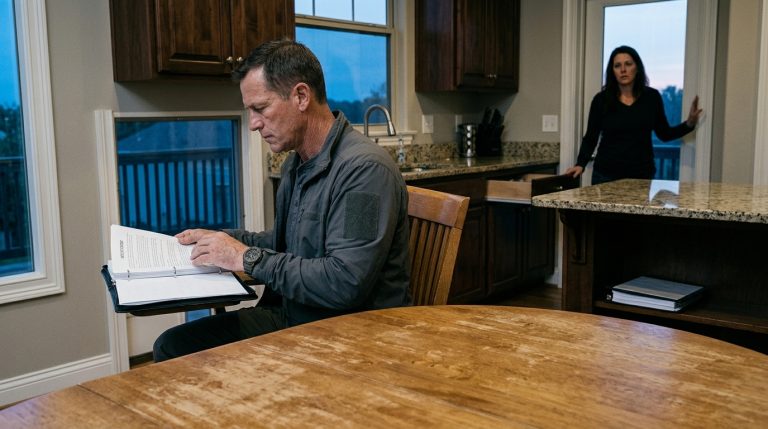
My house was quiet now, the unnatural silence after a storm. Emma had moved away from the window, her back turned to the glass, her posture rigid as she stood by the kitchen island. She was trying to act as if she hadn’t seen the vehicles, as if the intimidation hadn’t already breached the sanctity of her cereal and cartoons. I walked into the kitchen, my boots heavy on the reclaimed pine floors. I didn’t say anything immediately. I poured the remains of my coffee into the sink, the dark liquid swirling down the drain with a rhythmic, hollow sound.
“They’re coming back, aren’t they?” Emma’s voice was steady, but her grip on the edge of the granite counter was white-knuckled.
“Not today,” I said, my tone as flat and engineered as a bridge pillar. “They’re testing the perimeter. They need to see how much we bend before we break.”
I moved past her toward the back door, the scent of the morning air—crisp, damp, and smelling faintly of turned earth—meeting me as I stepped onto the porch. My mind went back to the desert, to the dry, metallic tang of an IED, the way the air would shimmer before the world blew apart. The scent of diesel exhaust from the departing SUVs triggered that same phantom heat in my chest. It was a chemical reaction to a threat. The bully expected me to panic; they expected the frantic, emotional response of a man losing his home. They didn’t realize they were dealing with a man who had spent decades calculating stress tolerances.
I circled the farmhouse, checking the perimeter. The mud was churned, deep ruts carved into the earth near the north fence, effectively destroying the drainage path I’d spent all spring grading. It was a petty, spiteful act of destruction, designed to ruin the land’s utility.
I stopped at the barn. The wire was clean, no damage here, but the dust on the locking mechanism had been disturbed. Someone had touched it. I took out my phone and triggered the app for my trail cameras. The feed loaded, the pixels grainy but clear.
1:17 a.m.
A Range Rover, sleek and dark as a shadow, had pulled up to the back fence. A woman stepped out—Sutton Blackwood. I recognized her from the earlier spectacle. She wasn’t carrying a camera to document zoning violations; she was carrying bolt cutters. The video showed her methodically working the wire, her movements practiced, devoid of hesitation. She wasn’t just a corporate stooge; she was a scout for a wrecking crew.
I zoomed in on the plate. Clean, sharp digits against the dark metal of the bumper. I saved the file, the data packet feeling heavier than it actually was. I didn’t need the sheriff to tell me what this was. I needed a trail of breadcrumbs that led directly to a federal indictment.
I looked up at the horizon. The mist was lifting, revealing the vast, flat expanse of the prairie. In the distance, the wind turbine blades were turning, a slow, hypnotic motion that felt like the world ticking away. My hands were steady. I checked the perimeter sensors one more time, ensuring the solar charging units were angled correctly. If they wanted to play games with my property, I would ensure every move they made was cataloged, time-stamped, and archived.
They thought they were dealing with a rancher. They were about to learn they were dealing with an engineer who understood exactly how to make a structure collapse under its own weight. I turned back toward the house, my gaze fixed on the spot where the G-Wagon had hit the fence. The earth there was still compressed. I would need to reinforce the footing, but for now, the terrain was just a variable. And I was already solving for the next one.
CHAPTER 3: THE MEETING OF SHADOWS
The data on my phone screen was a jagged piece of evidence, a digital splinter that I couldn’t pull out. I stood in the mud by the barn, the wind picking up, carrying the dry, metallic scent of iron from the fence wires. My fingers were cold, but my mind was firing in a sequence as disciplined as a hydraulic circuit. Sutton Blackwood wasn’t just trespassing; she was documenting my vulnerability, testing the structural integrity of my life just as she had tested the wire.
I walked back toward the house, the sound of my own boots crunching against the gravelly earth acting as a metronome. My heart rate stayed low. There was no room for adrenaline here. Adrenaline was for those who didn’t have a plan.
I entered the kitchen. Emma was still at the counter, her school books open, but she wasn’t reading. She was staring at the heavy oak table where I had set down my phone. I didn’t want her involved in the friction of this, but she was a part of the architecture now, whether I liked it or not.
“You’re going to talk to them, aren’t you?” she asked.
“I’m going to listen,” I corrected, my voice steady. “Listening is a reconnaissance mission.”
I went to the mudroom, peeling off my damp jacket. My hands brushed against a packet of papers I had shoved into the pocket earlier—minutes from the last Willowbrook HOA meeting. I hadn’t looked at them closely yet. I sat at the table, spreading them out under the harsh, clinical light of the overhead fixture. They were dense, filled with bureaucratic doublespeak about “community cohesion” and “prescriptive easement protocols.”
The language was designed to be exhausting, to force a person to surrender just to stop the paperwork. But as I scanned the fine print, I noticed the irregularities. The signatories. The timestamps. There was a recurring name on every authorization for the “environmental study” that had purportedly justified their initial encroachment: Bryce Kellerton. And every time his name appeared, it was accompanied by a signature that looked hurried, almost careless, as if he’d signed these under the assumption that no one would ever bother to check.
The doorbell chimed. It wasn’t the polite knock of a neighbor. It was a sharp, repetitive sound that cut through the silence of the farmhouse like a drill bit.
I didn’t rush. I stood up, feeling the weight of the phone in my pocket—the proof of the bolt cutters, the proof of the midnight trespass. I walked to the front door, each step measured. Through the sidelight, I saw the familiar, glossy silhouette of the Mercedes G-Wagon idling in the driveway, its exhaust pluming in the cool air like a challenge.
I opened the door. Bryce Kellerton stood on my porch, his khakis pressed to a knife-edge, his smile thin and synthetic. Behind him, a few paces back, a graying woman in a nondescript sedan—the old Buick—slowly rolled to a stop at the end of the gravel drive. It was Dorothy. She wasn’t getting out, but she was watching.
“Jed,” Bryce said, his voice smooth, rehearsed. “I think we’ve gotten off on the wrong foot. I’m here to offer a solution that benefits everyone.”
He didn’t look at my eyes. He looked at the house, at the barn, at the fence line. He was assessing his target.
“I’m listening,” I said.
“The board is concerned about the friction,” he continued, stepping onto the porch with a confidence that made my skin crawl. “We’re prepared to offer you an ‘early buyout’ option. It’s a standard procedure for properties in the path of development. It would save you the trouble of the zoning litigation.”
He held out a folder, its cover heavy, embossed with the same logo as the survey stakes I’d found earlier. It was a setup, a clear, desperate move to neutralize the threat I posed before I could dig any deeper. He thought he was closing a deal. He didn’t know he was walking into a terminal sequence.
I took the folder, the weight of it feeling like lead. I didn’t look at the offer. I looked at him, searching for the crack in the facade. Behind his eyes, there was nothing but the hunger of the deal. He wasn’t seeing a ranch; he was seeing a ledger entry. And he was so busy reading his own script that he hadn’t noticed I was already rewriting the ending.
“I’ll review it,” I said, my voice as neutral as a stone.
His smile didn’t reach his eyes. It was a mechanical response. “Good. We’d hate to see you have to… reconsider your position under less favorable circumstances.”
He turned and walked back to the G-Wagon, his movements precise, arrogant. I stood in the doorway, the folder clutched in my hand, watching the dust kick up as he drove away. I didn’t feel rage. I felt a cold, sharp focus. He had just confirmed everything. He was scared of the lawsuit because he was protecting something that couldn’t survive a court of law.
I closed the door and turned back to the kitchen. Emma was watching, her eyes wide. I laid the folder on the table, but I didn’t open it. I picked up the HOA minutes again. I had what I needed for the next move, but I had to be precise. One mistake, one emotional slip, and the entire structure would come crashing down on us before I could clear the foundation.
I walked over to the window and looked out at the fields. The sun was dipping lower, casting long, bruised shadows across the land. It was time to reach out to Jake. It was time to turn this reconnaissance into a tactical strike.
CHAPTER 4: THE BAIT
I didn’t open the folder until Bryce’s taillights had vanished into the twilight. When I finally pulled the tab, the paper felt unnaturally thick, coated in a glossy laminate that resisted my touch. It wasn’t just a purchase offer; it was a manifesto of intimidation disguised as a legal template.
I set it under the kitchen’s overhead light. My hands, calloused from years of working steel and stone, moved with a surgical lack of haste. I wasn’t looking for the price offer—I already knew they’d lowball me to test my desperation—I was looking for the supporting documentation. Attached to the back, buried beneath a map of the proposed “development zone,” was a spreadsheet detailing the projected costs for environmental mitigation.
It was a beautiful lie.
I ran a finger over the numbers. The decimal points aligned with a precision that was, in itself, a red flag. Real construction—the kind that moves earth and pours concrete in Texas—is never this neat. It’s messy, prone to delays, and fluctuates with the cost of diesel and labor. This was a projection generated by a software package, not a contractor.
As I pulled the sheet free, a scrap of paper—a loose-leaf ledger page, thin and slightly yellowed—slipped out from the binding. I caught it before it hit the floor. It wasn’t part of the HOA’s official packet. It was a handwritten note, likely a clerical error on their part, a scrap of internal accounting Bryce must have left in the folder by mistake. It detailed a series of transfers to a “Willowbrook Reserve Fund.” The dates were erratic, and the amounts were suspiciously round numbers.
My pulse didn’t spike, but my focus tightened. This was the friction I’d been looking for.
I reached for my phone and dialed Jake Martinez. He picked up on the first ring, his voice already sounding like he was in the middle of a smoke break.
“You’re calling late, Jed,” Jake said. “Usually you save the late-night stress for the weekend.”
“I have a discrepancy,” I said, my voice low and level. I didn’t need to explain further. We had a language, built on years of shared experience. “I need you to look at a ledger. It’s got names, dates, and a trail of money that doesn’t seem to lead to a physical project.”
I heard the shift in his tone—the instant transition from casual to professional. “Send the photos. Don’t touch the original. Get a high-res scan if you can.”
“Consider it done.”
I hung up and stood there in the silence of the kitchen. Emma was still in the living room, the muted glow of the television throwing long, flickering shadows against the walls. She was safe, but the periphery of our lives was shrinking. The HOA wasn’t just looking to buy land anymore; they were liquidating evidence.
I needed to make them think I was buying it.
The next morning, I drove to the feed store in town—a place where news traveled faster than the wind across the plains. I stood at the counter, ensuring my posture was hunched, my voice just loud enough for the old-timers and the gossips to hear. I complained about the rising cost of legal fees, the pressure of the bank, and the “unavoidable” necessity of selling my acreage to the highest bidder.
I played the role of the exhausted, defeated veteran. I spoke about my “impending” departure from the ranch with just enough tremor in my voice to make it sound authentic. I watched the eyes around the room. A few of the guys who lived in Willowbrook were listening, their gazes lingering on me a second too long. They were the ears of the community, and they were going to carry my “defeat” straight back to Bryce’s office.
By the time I drove back to the ranch, I felt the phantom weight of the situation. Every mile of road was a reminder that I was being watched. My tires kicked up dust, the dry, choking powder settling over the windshield like a veil.
Back at the house, I walked to the edge of the property where the land began its gentle roll toward the valley. I stood there for a long time, watching the way the light hit the grass. It wasn’t just land. It was a grid. It was a structural load-bearing member of my life, and I was going to use every square inch of it to build the trap they’d eventually fall into.
I checked my watch. 48 hours. That was the window. They’d react to the rumors by morning, and Sutton would be at my table by the next day, ready to squeeze the final signature out of a man they thought was broken.
I walked back to the barn, the smell of damp hay and steel tools a comfort. I began the work of prep, checking the battery levels on the sensors, clearing the debris from the hydraulic pathways, and cleaning the lens of every camera. The trap was already laid in the earth. Now, all I had to do was make sure the bait was sufficiently tempting.
I finished my walk around the perimeter as the sun began to set, the sky turning a deep, bruised purple. The ranch was silent, but it was the silence of a held breath, a static charge building up in the air, waiting for the first spark to ignite the entire grid.
CHAPTER 5: THE CONFESSION
The sky didn’t warn us. It just bruised. By mid-afternoon, a wall of gray-black clouds had swallowed the horizon, turning the Texas prairie into a monochromatic landscape of slick grass and driving rain. The change was abrupt, a violent shift in pressure that made the very air feel heavy, thick with the scent of ozone and wet earth.
I was on the porch, adjusting the waterproof housing on the north-perimeter camera, when the first deluge hit. It wasn’t a sprinkle; it was a curtain of water that turned the world into a blur. I pulled my hood up, the nylon scraping against my ears, and felt the sudden, frantic need to protect the sensors. If the storm knocked them out, I’d be blind.
The sound of a vehicle engine—a distinct, high-pitched whine—filtered through the roar of the downpour.
It was Sutton Blackwood. Again. She didn’t have the decency to wait for the storm to break. Her Range Rover crawled up the driveway, headlights cutting narrow, impotent beams through the gray wall of water. She stopped near the kitchen entrance, leaving the engine idling. I didn’t go to meet her. I finished securing the housing, my hands numb, and stepped back into the house just as the door clicked.
I didn’t open it. I waited. She knocked, a sharp, insistent sound that mirrored the rain against the siding. When I finally turned the bolt, she didn’t wait for an invitation. She practically fell into the mudroom, shaking off a high-end, soaking-wet trench coat that probably cost more than my first truck.
“You’re a hard man to pin down, Jed,” she said, her voice strained, the veneer of her usual corporate polish eroded by the weather.
“The weather’s making it difficult,” I replied, standing in the doorway of the kitchen. I didn’t move to offer her a chair. I didn’t offer her coffee.
She walked into the kitchen, her heels clicking sharply on the hardwood. She carried a leather-bound folio, her fingers white-knuckled around the handle. She looked tired—a genuine, bone-deep exhaustion that she couldn’t quite mask. “We’re losing our window, Jed. The board is getting nervous. They’re talking about forced acquisition, escalating the zoning pressure. I’m trying to keep them off your back, but you’re not making it easy.”
“I have a counter-offer,” I said. My voice was calm, a stark contrast to the rattling of the windowpanes.
She blinked, surprised. She had expected me to dig in, to fight back with noise. She hadn’t expected a negotiation. “What kind of counter-offer?”
“I’ve done my homework on the Willowbrook Reserve Fund,” I lied, keeping my eyes fixed on the blank space over her shoulder. “I know about the transfers. I know about the environmental studies that never happened.”
The blood drained from her face, leaving her skin looking sallow in the kitchen light. She didn’t speak. She just froze, her entire posture shifting from predatory to trapped.
“Once,” she said, her voice dropping to a whisper, “once I had a career. Before Bryce. Before this.” She looked around the kitchen, her eyes landing on a small, framed photo of Emma on the wall. “He’s not what he pretends to be, Jed. He’s not a visionary. He’s a hollow man running a shell game, and he’s going to burn everything to the ground when the math stops adding up.”
“Then give me something I can use,” I said. I didn’t move closer. I kept the distance, the space between us charged with the silent, dangerous friction of a secret exposed.
She leaned in, her voice barely audible over the drumming of the rain. “There’s a ledger. Not the one in the offer packet. The real one. It’s kept in a server drive in the back office of the HOA clubhouse, off-site from the main network. Everything—every bribe, every kickback, every fake zoning permit—is in that directory.”
She reached into her coat and pulled out a small, encrypted flash drive, sliding it across the wood of the kitchen table. It skittered to a stop near my hand. “Take it. But if you use it, make sure you don’t miss. Because if he knows I gave this to you, I’m as good as buried.”
She didn’t wait for a reply. She turned and walked back out into the rain, the heavy oak door slamming shut behind her.
I stared at the flash drive. It was small, nondescript, a piece of hardware that held the potential to dismantle an entire empire. But as the rain intensified, I realized the cost. She hadn’t been acting. She was terrified. And Bryce? Bryce was just getting started.
I looked out the window. The storm was only getting worse, and in the distance, I saw the flicker of a vehicle’s headlights—not one, but four—turning off the state highway and toward my gate. They weren’t coming for a contract. They were coming for the evidence.
I didn’t have time to process the betrayal or the fear. I had exactly five minutes before they reached the gate, and my security perimeter was already taking a beating from the wind. I picked up the drive, the plastic cool and smooth against my thumb, and turned toward my workbench. The game had just shifted from tactical maneuvers to a direct confrontation, and the storm was providing exactly the cover I needed.
CHAPTER 6: THE SABOTAGE
The rain was a rhythmic hammering against the barn’s corrugated metal roof, a sound so loud it felt like it was vibrating inside my own skull. I held the flash drive in my pocket, the plastic edge sharp against my thigh, while my gaze remained locked on the security monitors. The four sets of headlights were navigating the mud now, creeping toward the fence line with a predatory caution. They didn’t know I was watching them. They didn’t know I had the key to their entire house of cards.
Bryce wasn’t the type to handle a failure with grace. If Sutton had turned, he would know it within the hour. The fact that he was here, in the middle of a deluge, told me everything I needed to know: the confession wasn’t just a threat to his business—it was a threat to his freedom.
I left the workbench and stepped out into the mudroom, the air temperature plummeting as I opened the heavy door. The storm had turned the ranch into an obstacle course of slick, treacherous terrain. I didn’t reach for a weapon; I reached for the manual controls of the ballast system.
Outside, the darkness was absolute, broken only by the rhythmic sweeping of the approaching beams. They were cutting across the western pasture, taking the same path they’d used when they thought I was a pushover. They were arrogant, and in this weather, they were blind to the changes I’d made to the landscape.
I moved to the hidden control panel under the eaves of the barn, shielding it from the downpour with my body. My fingers found the toggle switches, cold and stiff. The system was live. The hydraulic lines were pressurized, ready to deploy the steel posts from the mud.
A shadow moved near the fence—a figure stepping out of one of the lead vehicles. It was Bryce. I recognized the silhouette—the way he held his shoulders, the unnecessary confidence in his gait. He wasn’t just here to intimidate; he was here to finish the job. I watched him approach the wire with a set of bolt cutters, the same tool Sutton had used. He was going to tear the fence down himself, a symbolic act of control before they moved onto the house.
Behind him, the others followed, carrying equipment that looked less like landscaping gear and more like demolition tools. My phone buzzed in my pocket. Jake. I didn’t pick up; I didn’t have the bandwidth.
I looked at the monitor one last time. The camera view was blurry, smeared with rain, but I could see the lead SUV stalling in the mud. They were stuck, and they were annoyed. The situation was escalating exactly the way I had engineered it, but the pressure in my chest was absolute. If I triggered the bollards now, I could trap them, but I risked a tactical failure if the hydraulics locked up under the weight of the rain-soaked soil.
I had to wait. I had to let them commit.
Bryce reached the wire. He paused, looking toward the house, his face unreadable in the dim glare of the vehicle’s lights. For a moment, it felt as though he were looking directly at me, through the darkness and the rain. Then, he swung the cutters.
The sound of the wire snapping was a sharp, metallic ping that cut through the storm.
My hand moved to the primary override button. My heart rate was non-existent. I was an engineer, and this was just a problem of stress, tension, and release. I watched him walk through the breach, his boots sinking into the saturated ground. He was three meters from the deployment zone.
Two meters.
My finger rested on the switch. The logic of the moment was clear. Every move they made was a consequence of the bait I had laid. They weren’t fighting me; they were fighting the terrain, the weather, and the trap I had built for them. Bryce raised his hand to signal his crew forward.
This was the pivot. The moment the decoy secret—the embezzlement—would be overtaken by the reality of their desperation.
I didn’t hesitate. I didn’t pray. I pressed the button.
The sound was instantaneous—a deep, resonant thrum of steel rising from the earth. The bollards emerged, an eight-inch barrier of solid, reinforced steel that erupted through the mud like a physical manifestation of justice. Bryce didn’t even have time to scream. The shock of the steel striking the frame of his lead vehicle sent a vibration through the ground that I felt in my own feet. The collision was a symphony of crunching metal, shattered glass, and the hiss of an airbag deployment.
The SUVs behind him, blinded by the rain and the sudden obstruction, couldn’t stop. They plowed into one another in a chaotic, tangled mess of chrome and high-end engineering. It was a demolition derby in the mud, and in the center of it, the only thing that stood perfectly, undeniably still, was the steel.
I stepped out from under the barn eaves into the driving rain, not to run, but to watch. The storm swirled around us, a chaotic vortex of noise and destruction, but as I stood there in the downpour, the peace was absolute.
Bryce was trapped. The evidence was in my pocket. And for the first time in years, the property line felt solid under my feet.
CHAPTER 7: THE AFTERMATH
The silence that followed the impact was heavy, dense with the smell of scorched rubber and atomized coolant. My breath hitched in my chest, a short, sharp intake of air that felt like swallowing cold needles. I remained where I was, standing in the lee of the barn, watching as the steam from the crumpled Mercedes rose into the driving rain, swirling like a ghostly shroud over the wreck.
Bryce was slumped against the steering wheel, his head lolling at an awkward, unnatural angle. He was alive—I could see the erratic rise and fall of his chest—but he looked broken, a man who had finally run out of structural integrity. Around him, the other vehicles were entangled in a mess of bumper-locked steel and shattered taillights, the debris field of the “suburban cavalry” scattered across my mud-slicked pasture like shrapnel.
I didn’t rush forward. My discipline held me in place. If I moved too soon, I risked compromising the site before the cavalry I’d actually summoned arrived. Instead, I waited, listening to the distant, rising wail of sirens—deputies, agents, the people I had coordinated with three days ago.
The first cruiser broke through the tree line, its emergency lights painting the rain-drenched grass in rhythmic flashes of blue and red. It was a disorienting, strobing effect that made the scene look like a long-exposure photograph of a disaster. I stepped forward into the light, my hands visible, open, and empty.
A deputy I recognized—Sheriff Miller—climbed out of the cruiser, his hand hovering near his holster until he saw it was me. He scanned the scene, his eyes widening as he took in the bollards, the tangled SUVs, and the pathetic, ruined state of the development crew. He looked at me, a silent question in his eyes, but I offered no explanation. I just pointed to the Mercedes.
“He was trespassing,” I said, my voice cutting through the wind. “And he just broke through a marked safety barrier.”
Miller didn’t have time to answer. A black Suburban swerved into the pasture, tires spinning in the mud before coming to a stop behind the wreckage. Three federal agents stepped out, their windbreakers pulled tight, their faces set in grim, purposeful lines. They weren’t here for a traffic accident. They were here for the fraud.
Margaret Smith, the forensic accountant Dorothy had helped us connect with, emerged from the lead Suburban. She moved with a purpose that made the chaos around her seem trivial. She didn’t look at the wreck; she looked at the flash drive I pulled from my pocket. I handed it over, the plastic cold and wet.
“It’s all there,” I said. “The reserve fund, the fake studies, the internal routing for the kickbacks.”
She took it, her expression unreadable. She turned to the agents, snapping out orders that were lost in the roar of the downpour. They converged on the wreck, pulling a dazed and bleeding Bryce from the mangled frame of his G-Wagon. The look on his face—the raw, unfiltered confusion of a man who suddenly realized the game was over—was not a moment of triumph for me. It was simply the completion of an equation.
As they cuffed him, the harsh, bright beam of a flashlight caught his face. He looked aged, stripped of the synthetic confidence that had been his only real asset. He tried to speak, to invoke his status, but Miller silenced him with a firm, professional hand on his shoulder.
“You’re under arrest for wire fraud and conspiracy, Mr. Kellerton,” an agent said, his voice clipped and efficient.
I watched them lead him toward the Suburban. He stumbled in the mud, his expensive khakis ruined, the veneer of his “visionary” persona completely dissolved by the elements. Sutton Blackwood was being led away by another set of deputies, her head bowed, her gaze fixed firmly on the ground. She knew exactly what she had done, and she knew the weight of the evidence I had handed over.
The rain continued to fall, steady and cold, washing away the traces of the chaos. The pasture would be ruined for the season—the tire ruts, the debris, the scarred earth—but the foundation was secure. The threat was gone.
I stood there for a long time, watching the convoy pull away, their red lights fading into the gray wall of the storm. The ranch was silent again, save for the patter of water against the barn’s metal siding. My body began to shake—not from fear, but from the sudden, jarring letdown of the tension.
I turned back to the house. Emma was standing on the porch, her small frame silhouetted by the warm light of the kitchen. She didn’t look scared anymore. She looked at me with a quiet, observant maturity that made her seem years older than she was.
I walked up the porch steps, the wood creaking beneath my boots. The war was over. The empire was in the back of a federal cruiser, and for the first time since I’d bought this place, the silence wasn’t a warning. It was a promise.
I didn’t say a word. I just leaned against the porch railing, feeling the cold rain dampen my skin, and let the truth settle into the foundation of the house. We had survived. We had defended what was ours. And now, all that remained was to start the long, slow work of rebuilding the ground beneath our feet.
CHAPTER 8: THE COOL DOWN
The rain had tapered off to a rhythmic drip from the barn’s tin roof, a gentle, persistent sound that replaced the roar of the storm. I remained on the porch, my hands resting on the cold, damp railing. The emergency lights from the departing cruisers had vanished from the prairie, leaving the ranch under a velvet canopy of night.
Inside, the house was warm. The soft, golden glow spilling from the kitchen window illuminated the mud-caked boots I’d abandoned by the door.
I walked inside, the floorboards groaning slightly beneath my weight. Emma was in the kitchen, making a pot of tea. The simplicity of the motion—the measured pour of water, the gentle clink of the spoon against the ceramic—was a language of normalcy that I hadn’t realized I was starving for. She looked up as I entered, her expression steady, stripped of the terror that had defined these past few months.
“They’re really gone,” she said. It wasn’t a question; it was an anchor, a statement of fact that tethered us to the present.
“They’re gone,” I confirmed, pulling out a chair and sitting down. My body felt heavy, a deep, satisfying exhaustion settling into my bones. The adrenaline was gone, leaving behind only the profound, aching reality of a war concluded.
We sat in silence for a time, sipping the tea. The conversation didn’t need to be loud. It didn’t need to be triumphant. The victory was in the stillness, in the fact that we were sitting in our own home, on our own land, with the future no longer being sold off in pieces by men in pressed khakis.
The truth—the real, ugly truth—had come out in the federal inquiry that followed the arrests. It hadn’t been about land. That was just the decoy, a front to keep the authorities looking at property lines while the real money moved through the insurance and environmental consulting firms. Bryce hadn’t wanted to build a road; he had wanted to build a balance sheet of phantom projects, siphoning off federal bonds and investor capital into accounts that were now being systematically frozen by the feds. It was a long-con, a cynical, cold-blooded machine that had assumed rural families were too isolated, too uneducated, and too afraid to fight back.
They had been wrong.
I thought of the surveyor’s level I’d left on the workbench. It was time to pull it out tomorrow. There was fence to mend, drainage to regrade, and a life to continue building. I looked at my hands, still scarred, still stained with the residue of the work I’d done, and felt a strange, quiet sense of pride. I hadn’t been a vigilante. I had been an engineer. I had identified a flaw in the system, calculated the stress, and applied force exactly where the structure was weakest.
Emma stood up, walking over to the window to look out at the dark, sprawling expanse of the ranch. “It’s quiet out there, Dad.”
“It is,” I said, joining her.
Beyond the glass, the prairie was dark, hidden by the shadows, but I knew every inch of it. I knew the slope of the land, the placement of the sensors, and the hidden power of the steel I’d buried in the mud. It was my land. It was our land.
I reached out and placed a hand on the window frame, a subtle gesture of connection. The house felt solid, a fortress of iron and wood that had weathered the storm and come out the other side. My arc—from the man who just wanted silence, to the man who had to engineer a war to find it—felt complete. I didn’t need to shout to the world. I didn’t need the validation of anyone else’s opinion.
I picked up the small, worn manual for the ranch’s irrigation system from the table, a task I’d put off for weeks, and began to flip through the pages. The work of maintenance was starting again. The work of life.
I looked at Emma, who was now smiling, a small, genuine expression that reached her eyes. In the reflection of the glass, I saw a father and a daughter, no longer defined by the threats of the outside world, but by the quiet, resilient space we had cleared for ourselves in the gray dust of the Texas prairie.
Peace didn’t just happen. It wasn’t a gift, and it wasn’t a static condition. It was a structure, built piece by piece, defended with patience, and maintained with a relentless, iron-willed commitment to the truth. And as I turned the page of the manual, the wind outside died down completely, leaving the ranch in a silence that finally, truly, felt earned.