The Architect of Silence: A Cold-Blooded Case for Property Rights and the Finality of Law
CHAPTER 1: THE FIRST BREACH
The judge laughed once, a short, sharp sound that stripped the veneer of legitimacy right off the opposing table. Karen didn’t move, but the color drained from her face, leaving her skin the shade of dead drywall. At the council table, my attorney merely clicked her mouse, refreshing the browser window where the smoking gun sat in plain view. It wasn’t a bomb, a threat, or a weapon; it was a simple, timestamped email, but it was enough to blow a crater through every lie Karen had spent the last six months constructing.
Ten minutes later, the injunction she’d banked on—the one designed to freeze my construction, bleed my bank account, and stop my build—was dead. Her “trespass crew,” those anonymous workers she’d sent to stake out my ridge, were now on the official record. The courtroom felt different, the air shifting from the performative outrage of an HOA grievance to the cold, hard reality of property law.
I sat back, my hands folded tightly in my lap, feeling the familiar weight of the folder resting against my thigh. It contained every permit, every fire setback, and every drainage report I’d spent months curating. I hadn’t been building a home anymore; I had been building a bunker of facts.
I remembered the first shot: a “courtesy outreach” email on official HOA letterhead. It was written with that practiced, faux-civil tone people use when they want to dictate your life while pretending they’re doing you a favor. She’d suggested I “voluntarily” move my deck and alter my roofline to preserve the “Western panorama.” She’d even copied my builder and my lender, a calculated move meant to seed doubt. She didn’t want a conversation; she wanted to contaminate my professional relationships before I could even break ground.
I leaned closer to the monitor. The evidence was right there, mocking her. The photo she’d attached to that initial complaint had been taken days before my foundation was even signed off. She’d been stalking the progress of my land, waiting for the perfect moment to strike, all while playing the role of the concerned, neighborly guardian.
The judge adjusted his robes, his eyes flickering toward the metadata projected on the wall. Karen’s lawyer began to stammer, but it was too late. I looked at the screen, then at the empty space beside Karen. I wasn’t just winning a lawsuit; I was proving that the silence I had fought for was a finite, quantifiable thing.
Then, the judge looked directly at Karen and asked for an explanation regarding the document’s revision history, and I realized with a jolt of cold clarity that the email wasn’t the end of the story—it was only the proof that she had accessed my private permit dashboard using a credential she had no right to possess. My stomach tightened. If she had the credentials to my dashboard, who else had she been watching?
CHAPTER 2: THE PAPER TRAIL
The judge’s gavel didn’t signal a retreat. It signaled the beginning of the real work. As the courtroom emptied, the air still tasted like dry paper and nervous sweat. I stood by the mahogany railing, waiting for the crowd to clear, watching Karen navigate the aisle with a stiff, calculated gait. She didn’t look back. She didn’t need to. I had the email on my screen, but she had the institutional weight of the HOA behind her—or so she thought.
My attorney, Sarah, stepped up beside me, her heels clicking sharply against the polished floor. She didn’t smile. She was already scanning the digital archives of the county’s planning department.
“If she has your dashboard credentials,” Sarah said, her voice dropping to a low, clipped register, “she didn’t just stumble upon them. She had help.”
The thought was a jagged piece of glass in my mind. I looked at the exit where Karen had vanished. A phantom memory flickered—the smell of stale coffee and industrial carpet from a routine planning meeting three months ago. Had I left a terminal open? Or was this a deeper compromise? The suspicion felt like a cold draft against my neck. I forced myself to focus on the immediate tactile reality of the room: the weight of my leather-bound portfolio, the sharp edge of the table, the rhythmic, indifferent ticking of the courthouse clock.
We left the building and drove to the county planning office in silence. The atmosphere inside my truck was thick with the scent of damp wool and the faint, metallic tang of the heating system. I kept my eyes on the road, but my mind was retracing the digital footprint of my own project.
Inside the county records room, the lighting was humless and fluorescent, casting harsh, clinical shadows over the stacks of filing cabinets. This was the territory of the gray, where property rights lived or died in inches of setback and degrees of slope. I pulled the master file for the Golden Summit Estates—Karen’s subdivision.
I began to sift through the documents, my fingers tracing the jagged lines of site maps and elevation profiles. The protocol was simple: find the precedent, find the hypocrisy.
“Look at this,” I whispered, sliding a blueprint toward Sarah.
It was a stone pavilion, approved for the overlook lot—a structure that pushed significantly into the same view corridor she was currently claiming was sacred ground. I flipped to the next page: two oversized, heavy-timber pergolas that sat right on the edge of the ridge, effectively blocking the very line of sight she had decried as ‘uninterrupted’ in her initial complaint to me.
The hypocrisy was so thick it was almost physical. It was a tangible, heavy thing. They had built their own skyline amenities while characterizing my lawful home as a ‘visual injury.’
“They aren’t protecting the view,” I muttered, the realization sinking in with the weight of a stone. “They’re protecting the market value of their own holdings.”
“It’s not just a neighborhood dispute,” Sarah agreed, her eyes narrowing as she cross-referenced the approval dates with the board minutes. “If she can force you to recede, if she can ‘de-value’ your parcel through endless litigation and ‘scenic’ restrictions, she lowers the competition for the view. She’s not just an HOA president; she’s managing a portfolio.”
I took a deep breath, the stale, recycled air filling my lungs. I felt a cold, sharp resolve settling into my bones. The anger was gone, replaced by the mechanical, predatory logic of the architect. I began photographing the variance sheets with my phone, the shutter click sounding like a gunshot in the quiet room.
I wasn’t going to just defend my house. I was going to turn their own bureaucracy into a trap. I would document every discrepancy, every double standard, and every unauthorized amendment they had pushed through to prioritize their own ‘skyline’.
As I closed the folder, I caught my reflection in the glass of the filing cabinet. I looked tired, the edges of my expression hard and worn, but my eyes were clear. The game had shifted. I wasn’t just building a house; I was documenting the erosion of her moral authority, one page at a time.
CHAPTER 3: THE STAKING INCIDENT
I didn’t have to wait for the next court filing to see how they would respond to my inquiry. Two mornings after my visit to the county planning office, the silence of the ridge was shattered not by the birds, but by the rhythmic, biting thud of steel on dry earth.
I pulled my truck off the access road, the gravel crunching beneath my tires with a violence that matched my pulse. I didn’t turn off the ignition. I left the truck idling, the engine’s low hum a steady, grounding vibration. I stepped out, the cool morning air biting at my cheeks, and there they were.
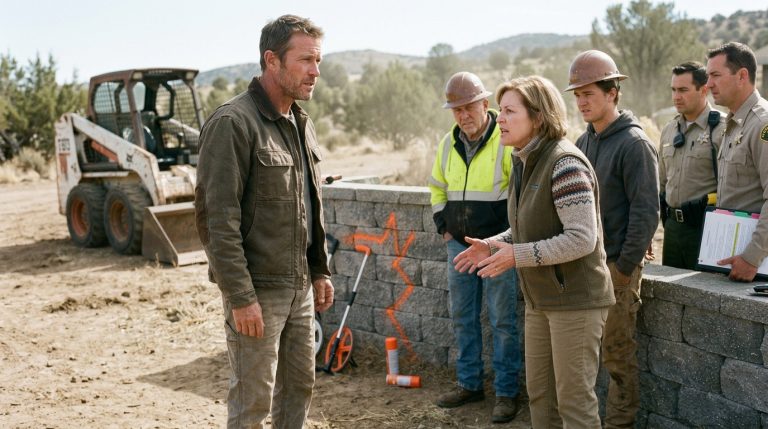
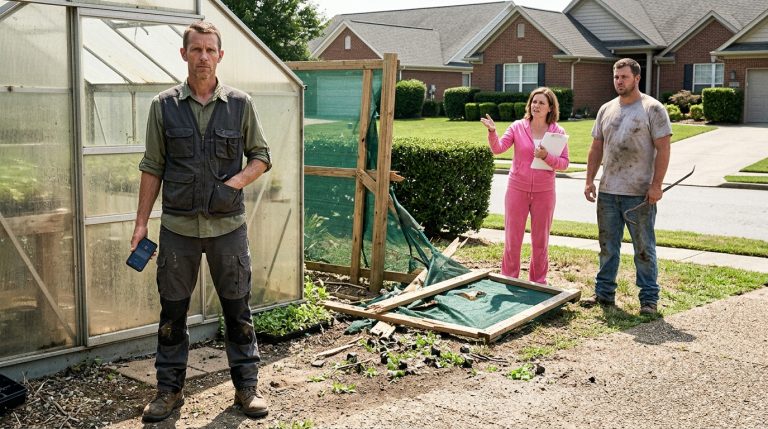
Two men, dressed in the high-visibility neon that always seems to turn the natural world into a construction site, were punching orange plastic stakes into the upper grade of my land—exactly where my patio line was designated to sit. A flatbed truck was parked awkwardly on the shoulder, its deck laden with bundles of chain-link fencing.
Karen stood off to the side, leaning against the hood of her SUV. She was wearing a cream-colored jacket that looked unnervingly pristine against the dusty, sun-bleached slope. She held a rolled-up set of site plans like a baton, pointing uphill with an air of practiced authority. She wasn’t holding a shovel or a hammer; she was holding the narrative.
I walked toward them, the mud of the incline clinging to my boots. I stopped ten feet from the nearest tech, a man whose forehead was beaded with sweat. I didn’t look at Karen. Not yet.
“What exactly are you doing on my land?” I asked. My voice sounded thin in the open air, but steady.
The tech glanced over his shoulder at Karen before looking at me. His hesitation was a clear signal—the chain of command was external, and it didn’t include the property owner. He shifted his weight, his boots sliding slightly on the loose dirt. “We’re staking the view buffer,” he muttered, his eyes darting back to his clipboard.
“The what?” I stepped closer.
He tapped his clipboard. “Hermes Holloway’s HOA scenic committee instruction.”
There it was. The phrase was clean, professional, and entirely fictitious. I felt a surge of cold, analytical clarity. I reached into my jacket pocket and triggered the recorder on my phone, keeping the device tucked away but active. I needed the audio, the specific admission of their intent.
Karen stepped forward then, the gravel crunching under her heels. She adjusted her sunglasses, her expression one of polite, almost condescending, concern. “You were notified that your current placement is incompatible with established sightlines,” she said, her voice smooth and well-rehearsed. “We’re simply demarcating the area that requires mitigation.”
I looked at the orange stakes—vivid, neon scars on the hillside—then back at her. “You don’t get to invent a buffer on my parcel, Karen. You don’t have the legal standing, and you certainly don’t have my permission.”
She folded her arms, her chin lifting in a defiant, practiced arc. “That’s not your decision to make. The committee has determined that your footprint infringes on the community’s visual corridor.”
“It’s my land,” I repeated, my tone dropping an octave. The wind picked up, a sudden, gusty shift that whipped a cloud of dust between us, forcing me to blink. It was a minor, annoying detour, a butterfly effect of weather that reminded me of the fragility of the entire scene. I stood my ground, ignoring the grit in my eyes. “And this is trespassing.”
I pulled out my phone, not to record this time, but to capture the visual evidence. I photographed the truck plates, the contractor’s name printed on the door, and the precise placement of the stakes in relation to my surveyed markers. Karen watched me with a tight, unblinking focus, but she didn’t move. She thought the optics were on her side. She thought the sight of workers performing a ‘civic duty’ would intimidate me.
She didn’t understand the difference between a project and a record. I wasn’t there to win a shouting match; I was there to curate a crime scene.
“I’m calling the sheriff,” I said, already dialing the non-emergency line. “And I’m going to make sure every person involved in this—every contractor, every tech, and you—is held individually liable for the damage to this soil.”
For the first time, Karen’s facade faltered. Just a flicker of uncertainty behind the sunglasses. She realized then that I wasn’t going to be ‘mitigated.’ I walked back to my truck, the engine still idling, and waited for the deputy.
As I sat in the cab, watching them work with a frantic, sudden haste—trying to finish the staking before the law arrived—I realized that their speed was their greatest weakness. They were rushing because they knew they were wrong. And in the silence of the ridge, I began to draft the formal trespass notice in my mind, a document that would carry the weight of this day long after the stakes were pulled.
CHAPTER 4: THE FALSE FILING
The deputy’s cruiser idled at the base of the ridge, the strobe of his light bar pulsing rhythmically against the dry earth, casting long, frantic shadows that seemed to dance in time with my own racing pulse. I stood by the hood of my truck, watching the deputy take statements from the subcontractors while Karen paced near the edge of the survey line, her phone pressed to her ear. She was still trying to negotiate a reality that no longer existed.
I didn’t engage. I pulled my laptop from the passenger seat, the screen’s backlight feeling stark and blinding against the fading daylight. I opened the digital filing the HOA had submitted to the county—the “Scenic Impact Memo.” It was a sprawling, dense document filled with architectural jargon designed to obfuscate rather than inform.
I started at the file properties. The creation date was the first thing I checked, and my breath hitched. The document had been generated four days after my permits were officially stamped and cleared. I dug deeper, opening the revision history embedded in the PDF’s hidden layers. My eyes scanned the lines of code and timestamped edits. Karen’s personal laptop—labeled ‘K-HOME-OFFICE’—was the primary author. She had been building this case for weeks, meticulously refining the language to mirror official county code, all while pretending it was a spontaneous concern arising from recent construction activity.
“They’re going to try to argue this as a technical amendment,” Sarah’s voice came over the speakerphone, sharp and hurried. She had spent the last two hours tearing through the HOA’s bylaws. “But they don’t have the vote, and they don’t have the timeline. You have to lock this down. If they realize you’ve seen the metadata, they’ll purge the server.”
I didn’t answer. I was too focused on the screen, the cursor blinking like a heartbeat. I exported the file, created three separate hash-verified copies, and uploaded them to an encrypted off-site cloud. I was no longer just a builder; I was a digital archivist of her deception.
The deputy walked over, his boots crunching in the dirt. He was a middle-aged man with a tired, pragmatic expression. “We’ve got the incident report logged,” he said, handing me a small, yellow slip of paper. “But you need to understand, this is a civil matter. If they come back, you call us again, and we’ll cite them for criminal trespass. But you need to keep your records tight.”
“I have everything,” I said, my voice sounding more certain than I felt.
“Good,” he said, looking at the orange stakes still punched into my grade. “Because people like that? They don’t usually quit because they’re caught. They quit when they run out of ways to lie.”
As the cruiser pulled away, the ridge fell into a heavy, suffocating silence. Karen was still on her phone, her back turned to me, her shoulders stiff with a frantic, unyielding intensity. She wasn’t looking at the view anymore; she was staring at the ground, her boots planted firmly on the dirt she was so desperate to control.
I walked toward the stakes. I didn’t pull them out—not yet. I wanted to see if she would have the gall to leave them there overnight. I knelt by the primary marker, the one defining the patio’s corner, and touched the orange plastic. It was cold, unnervingly smooth, a synthetic intrusion into the landscape.
I looked down into the valley. From this vantage point, the subdivision looked like a sprawling, meticulously ordered organism, every roofline and cul-de-sac planned with a chilling, artificial precision. It occurred to me then that Karen wasn’t just trying to stop my build because of a view. The documents I had uncovered in the planning office, the pavillion, the pergolas, the ‘visual corridors’ that only seemed to apply to others—it was a pattern. She was carving out a monopoly on the horizon.
My phone buzzed. A new notification from the permit portal: a fresh complaint, filed by an anonymous user from an internal subdivision IP address. They weren’t waiting for the court. They were attacking in real-time, hoping to force a delay that would drain my resources before I could present the metadata to the judge.
I stood up, the wind biting at my skin. My hands were shaking, not from fear, but from the sudden, sharp clarity of the stakes. I reached into my pocket, pulled out a small, steel-tipped pen, and began to scratch a mark onto the orange plastic, a personal record of where they stood. I knew, with a grim, calculating certainty, that tomorrow would bring a new, more aggressive escalation. The civil war for the ridge had moved past the point of dialogue. It was now a battle of records, and I was holding all the cards.
CHAPTER 5: THE COURTROOM CLIMAX
The courtroom was fuller than I had anticipated. The air inside felt thin, filtered through industrial vents, and it carried the sharp, sterile scent of floor wax and old paper. Karen sat at the plaintiff’s table, her spine rigid, flanked by two “sympathetic” homeowners who looked more like props than witnesses. They were there to perform the role of the aggrieved community, their faces composed in masks of polite, practiced concern.
My attorney, Sarah, set a heavy binder on the laminate surface. It was a dense, physical manifestation of everything we had excavated over the last few weeks: the permit logs, the site surveys, the notarized statements, and the irrefutable metadata of Karen’s own fabrications.
The judge entered. He didn’t waste time on pleasantries. He took his seat, his gaze sweeping the room with a lethargic, discerning precision. He looked at Karen, then at me, and finally at the mountain of evidence between us.
Karen’s lawyer stood. He was a man of expensive suits and expensive pauses. He began with a narrative that felt scripted, a rehearsed monologue about ‘community heritage’ and ‘reasonable expectations’ of a view. He spoke the words ‘visual injury’ and ‘material occupation’ as if they were established laws of physics rather than manufactured grievances. He was trying to pivot the court’s attention from the facts of property boundaries to the subjective realm of taste and ‘community standards.’
I watched him, my breath shallow. Beside me, Sarah didn’t fidget. She was waiting for the perfect, calculated moment to dismantle the performance.
The judge cut the lawyer off mid-sentence. “Counsel, are you asking this court to recognize property ownership over what your clients happen to see from their patio furniture?”
A ripple of nervous energy moved through the room. Karen’s posture didn’t change, but her hand, resting on the table, gripped the edge until her knuckles turned white.
“Your Honor,” her lawyer tried, his voice tightening, “the structure fundamentally alters the established visual character of—”
“That,” the judge said, the word cutting through the courtroom like a razor, “is not a property interest. That is disappointment dressed up as doctrine.”
He laughed—a single, sharp, and entirely dismissive sound. It wasn’t cruel, but it was absolute. It was the sound of a man who had heard a thousand versions of the same story and found this one particularly exhausting.
Sarah stood. She didn’t use theater. She didn’t need to. She called the sheriff’s deputy first. He provided the incident log, the photographs of the false staking, and the statement about Karen’s attempt to claim a stop order that had never been issued. She followed with the county survey supervisor, who methodically decimated the HOA’s reliance on the inactive scenic sheet.
When the builder took the stand, he was brief and devastating. He described the roadside encounter, the staged protest, and the deliberate misrepresentation Karen had employed to create the appearance of a legal stoppage.
Then came the final move. Sarah didn’t speak. She simply displayed the email on the courtroom’s overhead screen.
Use the older one for field purposes. We just need enough to pause him.
The courtroom went still. The silence was heavy, almost suffocating. My eyes flickered to Karen. For the first time, the mask of the ‘concerned neighbor’ dissolved, replaced by a jagged, raw look of fury and dawning realization. She wasn’t just losing; she was being exposed in real-time, her tactical maneuvers turned into evidence of her own malice.
Her lawyer scrambled to object, but it was performative. The foundation had been laid, and the evidence was authenticated. Sarah turned the page and pulled up the permit dashboard access logs, showing the precise timestamps where Karen had breached my private review credentials.
The judge looked at the screen, then at the access logs, then at Karen. The shift was seismic. He denied the injunction from the bench, his voice flat and devoid of interest. He went further, laying out a list of prohibitions that stripped Karen of every tactical advantage she had cultivated: no further contact with my lender or inspectors, no more staking, no more claims of authority where none existed.
He scheduled the sanctions briefing, his tone making it clear that if this behavior repeated, the court’s patience would reach its limit.
I looked at the judge, then back at Karen. She was staring at the floor, her face an unreadable, hardened mask. She looked smaller than she had in the morning, the cream jacket looking like a costume from a play that had just been shut down. I didn’t feel a rush of triumph. I didn’t feel the need to speak. I felt only a profound, hollow exhaustion. The reality of the law had finally caught up to the fiction she had been trying to build. I stood up, the chair scraping sharply against the floor, and began to pack my bag. The document, the binder, the digital footprint—it was all done. The silence I had fought for was finally within reach.
CHAPTER 6: THE FINAL SETTLEMENT
The courtroom doors hissed shut behind me, isolating me in the hallway’s echoing quiet. I walked to the entrance, the late-afternoon sun cutting through the lobby’s high windows in sharp, dusty shafts of light. My boots felt heavy, anchored by the weight of the last three months. I pushed out into the parking lot, the asphalt cooling under the coming twilight. Karen was already there, standing by her SUV. She wasn’t looking at me. She was looking at the horizon, her silhouette small and strangely diminished against the sprawling, manicured backdrop of the valley she had tried so hard to rule.
She didn’t speak as I passed. She didn’t have to. The defeat was written in the way she kept her hands buried deep in her coat pockets, as if guarding against the encroaching cold. I didn’t stop. I walked to my truck, the metal door handle cool and solid beneath my palm. The fight was over, but the resolution didn’t feel like a celebration; it felt like a clearing of debris.
The weeks that followed were defined by a systematic, almost ritualistic dissolution of the conflict. The HOA withdrew the nuisance claim, their board members—many of whom had grown weary of Karen’s crusade—issuing written corrections to my lender and contractor. The county records were scrubbed clean. The fake overlap, the manufactured scenic easement, the digital ghosts of her ambition—all of it was filed away, rendered inert by the court’s order.
The payoff came in installments. The court shifted a significant portion of my legal fees to her personal liability, a direct, mathematical penalty for the arrogance of the false filings. Karen was removed from her committee role before the next hearing even appeared on the docket.
I returned to the ridge alone. The house was finished, a silent, angular monument to the months I’d spent documenting the encroaching noise. I stood on the deck, the wood grain rough and warm under my fingertips. The view to the west was exactly as it had been from the start: expansive, indifferent, and entirely my own.
I heard the crunch of gravel and turned to see my builder pulling up, a cooler in the bed of his truck. He didn’t say a word as he stepped onto the deck, simply handed me a cold bottle and leaned against the railing. We stood there for a long time, watching the light bleed out of the sky, the valley below becoming a sea of artificial, twinkling lights. We didn’t talk about the litigation. We didn’t talk about the stakes or the emails or the court sessions. We talked about the framing, the way the roofline met the slope, the structural integrity of the west glass. It was the conversation we had promised ourselves months ago, finally earned.
A week later, I held a small gathering. My attorney came by for twenty minutes, her presence a crisp, professional contrast to the easy atmosphere. She stood by the rail, looking out at the skyline with a faint, wry smile. “For the record,” she said, her voice low, “that was one of the most absurd cases I’ve ever had the pleasure of winning.”
She left, and I was back to the quiet. I spent the afternoon repairing the section of the deck railing that had been marred during the staking incident. I took my time, sanding the wood until it was smooth, staining it to match the surrounding boards. It was a small, tactile act of restoration. As the sun dipped behind the mountain, casting long, dark shadows across the property, I felt the final, definitive weight of the situation lift.
I didn’t need Karen ruined. I didn’t need an apology. I needed the record set straight, the title trail cleared, and the legal precedent established so that the next time someone decided they owned a view that didn’t belong to them, they would remember the cost of the last attempt. I sat on the repaired bench, the wood grain solid, and took a deep, steady breath of the cool, mountain air. The silence was absolute. It was mine, and it was earned. The boundary was marked, the law was settled, and for the first time in a long time, I was simply home.