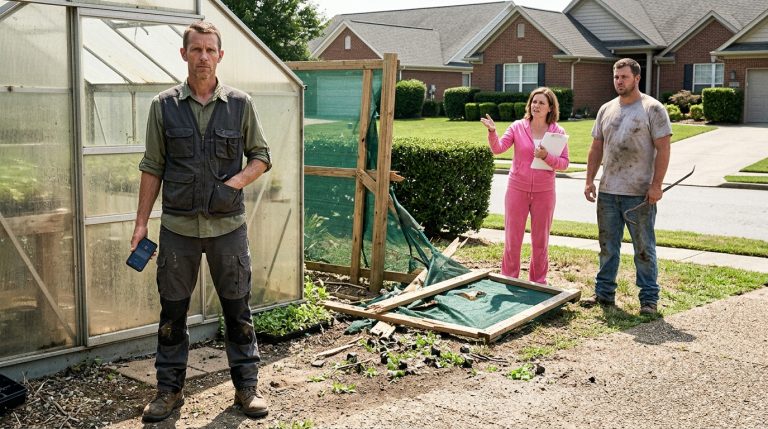
The Architect of Silence: A Calculated Dismantling of Suburban Tyranny and the Weight of Concrete
CHAPTER 1: The Geometry of a Scar
The slab sat on my pasture like a fresh bruise on clean skin. Ten feet by ten feet of poured, industrial concrete, completely alien to the five acres of oak and rolling grass I had curated for the last three years. It was an aesthetic tumor, but my attention wasn’t on the ugliness of it. My focus was purely physical: the texture of the edges, the depth of the pour, the way the sunlight hit the wet, uncured surface.
I stood five feet away, my boots planted firmly on my own land. I felt the familiar, detached cool of the desert creeping into my chest—the same sensation that used to silence my pulse before a patrol in Ramadi. There was no room for the jagged, hot pulse of anger. Anger was a variable that corrupted data. I needed to be a machine.
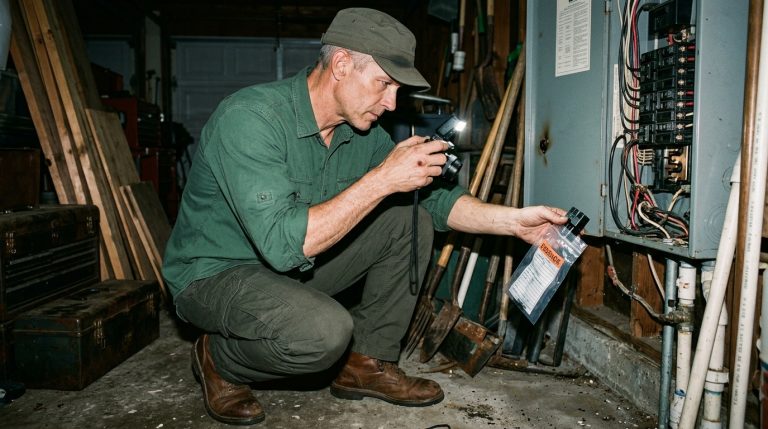
I took the first photo. The lens clicked, a sharp, metallic sound that seemed deafening in the stillness of the morning. I moved three steps to the left and captured the proximity to my fence line. I didn’t need to look over my shoulder to know she was watching; I could feel the invisible tether of her gaze from the edge of her manicured subdivision. Karen Johnson was likely standing in her kitchen, waiting for me to scream, waiting for the performance of a man losing his mind.
She was going to be disappointed.
I knelt, ignoring the dampness seeping into my denim, and zoomed in on the spilled concrete near the fence. There, perfectly preserved in the hardening gray paste, was the tread pattern of a woman’s sneaker. It wasn’t a construction boot. It was too light, too patterned for heavy labor. It was a footprint left by someone who had no business being here, someone who had stood over this spot and watched the wet concrete bury my well.
My eyes traveled upward, tracing the trajectory of the cable that fed my security camera. It had been snipped, not torn. The cut was clean, precise—a professional’s handiwork, or at least someone who knew exactly where to apply pressure to blind a system.
I stood up, the movement fluid and calculated. The evidence was aggregating. The unauthorized entry, the calculated vandalism, the deliberate disabling of my security. I wasn’t looking at a neighborhood dispute anymore. I was looking at a felony charge being assembled in real-time.
A shadow moved at the edge of the property line—a flash of floral print. She was there, closer now, her posture stiff with the kind of pride that precedes a long, agonizing fall. I didn’t acknowledge her. I didn’t look up. I just adjusted the focus on my camera and framed the footprint again. I was no longer a civilian in a property disagreement. I was a structural engineer identifying the load-bearing stress points of a house of cards. And I had all day to watch it fall.
CHAPTER 2: The Ghost in the Treads
The sneaker tread in the concrete was more than just a footprint; it was a signature. A size seven, likely a woman’s, with a distinct wear pattern on the heel that suggested a slight pronation. My eyes didn’t just see the indentation—they dismantled it. In the military, you learned to read ground like braille. A footprint is a message, a narrative of intent, a marker of where a body has been and, more importantly, the speed at which it was moving.
As I stared at the faint, rounded depression, the sharp, acidic scent of the curing concrete triggered a sensory flicker—a synaptic misfire that pulled me out of the humid morning and back to a sun-baked patrol route outside Ramadi. I was suddenly standing over a disturbed patch of sand, a rigged wire glinting under the heat, the air heavy with the same chemical tang of dust and danger. That time, the mistake hadn’t been mine, but the cost had been calculated in blood. Here, the scale was smaller, but the mechanics of the ambush were identical. The hidden camera cable, the calculated timing, the exploitation of an absence—it was the work of someone who viewed the world as a theater of tactical maneuvers.
I realized then that my initial reaction—the cold, clinical calm—wasn’t just a trait; it was a defense mechanism. I was fighting the same invisible war, just in a different uniform.
I stood up, the joints in my knees protesting, and walked toward the fence line. My boots crunched against the gravel, the sound amplified by the sudden, heavy silence of the neighborhood. The morning was perfectly still. No birds, no distant lawnmowers, just the oppressive, beige quiet of Whispering Pines. I traced the perimeter of the slab with my eyes, looking for any other anomalies.
There, near the eastern edge, I saw it: a small, irregular gouge in the dirt where the concrete had been poured over the grass. It wasn’t just a slip of the trowel. It looked like someone had dropped a tool—a heavy, metal object—and tried to hurriedly cover it with a shovel. I crouched, pulling a small pocketknife from my work pants. With the tip of the blade, I carefully flicked away a layer of loose soil.
A metallic glint caught the light. I brushed aside more dirt, revealing a small, brass-plated turnbuckle, the kind used for tensioning wire fencing. It didn’t belong to my property. My fencing was solid, high-tensile steel, well-maintained and nowhere near the end of its life. This was a piece of cheap, retail-grade hardware.
My tactical mind raced. Why was a fence tensioner here? It suggested that the “contractor” wasn’t just pouring concrete; they were bracing something. Or perhaps, they were measuring. The realization hit me with the force of a physical blow: Karen hadn’t just come to cover the well; she had been preparing the ground for something else, something she needed to anchor against my own property line.
I stood, my pulse steadying into a rhythmic, efficient thrum. I didn’t reach for my phone to call the authorities. Not yet. Documentation was the first step, but intelligence was the second. I needed to see what she was planning to attach to that fence. I looked back toward the subdivision, specifically toward 112 Magnolia Circle. The house was immaculate, a sterile, towering monument to her influence. But now, in my eyes, it was just a target.
I walked back to my truck and pulled a small, high-definition camera from the glove box—a backup unit I kept for field surveys. I didn’t set it on a tripod where it could be seen. I climbed the oak tree near the corner of my property, a vantage point that offered a clear, obscured view of the entire well site and the back entry to her property. I mounted the camera, disguised it with a cluster of foliage, and wired it into a small, solar-powered battery pack I’d kept in my kit.
From this height, the perspective shifted. The slab of concrete didn’t look like a monument anymore; it looked like a foundation stone for a larger structure. If she had used a turnbuckle, she was planning to pull something taut, likely a temporary barrier or a privacy screen meant to block my access to the well entirely.
She was going to come back. She would want to see her “project” completed. And when she did, she wouldn’t be walking into a victory; she would be walking into a carefully monitored observation post.
I climbed down, my hands calloused and steady. I didn’t head inside to cool off or drink coffee. I went to my office, the room where I kept the HOA folder. I pulled it out, but instead of filing the latest violation notice, I opened a blank legal pad. I began to map out a grid of the subdivision, marking every point where her influence touched my land. I was done reacting.
The war wasn’t in her hands. It was in my data. And I had just begun the process of turning her own actions into the weapon that would dismantle her. I checked my watch. 8:15 AM. The morning was young, and my plan was just beginning to harden, much like the concrete she had so foolishly laid. I was the architect now, and I was going to design her downfall with the same precision I had once used to build bridges that stood for generations.
CHAPTER 3: The Call to Dave
The list on my legal pad was a skeletal map of her vulnerability. I had the photographic evidence, the timeline, and the snip-point on the camera cable, but I was missing the one link that would move this from “unhinged neighbor dispute” to “criminal liability.” I needed a point of origin. I needed the authorization.
My phone sat on the desk like a dormant grenade. I knew the name of the company—A1 Concrete—and I knew the owner was a man named Dave. I reached for the handset, my fingers tracing the edge of the desk. There was no hesitation, only the cold, mechanical necessity of the next move. I dialed, keeping my voice stripped of emotion, the tone neutral and flat.
“A1 Concrete. How can I help you?”
“This is Mark Davies. I’m calling about the 10×10 slab poured on my property this past Saturday.”
There was a silence on the other end, the kind of hesitation that signaled immediate recognition. “Look, Mr. Davies, I—”
“I’m not looking for an apology, Dave,” I cut him off, keeping the tempo steady. “I’m looking for the work order. My property was trespassed upon, a well was compromised, and my security system was disabled. I’m currently documenting everything for a multi-count lawsuit. I’d rather not include your company as a co-defendant, but that depends entirely on the transparency of your records regarding this specific job.”
The silence stretched, filled only by the faint, distorted sound of a cement mixer idling in the background of his shop. He knew the risk. He knew the legal weight of property destruction.
“I need the authorization,” I pressed. “Who signed for the pour? Who provided the project specs? I have a clear, high-resolution photo of the work site, including tire tracks and a footprint in the concrete that matches the site visit timing. If this goes to a police report, that footprint becomes forensic evidence.”
“She told us it was community property,” Dave’s voice was lower now, defensive but crumbling. “She had the HOA letterhead. She insisted the well was a hazard to the neighborhood. My crew thought they were doing a service, not a crime. They were told it was a beautification project sanctioned by the board.”
“She lied to you, Dave. And now she’s made your company an accessory to a felony. I need the signed work order. I need the name on the invoice and the method of payment. You send that to me, and you’re a witness, not a target. You hold it back, and you’re the one explaining to a judge why your company vandalizes private property.”
“I… I’ll have to pull the file,” he stammered.
“Pull it now. Send it to the email I’m about to provide. You have one hour before I contact the sheriff’s deputy assigned to this jurisdiction. Don’t make me wait.”
I hung up, the sharp click of the phone echoing in the quiet office. I leaned back, looking out the window at the construction site across the lawn.
The sound of a heavy diesel engine rumbled to life, vibrating through the floorboards. I stood up and walked to the window. A white flatbed truck with the A1 Concrete logo emblazoned in peeling red vinyl was pulling into my driveway. Two men in neon-yellow safety vests were standing on the bed, looking confused. They hadn’t come to remove the concrete; they had come to finish the edges.
This was the butterfly detour. I hadn’t expected them back so soon.
I grabbed my camera, checked the battery, and stepped out onto the porch. The air was cool, the sharp, biting morning breeze cutting through my light jacket. I walked down the gravel path, my pace measured. The driver, a middle-aged man with a graying beard, jumped down from the cab.
“Hey, we’re here to clean up the edges on that slab,” he called out, his voice hesitant. “Boss said we were authorized.”
I didn’t stop. I kept walking until I was ten feet away, my posture open but imposing. “You’re on private property, and you’re here to finish a job that was built on a crime scene.”
The man blinked, looking at his partner. “We just follow the orders, man. We don’t know anything about crime scenes.”
“You do now.” I raised the camera, capturing their faces, the license plate, and the company logo in a single, fluid motion. “I’ve already spoken to Dave. You’re not touching that slab. If you step one foot on that concrete, I am calling the sheriff, and you will be arrested for trespassing and destruction of property. You want to save your company? Get back in the truck and drive away.”
The driver looked at the slab, then at me. He saw the cold, unyielding resolve in my eyes—a look that didn’t negotiate, didn’t threaten, but simply stated facts. He climbed back into the cab without another word. The truck backed out, tires spinning gravel, and disappeared back toward the subdivision.
I watched them go, the dust settling slowly in the light. The intervention had been unplanned, but it had yielded a vital piece of leverage: the realization that the company was already running scared. My next move was clear. The work order would be in my inbox within the hour, and then, I would have the evidence I needed to start the real dismantling.
CHAPTER 4: The Records Room
I didn’t head back inside. The idling truck had left a haze of exhaust hanging over the gravel, a foul, chemical scent that clung to my jacket. I left the porch, my boots finding the firm rhythm of the driveway, and climbed into my truck. The objective was the county records office. If I was going to dismantle the foundation of Karen’s authority, I needed to know exactly what that authority was tethered to.
The drive was quiet. I didn’t turn on the radio. I used the time to recalibrate. My mind was a system of gears, meshing the events of the last few days into a coherent threat vector. Karen thought she was playing with a homeowner; she didn’t realize she was dealing with a man who had spent two decades assessing the structural integrity of environments designed to collapse.
The records office was a cavern of fluorescent lights and the pervasive, dry smell of decaying paper. It was a place where time didn’t move; it accumulated in stacks of gray binders and microfiche reels. I approached the counter, my presence—boots, work clothes, the lingering scent of sawdust and outdoor air—a stark contrast to the sterile, climate-controlled office.
“I need the master utility schematics for the Whispering Pines development,” I said, my voice cutting through the hum of the overhead lights. “Original zoning, late seventies. Specifically, the phase one drainage and water infrastructure.”
The clerk, a woman whose skin had the texture of the vellum she handled, gave me a look that hovered between bored and suspicious. “That’s archived in the deep storage. It’ll take some time.”
“I have the time.”
I waited for forty minutes in a hard-backed chair, watching the clock move with agonizing, mechanical precision. When she finally returned, she dropped a heavy, dust-covered binder onto the table. It was thick, bound in cracked black plastic, the edges of the pages yellowed and brittle.
I opened it slowly. The blueprints were sprawling, complex maps of a world that didn’t exist anymore. I didn’t care about the lot lines or the road widths. I went straight to the utility layer. I traced the blue lines—water, sewage, fire suppression—across the grid of the subdivision. My finger followed the line that fed Magnolia Circle, the street where Karen lived.
It didn’t go to the municipal main. It veered off, crossing the boundary of the original farm—my land—and terminating at the site of the old agricultural well.
I leaned closer, the smell of dust stinging my nose. There was a handwritten note in the margin of the original utility plan, initialed by a county engineer from 1979. It was a contingency clause. Because of the elevation and the length of the line, the municipal water pressure was insufficient for fire code standards. This well wasn’t just an “industrial eyesore” in Karen’s delusional worldview; it was the secondary pressure pump for the entire street’s fire suppression system.
The physical reality of the situation solidified in my mind. Karen hadn’t just vandalized my property. She had effectively severed the fire protection for her own street to punish a neighbor.
I reached into my bag and pulled out my scanner. I digitized the page, the green light of the sensor moving rhythmically over the ink-and-vellum diagram. I was looking for more, and that’s when I noticed the discrepancy. Tucked into the back of the folder was a secondary set of drawings, dated three years after the initial development. They were marked REVISION, but they had never been officially filed with the fire department’s final sign-off.
The revision showed a proposed bypass, a new line that would have connected the hydrants to the city grid directly, removing the need for the well entirely. But the line was never drawn in solid ink. It was sketched in pencil.
I stared at the unfinished drawing. The bypass was never built. The county had approved the development based on the well-as-a-pump contingency, and the developer—likely seeking to cut costs—had simply abandoned the upgrade. For forty years, that entire street had been relying on a well that didn’t belong to them, a well that was legally mine, and a system that was fundamentally broken if the well ever failed.
The “mystery” of the well wasn’t just that she hated it. The mystery was that she didn’t know she was dependent on it.
I closed the binder, my heart rate steady, my mind processing the implications. I had the smoking gun. Karen was a tyrant whose kingdom was literally dying of thirst, and she had just cut off the life-support system. I didn’t need to yell. I didn’t need to force a confrontation. I just needed to show the fire marshal the math.
I walked out of the records office into the bright, blinding afternoon sun. The air felt cleaner now, stripped of the mystery that had been gnawing at the edges of my focus. I wasn’t just a homeowner fighting an HOA; I was a man holding the kill switch for an entire neighborhood’s illusion of security. I started my truck, the engine turning over with a reliable, heavy growl. The game was no longer being played on her terms. She had set the board, but I was the one who had read the blueprints.
CHAPTER 5: The PreMeeting Strategy
The Whispering Pines Clubhouse was an exercise in artificial harmony. The walls were painted a color the brochure called “Soft Sand,” a shade of beige that seemed designed to drain the urgency out of anyone who entered. Tonight, however, the room felt different. The air was charged with a brittle, synthetic tension, the kind that precedes a storm.
I checked my pocket. The thumb drive was there. It contained the scanned schematics, the work order signed by Karen, and the photographic evidence of the trespass. It wasn’t just a collection of files; it was a structural demolition charge.
I walked into the foyer, my boots echoing on the polished hardwood. The lobby was already filling with residents. I saw faces I recognized from my perimeter checks—the retired dentist, Dr. Albright, hovering near the coffee station with an expression of performative anxiety; George, the retiree who’d tipped me off, standing near the back, his posture guarded.
Karen Johnson was nowhere to be seen, but her presence was everywhere. It was in the way people whispered in clusters, the way they checked their watches with nervous, synchronized ticks. They were the subjects of her kingdom, gathered for the evening’s performance.
I found a seat in the back row, near the light switch and the projector power outlet. I kept my bag on the floor, the weight of the projector against my shin a grounding comfort. I didn’t engage. I didn’t nod or make eye contact. I watched. My eyes scanned the room, identifying the stress points: the board members near the podium, the agitators in the front row, the undecided majority in the center.
The door to the back office swung open. Karen emerged. She was wearing a red power blazer that looked like a uniform of command. She moved through the room with a deliberate, studied grace, stopping to touch a shoulder here, offer a tight, practiced smile there. She was building momentum, channeling the room’s collective anxiety into a singular, directed focus: me.
For a moment, as she turned to scan the room, our eyes locked. Her gaze was sharp, probing, looking for a sign of hesitation or doubt. I didn’t look away, but I didn’t challenge her either. I offered her nothing. I kept my expression a neutral, impenetrable mask. The flicker of confusion that crossed her face was barely a shadow, but I caught it. She was expecting a man who would fight with volume or emotion. She didn’t know she was looking at a man who was counting the seconds until her own logic consumed her.
My perception began to fray at the edges. The room seemed to tilt slightly, the fluorescent lights buzzing with an intensity that made my teeth ache. I looked at the crowd again, and for a fleeting, disorienting moment, they looked less like neighbors and more like a tactical formation. Was the man in the third row watching me, or was he just checking the time? Was the woman near the podium smiling at me, or was she part of the setup?
I blinked, forcing the sensation back. It was the adrenaline. It was the tactical fatigue of an engineer who had been awake for too long, staring at lines that didn’t connect. I took a deep, steadying breath. System check: Peripheral vision clear. Targets identified. Objective locked.
The room grew quiet. Karen stepped up to the podium, her hands smoothing the notes in front of her. She looked out over the crowd, a queen presiding over her court.
“Thank you all for being here tonight,” she began, her voice a smooth, calculated veneer. “It’s rare that we have to call a special session, but as you know, our community is currently facing a threat to our peaceful way of life.”
I didn’t move. I didn’t reach for my bag. I just sat there, listening, letting her build the scaffolding of her own trap. She was talking about “security,” “standards,” and “defending our values.” She was setting the stage for an exile.
She turned her head, her eyes finding mine in the back of the room. A flash of triumph touched her lips. She didn’t know that she wasn’t the one setting the stage. She was just the actor who had been given the wrong script.
I felt the projector cord against my leg. It was time. I stood up, slowly, deliberately, and walked toward the side of the room. The murmurs died down as people noticed the man in the work boots moving toward the power outlet. Karen’s smile faltered for a fraction of a second, her hands gripping the edges of the podium a little too tightly. She was starting to realize that the atmosphere in the room had shifted, and that the silence she had cultivated was no longer hers to control. It belonged to the facts, and the facts were about to be displayed in high definition.
CHAPTER 6: The Show Trial
I didn’t rush. The walk from the power outlet to the projector felt like moving through water, each step deliberate, calculated. The room was deathly quiet. Karen stood frozen at the podium, her knuckles white against the wood. She had built her narrative on the assumption that I would be an unguided projectile, a man fueled by impulsive rage. She was currently processing the fact that I was, instead, a precision instrument.
I keyed the remote, and the first slide hit the white wall behind her: the survey map. The red line of my property boundary cut across the room like a surgical incision.
“For those of you who may be confused,” I said, my voice steady, stripped of the oratorical flourishes Karen had used so effectively. “My name is Mark Davies. This is a map of my property. The area in white is my land. The area in beige is Whispering Pines. The red line marks the boundary. I am not a member of your association, and your covenants have no legal authority here.”
A ripple of low conversation moved through the room—a sound of shifting gears. Karen stepped away from the podium, her face flushing a mottled, angry red. “This is not on the agenda! You have no right to hijack this meeting!”
I didn’t answer her. I didn’t even look at her. I clicked the remote. The image of the concrete slab—my well, entombed in gray, brutalist ugliness—filled the wall behind her. The room gasped. It was a visceral, honest reaction. People looked from the screen to Karen, and for the first time, they weren’t seeing their leader. They were seeing a vandal.
“This,” I continued, my voice calm, “is the ‘safety measure’ the president undertook. It is not an eyesore. It is a functional water well on private property. She hired a contractor, waited until I was out of town, and had them trespass to pour three cubic yards of concrete over my well.”
“It was a hazard!” Karen shouted, her voice losing its composed, melodic veneer. “It was an unapproved, dangerous structure!”
I clicked the remote. The scan of the A1 Concrete work order appeared, the text sharp and clear against the wall. The camera zoomed in on the signature: Karen Johnson.
“This is the work order,” I said, ignoring her outburst. “It was not authorized by the board. It was signed by one person. And this,” I clicked again, the invoice appearing on the wall, “is the charge for three thousand dollars. Paid for by the Whispering Pines Homeowners Association.”
The silence in the room was now absolute, pressurized. The dentist, Dr. Albright, stood up in the third row, his face drained of color. “Karen? You used community funds for this? Without a vote?”
“I had the authority!” she stammered, turning to face him, her panic visible. “The bylaws state—”
“The bylaws do not authorize felony vandalism,” I interrupted, the quiet authority of my tone silencing her instantly. I clicked the final slide: the twelve-thousand-dollar repair estimate from the well-drilling company.
“This isn’t about me. This is about the abuse of your trust and the misuse of your money. My lawsuit is not against this community. It is against the individual who decided she was above the law.”
I felt the psychological phantom hit me then—a sudden, dizzying memory of a support beam buckling in the desert heat, the terrifying realization that the structure you were standing on was never as solid as you thought. The room felt like that—a buckling structure. I forced myself to focus on the cold, hard facts. If the structure was going to collapse, I needed to make sure it fell in the right direction.
Karen looked at the crowd, searching for a single sympathetic face, but found only cold, judgmental stares. The “Soft Sand” beige of the room felt like it was closing in on her. She had come here to stage a show trial, to secure her power through the public shaming of an outsider. Instead, she had provided the theater for her own indictment.
She turned back to the podium, her hands shaking so violently she had to grip the sides to remain standing. She looked small, diminished, the red blazer now just a costume that didn’t fit. I stood by the projector, the beam of light cutting across the room, illuminating the dust motes and the wreckage of her authority.
I didn’t need to say another word. The room was already doing the work for me. The questions began to rise—a low, angry murmur that grew in intensity with every passing second. Where did the money go? Who authorized the contractor? Why didn’t we know about the lawsuit?
She was no longer the prosecutor. She was the defendant, and the jury was already reaching its verdict. I turned off the projector, the room plunging back into the dim, artificial light of the clubhouse. The show was over, but the consequence, I knew, was only just beginning.
CHAPTER 7: The Fire Marshalls Arrival
The clubhouse doors swung shut behind me with a final, heavy thud, sealing in the chaos I had just unleashed. I stepped into the morning light, my pulse maintaining the steady, disciplined cadence I had practiced for years. The street was already awake. The rumble of the fire engine, its red paint gleaming like a fresh wound in the suburban beige, was the harbinger of a reality Karen couldn’t talk or bully her way out of.
Chief Miller climbed out of the driver’s side of his SUV. He was exactly the kind of man I had expected—shoulders like granite, a face that looked like it had been worn smooth by decades of procedure and no-nonsense command. He didn’t offer a greeting. He looked at the fire truck, then at the line of hydrants stretching down Magnolia Circle, then finally at me.
“Mr. Davies,” he said, his voice dropping into the register of a man who dealt in the hard physics of safety. “You reported a compromised hydrant system. Which one?”
I didn’t answer with words. I walked toward the edge of my property, my boots finding the familiar crunch of the gravel. I pointed toward the slab. The morning sun hit the concrete, highlighting the crude, uneven edges of the patch—the tombstone of my well.
“Underneath there,” I said.
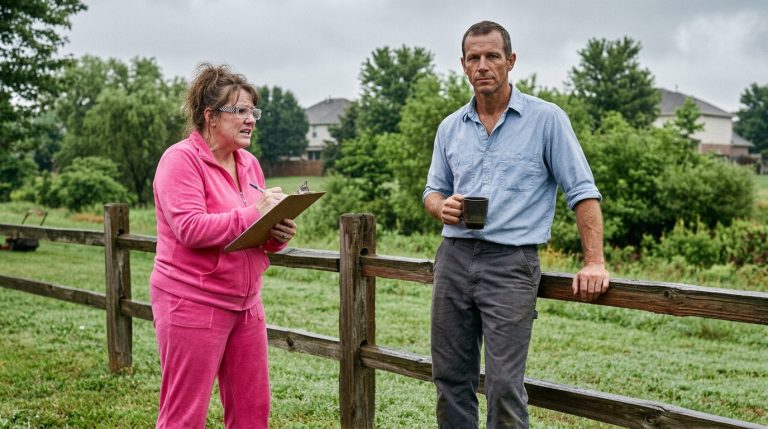
Miller walked toward the slab. He didn’t look at Karen, who had just burst out of the clubhouse behind me, her pink velour tracksuit starkly out of place in the industrial presence of the fire crew. She was shouting, her voice frayed, a hysterical, high-pitched sound that lacked any of the authority she’d commanded minutes ago.
“You can’t do this!” she screamed, rushing toward the Chief. “This is private property! This is an unapproved, hazardous site!”
Miller didn’t even turn his head. He gestured to his crew. “Hook up the flow meter. Let’s see what we’ve got.”
The firefighters moved with a specialized, choreographed efficiency. There was no hesitation, no conversation. They worked as a singular entity. A hose hissed, pressure gauges spiked, and then came the reading—a number that hit the air with the finality of a gavel strike.
“Forty pounds, Chief,” the lead firefighter called out. “Flow rate is abysmal. She’s right on the edge of a total system failure.”
Miller stepped onto the concrete slab, his boots making a dull, heavy sound against the unauthorized fill. He looked down, his eyes narrowing as he read the situation. He finally turned to Karen, his gaze so cold it seemed to drop the ambient temperature of the street by ten degrees.
“Ma’am,” he said, his voice quiet, carrying effortlessly over the hum of the truck. “You are the president of this association?”
Karen’s momentum faltered. She stopped, her chest heaving, the reality of the uniform and the engine beginning to penetrate her defensive wall. “I… I’m the president, yes. But that well is—”
“That well,” Miller cut her off, his voice sharpening, “is a county-registered, mandated emergency backup for this street’s fire suppression. By sealing it, you have effectively turned this entire subdivision into a fire hazard. You have violated state code, local safety ordinances, and federal infrastructure protection laws.”
He pulled a citation book from his pocket. The act was ritualistic, a slow, methodical unfolding of a document that meant the end of her game. The neighbors were coming out of their homes now, drawn by the sound of the truck and the sight of the Chief. They stood in their doorways, holding phones, watching as the woman who had terrorized them for months was systematically stripped of her theater.
“This is a state-level safety violation,” Miller continued, writing in a steady, rhythmic script. “The fines will be levied against the HOA, daily, until this is rectified to my department’s satisfaction. And the liability for the failure of these hydrants, in the event of a fire, will be assigned to the association board and the individual who authorized this work.”
He tore the top sheet from the book and extended it. Karen didn’t take it. She just stood there, her hands dropping to her sides, her face a pale, vacant mask of shock. The silence of the street was punctuated only by the distant, rhythmic ticking of the fire engine’s cooling engine—a sound of exhaustion, of a process coming to an inevitable, mechanical conclusion.
I watched it all, standing near the fence. I didn’t feel the triumph I’d anticipated. I felt the dry, empty peace of a job executed correctly. The structure had buckled, the foundation had cracked, and the architect of the chaos was finally standing in the wreckage of her own design. She had tried to build an empire on a property line, but she had failed to account for the one law that mattered: the hard, unyielding reality of the ground itself.
CHAPTER 8: The Architecture of Peace
The jackhammer’s roar ceased, replaced by the heavy, rhythmic breathing of the demolition crew and the metallic clatter of debris being tossed into the back of a dumpster. For three days, the percussive, mechanical symphony of deconstruction had been the only language that mattered. Now, as the last fragment of the brutalist slab was hoisted away, the silence of the pasture returned, fuller and deeper than it had ever been.
I stood on my porch, the ceramic mug of coffee in my hand still radiating warmth against my palms. The earth where the slab had been was raw, scarred, and dusty, but beneath it, the steel cap of the well was exactly as I had left it: functional, secure, and precisely where it belonged.
My phone vibrated in my pocket. It was a message from Dr. Albright, the new interim president, confirming the courier had arrived with the final settlement check. I didn’t open the bank app to verify the balance. The money was merely a corrective entry in a ledger, the closing of a cycle. The true payoff wasn’t in the account; it was in the view. The horizon line, once cluttered by the looming tension of Karen’s obsession, was now clear.
A truck pulled up to the curb of the subdivision. I watched as a moving company began loading the last of the furniture from 112 Magnolia Circle. Karen didn’t emerge to oversee the loading. She stayed inside, a ghost in her own home, stripped of the title that had been her only defense against the reality of her own mediocrity. She was selling the house, liquidating the asset to pay for the legal wreckage of her own making. The irony was poetic: she had tried to impose her vision of “aesthetic harmony” on the land, and in doing so, she had rendered herself a foreign object, destined to be excised.
I set my coffee mug down on the railing and walked out onto the lawn. The soil was soft under my boots, yielding, alive. I had spent so much of the last month thinking about systems, about pressure points, about the mechanics of human behavior, that I had forgotten the primary reason I had bought this land: to build something that was meant to endure, not something designed to control.
I knelt by the well. The steel cap was cool to the touch. With a wrench from my belt, I tightened the seal, the metal singing with a sharp, honest sound. It was a small, physical act, but it felt like the final step in a long, taxing assembly. The restoration was complete.
The fire marshal’s crew had finished their final pressure test an hour ago. The gauge had held steady at 150 PSI—a number that meant the hydrants on Magnolia Circle were no longer death traps. The neighborhood was quiet, the residents moving through their day with the tentative relief of people who have survived a near-miss. They would eventually forget the specifics of the incident—the concrete, the PowerPoint, the fire marshal—but they would remember the change in the climate. The fear that had acted as a ceiling on their autonomy had been punctured.
My daughter’s college tuition was secured. The property was restored. The system had been stress-tested, and it had held.
I stood up and looked back at my mailbox at the end of the driveway. A week ago, I had painted it a vibrant, defiant rustic red. In the afternoon light, the paint looked solid, unwavering, a small, stubborn assertion of sovereignty in a sea of beige. It wasn’t an act of aggression; it was a marker. I lived here. I occupied this space. And I was not going anywhere.
I didn’t feel the need to watch the moving truck leave. I didn’t need to see her go. Her departure was a mathematical inevitability, a consequence of the equations she hadn’t bothered to solve. I walked back toward the house, my pace slow and measured. The pasture was cooling as the sun began to dip toward the oak trees, casting long, peaceful shadows across the grass. The weight of the last few months seemed to lift, dissolving into the stillness of the evening.
There was a profound satisfaction in the quiet—a recognition that while the world would always have people who sought to pave over the things they didn’t understand, there would always be an architecture of truth, solid and grounded, waiting for them to break their teeth on it. I opened the door to my house, the latch clicking into place with a definitive, secure sound. Inside, the air was still, cool, and perfectly my own.