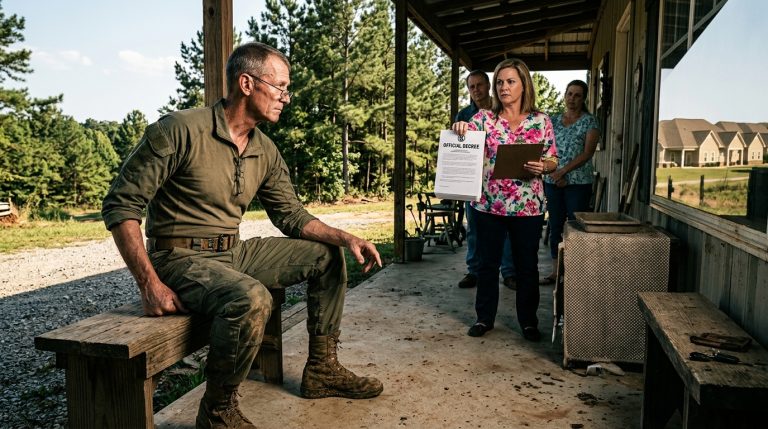
The Line Held Firm: How a Retired Engineer Dismantled a Petty Tyrant’s Kingdom of Paper Lies
CHAPTER 1: THE MORNING PERIMETER
The humidity was thick enough to taste, a damp blanket that clung to the split-rail cedar fence. I stood on my back porch, a lukewarm cup of black coffee in hand, watching the dew settle on the top rail. It had been standing there for fifteen years, marking the boundary of my half-acre with geometric indifference. It was a simple structure, yet someone had decided it was an affront to the neighborhood’s aesthetic harmony.
Karen Miller stood ten feet away on the community green belt, her pink tracksuit standing out like a neon wound against the muted greens of the lawn. She held a clipboard as if it were a weapon, her fingers gripping the plastic edges until the knuckles turned white.
“Mr. Thompson,” she began, her voice a syrupy, rehearsed cadence. “You are in violation of Article 4, Section 2B. Ten feet. That is the encroachment. Move it within thirty days, or the association will handle the demolition at your expense.”
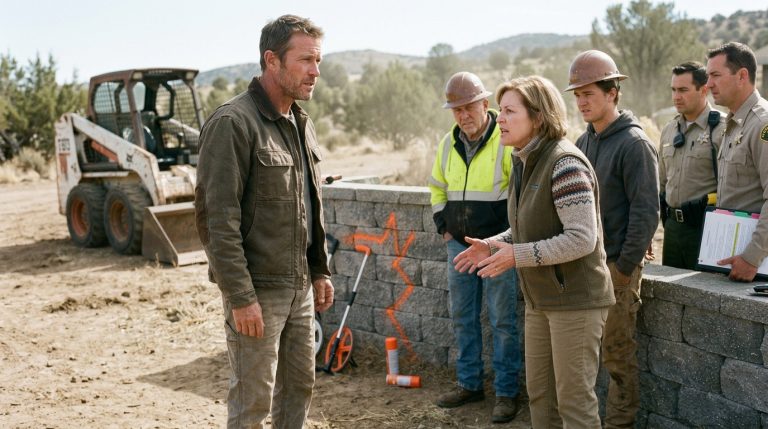
I didn’t answer immediately. I took a slow, measured sip of the coffee, letting the heat settle in my chest. I didn’t look at her face; I looked at the grass beneath her feet. I tracked the iron pin buried in the sod six inches behind her left heel—the pin I had verified with a compass and a certified plat map six months ago.
She wanted a reaction. She wanted the spike in blood pressure, the shouting, the amateur-hour temper tantrum that would justify her role as the neighborhood enforcer. She was a petty tyrant, a woman whose entire existence was predicated on the belief that she held the leash to everyone else’s reality.
“I see,” I said. My voice was level, a flat line in the humid air. I turned my gaze upward, meeting her eyes through the thick lenses of her rhinestone-studded glasses. There was no apology in my posture, no defensive slouch.
She opened her mouth, her smirk deepening, waiting for the argument to begin. She was prepared for a fight, but she wasn’t prepared for an engineer who had spent twenty-five years assessing the integrity of bridges under fire.
“I have the plat survey in my office,” I continued, keeping the tone polite, almost conversational. “It’s stamped and certified. If you’re referencing a document that contradicts the county record, I’d be happy to compare them for you by noon.”
The smirk faltered. It didn’t vanish, but it thinned, struggling to maintain its shape. She had expected a victim, not an auditor.
“The master community plat is the only governing document,” she snapped, her hand trembling slightly as she scribbled on the clipboard. “Your personal survey is irrelevant.”
She turned, her movements ponderous, a heavy barge navigating the lawn. She didn’t march away; she retreated, her ego bruised by a lack of friction. As she walked, I noticed the way she skirted the edge of the large oak tree near the green belt, her eyes darting toward the fence line with a twitchy, nervous energy.
I set the coffee mug on the porch railing and went inside. I didn’t reach for the phone. I reached for the filing cabinet. It was time to build a foundation of evidence, and I had a feeling the cracks in Karen’s kingdom went much deeper than a simple fence.
CHAPTER 2: THE INTELLIGENCE GATHERING
The file cabinet groaned as I closed the drawer, a metallic rasp that sounded too loud in the quiet of my home office. Outside, the morning sun was burning off the humidity, but in here, the air felt recycled, still. I stood before the metal frame, my hand resting on the cool gray handle, and for a fleeting, unwanted second, the office walls seemed to stretch into the canvas of a desert tent, the beige wallpaper flickering into the dusty, sun-bleached fabric of a forward operating base.
The phantom sensation—the phantom smell of burnt diesel and pulverized concrete—tightened my chest. I blinked, forcibly tethering my focus to the here and now. The mission was different, but the methodology remained the gold standard. In the Corps, we didn’t negotiate with unstable terrain; we surveyed it, we mapped the fault lines, and then we reinforced the foundation. Karen Miller wasn’t a tactical threat, but she was a structural one. She was an error in the system that needed to be debugged.
I walked to the kitchen, the hardwood floor solid and unyielding under my boots. Sarah was at the table, her phone laid out beside a bowl of half-eaten cereal. She looked up as I entered, her eyes searching mine for the anger she expected. I gave her none.
“I’m heading downtown,” I said, grabbing my keys. “County records office.”
“Mike, it’s an HOA,” she said, her voice soft but laced with the kind of fatigue that comes from living in a state of perpetual low-level alarm. “Is it really worth this? Another day of digging?”
“It’s not about the fence, Sarah,” I replied, my voice steady, stripped of the emotional agitation she was looking for. “It’s about the truth. If I don’t define the boundaries, she will. And I don’t intend to live in a reality of her making.”
The drive downtown was a ritual. I needed the quiet of the road to calibrate, to shift from the persona of a retired resident to that of a man conducting a formal site assessment. The county records office was a cavernous space of high ceilings and fluorescent lights that buzzed with the static energy of buried secrets. It smelled of ozone and disintegrating cellulose—a smell I’d learned to associate with the only kind of power that actually mattered: the kind backed by a government seal.
I approached the counter. The clerk, a woman whose skin looked like parchment, didn’t bother looking up from her screen as I requested access to the original subdivision plat maps and the deed histories for the entire Oakmont Estates tract.
I spent four hours at a long, laminate table in the back of the archives, a space where the world of manicured lawns and pastel tracksuits didn’t exist. Here, the world was a flat, two-dimensional grid of precision. I laid out the original developer’s master plat—a sprawling, complex document from 1988—and aligned it with my own survey. I checked the lot measurements, the setbacks, the easement allowances.
My finger traced the line that defined my western boundary. It was a straight shot, a perfectly executed vector. I cross-referenced it with the history of lot 128—Karen’s property. My eyes caught on the permit logs. My pen hovered over an entry from five years ago: Permit #8842-P: Rear Patio Extension.
I leaned in, the fluorescent light humming directly over my shoulder, casting a sharp, hard shadow across the paper. The patio was listed as a 15-by-20 slab. I remembered the structure. I’d walked past it a dozen times, watching my dog sniff the base of the foundation. It wasn’t a slab. It was a raised, enclosed sunroom with a permanent footer, a shingled roof, and glass walls.
It was a structural anomaly, a violation that required a different tier of engineering review—a foundation-level assessment. If the patio was a room, it needed a different set of setbacks. If it was a room, it had been built on top of an undocumented foundation depth. And if it was built without the proper inspections, it was a liability.
The discrepancy was a faint, vibrating wire in my mind. If she had built the room that large, she had almost certainly crossed the lot line to accommodate the footer depth. She wasn’t just bullying me to maintain aesthetic control; she was performing a high-stakes, frantic maintenance on a house that was technically, legally, and structurally out of code.
I printed the certified copies, the machine’s rhythmic thwack-thwack-thwack providing a cadence for my thoughts. I wasn’t fighting a bully anymore. I was documenting the structural failure of a fraud. I packed the papers into my briefcase, the weight of them solid and reassuring.
As I walked out of the building, the midday sun was brutal, turning the asphalt into a shimmering, heat-distorted mirage. I didn’t head straight home. I pulled my truck into a quiet side street two blocks from the archives, opened the laptop, and started a new file: Operation Quiet Fence: Strategic Assessment.
The ghost of the desert faded as I typed. There was no sand here, no incoming fire, no broken bridges. Just paper, math, and the inevitable collapse of someone who hadn’t bothered to check their own load-bearing capacity.
I had the map. Now, I just needed to see if she was smart enough to realize the ground beneath her was already giving way.
CHAPTER 3: THE SCOUT
I closed the laptop, the screen going dark with a satisfying click. The strategic assessment was only a foundation; it needed context. Data on a drive was static—it lacked the human element, the social architecture that allowed someone like Karen Miller to maintain control over a neighborhood. I stepped out of the office and into the humid afternoon. The air felt heavier now, charged with the kind of static you feel before a storm.
My destination was three doors down. Bob Peterson’s house was a study in lived-in endurance. Where Karen’s home was a curated facade of pastel perfection, Bob’s was a testament to utility. His lawn was healthy, not manicured to the millimeter, and his porch was cluttered with the tools of someone who actually worked with his hands.
I walked the distance slowly. Every step across the sidewalk felt intentional. I could feel the weight of the security camera I’d need to install later, the way one feels the weight of a pack before a long march. My eyes kept drifting to the cul-de-sac. Karen’s house sat at the end of the line like a silent sentry, the blinds drawn tight. I didn’t see her, but I could feel the gaze—the paranoid, intrusive pressure of someone who considered the entire street their private property.
Bob was in his flower bed, his knees on a foam pad, his hands deep in the earth. He looked up as I approached, his face etched with the kind of deep, comfortable wrinkles that only come from decades of watching the world.
“Afternoon, Mike,” he grunted, his voice a gravelly, familiar sound. He stood up, using a trowel as a cane, his joints popping in the quiet air. “Decided to fight the city, or just the neighborhood?”
“Just the neighborhood,” I said, leaning against the fender of my truck, which I’d left parked near his drive. “Karen’s looking for blood, Bob. I figured I should find out whose blood she’s already spilled.”
Bob let out a short, sharp laugh that turned into a cough. He wiped his hands on a dirt-caked glove and gestured for me to step into the shade of his porch. The porch was a sanctuary of sorts, smelling of cedar and old tobacco. He sat in a weathered Adirondack chair, his eyes scanning the street before leaning in.
“She’s been on a power trip for ten years,” he said, his voice dropping an octave. “It started when Frank—that’s her husband, the one who thinks he’s a general contractor—managed to lowball the bid on the community clubhouse roof. They used recycled shingles that didn’t meet the fire code. It’s been leaking since the first rain, but by then, she had the board in her pocket.”
I listened, my mind cataloging the information. The clubhouse roof wasn’t just an anecdote; it was a precedent. It was proof of a systemic vulnerability in the HOA’s procurement process.
“She targets the low-hanging fruit, Mike,” Bob continued, ticking off names on his fingers. “The widows who don’t want the hassle, the families just trying to get a mortgage approval. She threatens them with fines until they’re too scared to say no. She’s built a kingdom on the fear of a legal fee. Tried to ding me for the color of my mailbox once. I pulled the original developer covenants, showed her the section on ‘harmonious streetscape,’ and told her to check her definitions. She didn’t bother me again, but she’s been watching me ever since.”
Bob’s eyes drifted toward Karen’s house. “She’s not just a busybody, Mike. She’s a desperate one. Frank’s company hasn’t had a real contract in two years. They’re underwater, and she’s treating these fines like a revenue stream. If you’re fighting her, you’re not fighting an HOA president. You’re fighting a business manager trying to keep her personal lights on.”
The revelation settled into the cold, strategic center of my mind. It was a classic scenario: a localized conflict acting as a shield for a much larger, internal systemic failure. She was protecting her lifestyle, and she was doing it by weaponizing the very bylaws designed to maintain neighborhood order.
“I need to know if there are others,” I said, my voice barely audible over the hum of a distant lawnmower. “If she’s doing this for the money, there’s a trail. A trail of fines, a trail of ‘remediation’ fees, a trail of contracts.”
Bob looked at me, a slow, knowing smile spreading across his face. “You’re going to need more than just my word for it. But I have a ledger. Every fine, every notice, every neighbor she’s squeezed. I’ve been keeping a tally since she took over the presidency. I thought, one day, someone might actually be stubborn enough to use it.”
He stood up and walked into his house, leaving me alone on the porch. The silence that returned to the cul-de-sac felt different now. It wasn’t the silence of peace, but the silence of an ambush site. I looked back toward my own house, toward that four-foot cedar fence. It was just a boundary. But to Karen, it was a tactical weakness.
The crunch of tires on gravel pulled my attention to the end of the street. A heavy, dark sedan pulled into Karen’s driveway. It wasn’t Frank’s work truck. It was a different vehicle—sleeker, more expensive, the kind that didn’t belong in a neighborhood of split-level homes. My heart rate stayed flat, my breathing remained rhythmic and slow, a habit formed on a different kind of perimeter.
I wasn’t the one being watched anymore. I was the one doing the watching. And as Bob stepped back onto the porch holding a worn, black-bound ledger, I knew the real operation was just beginning. The fence was the hook, but the truth? The truth was the mortar we were about to pour.
CHAPTER 4: THE DEPLOYMENT
The drive back from Bob’s house felt different. I wasn’t just a neighbor anymore; I was the recipient of a decade’s worth of grievances, bound in a black-leather ledger that sat on the passenger seat like a live fuse. I didn’t look at it. I didn’t need to. I knew the contents would be the structural roadmap for my own counter-offensive. Every entry in that book—every fine, every forced repair, every intimidation tactic—was a data point. And data, when compiled correctly, is the only thing that stands up under the weight of a court’s scrutiny.
I pulled into my driveway, the engine of the truck ticking as it cooled in the humid air. I didn’t go inside immediately. I sat there, watching the house—my house—for a long, slow count of sixty. It was a sturdy, well-maintained structure, the kind of place that provided a quiet, predictable rhythm. But the last few days had injected a jagged, erratic pulse into that rhythm. I could feel the change. I could see it in the way the shadows fell differently across the lawn, in the way the air seemed to hold its breath.
I climbed out, the ledger tucked securely under my arm. Inside, Sarah was in the kitchen, her back to me, the rhythmic thwack of a knife against a cutting board keeping time. She didn’t turn around until I set the ledger on the island. The sound was flat, heavy—the sound of evidence.
“What’s that?” she asked, her voice tight.
“The cost of doing business in Oakmont Estates,” I said, opening it to a random page. It was a log of the Rodriguez family, basketball hoop, fine, forced removal, date recorded. It was clinical, precise, and devastatingly consistent.
I didn’t give her time to process it. I went straight to my home office. The desk was already covered in the plats I’d retrieved from the county records office. I cleared a space, the legal pad sitting center stage. It was time to draft the response. I didn’t write it as an angry resident; I wrote it as a consultant. I drafted a professional, cold, and utterly neutral acknowledgment of the HOA’s notice of violation. I referenced the violation number, the date, and the specific bylaws cited. Then, I added the kicker: Pursuant to the official property survey conducted by licensed state surveyor L.R. Henderson, license number 582-LS, the fence is situated entirely within the legal boundaries of 121 Oak Drive. Please provide the alternative survey document the HOA is utilizing as the basis for this contradictory claim.
It was a trap, of course. I knew she didn’t have one.
I printed the letter, the printer’s hum the only sound in the room. I attached a high-resolution scan of my survey, highlighting the boundary line in a color that was impossible to miss. I didn’t just email it; I printed a hard copy, slipped it into a high-quality envelope, and walked to the kitchen to sign it with a fountain pen.
“I’m mailing this certified,” I told Sarah. “I’m also installing the cameras. Today.”
“Cameras?” she asked, stopping the knife.
“If she’s going to escalate, she’s going to do it on the perimeter,” I said, my voice steady. “I need the footage. I need to see exactly when she’s standing on my property, what she’s taking notes on, and how she’s documenting these ‘violations.'”
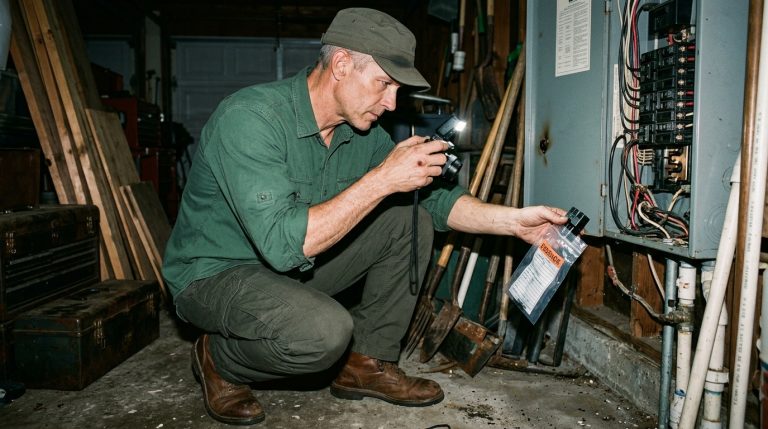
The afternoon was consumed by the installation. I found a spot under the garage eaves that provided a perfect, wide-angle view of the driveway, the mailbox, and the property line. It was a professional-grade unit, motion-activated, night-vision enabled, and linked directly to a cloud server I’d encrypted. As I tightened the mounting bracket, I felt the familiar, grounding weight of the process. In the Corps, we spent hours on the setup—the pre-trip inspection, the security sweep, the staging of the assets. You don’t rush the setup. If the setup is right, the rest is just execution.
While I worked, I kept glancing at the street. I was waiting for the inevitable. And I wasn’t disappointed. About an hour later, a familiar, ponderous figure appeared on the sidewalk. Karen was walking her routine, clipboard in hand, stopping every few feet to stare at a neighbor’s house, her rhinestone-studded glasses catching the sun.
She turned into my driveway. I froze, my hand still on the camera. She didn’t look up. She walked to the mailbox, pulled out the flag, and stood there for a long moment, staring at the front door. She knew I was home. She knew I was watching. She tapped her pen against the clipboard—a rhythmic, impatient sound—and then turned on her heel and marched away, her pink sneakers leaving no trace on the hot asphalt.
She was waiting for me to react, to stomp out there, to yell. She wanted the confrontation. She wanted to document the “uncooperative resident” for her board members.
I stayed on the ladder, my breathing controlled, my muscles relaxed. I adjusted the lens by a fraction of a millimeter, ensuring the frame captured every inch of the mailbox. I wasn’t a resident. I was the surveyor, and I had just set my first, invisible pin. The trap was laid. All she had to do now was walk into it.