The Geometry of Boundaries: A Study in Property, Procedure, and the Quiet Weight of Final Truth
CHAPTER 1: THE FIRST MARK
The vibration of the engine died, leaving a silence that felt pressurized, heavy with the dust of the valley floor. I kept the engine running just long enough to pull my phone from the center console, the screen flickering to life with a steady, clinical glow. Before my boots hit the ground, I was recording.
“What are you doing on my turnout?”
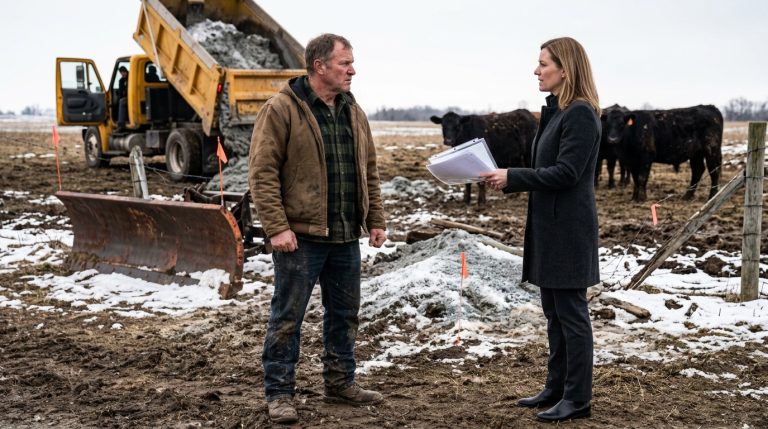
My voice didn’t waver. It was flat, stripped of the reflexive anger that usually makes men stupid in a fight. Karen didn’t flinch. She adjusted her grip on the folder, her chin tilted at that practiced, self-righteous angle. Behind her, the contractor with the orange paint can hesitated, the tip of the nozzle hovering just inches from my retaining wall.
“We’re performing an emergency sweep clearance layout,” the contractor said, not meeting my eyes. “We were told this section needs to be normalized for ridge safety.”
“By who?”
The man glanced at Karen, a subtle, nervous twitch of the head. Karen stepped forward, smoothing the front of her jacket with a palm that looked too clean for the job site. Her smile was practiced, a polite veneer stretched thin over iron-hard intent.
“We’re documenting the requirements, as per the county’s recent wildfire recommendations,” she said, her tone honey-sweet and utterly hollow. “This is for the good of the entire ridge.”
I walked toward them, moving slowly, my boots biting into the dry dirt. I didn’t look at the paint; I looked at the metadata in my head—the email header from three days ago, the draft drawing I’d found in the HOA’s digital trash, the timestamp that proved this “emergency” had been scheduled before anyone had even knocked on my door.
“That isn’t documentation,” I said, stopping a few feet from the worker. “That’s trespass.”
The younger contractor shifted his weight, his eyes darting from the paint line—a jagged, bright orange scar on my stone wall—back to Karen. The friction of the moment was palpable, a grinding tension between the cold, hard logic of my property line and the bureaucratic fiction she was trying to force over it.
“Ma’am told us to finish the mark set before the county arrives to verify,” the younger worker muttered.
I looked at Karen. She held the folder against her hip like a weapon, her expression shifting from polite to defiant as the realization hit her that I wasn’t going to engage with her safety script.
“County didn’t order this,” I said, my voice low and steady. “And you don’t own this ground. Pack it up.”
Karen’s smile didn’t disappear, but it froze, turning into a brittle thing. “You’re obstructing emergency planning. The liability for that, if something happens on this ridge—”
I ignored her, reaching for the non-emergency line on my phone. The screen displayed the timestamp of our conversation. I knew, with the cold certainty of a man checking a clock, that she had already lost. But as I dialed, a detail snagged my attention: the contractor’s measuring wheel had a rental sticker from a firm three towns over—the same firm that managed the county’s public works contracts. The puzzle wasn’t just a neighbor dispute anymore. It was a bridge to something much larger, and much more dangerous.
CHAPTER 2: THE AUDIT
The deputy’s cruiser wouldn’t be here for another twenty minutes. In the high, thin air of the ridge, that was an eternity. The younger worker looked at the orange paint still drying on the gray stone of my retaining wall—a jagged, artificial wound in the landscape—and then he looked at his supervisor. The older man was smarter; he didn’t reach for the paint again. He just shoved his hands into his pockets and leaned against the loader, waiting for a signal that wasn’t coming.
Karen hadn’t moved. She was still holding that folder, but the firm, practiced arch of her spine had softened. She was breathing shallowly, her eyes fixed on my phone, which was still recording the scene. She wasn’t looking at the turnout anymore; she was looking at the end of her leverage.
“You’re making a mistake,” she said. Her voice lacked the crystalline authority it had held ten minutes ago. It sounded frayed, worn thin by the sudden intrusion of actual law. “The board will have to address this.”
“The board can address whatever it likes,” I said, keeping my focus on the digital interface of my records. “But you’re standing on private property, and you’ve authorized the defacement of a permanent structure. That’s not a board issue, Karen. That’s a liability issue.”
I didn’t argue with her. I didn’t offer her a way out. I watched as she tried to reconstruct her composure, adjusting the safety vest as if it were a coat of armor. She was waiting for me to get angry, to shout, to provide her with a moment of unprofessionalism she could report, but I gave her nothing but the cold, indifferent glare of an auditor.
I left them there. I walked back to my truck, the gravel crunching under my boots—a sound of dry, geological permanence. Inside the cab, the air was cooler. I sat in the driver’s seat and opened the laptop I kept mounted to the console. It was time to find the cracks.
The HOA’s digital footprint was messy. They were used to operating in a closed loop where their own documents were accepted as absolute truth. I logged into the portal where they’d hosted the concept drawings for the “Ridge Emergency Flow.” It was a standard, poorly secured server. I wasn’t a hacker, but I knew how to look at the bones of a file.
I pulled up the concept drawing they had circulated to the residents. I looked at the properties—the metadata. The file had been created on a Tuesday afternoon, four days before Karen had ever stepped onto my road for her initial “safety” visit. The timestamp was etched into the digital file like a fingerprint. She had designed the “solution” before she had even identified the “problem.”
Then, I shifted to the intake packet she had supposedly submitted to the county fire marshal. It was a digital PDF, a cold, clinical document filled with stock imagery and borrowed safety guidelines. I opened it in a hex editor. I didn’t need to read the lines of code to see the discrepancy. The image of my turnout—labeled as a “choke point”—had been inserted into the document layer after the base document had been signed and formatted by the marshal’s office intake clerk.
It was a collage. A cut-and-paste job masquerading as a public safety mandate.
I felt a surge of cold, analytical clarity. My phone buzzed in the cradle—a notification from the county road office. I’d sent them a records request earlier that morning, a shot in the dark. They had replied faster than I expected, likely because they were tired of getting caught in the middle of these HOA squabbles. They sent the routing logs for the packet.
The entry point wasn’t the public works office. It wasn’t even the fire marshal’s direct intake. It was a private alias, an email address disguised as an official “Ridge Coordination Board.” It was Karen. She hadn’t just influenced the process; she had built a private pipeline to the county and was pumping her own agenda through it.
I looked back out the window. The contractors were packing their tools into the back of their flatbed. They didn’t look like men who enjoyed being part of a lie. Karen was pacing now, a frantic, rhythmic movement on the edge of my property, checking her watch. She was trapped in the same frame she had built for me.
I saved the screenshot of the routing log and cross-referenced it with the timestamp of the board memo she’d sent out. The logic was inescapable. The “emergency” she was so concerned about was nothing more than a cover for the widening of the turnout, which would provide the exact clearance needed to allow construction equipment into the lot behind my land—the lot she was clearly preparing to flip.
I didn’t need to shout. I didn’t need to fight. I just needed to print. I reached for the portable printer in the back of the truck, the hum of its motor a steady, reassuring vibration against the seat. Every document I created, every timestamp I locked, was a brick in the wall I was building between her and the road. She thought she was maneuvering through a gray area, but the truth wasn’t gray. It was as hard, and as cold, as the stone in my retaining wall.
I watched her through the windshield. She stopped pacing and looked toward my truck, her face a mask of calculated uncertainty. She knew the deputy was coming. She knew the paint was still wet. And for the first time, she realized that in a war of paper, she was completely outgunned.
CHAPTER 3: THE INCURSION
The deputy moved with the slow, deliberate pace of a man who dealt in the tangible—things you could touch, measure, and cite in a report. He stepped out of the cruiser, his boots crunching heavily on the gravel, a stark contrast to the light, frantic movements Karen had been making only minutes before. He didn’t look at me or Karen immediately; he looked at the paint. He stared at the bright, garish orange line slashed across the gray stone of the retaining wall, his eyes narrowing as he traced the path it cut through the shoulder of the road.
“Problem here?” the deputy asked. His voice was gravelly, filtered through the dry heat of the ridge.
“Trespass,” I said, my voice steady. “Unauthorized alteration of a permanent structure.”
Karen stepped forward, her hands now empty of the folder, which she had set on the hood of her SUV. She attempted to regain the narrative, her posture shifting from defensive to aggrieved. “Deputy, we’re simply identifying the necessary clearances for the county’s emergency wildfire recommendations. This owner is obstructing—”
“I didn’t ask for a speech, ma’am,” the deputy interrupted, his tone indifferent. He kept his eyes on the paint mark, then shifted them to the compact loader parked at a precarious angle toward the shoulder. He looked at the workers, who were now standing awkwardly by their trailer, their measuring wheels tucked away like guilty secrets. “Who authorized the paint?”
The older contractor didn’t hesitate. He looked at the deputy, then at the orange line, and pointed a calloused finger toward Karen. “Management at the HOA office. We were told it was a standard clearance sweep.”
“Did the county sign off on this specific layout?” the deputy asked, his eyes sharp.
“We were told,” the contractor started, then stopped, his throat tightening. He looked at Karen, who was now visibly bristling, her face flushing a tight, controlled pink. “We were told the paperwork was in the intake queue.”
The deputy grunted and moved toward me. I reached into the bed of my truck and pulled out the binder I had prepared. It was heavy, the plastic dividers clicking against each other in the wind—a tactile manifestation of my defense. I handed it to him. He didn’t read it then and there, but he took it, sensing the weight of the documentation.
“I’m going to need you to move your equipment,” the deputy said, turning back to the contractors. “And leave the property. Until you have a signed, sealed directive from the county’s actual Public Works office, there is to be no marking, no digging, and no ‘clearance’ of any kind on this parcel.”
Karen made a sharp, involuntary sound. “You can’t just stop a safety initiative on the word of a single resident. The board has a mandate—”
“The board has a responsibility to follow the law, ma’am,” the deputy replied, his voice devoid of heat. “Right now, I see a private owner who has provided proof of property and a contractor who’s marking up land they don’t have a permit to touch. That’s a civil matter that’s rapidly looking like a criminal one if you don’t vacate the site.”
The contractors didn’t argue. They started the loader, the engine coughing to life with a thick, acrid cloud of diesel exhaust that hung in the still air. I watched them go, the machine grinding down the narrow access road until the sound faded into the distant hum of the valley. Karen remained, her face a hard, crystalline mask. She was trying to decide if she could salvage the situation, but the deputy wasn’t looking at her anymore. He was looking at me, checking the map in the binder against the physical landscape.
“Keep this paperwork,” the deputy said, handing the binder back. “And if they return without a sheriff’s escort and a court order, call the line. Don’t engage. Just call.”
He left shortly after, his cruiser pulling away with a crunch of loose rock. I was alone on the turnout again. The orange paint looked uglier now, stripped of the pretense of “emergency planning.” It was just graffiti. I walked over to the retaining wall and touched the dry, textured stone. The paint was already starting to flake in the heat, an cheap, low-grade product that hadn’t been made to endure.
I took a picture of the markings one last time, making sure to capture the context of the wall and the road. Then I pulled out a scrub brush and a jug of solvent I kept in the tool box. I didn’t rush. I worked the paint off slowly, watching the orange liquid pool on the ground, a reminder of the wasted effort Karen had put into her little performance.
My mind was already racing ahead. The contractor’s admission was the first real crack. If the HOA office was managing the planning directly, then the “emergency packet” was a house of cards. I knew what I had to do next: I needed to get into the county’s fire records office, not through an online portal, but in person. I needed to see who had actually filed the packet, and more importantly, who had approved the insertion of my property into the document stream.
The sun began to dip behind the pines, casting long, sharp shadows across the turnout. The wind picked up, a cool, dry breeze that smelled of pine needles and iron. I finished cleaning the wall, the stone returning to its natural, weathered gray. I was tired, a deep, bone-weary exhaustion that comes from calculated labor, but my resolve was harder than the wall itself.
I sat in the truck and watched the road. The HOA wouldn’t stop here. They never did. They would retreat, regroup, and try to find another point of entry, another piece of language they could twist. But they had made a mistake—they had left a trail of paper. And every scrap of that paper was a weapon I was going to use to dismantle their entire claim. The ridge was quiet now, the way it should be, but the silence was temporary. I knew Karen. She was already planning her next move, and I was going to be waiting to turn every single page she threw at me into a reason to shut her down for good.
CHAPTER 4: THE PAPER WAR
I didn’t drive back to the house. I kept the truck aimed toward the county seat, the asphalt beneath the tires humming a steady, monotonous rhythm. The sun was fully up now, bleaching the landscape into sharp, high-contrast shapes, but my focus remained entirely on the contents of the passenger seat. The binder was my world. Every page was a tactical coordinate, every highlighted paragraph a line drawn in the dirt.
The county road and slope office was a relic of municipal architecture, filled with the smell of old coffee, floor wax, and the damp, metallic scent of archival storage. I pulled into a parking spot, killed the engine, and sat for a moment. My pulse was steady—a disciplined, slow beat. I wasn’t just here to complain; I was here to force an audit. I checked my phone one last time, verifying the GPS location of my turnout and the high-resolution images of the initial paint markings.
Inside, the office was quiet. The clerk at the front desk had the weary look of someone who spent their days navigating the friction of bureaucracy. I didn’t rush. I approached the counter, set the binder down with a controlled thud, and waited for her to acknowledge me.
“I’m here to submit a formal preservation notice and a counter-intake for a fire marshal packet,” I said. My voice was pitched for professional impact—even, detached, and firm.
She looked up, her expression skeptical until she saw the weight of the documentation. I opened the binder, laying out the timeline I had constructed. I didn’t start with the anger; I started with the sequence. “This is the intake packet submitted by the Ridge HOA. It purports to be a county-approved emergency clearance sweep.”
She squinted at the page, her finger tracing the text. “And?”
“And I own the property in question,” I said, sliding the land survey map across the laminate surface. “No county inspector has ever been to my turnout. No survey was requested. This entire packet is a fabrication, and it has been used to authorize trespass on my land.”
She pulled a pair of glasses from her pocket, the silence in the office deepening. She began to flip through the pages—the logs, the metadata printouts, the email headers that tied the packet directly back to Karen’s board alias. I watched her eyes move across the data. I saw the moment her skepticism vanished, replaced by the instinctual caution of a civil servant who realizes they are looking at something that could trigger a departmental investigation.
“This,” she said, tapping the contractor’s native export stamp I’d highlighted in the corner, “this isn’t a county output.”
“It isn’t,” I confirmed. “It’s a doctored document meant to look like one. And it’s been submitted into your queue as a legitimate safety filing.”
She stood up and walked toward the back office, leaving me at the counter. I watched her go, the feeling of the room changing. The air felt colder, the lights buzzing with a sharp, insistent frequency. I wasn’t just playing defense anymore; I was actively turning the institution against the person who had tried to weaponize it.
When she returned, she was accompanied by a supervisor, a man in a rumpled shirt who looked like he hadn’t slept well in a week. He looked at the binder, then at me. He didn’t ask who I was; he asked what I wanted.
“I want this packet flagged as fraudulent,” I said. “And I want a full history of the user account that submitted it. You’ve been used as a tool to facilitate private land encroachment. You have a duty to correct the record.”
The supervisor took the binder. He flipped through the metadata screenshots, his face reddening as the implications of the “board alias” became clear. “You have evidence that this was submitted by a non-county entity?”
“I have the email headers,” I said. “And I have a recording of the contractor admitting they were hired by the HOA, not the county. I’m not asking for a favor. I’m asking for the record to reflect the truth.”
He closed the binder, the sound final. “If this is what it looks like, there’s going to be a formal review of the intake logs. We’ll need a statement.”
“I have a written statement ready,” I said, sliding a second document out of the back of the binder. “And I’ve retained legal counsel who is currently drafting a preservation notice for all drafts of this document, including those that were deleted or modified.”
He looked at me, a flicker of something like respect crossing his tired face. People usually came in here to shout or to plead. I was doing neither. I was simply presenting the facts in a way that made it impossible for them to ignore the rot in their own system.
I spent the next two hours in a small, windowless office, dictating the timeline. I walked them through the sequence: the visit, the post, the drawing, the packet, the trespass. Every detail was a stone in the foundation of my position. By the time I walked out, the sun was lower, the heat of the day beginning to break.
I stopped on the sidewalk, the dry air hitting my face. I had done it. I had pushed the conflict into the institutional sphere. Karen was used to controlling the conversation in the HOA newsletter and the neighborhood Facebook groups, where she could frame the narrative however she pleased. She wasn’t used to dealing with a bureaucratic wall that was being built by the county itself.
I looked at my truck. The binder was lighter now, the documents sitting in the hands of the supervisor, moving through the system. But I knew this wasn’t the end. Karen would have her own lawyers, her own spin, and her own desperate reasons for wanting my turnout. She was a woman who saw the world as a game of acquisition, and she wouldn’t give up simply because the rules had shifted.
The next few days would be a waiting game. I drove back toward the ridge, the familiar silhouette of the hills rising against the darkening sky. I felt a cold, quiet satisfaction. I hadn’t just protected my property; I had taken the very tools of my antagonist and turned them against her. The truth was out there now, moving through the veins of the county, and it wouldn’t be long before it reached her desk.
CHAPTER 5: THE PAPER TRAIL
The drive back to the ridge was a descent into a deepening, low-angled light. I kept my eyes on the road, but my mind was stuck in the county records office, replaying the supervisor’s expression. He had recognized the pattern. He had seen the way the “safety” packet had been spliced together, the clumsy seams of a forged narrative visible to anyone who knew where to look.
When I pulled up to my turnout, the silence was absolute. The orange paint was gone, replaced by the honest, weathered gray of stone, but the property still felt compromised. I walked out to the edge of the retaining wall, testing the stability of the shoulder. It was solid, held in place by years of deliberate, careful maintenance. It was the antithesis of everything Karen stood for.
My phone buzzed—a notification from my attorney. He had received a copy of the preservation notice I’d triggered, and he had some news. The HOA’s legal firm had filed a response, but it was weak—a standard, boilerplate deflection that relied on the very packet I had just dismantled at the county office. They were still using the forged logic.
I walked into my workshop, the air smelling of linseed oil and steel. I sat at my workbench and pulled up the digital archives I’d been building. I needed to cross-reference the intake packet’s revision history with the HOA’s internal board memos. If Karen had been “laundering” her land problem, there had to be a ledger. There had to be a point where the administrative facade met the private financial intent.
I opened the file containing the board’s meeting minutes from three months prior. I had highlighted a paragraph about “future ridge use expectations.” At the time, it had seemed like typical HOA bloat, the kind of vague, self-important language boards used to justify their existence. But looking at it now, with the knowledge of the forged packets and the specific interest in my turnout, the language shifted.
“Optimizing infrastructure for potential secondary development,” the memo read.
I zoomed in. The words felt like a physical weight. My turnout wasn’t just a choke point for emergency vehicles; it was the only access point for the lot behind my parcel. If she could widen my turnout and remove my gate, she would be creating the required frontage for the development deal she was secretly negotiating.
The realization hit me with the force of a sudden temperature drop. It wasn’t just about control—it was about value. She wasn’t just a power-hungry neighbor; she was a facilitator. The “safety” measure was the mechanism by which she intended to unlock the value of the land she had her eyes on.
I began to dig deeper into the HOA’s historical filings. I found a link between the consulting firm she’d hired to draw up the “emergency” plans and a real estate holding company that had recently acquired the lot behind mine. They were the same entity, shielded by layers of anonymous LLCs. Karen wasn’t just the board president; she was the silent partner in a land-flipping scheme.
The weight of the betrayal was cold. It went beyond a property dispute; it was a calculated campaign to erase my privacy to fill a developer’s pockets. I stood up from the workbench, the chair scraping sharply against the concrete floor. The psychological phantom—the feeling that someone was watching from the edge of the trees—wasn’t just paranoia. It was the awareness that the entire mechanism of the HOA had been turned into a tool of private profit.
I grabbed my coat and stepped out onto the deck. The ridge was darkening, the silhouettes of the pines blending into a solid, black wall against the purple sky. I knew what would come next. As soon as the county office contacted the HOA regarding the fraudulent packet, Karen would know. She would know that her trail had been found, that the “process” she had weaponized had become the evidence of her guilt.
She would double down. She wouldn’t retreat now; she would try to suppress the records. She would call for an emergency board session, she would try to intimidate the staff at the county office, and she would try to frame my exposure of the fraud as an act of bad-faith harassment.
I looked at the turnout one more time. The iron of the gate, the strength of the retaining wall—these were real things. They weren’t concepts on a PDF. They were the result of work, of labor, of a commitment to the land that she could never understand. I felt the familiar, grounding friction of my own resolve. I had the paper trail now. I had the connections. And tomorrow, I was going to finish the audit.
The light in the house behind me flickered—a reminder of the thin, artificial grid I lived on. But out here, in the dark, the land was clear. I was the sovereign of this turnout, and I was going to defend it until the last sheet of their forged history was torn to pieces. The escalation had started, and for the first time, I felt the sharp, exhilarating edge of a fight I knew I could win.
CHAPTER 6: THE COUNTERMOVE
The headlights didn’t turn into the driveway; they parked at an aggressive angle just off the shoulder, partially blocking my access. I didn’t reach for my phone to record this time. I reached for the heavy flashlight I kept by the door, the weight of it comforting and solid in my grip. I stepped out onto the porch, the air biting and sharp with the scent of upcoming rain. The engine of the SUV cut out, but no one stepped out. The silence that followed was heavy, artificial, and deliberate.
I walked down the steps, my boots making no sound on the damp earth. When I reached the edge of my turnout, I stopped. The SUV’s window rolled down, and a figure leaned out. It wasn’t Karen. It was Miller, a board member whose name I’d seen in the meeting minutes—a man who usually stayed in the background, a silent vote for whatever policy Karen put forward.
“You’re making things difficult, friend,” Miller said. His voice was too calm, a forced veneer that didn’t match the tension in his posture.
“I’m defending my property, Miller,” I replied. I held the flashlight at my side, not aiming it, just letting the presence of it be known. “If you’re here to talk about the county audit, you’re talking to the wrong person. The county has all the paperwork now. Any questions you have should go through the fire marshal’s intake office.”
Miller laughed—a short, dry sound that lacked any real humor. “The county doesn’t care about a minor boundary dispute. You think you’ve won something because you filed a few forms? All you’ve done is trigger a board review that’s going to make your life a hell of a lot more complicated. Karen isn’t going to let a piece of paper stop the ridge’s development.”
“Development?” I asked, keeping my voice neutral. “I thought this was about emergency wildfire readiness.”
“It’s about what the board decides is necessary for the community,” Miller said, his eyes scanning the gate. He didn’t look like a board member anymore; he looked like a scout, assessing the physical reality of my defenses. “And right now, the board has decided that your ‘improvements’ are a liability that needs to be addressed before the next fire season.”
I felt the shift in the air—the butterfly detour that Karen had initiated. They weren’t waiting for the legal process anymore. They were shifting to direct, physical intimidation. Miller was here to gauge my resolve, to see if I would back down if I felt the weight of the collective pushing against me.
“Leave the property, Miller,” I said. My voice was a low, hard line. “This isn’t a board discussion. This is a private parcel. If you aren’t here for a legitimate, documented emergency, you are trespassing.”
Miller didn’t move. He kept his eyes on me, trying to find a tremor, a sign of doubt. He was looking for the weak point in the defense. I didn’t give it to him. I stayed rooted, my posture relaxed but ready. The standoff lasted for a minute—an eternity of stillness beneath the darkening sky. Then, Miller turned his head back to the wheel.
“You’re going to regret this,” he said, his voice dropping into something sharper. “When the insurance companies start looking at your gate as an obstacle, you’ll find out that you don’t have the leverage you think you have.”
He shifted the SUV into gear and backed out, his tires spraying loose gravel against my retaining wall. I watched the taillights disappear into the gloom of the valley. He had come to deliver a warning, but all he had done was confirm the threat. They were escalating. They were moving from bureaucratic forgery to direct interference, trying to squeeze me through the insurance and HOA regulations that I couldn’t fight in a county office.
I walked back to the workbench, but I didn’t pick up the files. I grabbed my camera. I needed to document the perimeter—not just the turnout, but the entire length of the fence line. If they were going to start attacking through administrative channels, I needed to ensure that every inch of this land was legally, physically, and photographically armored.
The psychological phantom was gone, replaced by a cold, clear focus. Karen had sent Miller because she was afraid of the audit. She was losing her grip on the process, and when a person like that loses control, they stop acting like a neighbor and start acting like an occupier.
I looked at the gate—the sturdy, iron construction that stood at the entrance to my life. It was just a piece of metal, a structural element designed to keep the road stable. But tonight, it felt like the only thing keeping the world of forged papers and developer schemes from swallowing the ridge whole. I pulled the gate shut and locked it, the sound of the bolt sliding home echoing into the night. They wanted a fight over access? I was going to make sure that for every step they took, they’d be walking on the thinnest, most brittle ice they’d ever encountered. The audit was the opening move, but the actual battle was just beginning.
CHAPTER 7: THE MEETING
The room was clinical. White walls, a sprawling mahogany table, and a bank of fluorescent lights that hummed with a low, parasitic frequency. Karen sat at the head, her posture impeccable. Beside her, three board members sat with their files organized in perfect, terrifying alignment. The room was packed with residents—the quiet, observing neighbors who had been fed the story of a selfish owner blocking an essential safety corridor.
I walked to the only empty chair, my footsteps muffled by the industrial carpet. I didn’t look at Karen. I looked at the fire marshal staffer who sat to her right, his face buried in a folder. My lawyer, a man who moved with the quiet efficiency of a surgical instrument, sat down beside me and placed the binder I’d built on the table. It was heavy, a dense block of evidence that acted as a structural anchor in a room filled with drifting, unsubstantiated claims.
Karen opened the session with a practiced, solemn tone. “We’re here to address the emergency access bottlenecks on the ridge,” she said, her voice projecting to the back of the room. “The board has provided the county with a comprehensive safety review, and we are currently working to implement the necessary clearance measures.”
She looked at me, a brief, sharp glance. “Some members have chosen to ignore the consensus, preferring to prioritize individual structures over the survival of our community. Tonight, we move to formalize the next phase of the emergency apparatus sweep.”
The residents murmured. A few heads turned in my direction, their eyes clouded with the manufactured worry Karen had spent weeks cultivating. She was painting me as a hazard, a physical roadblock to their safety. It was elegant in its simplicity—turn the community’s fear into a mandate for her own private gain.
My lawyer stood before I could even shift in my chair. He didn’t raise his voice. He didn’t need to. “Before we discuss the ‘next phase,’ I think it’s important we clarify the foundation of this one.”
He opened the binder. He didn’t look at Karen; he looked directly at the fire marshal staffer. “Could you confirm for the record whether your office has issued any directive to remove or alter the retaining wall on the property in question?”
The room went still. The staffer, a man who clearly hadn’t been briefed on the specific lies Karen had been spinning, adjusted his glasses. He looked down at the documents my lawyer had laid out—the timestamped revision logs, the contractor’s metadata, the internal emails detailing the ‘normalization’ strategy.
“No,” the staffer said. The word was small, dry, and final.
Karen didn’t blink, but the hand she had resting on the mahogany table curled into a tight, white-knuckled fist. “That’s a matter of administrative process,” she interrupted, her voice gaining a sharp, defensive edge. “The county review is ongoing.”
“Is it?” my lawyer asked. He produced the county’s official correction memo—the one I had spent all week pushing through the office. “Because the county seems to have concluded their review. They’ve flagged the intake packet as a private submission—not a county directive. And they’ve clarified that no safety sweep has been ordered.”
The room erupted. The murmur of the residents changed, shifting from a low drone to a jagged, confused spike of noise. Karen was trying to talk over them, her face flushed, her composure finally beginning to buckle under the weight of the facts. She had expected to steamroll me with the authority of the HOA board, but she hadn’t accounted for the paper trail.
“This is a distraction,” Karen said, her voice rising. “We are talking about community safety, not personal grievances. The turnout is a danger, regardless of what the county currently says. The board has the authority to regulate common access points for the protection of all households.”
“Does the board have the authority to fabricate county intake packets?” I asked. The room silenced instantly. My voice was steady, quiet, and carried more weight than all of Karen’s theatrical concerns. “Because I have the file properties for the concept drawings. They were created days before you first contacted me. You didn’t identify a safety risk. You designed a property acquisition plan and tried to pass it off as a community emergency.”
I pushed the printouts across the table. They showed the truth—plain, ugly, and undeniable. Karen stared at the pages, her eyes frantically darting over the metadata. She realized then that the decoy secret she had used—the “safety audit”—had been turned into a confession.
“I think,” the fire marshal staffer said, standing up and closing his folder, “that this meeting is no longer about wildfire readiness. I am recommending that all current ’emergency’ projects on the ridge be suspended pending a formal investigation into the intake process.”
He turned and walked toward the door. The board members looked at each other, their faces pale, the reality of their potential liability sinking in. Karen looked at me, and for a split second, the mask dropped. There was no more concern, no more civic duty. There was only the cold, hard, desperate look of someone who had gambled everything on a lie and lost.
I didn’t smile. I didn’t gloat. I just stood up, took the binder, and turned toward the door. I had played the game by their rules, filed the forms, and built the case. And I had done it by holding onto the only thing that mattered: the absolute, physical truth of my own boundaries. The meeting was over, and the house of cards wasn’t just falling—it had already hit the floor.
CHAPTER 8: THE QUIET AFTER
The drive back up the ridge was slower than usual. The engine’s purr felt different, a steady, rhythmic cadence that matched the settling of my own nerves. When I reached the turnout, the moonlight cast long, skeletal shadows across the road, but the ground looked different. It was no longer a stage for a confrontation; it was just dirt, rock, and the heavy, silent weight of the slope.
I pulled the truck to a stop and let the engine idle, watching the turnout for a long moment. It was empty. The paint was gone, the contractors’ machinery had been hauled away days ago, and the HOA’s “emergency” presence had evaporated the moment their administrative fraud was brought into the light of the county clerk’s office. I stepped out, my boots crunching on the gravel with a sound that felt like punctuation.
The final outcome had been swifter than I’d expected. By the time I’d reached home, the email notifications were already arriving: the HOA’s retraction of their board memo, the fire marshal’s formal letter to the residents, and the notice of Karen’s resignation. She hadn’t even waited for the formal board vote. She had packed her life into banker’s boxes and disappeared before the ink on the correction notices was even dry. Her defeat hadn’t been a dramatic explosion; it was a quiet, suffocating collapse of her own house of cards. The developer behind her had cut ties the second the county investigation opened, realizing that the “property asset” they’d been sold was now a legal liability.
I walked to the retaining wall and ran my hand along the surface of the stones. They were cool, damp with the evening dew. I had spent so much time calculating the risk, analyzing the metadata, and planning the defense that I hadn’t realized how much of my energy had been poured into this singular patch of ground.
I reached into the back of my truck and pulled out a small bag of aggregate and a trowel. I’d noticed a slight gap in the mortar near the edge of the wall during the height of the dispute—a tiny, structural weakness that I hadn’t had the headspace to fix while I was busy building my defense. Now, in the silence of the aftermath, it felt like the only thing left to do.
I worked the mortar into the gap, the rhythmic scrape of the trowel steady and grounding. This was the work I understood. This was the labor that didn’t require a lawyer, a county official, or a board alias. It was just the physics of the wall and the integrity of the stone. As I smoothed the surface, I felt the tension that had been coiled in my shoulders for weeks finally begin to dissipate, draining away into the earth.
Poetic justice, my lawyer had called it, and perhaps he was right. Karen had tried to control the ridge, to manipulate the geometry of the road to serve her own private financial endgame, and in doing so, she had been dismantled by the very rules she tried to pervert. She was defeated by her own methods, outmaneuvered by the record she helped create, and left with nothing but the debris of her own reputation.
The cool-down of the evening settled over the valley, the air thick with the scent of pine and the approaching rain. I finished the repair, wiped the tools clean, and set them back in the truck. The turnout looked as it always had: solid, functional, and unbothered.
I walked over to the gate, the heavy iron bars cold to the touch. I checked the lock, feeling the resistance and the final, solid click of the mechanism. It was more than just a gate; it was a boundary that I had successfully defended, not with force, but with the persistence of the truth. I had started this with a single photo and a single timestamp, and I ended it by simply refusing to let the fiction replace the physical reality of my home.
I stood there for a long time, looking out over the valley. The lights of the distant town were flickering, but up here, the darkness was absolute and serene. I thought about the board members, the developers, and the endless, frantic motion of people trying to grab more than they had, and I felt a profound, quiet detachment from it all. My arc was small, bounded by the limits of my own parcel, but it was mine, and it was intact.
When I turned back to the truck, I saw a familiar set of headlights moving slowly up the road—not an SUV full of contractors, but a couple of friends coming up for the weekend. I walked to the edge of the turnout to greet them, the heavy, metallic smell of the iron gate fading into the clean, sharp air of the night. The battle was over. The records were corrected. The wall was repaired. And for the first time in months, the ridge was just a place to live, a quiet, solid foundation in a world that always seemed to be shifting.
I waved them in, the routine of the night taking over. There were no more packets to review, no more intake logs to analyze, and no more secret meetings to track. There was only the work, the silence, and the simple, enduring fact that the ground beneath my feet was mine.