The Weight of Salt: A Chronicle of Soil, Law, and the Slow Cost of Ownership
CHAPTER 1: THE BREACH
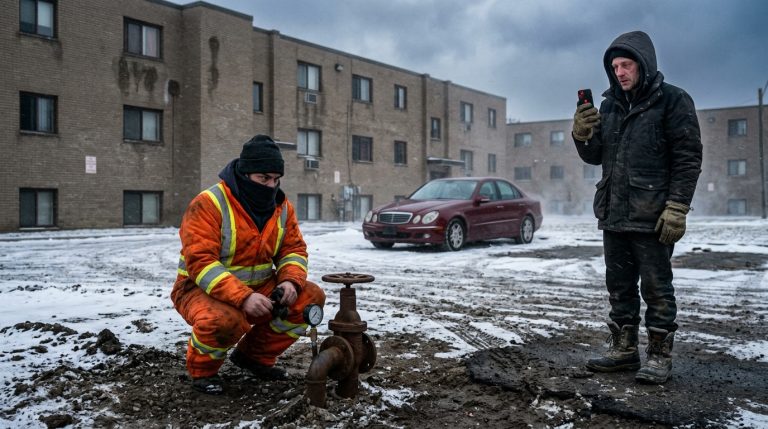
The sound wasn’t like a crash; it was a rhythmic, industrial violation. A snow plow, its blade scarred and rusted, tore through the wire fencing with the careless precision of a machine that had done this a hundred times before. Posts snapped, sending splinters of dry wood into the swirling white air, and before the dust of the impact could settle, the dump trucks were already pivoting. They backed into the pasture, their reverse alarms blaring a frantic, incessant rhythm against the roar of the storm.
I stood there, boots sinking into the mud that had been frozen solid only an hour ago, watching them deposit a slurry of gray sludge—road salt, chemical melt, and grime—directly onto the grazing land. The bulls, usually placid, were frantic. They bolted toward the far fence, their hooves scrambling for traction on the slick, thawing ground. One slammed into the feed trough, the galvanized steel buckling under his weight.
My wife stood in the barn doorway, wrapped in a wool coat that looked thin against the biting wind. She wasn’t moving. She was just watching the dark, oily mounds of waste swallow the pasture, her eyes tracking the movement of the trucks as if she were counting them.
The air smelled of diesel and burning salt—an unnatural, biting scent that coated the back of my throat. I wanted to run to the fence, to put my hands up and block the next truck, but the momentum of the machinery was absolute. There was no hesitation in the drivers, no curiosity in their maneuvers. They were executing a plan.
A red BMW pulled up alongside the ruin of my gate, its sleek lines a sharp, out-of-place contrast to the rugged utility of the trucks. The door opened and the HOA president stepped out, her boots clicking against the ice, not a single flake of snow clinging to her tailored wool coat. She held a stack of papers in one hand, protected by a plastic sleeve.
She didn’t look at me at first. She looked at the pasture, then at the barn where my wife stood huddled in the doorway.
“This is just the start,” she said. Her voice was thin, sharp, and carried clearly over the grinding of the engines.
She turned to face me. Her face was calm, the expression of someone who had already finished the conversation in her head. She held the papers out as if they were a shield. “I’m operating under winter safety authority. This is a temporary land seizure for the good of the subdivision.”
I took a step toward her, the mud pulling at my heels. The fence was gone, the pasture was ruined, and the machinery was still humming, waiting for the next signal to dump more poison into the soil that had been in my family for three generations. The cold started to seep through my jeans, a dull, aching pressure, but it was nothing compared to the realization that the fence line wasn’t just broken—it had been erased.
CHAPTER 2: THE GATES SHADOW
The roar of the engines didn’t fade when she drove off. It lingered, a low-frequency vibration that rattled the loose boards of the barn wall and seemed to settle deep into the frozen mud of the driveway. The red BMW left two perfectly crisp, dark ruts in the snow, a mocking signature left behind on the white expanse. My wife, Sarah, hadn’t moved from the barn doorway. Her fingers were white, knuckles locked around the rough-hewn wood of the frame.
“She didn’t even look at the cattle,” Sarah said. Her voice was flat, devoid of the tremor that usually betrayed her fear. It was the sound of someone who had seen the mechanics of the machine and understood exactly what they were designed to crush.
“She doesn’t have to,” I replied. I was still standing by the remains of the gate, my boots caked in a mixture of black soil and the chemical-laced slush the plow had deposited. The fence was a tangle of snapped wire and jagged wood, the structure that had held for forty years dismantled in forty seconds. I reached down to pick up a splintered post, but the wood was frozen into the earth, stubborn and unyielding.
I didn’t try to pull it free. Instead, I stood still, letting the cold air sharpen my focus. The trucks were idling a hundred yards out, waiting. They weren’t moving, but they weren’t turning off their ignitions either. They were a perimeter, a line of iron sentinels ensuring the “temporary” zone remained under their control.
A loud, wet thud echoed from the pasture. One of the bulls had slipped in the slush, his flank hitting the hardening sludge with a sickening, heavy sound. He scrambled, his hooves sliding against the ice, legs kicking out with desperate, uncontrolled energy. I moved toward the gate, my pulse hammering against the base of my throat. I couldn’t afford to lose the herd—that was their leverage. If the animals died, the land was just empty dirt, and empty dirt was the easiest thing in the world to condemn.
I walked past the bright orange flags they had hammered into the snow, my heart rate spiking as I crossed the invisible line of their jurisdiction. My phone buzzed—a sharp, aggressive vibration against my hip. I glanced at the screen: Violation: Unauthorized Entry. Another automated fine, logged and dated before I’d even cleared the snow drift.
I kept walking, ignoring the warning. The bull was up, but he was limping, his dark coat matted with the grayish-blue slurry of road waste. I grabbed the halter, my hands trembling slightly as I felt the animal’s shivering. He was terrified, his breath exploding in short, ragged clouds that mingled with the steam rising from the chemical pits.
“Steady,” I whispered, the word feeling foreign in the absolute silence of the field.
Behind me, one of the plow drivers climbed down from his cab. He didn’t approach; he just stood by the running engine, his silhouette sharp and predatory against the pale, dying light of the afternoon. He was watching. He was recording. Every move I made, every struggle with the animal, was being cataloged for the next official notice.
The weight of the situation felt like physical pressure on my chest. This wasn’t just a neighborly dispute about snow removal; it was an exercise in attrition. They wanted me to tire, to snap, to do something that would allow them to invoke the next clause in their “emergency” paperwork.
I led the bull toward the barn, keeping my eyes fixed on the path ahead, refusing to look at the trucks. Sarah met me halfway, her face tight. She reached out and placed a hand on the bull’s neck, her touch light, calming the animal. She didn’t look at the drivers either.
“We need to document this,” she said quietly, barely audible over the hum of the idling trucks. “Every yard of this. Every time they dump. If they’re going to act like a municipal authority, we’ll treat them like one.”
“It’s not enough,” I said, looking back at the tangled ruin of the fence. “They’re not just dumping snow, Sarah. Look at the way they’re positioning the loads. They aren’t trying to clear the road. They’re building a perimeter.”
As if to prove the point, the driver at the gate climbed back into his cab. The engine revved, a violent, metallic sound that sent a vibration through the ground, and the truck began to back in again. Not toward the pasture, but toward the corner of the barn—the only place where the wind was blocked. They weren’t just dumping; they were cutting off our shelter, one load at a time.
I watched the truck maneuver, the tires biting into the frozen earth with a grinding, screeching friction. My hands felt numb, the cold finally beginning to penetrate my gloves. I realized then that I couldn’t fight this with force. The moment I laid a hand on a driver or stepped in front of a blade, I was providing them with the exact catalyst they were waiting for.
I looked at the house, the small, quiet structure that had been home for decades, then back at the trucks. The cold, precise logic of the HOA president’s smile came back to me, the way she had looked at the barn as if it were already a demolition site.
“Get the camera,” I said, my voice low and steady. “And the logbook. Start with the truck serial numbers and the exact times of the loads. If they want to play by the rules of an emergency operation, we’ll hold them to every single letter of the code.”
I stood my ground at the edge of the muck, watching the truck reach the barn. It dumped its load with a roar that felt like a challenge, a wall of dirty, salt-stained snow that blocked the path to the side door. I didn’t move. I kept my gaze fixed on the driver’s side mirror, waiting for him to look back, waiting for a sign of hesitation.
He didn’t. He shifted gears, the heavy machinery groaning, and pulled forward, his tires throwing slush onto my boots. I remained motionless, a single, stubborn point of resistance in a landscape that was rapidly being transformed by force. The sun dipped below the horizon, and the night air began to harden the sludge, locking the chemicals into the soil.
The game had begun. It wasn’t about the snow. It was about who would break first—the land, or the people standing on it. And as the dark settled over the pasture, I knew that the silence was only the first weapon they were using.
CHAPTER 3: THE SQUEEZE
The night did not bring quiet. It brought a stillness so absolute it felt heavy, a pressurized vacuum that seemed to amplify the smallest sounds: the rhythmic shifting of the bulls, the crackle of ice forming on the newly dumped mounds of road waste, and the distant, constant hum of a plow truck idling on the perimeter of the property. I stood in the barn, the lantern light casting long, distorted shadows against the rough-sawn timber. Sarah sat on a bail of hay, her shoulders hunched, her breath coming in slow, rhythmic clouds that didn’t quite dissipate in the frigid air.
“They’re not leaving, are they?” she whispered. It wasn’t a question, but a resignation.
“No,” I said, checking the bolt on the side door. The trucks had effectively pinned us into the northern corner of the barn. Every exit that led toward the main road or the feeding lanes was now obstructed by six-foot piles of frozen, salt-crusted debris. It was a calculated isolation. They were waiting for the herd to grow restless, for the hunger to drive the animals toward the troughs—which were now buried under a mountain of chemical runoff.
I turned back to the ledger I had laid out on a feed sack. My hands were stiff, the skin cracked from the cold and the constant abrasion of frozen wire and rusted iron. I had been cataloging the arrival times of the trucks since the sun went down. Every forty-five minutes, a new load. Every load, a deeper encroachment. I had the timestamps, the registration numbers I’d managed to catch through the beam of my flashlight, and the specific delivery routes.
“They’re moving in a pattern,” I muttered, more to myself than to Sarah. I traced the line of the dump sites on the map I’d scratched out on the back of a shipping invoice. “They aren’t dumping randomly. They’re forming a channel. They’re forcing the herd into the drainage ditch.”
Sarah looked up, her brow furrowed. “Why the ditch? That’s the lowest point on the property. If it freezes, the runoff will pool there.”
“Exactly,” I said, the realization settling into my gut like lead. “If the runoff pools, it’s a containment issue. If it’s a containment issue, they can claim the entire pasture is a hazardous site. It’s not just about dumping snow anymore, Sarah. It’s about creating a justification for a complete, permanent land seizure. They need a reason for the county to declare this place a disaster zone.”
I stood up, the movement causing my stiff muscles to ache. I walked to the edge of the stall, listening to the bulls. They were restless, their low, guttural snorts echoing against the barn’s tin roof. One of the younger bulls was pacing, his hooves clattering against the concrete with a frantic, uneven rhythm. The smell of the chemicals had started to permeate the barn, a sharp, metallic tang that burned the back of my throat.
I walked to the side door and pressed my ear against the wood. Outside, the wind howled, but underneath it, there was the sound of metal scraping against stone—the plows were working again, not dumping, but clearing the very path that would funnel the runoff toward the ditch. They were sculpting the land, molding it like clay to serve their end goal.
I went back to the ledger. I needed a way to prove the intent, to show that this wasn’t an emergency operation, but a deliberate, engineered conversion. I thought about the forged notice I’d found on the gate earlier, the one with the signature that looked like a bad imitation of my own. I pulled it from my jacket pocket. The ink was slightly smudged from the snow, but the bureaucratic language remained chillingly clear: Temporary Land Use Authorization – Emergency Infrastructure Maintenance.
“I’m going to go out there,” I said, reaching for my heavy coat.
Sarah was up in an instant, her hand gripping my forearm. “You said yourself—if you step past the line, they hit you with the fine. They’re watching for you to lose your temper. That’s what she wants, remember? She said it herself.”
“I’m not going to fight them,” I said, pulling my arm free gently. “I’m going to mark the boundaries. If they want to treat this like an official survey, I’ll give them a survey they can’t ignore.”
I stepped out into the night. The air was like a physical weight, cold enough to make my teeth ache. I took a spool of reflective tape and a handful of surveyor’s stakes I’d scavenged from the garage. The darkness was thick, but the floodlights from the idling trucks turned the snow into a blinding, featureless white. I moved carefully, keeping to the shadows of the machinery.
Every crunch of my boots on the frozen mud sounded like a gunshot in the still air. I could see the drivers inside the cabs, their faces illuminated by the blue light of their tablets, their expressions vacant and bored. They were just gears in a larger machine, following the coordinates punched into their systems.
I reached the first line of the orange markers they had set up. I took a stake and pounded it into the ground, a few inches outside their imaginary border. Then I took the reflective tape and stretched it between my stakes, creating a clear, visible demarcation line that followed the original, legal deed of my property.
I was working with a methodical, cold precision. This wasn’t about anger; it was about reclaiming the space in the only language they seemed to understand: documentation. As I worked, a movement near the edge of the lights caught my eye. It was a man, standing by the lead truck—not a driver, but someone else. He was holding a clipboard, his movements purposeful and slow. He watched me for a moment, his gaze lingering on the stakes I was driving into the earth, then he made a note and turned back to the driver.
He didn’t shout. He didn’t approach. He just stood there, the master of the operation, observing the small, defiant line I was drawing in the dirt. I felt a surge of cold, hard focus. They wanted to turn this place into a landfill? Then I would make sure every square inch of the record was as accurate as the law required.
I finished the last stake and stood back, the reflective tape shimmering in the strobe of the truck’s warning lights. It was a pathetic gesture in the face of their power, a thin ribbon of plastic against tons of steel and salt. But as I looked at it, I saw the truth of our situation. They were counting on us to be reactive, to be messy, to let our emotions dictate our actions. By remaining disciplined, by focusing on the geometry of the property and the legal reality of the boundaries, I was forcing them to recognize the framework I was standing on.
I walked back toward the barn, my boots heavy with the frozen weight of the soil. As I reached the door, I looked up at the trucks. The man with the clipboard was still watching. He didn’t look like a bureaucrat; he looked like a landlord evaluating the progress of a demolition.
I stepped inside and locked the door, the click of the latch echoing in the barn. Sarah looked at me, her eyes searching my face. I didn’t say a word. I just sat down at the table and picked up my pen. There was more documentation to do, and I knew that if I didn’t map every inch of the violation, there would be nothing left to defend by morning.
CHAPTER 4: THE ARCHIVAL STRIKE
The blue light of my phone screen was the only illumination in the barn, casting long, jittery shadows against the grain of the wood. My thumb hovered over the county’s property records portal, the page already cached from my earlier, frantic search. Sarah sat across from me, wrapped in the wool blanket, her eyes fixed on the flickering lantern light. Neither of us spoke. The silence was thick, filled with the distant, rhythmic growl of the plow engines circling the property like predatory fish.
I zoomed in on the document titled Temporary Land Use Authorization. It looked official enough at a glance: the county seal, the bold headers, the dense legalese that was designed to intimidate anyone without a law degree. But as I leaned in, the screen’s light caught a subtle error in the rendering of the seal. The lines were slightly blurred, the shading on the emblem inconsistent with the digital stamps on the surrounding property filings.
“Look at this,” I whispered, sliding the phone toward Sarah. I pointed to the bottom of the page, where the signature block resided. “It’s not just a bad imitation. It’s a copy-paste job. Look at the alignment of the notary’s stamp compared to the date line. They’re off-kilter by three degrees.”
Sarah squinted at the screen, her finger tracing the edge of the forged seal. “If this is a fake, then the whole ’emergency’ designation is a lie. If there’s no valid document, there’s no legal standing for them to be on this land.”
“Exactly,” I said, my voice hardening. “But they’re relying on the fact that I wouldn’t know how to navigate the county’s archival system. They’re banking on the assumption that a rancher will get angry, get violent, and give them the very leverage they need to make this land seizure permanent.”
I shifted my focus to the metadata of the file. Someone had uploaded this document on a weekend—an after-hours override that shouldn’t have been possible without high-level administrative access. I started digging, pulling up the history of the parcel. The deeper I went, the more the complexity of the scheme began to reveal itself. It wasn’t just a simple land grab. The parcel was tied into a complex network of LLCs—shell vendors, snow-management partnerships, and maintenance contracts that all funneled back to a single primary account.
It was a $2.8 million laundering machine. They weren’t just clearing roads; they were using the emergency codes as a tax-and-fee vacuum, routing community funds into their own pockets while systematically destroying the assets that stood in their way.
“They aren’t just taking the land,” I said, the gravity of the realization making my chest ache. “They’re using my property as a clearinghouse for public funds. If I fight this the wrong way—if I just go in swinging—they win. They’ll bury me under an ‘obstruction of public safety’ charge, and the investigation will die with me.”
Sarah’s hand reached out, covering mine. “We need someone who understands the system better than they do. Not just an attorney, but someone who knows how the county archives work. Someone who can pull the audit trail without flagging the HOA’s network.”
“I know one,” I said, remembering an old contact—a former auditor who had been sidelined after pointing out discrepancies in the HOA’s books years ago. My son had known him. It was a name I hadn’t thought of in years, a piece of the puzzle that was now clicking into place with a sickening clarity. My son’s report on fund mismanagement hadn’t been a fluke; it had been the first time someone had scraped the surface of this, and the HOA had spent years burying it.
I stood up, the chair scraping sharply against the concrete. I felt a sudden, cold urgency. I grabbed my coat and headed toward the door.
“Where are you going?” Sarah asked, her voice rising.
“I need to get into the county archive office before they wake up and realize the portal is being audited,” I said. “I can’t do this from the phone. I need a physical terminal. If I can get in and pull the original log of who accessed the portal to upload this easement, I can link the account directly to the president’s office.”
“They have the pasture surrounded,” Sarah reminded me, gesturing toward the door. “If you try to leave, they’ll stop you. They’re looking for any reason to escalate.”
“Then I won’t leave the way they expect,” I said, looking toward the rear of the barn, where the slope of the land led down into the ravine. It was a treacherous path, buried under two feet of snow and ice, but it was the one place they hadn’t bothered to monitor with the plows.
I checked my heavy flashlight and grabbed a shovel. It was going to be a long, grueling trek through the drift-choked ravine, but every minute I spent waiting for them to move was a minute they used to solidify the forgery. I stepped out into the night, the freezing wind hitting my face like a physical blow. The world was a vast, blinding white, and for the first time, I felt the sharp, cold edge of resolve. I wasn’t going to out-muscle them, and I wasn’t going to scream at them. I was going to dismantle their foundation, piece by piece, starting with the very files they thought they’d hidden.
I began to dig, the metal of the shovel biting into the frozen crust of the earth, the sound of the friction the only thing masking my movement from the trucks parked at the front gate. Each shovel of snow I cleared was a step toward the truth, a step toward ending the lie that was slowly strangling our home.
CHAPTER 5: THE CEMETERY PATH
The trek through the ravine was not a journey; it was a slow, agonizing attrition of will. The snow in the gully had drifted deep, a soft, treacherous powder that hid jagged rocks and tangled brush, forcing me to climb with a desperate, clumsy force. Every time I slipped, the shovel I carried seemed to grow heavier, a leaden anchor pulling at my arm. My breath was a ragged rasp in the stillness, a loud, intrusive sound that felt like it could carry for miles across the frozen landscape.
When I finally pulled myself up over the final ridge, the wind hit me with the force of an oncoming train. I stood on the edge of the old cemetery, the site where the town’s oldest families lay under heavy, frost-bitten granite. In the pale, watery moonlight, the headstones looked like ragged teeth biting into the edge of the sky.
I walked toward the center, my boots crunching on the frozen crust. I stopped at the plot marked by the small, weathered marker that bore my son’s name. My heart stalled.
The snow around the headstone had been recently disturbed. Sharp, distinct tracks—the tread of heavy, industrial-grade boots—led directly to the marker. I felt a surge of cold, sharp adrenaline that pushed back the exhaustion. The small wooden cross I had placed there months ago—a simple, hand-crafted memorial—had been snapped clean in half. One piece lay discarded in a drift; the other had been driven into the frozen earth with such violence that it stood like a jagged spear point.
I knelt, my hands shaking as I reached for the broken wood. It wasn’t just vandalism; it was a message. This was the specific spot where, years ago, my son had held the first meeting with the auditor to discuss the early signs of fund misuse. It was a place only the local board would know about.
I leaned closer, my flashlight beam cutting through the gloom. There were no other tracks leading away from the plot. Someone had walked here with purpose, destroyed the marker, and left as silently as a ghost.
I felt a sudden, disorienting spin in my perception. For a split second, the shadow cast by the snapped cross seemed to stretch and shift, mimicking the silhouette of the HOA president. I blinked, rubbing my eyes. The exhaustion was setting in; my mind was beginning to project the face of my enemy onto the landscape, a byproduct of too many hours in the cold and too much silence. I forced myself to focus on the grit of the ground, the smell of damp pine and bitter iron.
Stay grounded, I told myself. The facts are the only thing that holds.
I pulled out my phone. The signal in the valley was non-existent, but here on the ridge, I caught a single, flickering bar. I began to record the scene—the broken cross, the tracks, the proximity of the marker to the overgrown fence line that bordered the subdivision’s maintenance road. I took wide shots, then macro details of the boot treads. They weren’t just any boots; they were the thick, reinforced soles used by the heavy machinery contractors.
The connection between the contractors and the HOA was no longer a theory. It was a physical, documented presence.
“They aren’t just trying to bury the land,” I whispered to the empty air, the words feeling brittle. “They’re trying to erase the memory of anyone who ever challenged them.”
As I stood to leave, a sound caught my attention. It was the low, rhythmic thrum of a heavy engine. I dropped to the ground, pulling my coat tight to merge with the shadow of a large monument. A maintenance vehicle, its beacon muted, was idling on the access road just beyond the cemetery line. A man stepped out, his flashlight sweeping over the trees. He wasn’t looking for deer. He was checking the boundary.
I held my breath, my muscles locked in a spasm of tension. The beam of his light passed inches from where I lay, illuminating the snow-dusted granite just above my head. He walked to the fence, tested the tension of the wire, and then, after a long, agonizing pause, turned back to his truck.
I didn’t move for ten minutes after he drove away. I lay in the freezing mud, my pulse hammering against the cold earth, feeling the weight of the stakes I’d driven into the pasture earlier. They were moving in. The “emergency” operation was shifting from a temporary dumping project to a full-scale occupation of the perimeter.
I stood up, my joints stiff, and began the climb back toward the barn. I had the photos. I had the proof of the site’s desecration and the evidence of the illegal patrols. But as I moved, I felt a new, darker realization settling in. They knew I was out here. The broken cross hadn’t been a warning; it had been a lure. They had wanted me to come to the cemetery, to expose myself, and now they knew exactly where I went when the night grew thin.
The path back felt longer, the shadows deeper. Every tree seemed to hold a watcher, every gust of wind sounded like a whispered order. I reached the edge of the ravine, but I didn’t head straight back to the barn. I circled wide, through the thicket of birch trees, looking for any sign of a perimeter sweep.
I was no longer the one documenting the process. I was the one being tracked by it. And as I neared the barn, I saw the lights were out—total, suffocating darkness. Sarah wasn’t in the doorway. The silence that hung over the property was no longer the silence of a siege; it was the silence of something having already been breached.
CHAPTER 6: THE GATHERING STORM
I stood in the mouth of the barn, my boots locked against the frozen earth. The darkness was total, a suffocating velvet that pressed into my eyes. I didn’t reach for my flashlight. I knew that in the current climate of this siege, light was a declaration of presence. I listened, my pulse thrumming in my ears like a distant, frantic drum.
Sarah? The name formed in my throat, a dry, constricted ache, but I swallowed it back. If they had taken her, they were waiting for me to announce myself.
I felt the grit of hay under my boots—scattered, trampled, the telltale sign of a struggle. I crouched, my hand skimming the ground until it met a cold, hard object: a discarded hair clip. My fingers closed around it, the metal biting into my skin. It was hers. The air in the barn had shifted; the sharp, chemical tang of the road salt was overlaid now with something else—the faint, lingering scent of the HOA president’s expensive, antiseptic perfume.
They had been here. They hadn’t just watched; they had entered.
I moved with the slow, deliberate motion of a predator, my senses sharpened by the adrenaline that now flooded my system. Every creak of the floorboards under my weight sounded like a thunderclap. I reached the interior stall, finding the gate hanging open, the latch bent backward with a violent, unnecessary force. The cattle were gone.
A hollow, agonizing realization crashed over me. They hadn’t just kidnapped my wife; they had cleared the herd. They had erased the only reason I had to remain on this land. Without the animals, the “agricultural” designation was void. They had effectively nullified my legal standing to contest the land use.
My son’s voice, a ghost from a decade ago, whispered through the rafters of the barn—a memory of his warning about the HOA’s reach, about how they viewed the law not as a fence to keep them in, but as a net to hold others down. I pushed the thought away, focusing on the tactical reality: the empty stalls, the silence, and the encroaching pressure of the trucks still idling outside.
I retreated toward the rear of the barn, finding the hidden panel behind the feed bin where we kept the spare keys and the emergency log. It was gone. The entire wall had been stripped bare. They hadn’t just come for the living; they had come for the proof.
I backed out into the cold night air, the snow beginning to fall in heavy, suffocating sheets that turned the world into a blurred, featureless void. I didn’t have time to mourn. I didn’t have time to fall apart. I had to reach the people—the retirees, the families, the folks who still believed that a signature on a document meant something.
I moved through the brush, staying off the main paths, my breath coming in jagged, silent hitches. I was headed for the Miller place, a quarter-mile through the trees. Arthur Miller was the one who had helped my son with the original report; he was the one who had kept the duplicate files for all these years. If he still had them, I had a chance to blow the lid off the shell companies.
The wind shrieked through the birch trees, pulling at my clothes like unseen hands. I tripped over a hidden root, the fall driving the breath from my lungs, but I scrambled up, my fingers digging into the frozen mud until my fingernails bled. I was a man coming apart, but I was also the only man left standing.
I reached the Miller gate, but it wasn’t the way I’d left it. The house was dark, but a truck—a heavy-duty pickup with the same logo as the HOA’s favored contractor—sat idling in the driveway. The doors were wide open. A man was walking out of the house, his coat covered in snow, a stack of folders clutched to his chest. He didn’t look like an official. He looked like an eraser.
I didn’t think. I didn’t plan. I simply lunged.
I hit him in the middle of the driveway, the impact driving us both into the deep, drifted snow. We tangled, a chaotic, thrashing mess of limbs and breath, the cold turning the struggle into a frantic, blurred choreography. He was strong, trained in the kind of systematic, efficient violence that characterizes a hired hand, but he was startled. I got my hand around his wrist, twisting until the folders scattered, papers flying into the wind like wounded birds.
“Where is she?” I roared, the sound tearing through my throat. I slammed him back against the truck, the metal ringing with the force of his frame. “Where did you take her?”
He didn’t speak. He just grinned, a jagged, broken line in the pale light. He reached for something in his jacket, but I was faster. I forced his arm back, pinning it, and grabbed the nearest folder from the snow.
It wasn’t a file. It was a digital drive, labeled with the HOA’s internal audit code.
He kicked out, his boot catching me in the ribs, sending me reeling back. I scrambled for the drive, my fingers brushing it, but he was back on his feet, reaching for his own weapon. I didn’t wait for him. I snatched the drive and bolted, diving into the deep woods before he could clear his holster.
The shots went wide, snapping branches around my head, but I didn’t stop. I ran until my lungs felt like they were filled with shattered glass, until the world dissolved into the dark, rhythmic pounding of my own heart. I had the audit. I had the truth. But as the sound of the pursuit faded into the howling wind, I knew that the cost of this evidence was everything I had left. I was alone, Sarah was gone, and the trucks were moving in on the house.
CHAPTER 7: THE COMMUNITY RECKONING
The storm had become a living, breathing entity, a swirling wall of white that turned the world into a claustrophobic tunnel of ice. I kept to the tree line, my boots leaving deep, erratic impressions in the snow. My legs felt hollowed out, the muscles twitching with the onset of hypothermia, but the drive—the small, silver sliver of metal against my skin—was a burning coal of purpose.
I crested the final hill overlooking the community center. The parking lot was a chaos of flashing amber lights and the deep, guttural idling of heavy plows. They were everywhere. It looked less like a meeting and more like a siege installation. I watched from the cover of a dense cedar grove as the residents—the retirees, the families, the people whose silence had been purchased with fear—trudged toward the center’s entrance, their heads bowed against the wind.
They were being herded.
I checked my phone; the screen was dead, the cold having finally sapped the last of the battery. I was blind to the updates, cut off from any outside help. I had to get inside. I had to find a way to make the evidence speak before the meeting was called to order and the vote was forced through.
I bypassed the main entrance, moving toward the rear service door—a heavy, rusted steel slab that served as the intake for the building’s heating system. I had worked on the building’s infrastructure years ago; I knew the latch was temperamental, prone to sticking if the ice built up. I pried at the metal with my pocketknife, the cold metal biting into my fingertips until they bled, the blood instantly freezing on the surface.
With a final, desperate shove, the lock gave. I slipped into the dark, echoing utility corridor. The sound of the meeting hit me immediately—the low, droning hum of voices, a sharp gavel strike, and then the voice of the HOA president, amplified through a PA system that rattled the walls.
“The motion for permanent conversion is already recorded,” her voice stated, cold and clipped. “There is no need for further debate. We are here to finalize the resolution of the emergency site.”
I moved toward the main hall, my footsteps silent on the concrete floor. The ventilation ducts above me were vibrating with the force of the wind outside. I reached the service door that led into the back of the auditorium, near the podium. I could see the silhouette of the room—the rows of chairs, the tense backs of the residents, and the president at the front, standing behind a wall of official-looking documents.
I didn’t rush. I took a breath, letting the adrenaline settle into a hard, cold focus. I had one shot at this. If I walked out there, I would be swarmed, stopped, and removed before the first image hit the projector screen. I needed to bypass her control of the system.
I looked up at the wall-mounted junction box. It was a standard interface for the building’s AV setup. If I could bridge the connection, I could bypass her laptop and force the display to recognize the drive I carried. It was a long shot, a gamble on hardware that had been outdated for a decade, but it was the only way to ensure the entire room saw the audit trail at the same time.
I unscrewed the casing, my hands clumsy with cold. The wires were a tangle of gray and white—a chaotic, unorganized mess. I traced them, my heart hammering against my ribs, until I found the main output loop. I spliced the connection, the spark of electricity stinging my thumb, and shoved the drive into the port.
“The vote will proceed now,” the president said, her voice dripping with artificial authority. “Please, show of hands for the ratification.”
I pressed the transmit key.
The projector overhead, which had been displaying a sterile map of my pasture, flickered violently. The image shattered into static, then corrected into the raw, unflinching reality of the audit. Lines of financial transfers, highlighted in red, cascaded onto the screen. The forged signature of the notary, blown up to twenty feet in height, hovered over the room, the blurred edges of the seal now painfully apparent to everyone in attendance.
The room went dead silent. The only sound was the howling of the wind outside and the frantic, rhythmic tapping of keys from the president’s laptop. She spun around, her face pale, her composure finally fracturing into a mask of pure, unadulterated fear.
“What is this?” she shouted, her voice breaking. “Who did this? Cut the power!”
The residents turned in their seats, their eyes wide, locking onto the scrolling columns of money—the $2.8 million that had been siphoned from their community funds. I didn’t wait. I pushed the door open and stepped out into the light, my clothes covered in mud, my hands raw and bleeding.
I didn’t have to say a word. The screen was saying it for me. I walked down the center aisle, the room parting like water as the realization of what they were seeing—and what they had been paying for—began to register. I stopped ten feet from the podium, my boots leaving dark, muddy tracks on the polished floor.
The president looked at me, her eyes darting between the screen and the room. For the first time, she wasn’t a regulator or an administrator. She was just a person who had spent years building a house of lies, and now, the foundation was finally starting to crack.
The gavel fell, not from her hand, but from the shock of the room. The silence wasn’t the silence of fear anymore; it was the heavy, suffocating silence of a truth that could no longer be ignored. And as the back doors of the center burst open, and the county officials I’d hoped would be here finally arrived, I felt the cold, hard weight of the drive release from my hand. It was over. The lie had been dismantled, and the pasture, the barn, and the memory of my son would finally be left to heal.
CHAPTER 8: THE RESTORATION
The silence that followed the revelation wasn’t the silence of confusion; it was the heavy, settling quiet of a world finally clicking back into its proper axis. The HOA president stood frozen at the podium, her hands still clutching the edges of the wood as if it were a life raft. The screen behind her—the glaring, digital indictment of her $2.8 million web of shell corporations and forged land-use orders—seemed to bleed into the very atmosphere of the room. The county officials moved with a measured, calm efficiency that stood in stark contrast to the chaotic, grinding friction of the past weeks.
One officer stepped forward, the metallic click of his cuffs sounding like a gavel strike in the hollow space. He didn’t rush. He didn’t need to. The evidence displayed on the wall had stripped the president of her authority, her momentum, and her defiance. As they led her past me, her eyes met mine—not with malice, but with a hollow, diminished shock. She was being defeated by the very process she had once sought to weaponize, a poetic justice that left her visibly smaller, stripped of the manufactured power she had wielded for so long.
I didn’t turn to watch her leave. I didn’t need to. I walked toward the back of the auditorium, where Sarah stood near the service entrance. When I reached her, I didn’t say anything. I simply took her hand, the warmth of her palm grounding me, pulling me out of the cold, mechanical headspace I had occupied for days. She squeezed my fingers, her grip firm, a silent testament to the long, grueling stretch of the siege.
The room began to empty, not in a rush, but in a slow, contemplative exodus. People lingered, their hushed conversations replaced by the sound of shuffling feet and the distant, fading roar of the plows outside. An older man, a retired civil engineer who had spent decades in the county’s employ, stopped by the aisle where I stood. He looked at the screen, then at me.
“The numbers didn’t make sense,” he said quietly. “We just didn’t want to see it.” He gave a curt, respectful nod and walked out into the storm, his shoulders set with a new, weary resolve.
The cleanup began before the meeting had officially concluded. By the time we stepped out into the night, the heavy machinery had been repurposed. The same trucks that had spent days dumping chemical sludge into our pasture were now being directed by county supervisors to load the contaminated piles into sealed containers. It was a rhythmic, orderly process. The headlights of the trucks swung away from our property, the drivers working with a somber diligence that spoke of a collective, quiet understanding of the damage done.
We drove back to the ranch in a silence that was finally peaceful. The air smelled of damp earth and the sharp, clean ozone of the storm’s tail end. When we pulled up to the gate, the pasture looked like a battlefield, the soil churned and scarred by the plows, but the fence was gone—the illegal barriers removed, the orange flags torn down and discarded in a pile by the roadside.
I stepped out of the truck and walked to the barn. The air inside was still cold, but it was no longer heavy. I found the box of tools I had left near the feed bin, the metal handles feeling familiar, almost soothing, against my skin. I began the work of resetting the first post, the rhythmic thud of the mallet against the wood echoing the heartbeat of the land returning to its natural state.
Sarah stood by the stall, holding the lantern high. We worked in a steady, synchronized rhythm, the kind of labor that doesn’t require words. We were repairing the structure, but we were also healing the space. As I tightened the final wire, I looked out over the pasture. The snow was beginning to melt, revealing the dark, resilient grit of the earth beneath. The bulls were already moving back toward the shelter, their movements slow and steady, untethered by the noise and the salt.
My son’s small wooden cross sat on the workbench, waiting to be returned to the cemetery. I picked it up, the grain smooth under my thumb. We would set it back when the thaw was complete, when the ground was soft enough to accept it once more. There would be no more notices, no more forged documents, and no more predatory shadow looming over our fence line.
The HOA was under external oversight, the funds were traced and secured for restitution, and the emergency powers had been stripped away, never to be abused in this county again. The restoration was methodical, and the peace, while fragile, felt earned. I leaned against the post, the wood solid and unyielding beneath my hands. The storm was finally breaking, the clouds above thinning to reveal the faint, cold light of the stars. It was over. The land was still here, and in the quiet of the night, I knew that was enough. We had held the line, and the line had held us in return.