The Silent Ledger: A Siege of Snow, Steel, and the Cold Geometry of Absolute Truth
CHAPTER 1: THE PERIMETER BREACH
The wind didn’t howl; it scraped. It was a gritty, metallic sound, like a file drawn across iron, carrying the weight of the sub-zero drift that had buried the lot. I gripped the doorframe, watching the space where the yellow caution tape had been ten minutes ago. Now, there was only the raw, jagged plastic flapping in the dark, tethered to a single post that groaned under the assault.
Lena Caldwell’s red Mercedes GLE sat in the center of the restricted zone, a dark bruise against the snow. She didn’t look like someone who had just broken a fire department order; she looked like someone who had just claimed a trophy.
I stepped onto the porch. The air wasn’t just cold; it was predatory. My fingers felt stiff as I reached for my phone, the screen already chilled, a single drop of condensation sliding down the corner. I didn’t rush. I didn’t shout. I stood in the biting silence and started the recording, the red light of the lens blinking back at me like a heartbeat.
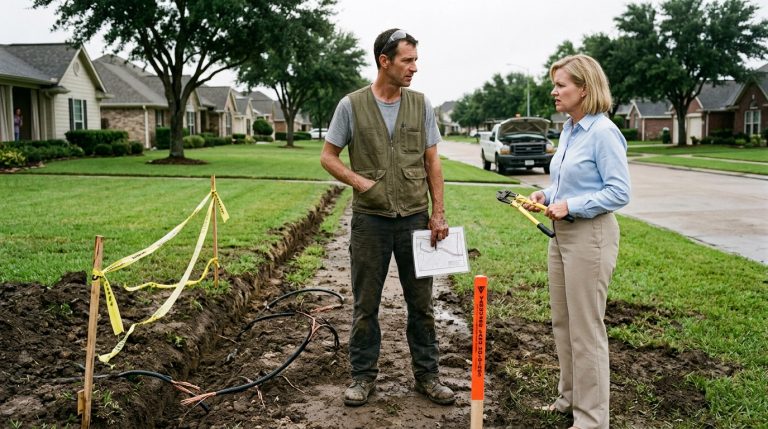
The ground beneath the Mercedes was the point of failure. I could see the way the snow had been compressed into a hard, slick concave where the line—the vital, broken artery of my home’s heat—lay dormant. The city technician had been clear: a weight like that, coupled with the age of the pipe, was a gamble no one should be taking. Lena wasn’t gambling, though. She was performing.
“You’re making a mistake,” I said, my voice thin against the wind.
Lena turned, her hand resting on the driver’s side door. Her coat was immaculate, the color of expensive stone, contrasting against the rusted metal of the utility post behind her. She didn’t look at the warning signs that lay face-down in the drift; she looked through me, as if I were a smudge on a window she was about to wipe clean.
“The lot is at capacity,” she said, her voice carrying a practiced, administrative authority that didn’t belong in a storm. “I don’t have time for these neighborhood dramatics. The HOA has emergency authorization for snow clearance. You’re obstructing.”
I didn’t argue. I didn’t point to the charred smell or the fact that she was parked directly over a utility line that had been flagged for emergency repair. I simply held the phone steady. The zoom lens captured the way her glove touched the caution tape, the snap of the plastic as she finished tearing the last segment away. It was a deliberate movement—precise, rhythmic, cold.
She didn’t believe the danger existed, or perhaps she just hated that the danger was something she hadn’t authorized. As she climbed into the driver’s seat, I noticed something that hadn’t been there before: a small, dark oil leak staining the snow, mixing with the melting slush near the Mercedes’ front tire. A detail. A friction point.
She slammed the door. The sound was flat, swallowed instantly by the blizzard. I backed toward my house, my boots crunching on the frozen earth, realizing that the heat in my own home was a memory fading by the second. She was going to turn the key. And she was going to prove that, to her, reality was just a suggestion.
CHAPTER 2: THE PAPER TRAIL
The hum of the furnace didn’t return. The silence in the house was heavy, a physical weight that pressed against my eardrums. I stood in the living room, the space where I’d spent the last thirty-six hours, and watched the frost on the windows grow, tracing intricate, jagged maps of the sub-zero world outside. My breath hung in the air—a pale, translucent ghost of my own exhaustion.
I looked at my phone. The screen was dark, reflecting my own face—gaunt, shadowed, the eyes rimmed with the redness of a long night. I didn’t reach for the heat. I reached for the charger, then the laptop.
The cold was a constant, biting presence, seeping through the gaps in the window seals and the floorboards. It was a Rusted Truth of this place: the infrastructure was failing, but the bureaucracy was designed to hold even longer. I sat at the kitchen table, the wood freezing to the touch, and opened the digital filing system I’d built over the last week.
I began with the timestamps. Every interaction with Lena, every email sent, every violation notice received. It was a digital map of a siege. I cross-referenced the HOA’s emails about “Emergency Authorization” with the actual municipal guidelines for utility line safety. My fingers moved with a mechanical precision, ignoring the trembling that set in as the temperature dropped further.
Memory flared, unbidden—the smell of the chemical sharpener in the air, the sound of the Mercedes tires crunching over the hard, packed snow. It was a phantom sensation, a lingering echo of the danger that Lena refused to acknowledge. I saw her in my mind, the way she flicked that yellow tape aside like a bothersome cobweb, her face devoid of anything but the smug satisfaction of a power move. She wasn’t just parking; she was asserting that the laws of physics didn’t apply to the HOA.
I pulled up the property maps of the complex, tracing the lines of the utility access. Something felt off. I hovered the cursor over the parking area where the Mercedes was currently stationed. There was a discrepancy—a faint, hand-drawn amendment to the original site plans, dated three years prior. It marked a junction point, a secondary line that shouldn’t have been there, buried directly beneath the most convenient, “reserved” parking spot in the lot.
My heart hammered a slow, steady rhythm. Why would the HOA prioritize this specific spot, enough to risk a gas line breach?
I didn’t guess. I started digging into the maintenance logs, the ones buried in the obscure, often ignored sub-directories of the community portal. I began pulling records of “Emergency Remediation” costs—thousands of dollars billed annually for “surface work” and “valve stabilization.” The money was leaving the HOA account, but the photos I’d taken over the last few days showed nothing but decay.
The cold was deepening. I could hear the pipes straining, a low, metallic groan that made me wince. I had to get out, had to check the perimeter one more time, not to confront Lena—that was a path to nowhere—but to verify the physical reality of what I was reading on the screen.
I stood up, my joints feeling brittle, and moved to the closet. I pulled on layers, my movements deliberate and slow, treating the task like a ritual. Every zipper, every button was a piece of armor. As I stepped toward the back door, I took a long, hard look at the living room. It was turning into a tomb, a shell of a home being sacrificed to keep the truth on the table.
Stepping onto the porch was like stepping into an industrial freezer. The wind carried a fine, abrasive dust of ice that stung my cheeks. I walked toward the edge of the lot, my boots crushing the frozen ruts. I didn’t look at Lena’s apartment, didn’t look at the Mercedes. I walked straight to the utility access point, the steel cage still missing, the snow churned and dark.
I knelt. The metal of the utility post was rusted, flaking away under my gloved touch. I looked at the ground, at the way the earth had shifted, and I noticed a slight discoloration in the snow—a faint, yellowish sheen, like the ghost of a leak.
The system wasn’t just failing. It was rotting from the inside out, and the “emergency” closures were the only thing keeping the rot from being exposed. I reached out, my fingers trembling as I cleared away a layer of packed ice, and found it: a small, steel valve handle, protruding from the earth just inches away from the primary line. It shouldn’t have been there. It was a bypass, hidden in plain sight, and it was a direct violation of every safety standard the fire department had just reaffirmed.
The silence of the neighborhood felt different now—it was a watchful silence. I stood up, heart thudding, and looked back at my home. The light from my kitchen window was a small, steady beacon in the dark, and for the first time, I realized the cost of what I had just found. I had the evidence. Now, I needed to make sure it survived long enough to be heard.
CHAPTER 3: THE UTILITY CONFRONTATION
The steel valve handle was cold, a bite of reality that felt unnaturally heavy. I gripped it, my knuckles white under the nylon of my glove, staring at the patch of exposed ground. It wasn’t just a mistake. It was a deliberate, illicit modification to the infrastructure, hidden beneath the very spot where Lena insisted on parking her Mercedes.
I didn’t try to pull it; I knew better. I stood, my breath hitching in the frigid air, and looked toward the complex entrance. A utility truck was crawling up the access lane, its lights cutting through the white-out like twin spears. This was the moment—not for confrontation, but for evidence. I checked my phone. The battery icon was yellow, flickering, but the signal bar held.
I didn’t step toward the truck. I stayed put, keeping the valve in my peripheral vision as I backed toward the main path. The truck pulled to a stop, the hydraulics of the brake system hissing in the silence. The driver’s door opened, and a technician stepped out, his boots crunching loudly on the frozen ruts. He was bundled in heavy, high-visibility gear, his face obscured by a scarf and a thick, woolen cap.
“You the one who called again?” he asked, his voice muffled.
I nodded, gesturing to the spot behind me. “I didn’t touch anything. But you need to see what the snow uncovered.”
He looked at me, then at the spot. His eyes, narrowed against the wind, tracked the line of the ground. He walked toward the exposed valve, his movements heavy and slow, burdened by the thick insulation of his suit. I followed him, keeping a respectful distance, watching his body language. He wasn’t surprised—he was wary. There was a specific, taut quality to his posture that suggested this wasn’t the first time he’d seen something “unexpected” in this complex.
He knelt, brushing aside the loose ice with a gloved hand. He didn’t speak. He took out a heavy-duty flashlight and clicked it on. The beam was intense, cutting through the shadows and illuminating the rusted, incongruous steel of the bypass valve. He leaned in, his nose inches from the metal.
“That’s not municipal,” he muttered, more to himself than to me. “That’s a direct tap.”
“Is it safe?” I asked, though I knew the answer.
He didn’t answer immediately. He reached into his kit for a portable gauge, his movements precise and practiced. He attached it to the fitting, his hands moving with a practiced, almost rhythmic efficiency. The wind whipped around us, tugging at our clothes, but he remained motionless, eyes fixed on the dial.
“The pressure’s fluctuating,” he said finally, standing up and turning to me. His expression was guarded, the look of a man who realized he’d stumbled into a situation far more complicated than a simple gas leak. “This line shouldn’t even be live. By all rights, it should have been purged and sealed years ago.”
“Lena Caldwell said the HOA had emergency authority,” I said, my voice steady despite the shivering that started to rattle my core. “She said they were managing the community infrastructure.”
The technician let out a sharp, humorless laugh. “The HOA doesn’t have the training, the clearance, or the equipment to touch a valve like this. This is a liability, plain and simple.”
He looked back at the valve, then at the red Mercedes parked just ten feet away. “This bypass? It’s designed to redirect flow. If they were using this to avoid paying for a proper repair, they’ve been playing with fire—literally.”
He looked at me, his gaze lingering on my face for a second too long. There was a hesitation there, a flicker of something that wasn’t just professional concern. It was a warning.
“Listen,” he said, lowering his voice. “I’m going to document this. I’m going to flag it, and I’m going to make sure it’s shut down for good. But you need to be careful. You’re talking about a lot of money and a lot of history in this complex. People don’t like it when their ’emergency’ shortcuts are exposed.”
“I just want my heat back,” I said, realizing how hollow that sounded.
“You’ll get it,” he promised, turning back to his truck. “But this ground isn’t safe. Not until the system is fully audited and the legal lines are drawn. Keep your distance from that Mercedes. If she moves it again, don’t try to stop her. Call the fire department. Call the police. Don’t engage.”
He walked back to his truck, leaving me alone in the biting cold. I watched him climb in, watched the truck pull away, leaving deep, tire-tread scars in the snow. I looked back at the valve. It was a small, unassuming piece of metal, but it held the weight of everything that had been happening—the fines, the threats, the manufactured emergencies.
I took one final photo, the flash illuminating the rusted surface in a stark, unforgiving white. I needed to get inside. The cold was a physical drain now, pulling the energy from my limbs. As I walked back to the house, I could feel the eyes of the complex on me—behind curtains, in the gaps of blinds. The truth wasn’t just a file on my laptop anymore; it was a physical artifact in the ground, and it was becoming dangerous.
I reached my door, fumbling with the keys, my fingers stiff and uncooperative. I stepped inside and shut the door, the lock clicking home with a sound of finality. I wasn’t just a resident following orders anymore. I was a witness. And the silence in the house, previously a weight, now felt like a prelude.
CHAPTER 4: THE RETALIATION
The kitchen was a tomb of shadows, save for the rhythmic, stuttering pulse of the overhead light. I sat at the table, my laptop screen a harsh rectangle of blue light in the gloom, watching the cursor blink. The email notification was a jarring intrusion: HOA Violation Notice – Final Warning.
I opened it. It was cold, clinical, and aggressive. A fine, tripled in amount, for “unauthorized interference with community infrastructure.” My chest tightened. Lena wasn’t just posturing; she was moving to neutralize me. By framing my discovery of the bypass valve as an act of sabotage, she was effectively stripping away my standing to complain about the heat. If I was the vandal, I was the enemy of the community.
A sharp crack echoed from the utility room, the sound of metal contracting in the sudden drop in temperature. I stood, my legs stiff, and moved to the hallway. The house was freezing—the temperature had bottomed out, and the air held a metallic tang, the smell of dust and stagnant, unmoving heat. I reached for my coat, my hand brushing the valve handle I’d retrieved from the lot. It was sitting on the sideboard, a heavy, jagged piece of evidence that felt more like a curse than a key.
Outside, the storm had shifted. The wind didn’t scrape anymore; it slammed, a dull, repetitive thud against the exterior walls that made the house shiver. I looked through the kitchen window. The red Mercedes was still there, a dark, motionless silhouette in the driving snow. But something had changed. A shadow—a person—was standing by the driver’s side door, back turned, face obscured by a hood.
They weren’t clearing snow. They were moving deliberately, their hands busy with something strapped to the car’s bumper. I didn’t breathe. I didn’t reach for the light. I watched, my heart hammering against my ribs, until the figure turned and walked toward the building’s service entrance. It was a man, stocky, with the distinctive walk of someone accustomed to wearing heavy work boots. He wasn’t a resident.
The flickering light over the stove died completely, leaving me in near-total darkness. I moved to the living room window, keeping low. The power was surging, struggling to maintain the load, or perhaps it was being throttled. I pulled up the HOA’s internal portal again. I needed to see if there was a record of this “maintenance.”
There was nothing. The portal was clean, almost suspiciously so. I began to cycle through the older files, looking for anything that contradicted the narrative of a “weather emergency.” My fingers flew across the keyboard, my breath coming in shallow, jagged gasps. I bypassed the user-facing interface and dived into the raw server data, the kind of logs that weren’t meant for public eyes.
I found it buried in a directory labeled “Common Area Assets.” A series of invoices—not for gas, but for “Disaster Remediation Services” paid out to a shell corporation that shared the same registered address as Lena’s personal business. It was all there: dates that perfectly aligned with every “emergency” restriction I had documented. They weren’t repairing the lines; they were filing claims for imaginary catastrophes.
I sat back, the weight of it settling into my bones. The heat, the convenience, the parking space—it was all secondary. The bypass valve was a failsafe, a way to ensure that if an actual inspection was ever forced, they could manually divert the flow to hide the evidence of years of neglect. They were literally siphoning the community’s safety budget to pay for their own failures.
A sudden, sharp thump at the front door made me jump, the sound vibrating through the floorboards. I froze, my eyes snapping to the dark entry. Silence followed, thick and suffocating. I didn’t move. I waited, the rhythm of my heart filling the void. My hand hovered over the phone, my thumb ready to hit the emergency line for the fire department.
“I know you’re in there,” a voice called out—low, muffled, and entirely devoid of warmth. It wasn’t Lena. It was the man from the lot.
I remained motionless, a shadow in the dark. I didn’t speak. I looked at the sideboard, at the valve handle, then back to the door. The handle of the front door turned slowly, testing the lock. The metal groaned, a high-pitched, protesting sound that set my teeth on edge. They had the keys—the master access for the units.
I turned away from the window, my pulse thrumming in my ears. I didn’t go for the door. I went for the laptop, my fingers trembling as I hit ‘sync’ one last time to upload the invoice logs to an off-site cloud server. The progress bar crawled, an agonizing sliver of white against the dark screen.
The door began to open, the heavy deadbolt sliding back with a mechanical thud. I grabbed the laptop and the valve handle, moving silently into the utility room. It was the only space with a secondary exit—a small, narrow hatch that led to the crawlspace under the unit. It wasn’t elegant, and it certainly wasn’t comfortable, but it was the only way out.
The front door swung wide, letting in a swirl of ice and shadow. Footsteps, heavy and deliberate, moved into the living room. I crawled into the narrow space beneath the floorboards, the smell of damp earth and rust rising up to meet me. I watched through the gap as a beam of a heavy flashlight swung across the room, illuminating the spot where I had been sitting seconds before. The chair was still warm. The screen of the laptop, left on the table, flickered once and then went dark.
I didn’t move. I didn’t hold my breath. I kept my eyes on the light, watching as it swept the room, searching for the person who had finally dared to look at the books. I had the evidence, but I was now completely exposed. And as the beam moved toward the kitchen, I knew the game had moved from administrative warfare to something much darker.
CHAPTER 5: THE DECOY DISCOVERY
The light lingered on the kitchen table, illuminating the hollow space where my laptop had been. The man—his movements heavy, boots scraping against the linoleum—shifted his weight. I pressed my back against the underside of the floorboards, the damp, rotting wood digging into my shoulders. The smell of earth and rust was overpowering, a stifling weight that made my lungs labor. My hands were frozen, gripping the valve handle so tightly the steel seemed to imprint itself into my skin.
He grunted, a low, guttural sound of frustration. He wasn’t just searching; he was dismantling. I heard the crash of the kitchen drawers being ripped from their runners, the sound of silverware skittering across the floor. He was looking for the drives, for the physical evidence of what I’d pulled from the server. He didn’t know I’d already hit ‘sync.’
I held my position. The logic of the moment was stripped down to the barest, coldest elements: stay quiet, stay hidden, survive. The flashlight beam swung toward the utility room entrance. It caught the edges of the floorboards above me, the dusty, uneven slats casting long, skeletal shadows across the dark expanse of the crawlspace.
My perception was beginning to fray. The cold was moving past discomfort into a deeper, more dangerous numbness. I felt a phantom vibration beneath my chest—a rhythmic, thumping cadence that might have been my own heart or the distant, muffled thrum of the storm outside. I had to ground myself. I focused on the texture of the wood beneath my palms, the grit of the dirt against my knees. This was the environment of the HOA’s “emergency” work—this was where they hid the reality.
He stepped into the utility room. The floorboard directly above my head groaned under his weight, dust sifting down like gray snow, settling in my hair. He kicked aside a pile of old rags, the sound harsh and violent in the confined space.
“Nothing here,” he muttered, his voice hitting the walls and bouncing back. He sounded bored, a man doing a job he clearly despised, yet his hand remained steady on the light.
I watched his boots through the thin gap in the subfloor. Heavy, rubber-soled, coated in the same dark, oily slush that had been staining the snow near the Mercedes. He paused, his boot resting mere inches from my face. He was looking at the hatch.
My muscles coiled, an instinctive, primal reaction. If he opened it, I would have no choice. The valve handle in my hand suddenly felt very small, very insufficient. I searched the dim space around me for anything else—a loose pipe, a discarded tool—but there was only the damp, unforgiving earth.
He didn’t open the hatch. Instead, he leaned down and shone the light directly into the gap. I squeezed my eyes shut, holding my breath until my lungs burned. The beam washed over the dark, stagnant air of the crawlspace, catching the glint of a discarded soda can, a pile of wet insulation, and finally, the edge of a plastic conduit that ran beneath the flooring.
He lingered there. The conduit was part of the original building plan—I remembered seeing it in the schematics on my laptop. It was supposed to be empty, a relic of a failed upgrade. But the man pulled a small, multi-tool from his belt and tapped the conduit, the plastic emitting a hollow, resonant thud. He seemed satisfied. He stood up, turning away from the hatch, and moved back into the kitchen.
The silence that followed was a physical relief, yet it didn’t signal safety. He was still in the house. He was still waiting.
I waited for what felt like hours, my body locking into a rigid, painful posture. When the sound of the front door finally clicked shut, leaving the house to the howling of the storm, I didn’t move immediately. I waited, listening for the engine of a vehicle to start, for the crunch of tires in the lot.
Only when the silence became absolute did I push the hatch up. It moved with a protest of rusted hinges, and I spilled out onto the floor of the utility room, gasping for air that felt thin and sharp. I climbed to my feet, my legs wobbling, and moved to the center of the kitchen.
It was a wreckage. Drawers lay in ruins, papers were strewn across the counter, and the air felt charged with a lingering, metallic malice. I looked at the spot where the man had lingered—the plastic conduit. I knelt, pushing aside the debris, and used the valve handle to pry the casing loose.
Inside, there was no wiring. There was a ledger.
It was wrapped in a heavy, waterproof bag, the edges brittle with age. I pulled it out, my fingers trembling as I unzipped the seal. It wasn’t digital. It was paper—ink-stained, handwritten, and terrifyingly comprehensive. It was a complete record of every “emergency” claim filed by the HOA over the last decade. It didn’t just list the costs; it listed the kickbacks, the names of the contractors who had never done the work, and the signatures of every board member who had profited.
The decoy secret—the bypass valve—was just the physical manifestation of a much larger, more systemic crime. They hadn’t just been stealing money; they had been orchestrating a decade of manufactured decay, ensuring the community remained in a perpetual state of crisis so they could continue to drain the accounts.
I stared at the pages, the ink looking like dried blood in the dim light. I had the evidence, but the realization hit me with the force of a physical blow: I wasn’t just fighting a neighbor, or even an association. I was holding a mirror to a decade of corruption that the entire local system had been complicit in maintaining. And now, the flashlight beam in my mind’s eye was growing brighter, searching for the person who had just opened the conduit.
CHAPTER 6: THE FLASHPOINT
The cold in the utility room was absolute, a living thing that clung to my skin the moment I emerged from the hatch. I stood, my knees aching, and clutched the waterproof bag to my chest. The ledger was warm—a startling contrast to the frigid air. Outside, the storm had reached a fever pitch, the wind wailing through the gaps in the eaves with the sound of a thousand panicked voices.
I didn’t linger in the house. Every second I spent inside was a gamble, a bet that the man in the heavy boots wouldn’t return to finish his search. I moved to the back door, stepping out into the white-out. The visibility was reduced to a few feet, the world reduced to a swirling, chaotic blur of gray and white. I didn’t care. I knew the geometry of this lot by heart.
I needed to reach the fire department’s designated emergency checkpoint—the reinforced box where they kept the incident logs and safety manifests. If I could get this ledger inside that box, I wouldn’t just have evidence; I would have an official record that couldn’t be “lost” or “misplaced” by an HOA cleanup crew.
I moved along the perimeter of the buildings, keeping low, my boots finding purchase on the ice-slicked pavement. The memory of those warning signs—the bright, yellow block letters being torn down—flashed behind my eyes. I felt a surge of cold, focused rage. It wasn’t the heat of anger; it was the clinical, sharpening clarity of a predator realizing it had been tracked by a scavenger.
The lot was empty, but the sense of being watched was constant. Every gust of wind sounded like a footstep; every shadow cast by the blowing snow looked like a figure standing guard. I reached the service lane, the ground here rutted and treacherous. I could see the Mercedes ahead, its roof buried in a drift, its red paint dulled by the relentless descent of the snow.
A shape moved near the vehicle.
I stopped, pressing my back against the rough, freezing brick of the service wall. It was Lena. She wasn’t standing by the door this time; she was crouched by the front bumper, her hands moving over the area where the illegal bypass valve was buried. She was holding a heavy wrench, her movements frantic, uncoordinated. She was trying to undo the damage, to bury the evidence before the inspectors could return for the pressure test.
I saw the flash of metal—a gleam of steel in the dim light. She was trying to cap the valve, to seal the rot away.
Therefore, if I stayed silent, she would bury the proof. But if I acted now, I risked everything. The logic of the moment demanded action, but the constraints of the situation dictated caution. I watched, my breath hitching, as she hammered at the ice, her face twisted in a mask of desperation. She was terrified. She knew the inspection was coming.
I realized then that I didn’t need to confront her. I needed to ensure she couldn’t complete the work. I scanned the area. A heavy-duty snow shovel lay abandoned near the entrance of the service lane—likely left by the same man who had been in my house. I crept toward it, the plastic handle freezing and slick.
I made a sound—a deliberate, sharp crack of the shovel against the brick wall.
Lena spun around, the wrench slipping from her fingers with a metallic clatter. She stared into the white-out, her eyes wide, searching for the source of the noise. She was unhinged, her authority stripped away, leaving only the raw, exposed fear of someone who had gambled the community’s safety and lost.
“Who’s there?” she screamed, her voice cracking against the wind.
I didn’t answer. I dropped the shovel and turned, sprinting in the opposite direction, toward the fire department checkpoint.
“I know it’s you!” she shouted, her footsteps crunching toward me. She wasn’t thinking; she was running on pure adrenaline, chasing the threat she couldn’t name. She stumbled, fell, and scrambled back up, her coat dragging through the slush.
I reached the checkpoint—a steel locker bolted to the concrete base—and jammed my key into the lock. It was stuck, frozen by the sub-zero temperatures. I pulled, twisted, and forced it, the mechanism groaning in protest.
Lena was gaining. She was only twenty feet away now, her face a pale blur in the storm, the wrench clutched in her hand. She wasn’t just trying to stop me; she was trying to silence the last witness.
The lock clicked open. I swung the door wide, shoved the waterproof bag into the slot, and slammed it shut, twisting the key until the locking pin engaged.
It was done. The evidence was in the system.
I turned, my back against the steel locker, and saw Lena stop. She was shivering, her breath coming in ragged, audible sobs. She looked at the locker, then at me, the reality of the situation finally settling into the space between us. She didn’t move to strike. She didn’t shout. She just slumped, the wrench slipping from her grip and disappearing into the snow.
The storm didn’t ease, but the tension shifted. The silence that followed was heavy, laden with the weight of everything that had been broken. And as the distant, rising sound of sirens began to cut through the howl of the wind, I knew the audit was finally here. The truth wasn’t a secret anymore; it was a physical fact, locked in the very system that had been built to hide it.
CHAPTER 7: THE AFTERMATH
The police cruisers slid into the parking lot like predators surfacing in deep water, their strobe lights painting the falling snow in rhythmic bursts of alternating blue and white. Lena didn’t move. She stood as if frozen, her shoulders hunched against the biting cold, staring at the steel locker where the ledger—the physical proof of a decade of theft—lay secured. The wrench she had dropped was slowly being claimed by the drifting snow, its metallic sheen fading into the gray-white shroud of the lot.
I stepped back, my boots heavy and numb, feeling the sudden vacuum left by the adrenaline. The fire captain was already moving toward us, his pace measured, his face a mask of practiced neutrality. He didn’t look at Lena. He looked at the locker, then at me.
“Is the evidence secured?” he asked, his voice low and distinct, cutting through the mechanical thrum of idling engines.
“It’s in the locker,” I said, my voice sounding foreign to my own ears—raspy and thin. “It’s all in there. The maintenance logs, the shell company invoices, the bypass data.”
The captain nodded, a slight, almost imperceptible shift in his expression suggesting this wasn’t just a fire response anymore. An officer stepped out of the cruiser, his hand hovering near his belt, not in threat, but in ready posture. He moved to Lena, his notebook already out.
“Ma’am, I need you to step away from the vehicle and the restricted zone,” the officer said. He didn’t raise his voice, but the command carried the weight of the badge.
Lena finally turned. Her face was a landscape of raw, exposed vulnerability. The arrogance that had fueled her for years—the belief that she could manufacture reality simply by asserting it—had evaporated, leaving behind a terrified, middle-aged woman in an expensive coat that was now soaked through with icy slush. “He’s sabotaging everything,” she whispered, pointing at me, her finger trembling. “This is a private association. He’s been harassing me for weeks. He’s making it all up!”
The officer didn’t look at me. He kept his eyes on Lena, his pen poised. “We have the written safety orders, Ms. Caldwell. We have the reports from the utility company regarding the unauthorized structural modifications. And now, we have an incident report regarding the evidence you attempted to destroy.”
She went silent. The weight of it hit her, not as a sudden blow, but as a slow, inexorable sinking. The blue lights danced across her face, highlighting the lines of exhaustion and the hollow realization that her title, her authority, and her leverage were now worth less than the scrap metal of her totaled Mercedes.
I stood in the periphery, watching the process unfold. It was clinical, stripping away the layers of pretense one by one. The utility supervisor arrived, his team moving with methodical speed to cordon off the site. They didn’t just tape it off; they installed high-visibility fencing, heavy-duty signage, and began the process of pressure-testing the lines while documenting the illegal bypass. Every action was a testament to reality. Physics, as the captain had said, does not stage itself.
Neighbors were beginning to emerge, drawn by the lights and the sirens. They stood in small, huddled groups, their faces obscured by scarves, watching as their HOA president—the woman who had fine-tuned their community into a cage of manufactured emergencies—was escorted toward the back of the cruiser. They didn’t cheer. They didn’t shout. They watched with a cold, hollow recognition, the kind that comes when you realize the person you feared was never anything more than a small, desperate shadow.
The cold was settling into my marrow, but for the first time, it didn’t feel like a threat. It felt like an ending. The captain walked over to me, his heavy boots crunching on the packed, oily snow. He didn’t say ‘good job.’ He didn’t offer a platitude.
“The evidence is being processed as a formal criminal investigation,” he said, handing me a slip of paper with a case number. “You’ve done your part. Now, the system has to do its own.”
I looked at the number. It was just a sequence of digits, but it felt like a foundation.
“What happens to the complex?” I asked.
“Repairs are being authorized under municipal oversight,” he replied, his eyes scanning the lot. “The board is being dissolved, effective immediately. The city is taking over the site management until an independent audit is completed.”
He turned to leave, but stopped, looking back at the darkened, silent shell of my home. “Get inside, kid. You’re shaking.”
I walked back toward my front door, my movements mechanical. I looked back one last time. Lena was already gone, the cruiser doors slammed shut, the red lights of the vehicle receding into the white-out of the storm. The parking lot, so recently a battlefield of wills, felt suddenly, strangely empty. The only sound was the wind, whistling through the empty space where the caution tape had once whipped against the metal posts. The truth had finally arrived, not with a fanfare or a triumph, but with the cold, relentless efficiency of a document being filed. I reached my door, turned the key, and stepped inside, leaving the rusted, fractured world of the lot behind me.
CHAPTER 8: THE FINAL AUDIT
The house had settled into a profound, unnatural silence. Outside, the storm had finally broken, leaving behind a world draped in heavy, indifferent snow. The heat was steady, radiating from the vents in a low, consistent hiss that no longer felt like a luxury, but like a basic, undeniable function of a world returned to order.
I sat by the window, a cup of tepid coffee forgotten in my hands. The utility crews had finished the final pressure test on the main line hours ago, and the temporary protective cage—that steel, reflective monument to accountability—stood firm in the center of the lot. It caught the harsh, artificial glare of the streetlights, a bright, unavoidable beacon in the night.
The audit was in its final stages. A city representative had come by early that morning, his suit smelling of ozone and ink, to formally document the state of the infrastructure. He didn’t ask questions; he took measurements. He didn’t speculate; he looked at the ledger, the invoices, and the pressure gauges. He was the embodiment of the system’s cold, bureaucratic patience—the antithesis of Lena’s frantic, desperate noise.
I had watched from the window as they dismantled the temporary barriers, replaced the rotted seals, and bolted the new, standardized covers over the entire utility corridor. There were no shortcuts anymore. The bypass valve—that small, rusted piece of metal that had nearly cost me everything—had been pulled from the earth like an infected tooth. I’d watched the technician drop it into a plastic evidence bag, his face unreadable. It was just a piece of hardware, a violation of code, but to me, it was the final period on a sentence that had been running for years.
The embezzlement had been absolute. The invoices I’d recovered from the conduit proved it: the “emergency remediation” fees had been siphoned off at every stage, funding everything from the board’s travel expenses to the maintenance of their own private properties, all under the guise of protecting the community from phantom leaks. The system had been designed to keep everyone afraid enough to stay quiet, and poor enough to keep paying the fines.
There was no grand, cinematic confrontation left to have. The final resolution was quiet, almost anticlimactic. I heard the front door of the neighboring unit open, the sound of official footsteps, and then the quiet, shuffling departure of the remaining board members as they were escorted out by the city’s enforcement officers. They weren’t fighting back. There was nothing left to fight with. The documentation had rendered their authority obsolete.
I stood up and moved to the sideboard. I picked up the valve handle—the only object from the struggle I’d kept. I walked to the utility closet and, with a few turns of a screwdriver, tightened the hinge that had been rattling for weeks—a minor, persistent nuisance that had driven me to distraction before the storm had hit. It was a small thing, but as the screw bit into the wood and the door stopped its shuddering, I felt a strange, resonant satisfaction. It was the repair of a physical space, a small act of maintenance that finally felt earned.
My phone buzzed—a notification from the city auditor. Case status: Remediated. Permanent oversight enacted. Audit of all HOA fiscal history pending.
I leaned my forehead against the cool glass of the window, looking out at the lot. The snow-covered ground was smooth, undisturbed, and for the first time in months, it didn’t look like a minefield. It looked like a parking lot.
A knock at the door—soft, hesitant. I opened it to find a neighbor, a woman from the third floor I’d only ever nodded to in passing. She was holding a thermos, her eyes red-rimmed but clear.
“I heard the heat’s back,” she said, her voice small. “I just… I wanted to say thank you.”
I didn’t offer a speech. I didn’t recount the struggle or the cold or the terror of the crawlspace. I just nodded, taking the thermos, the warmth of it seeping through my palms, a simple, human anchor in the aftermath.
“It’s quiet now,” I said.
“It is,” she agreed, looking out at the lot. “It’s finally just quiet.”
I stood in the doorway, watching her walk back to her unit, the crunch of her boots in the snow the only sound in the night. The weight of the last few days began to lift, replaced by a deep, hollow-out exhaustion that I knew would take weeks to mend. I stepped back inside, locked the door, and for the first time in an eternity, I didn’t check my email. I didn’t look at the files. I simply let the warmth of the house settle around me, a boundary of my own making, safe and finally, mercifully, solid.