The Architect of Shadows: A Tactical War for the Soul of a Suburban Empire
CHAPTER 1: THE WEIGHT OF A BROKEN LINE
The smell of ozone was still hanging in the air, a metallic tang that sat heavy on my tongue. I didn’t reach for the anger. Anger was a luxury for people who didn’t understand the physics of a catastrophe. Instead, I stood by my truck, the engine ticking as it cooled—a rhythmic, cooling pulse in the unnatural quiet.
Karen stood five feet away, her boots caked in the dark, disturbed earth of my easement. She held the yellow bolt cutters like a trophy, her posture rigid, her smile the kind of thin, terrifying line that usually preceded a court-martial.
“This,” she said, her voice dripping with the self-righteousness of a woman who had never spent a day in the mud, “is an eyesore, Mr. Miller. It violated the community standards. I’ve saved us all from an industrial blight.”
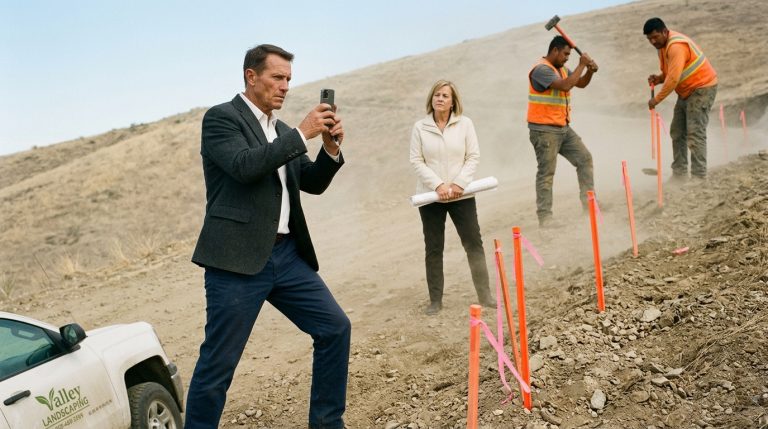
I looked at the severed cable. The copper strands, frayed and jagged, were already oxidizing in the humid air. Two hundred amps of potential energy, reduced to scrap metal in a single, ignorant movement. My shop was dead. My livelihood was dark. But as I stared at the raw ends of the wire, something else caught my eye—a small, plastic stake driven into the dirt near the trench. It was a survey marker, bright orange, branded with a logo I didn’t recognize: Vanguard Land Holdings.
That wasn’t a standard utility mark.
I didn’t yell. I didn’t draw my weapon, though the training pulsed in my fingertips, reminding me that a combat engineer knows exactly how to identify a structural weakness. I reached into my pocket, pulled out my phone, and hit record.
“Karen,” I said, my voice steady, stripped of everything but the facts. “Do you have any idea what you just cut?”
She didn’t blink. “I have the authority of the board, Frank. This line crosses common property. It’s a violation.”
“It’s a bonded easement,” I replied. I walked past her, my eyes tracing the path of the trench. She’d been precise. Too precise. She hadn’t just vandalized a line; she had targeted the exact center of the conduit.
I looked back at her. Her confidence was absolute, but there was a tremor in her hand—not from guilt, but from an adrenaline spike. She wasn’t just enforcing a rule. She was clearing a path.
“You didn’t cut this because of the lawn,” I said softly, the realization chilling me deeper than the silence of my dead workshop. “You cut this because it was standing in the way of someone else’s blueprints.”
Her smile faltered for a fraction of a second, just long enough for me to see the raw, desperate fear beneath the veneer. The wind picked up, rustling the leaves in the quiet Oak Creek afternoon, and for the first time, I realized the war wasn’t about my shop. It was about what was buried beneath it.
CHAPTER 2: THE PAPER ARCHITECTURE
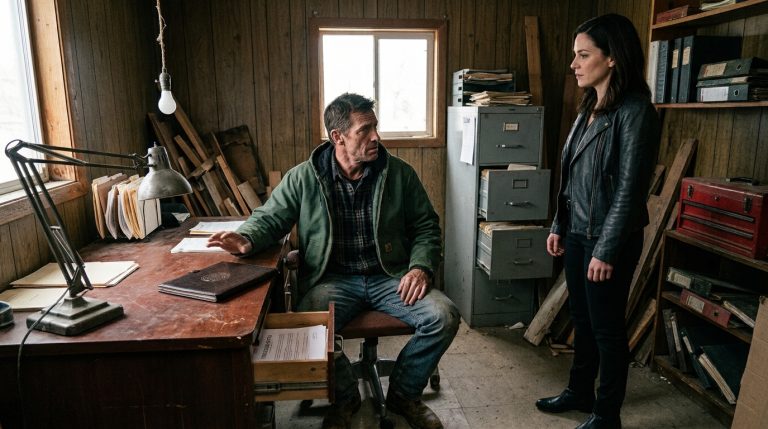
The police cruiser hadn’t even cleared the cul-de-sac before I was inside my house, the deadbolt clicking home with a finality that felt like locking a bunker. My hands were steady—a conditioned response from years of working with high-voltage circuits and unstable explosives. Anger was still there, a dormant current beneath the surface, but I funneled it into the only tool I had left: information.
I bypassed the living room, heading straight for the small den I’d converted into an office. The desk was covered in technical manuals and permit applications, but in the center sat the binder Karen had dumped on me during my first week. I hadn’t touched it since that day. Now, I laid it out like a set of blueprints, ready to be interrogated.
I flipped through the pages. Most of it was noise—fines for grass height, warnings about exterior paint palettes, the petty authoritarianism of a bored mind. But beneath the layers of HOA propaganda, I started looking for the patterns.
Vanguard Land Holdings.
I pulled my laptop toward me, the screen casting a pale, cold light over the messy stack of documents. The name felt wrong. I cross-referenced the county property records, my fingers dancing across the keys. The HOA was a nonprofit, meant to serve the residents, but the financial filings were a labyrinth of convoluted shell entities.
My mind wandered back to a bridge I’d helped survey in a valley that shouldn’t have held one. We’d calculated the load-bearing capacity twice, but the soil composition had been soft—a hidden, shifting weakness that made the entire structure a death trap waiting for a heavy load. I had caught the discrepancy before the concrete poured. Standing in my office, looking at the way the HOA’s budget allocations shifted toward “environmental remediation” and “land stabilization” in areas slated for development, I felt that same familiar prickle at the base of my neck.
This wasn’t about aesthetics. It was about site preparation.
I printed a series of reports, my printer humming in the quiet house—a stark contrast to the silence of my dead workshop. Every time the ink hit the paper, I felt the structure of Karen’s little empire begin to crack. I wasn’t just reading documents; I was tracing the skeleton of a fraud. The dates aligned with property tax re-assessments that had been conveniently overlooked by the board.
Then, I found the signature.
It wasn’t on the public filings, but it was buried in an annex of a deed transfer. Karen Peterson. She wasn’t just the president; she was the designated agent for an LLC that had been quietly purchasing the land adjacent to the green space for pennies on the dollar.
A shadow moved against the window—a neighbor walking a dog, oblivious to the fact that their property value was being hollowed out like a rotted tree. I didn’t look up. My vision was fixed on a line item that didn’t make sense: a massive “consulting fee” paid to a firm that appeared to exist only on paper.
The telephone rang, a sharp, jarring intrusion. I didn’t answer it. I let it go to voicemail, watching the light blink in the dark. It was likely a reporter, or maybe one of the board members checking to see if I was still going to be a problem.
I closed the laptop and walked to the window, peering through the blinds. The street was quiet, the houses orderly and pristine, a perfect facade masking a foundation of sand. I realized then that I couldn’t just call the police and hope for a resolution. This was a structural failure that required a controlled demolition. If I wanted to stop them, I had to expose the entire load-bearing frame of her scheme.
I walked back to the desk and picked up the laminated map of the easement again. I ran my thumb over the lines I’d had marked months ago. The power line wasn’t just a conduit for my welder; it was a physical obstacle to their development. By cutting it, she hadn’t just attacked my business—she’d accidentally signaled exactly where their path needed to be.
I reached for my phone and dialed a contact I hadn’t called since my retirement. It was time to pull in someone who understood the geology of the county better than the HOA board understood their own bylaws.
The game had shifted. I wasn’t a homeowner fighting a neighbor anymore. I was a combat engineer preparing to dismantle a threat, and for the first time in weeks, the silence in my house didn’t feel heavy. It felt like the calm before the fuse was lit.
CHAPTER 3: THE FABRICATED FOUNDATION
The air in the office felt stale, filtered through the hum of the cooling laptop. I spread the printed documents across the scarred oak of my desk, creating a temporary, chaotic map of the HOA’s true intent. It wasn’t just a simple land grab—it was a precise, surgical extraction of value, disguised as suburban oversight.
I focused on the incorporation papers for Vanguard Land Holdings. The date of registration was the detail that caught my eye: it was filed three weeks before the current HOA board had even begun their aggressive campaign to “standardize” the neighborhood’s architecture. That wasn’t a coincidence; it was a strategy. They had identified the weaknesses in the neighborhood covenants, manufactured the violations to force out the original residents, and were now preparing to sell the land out from under us.
The phone buzzed again, a sharp, buzzing vibration against the wooden surface. I ignored it, my attention locked on the discrepancy. If the HOA board was a nonprofit designed to protect homeowners, why were they effectively acting as a silent partner for a shell corporation?
I stood up, the chair scraping harshly against the hardwood, and paced the small perimeter of the room. My mind, trained to assess structural integrity under duress, was already constructing the counter-narrative. I didn’t need to fight them in the courtroom—not yet. I needed to fight them in the arena where they felt most confident: the paperwork. If I could map the connections between Karen’s personal finances and the board’s “consulting” payments, I could dismantle their authority with the same efficiency I once used to bring down an unstable bridge.
I moved to the file cabinet in the corner, pulling out the folder I had kept for all the violation notices Karen had sent me. I began laying them out chronologically. There was a pattern to the cruelty. The neighbors who received the most frequent, debilitating fines were the ones who owned properties directly abutting the common green space—the very land Vanguard needed for their access road.
It was a tactic as old as combat engineering: isolate the target, break their line of communication, and seize the ground. Karen hadn’t been acting as a neighbor; she had been acting as a vanguard for an invading force.
I reached for my coffee, finding the mug cold, but I drank it anyway, the bitterness matching the taste of the discovery. I needed more than just the papers. I needed corroboration. I needed to see who else had been targeted.
I grabbed my jacket and headed for the door, stepping out into the late afternoon. The neighborhood looked the same as it had that morning—pristine, manicured, and quiet—but now I saw it for what it was: a minefield.
I started with the house next door. Mrs. Gable was sitting on her porch, staring at the rosebushes that had been the subject of her latest violation notice. She looked tired, the kind of exhaustion that comes from fighting a war you didn’t know you were in.
I walked up the drive, my footsteps deliberate. She looked up, her expression guarded. “Frank. I heard about the trouble with your shop. I’m sorry.”
“I’m not looking for sympathy, Martha,” I said, keeping my voice low, professional. “I’m looking for the record of the violations. How many times has the board sent you notice about the roses?”
She blinked, surprised by the directness of the question. “Three times this month. They say they’re invasive, that they don’t meet the aesthetic requirements.”
“Have you kept the notices?”
“In a folder, inside. Why?”
“Because they aren’t about the roses, Martha.” I stood on her porch, looking at the meticulous way she’d maintained her property, a sharp contrast to the chaotic, hollowed-out corporate structure behind Karen’s desk. “And if we want to keep them, we need to show the board that we’ve mapped out exactly what they’re trying to hide.”
She hesitated, then nodded slowly, standing up to go inside. I stood there, watching the sun dip behind the rooftops. The shadows were stretching, long and sharp, reaching across the lawns like fingers. My resolve, tempered by years of analyzing infrastructure, was hardening. Every fine Karen had issued, every forced removal, every attempt to break the spirit of this neighborhood was a piece of evidence. And piece by piece, I was going to tear their facade apart.
The wind picked up, carrying the faint scent of rain and cut grass. It felt like the air before a storm—a high-pressure system meeting a low-pressure front. I waited for her to return, my mind already drafting the next move, the next piece of documentation that would force them into the open. I was in the context zone now, the place where decisions were made, and for the first time in this battle, I felt the initiative tilt firmly into my hands.
CHAPTER 4: THE NETWORK OF SILENCE
I took the folder from Martha, my fingers grazing the paper. It was a catalog of intimidation. Every document was a snapshot of a life being slowly dismantled, one forced compliance at a time. I stepped back from her porch, the rain starting to prickle against my skin, turning the driveway into a slick, dark mirror.
“Thank you, Martha,” I said, my voice barely audible over the rising wind. “Keep your doors locked. If she comes by, or if anyone from the board asks, you don’t know who I am. You haven’t seen me.”
She looked at me, her eyes wide with a sudden, dawning fear. “Frank, what are you planning?”
“I’m just doing the math, Martha. That’s all.”
I turned and moved toward the street, my pace measured. The sky opened up then, a sudden, violent deluge that turned the suburban quiet into a cacophony of drumming rain. I needed to get to my house, but the shortcut through the common area garage—the one Karen had always claimed was “exclusive to board business”—was the only way to avoid the main road where her allies might be watching.
The garage door was propped open with a heavy cinderblock, a careless oversight by someone in a hurry. I slipped inside, the air smelling of oil, damp concrete, and the ozone tang of a dying summer storm. The lighting was poor, a flickering fluorescent tube casting long, skeletal shadows across the floor.
As I brushed past a row of storage lockers, my shoulder caught a plastic bin that had been shoved into the corner, half-concealed by a discarded tarp. It tipped, the lid clattering to the floor. Inside, I didn’t see the usual maintenance supplies. It was filled with physical blueprints—the large, rolled-up variety that required a table to read.
I froze, the rain still drumming a frantic rhythm on the corrugated metal roof. I knelt, pulling one of the sheets out. It was a site plan for the neighborhood, marked with highlighters in a neon-yellow ink I recognized instantly from the violation notices. But these weren’t marking aesthetic issues. They were marking structural boundaries, easements, and, in the center of the green space, a designated pathway for heavy equipment.
This was the smoking gun.
Karen hadn’t just been planning to sell the land; she had been preparing the site for construction, ignoring every safety code, every environmental restriction, and every legal requirement for the neighborhood. My gaze drifted to the corner of the map. There was a ledger, bound in a worn, leather-backed notebook. I flipped it open. It was a list of names—every resident who had been targeted for a “violation,” alongside the dollar amount they had been fined. The totals didn’t go to the HOA maintenance fund. They were being funneled into an account labeled Project Obsidian.
My pulse hammered against my ribs—not from panic, but from the grim satisfaction of a trap snapping shut. This wasn’t just administrative corruption. This was a systematic liquidation of a neighborhood for personal gain.
A sound echoed from the front of the garage—the metallic clink of the garage door being kicked shut, followed by the heavy, deliberate tread of boots on concrete. Someone was coming.
I didn’t have time to hide the blueprint. I stuffed the ledger into my jacket, the leather cool and smooth against my skin, and pressed myself into the shadows behind a stack of industrial-grade paint buckets. My breathing slowed, turning into the measured, rhythmic inhalations of a man who had waited in the dark for far more dangerous predators than a neighborhood bully.
The footsteps stopped near the lockers. A beam of a high-intensity flashlight swept across the room, cutting through the dusty air. It hovered over the tipped bin, then paused.
“I know someone was in here,” a voice hissed. It was Dave, one of the board members—a man I’d seen nodding in lockstep with every one of Karen’s decisions. He sounded nervous, his voice lacking the practiced arrogance he usually carried in board meetings. “If the documents are missing, the deal is dead.”
I waited, my fingers gripping the edge of the ledger beneath my coat. The silence in the garage was absolute, save for the rain. My mind flicked through the layout of the space—the exits, the blind spots, the weight of the objects around me. I was trapped, but I was in control. Every second they spent looking for the ledger was a second they weren’t spending covering their tracks. I wasn’t going to let them off this time. The architecture of their deceit was finally shifting under the weight of its own greed, and I was going to be the one to ensure it collapsed.
CHAPTER 5: THE COMMUNITY SIEGE
I didn’t wait for him to find the right aisle. I knew the layout of the garage better than he did; it was a structure, and structures had failure points. I shifted my weight, the damp concrete beneath me feeling like a tactical foundation. I didn’t need to fight him. I needed him to know I was watching.
I let my hand brush against a metal pipe, a sharp clack that sounded like a gunshot in the confined space. Dave froze. The beam of his light swung wildly, illuminating the dust motes dancing in the humid, stagnant air.
“Who’s there?” he demanded, his voice cracking. “Karen said the property was secured.”
I didn’t answer. I rose, staying low, and moved to the heavy chain that operated the manual override for the garage door. With a single, fluid motion, I yanked it. The door groaned—a rusted, shrieking sound of metal against metal—and shuddered upward, exposing the interior to the street. The light of the streetlamps flooded in, turning Dave into a silhouette against the white glare.
He spun around, shielding his eyes. I was already moving toward the side door, slipping out into the downpour.
“Frank?” he shouted, his voice caught in the wind. “Miller? You’re finished! You have no idea what you’ve started!”
I didn’t look back. I ran, my boots splashing through the gutters that were already overflowing. The community meeting was in twenty minutes. The clubhouse would be full, the residents gathered for their monthly update on “neighborhood compliance.” I didn’t need a weapon; I had the ledger. I had the map. And I had the weight of every broken promise they’d made to the people living here.
The clubhouse was a glass-and-steel building that looked more like an office complex than a community space. I reached the doors, dripping wet, my clothes clinging to my skin. The lobby was already crowded. I saw Karen standing by the podium, looking immaculate in a silk blouse that cost more than my first welder. She was smiling, that familiar, thin-lipped expression of absolute authority.
I walked straight through the center aisle. The murmurs died down as people saw me—a wet, shadowed figure trailing water across the pristine carpet. Karen’s eyes widened, her smile fracturing for a split second before she recovered, her composure sliding back into place like a mask.
“Mr. Miller,” she said, her voice amplified by the room’s speakers, cool and dismissive. “I believe your presence here is a violation of the conduct policy.”
“The only thing violating policy, Karen,” I said, my voice cutting through the silence of the room, “is the shell company you’ve been using to drain this neighborhood’s assets.”
The room went still. I walked to the front, feeling the eyes of my neighbors—Martha, Dave, the retired vet who had lost his flagpole—tracking my every step. I didn’t look at Karen. I pulled the ledger from my coat. It was damp, but the ink was legible.
“This is the list,” I announced, laying it on the podium. “This is where your fines go. It doesn’t go to the park, or the common areas, or the repairs. It goes to Project Obsidian. A shell account for a development firm that doesn’t exist.”
Karen stepped forward, her hand reaching for the ledger. “This is theft, Frank. You broke into private property—”
“I found a record of a crime,” I countered. I turned to the audience. “They aren’t enforcing standards. They’re manufacturing an exit strategy. They’re selling your homes out from under you so they can liquidate the land for a commercial highway.”
A murmur broke out, rising into a roar. I saw Dave at the back of the room, his face pale, retreating toward the exit. The board members, usually so unified, were glancing at each other, their unspoken alliance crumbling.
Karen’s hands were shaking now, the mask finally slipping. “You have no proof of that,” she hissed, her voice trembling with an rage that finally, finally, felt human. “The board approved these measures. The records are legitimate.”
“The records are fabricated,” I said, pulling the blueprints from my jacket and unfurling them across the podium, their edges curled and dripping. “And these site plans show exactly where the construction begins. Unless, of course, you’d like to explain to the county inspector why you’ve been zoning a residential park for industrial equipment.”
I looked around the room. I wasn’t just a combat engineer anymore. I was the one who had cleared the path, exposing the rot in the foundation. The crowd began to surge forward, not with violence, but with a sudden, overwhelming demand for answers. Karen looked around, her eyes darting to the doors, to the faces of the people she’d spent months bullying. For the first time, she looked small.
The tension in the room was a physical thing—a high-pressure wire pulled to its breaking point. I stood back, the ledger still under my hand, and watched as the architects of this neighborhood’s destruction realized that they had no more blueprints left to hide behind. The structural failure was complete.
CHAPTER 6: THE AFTERMATH OF IRON
Karen tried to speak, her jaw working, but the words died in her throat. She looked for an ally, but the board members had already begun to distance themselves, their chairs pushed back, their gazes fixed on the floor. The “consulting fees” I had documented in the ledger were now being read aloud by Dave, who had decided that full cooperation was the only way to avoid the legal fallout that was clearly landing on Karen’s shoulders.
The reveal of the Layer 2 truth—the massive embezzlement of HOA funds to cover the tracks of a bankrupt development firm she had mismanaged years prior—didn’t come as a shout. It came as a quiet, crushing realization. The neighborhood wasn’t just losing a tyrant; they were witnessing the total disintegration of a criminal enterprise.
She didn’t surrender easily. She stood tall for one final, desperate moment, her chin tilted up in a facsimile of the authority she once wielded. “You have no idea what you’ve done, Frank,” she said, her voice devoid of its usual polish, cracking into something thin and jagged. “This development was the only thing keeping the property values from plummeting when the original firm went under. I was fixing a mistake.”
“You weren’t fixing a mistake,” I replied, my voice steady, cutting through her narrative. “You were building a grave, and you were planning on burying the neighborhood in it.”
The police arrived five minutes later—two cruisers, lights strobing against the clubhouse glass. When they walked in, the room was quiet. Karen didn’t struggle as the officer took her by the arm; she simply seemed to deflate, the expensive silk of her blouse losing its sheen as she was led out, past the very people she had spent months fine-tuning into submission.
The aftermath didn’t happen in a single moment. It was a slow, deliberate process of restoration. The civil lawsuits were filed by the end of the week, and the restitution court order was handed down within a month. The money she had embezzled—tracked through the shell company accounts I had helped the forensic accountants trace—was frozen, redirected back into the neighborhood’s escrow fund.
In the weeks that followed, the atmosphere in Oak Creek Estates shifted. The tension that had defined our daily lives evaporated, replaced by a strange, tentative sense of ownership.
I returned to my workshop, the space feeling cavernous and quiet. The power line had been repaired, the conduit laid correctly and legally by a crew that had worked through the weekend once the dust had settled. I stood at my workbench, looking at the spot where the power had been cut. I picked up a piece of scrap steel—a jagged, bent section of the bracket Karen had tried to force me to remove.
With a methodical focus, I clamped it into the vise. I didn’t rush. I spent hours grinding away the burrs, heating the metal until it glowed a dull, cherry red, and then hammering it back into a perfect, uniform shape. I wasn’t fixing it for the house; I was fixing it for myself. It was a simple act of repair, a way to reclaim the space she had once tried to dictate.
By the time the metal cooled, the sun was setting, casting long, warm light through the windows of the workshop. Martha stopped by, dropping off a box of tools she’d found in her garage that she thought I could use. She didn’t stay long—just a nod, a quiet smile, and a sense of shared, understated victory.
I finished the weld, the steady arc of the torch illuminating the dark corners of the shop. The machines were humming again, a rhythmic, deep-seated vibration that felt like the pulse of the neighborhood itself. We had learned that power wasn’t a static commodity to be held by a few; it was a connection, like an electrical circuit, meant to be shared and maintained.
I hung the finished bracket on the wall. The shop was whole. The neighborhood was quiet, but not the suffocating silence of fear—it was the peaceful quiet of a place that was finally being allowed to breathe. My work here was done, and for the first time in a long time, I didn’t feel like an engineer standing guard against a catastrophe. I felt like a neighbor, standing on solid, honest ground.