The Final Boundary: A Retired Colonel’s Calculated Siege to Protect His Ancestral Land from Corrupt HOA Tyranny
CHAPTER 1: The First Notice
The air on the porch tasted of dry earth and impending rain. It was the kind of silence that usually preceded a storm, but today it was punctured by the stiff, rhythmic clicking of heels on my gravel driveway. I did not look up from the bench immediately. I knew the cadence. It was the sound of someone who believed they owned the ground they walked on.
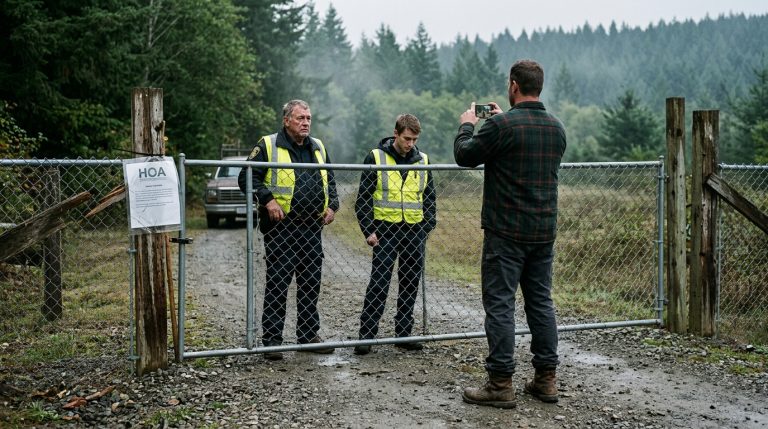
Karen Henderson reached the property line, her floral blouse a gaudy, synthetic splash against the muted, natural greens of my ridge. She carried a clipboard like a weapon of state, her face a mask of manufactured authority. Beside her, Bob and Linda flanked her like two hollowed-out pillars of suburban resentment.
“Mr. Davies,” she began, the name sharp enough to cut the stillness. “As per article 7, subsection C of the Oakridge Estates Covenants, we are officially designating this hilltop as community improvement area alpha. Your personal access and use of this parcel are, as of this moment, terminated.”
I finally looked up, letting my gaze drift over the top of my reading glasses. I didn’t see a neighbor; I saw an obstacle. The document she extended was thick, dense with legal jargon meant to intimidate, but its physical texture—the cheap, bleached whiteness of the paper—looked entirely out of place here. It felt like a contaminant.
I took the notice, my fingers brushing the cold, slick surface of the clipboard. I could feel the tension radiating off her, the desperate need for a reaction. She wanted a shout, a protest, a sign that she had successfully disrupted my world.
“Noted,” I said. My voice was a flat, low-frequency rumble, the kind I had used to quiet panicked crews under fire.
She blinked, her smile faltering. The rehearsed script in her mind clearly didn’t account for the absence of resistance. “That is all you have to say? This is a formal designation, Mr. Davies. We have the right.”
“You have a notice,” I corrected, my tone devoid of heat. “What you don’t have is jurisdiction.”
I watched her face tighten, the blood rising beneath her skin. She wasn’t just here to manage a subdivision; she was here to conquer an island. I looked past her shoulder to the beige monstrosities of Oakridge Estates, a sprawl of identical lives tethered by arbitrary rules. This hill was the only thing standing between her and a horizon she could actually own.
“We will be back on Monday,” she threatened, turning on her heel with a metallic click of her shoes. “Surveyors. Eight o’clock. Don’t interfere, or you’ll regret it.”
As she marched back toward the asphalt, I folded the notice and slipped it into my shirt pocket. The paper felt heavy, like a piece of shrapnel. The peace of the morning was shattered, but as I sat back and listened to the distant, muffled sound of their departure, my mind didn’t panic. It shifted gears. The operational planning started with the dry, rational certainty of a clockwork machine.
She had chosen the battlefield, but she hadn’t checked the terrain. And she had no idea what was buried in the fine print of my life.
CHAPTER 2: The First Breach
The sound of Karen’s sedan fading into the distance did not bring peace. It brought the cold, familiar hum of a generator spooling up deep inside my chest. I remained on the bench for a long moment, the wood hard and unyielding against my spine, feeling the textured grain—the only thing that had remained constant for the last five years. In my pocket, the HOA notice felt like a foreign object, an intrusive weight that disrupted the equilibrium of my sanctuary.
I stood up, my knees popping, the movement stiff and deliberate. I didn’t rush toward the house. Rushing was a civilian mistake. I walked the perimeter of the front porch, my boots crunching on the dry Virginia soil. The afternoon sun was beginning to dip, casting long, jagged shadows across the landscape that seemed to point accusingly toward the Oakridge development. Those beige structures, uniform and soulless, looked like an infection spreading toward my ridge.
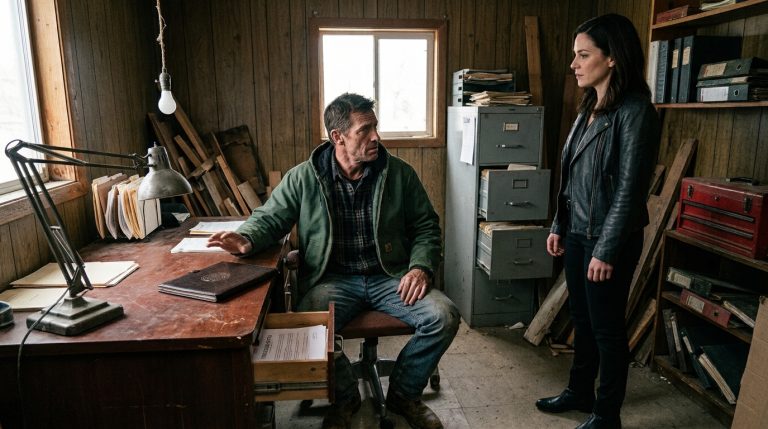
I reached the front door and pushed it open, the hinges groaning in a way that sounded like a warning. Inside, the house smelled of cedar, old paper, and the faint, lingering ghost of Sarah’s jasmine perfume—a scent I had cultivated like a rare botanical specimen. I went straight to the desk. The surface was oak, scarred by years of use, the wood grain worn smooth by my constant touch. I laid the HOA notice flat on the blotter and smoothed it out with the side of my palm.
My reflection caught in the darkened window pane. I looked like a ghost of the man I had been at the Pentagon. My posture was too rigid, my jaw set with a lock that hadn’t eased in hours. I was slipping back into the “Colonel” persona, a mask I had tried to discard. It was efficient, but it was also a dangerous narrowing of my perception. I had to be careful; if I viewed every interaction as a tactical engagement, I might end up fighting a war of my own making.
I opened the top drawer and pulled out a leather-bound notebook. I started a log. 15:10 hours. First notice received. Subjects: Karen Henderson, Bob, Linda. Status: Conflict initiated.
The sound of a vehicle on the gravel outside snapped my head toward the window. It was just a delivery truck, its engine rattling with the loose, metallic vibration of a dying fuel pump. I watched it pass, my hand hovering near the desk lamp. I was primed to interpret every anomaly as an attack. I took a breath, forcing my shoulders to drop an inch, and reminded myself that the HOA was a bureaucracy, not an insurgency. They operated on rules, not tactical aggression. They would come with paperwork, not bayonets.
I turned my focus back to the desk, sliding open the lower drawer. I needed the deed. Not a copy—the original. It was wrapped in heavy, oil-resistant cloth. I unwound it, the document crackling as it unfurled. The 1923 date was stamped in bold, archaic black ink. It was the bedrock of my defense.
I spent the next two hours mapping the battlefield. I wasn’t just defending a hilltop; I was guarding a secret that sat at the very heart of the property. The Verizon lease was ironclad, but it was a quiet giant. If Karen’s “community improvement” efforts involved any soil testing or utility placement, she risked triggering a breach of contract that would force Verizon’s legal team to intervene. I didn’t want them involved yet. I needed to handle this on the perimeter, keeping the focus local and contained, like a brushfire kept in a trench.
I checked the trail camera monitor—a small, dedicated screen I’d wired into the bookshelf. The lens, tucked into the crook of a century-old pine, showed the entrance to the access road. It was empty, a strip of grey gravel framed by the encroaching shadows. Everything was quiet for now, but the silence felt thin, brittle.
I walked to the kitchen and put the kettle on. The whistle seemed an alien sound in the stillness. As I waited for the water to boil, I stared at the door. I had three days until the surveyors arrived. Three days to turn a piece of paper into an impenetrable wall. I felt the familiar weight of duty settle over me, not as a burden, but as a framework. I had built bridges in places where the ground was nothing but sand; I could certainly keep a HOA president from planting a cell tower on my wife’s memorial.
I sipped the hot, bitter tea, letting the steam rise against my face. The house felt smaller tonight, more like a fortification than a home. I wasn’t fighting for land anymore. I was fighting for the right to remain invisible. And in the world of Oakridge Estates, invisibility was the rarest commodity of all. I looked at the calendar on the wall, the date circled in red, and felt the iron certainty of the coming confrontation. Monday morning wouldn’t be a negotiation. It would be a lesson.
CHAPTER 3: The CounterSurveillance
The sound was faint—a sharp, metallic rasp that didn’t belong in the natural chorus of the morning. I was at my desk, the ink on my tactical log still fresh, when it hit my ears. It was the sound of a surveyor’s tripod leg dragging over shale. I didn’t wait for a second confirmation. I stood, my chair sliding back with a harsh, protesting screech against the hardwood floor.
I moved with the economy of motion I hadn’t used in years. I checked the perimeter monitor first. The screen remained dark, the camera showing nothing but the dense, unmoving shadows of the pines. That meant the noise was coming from the blind spot near the western tree line—the gap where the HOA’s territory bled into my own.
I stepped out onto the porch. The air was frigid, the kind of cold that bit through my sweater and settled into the marrow of my bones. I didn’t reach for a weapon; I reached for the heavy, iron-handled walking stick I kept by the door, a relic of my grandfather’s that felt like an extension of my own arm. I walked down the steps, the gravel crunching under my boots with a sound that felt deafeningly loud.
I took the path toward the tree line, my eyes scanning the terrain. Every step was deliberate. I wasn’t just walking; I was reading the ground. The soil here was dry, parched by a long, rainless stretch, and it held prints with brutal honesty. I stopped near the ancient, gnarled oak that marked the true boundary. There, in the soft dust at the base, was the jagged, circular imprint of a surveyor’s tripod.
They weren’t supposed to be here until Monday. It was Friday.
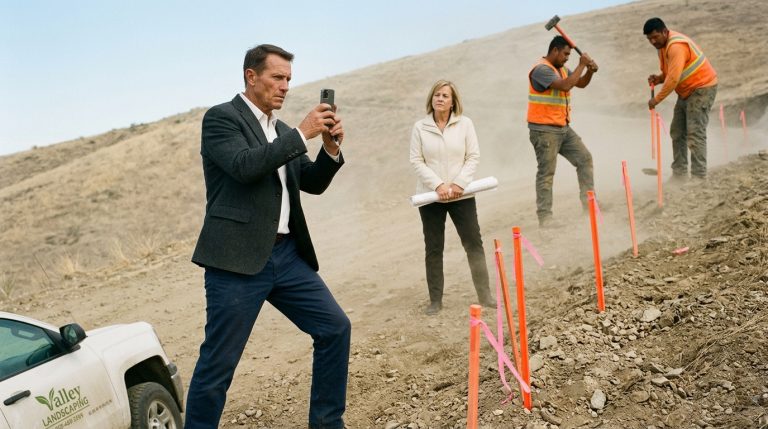
I leaned down, the movement putting a strain on my lower back. I inspected the markings. They were fresh, the edges of the indentations still sharp. But there was something else—a bright, neon-orange plastic marker hammered into the earth, just inches from the tree’s root system. I reached out, my fingers brushing the synthetic, jarring material. It was an insult to the landscape, a neon stain on the deep, earthy palette of the ridge.
Then, I noticed it. Near the base of the pine tree, someone had carved a strange, jagged “X” into the bark. It wasn’t an official surveyor’s mark. It looked deliberate, hasty, and aggressive. I pulled a small, high-definition camera from my pocket—a tactical unit I’d kept in my gear bag—and began to document. I photographed the tripod marks, the neon spike, and the carved “X” from multiple angles.
I didn’t call out. I didn’t confront. I simply recorded.
As I straightened, a sudden movement in the distance caught my eye—a flicker of movement near the edge of the HOA’s asphalt. A white vehicle, unmarked and nondescript, was idling near the transition zone. I watched it for a long, steady heartbeat. It didn’t belong to the contractors I’d seen before. It sat there, a white phantom in the morning haze, its engine idling with a low, throaty vibration that I could feel in the soles of my boots.
I stayed still, blending into the shadows of the tree line. My pulse was a steady, rhythmic thrum—the rhythm of a man who had waited years for an enemy to make a mistake. They were testing the line. They were seeing if I would react with violence, if I would lose my composure and storm the fence. They wanted the “Crazy Old Vet” to show up, gun or shouting, so they could call the police and claim the hilltop for “public safety.”
I turned away, the iron stick heavy in my hand. I walked back toward the farmhouse, my stride measured. I wouldn’t give them the confrontation they were fishing for. Instead, I went back to the office and unlocked the fireproof safe. The Project Sunset VZW binder felt cool, almost comforting, against my palms.
I opened it to the page where I had mapped the fiber optic line routes. If they were looking to install a cell tower, they would need power and a backhaul connection. I looked at the map. The easiest route for them was through the utility easement on the ridge. I began to mark the location of the carved “X” on my map. It lined up perfectly with the projected trenching path for a secondary fiber link.
They weren’t just surveying; they were scouting.
I sat back, the room silent save for the ticking of the clock. My hands were steady, my mind clearing of the initial spike of adrenaline. I needed to see what they were looking for, but I couldn’t be the one to find it. I opened my email and began a draft. No names, no threats. Just a request to the county zoning department, asking for the permit status of any land-disturbance activity near the Oakridge perimeter. It was a standard, boring, bureaucratic request. The kind of thing an “old man” would do to satisfy his own curiosity.
I looked back at the screen of the trail camera. The white vehicle was gone. The dust on the road settled, and the ridge returned to its state of brooding, natural calm. I picked up the walking stick and leaned it against the desk. The game had shifted from a standoff to a hunt, and I knew exactly how to track the scent.
I wasn’t just protecting a tree or a hill; I was defending the silence. And for the next few days, I would turn the entire property into a sieve of information. Every movement, every car, every marker they hammered into my ground would be indexed, cataloged, and used to build the noose.
The morning air outside began to warm, a thin, weak sunlight breaking through the pine needles. I took a deep breath, the smell of damp earth and iron filling my lungs. They wanted to build a tower. They wanted to connect the world. But they had forgotten that this hill was already connected to something much older, much deeper, and significantly more stubborn than they could ever comprehend.
CHAPTER 4: The Gathering Storm
The walk back from the perimeter was slower than the outward trek. The air had shifted. It was heavier, humid with the promise of a mountain storm, and the scent of ozone began to sharpen against the dry, parched dust of the ridge. I kept my hand on the iron walking stick, its surface pitted and cold, a reminder of the generations that had weathered this land before me.
When I reached the farmhouse, I didn’t head for the kitchen. I went straight to the office. The room was a sanctuary of paper and quiet, but it felt different now—charged, expectant. I sat at the desk and slid the Project Sunset binder into the center of the blotter. I needed to see where the HOA was bleeding money. I started with the last six months of meeting minutes I’d downloaded.
The prose in these documents was a masterclass in obfuscation. “Infrastructure optimization,” “Community revitalization projects,” “Strategic landscaping enhancements.” It was all vague, high-level corporate speak designed to hide the fact that they were hemorrhaging capital into the pockets of the board’s inner circle. I pulled out a fresh legal pad, the paper bright and crisp. I began to map the flow: HOA dues collected to Karen’s bank accounts, then siphoned through “Lawn and Order LLC.”
The math was crude. It was the work of someone who thought they were clever, not someone who was careful. I checked the figures against the standard market rates for grounds maintenance in our district. The markup was staggering. It wasn’t just a conflict of interest; it was a systematic looting of the HOA’s coffers.
As I worked, the wind kicked up outside, a low, mournful howl that rattled the windowpanes. A flash of lightning illuminated the room for a split second, turning the walls into stark, white ghosts. The smell of rain on dry earth—petrichor—hit me, and for a heartbeat, I was back on this very hill, twenty years ago. Sarah was laughing, her hair wild in the wind, a cheap blanket spread beneath the old oak. She had reached out to steady me, her hand warm and solid against my arm.
I blinked, and the office returned—the cold, the maps, the ledger. I felt a pang of sharp, jagged grief, a reminder of what was truly at stake. This wasn’t just a legal fight over a cell tower; it was a battle against the erasure of that memory. I shook the feeling off, forcing my focus back to the figures. I was a strategist, not a mourner.
I turned to the list of residents Eleanor Gable had provided. It was a digital map of the HOA’s victims. I picked one at random—the Millers. They were being fined for a “jaunty” front door color. I cross-referenced their address with the property survey I’d pulled from the county records earlier that week. The survey showed their property line actually extended three feet further than the HOA’s “official” map claimed. Karen wasn’t just embezzling; she was using her position to bully neighbors into giving up land she could later flip or incorporate into the community common areas.
She was playing a game of expansionist tactics with suburban property deeds. It was the same logic I’d seen used to seize land in conflict zones—take the edges, establish a new reality, and wait for the resistance to tire out.
I checked the time. 19:00 hours. The storm was hitting the ridge. Rain began to lash against the siding of the farmhouse, a relentless, rhythmic drumming that made the house feel like a ship adrift in a black sea. I tapped my pen against the desk. I needed to make contact with Marcus Rodriguez. He had the energy, the tech-savviness, and more importantly, he was the one being pushed the hardest.
I opened the encrypted messaging app we’d set up. The interface was clean, devoid of the clutter that marked the HOA’s own digital presence.
Mark Davies: The situation is escalating. They’re scouting the utility easement. Document everything. Do not confront, just record.
A moment later, the screen blinked. Marcus: Copy that. We’ve got eyes on the common areas. You won’t believe what the Millers just sent me—a notice about their mailbox being two inches off-center. They’re getting desperate.
Mark Davies: Good. Let them get desperate. Desperation leads to mistakes. We stay patient.
I closed the app and sat back in the chair. The house groaned under the wind, a deep, structural sound. I was building a cage for her, bar by bar. The embezzlement, the land-grabbing, the falsified violations—it was all there, in the documents I was methodically organizing. I wasn’t going to storm her office. I was going to let her arrive at the annual meeting thinking she was in control, only to pull the floor out from under her in front of every single person she had cheated.
I looked at the Project Sunset binder one last time before closing it. It was the core of my identity, my promise to the land. I stood up and walked to the window. The rain was turning into a deluge, the valley below hidden in a veil of grey. Somewhere out there, Karen was probably dry in her climate-controlled living room, planning her next “improvement.” She thought she was building a future. She had no idea she was just clearing the ground for her own collapse.
I reached out and locked the office door, the bolt sliding home with a heavy, satisfying metallic thud. The storm outside was loud, but in here, there was only the cold, clear logic of the next phase.
CHAPTER 5: The Subtle Rebellion
The rap at the door was not the tentative knock of a neighbor. It was a rhythmic, forceful cadence—the kind of summons that demanded an audience. I checked the monitor again. Two men in official-looking grey windbreakers stood on my porch, their posture rigid, eyes scanning the farmhouse with the clinical detachment of men used to finding violations.
I didn’t open the door immediately. I spent ten seconds checking the desktop. The Project Sunset binder was closed, its spine pressed against the leather blotter. The map of the utility easement was hidden beneath a stack of innocuous invoices for heating oil and livestock feed. I stood, smoothed my sweater, and gripped the iron walking stick. The cold weight of it in my palm was grounding.
When I opened the door, the wind snatched at the air, carrying the smell of wet pine and damp grit. The men didn’t smile. One, a thin man with rimless glasses, held out an ID badge. “Mr. Davies? We’re with the county inspector’s office. We received a report regarding unpermitted ground-disturbance activity on this parcel.”
My heart rate didn’t spike. I had been interrogated by men with far more authority than this. I didn’t invite them in. “Inspector,” I said, my voice as neutral as a stone. “I’m familiar with the county ordinances. I haven’t initiated any work that requires a permit. May I see the report?”
The thin man looked uncomfortable. He glanced at his partner, a broader man who seemed to be there solely for the intimidation factor. “We don’t share the source, sir. We just need to inspect the perimeter. We have information that unauthorized trenching is being performed on the hilltop.”
“The hilltop is private property,” I said, keeping my tone perfectly level. “And it’s currently under a long-term commercial lease. If you have any questions about the site’s status, I suggest you contact the county clerk’s office. They have the original survey on file. Unless you have a warrant, I’d appreciate you staying off the grass.”
The broad man stepped forward, his boot heel digging into the dirt. “Mr. Davies, this isn’t a debate. If we find non-compliance, the fines will escalate rapidly. It would be in your best interest to cooperate.”
“I am cooperating, inspector,” I replied, standing my ground. I felt the familiar burn of tactical exhaustion, the weariness of a man who had fought too many battles over too many miles. But I also felt the cold, hard logic of the situation. They were the HOA’s errand boys, trying to create an official paper trail of “non-compliance” that Karen could use in her upcoming board meeting.
I reached into my pocket and produced a small, laminated card. “This is a copy of the recorded easement. Note the exemption clause for maintenance and existing commercial infrastructure. If you’re here to inspect my property, you’re in the wrong place. If you’re here to harass a retired officer, you’re in the wrong zip code.”
The man with the rimless glasses took the card, his hands shaking slightly. He studied it, then looked at his partner. The Broad man’s face went stiff. He realized the ground was shifting beneath them. They didn’t have the legal authority to force their way onto the land, and they knew that if they pushed and were wrong, the resulting lawsuit would be the last thing their department needed.
“We’ll be taking this information back to the office, Mr. Davies,” the thin man said, his voice clipped. “If we find any discrepancy, we’ll be back.”
“I look forward to it,” I said. I watched them walk back to their truck, their movements heavy and defeated. I didn’t close the door until they were off the gravel, their vehicle disappearing down the road.
I leaned against the doorframe, my breath fogging in the frigid air. The storm outside was still raging, but the house felt quiet, secure. I went back to the office and picked up the encrypted phone. I tapped out a message to Marcus.
Mark Davies: The HOA is escalating to state-level administrative harassment. They’re using the inspector’s office to try and build a case of code violations.
A moment passed before he replied. Marcus: We’re ready. The Chens are hosting a private meeting tonight for the coalition. Are you going to be there?
Mark Davies: I will. It’s time to consolidate the proxies.
The stakes had jumped. They weren’t just going to try to bully me into giving up the hill; they were going to try to legislate me out of existence. But they had made a tactical error. They had brought the county into a local dispute, and now, the county would see the records for what they really were: a clear, recorded history of the HOA’s overreach.
I sat down at the desk and looked at the ledger again. My hands were steady. Every move they made was another layer of evidence for the final reveal. I was tired, my body aching with the long tension of the day, but I was also focused. The storm would pass, and when it did, the path would be clear for the counter-offensive.
I spent the next hour cleaning my gear, the rhythmic friction of the rag against the steel of the walking stick a meditative act. I was ready. The coalition was ready. And in two weeks, when the annual meeting convened, the storm would be a memory, and the HOA would be the only thing left in pieces. I walked to the mirror and studied the face staring back. It was tired, but the eyes were sharp. They were the eyes of a man who knew exactly how to win a war of attrition.
CHAPTER 6: The Corporate Leverage
The sound was archaic, a jarring, mechanical shriek that pulled me out of my focused vigil. I stared at the phone. It was the landline, the one I kept primarily for the property’s security sensors and the rare, necessary contact with the outside world. I picked up the receiver, my thumb hovering near the mute button.
“Davies,” I said.
“Colonel.” The voice was professional, clipped, and devoid of warmth. It was a voice that belonged in a boardroom, not a farmhouse. “This is regional counsel for Verizon. We need to discuss the status of site VA2281. The situation regarding the easement interference has reached a threshold that requires direct escalation.”
I leaned back, the leather of the chair creaking. I knew this voice. It was the cold, sterile reality I had been preparing for. “The threshold being the HOA’s recent attempt at site surveying?” I asked.
“Among other things,” the attorney replied. “Our local field assets have been reporting an increased frequency of unauthorized personnel near the access track. Our internal monitoring indicates that the Oakridge HOA is preparing to file for an injunction. They are claiming a zoning discrepancy, Colonel. They’re arguing that the initial lease agreement was made in violation of the neighborhood’s original charter.”
I felt the tension coil in my gut. This was it—the counter-move I had anticipated but hoped to avoid. “That’s a groundless claim,” I said, my voice steady. “The deed carve-out is absolute. The county records are clear.”
“To you and me, perhaps,” the counsel continued, the sound of digital static buzzing on the line. “But legal strategy isn’t about truth. It’s about creating enough friction to force a settlement. If they file for an injunction, they will effectively freeze all access to the site. That puts our equipment at risk, and it puts your revenue stream in escrow. They aren’t trying to win the title, Colonel. They’re trying to starve the asset.”
I looked out the window. The storm had broken, but the sky was still a bruised, heavy purple. The ridge looked defiant, the pines swaying in the aftermath of the wind.
“They won’t get an injunction,” I said, my voice dropping to a lower, more dangerous register. “I have the historical survey records, the plat map from ’88, and the original deed. They’re building a case on a foundation of sand.”
“Send the originals to our regional office by courier tonight,” the counsel ordered. “We need to preempt their filing. If we can get a judge to review the historical record before they get to the bench, we can kill this before it gains momentum. But understand this, Colonel: if you are holding back any details—if there is any ambiguity in that deed you haven’t disclosed—you need to tell me now. This is a Fortune 50 company. We do not lose.”
“There is no ambiguity,” I said. “Only facts.”
“Good. One more thing. We’ve been tracking the HOA’s financial maneuvers. They’ve recently moved a significant amount of capital into a ‘legal defense fund.’ It’s a bad sign, Colonel. It means they’ve stopped trying to build a tower and started trying to bankrupt you. Be prepared for a very messy, very public fight.”
The line went dead with a soft, final click. I held the receiver for a moment, the silence of the office rushing back in to fill the space. They were trying to starve the asset. It was a classic siege tactic—cut off the supply lines, wait for the morale to break, and eventually, the gates would open.
I stood up and paced the small perimeter of the room. The room felt crowded with documents, the walls lined with the history of a life spent building things that endured. Karen Henderson was a petty, small-minded woman, but she was a predator. She had realized she couldn’t win on the merit of her case, so she was changing the rules to ensure she could win on the sheer cost of participation.
I went to the safe and pulled out the original deed. I held it in my hands, the paper thin and brittle, yet it felt heavier than it ever had. It was a piece of history, a mandate of ownership that had survived wars, developers, and decades of shifting tides. I would not let it be eroded by the spite of a woman in a floral blouse.
I began to pack the documents, wrapping them in heavy plastic, placing them into a secure courier envelope. I wouldn’t just send the records. I would send an addendum—a detailed, itemized list of every fine, every threat, and every instance of documented fraud I had logged. I would show them exactly who they were fighting.
The front door needed to be checked. I walked to the porch, the air outside smelling of wet leaves and cold, wet stone. The storm had left behind a heavy, dripping silence. I looked down the long, winding road toward the development. Everything was still. But in the distance, I could see the faint glow of the clubhouse. They were still there, still plotting, still trying to find a way to break the perimeter.
I walked to the end of the driveway, my boots finding the firm, solid ground of the road. I was the sovereign of this patch of earth, the last line of defense. I looked at the old, gnarled pine where I’d marked the “X”. The rain had washed away some of the dirt, but the mark remained. It was a signpost, a warning.
I was not the victim they were waiting for. I was the architect of their downfall, and I was just getting started. I turned and headed back toward the house, my stride purposeful. The battle had escalated, but the terms of engagement were now entirely in my control.
CHAPTER 7: The Final Confrontation
The clubhouse was a cavernous, airless space that smelled of stale pool water and industrial carpet cleaner. It was packed. Every chair was taken, and the overflow crowd lined the back walls, a restless, whispering mass of people who were beginning to realize that the “community improvement” they had been promised was nothing more than a front for something far uglier.
I walked down the center aisle, the iron walking stick finding a steady, rhythmic purchase on the low-pile carpet. I didn’t look at the faces. I felt them—the confusion, the latent anger, the cautious hope. Karen Henderson sat at the folding table at the front, her posture unnaturally rigid, her eyes fixed on a script that looked like it had been revised three times in the last hour. Bob and Linda were beside her, glancing nervously at the back of the room where the crowd was murmuring.
I reached the front and stood near the dais. I didn’t take a seat. I placed my heavy, leather-bound binder on the edge of the table. It made a solid, final sound. Karen looked up, her gaze hardening.
“Mr. Davies,” she said, her voice strained. “You’re late. We have a full agenda.”
“The agenda is about to change, Karen,” I replied, my voice carrying into the back of the room, cutting through the low hum of the crowd. I didn’t raise the volume; I used the silence. “We’re going to address the state of the HOA financials and the matter of the hilltop parcel.”
She tried to laugh, but it was brittle. “We have a process, Mark. You’ll have your three minutes during the public comment period, just like everyone else.”
“I don’t think that will be necessary,” I said, opening the binder.
The room grew quiet. It was the silence of a held breath. I looked at the crowd. I saw Marcus Rodriguez near the front, his expression set. I saw Mrs. Gable, her eyes alert and sharp. I saw the Millers, clutching their own notices, waiting for a signal.
“Three months ago,” I began, my voice steady, “the board voted to designate the hilltop as ‘Community Improvement Area Alpha.’ It was done in an executive session, behind closed doors, without a survey, without a title search, and without notifying the rightful owner.”
Karen stood up, her hand hovering over the gavel. “This is defamatory. I’m asking you to leave, Mark. Now.”
“The rightful owner,” I continued, ignoring her, “is standing right here.” I pulled the original 1923 deed from the binder and held it up. The paper was weathered, the ink faint, but the words were clear. I didn’t wait for her to object. I moved the presentation slides to the projector screen behind her.
The first slide was the deed. The second was the county plat map showing the carve-out. The third was the fraudulent email to the carrier—the one where she claimed authority over land she didn’t own.
The murmur in the crowd turned into a wave of agitated whispering. People were turning to each other, comparing notes, pointing at the screen. Karen’s face turned an ugly, mottled red.
“This is a forgery,” she hissed, though her voice lacked conviction. “Bob, call security.”
“Security isn’t coming, Karen,” Bob muttered, staring at the screen. His eyes were wide, fixed on the financial slide—the one detailing the lawn care contract. He looked like a man waking up from a long, fevered dream. “I didn’t know about the shell company, Karen. You told me the bid was competitive.”
The room erupted. It wasn’t an explosion of noise, but a sudden, sharp intake of breath followed by an overlapping chorus of questions and shouts. Marcus Rodriguez stood up. “How much money is gone, Karen?”
I stood my ground, my hands resting on the binder. I watched her disintegrate. She wasn’t fighting for her position anymore; she was fighting for her survival. She reached for the gavel, her movements frantic, but it slipped from her sweating palm and clattered to the floor, rolling to a stop near my boot. I picked it up. It felt small, hollow, and utterly weightless.
“The hilltop is not for sale,” I said, my voice quiet but commanding. “And it never was. The infrastructure you were planning to build would have triggered a multi-million dollar breach of contract with Verizon—a lease that has been in place for five years, providing the financial stability this property deserves.”
I didn’t need to say anything else. The look on the crowd’s faces—a mix of betrayal and dawning comprehension—was enough. They realized they had been played. They realized that their dues had been stolen, their neighbors bullied, and their community dignity traded for the petty whims of a woman who thought she was the queen of a suburban ridge.
Karen looked at the crowd, then at me. Her expression changed from defiance to a desperate, wild-eyed search for an escape. But there was no exit that didn’t lead through the people she had wronged.
I looked at the clock on the wall. The time had come. The truth was out, the record was public, and the support I had built—the coalition of neighbors, the legal weight of the corporations, and the absolute, unyielding facts of the deed—had done its work. The war was over before the vote had even begun.
I leaned over the table, my shadow falling across her face. “You’re done, Karen. Pack your things.”
The room felt like it was shrinking around us, the tension so thick it felt like the air itself was turning to iron. I turned away, leaving the binder open on the table—a physical monument to the evidence. I walked back toward the door, the crowd parting to let me through. Behind me, the clubhouse became a swirling vortex of accusations, but I didn’t look back. I had my hill. I had my peace. And I had finally brought the silence home.