The Quiet Hand That Stitched the Trap: How an Erased Bride Rewrote Her Family’s Cruel Script
CHAPTER 1: THE CLEARANCE COMMENT
The heavy iron patio chair scraped against the pristine Saltillo tile of the kitchen floor, a harsh, grounding sound that cut through the high-pitched hum of voices. I sat perfectly still, focusing the entirety of my attention on the micro-movements of my matte-black fountain pen as I rolled it slowly between my thumb and forefinger. The metal barrel was cool, holding the air-conditioned chill of the house against the rising midday heat outside.
“Oh, there she is,” Saraphene sang out, her voice carrying the exact syrupy glaze she used whenever she had an audience. She sat dead center at the long oak table, her pastel linen suit completely unwrinkled, holding a half-drained mimosa like a scepter. “The bride herself. We were beginning to think you’d gotten lost looking for a bargain.”
A soft, collective chuckle rippled through the room. Aunt Oili didn’t look up from her plate of sliced fruit, but her shoulders shook in silent agreement. My mother, Delora, stood by the copper sink, her eyes darting between us for a fraction of a second before she smoothed her apron and poured herself another splash of rosé. The room settled back into its rhythmic, suffocating comfort, completely ignoring the fact that my chair had been placed at the very edge of the rug, three feet away from the main settings.
“I was finalizing the lace inventory with the seamstress,” I said, keeping my voice level, stripped of any rising heat. I placed the black pen flat on the wood, the scratchy nib pointing directly toward Saraphene’s gold-rimmed plate. “The ivory crepe is set. Vintage lace along the sleeves, open back, clean lines.”
Saraphene set her glass down with a tiny, deliberate click against the wood. She leaned slightly toward Aunt Oili, not lowering her voice in the slightest. “Did you hear that, Oili? Minimalist. That sounds exactly like the kind of fabric you find in the clearance bin at Walmart after a holiday rush.”
The laughter this time was louder, sharper, hitting the granite countertops and bouncing back. I felt the skin across my knuckles tighten. Underneath the table, my boots remained flat on the floor, anchored. I didn’t reach for the glass they hadn’t filled for me. Instead, my right hand quietly slid the matte-black pen back into the pocket of my slacks, my fingers tracing the hard outline of the clip. They wanted a reaction—the classic, emotional outburst that would allow Delora to sigh, pat my shoulder, and tell the room how difficult I had always been to manage.
“Saraphene, sweetie,” Delora murmured, though her lips carried the same faint amusement. She tapped her glass with a manicured nail. “Don’t tease her. We wouldn’t want the guests thinking we organized a thrift-store theme by choice.”
“I’m just being practical, Mom,” Saraphene replied, her eyes locked onto mine, wide and completely devoid of warmth. “Some people are built for couture. Others just look aspirational.”
I looked down at the table, where the corner of a thick, blue notarized folder was peeking out from the side of Saraphene’s oversized designer tote. The gold seal of a San Diego county clerk was barely visible beneath the leather strap. I didn’t ask what it was. I didn’t push past the defensive perimeter they had spent the last hour constructing with swatches and catering menus.
I simply reached into my pocket, touched the cold metal of my phone, and opened the blank document that had been growing since the day Garrett and I announced the date.
April 2nd, I typed under the table, my eyes never leaving Saraphene’s tight, victorious smile. San Diego kitchen. Clearance bin comment. Delora co-signed with silence. Saraphene’s tote contains unlisted legal documentation.
I cleared my throat, stood up from the margin of the table, and tucked the chair back into its designated slot with precise, measured force. “The minimal look fits the venue perfectly. Excuse me, I need to check the traffic on the freeway.”
Saraphene’s smile didn’t falter, but her fingers twitched against the stem of her glass as I walked past without looking back.
CHAPTER 2: THE PORTAL BETRAYAL
The heat in the driveway was a physical weight, pressing through the windshield as I stared at the stucco facade of my mother’s house in the rearview mirror. I needed to breathe without the scent of mint and false smiles clogging my throat. Garrett’s apartment was three miles away, a small, rent-controlled space over a hardware store—no corporate high-rises, no institutional shields, just a working-class sanctuary.
My phone vibrated against the plastic cup holder, a rhythmic buzzing that broke the silence.
It wasn’t a call. It was a forwarded image from an unknown local number, a single screenshot of a group chat titled Wedding Team. The member list displayed three avatars: Delora, Aunt Oili, and Saraphene. My name was nowhere on the roster.
I scrolled through the text bubbles rendered on the screen, my eyes narrowing as the plain, blunt reality of the words settled into my vision.
If she insists on those wild flowers again, I swear I’ll scream, Saraphene had written at 10:14 a.m.
Let’s not ask her about table decor anymore. We’re doing blush and gold. Keep her out of floral. She has no taste, Delora’s reply was stamped a minute later.
There was a photo attached to the thread—a candid shot of me from three weeks ago at the local nursery, holding a bunch of lavender, looking entirely separate from the world they inhabited. The caption beneath it, typed by Saraphene, read: Ailen, thinking she’s a vision board queen.
I didn’t flinch. I didn’t feel the familiar sting of high school exclusion. The emotion had burned out years ago, leaving only a cold, calculating stillness.
When I reached the apartment, Garrett was already clearing his work tools from the small kitchen counter, his calloused hands moving with the steady rhythm of a man who worked for every dollar he made. He didn’t have a legal team or a corporate portfolio to protect me. He just had common sense and an immovable core.
“Someone sent you this,” I said, laying the phone flat between us on the laminate counter.
Garrett took the device, his thick eyebrows drawing together as his thumb scrolled through the text stream. “Anonymous routing. Looks like someone on the outer staff doesn’t like a hit squad disguised as a family.”
“They think I’m still playing by the rules of polite consensus,” I said, reaching into my pocket and retrieving the matte-black fountain pen. I uncapped it, the scratchy metal nib catching the yellow light of the kitchen bulb as I twirled it. “They want a decorative bride who nods on command.”
“What’s the play?” Garrett asked, setting the phone down. He didn’t offer to fight them for me; he knew I wouldn’t let him. “You want me to talk to the venue manager?”
“No,” I said, capping the pen with a sharp, decisive snap. “Let them believe the silence means submission.”
I opened my laptop, pulling up the bookmarks for the official wedding planning portal. My fingers moved across the keys, entering the master login I had established with the coordinator.
The screen blinked, a red error banner flashing across the center: Access Denied. Invalid Credentials.
I tried the password reset option. The security question had been changed from my grandmother’s maiden name to a string of random characters.
I checked my email inbox. A single notification sat at the top, timed precisely during my drive home from the brunch. It was a CC line from Blush Concepts, the design firm Saraphene retained for her own lifestyle events. The primary recipient was the bridal boutique in La Jolla.
The loop was closing, and they were pulling the string from the outside. They hadn’t just locked me out of a group chat; they had hijacked the legal vendor accounts under my name.
My gaze shifted to the corner of the screen, where the automated backup logs for my personal accounts were still refreshing in the background. A tiny, out-of-place file size anomaly appeared in the shared document folder—a mirrored archive titled SD_Execution_Final.
They had left a digital footprint while transferring the administrative rights.
“They’re changing the foundation,” I whispered, the dry wit returning to my chest like armor. “They want to see how much I’ll lose before I scream.”
Garrett leaned over the counter, his eyes fixed on the red error screen. “They underestimate how comfortable you are in the dark.”
“Let’s see what else they’ve touched,” I said, clicking the master archive override.
CHAPTER 3: THE RED DELUGE
The boutique in La Jolla smelled aggressively of clean linen and unearned confidence. The glass doors didn’t smudge under the sea breeze, and the mirrors inside were positioned to make every client look small until they bought their way out. I walked into the private suite alone, leaving Garrett behind at the front desk.
A large, white cardboard cup sat on the mahogany side table next to the tri-fold mirror. The lid was snapped shut, a faint ring of condensation staining the wood beneath it.
“Your sister dropped that off ten minutes ago,” the seamstress murmured from behind a rolling rack of silk tulle. Her hands were buried in a box of silver pins. “She said you’d need the caffeine.”
I didn’t touch it. Instead, I stepped into the center of the heavy crepe gown, tracking the cool slide of the fabric against my skin as the seamstress pulled the zipper shut with a small, metallic click. The dress fell exactly how I had designed it—a sharp, uncompromising silhouette that required no extra fluff to command the space.
The door swung open without a knock, the scent of expensive perfume cutting through the linen air.
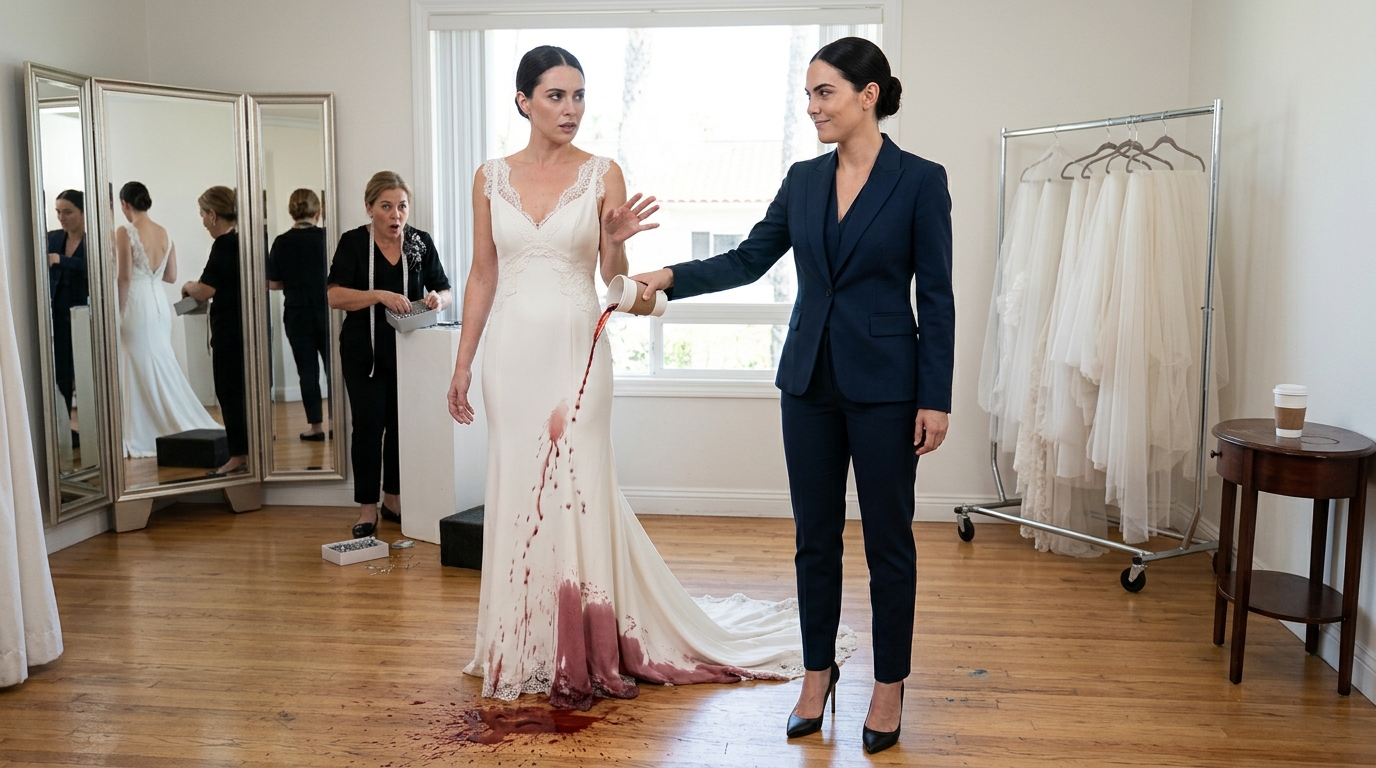
Saraphene stepped inside, her designer stiletto heels clicking loudly against the hardwood floor as she balanced a second white cardboard cup in her hand. Her eyes immediately swept down to the hem of my gown, her jaw tightening for a fraction of a second before her standard lifestyle smile slid into place.
“You really should have gone with the satin, Ailen,” she said, her voice dropping into that syrupy tone that always preceded a strike. “Crepe just shows every single flaw. It looks so… rigid.”
“The lines are exactly where they belong,” I replied, standing perfectly still on the wooden pedestal.
Saraphene closed the distance between us, her movements quick, deliberate, and crowded with an artificial urgency. She reached out, extending the warm cup toward my chest. —”Here, take the real blend before you pass out from the stress.”
I didn’t move my hands from my sides.
Her wrist twisted. It wasn’t a clumsy stumble or an uncoordinated lapse. It was a sharp, calculated jerk of her forearm. The plastic lid popped free, and a thick, dark crimson wave erupted from the top of the cup, splashing heavily across the bottom third of the ivory crepe.
It wasn’t coffee. The pungent, bitter aroma of cheap merlot instantly filled the small dressing room.
“Oh no,” Saraphene gasped, her palm slamming against her mouth as she stepped back, her eyes wide with a theatrical horror that didn’t reach her brows. “I—I thought this was the espresso. The cups look identical.”
The seamstress let out a sharp, choked noise, dropping her box of pins across the floor.
I looked down at the dark red stain spreading through the vintage lace, soaking deep into the second layer of fabric like an oil slick on fresh snow. The liquid was heavy, bleeding upward toward the waistline.
My right hand quietly reached into the pocket of my gray sweater, my fingers wrapping around the cold, matte-black barrel of my fountain pen. I gripped it until the metal clip bit into my palm, using the physical sting to lock the cold fury squarely behind my teeth.
“It’s fine,” I said, my voice entirely flat, stripped of the tears she was waiting to see. “I just need a minute.”
Saraphene’s small physical tell appeared—a nervous, rapid tapping of her designer fingernails against her empty cup as she realized I wasn’t going to scream. “Well, at least the cleaners can try to save the clearance fabric. I’ll leave you to your thoughts, honey.”
She turned and exited, the heavy door clicking shut behind her.
I stepped off the pedestal, the wet fabric dragging heavily against my ankles, and looked into the mirror. The woman staring back didn’t look defeated. She looked like someone who had just watched her enemy play her absolute best card too early in the game.
They wanted a war of emotion, but I was building a ledger.
CHAPTER 4: THE SILENCED MICROPHONE
The private banquet hall in downtown San Diego hummed with the performative warmth of a family that only loved its own reflection. High vaulted ceilings trapped the clink of crystal glasses, while massive chandeliers threw long, fractured shadows across tables draped in the unapproved blush and gold silk.
I sat at the far end of the head table, my navy sheath dress anchoring me to the wooden chair.
To the room, we were celebrating. But across the linen spread, Delora was raising her wine glass to a guest, her tight, polished laughter cutting through the room’s noise while her eyes deliberately drifted over the top of my head. Saraphene stood near the main projection screen, her stiletto heels shifting restlessly as she whispered something into the ear of the master of ceremonies.
The young man with the microphone gave a stiff nod, his eyes quickly darting toward my position before he cleared his throat into the mic.
“Ladies and gentlemen, if you could please take your seats,” the host’s voice boomed through the speakers, cutting the room’s chatter instantly. “We have a special look down memory lane prepared by the family.”
The lights dropped with sudden, jarring finality.
The projection screen flickered, casting a harsh blue glow over the room as a soft, generic piano melody began to play. Photos began to bleed into one another—Saraphene winning a high school tennis match, Saraphene standing before a pristine beach house, Delora hugging Saraphene at an upscale gala.
Frame after frame passed, a meticulous archive of a family dynasty that apparently only had one child.
I appeared exactly once, captured by accident in the dark background of a holiday party, my face completely blurred behind someone else’s shoulder. The room remained completely quiet until a low, unmistakable whisper carried from the dessert bar near the entrance. —”I thought this was supposed to be Ailen’s wedding dinner.”
Garrett’s hand slid across the fabric of my lap, his fingers wrapping firmly around mine under the table line. His skin was rough, cool, and solid—a silent, physical grounding that reminded me of exactly who was real in this room of expensive ghosts.
The screen went black, and the house lights snapped back up, catching the room in a collective blink.
“And now,” the host announced, lifting his index finger as he checked a printed card, “we have a few words read on behalf of the bride.”
I stood up immediately, the folded sheets of my actual speech gripped tightly between my fingers. “I can take the microphone.”
The host didn’t hand it over. He stepped back slightly, his shoulder blocking the path to the podium as he cleared his throat again, his voice echoing over my words. —”Ailen has asked me to express her deepest gratitude to her mother, Delora, and her coordinator sister, Saraphene, for executing a vision far grander than she could have ever imagined on her own.”
The text he was reading wasn’t mine. It was cotton-candy fluff laced with passive submission, painting me as a grateful charity case who had finally been taught how to have taste.
Saraphene adjusted the strap of her watch, a slow, micro-action of pure satisfaction settling into her posture as she watched me stand there with my useless pages. They had stolen my presence from the screen, and now they were using a stranger to overwrite my voice at my own rehearsal table.
I didn’t argue. I didn’t shout over the amplification system.
I simply sat back down, sliding my hand back into my pocket to touch the heavy, matte-black fountain pen resting against my keys. My thumb traced the hard edge of the clip, my mind silently cross-referencing the file sizes from the digital archive with the fake script currently being read aloud.
The true purpose of the blue folder in Saraphene’s tote wasn’t a design layout; it was the estate transfer paperwork that required a bride’s signature under the guise of wedding registration.
“They think they’ve deleted the master file,” I whispered to Garrett, my voice dropping beneath the steady drone of the host’s reading.
Garrett looked toward the main control booth at the back of the hall, his face tight with a quiet, working-class resolve. “The tech guy left the back door open when he updated the system portal.”
“Let them finish the performance,” I said, capping my pen inside my pocket with a single, unvoiced snap. “The altar is tomorrow.”
CHAPTER 5: THE ALTAR CHECKMATE
The midday sun beat down on the outdoor estate garden like an interrogator’s lamp. Hundreds of guests sat in rows of ivory silk chairs, their whispers rising in a low hum that competed with the serene drone of the string quartet. I walked the perimeter, my dress—re-hemmed past the wine damage by my own hands the previous night—moving sharply against my ankles.
I reached the front row and stopped.
Resting squarely on the seat assigned to the bride’s immediate circle was a laser-engraved acrylic plaque. It didn’t bear the name Ailen Robinson. In bold, gold calligraphy, the plastic read: Mrs. Wrong.
Saraphene stood three feet away near the altar steps, her arms crossed over a sleek cocktail dress. It wasn’t just any dress; it was a fitted white garment built exactly to the parameters of my original sketch—the exact neckline and lace motif she had systematically lifted from the vendor portal files. Her jaw tightened as she watched me trace the plastic plaque, a tiny, involuntary twitch shaking her left index finger.
“The seating assignments are locked, Ailen,” Saraphene whispered, her tone dropping into that familiar, unearned authority. “Don’t make a scene in front of the partners.”
I didn’t argue. I didn’t reach for the microphone to scream.
Instead, I pulled the matte-black fountain pen from the small clutch at my side, uncapped the heavy barrel, and dragged the scratchy steel nib directly across the word Wrong. The dark ink tore through the gold foil finish, leaving a ragged, black line before I printed the letters of my grandmother’s maiden name above it.
“The script changed,” I said, capping the pen with a single, resonant snap that made the nearest usher blink.
Delora approached from the aisle, her hands smoothing her silk dress, her eyes darting toward the defaced acrylic plaque with a sharp flare of panic. —”Ailen, stop this immediately. Ethan is already seated at the VIP table. Your behavior is reflecting poorly on the entire family.”
“Ethan is an uninvited variable,” I replied, my voice dry and completely level. “And this table is no longer your asset.”
I turned my back on them, my gaze locking onto the rear booth where the audio-visual technician was adjusting his headset. Through the window of the control booth, a tiny green light flickered on the auxiliary drive—the physical confirmation that my independent master file override had successfully bypassed the administrative lockout.
Saraphene stepped forward, her heels digging hard into the turf as she tried to block my path to the altar steps. —”You don’t have the authority to alter this itinerary. Mom signed the venue clearance this morning.”
“She signed a digital copy,” I said, leaning in just enough to look past her shoulder at the blue folder now sitting openly on the coordinator’s podium. “But the master file requires a physical identity she can’t simulate.”
The officiant cleared his throat, stepping onto the riser as the music abruptly died, leaving the entire garden trapped in a heavy, suffocating silence.
CHAPTER 6: THE MASTER FILE
The video stream didn’t display the staged vacation photos or the syrupy family timeline they had tried to force into the system. Instead, the screen rendered a crystal-clear, real-time recording of the backdoor administrative portal, tracking the exact IP address from Saraphene’s design firm as it systematically altered the vendor contracts and forged my signature on the estate deed transfer.
“Turn that off!” Delora shrieked, her voice cracking as she bolted from the front row, her manicured nails digging deep into the linen fabric of her purse. —”This is an invasion of privacy! Ailen, stop this madness right now!”
“The feed is hardwired into the main house server, Mom,” I said, my voice carrying flat and even through the speaker system without a hint of rising heat. “You can’t delete a master file when the local server is completely locked from the inside.”
Saraphene surged forward, her face contorting into an enraged mask, the white cocktail dress she had stolen from my sketches suddenly looking tight and restricted under the glare of the projection screen. —”You think you’re so smart, Ailen! You’re nothing without this family! You’re just a low-level worker trying to steal credit for my management!”
“I didn’t steal anything,” I said, pulling the matte-black fountain pen from my clutch and pointing it directly toward the notarized blue folder resting on the podium. “The local clerk’s office already verified the digital footprint. You didn’t want to plan a wedding, Saraphene. You wanted to use the registration documents to liquidate Grandma’s inheritance trust under my name.”
A collective gasp ripped through the rows of guests as the screen shifted, displaying the official, certified stop-work order and the fraud notification issued by the county clerk two hours before the ceremony began.
Saraphene reached for the podium, her fingers trembling wildly as she grabbed the folder, trying to shield the legal seal from the cameras. —”This isn’t legal! You rigged the portal! I am the lead coordinator here!”
“You were the coordinator,” I said, stepping down from the altar platform, my boots clicking with absolute finality against the stone walkway. “But the venue contract requires an active signature from the sole beneficiary of the estate. And that signature belongs to me.”
Delora collapsed back into her chair, her face draining of color as she realized the institutional leverage she had spent months building had completely dissolved under the weight of her own recorded arrogance. Ethan quietly slipped out through the side hedge, completely abandoned by the family that had weaponized him.
I looked at Garrett, who stood at the edge of the garden riser, his jaw steady, holding the physical, notarized ledger containing every single entry I had typed since the very first brunch. We didn’t need a corporate legal team or a public relations shield; the truth was rendered in plain, unyielding ink.
“The performance is over,” I said into the microphone, looking directly at Saraphene as she stood frozen on the steps, stripped of her unearned entitlement. “You wanted to write me out of the script. But I kept the master file.”
The screen blinked out, returning the garden to the natural, quiet sunlight of the San Diego coast, completely devoid of the tension that had suffocated it for weeks.
The kitchen of our new apartment smelled of fresh wood and quiet stability, the afternoon sun cutting a clean, warm line across the bare laminate counter. I stood by the sink, slowly rinsing the black ink from the nib of my fountain pen, watching the water run clear into the drain without a single sound breaking the peace. Garrett walked in from the small balcony, setting two simple mugs of coffee down on the counter before sitting beside me in the quiet room.