Building a Legacy From the Ground Up When Family Demands You Remain Invisible
CHAPTER 1: THE ENGAGEMENT TABLE
The signage outside Maison Verde gleamed subtly, catching the last bit of sunlight as I stepped onto the pavement.
I wore a slate gray wrap dress, understated and tailored, keeping my hair pulled back in a practical twist.
Marcus, our floor manager, stood near the host stand.
His eyes widened a fraction when he saw me walk through the front entrance instead of the service halls.
He nodded discreetly, keeping his professional composure intact while I made my way toward the center table.
Clarinda wore pale pink silk, her overpowering gardenia perfume cutting through the scent of roasted herbs.
“Venora,” she said, her tone flat like someone acknowledging a utility worker. “You’re early.”
“On time, actually,” I replied softly, sliding into the chair left open between my father and an empty setting.
Isolda offered her cheek without rising, her ivory dress draped over her shoulders like a shield.
Alden gave me a firm, vacant nod, his handshake from two years prior completely erased from his memory.
Silverware clinked against porcelain as dinner service commenced around us.
The plates were warm, the garnish precise, exactly as I had trained the kitchen staff to deliver.
Clarinda turned her head slightly during the first course, her gaze sweeping over my outfit with calculated pity.
“That dress is very practical,” she said, a faint smirk touching her lips. “Just like your work, I imagine.”
I kept my hands folded in my lap, feeling the cool linen beneath my fingertips.
“It serves,” I said, letting the silence settle between us without rushing to fill the void.
Wendell cleared his throat, lifting his heavy crystal glass to toast the man who would supposedly elevate their family name.
No one looked at me as the glasses chimed together in the dim light of the reclaimed wood chandelier.
Inside, the machinery of the room hummed quietly, fueled entirely by the labor they refused to acknowledge.
CHAPTER 2: THE RESTROOM ANCHOR
I stared into the illuminated mirror, watching the reflection of a woman who had spent seven years trading sleep for structural permits.
My lipstick had faded around the edges, but the jawline remained steady.
Outside the heavy wooden door, the muffled clatter of cutlery against porcelain carried the weight of a performance that had been running on empty for decades.
A sharp rap echoed against the stall partition.
“Venora?”
Isolda’s voice slipped through the wood, pitched with the artificial sweetness she used when she wanted an audience to think she cared.
“Mother is wondering if you’re rehearsing a speech out here, or just taking up space.”
I didn’t rush.
I smoothed the slate gray fabric of my wrap dress, taking a slow breath that tasted faintly of rosemary and old vinegar.
“Tell her I’m admiring the plumbing,” I said, my voice carrying cleanly through the gap beneath the door.
A pause hung in the air, thick enough to choke on.
The handle rattled once, twice, before the soft click of her heels retreated down the tiled corridor.
I reached into my pocket, my fingers brushing against the cool, worn metal of a brass-capped pen.
It was the same pen I used to sign the primary deed on this building three years ago, back when the bank officers laughed at a woman in a stained utility jacket asking for commercial credit.
They had looked at me the exact same way Isolda looked at a menu without prices.
I stepped out of the washroom, the cool air of the back hallway hitting my shoulders like a cold towel.
Marcus was standing near the service hatch, checking an inventory tablet with absolute focus.
He didn’t look up as I passed, but his thumb gave the corner of the tablet a sharp, rhythmic tap—our old signal for perimeter secure.
I rounded the corner and saw the family table sitting under the reclaimed wood chandelier, entirely unaware that the floor beneath their silk shoes was anchored by a foundation they wouldn’t know how to pour.
Clarinda was leaning forward, her face pinched into a tight mask as she whispered something across the linen to Alden.
I didn’t break my stride.
I slid back into my chair, the wood scraping against the polished concrete with a dull, heavy thud that made Wendell glance up from his glowing phone screen.
“You missed the entrée selection,” Clarinda murmured, her fingers tightening around the stem of her wine glass until the knuckles went white.
“I didn’t miss anything,” I replied softly, picking up my heavy silver fork. “I was just checking the foundation.”
CHAPTER 3: THE GLACIAL COURSE
“To the man who will elevate this family’s name, its vision, our future,” Wendell declared, lifting his heavy crystal glass with practiced resonance.
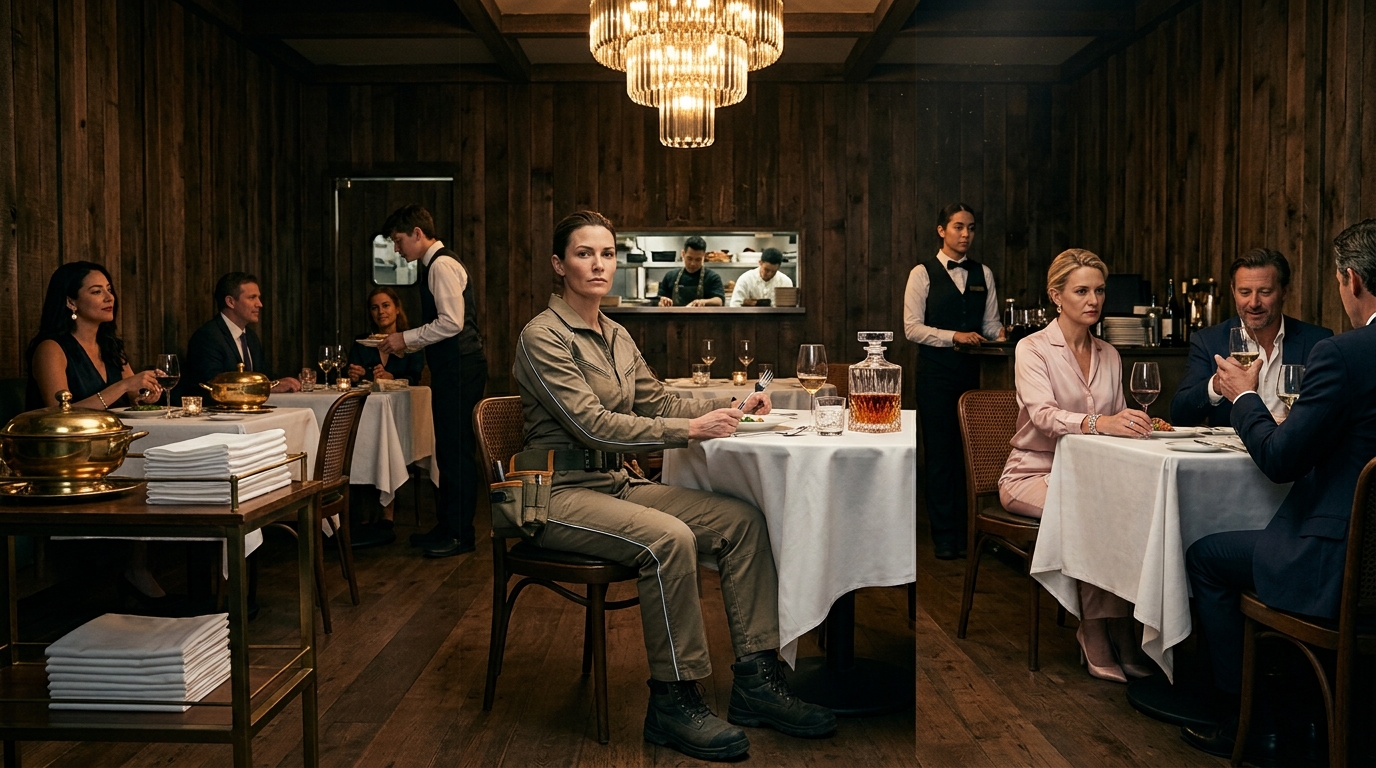
A chorus of silverware clinking against porcelain rippled around the center table beneath the reclaimed wood chandelier.
Isolda beamed, her engagement ring catching the low amber light, while Clarinda nodded with tight, approving satisfaction.
I raised my flute of sparkling water without looking up, feeling the bubbles pop against the glass edge.
No one glanced in my direction as the main course arrived, carried by a junior server whose hands shook slightly under the weight of the heavy ceramic platters.
The seared halibut rested precisely over a bed of herbed lentils with a fermented onion reduction glaze, exactly meeting the forty-eight-hour infusion standard I had personally written into the operational manual.
Isolda’s fork hovered over the plate before she pulled back with a sharp sniff.
“I thought I said no onions,” she snapped, her voice carrying loudly enough to draw a sideways glance from the neighboring table.
Alden leaned closer, his brow furrowing as he inspected his own meal. “Is this a problem?”
“It’s a fermented glaze,” I said calmly, resting my hands flat on the table. “No raw ingredients. But if it’s an issue, we can have the kitchen prepare something else.”
Jessica, our lead floor server, froze for a fraction of a second near the service station, looking toward me for confirmation.
I gave her a single, imperceptible nod.
Isolda pushed the plate an inch forward, her cheeks flushing under the soft lighting.
“It’s fine,” she muttered, forcing a tight smile back onto her face. “I’ll manage.”
Alden chuckled, trying to recover his posture by gesturing toward me with his wine glass.
“Just shows you how hands-on she still is with her little sanitation projects, huh?”
Clarinda adjusted her diamond bracelet, her lips thinning into a hard line.
“Still running that little operation of yours, Venora?” she asked, her tone dripping with manufactured pity. “Or did you finally decide garbage sorting wasn’t a real career path?”
I didn’t blink, keeping my gaze locked onto the polished silver of my knife.
“We’re expanding, actually,” I said softly, the silence at our table stretching taut like a pulled wire. “Three new municipal contracts this quarter alone.”
Clarinda chuckled dryly, dismissing the fact as if I were talking about a hobby farm.
Before anyone else could lob another practiced insult across the table, a man in a navy suit from the adjacent table stepped up and paused beside our chairs.
“Excuse me,” he said, addressing the room with quiet confidence. “I just wanted to compliment the management. The air quality, the lighting, the acoustic balance—it’s all intentional. You don’t get this level of design everywhere.”
He turned his focus directly to me. “This feels like your aesthetic. Are you part of the concept here?”
I looked up, meeting his eyes across the linen.
“You could be right,” I said.
CHAPTER 4: THE UNRAVELING THREAD
Clarinda’s jaw tightened, her gaze snapping back from the retreating guest to lock onto my face.
“What did he mean by that?” she asked, her voice dropping into an icy register meant only for family ears.
Isolda forced a breathless, brittle laugh, waving her hand dismissively over her water glass.
“Probably just another eccentric local,” she muttered, though her eyes darted nervously toward Alden.
Alden didn’t laugh.
He was staring across the linen at me, his fingers tapping a restless, uneven rhythm against the polished wood of the table.
“I remember seeing your name on a portfolio proposal a couple of years back,” Alden said, his voice tightening at the edges. “Clean Living, right? I tried to pitch an enterprise investment strategy to your group. We never heard back.”
I didn’t blink, keeping my posture entirely relaxed against the back of the chair.
“You did,” I said simply.
A heavy, suffocating silence settled over the center table, instantly killing the artificial chatter.
Before Alden could sputter a defense or Clarinda could demand an explanation, the side doors near the service hallway clicked open.
Leona stepped through.
She wore a navy wrap coat with a silk scarf tied neatly at her throat, moving with the quiet, unquestioned authority of someone who owned the building she stood in.
She walked straight to our table, her eyes bypassing Clarinda and Isolda entirely to rest on my shoulder.
“I heard you were dining tonight,” Leona said, her voice cutting through the heavy air like a clean blade. “I just wanted to check the evening tallies. You’ve completely outdone yourself with this layout.”
Isolda blinked rapidly, her face draining of color.
“Leona? What are you doing here?”
Leona placed a warm, steady hand on my shoulder, giving it a light, grounding squeeze.
“I work for the woman who designed every square inch of this room,” Leona replied smoothly, turning her cool gaze toward Isolda. “And if this is her family, they should know better than anyone what it takes to build a foundation from the ground up.”
The investors at the neighboring table turned their heads, watching the unravelling performance with undisguised curiosity.
Wendell finally dropped his phone onto the tablecloth, his face twisting in sudden confusion as he looked between Leona and me.
“Build what?” Wendell demanded, his voice cracking slightly on the vowels. “Venora works in public sanitation. What does she have to do with Maison Verde?”
I set my glass down, letting the crystal make a sharp, definitive click against the linen.
“Everything,” I said.
CHAPTER 5: THE WEIGHT OF STEEL
Wendell’s jaw slackened, his eyes darting from Leona’s tailored navy coat to the polished brass numbering on our table marker.
“You’re making a scene,” Wendell muttered, his face mottling with sudden, uncomfortable heat as he reached blindly for his water glass.
“I’m not making a scene,” I said, my voice dropping an octave into absolute stillness. “I’m answering a question your table asked twice.”
Alden slammed his flat palm against the mahogany edge, the vibration rattling the heavy silver cutlery across the linen.
“This is ridiculous—you don’t own a flagship commercial property in downtown Nashville,” Alden barked, his face twisting into an ugly, cornered grimace. “I saw your corporate filings from three years ago—you were scrubbing floors for municipal waste contracts.”
I didn’t blink.
I reached slowly into my pocket, my fingers wrapping around the cool metal of the brass-capped pen, and laid it deliberately across the center of my plate.
“I signed the mortgage for these walls with this exact pen,” I said, leaning forward into the tense space between us. “The same year your firm sent an intern to beg my leasing office for a sub-tier maintenance grant.”
Isolda let out a sharp, breathless gasp, her hands flying to her mouth as the full, crushing weight of the architectural truth slammed into her structured reality.
“You planned this,” Isolda hissed, her eyes narrowing into venomous fury. “You sat here all night like a martyr just to humiliate us in front of the district.”
“I came here because my mother invited me to dinner,” I replied, my tone flat, unyielding, and devoid of fear. “You’re the ones who decided my name was an insult.”
Clarinda rose halfway out of her chair, her silk blouse straining against her rigid shoulders, her breath coming in ragged, shallow gasps.
“We raised you better than this bitter, ungrateful defiance,” Clarinda snapped, her voice trembling with outraged entitlement.
“No,” I said, holding her panicked gaze without an inch of give. “You raised me to stay invisible so you never had to look at what real work looks like.”
Marcus stepped closer from the service archway, his hand resting quietly on the partition, while the rest of the dining room held its collective breath in the heavy, suffocating quiet.
CHAPTER 6: THE DUSTY GRAY AFTERMATH
Clarinda snatched her handbag from the adjacent chair, her fingers clawing at the leather strap with frantic, uncoordinated jerks.
“We are leaving,” Clarinda snapped, her voice cracking as she avoided looking at any of the surrounding tables.
Isolda didn’t utter a single defense, her gaze fixed entirely on the polished concrete floor as she swept past my chair with rigid, mechanical strides.
Alden followed close behind, his expensive suit jacket bunched tightly across his shoulders, refusing to grant me even a fraction of a glance.
Wendell lingered for a heartbeat, his thumb nervously rubbing the corner of his phone screen before he turned and shuffled after his wife toward the exit.
The heavy glass front doors swung shut behind them, cutting off the humid Nashville night air and leaving behind an abrupt, heavy stillness.
I picked up the brass-capped pen, slipping it back into the pocket of my slate gray dress where it belonged.
Leona gave my shoulder a light, affirming pat before walking back toward the administrative office.
Marcus stepped up to the table, quietly lifting Clarinda’s untouched wine glass and setting it onto a bus tub without a word.
“Shall I have the staff reset the center table for the morning breakfast briefing?” Marcus asked calmly.
“Yes,” I said, standing up and smoothing the fabric of my skirt. “Make sure the fresh basil is stocked.”
I walked slowly through the dimming dining room, running my fingertips lightly along the reclaimed wood beams of the booths I had spent months designing.
There were no cameras flashing, no grand crowds cheering, and no dramatic speeches left to deliver.
The silence that filled the room wasn’t empty anymore; it was solid, honest, and entirely mine.
I stepped into the back kitchen just as the night crew began prepping the morning stock, the familiar hum of refrigeration units and the sharp scent of roasted garlic greeting my senses.
I hung my jacket on the iron hook by the door, rolled up my sleeves, and walked straight to the prep line to check the morning inventory.
The work didn’t care about last names, social status, or who sat at the tables upstairs.
It just waited for someone willing to build it right.