The Weight of a Single Coin: Finding Grace and Redemption within the Halls of Crest Holdings
CHAPTER 1: The Placeholder
The bell chime was sharp, cutting through the low hum of the store’s climate control. Zoe kept her head down, her movements practiced, her focus entirely on the diamond choker she was polishing. But then came the scrape. A rhythmic, dragging sound of rubber against polished stone, the kind of sound that made the senior staff stop breathing.
She looked up. An old woman stood in the threshold, her coat looking less like fabric and more like a collection of memories stitched together to stave off the chill. Her sneakers, cracked at the toe, seemed to hold the dust of three different bus lines.
Brittany, standing nearest to the entrance, moved with the predatory grace of someone who had never had to worry about a rent payment. Her posture was a wall.
“Can I help you?” Brittany asked. It wasn’t an offer. It was a barricade.
“I just want to look around,” the woman replied. Her voice was like dry leaves.
Tanya didn’t walk; she materialized. Her heels didn’t click on the marble so much as they declared ownership of it. She hovered behind the woman, her perfume—something floral and aggressive—clinging to the air.
“This isn’t that kind of store,” Tanya said, the words dripping with a practiced, synthetic politeness. “We serve high-end clients. You’d be more comfortable somewhere else.”
A ripple of laughter moved through the shop, a hollow sound that bounced off the glass. Zoe felt a knot tighten in her gut—a familiar, sharp ache. She set down the choker, the velvet tray heavy in her hands. She knew this script. She knew that Tanya was looking at the woman’s shoes and seeing a mark on the store’s ledger.
She stepped forward, her own uniform feeling like a costume she had outgrown. “Can I get you some water?”
The room went still. The air changed, thickening with the sudden, collective disapproval of the senior staff. Tanya turned, her eyes narrowing into cold slits. Zoe ignored the sharp sting of that gaze. She walked toward the woman, reaching out to gently touch an arm that felt as fragile as parchment.
“That would be nice,” the woman whispered, her eyes meeting Zoe’s with a sudden, unnerving clarity.
As Zoe led her to a chair near the side wall, she felt the silence following them—a cold, heavy curtain of judgment. She sat with her, shielding the woman from the sharp, whispering glares. She didn’t have much, but she had the grace to wait, and for a fleeting moment, she didn’t feel like a placeholder. She felt like a human being.
But as she reached into her bag to offer the woman a glass of water, her fingers brushed against something else—a small, crumpled receipt for a utility bill she couldn’t afford to pay. It wasn’t just the bill, though. Tucked inside the fold was a business card she hadn’t touched in months, belonging to an old contact in the city, the name printed in fading, rusted ink. Why was it in her bag? She didn’t remember putting it there.
CHAPTER 2: The 20 Cab Fare
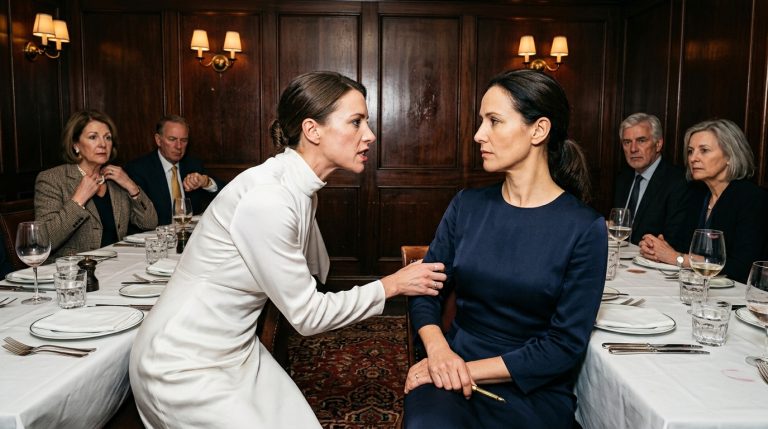
The silence in the store was not the absence of sound; it was a physical weight, a suffocating layer of judgment pressed against Zoe’s skin. Tanya stood a few feet away, her arms folded, her smile a thin, sharp line that promised consequences. The air smelled of expensive, antiseptic floor wax and the floral, aggressive perfume that clung to Tanya like a second skin.
Zoe felt the phantom eyes of the senior staff on her back—Brittany’s smirk, the hushed, mocking whispers that had been the background noise of her existence for eight months. She looked down at the woman sitting beside her. The old woman’s hand, resting on the velvet upholstery of the store chair, was a roadmap of a long, difficult life. Her skin was dry, papery, and warm, a stark, grounding contrast to the cold, clinical marble floors of Lux and Stone.
“Can I get you some water?” Zoe whispered again, her own voice sounding thin in the cavernous room.
The woman didn’t answer immediately. She looked around the boutique, her gaze lingering on the glittering, over-lit displays of necklaces and rings as if she were reading a book in a language she found tedious. When she finally looked back at Zoe, her eyes were clear, bright, and frighteningly steady.
“That would be nice,” she said again.
Zoe walked to the breakroom, her movements stiff. She could feel the stares—she was the Placeholder, the girl who didn’t sell, the girl who cleaned the vaults and fetched the coffee. Every step felt like walking through deep water. She filled a glass with water, her reflection in the stainless-steel cooler looking distorted and small.
When she returned, the woman was sitting exactly as she had left her. Zoe handed her the glass, their fingers brushing for a brief, electric moment. The old woman’s grip was surprisingly firm.
“Take your time,” Zoe said, her voice dropping to a low, protective register. “There’s no rush.”
As she stood there, a sudden, intrusive thought gripped her: the memory of being invisible. She remembered the faces of customers who would look right through her, their eyes gliding over her as if she were a piece of furniture, a fixture of the store like the velvet display trays. For a second, the boutique seemed to blur. Was she actually here, or was she just a projection of the store’s own coldness? The phantom of that insignificance tried to swallow her whole, making her heart hammer against her ribs.
“Good things find good people,” the woman said suddenly, her voice cutting through Zoe’s internal spiral. “Remember that.”
Zoe blinked, the cold shop snapping back into focus. She nodded, unable to articulate the sudden, inexplicable lump in her throat. The woman then straightened, her demeanor shifting from tired traveler to someone with an iron-clad purpose.
“I’d like to see ten luxury sets,” the woman said, her tone suddenly authoritative, resonating with a quiet, refined power that made the air in the room hitch. “Your finest ones. Full sets—necklace, earrings, bracelet, ring.”
Zoe felt the room tilt on its axis. The request was absurd, an impossibility that defied the logic of the store’s elitist hierarchy. She glanced toward Tanya, who was already walking over, her heels clicking against the floor like a countdown.
“Ten?” Zoe repeated, her voice barely a whisper.
“The best you have,” the woman replied, her eyes locked onto Zoe’s, waiting.
Zoe reached out, her hands moving with a newfound, deliberate grace. She didn’t look at Brittany or the other girls. She began to pull the velvet trays from the high shelves, each one heavy with diamonds that felt like ice in her palms. She worked for nearly an hour, a slow, methodical dance of logistics and care. Every setting was checked, every stone aligned. She ignored the laughter that drifted from the back of the store, the whispers about the “bad circus” they were all watching.
When the final tray was set down, displaying ten of the most expensive collections in the city, the old woman clasped her hands together.
“I’ll take all of them,” the woman announced, her voice echoing in the sudden, absolute silence of the boutique.
The price tag hit like a physical blow: $240,000.
Zoe felt a surge of exhilaration, a triumphant spark in her chest, but it was quickly extinguished by the roar of laughter that erupted from behind her. It was loud, ugly, and unfiltered. Tanya moved forward, her face a mask of cruel delight.
“Oh my god,” Brittany choked out, covering her mouth.
The old woman didn’t flinch. She began to check her pockets, her movements slow and devoid of panic. “I don’t have my card on me, dear,” she said, her voice calm, addressed only to Zoe. “My grandson has it. I’ll need to reach him.”
Tanya stepped between them, her scent of floral perfume suffocating. She looked down at the old woman with a sneer that was centuries old. “Honey, you don’t have a grandson with $200,000. You’d be more comfortable somewhere else.” She gestured toward the door, her hand slicing through the air. “Security can walk you out.”
Zoe looked at the woman—really looked at her—and saw not a beggar, but a person being dismantled by greed. She didn’t think about the repercussions. She didn’t think about the rent she couldn’t pay. She reached into her bag, pulling out her last twenty-dollar bill—her emergency, her lifeline, the only thing she had left to survive the week.
She pressed it into the woman’s hand.
“For a cab, please,” Zoe said.
The woman stared at the bill, her fingers closing tightly around it. When she looked up, the light in her eyes was sharp, almost piercing. “You are a rare kind of person, Zoe.”
Tanya’s voice cut through the moment like a blade. “That’s it. You’re fired.”
Zoe didn’t argue. She didn’t cry. She simply picked up her bag and walked toward the door, leaving the diamonds, the store, and her future behind. As she stepped into the cold afternoon, the sun hit her face, blinding and indifferent. She had no job, no money, and no idea that the woman standing behind her had already begun to smile.
CHAPTER 3: The Summons to the Estate
The afternoon sun in Atlanta was a heavy, golden thing, but standing on the sidewalk outside Lux and Stone, Zoe felt only a sharp, icy draft. The door behind her clicked shut—a sound of finality that echoed in the marrow of her bones. She clutched her bag, the strap digging into her shoulder, her mind a frantic, swirling daze of logistics. Rent. Utilities. The quiet, terrifying realization that the “placeholder” was now officially displaced.
She walked. There was no destination, only a desperate need to put distance between herself and the humiliation of the boutique. She found herself at a bus bench, a rusted structure of metal and splintered wood that felt more honest than the marble halls she had just exited. She sat down, her legs feeling like lead. Pulling a crumpled notebook from her bag, she began to list the local employment agencies, her handwriting shaky.
The heat began to shimmer off the blacktop, a hazy veil that distorted the passing traffic. Every sleek sedan that slowed down sent a jolt of anxiety through her. She was scanning a listing for a part-time retail gig at a big-box store—miles away from diamonds, miles away from the life she had just lost—when the rhythm of the street changed.
A black SUV, its paint gleaming like polished obsidian, slid to a halt directly in front of the bench. The curb-side window hummed downward with a soundless precision that was immediately alien to this part of the city.
Zoe went rigid. She didn’t look up, her gaze fixed on the screen of her phone, her thumb hovering over the ‘Apply’ button.
“Ms. Zoe?”
The voice was polite, measured, and carried the specific, clipped cadence of a professional assistant.
She looked up. A man was watching her from the driver’s seat. He was wearing a fitted suit that looked expensive, the fabric dark and impeccable despite the rising humidity. He didn’t look at her with the pity Tanya had possessed, nor the disdain of the senior girls. He looked at her with the cool, analytical interest of a man whose job was to observe.
“Who’s asking?” Zoe managed to say, her voice steadier than she felt.
“My name is Darius,” the man replied. He didn’t introduce himself further, as if his name were a key that should already be familiar to her. “I’m the personal assistant to Nathan Crest, CEO of Crest Holdings.”
The name struck her like a physical blow. Crest Holdings. The conglomerate that owned half the commercial real estate downtown—including, she realized with a sinking heart, the very building she had just been evicted from. She felt the blood drain from her face. This was it. They had come to collect on some imagined grievance, or perhaps they were here to silence her before she could tell anyone how Tanya ran their luxury storefront.
“The woman you helped this afternoon,” Darius continued, his eyes scanning the street before returning to her, “is his grandmother. He would like to meet you.”
Zoe stared at him. The absurdity of it made the world feel momentarily thin. She had spent the last eight months being ignored, and now, in the span of an afternoon, she had been fired by a manager, defended by an elderly stranger, and summoned by the most powerful man in the city.
“This has to be a mistake,” she murmured, though she stood up, her movements mechanical.
“It is not a mistake,” Darius said, opening the door for her.
She got in. The interior of the SUV was a cocoon of silent, climate-controlled comfort—the smell of fine leather and charcoal filters. As the vehicle pulled away, Zoe watched the bus bench shrink in the rearview mirror. It was just a place to wait, she realized, but she was done waiting.
The drive was quiet. Darius didn’t make small talk, and Zoe didn’t ask questions. She watched the cityscape transform, the grit of the downtown core giving way to the sprawling, manicured estates of the outskirts. The transition was jarring—the transition from the concrete reality of survival to the hushed, gilded world of the elite.
When they pulled through the gates of the Crest estate, Zoe felt a strange, tightening sensation in her chest. It wasn’t the size of the house that impressed her; it was the atmosphere. Everything was bathed in an early evening light, the shadows long and deliberate. It was the stillness of the place that unsettled her—the feeling that here, in this pocket of the world, time didn’t tick in seconds; it moved in long, sweeping tides.
Darius parked and led her toward the house. As they crossed the threshold, the silence intensified, wrapped in the scent of old paper and polished wood.
Then she saw him.
Nate Crest was standing at the top of the grand staircase, his silhouette framed by the expansive window behind him. He looked like the photographs in the magazines, yet they had captured only the surface. In person, he had a gravitational presence, a weight that seemed to anchor the room around him. He wasn’t looking at his phone or a screen; he was looking at her, his expression unreadable, calm, and devastatingly steady.
Zoe felt the vulnerability of her own position—the mismatched clothes, the lingering scent of the boutique’s floor wax, the exhaustion that had finally begun to settle into her bones. She stood at the base of the stairs, a silent participant in a play she hadn’t auditioned for, wondering if this was the start of something that would heal her, or something that would simply consume her.
CHAPTER 4: The Interview
The lobby of Crest Holdings was a cathedral of industry. Everything—the brushed steel, the seamless glass, the absence of dust—spoke of a singular, uncompromising order. Zoe stood in the center of the vast expanse, her bag feeling heavy, a physical anchor against the drift of the marble floor beneath her feet. She had expected questions about her dismissal from Lux and Stone, expected the condescension of a corporate ladder, but as she moved toward the HR wing, the atmosphere felt less like an interview and more like an initiation.
She was ushered into a room that smelled faintly of ozone and expensive filtration. A woman sat behind a desk of dark, polished mahogany. Her name tag read Sarah, and she moved with the efficiency of a machine.
“Zoe,” Sarah said, not looking up from the screen. “You are here at Mr. Crest’s personal recommendation.”
Zoe felt a sharp prickle of unease. “I’m here because I wanted a chance to interview. I didn’t want any favors.”
Sarah paused, her fingers hovering over the keyboard. She looked up, her gaze steady, almost unnervingly so. For a fraction of a second, Zoe saw a flicker in Sarah’s eyes—a momentary hesitation, a subtle shift in focus as if the woman were weighing a secret she wasn’t supposed to share. It was a micro-mystery, a tiny discrepancy in the clinical efficiency of the room. Sarah recovered instantly, her expression sliding back into a professional mask.
“Favor or not, the criteria for this role remain the same,” Sarah said, sliding a thick, stiff packet of paper across the desk. “It is the highest-paying PA role in the company. We expect total discretion, extreme organizational capability, and the ability to operate under what I would call ‘fluid conditions’.”
Zoe took the packet. The paper was cool and heavy, a stark contrast to the sweat gathering in her palms. As she flipped through the pages, she noticed that the requirements weren’t just standard administrative tasks. They involved managing, curating, and at times, diverting—a language of management that seemed designed to protect something behind the scenes.
“Why me?” Zoe asked, her voice quiet.
Sarah leaned back, the leather of her chair creaking—the only sound in the dead-quiet room. “You were fired for an act of kindness, Zoe. In a building owned by this corporation, you managed to prioritize a person over a policy. Mr. Crest is not interested in resumes that list perfect retail sales records. He is interested in people who recognize the value of a situation before it is measured in dollars.”
Zoe felt a wave of relief, followed immediately by a surge of renewed caution. She understood the game now—or at least, she understood that the game was being played on a different board. She began to answer the questions, her responses clipped and direct. She drew upon every detail of her eight months at the boutique—the inventory logs she’d re-organized in secret, the irate clients she’d managed when Tanya was nowhere to be found, the sheer, relentless persistence required to be invisible yet essential.
The interview was a grueling hour of precision. Zoe found herself constantly recalibrating, sensing the weight behind Sarah’s questions. Every time she spoke about a past difficulty, she saw the woman look for the exact moment Zoe’s resolve shifted. It was an interrogation of character, not credentials.
When the final question was asked, the room felt smaller, the air tighter.
“If you were tasked with a directive that seemed contrary to company policy but necessary for the preservation of its reputation, how would you proceed?” Sarah asked.
Zoe thought of the old woman, of the $20 bill, and of the look in Tanya’s eyes when she had been dismissed. She thought of the cold, hard marble and the warmth of a human hand.
“I would verify the truth of the situation,” Zoe said, her voice firm. “And I would choose the path that doesn’t leave me ashamed of my own reflection at the end of the day.”
Sarah stared at her for a long, uncomfortable duration. The silence stretched until it felt brittle. Then, with a slow, deliberate movement, she reached out and pulled the application back.
“We’ll be in touch by end of day,” Sarah said.
Zoe stood, her legs feeling shaky. As she walked out of the office, she caught her reflection in the glass wall of the corridor. She looked different—not more polished, but more substantial. She had done it without a single favor, without a single apology for who she was.
She exited the building and stepped back into the humid, loud, living city. She had survived the interview, but as she walked toward the transit station, she noticed a black SUV idling across the street, a dark shadow in the afternoon light. It didn’t follow her, but it remained there, a silent, watchful presence that made the air feel electrified. She was in. She had the job. But as she touched the pocket where she kept the last of her emergency cash, she felt a premonition that the “Groundwork” she had just established was about to be tested in ways she hadn’t yet begun to imagine.
CHAPTER 5: The Shadow of Jade
The silence in the hallway of Crest Holdings was different from the silence of the estate. It was a sterile, vibration-dampened hush that felt engineered to make a heartbeat sound like a drum. Zoe reached her cubicle, the fabric of her coat brushing against the edge of the sleek, grey-metal desk. She stopped.
The angle of her chair was wrong. It was pushed in three inches further than she had left it.
She felt the shift in her own perception—the sudden, sharp spike of paranoia that had been simmering since Jade’s arrival. It was a cold, crawling sensation at the base of her neck. She didn’t move toward the chair. She stood in the doorway, eyes scanning the desktop. Everything looked orderly—the stack of memos, the pen holder, the high-end tablet. But the air felt stagnant, as if someone had been standing there only moments before, waiting for her to return.
She sat down, the movement feeling heavy. She reached for the center drawer—the one where she kept her personal items and the few notes she had taken during her first weeks. The drawer opened with a smooth, silent glide.
Her breath hitched.
The contents had been shifted. Not tossed, not destroyed, but subtly rearranged. The notebook was placed at a ninety-degree angle to the wall, and the small, leather-bound planner she used for scheduling was resting on top of her spare set of keys. It was a message. A quiet, terrifying signal that she was being watched, that her boundaries were paper-thin.
A shadow fell across her desk.
“Is there a problem, Zoe?”
The voice was like silk pulled over glass—perfect, expensive, and utterly devoid of genuine inquiry. Zoe looked up to see Jade standing there, leaning against the doorframe of the adjacent office. She was dressed in a structured suit that made her look like a razor blade, her heels clicking softly as she shifted her weight.
“No,” Zoe said, her voice steadying. “Just catching up on files.”
Jade’s smile didn’t reach her eyes. It was a practiced expression, a cosmetic veneer applied over a deep, structural rot. “I’m sure you are. Nate expects so much of his favorites. It must be exhausting, trying to keep up with the demands of the office while… maintaining your particular brand of reputation.”
Zoe felt the barb. She knew the rumors—the whispered stories about how she had maneuvered her way into this position through the grandmother, through the sympathy play, through the “charity” of a twenty-dollar bill. Jade wasn’t just insulting her; she was dismantling her credibility, one whisper at a time.
“I’m just doing my job, Jade,” Zoe replied, turning back to her screen.
“Are you?” Jade walked into the cubicle, her presence filling the small space with an overwhelming, cloying perfume—something heavy, like lilies left too long in a vase. She reached out and tapped the edge of Zoe’s desk with a manicured nail. “Because some of us have been here for years, building something real. Some of us don’t need to perform acts of heroism to get a seat at the table.”
Zoe didn’t answer. She focused on the cursor blinking on her monitor, a relentless, steady heartbeat. She felt the weight of the air, the coldness of the desk, and the deliberate, calculated way Jade was invading her space. It was a siege. Jade wasn’t going to fight with noise; she was going to fight with the slow, incremental erosion of Zoe’s presence.
As Jade finally turned to leave, her heels retreating down the hall, Zoe felt a sudden, frantic need to check the rest of her belongings. She pulled out the lower drawer, her heart hammering against her ribs. Everything seemed to be in order, but the feeling of being violated—the sense that her professional sanctuary had been turned into a fishbowl—was overwhelming.
She looked at her reflection in the dark screen of her monitor. She looked pale, tired, and dangerously exposed. She knew that if she went to Nate, it would only prove the rumors—that she was the girl who needed rescuing. If she stayed silent, she would be swallowed by the rumors Jade was crafting.
She took a deep breath, the air-conditioned office cooling the sweat on her brow. She wasn’t going to run. She picked up her pen, the plastic body of it feeling warm in her hand, and began to log every interaction, every time her desk was shifted, every rumor she heard. She would play the game, but she would play it on her own terms. She would build her own foundation, even if she had to dig through the rubble of Jade’s lies to do it. The war had begun, and for the first time, Zoe wasn’t waiting for someone to offer her a chair. She was going to hold her ground, no matter what it cost.
CHAPTER 6: The Torn Check
The library was a sanctuary of dark mahogany and leather-bound spines, a room that smelled of dust, success, and something intangible—the scent of legacies built over generations. Zoe stood just inside the doorway, her bag clutched tightly, the strap cutting a red line into her palm. Patricia Crest sat in a wingback chair by the window, the soft evening light highlighting the silver in her hair and the unwavering, aristocratic sharpness of her profile. She didn’t look up when Zoe entered; she merely turned a page of the book in her lap, the sound crisp and deliberate in the expansive silence.
“Sit, Zoe,” Patricia said. Her voice wasn’t an invitation; it was a directive.
Zoe chose a small, velvet-covered chair across from the window. She felt like a trespasser in a world that had been carefully curated to exclude anyone who hadn’t earned their place through birthright. Patricia finally closed her book, setting it aside with a soft thud. She looked at Zoe, her gaze cool, measuring, and utterly transparent in its disapproval.
“You’ve caused quite a stir,” Patricia began, her tone conversational, which only made it more dangerous. “Not just in the office, but in the family. My son has a… sentimental streak. He values things that don’t necessarily have a price tag. It’s an endearing trait in a child. It is a liability in a CEO.”
Zoe sat motionless, her pulse thumping a frantic rhythm in her ears. She knew exactly where this was going. She had lived this scene in variations for most of her adult life—the moment when the gatekeepers decided the visitor had stayed long enough.
Patricia reached into a small box on the table beside her. Her movements were graceful, practiced, and devastatingly precise. She produced a check, its surface white and thick, the numbers written in a dark, bold ink. She slid it across the mahogany table until it rested in the center of the light.
Five hundred thousand dollars.
“Leave,” Patricia said, the word simple, clean, and final. “Not just the job. Leave my son’s life. Take this. Start over somewhere else, in a city where your history hasn’t preceded you. I’ll make sure no one interferes with your transition. You’ll be comfortable, Zoe. You’ll be safe.”
The silence that followed was suffocating. Zoe looked at the check. She saw the zeros, a string of digits that could wash away every debt, every sleepless night, every humiliating day at Lux and Stone. It was an escape pod. A ticket out of the fight, out of the gaze of people like Jade, out of the constant, exhausting pressure to prove her own humanity.
She looked up at Patricia, whose expression remained a calm, neutral mask. There was no hatred there, which was almost worse. There was only a cold, detached belief that Zoe was a problem to be solved with an equation.
“I love your son,” Zoe said. The words came out softer than she intended, yet they carried a weight that made the air in the library feel heavy.
Patricia’s eyes flickered—the first crack in the porcelain. “Love is a luxury, Zoe. It is rarely a viable business strategy.”
“I didn’t plan to love him,” Zoe continued, her voice gaining strength, drawing on the memory of the rooftop, the way Nate looked at her when he thought no one was watching, the way he respected the truth even when it was inconvenient. “I didn’t plan to become a part of his world, and I certainly didn’t plan to be a threat to his reputation. But I am not going to take money to walk away from something real.”
She stood up. Her legs were steady, the phantom of her insecurity fading as she reached across the table. Her fingers touched the paper—cool, smooth, and utterly meaningless. With a deliberate motion, she tore it in two. The sound of the paper rending was loud in the library, a jagged, tearing noise that echoed off the mahogany bookshelves.
She dropped the pieces on the table. They lay like fallen leaves.
Patricia stared at them, her posture remaining perfectly upright, though a slight, sharp tension appeared in the set of her jaw. She didn’t look at Zoe; she looked at the paper.
“You think you’re acting with integrity,” Patricia whispered, her voice barely audible. “You’re only acting with pride.”
“Maybe,” Zoe replied, turning toward the door. “But it’s my pride. And it’s the only thing I have left that hasn’t been bought.”
She walked out of the library, the heavy oak doors closing behind her with a muted thud. She didn’t look back. She navigated the hall, the grandeur of the estate feeling smaller now, less like a fortress and more like a shell. She had done it. She had pushed back against the tide of expectations, but as she reached the front foyer, she saw a shadow flickering in the periphery—a glimpse of someone watching from the landing. She didn’t stop, but she knew the consequences of her choice were already settling in. The siege wasn’t over. It was just changing shape.
CHAPTER 7: The Watch Protocol
The office was a vacuum, drained of its usual corporate hum. It was Friday afternoon, the kind of time when the building usually breathed a collective sigh of relief, but for Zoe, it was the eye of a hurricane. She sat at her terminal, the glow of the monitor washing out the color in her face, her eyes burning as she parsed the data. Nate had given her access to the internal security logs the night before, a silent vote of confidence that felt like a heavy stone in her stomach.
She found it at 11:43 p.m.
The digital trail was meticulous, but it wasn’t perfect. Jade had been efficient, yes, but she had been arrogant. Zoe watched the grainy, high-definition footage on the screen: Jade walking with purposeful, predatory strides toward Zoe’s cubicle. She watched the way Jade paused, her hand hovering over the drawer, her gaze scanning the empty office for witnesses. But Jade hadn’t accounted for the peripheral sensors—the small, automated loggers that recorded movement in the dark.
Zoe watched the frame rate, her heart hammering against her ribs. She saw the flash—a reflection of something metallic—as Jade placed the watch.
She wasn’t just observing a theft; she was observing a theater of malice.
The sound of footsteps in the hallway made Zoe jump. She minimized the window instantly, her breath hitching. The office door opened, and Nate entered. He looked tired—a weariness that spoke of long board meetings and the constant, grinding pressure of maintaining the Crest legacy. He stopped when he saw her, his gaze softening in a way that was meant only for her.
“Zoe,” he said, his voice quiet. “You’re still here.”
“I found it, Nate,” she said, her voice trembling slightly. She didn’t need to elaborate. She gestured to the screen, pulling the footage back into view.
Nate moved to stand behind her, his hand resting briefly on the back of her chair—a gesture of support, of shared burden. He watched the screen for a long, silent moment. His jaw tightened, a hard, sharp line forming under his skin.
“She was so careful,” he whispered. “She thought she was untouchable.”
“She thought I was disposable,” Zoe corrected.
Nate straightened, his face shifting into a mask of cold, corporate resolve. “This isn’t just about the watch anymore, is it? This is about the integrity of the entire floor. If she can plant evidence to remove a PA, she can plant evidence to dismantle a contract.”
“What are we going to do?” Zoe asked, looking up at him.
“We follow the protocol,” Nate said, his voice flat. “We make sure this is recorded in a way that allows for no ambiguity. Then, we let the board see exactly what the director of our operations thinks of our assets.”
They moved to the conference room ten minutes later. It was a space designed for intimidation—a glass-walled expanse that looked out over the sprawling, darkening city. Patricia was there, sitting at the head of the table with a regal, icy composure. Jade sat opposite her, her face a carefully curated portrait of professional concern. Legal counsel, a man who looked like he had never smiled, sat to the side.
Zoe felt the temperature in the room drop as she entered. Jade looked at her with a fleeting, smug confidence, clearly expecting this to be the end of Zoe’s tenure.
“I’m so sorry, Zoe,” Jade said, her voice honey-dipped, a perfect performance of manufactured sympathy. “I know this is incredibly difficult, but the watch was found in your desk. We have the cleaning crew’s statement.”
Zoe didn’t say a word. She looked at Nate, who stood at the head of the table. He didn’t look at his mother. He didn’t look at Jade. He looked at the legal representative and nodded once.
The monitor on the wall flickered to life. The high-definition footage began to play, silent and damning.
Jade’s face drained of color as she watched herself—the careful placement, the deliberate movement, the arrogance of her own shadow. She tried to interrupt, her voice rising in a jagged, desperate arc. “That’s not—that’s a misrepresentation! The angle—the system has been compromised!”
“Jade,” Nate said, his voice cutting through the panic like a blade. “Don’t.”
The silence that followed was absolute. Patricia Crest looked at the screen, then at Jade, her expression shifting from cold arrogance to a visceral, freezing disappointment. It was the look of a queen watching a subject betray the kingdom.
Jade scrambled to her feet, her chair scraping harshly against the floor. “You set me up! You’ve been waiting for this!”
“No,” Zoe said, her voice steady, cutting through the noise. “I’ve just been waiting for the truth to be as visible as your pride.”
Security was there within seconds. They didn’t need to be called; they had been waiting outside the door, the silent arbiters of the Crest protocol. They escorted Jade out, her protests fading into the sterile, distant echoes of the hallway.
Zoe stood alone in the conference room. She felt the weight of the moment, the physical sensation of the air clearing, of the pressure finally lifting from her chest. Patricia looked at her, then slowly, almost painfully, nodded. It wasn’t an apology, but it was an acknowledgment—the first one Zoe had ever received. The decoy secret was dead, the threat was removed, and for the first time, the path ahead felt like it belonged to her.
CHAPTER 8: The Foundation
The garden behind the estate was a landscape of soft, muted colors—deep greens, faded purples, and the amber glow of the setting sun filtering through the oak canopy. Zoe walked the stone path, her footsteps light against the grit. The confrontation in the conference room felt like a lifetime ago. The adrenaline had bled out of her, replaced by a profound, hollowed-out calm.
She stopped near a wrought-iron bench, the paint peeling in delicate, silver-grey flakes. It was here that she had first felt the full weight of her decision to stay, and it was here that she found the missing piece of her own internal architecture.
Patricia was already there, seated at the far end of the bench, her posture less rigid than it had been in the library. She was watching the way the light caught the leaves, her expression lost in a private, distant geography. She didn’t turn when Zoe approached, but she shifted to make room.
“You won,” Patricia said. It wasn’t a question, and it wasn’t a rebuke. It was a statement of fact.
“I didn’t win,” Zoe replied, sitting down. “I just survived.”
“In this house, surviving is the only victory that lasts.” Patricia finally looked at her. Her eyes were softer, the sharp edges of her aristocratic mask softened by the twilight. “I spent years building walls around this family. I thought that keeping people out was the same thing as keeping the family safe. Jade… Jade understood that language perfectly. That’s why she was so effective, and why she was so dangerous. She played by the rules of the walls.”
Zoe looked at her hands, the hands that had polished diamonds and scrubbed floors and held a stranger’s palm in a moment of pure, unadorned humanity. “And what about the foundation?”
“The foundation,” Patricia murmured, looking back toward the house. “That was something I forgot how to maintain.”
Zoe reached into her bag. She didn’t pull out a check or a report. She pulled out a small, heavy object—a stone paperweight from her old desk at Lux and Stone, one she had kept during her move. It was scratched, the surface worn down by years of clumsy handling. It was an object of no value to anyone but her.
“I kept this,” Zoe said, setting it on the iron slats of the bench. “Because it reminded me that even when you’re invisible, you still have weight.”
Patricia looked at the stone. She didn’t dismiss it. She reached out and touched it, her fingers lingering on the rough texture. “You taught my son that his power didn’t come from the Crest name, but from the actions he chose to take when he thought no one was watching. I was scared of that, Zoe. I was scared that if he stopped playing by the rules of the walls, he would lose everything.”
“He didn’t lose anything,” Zoe said quietly. “He gained a perspective.”
Nate appeared on the terrace above them, his silhouette dark against the warm, internal light of the house. He stood there for a long moment, watching them—two women connected by the man he was, and by the resilience they had each found in their own way. He didn’t interrupt. He simply stood, a guardian of the space they were creating.
The resolution wasn’t a spectacle. There were no cameras, no announcements, no grand gestures. It was the slow, rhythmic settling of a storm.
Months later, on the opening day of the Groundwork Center, the atmosphere was a mirror of that quiet twilight. The space was bright, filled with the hum of people who were finally being given a chance to prove their own worth. Zoe stood at the podium, her voice steady as she looked out at the faces of apprentices, business leaders, and the quiet, supportive presence of the Crest family.
“I know what it feels like when a room decides you’re nothing before you speak,” she said, her voice carrying clearly through the hall. “I want this to be the place where that stops.”
In the front row, Patricia sat with a small, genuine smile, her hands clasped comfortably in her lap. Beside her, Nate watched Zoe—not with the intensity of a CEO, but with the quiet, unwavering devotion of a man who knew exactly who his partner was.
Zoe felt the truth finally settle into place: she hadn’t needed to change her identity to fit into their world; she had needed to change their world to acknowledge hers. She had brought her own foundation with her, the one built on the currency of a twenty-dollar bill and the refusal to be anything other than human. As the applause rose, soft and genuine, Zoe realized that the ultimate mystery—the secret of how she had managed to bridge such a cavernous divide—was no mystery at all. It was just kindness. Persistent, unbreakable, and foundational kindness.
She turned to Nate as she left the stage, and he took her hand. It was a simple, grounding touch, the texture of his skin against hers, a connection that didn’t need to be explained or justified. It was the end of the climb, and for the first time, the view from the top felt exactly like the beginning of something real.