The Disinherited Daughter’s Cold Revenge: Exposing the Empire Built on Stolen Lies
CHAPTER 1: THE INHERITED INSULT
The air inside the mahogany-paneled conference room smelled of expensive leather, stale espresso, and bad intentions.
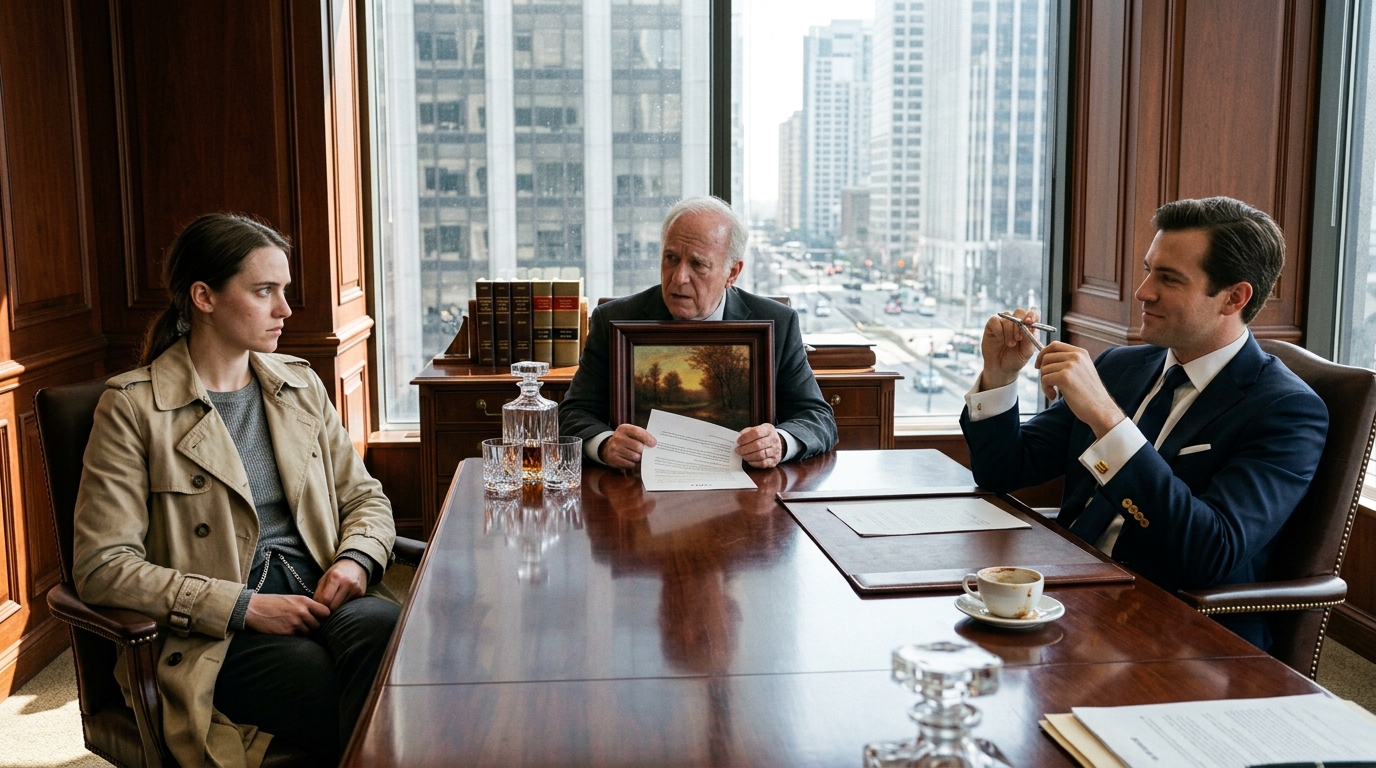
My brother Marcus adjusted the cuffs of his thousand-dollar suit, his gold cufflinks catching the hard morning light streaming through the floor-to-ceiling windows. He didn’t look at me. He didn’t need to. He had spent his entire life looking right through me, and today was the grand finale.
Mr. Wilson, the family lawyer whose hair had gone thin and white serving my father’s dirty work, cleared his throat and slid his glasses down his nose.
“To my son, Marcus John Bennett,” Wilson read, his voice flat as cardboard, “I leave controlling interest in Bennett Industries, the real estate portfolio in Vermont and the Hamptons, and all associated liquid accounts.”
Marcus didn’t laugh out loud, but his shoulders relaxed in that slow, suffocating way a predator relaxes when the prey is finally cornered. Sixty million dollars in equity. The keys to the kingdom.
“And to my daughter, Sarah Elizabeth Bennett…” Wilson paused, his thumb scraping nervously against the edge of a heavy yellowed folder. He looked up at me for a fraction of a second before dropping his eyes back to the page. “…I leave the framed oil painting, Autumn Twilight, currently stored in the secondary study.”
Silence settled over the table like heavy wet wool.
Marcus leaned back, his chair creaking under his weight, and picked up a silver pen. He balanced it horizontally across his index finger. “A painting, Sarah. Mom’s old garage-sale find. I suppose you can put it over your kitchen sink in that cramped apartment of yours.”
My fingers tightened around the worn crown of my mother’s silver pocket watch in my jacket pocket. I didn’t reach for my glass of water. I didn’t blink.
“Is the distribution documentation finalized, Mr. Wilson?” I asked, keeping my voice level, stripped of every drop of heat.
“It is, Sarah,” Wilson said softly. “The transfer of real property takes effect immediately. The physical item left to you must be collected from the estate within seven days.”
“I’ll take it today,” I said.
Marcus stood up, buttoning his jacket with a single smooth motion. “I’ll have the gate guards let you in, sis. Don’t linger too long. I’ve got appraisers coming at three to value the main house.”
I walked out of the law office without saying another word to either of them.
The drive out to the estate in my ten-year-old sedan was quiet, the engine ticking quietly every time I hit a red light. Two years of art restoration training in Chicago had taught me one fundamental truth: people only hide things when they are terrified someone will look too closely.
The gates to the Bennett property swung open slowly, the heavy iron tires grinding against stone. Inside, the house was already dead. The drapes in the formal living room were drawn, blocking out the cold afternoon sun.
Margaret, the housekeeper who had worked off her arthritis in this house for twenty years, met me at the base of the grand staircase. Her hands were raw and red from bleach.
“Miss Sarah,” she whispered, her voice cracking as she took my hands. “It isn’t right. It isn’t right what he did.”
“Where is it, Margaret?”
“Upstairs. In the small study. I didn’t let the movers touch it.”
The painting hung in the dark corner behind my father’s heavy oak desk. Autumn Twilight. It was a muted, moody landscape—dark orange trees, a muddy brown sky, and strange, rigid geometric lines tucked into the shadows of the painted hills. My mother had stared at it for hours during the months before she died in that hospice bed across town.
I lifted it off the brass hook. The frame was heavy—dark cherry wood, hand-carved, thick enough to hold a book.
My thumb swept across the left edge of the wood backing.
Right where the linen canvas joined the inner lip of the frame, there was an unnatural ridge. A tiny, raised seam running three inches down the side, painted over with fresh varnish that hadn’t quite dried flat.
Someone had opened this frame, put something inside, and resealed it in a hurry.
“Miss Sarah?” Margaret stood in the doorway, holding a brown paper moving bag. “Is everything alright?”
“It’s perfect, Margaret,” I said, sliding the heavy frame into the bag. “It’s exactly what I came for.”
CHAPTER 2: MIDNIGHT INTRUSION
A thin spiral of clear resin popped free, exposing the raw, unvarnished pine edge underneath. I didn’t breathe. I braced the canvas flat against my laminate kitchen table, pressing my left hand hard against the painted forest scene while my right hand worked the steel point deeper into the seam.
The wood gave a quiet, wet groan.
I wasn’t an investigator, and I certainly wasn’t a corporate spy. I was an art conservator who spent forty hours a week scraping yellowed varnish off eighteenth-century portraits with camel-hair brushes. But precision leaves a paper trail, and whoever framed this painting had been in a hurry.
The back panel didn’t swing open; it shifted half an inch to the left, exposing a narrow, black void lined with oiled paper.
Inside lay a heavy folded sheet of archival bond, stiff and discolored at the margins, alongside a hand-drawn grid executed in waterproof drafting ink. My mother’s handwriting. Crisp, tilted, and uncompromising.
Sarah, the top line read. If you are holding this, John and Marcus have completed the valuation transfer. Do not call the firm. Do not go to the bank.
A sharp, violent metallic scrape rattled the lock on my front door.
I froze. My thumb stayed pressed against the corner of the drafting grid.
The brass deadbolt turned with a heavy, dry clack. The door swung open, hitting the rubber wall-stopper with a dull thud.
Marcus stood on the threshold. His silk tie was loosened at the collar, his tailored jacket unbuttoned to reveal the dark sweat staining the ribs of his dress shirt. He didn’t look like the polished corporate heir who had sat across from me at Wilson’s office four hours ago. He looked unhinged, breathing hard through his nose.
“You always were too smart for your own good, Sarah,” he said, stepping into the hallway and letting the heavy oak door slam shut behind him.
He didn’t take off his shoes. He walked straight toward the kitchen nook, his eyes locked on the open wood backing lying on my table.
“Get out of my apartment, Marcus,” I said. My voice was low, flat, stripped of the shake I felt in my knees. I didn’t drop the paring knife. I let the flat of the blade rest against the table next to the exposed paper.
“I have a spare key. Dad gave it to me when you had the flu last winter. Remember?” Marcus reached into his pocket, pulled out a heavy brass ring, and tossed it onto the kitchen counter. It clattered against my drying rack. “I need the canvas back. Right now.”
“It was willed to me. Legally transferred three hours ago.”
“I don’t give a damn about the will!” Marcus slammed both palms down on the laminate counter, making the salt shakers jump. The arrogance hit me like cold air from an open freezer. “You think Dad left you that painting because he cared about your art degree? It belongs to Bennett Industries. It’s corporate asset material.”
“It’s a five-dollar landscape,” I replied, keeping my eyes fixed on his chest, watching the violent, irregular rhythm of his breathing. “You laughed at it in front of Wilson.”
“I was told to let you take it so you wouldn’t ask questions about the liquid accounts!” He leaned over the counter, his face flush, a line of sweat glistening along his hairline. “Give me the paper inside the frame, Sarah. I’ll write you a check for fifty thousand dollars right now. Out of my personal fund. You walk away, buy a small studio, live your quiet little life.”
Fifty thousand. For a piece of canvas he claimed was garbage.
“The frame stays here,” I said softly, my fingers sliding over the drafting paper, pushing it beneath the lip of my palm. “And you leave. Or I throw this knife through your front windshield.”
Marcus stared at me, his jaw clenching until the muscle beneath his cheek quivered. He didn’t reach for the table. He knew I had the angle, and he knew I wasn’t twenty-two anymore, flinching every time he raised his voice at the dinner table.
“You have no idea what you’re messing with,” he hissed, backing toward the door, his hand reaching behind him to grip the brass knob. “You think you’re vindicating Mom? Mom was unstable. She was losing her mind at the end.”
“She hid the truth from two men who thought they were clever,” I said. “That doesn’t sound unstable to me.”
He pulled the door open, the hallway fluorescent light casting a sharp, elongated shadow across my living room floor. “Hold onto that paper, Sarah. See how much it’s worth when the estate frozen-asset team comes knocking at six in the morning.”
The door slammed shut. The deadbolt didn’t engage.
I didn’t wait to hear his footsteps reach the elevator. I swept the drafting paper, the archival document, and my mother’s silver watch into my leather satchel. I wrapped the cherry wood frame in a canvas laundry bag, grabbed my coat, and walked out the back service exit into the rain.
CHAPTER 3: THE SANCTUARY IN THE WOODS
The mud pulled at my shoes with every step, heavy and smelling of rotted oak leaves. The Berkshires air was sharp enough to bite the back of my throat, but my hands were warm where I hugged the leather satchel tight against my ribs.
I stopped at the edge of the clearing.
There was no farmhouse left—just a moss-covered stone foundation half-swallowed by wild blackberry bushes and a fallen chimney split down the middle by an ash tree. But thirty yards to the east, right where the hand-drawn grid on my mother’s drafting paper intersected with a stand of white pines, two heavy iron doors lay flat against the embankment.
The iron was dark, pitted with rust, and bound by a heavy iron latch handle buried in wet grass.
I dropped my satchel onto a flat rock beneath a hemlock branch, wiping rain from my forehead with the back of my sleeve. My thumb instinctively reached into my pocket, rolling the cool, serrated crown of my mother’s silver pocket watch back and forth.
I pulled the drafting grid from the bag. The numbers along the left margin weren’t financial accounts. They were mechanical inputs.
I knelt in the soaked weeds beside the cellar doors. Beneath the dripping edge of the iron lip sat a brass housing—green with verdigris, but sealed tight against the damp. It wasn’t a digital keypad. It was a five-dial mechanical tumbler, built into the heavy iron casing like the door of a bank vault.
My fingers were stiff from the cold drive. The first tumbler resisted, grinding against decades of grit before settling into position with a dull, heavy click.
Seven.
I aligned the second dial, watching the worn brass numbers line up against the steel notch.
Three.
A headlight beam swept through the tree line behind me.
The light cut through the rain in a flat, blinding yellow sheet, illuminating the rain falling through the hemlock branches. Engine idle echoed off the hillside—the wet, throaty idle of a high-end commercial truck.
They hadn’t followed me from the city. Marcus had used the tracking system on the company vehicle he’d assigned me three years ago, or he’d simply guessed the property deed from the old tax records.
I didn’t run for the treeline. I didn’t freeze.
I laid my body flat against the iron door, hiding the brass housing behind my shoulder, and spun the third dial.
Nine.
The truck door slammed in the distance. Boots crunched heavy against wet gravel, deliberate and unhurried.
“Sarah!” Marcus’s voice carried over the sound of rain hitting the leaves. He wasn’t yelling; his tone was flat, exhausted, and bitter. “The gates were locked for a reason. Dad put a lien on this parcel ten years ago. You’re trespassing on corporate property!”
I didn’t answer. I set the fourth dial.
Zero.
The footsteps reached the edge of the clearing, snapping dead branches underfoot. “I know you’re down here,” he called out. “There’s nothing in those woods except snake holes and collapsed timber. Don’t make this any harder than it needs to be.”
I set the final dial.
Four.
The brass housing clicked internally, a heavy counterweight dropping inside the steel casing.
I grabbed the iron handle with both hands, bracing my boot against the stone ledge, and threw my weight backward. The iron seal broke with a sharp, echoing crack, like a dry branch snapping under cold ice.
The left door swung upward four inches, releasing a rush of dry, pressurized air that smelled of ozone, warm copper, and old paper.
I shoved my satchel through the gap, slid my body down the narrow stone threshold, and pulled the heavy iron handle from the inside just as a bright beam of light hit the rusted outer hinges.
The door dropped shut with a dead, heavy thud, locking the latch into place behind me.
Darkness closed in instantly, absolute and dry.
I stood on a concrete step, listening to the heavy rain muffled above six feet of reinforced earth. Then, three feet to my right, a low hum vibrated through the floorboards as a bank of warm yellow overhead lights flickered to life.
A concrete staircase led down into a vast, dry bunker lined with industrial shelving, steel filing cabinets, and long wooden workbenches piled high with original mechanical schematics.
At the far end of the room, seated behind a heavy glass desk with his hands folded neatly over a fountain pen, sat my father.
CHAPTER 4: THE DEAD FATHERS SHADOW
John Bennett pulled off his wire-rimmed spectacles, wiping the lenses with a silk handkerchief before placing them neatly beside his fountain pen. He didn’t look sick. He didn’t look dead. He looked like a man sitting in his corner suite on the forty-fifth floor, waiting for an associate to finish filing a report.
“You took twenty minutes longer than your mother predicted,” he said. His voice was raspy from age, but completely clear.
“The funeral was open-casket,” I said, my voice cutting through the hum of the air scrubbers. “Two months ago. I stood four feet from the mahogany box.”
“A wax display, Sarah. Very costly, but well within corporate contingency funds.” He rested his elbows on the glass desk, leaning forward. “Marcus couldn’t handle the restructuring alone. We needed the press to look away while we consolidated the offshore debt.”
A heavy iron thud echoed from the top of the concrete stairs behind me.
The heavy hatch handle engaged from the outside. Marcus came down the steps slowly, his coat soaked black across the shoulders, a heavy iron crowbar dangling from his right hand. He didn’t look surprised to see our father. He walked straight past me, tossing the crowbar onto a steel workbench where it hit a pile of blueprinted schematics with a deafening ring.
“She used the five-digit tumbler,” Marcus muttered, wiping rain from his eyes. “She had the grid paper from the frame.”
“I know,” John said flatly. He didn’t look at Marcus. He kept his eyes on me. “Hand over the leather satchel, Sarah.”
I didn’t step off the concrete landing. My thumb hooked into the pocket of my coat, winding the crown of my mother’s silver watch until the spring hit hard resistance.
“You didn’t build Bennett Industries,” I said. My voice didn’t rise. It stayed right at the edge of the quiet room. “None of it. The micro-valves, the hydraulic dampers, the secondary drive patents—they’re all signed in her maiden name. Dated four years before you registered the corporation.”
“Your mother was a brilliant researcher,” John said, his voice dropping an octave into that familiar, dismissive tone he used whenever I brought up my art history degree. “But research doesn’t pay for steel foundries. It doesn’t negotiate union contracts or secure bank credit lines. I made those drawings worth something.”
“You stole them,” I corrected him. “And when she tried to put them into a private trust for me, you locked her out of the estate accounts.”
Marcus took two steps toward the landing, his leather shoes squeaking against the dry concrete floor. “It doesn’t matter what happened thirty years ago, Sarah. You’re down here without cell service, six feet under a forest parcel that’s legally deeded to Bennett Holdings. Nobody knows you drove out here.”
I looked at the walls. Thick poured concrete, reinforced steel beams overhead, and a single heavy iron manual release lever mounted next to the staircase door. No digital panels. No network cables. Just old-fashioned industrial pneumatic seals designed to operate off a local generator.
There was no automated system coming to broadcast her files to the press. There was no squad car pulling up the mud track. It was just me, two men who had spent forty years taking credit for someone else’s sweat, and a room full of yellowed paper.
“You think you cornered me down here,” I said, unbuckling the leather strap on my satchel.
“You cornered yourself,” Marcus said, extending his hand. “Give Dad the grid paper. We’ll sign a corporate release for your small apartment, clear your student debt, and you can go back to scrubbing old paintings.”
I reached into the bag, my fingers wrapping around the thick bond paper my mother had hidden behind the oil painting. I pulled it out just far enough for John to see her crisp, tilted handwriting across the header.
“She knew you’d fake your death, Dad,” I said, looking John dead in the eye. “She knew Marcus wasn’t smart enough to read the schematics without her notes. That’s why she didn’t leave the codes in a bank vault.”
John stood up slowly, his hands pressing against the edge of the glass desk until his knuckles turned white. “What did she put in that letter, Sarah?”
I didn’t answer. I stepped backward, my heel mounting the first concrete riser toward the exit.
CHAPTER 5: THE TRAP AT THE TABLE
Marcus grabbed the iron handrail at the base of the steps, his chest heaving as he pointed a trembling index finger up at me. “You aren’t walking out of here with those papers, Sarah! You have no legal standing! You’re an trespasser on corporate land!”
“Shut up, Marcus,” John said from behind the glass desk.
The room went dead quiet except for the low, rhythmic hum of the air scrubbers. Marcus blinked, turning his head slowly toward our father, his jaw slacking in disbelief.
“Dad?” Marcus stammered. “She’s got the original assignation deeds. If she takes those—”
“I said quiet,” John repeated, his voice dropping into that cold, sharp tone that used to make the whole dinner table go silent when we were kids. He walked around the glass desk, his leather soles slapping flat against the sealed concrete floor. He didn’t look at Marcus. He looked up the stairs at me. “She isn’t going to publish anything. Because she knows how corporate law works.”
I didn’t move off the third riser. My hand rested on the cold cast-iron handle of the wall-mounted release lever.
“Explain it to him, Dad,” I said, my voice steady. “Tell him what happens when an estate transfers assets under a fraudulent death certificate.”
John stopped at the foot of the stairs, three feet away from Marcus. “If those original deeds hit an auditor’s desk, every loan covenant Bennett Industries signed in the last five years defaults instantly. The banks freeze the operational payroll within forty-eight hours.”
Marcus looked back and forth between us, a bead of sweat tracing a line down his temple. “We can fight it in court! We have the firm’s legal team—”
“With what retainer?” I hijacked, slamming my palm flat against the iron housing of the wall lever. “The moment the board sees Mom’s original ledger signatures, they won’t defend you, Marcus. They’ll vote to liquidate your stock options just to cover the civil fraud liabilities.”
Marcus stepped forward, his knuckles white around the railing. “You wouldn’t destroy the family company! It’s everything Dad built!”
“He didn’t build it,” I said, looking down at John. “He took out predatory loans against Mom’s private research, forced her into a non-disclosure isolation agreement, and then reported her laboratory expenses as tax write-offs. That wasn’t an empire, Marcus. It was a twenty-year embezzlement scheme.”
John’s mouth thinned into a pale line. “You take one more step up those stairs, Sarah, and I’ll file an immediate injunction for stolen corporate records. You’ll be tied up in preliminary hearings for the next three years while your landlord evicts you.”
“I don’t need three years,” I said.
I didn’t pull the lever down. Instead, I reached out with my left hand and flipped the heavy mechanical safety latch built into the side of the iron housing.
A sharp, pneumatic hiss exploded through the wall vents. The heavy steel locking pins inside the outer storm hatch shot forward with a brutal, metallic clunk, locking the overhead iron doors from the inside.
Marcus spun around, staring at the ceiling as the dust settled. “What did you just do?”
“This vault operates on a forty-minute mechanical timer once the emergency latch is engaged,” I said, holding the folded manuscript tight against my coat. “The outer hatch won’t open from the outside or the inside until the cycle finishes. And there’s no cell signal through six feet of reinforced earth.”
John’s face turned grey. “Sarah… think about what you’re doing.”
“I am thinking,” I said, sitting down on the top concrete step and resting my elbows on my knees. “We have thirty-nine minutes. You’re going to sit at that glass desk, Dad, and you’re going to write out a full legal surrender of your executive proxy. And Marcus is going to sign the corporate transfer of Mom’s patents directly over to the estate.”
Marcus took a wild step up the first riser, his face flushed red with rage. “And if I don’t?”
“Then in thirty-nine minutes,” I said, pulling my mother’s watch from my pocket and setting it on the concrete step beside me, “I walk out that hatch, drive straight to the SEC regional office in Boston, and hand them the original paper trail. Choice is yours.”
CHAPTER 6: THE PAPER TRAIL SIEGE
The loud metallic bang echoed off the bunker’s concrete walls, vibrating right through my shoes. Marcus turned his back on me, his chest heaving as he stared up at the heavy iron hatch overhead.
“Thirty-three minutes, Marcus,” I said. I picked up my mother’s silver watch from the step beside me and wound the crown twice. The dry mechanical click was small, but in the silence of the vault, it sounded like a door latch catching.
John hadn’t moved from the edge of his glass desk. His hand trembled slightly as he smoothed the lapel of his tailored jacket, his face pale under the harsh yellow fluorescent lights. He looked eighty years old.
“You won’t make it past the executive committee, Sarah,” John said, his raspy voice dropping into a tight, desperate rhythm. “They know me. They’ve trusted my signature for thirty years. You walk into that board room with handwritten sheets from a dead woman, and they’ll call security before you clear the lobby.”
“They won’t call security,” I replied, holding his gaze. “Because I’m not walking in as a grieving daughter asking for an audit. I’m walking in as the majority lien holder on the foundation technology.”
“You don’t own the foundation!” Marcus yelled, spinning back around. He pointed at the steel workbench piled with blueprinted schematics. “Dad filed those patents under Bennett Holdings!”
“Using fraudulent debt transfers from Mom’s shell trust,” I said, tapping the thick folded manuscript resting on my knees. “Every quarter, Dad transferred two hundred thousand dollars out of her research allowance to pay off the mortgage on the Hamptons estate. He called it ‘administrative overhead.’ It’s documented right here in her handwriting, backed by bank routing numbers.”
John walked over to the workbench, his fingers brushing against the cold steel edge of the crowbar Marcus had tossed down earlier. For a second, he looked at the iron bar, his knuckles tightening.
I didn’t flinch. I just pointed down at the floor.
“If you hit me with that, Dad, you die down here,” I said plainly. “Because I have the only key combination to reset the outer pneumatic latch once the timer runs out.”
John’s hand slowly slipped off the crowbar. He swallowed hard, a dry, rasping sound in his throat.
“You’re destroying your own name,” he whispered.
“No,” I said, standing up on the top step and slinging my leather satchel over my shoulder. “I’m stripping your name off her work. Marcus, get the legal notepad off that desk.”
Marcus looked at our father, waiting for a command, a refusal, anything. But John just stood there, staring at the floorboards, his shoulders slumping under the weight of forty years of lies finally catching up to him.
Marcus walked stiffly to the glass desk, pulled a legal pad and a gold fountain pen from the drawer, and brought them to the base of the stairs. His hand shook so badly the pen rattled against the paper.
“Write,” I commanded, looking down at him. “A complete assignment of voting rights for all foundational patents, effective immediately, transferred to the Sarah Bennett Revocable Trust.”
“Sarah, please—” Marcus started, his voice cracking.
“Write it,” I repeated, “or the first person who reads these original journals in twenty minutes will be the federal prosecutor.”
CHAPTER 7: THE UNRAVELING EMPIRE
A loud pneumatic thud echoed through the concrete staircase as the mechanical forty-minute timer hit zero. Above us, the steel locking pins retracted into the frame with a dry, mechanical clatter, releasing the pressure seal on the outer hatch.
Marcus didn’t move from the base of the steps. His fingers remained locked around the handrail, his knuckles white, his eyes darting wildly toward the ceiling as the rush of damp Berkshire air spilled down the stairwell.
“This document isn’t worth the ink, Sarah,” Marcus spat, his voice dropping into a rasping, cornered tone. He stepped onto the bottom riser, blocking my path upward. “Dad signed it under duress in an unmapped bunker. Any corporate attorney in Boston will have it thrown out before sunrise.”
I didn’t step back. I reached into my coat pocket, pulled out my mother’s silver watch, and let the chain drape over my fingers.
“The signature isn’t for a judge, Marcus,” I said, looking down at him with flat, weary common sense. “It’s for the executive board. When I hand Wilson and the senior partners these original deeds alongside your written proxy transfer, they aren’t going to hire a defense team for you. They’re going to freeze your corporate credit lines to protect their own shares.”
John leaned heavily against the edge of his glass desk, his hands trembling as he tried to adjust his cuffs. “Sarah… you’re stripping the company down to raw debt. There won’t be anything left for you to inherit.”
“I don’t want an inheritance built on stolen patents,” I said.
Marcus lunged forward on the step, reaching out with a flat palm to snatch the leather strap of my satchel.
I didn’t swing or scramble backward. I pivoted my weight against the concrete wall, driving my left forearm hard against his chest. The physical strain was heavy and clumsy—two exhausted adults shoving against each other in a cold concrete stairwell—but gravity was on my side. Marcus stumbled backward, his dress shoes squeaking violently against the sealed floor before his lower back slammed into the edge of the steel workbench.
A stack of original mechanical schematics slid off the metal table, cascading onto the concrete floor like dry leaves.
“You’re a low-level art restorer!” Marcus screamed, his voice cracking as he scrambled to his feet, his tailored jacket torn at the shoulder seam. He pointed a shaking, grease-stained finger at me. “You scrape dirt off old canvas for thirty dollars an hour! You can’t run a manufacturing firm!”
“I don’t need to run it,” I said, stepping past him onto the vault floor and walking straight toward the open stairwell. “I just need to return what was taken.”
John didn’t move to stop me. He sat down slowly in his executive leather chair, staring blankly at the scattered blueprints across the floor. The defiance was gone from his eyes, replaced by the hollow, exhausting reality of an old man whose forty-year illusion had just dissolved in a damp cellar.
“Sarah,” John muttered, his voice barely audible over the hum of the ventilation. “What are you going to do with the primary estate?”
I paused on the first concrete riser, my hand resting flat against the cold iron door frame.
“I’m giving Margaret the deed to the main house,” I said. “And tomorrow morning, Wilson receives the full paper trail.”
I didn’t look back as I climbed the stairs into the cold morning rain.
CHAPTER 8: A COLD NEW DAWN
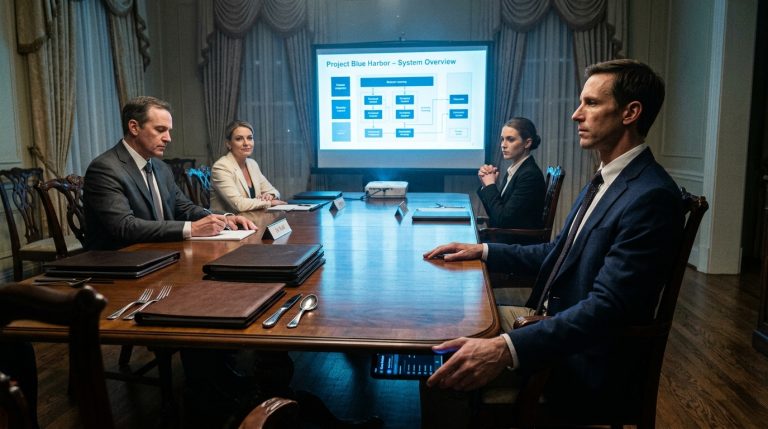
Six senior partners sat in the high-backed leather chairs along the perimeter of the Bennett Holdings corporate suite. None of them spoke.
Marcus stood by the glass floor-to-ceiling window, his suit jacket wrinkled, his collar open, his eyes bloodshot as he watched me slide the yellow legal pad across the mahogany finish directly toward Wilson.
“This is an unverified proxy transfer,” Marcus snarled, his voice raspy as he turned away from the window. He grabbed the edge of the table with both hands, leaning over the brass nameplate in front of Wilson. “She forced John to write that in a cellar under duress! I am the chief executive officer of this firm!”
“You were,” Wilson said softly.
The old lawyer adjusted his wire-rimmed glasses with a trembling finger, his eyes scanning the original blueprinted deeds laying open beside the cherry frame. “Your father’s signature on these primary assignment deeds predates the incorporation papers by four years, Marcus. The voting rights didn’t belong to John when he assigned them to you in the will.”
“I’ll file an emergency injunction!” Marcus slammed his palm flat against the mahogany, making the heavy glass water pitcher shake. “I’ll tie this trust up in civil court until every dollar of operational capital is drained!”
“With what credit line, Marcus?” I asked, my voice calm, practical, and devoid of heat.
I reached into my pocket, pulled out my mother’s silver watch, and laid it on the table right next to the signed legal pad.
“The corporate bank accounts were frozen at eight this morning when Wilson verified the patent lien filings,” I said, looking him dead in the eye. “You don’t have a legal retainer. You don’t have a board majority. And as of twenty minutes ago, the estate’s debt liabilities fall directly on John’s personal holding accounts.”
Marcus looked around the table at the six board members. Not one of them looked back at him. Two of them quietly closed their leather portfolios and slid their pens into their breast pockets.
“You’re throwing away sixty million dollars of equity!” Marcus hissed, his voice dropping into a desperate, hollow pitch. “You’re ruining our family!”
“Our mother built the equity,” I said, standing up and pulling the leather strap of my satchel over my shoulder. “You just tried to collect the rent on a house you didn’t build.”
Marcus didn’t move as Wilson picked up his fountain pen and signed his name along the bottom margin of the proxy validation sheet. The soft, scratching sound of metal against paper was the only noise left in the room.
The morning sun broke through the gray sky outside the glass tower, casting a long, clean beam of light across the mahogany table.
I picked up the cherry wood frame, my thumb resting over the smooth, scraped pine edge where the fake seam had been cut away. The canvas inside was just painted linen—orange trees, a muddy sky, and geometric shapes that no longer held any secrets.
I walked out of the suite, down the carpeted hallway, and into the cool street air without looking back once.
Across town, in the quiet back kitchen of my small apartment, the tap dripped twice into the stainless steel sink. I set the painting flat against the wall above my small wooden table, picked up a clean linen cloth, and wiped the rain from the glass face of my mother’s watch before winding the crown one last time.
The tick was steady, crisp, and quiet.