The Cold Edge of Charity: How an Old Man and a Hungry Boy Fought the System for Dignity
CHAPTER 1: COLD CONCRETE AND BROKEN BAGS
The wind came off Lake Erie like a wet towel slapped across the face. It rattled the tin sign outside Marshall Foods, humming a low, sour note that never quite stopped.
Elijah Monroe stood on the curb, his hands crammed so far up his sleeves his knuckles touched his armpits. His sneakers were two sizes too big, stuffed at the toes with yellowed sheets of the Plain Dealer so his heels wouldn’t slap the slush with every step. He didn’t look at the sky. He looked at the bottom seam of a brown paper bag held by an old man in a gray wool coat.
The paper was turning dark where a cold tub of lard or a sweating glass jar was pressing through.
“Sir,” Elijah said, stepping off the curb before his mind could count the reasons not to. “That’s going to blow out.”
The old man stopped. He had silver hair cut short like a military sergeant’s and a dark wood cane tipped with brass. He looked down through watery blue eyes, his breath blooming in a slow, grey plume.
“What’s that, son?”
“The bag.” Elijah reached out, his bare forearms taking the dead weight of the wet paper from underneath. “It’s split at the corner. Give it here.”
The old man didn’t pull back. He didn’t check his pockets or look around for a mother who wasn’t coming. He just shifted his grip on his brass-headed cane and let the boy take the load.
“Name’s Harold,” the old man said, his boots crunching on the frozen salt as they turned down 8th Street.
“Elijah.”
They walked six blocks without talking about money, or why Elijah’s elbows looked like broom handles under his thin jacket. The cold worked its way through Elijah’s socks, turning his toes numb, but he kept his fingers wedged under the damp paper. Inside the bag, one single, unpeeled orange rested against his thumb—cold, heavy, and firm.
A dark sedan idling by the bait shop clicked its lights twice when they rounded the corner. A broad-shouldered man in a cap stepped out, opening the rear door with a quiet pop of the rubber seal.
“Thank you, Elijah,” Harold said, reaching into his coat.
Elijah took a quick step back into the wind, his teeth chattering once against his will. “I didn’t do it for a dollar, sir. I did it because the bag was dropping.”
Harold’s hand came out of his pocket empty. He looked at the boy’s face—the tight jaw, the dry lips—and nodded once, slow and deliberate.
“I know,” Harold said. “Get in the car. It’s too cold out here to be proud.”
The inside of the sedan smelled of warm wool and old cedar. Half an hour later, Elijah sat at a small table near the kitchen door at Anna’s on Larchmere Boulevard. The tablecloth was thick, white cotton, stiff with starch. A bowl of hot chicken soup sat between his hands, the steam rising up to coat his cheeks in wet warmth.
Harold sat across from him, tearing a heel of dark bread into two equal pieces. He didn’t ask Elijah where his mother was. He didn’t ask why his backpack was bulging with everything he owned.
“Eat,” Harold said, setting the larger piece of bread on Elijah’s plate. “We’ve got work to do tomorrow.”
CHAPTER 2: THE KNOCK AT THE FARMHOUSE
The farmhouse didn’t smell like East Cleveland. It smelled of old pine floors, boiled starch, and the cold wool of Harold’s heavy coat hanging on a peg by the door.
Elijah sat on the edge of the small mattress in the first-floor guest room. The sheets were stiff, smelling of bleach and cold wind from a clothesline, tucked so tight at the corners his feet barely fit under the hospital corners. On the nightstand sat the unpeeled orange from the grocery bag.
Across the gravel driveway, a pair of headlights cut through the dark, throwing the shadows of the window frames long and crooked across the bedroom floor.
A car door slammed. It wasn’t the soft, heavy pop of Marcus’s sedan. It was the flat, tinny bang of a state sedan with cheap doors.
Heavy boots stomped off the frost on the front porch. The doorbell didn’t ring—a thick, knuckle-hard rap hit the oak door panel three times, rapid and dry.
Harold was already in the hallway, his dark wood cane clicking against the floorboards. He didn’t hurry. He moved with the slow, deliberate weight of a tree leaning into a fence.
“Dorothy,” Harold said, his voice flat as a iron stove top. “Stay in the kitchen.”
Elijah slid his big sneakers onto his feet, not taking the time to tie the frayed laces. He cracked the bedroom door three inches, his breath holding tight in his throat.
The front door opened. The cold air rushed into the hall, smelling of wet exhaust and lake salt.
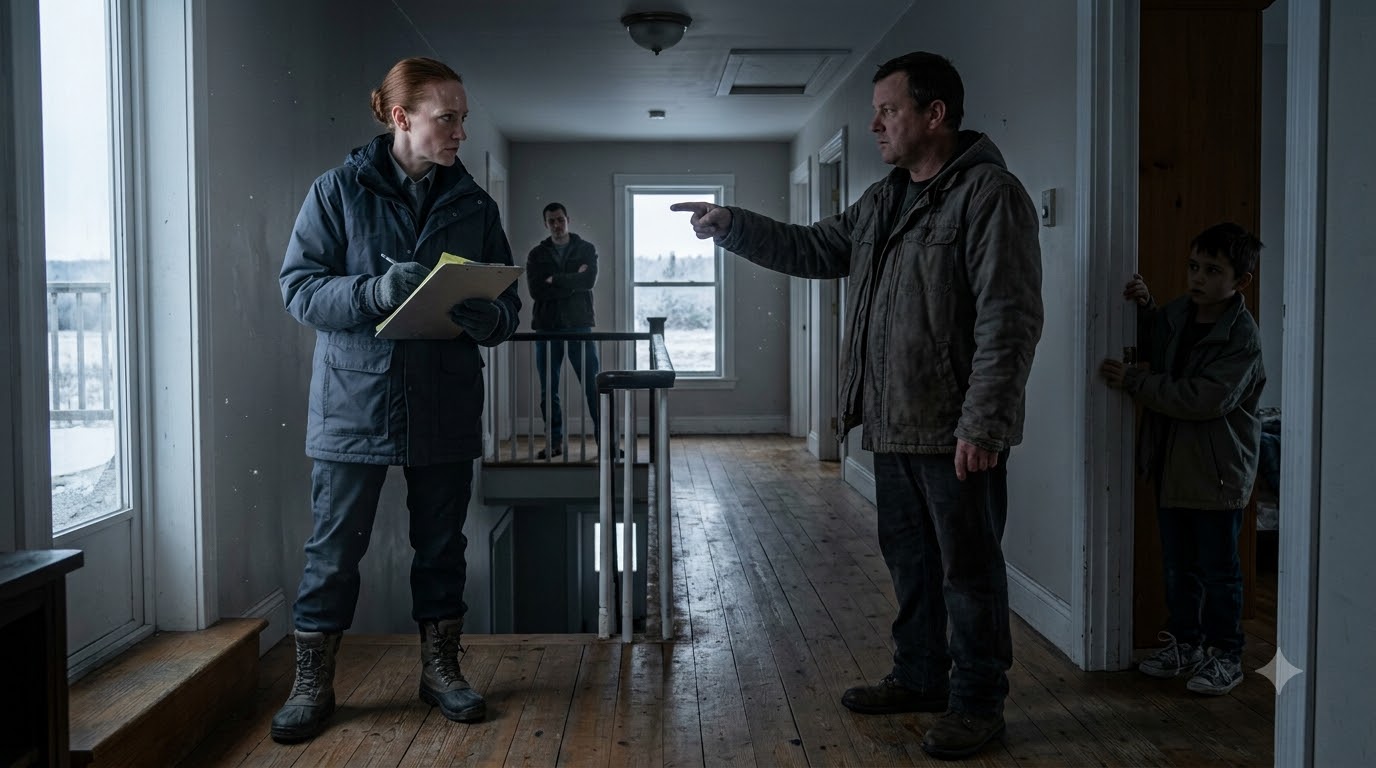
A woman in a stiff nylon parka stood on the porch, a thick clipboard tucked under her arm like a pigskin. She had red hair pulled back so tight her forehead looked shiny, and her eyes didn’t look at Harold’s face—they looked right past his shoulder, scanning the dark hall.
“Harold Whittaker?” her voice hit the hallway like a dry sponge. “I’m Vane. County Children’s Services. We have a report of an unregistered minor at this address.”
Harold didn’t move an inch back from the threshold. His right hand rested on the brass knob of his cane, his knuckles white against the dark wood.
“It’s nine o’clock at night, Miss Vane,” Harold said. “The county offices closed at five.”
“Emergency temporary custody warrants don’t keep office hours,” Vane said. She reached into her parka pocket and pulled out a yellow carbon slip, tapping it against the aluminum frame of her clipboard. “Elijah Monroe. Ten years old. Ward of the state following the institutional intake of his grandmother.”
Elijah’s fingers tightened on the door frame. The wood splintered slightly under his nail.
“The boy is eating a hot meal and sleeping in a clean bed,” Harold said. His voice dropped an octave, quiet and rasping like sand slid across slate. “He isn’t missing.”
“He’s out of jurisdiction,” Vane replied, stepping forward until the toe of her practical boot touched the oak sill. “He belongs in the emergency shelter on 55th until a placement panel reviews his file on Monday. You aren’t listed as a relative, Mr. Whittaker. You aren’t a certified foster parent.”
She didn’t look angry. That was what made Elijah’s stomach drop into his boots—she looked like a clerk marking down a crate of bolts that had been left on the wrong loading dock.
“I am his host for the night,” Harold said softly.
“You’re an unrelated adult holding a state ward,” Vane said, her voice dropping into a rehearsed rhythm. “If you don’t bring the boy to the door right now, I call the township squad car idling at the end of your lane. They’ll take him, and they’ll take you for interference.”
From the dark back hall, Marcus stepped into the frame. He didn’t raise his hands or make a threat; he just stood behind Harold’s left shoulder, six-foot-two of quiet, heavy bone, his eyes fixed on the yellow carbon paper in Vane’s hand.
Harold looked down at the woman’s boots, then slowly up to her eyes. He didn’t mention his lawyers. He didn’t mention the millions he’d spent building public libraries three counties over. None of that meant a damn thing to a county worker with a rubber stamp and a squad car at the gate.
“The township squad is Officer Miller,” Harold said, his voice turning ice-cold. “He’s been on this road twenty years. He knows where I live.”
“He knows the law, too,” Vane said, her mouth twisting into a sharp, thin line.
Harold reached back into his pocket, his gloved fingers wrapping around the single, thick business card he kept there. He didn’t offer it to her. He held it down by his thigh, his thumb running over the smooth, heavy paper.
“The boy stays until six tomorrow morning,” Harold said. “You bring a judge’s signature on a blue form, not a carbon memo from an intake desk, or you don’t cross that rug.”
Vane stared at him for three long seconds. The wind whipped her red hair across her face, but she didn’t blink. She took two steps backward onto the icy porch steps.
“Six AM, Mr. Whittaker,” she said, pointing a mittened finger at his chest. “If he isn’t sitting on the front porch with his backpack tied up when my van pulls in, the sheriff breaks the lock.”
CHAPTER 3: PAPERWORK AND PITY
The radiator in the hallway clanked, a dry metallic thud that sounded like a hammer striking an empty kettle.
Harold turned around, his cane dragging a small crescent through the dust on the floorboards. He didn’t look at Marcus, who was standing quietly by the coat rack, nor at Elijah, whose small silhouette hovered near the bedroom doorframe.
“Dorothy,” Harold said, setting his coat over the banister. “Pull the township ledger from sixty-eight. The hardbound index.”
“Harold,” Dorothy said, stepping out from the kitchen with a mug of black coffee, her voice tight with caution. “You haven’t touched those property rolls in twelve years. Your hips won’t take sitting in that basement till dawn.”
“I’m not sitting in the basement,” Harold said, taking the mug. His fingers were stiff from the doorway cold, the joints swollen. “We’re going to the municipal annex on 8th. The old clerk’s office.”
Elijah walked into the hall, his oversized sneakers squeaking against the polished pine. He reached into his jacket pocket and pulled out the unpeeled orange, holding it in both hands like a cold stone.
“Mr. Harold,” Elijah whispered. “She said she’s coming back with the police.”
“She’s coming back with a squad car,” Harold corrected, taking a slow sip of the scalding coffee. “Police follow warrants. County workers follow administrative orders. There’s a quarter-inch of difference between the two, Elijah, and that’s where we’re going to stand.”
He looked down at the boy’s hands. The knuckles were raw from the lake wind, but his grip on the orange didn’t loosen.
“You know how to read a parcel map, son?”
“No, sir,” Elijah said.
“Then you’re going to learn tonight,” Harold said.
By five in the morning, the kitchen table was buried under yellowed paper. Marcus had brought three cardboard file boxes up from the cellar, their corners softened by damp basement air. Without his corporate legal team or a single phone call to a high-priced attorney, Harold relied on what he had accumulated over forty years of working the district: local municipal codes, tax assessment receipts, and land-use covenants written in faded fountain-pen ink.
Harold pointed a thick finger at a blue-lined ledger page.
“Your grandmother’s house on 8th Street,” Harold said, his thumb pressing down near a red margin line. “She didn’t rent from a management company. She held a life-estate tenancy signed by the township council in ninety-four.”
Elijah leaned over the table, the scent of dust and old paper filling his nose. “What’s that mean?”
“It means the county social services department can’t declare her home abandoned until ninety days after institutional intake,” Harold said flatly. “And as long as her legal residence stands, you aren’t a homeless minor under state jurisdiction. You’re a dependent residing at a verified municipal address.”
“She said I didn’t have a legal guardian here,” Elijah said, his voice small.
“You don’t,” Harold said, turning a heavy page that rustled like dry leaves. “You have a temporary caretaker designated under the old township emergency housing ordinance. An ordinance written in nineteen-seventy-two that the county forgot to repeal.”
Marcus leaned against the doorframe, crossing his arms. “That ordinance requires a local property owner to sign as guarantor, Mr. Whittaker. And you can’t touch your commercial assets to secure a bond right now.”
“I don’t need commercial assets,” Harold said, his voice razor-sharp. “I own this house. I’ve owned the dirt under it since before Miss Vane was born.”
He rolled the unpeeled orange across the table. It bumped gently against the edge of the ledger.
“When she pulls into that driveway at six o’clock,” Harold said, looking Elijah straight in the eyes, “you don’t say a word about shelters or foster homes. You tell her you’re staying at your grandmother’s legal secondary address. And you hand her this paper.”
Outside, the first pale light of morning hit the frosted pane, gray and cold. Down the lane, gravel crunched under heavy tires.
CHAPTER 4: THE UNPEELED WEAPON
The fluorescent light in Hearing Room B flickered with a low, dying hum. The linoleum floor smelled of industrial pine cleaner and decades of wet boots.
Vane sat behind a steel folding table, her parka draped over the back of her chair. She didn’t look up when Harold entered. She had two thick manila folders open before her, a yellow highlighter balanced across her knuckles like a pencil trick.
“You’re wasting the county’s time, Mr. Whittaker,” Vane said, tapping the edge of her pen against the laminate. “The juvenile court clerk doesn’t recognize ninety-four township covenants. Those were rendered void when the district merged.”
Harold pulled out a heavy oak chair across from her, his joints popping with a dry, wooden snap. He didn’t sit immediately. He placed the unpeeled orange directly in the center of the table, right between her manila files and his single sheet of yellowed ledger paper.
“They weren’t merged,” Harold said, his voice flat and dry. “The county annexed the fire district, but the housing trust remained autonomous. Section four, paragraph B.”
Vane let out a short, nasal laugh. “You’re a retired machinist trying to play lawyer on a Tuesday morning.”
“I spent forty years reading contracts written by men who tried to take my shop floor out from under me,” Harold said. He slowly lowered himself into the chair, his hands resting on his brass cane. “I know when a line has been drawn, and I know when someone is stepping over it because they think no one’s looking.”
Vane’s eyes flicked to the orange, then back to Harold’s face. Her left hand subtly shifted, sliding a loose printed sheet underneath her top folder.
It was a quick movement, but not quick enough to hide the bright pink highlight covering the margin column. The code at the top read PL-883-RET—followed by a dollar figure printed right next to Elijah’s state intake number.
The leak was out. It wasn’t about proper placement. It wasn’t about administrative jurisdiction or state mandates.
“That’s a privatized referral code,” Harold said softly, pointing a crooked finger at the edge of the paper poking out from beneath her sleeve. “The shelter on 55th isn’t a county facility. It’s a private contractor.”
Vane’s neck flushed a dark, angry red. She slammed her hand flat onto the folder, hiding the paper completely.
“You have zero standing here, Mr. Whittaker,” she snapped, her voice dropping into a sharp, grating hissed whisper. “That boy’s grandmother signed away her temporary authority when she entered the nursing facility. The state assumes legal guardianship. End of story.”
“She didn’t sign away her secondary designation,” Harold said. He picked up the unpeeled orange, turning it slowly in his palm. The thick skin gave off a faint, sharp burst of citrus oil as his thumb pressed into the stem mark. “And as long as her life-estate stands on 8th Street, Elijah has a legal address. Which means your private shelter doesn’t collect its bed-vacancy stipend on Monday.”
Vane stood up so fast her metal chair screeched against the linoleum.
“I’m signing the immediate removal order at noon,” she said, leaning over the table, her knuckles white against her desk blotter. “You bring that boy to the intake desk by two PM, or I have a deputy meet you on the farmhouse porch. Let’s see how your ninety-four covenant holds up against a county transport unit.”
Harold didn’t flinch. He picked up the paper, stood up slowly using his cane for leverage, and tucked the orange back into his coat pocket.
“Two PM,” Harold said quietly. “We’ll be there.”
CHAPTER 5: THE CORNERED MACHINE
The gravel in the farmhouse lane crunched under heavy tires at precisely one forty-five PM.
Harold didn’t wait inside. He sat on the top porch step, his long gray coat draped over his knees, his brass-headed cane resting between his boots like a iron stake driven into the dirt. Elijah sat beside him, his oversized sneakers pulled back tight against the riser, his backpack clutched in his lap.
Two vehicles pulled up. The first was Vane’s white county sedan. The second was a dark blue township squad car, its tires kicking up slush as it banked into the yard.
Vane stepped out before her engine even cut off, her clipboard jammed under her elbow, a thick blue folder held flat in her right hand.
“Two o’clock, Whittaker,” Vane called out, her voice cutting through the wind off Lake Erie. “Court clerk signed the emergency removal. Township deputy is here to execute.”
Deputy Miller stepped out of the squad car, pulling his hat down low over his brow against the sleet. He looked at Harold, then at the small boy huddled beside him, and hesitated on the gravel.
“Harold,” Miller said, his boots crunching slowly toward the porch. “Vane’s got a signed transport order from the magistrate’s desk. I have to escort the vehicle.”
Harold didn’t stand. He didn’t reach for a checkbook or name a single lawyer. He reached into his coat, pulled out the 1972 township ledger page, and laid it flat across his knees, holding it down against the wind with the unpeeled orange.
“Miller,” Harold said, his voice low and steady as an old diesel idle. “Read paragraph four before you open that car door.”
Vane marched straight up the porch steps, her practical boots stomping on the timber. “Don’t waste time looking at his obsolete trash, Deputy. The county order supersedes local covenants.”
“It supersedes covenants on private property,” Harold said without looking up at her. “It doesn’t supersede municipal boundaries. This farm sits on land designated under the 1972 Rural Housing Trust. Under township law, an emergency ward cannot be removed from a designated trust address without a formal hearing before the board of trustees.”
Vane let out a loud, harsh crack of a laugh. “The board of trustees hasn’t met in ten years!”
“They meet on the first Thursday of every month at the fire hall,” Harold said, pointing his brass cane down the driveway toward the road. “And Miller’s uncle happens to be the board chairman.”
Miller stopped five feet from the porch. He looked from Harold’s calm, lined face to Vane’s flushed red cheeks, then slowly leaned over to look at the ledger page under the orange.
“Paragraph four,” Miller read aloud, his thumb tracing the faded blue line. “No minor resident shall be removed from a registered trust homestead without thirty days written notice to the town clerk.”
“That’s for landowners!” Vane snapped, her voice rising into a sharp screech as she grabbed the edge of her clipboard. “The boy isn’t a resident! He’s a stray found on 8th Street!”
Elijah’s grip tightened on his backpack straps, but he didn’t flinch. He looked up at Vane, then at the orange resting heavy on the old paper.
“He’s my guest,” Harold said, standing up slowly, leaning his full weight onto his cane until the brass handle groaned. “And under section six, a guest of a trust owner carries equal residency status for ninety days. You want to take him, Miss Vane? You go down to the fire hall, you file a petition with the trustees, and you explain why you’re trying to bypass township law to fill a private bed on 55th Street.”
Vane’s face went pale, the red flush draining straight down her neck. Her hand shook as she tightened her grip on the blue folder, her eyes darting to Miller.
“Deputy,” Vane demanded, her voice trembling with furious authority. “Handcuff this man for obstructing a county officer!”
Miller didn’t move. He reached up, pushed his hat back with one finger, and looked Vane straight in the eye.
“I don’t arrest men on their own porch for citing township law, Miss Vane,” Miller said flatly. “And I don’t execute removal orders that break local code. You want this boy moved today, you bring a state trooper and a judge’s ruling that strikes down the 1972 trust.”
Vane stared at him, her mouth opening and closing like a landed perch. She whirled around, her parka flapping in the freezing wind, and marched back toward her car.
“This isn’t over, Whittaker!” she yelled over her shoulder, tearing open her car door. “I’ll have a state team here by morning!”
“Bring them,” Harold said softly to the empty yard as her car backed out, spraying gravel against the barn wall. “We’ll be sitting right here.”
CHAPTER 6: CLEAN LINEN AND QUIET JUSTICE
The kitchen smelled of boiled oats and roasted pork shoulder. Steam condensed on the double-pane glass of the back window, running down in heavy, steady drops that blurred the grey winter outline of the stone barn.
Elijah sat at the farmhouse kitchen table, a wooden spoon resting against his thumb. Next to his bowl lay a fresh blue township residence card, signed by Miller’s uncle and stamped with the heavy iron press of the Rural Housing Trust. Beside it rested the unpeeled orange, its skin dry and dimpled, sitting in the morning sun.
Vane’s desperate counter-move—a surprise administrative injunction filed through an out-of-district magistrate—had fallen apart at six o’clock the previous evening. Without a single dollar spent from Harold’s inaccessible corporate accounts, the township board had convened at the fire hall. They didn’t review financial statements; they reviewed forty years of municipal land records, recognized the life-estate covenant, and formally recorded Elijah Monroe as a legal resident of the Whittaker homestead.
Vane’s regional supervisor had arrived personally at eight o’clock to collect her files. The privatized referral code PL-883-RET was now part of an internal county audit, and the removal order against Elijah had been formally rescinded with prejudice.
Marcus walked into the kitchen carrying a armful of oak logs for the stove. He stacked them in the brass woodbox with a soft, solid thud that didn’t make Elijah jump.
“Bus comes at seven-fifteen, Elijah,” Marcus said, wiping his palms on his work apron. “Driver knows to stop at the gate now.”
Elijah picked up his spoon, dipped it into the warm oats, and chewed slowly. He didn’t look over his shoulder. He didn’t listen for the sound of car doors or the dry, rapid knock of a state worker’s knuckles on oak.
Harold walked in from the hallway, his brass-headed cane clicking rhythmically against the floorboards before coming to rest against the table edge. He pulled out his chair, sat down, and picked up the orange.
With his thumbnail, Harold caught the thick skin near the stem, peeling back a single, clean strip of orange rind. The sharp, sweet scent filled the warm kitchen air, cutting right through the smell of woodsmoke and oats.
He split the orange in two, setting the larger half on Elijah’s side of the table.
“You’ve got spelling third period today,” Harold said, taking a piece for himself.
“Yes, sir,” Elijah said. He reached out, took his half of the orange, and popped a segment into his mouth.
Outside, down at the end of the long stone lane, the yellow lights of the township school bus flashed through the morning mist, slowing down right at the wooden mailbox.