The Ledger of Broken Promises: How a Small-Town Bookkeeper Dismantled Her Entitled Boss Without Firing a Single Shot
CHAPTER 1: THE FINAL SIGNATURE
The cold morning light hit the dusty glass of the front counter, casting long shadows across the stack of supplier invoices waiting for my signature.
At precisely eight in the morning on the twentieth of the month, the door to the inner office didn’t just open—it slammed against the drywall. Tom stood in the frame, his cheap suit jacket unbuttoned, carrying the stale smell of expensive bourbon and bad decisions.
“Clear your desk,” Tom said, stepping into the small clerical space until his knees nearly pressed against the front panel of my metal desk. “My daughter graduated last week. She takes over the books today. You’re done.”
I didn’t reach for the phone. I didn’t reach for my purse. My hand simply rested on the cold, iron base of the heavy vintage desk stapler—the same one the old Chairman had bought thirty years ago when this paving yard was just two dump trucks and a heap of gravel.
“Today is the twentieth, Tom,” I said, keeping my voice as flat as a scraped asphalt road. “The regional stone quarry needs their wire transfer authorized by noon. The diesel supplier is coming by at two for his physical check.”
“I don’t care if the Pope is coming by for a handout,” Tom sneered, stepping closer and dropping a manila folder right over my open ledger. “You’re an employee. I’m the President. What I say goes, and I say you’re off the property in five minutes or I call the sheriff for trespassing.”
He reached out, grabbed my box of personal belongings from the corner shelf, and shoved it toward my chest. He thought he was sweeping away a piece of office furniture. He had no idea he was stepping directly onto a floorboard I had loosened three months ago.
I picked up the vintage stapler, set it precisely in the center of the clean blotter, and stood up. I didn’t argue. I didn’t plead. I simply picked up my coat, pulled the ledger closed with a quiet thud, and walked out into the biting morning air, leaving the front door key right on the lock cylinder.
CHAPTER 2: THE SILENT AUDIT
I didn’t turn back when I heard Tom’s muffled voice barking orders inside the lobby.
The morning air smelled of wet asphalt and diesel smoke from the yard across the street. Instead of reaching into my coat pocket to call Kelly or the Chairman, I kept my hands pulled deep into my wool sleeves, walking past the rows of yellow paving equipment sitting idle under the dawn frost.
Let him handle the nine o’clock wire transfers. Let him explain to the quarry manager why three trucks of crushed stone weren’t getting released without my personal seal on the bill of lading.
I spent forty-five minutes sitting in my rusted sedan at the edge of the public parking lot down the street, watching through the fogged windshield. At eight-forty, the first delivery flatbed pulled up to the main gate.
The driver didn’t even turn off his engine. He stood by the cab for five minutes, waiting for the daily physical receipt I usually brought out with a steaming cup of gas-station coffee.
Instead, Tom stormed out onto the gravel in his dress shoes, waving a manicured hand and shouting so loud I could hear the tinny echo across the tarmac. The driver didn’t argue. He simply climbed back into his cab, pulled his clipboards inside, and backed the fifty-foot rig right out onto the highway.
On my passenger seat lay the black leather notebook I’d kept for ten years. Every overtime hour Tom had shaved off the yard crew’s timecards last month was scribbled in blue ink, right beside the exact serial numbers of the company credit cards he’d run at the riverboat casino in city limits.
He thought firing me deleted the paper trail. He didn’t realize that in a three-person front office, the paper trail isn’t in the computer system—it’s in the head of the woman who bought the paper.
Around eleven, a black sedan turned into the lot. Through my fogged side window, I watched Tom’s daughter step out in a tailored suit that looked like it belonged in a high-rise law firm, holding a pink leather tablet case.
She walked into the office with the high-strung confidence of someone who had never seen an unwashed invoice in her life. Three minutes later, the lights inside the main clerical room began flickering as someone tried—and failed—to bypass the dual-authentication tax portal I had locked before pulled the plug.
My phone vibrated against the console. Not Kelly. Not the Chairman.
It was the automated alert from the state labor standards board, confirming that my formal complaint regarding wage theft and wrongful termination had cleared the preliminary intake queue.
I turned the ignition key, feeling the engine rumble under my feet. Tom was currently sitting at my old oak desk, likely staring at a screen full of locked spreadsheets, completely unaware that the heavy paperweight sitting on top of the corporate filings in the bottom drawer wasn’t decorative—it was holding down the unexecuted signature page that kept him from being anything more than a glorified temp.
CHAPTER 3: THE BOARDROOM TRAP
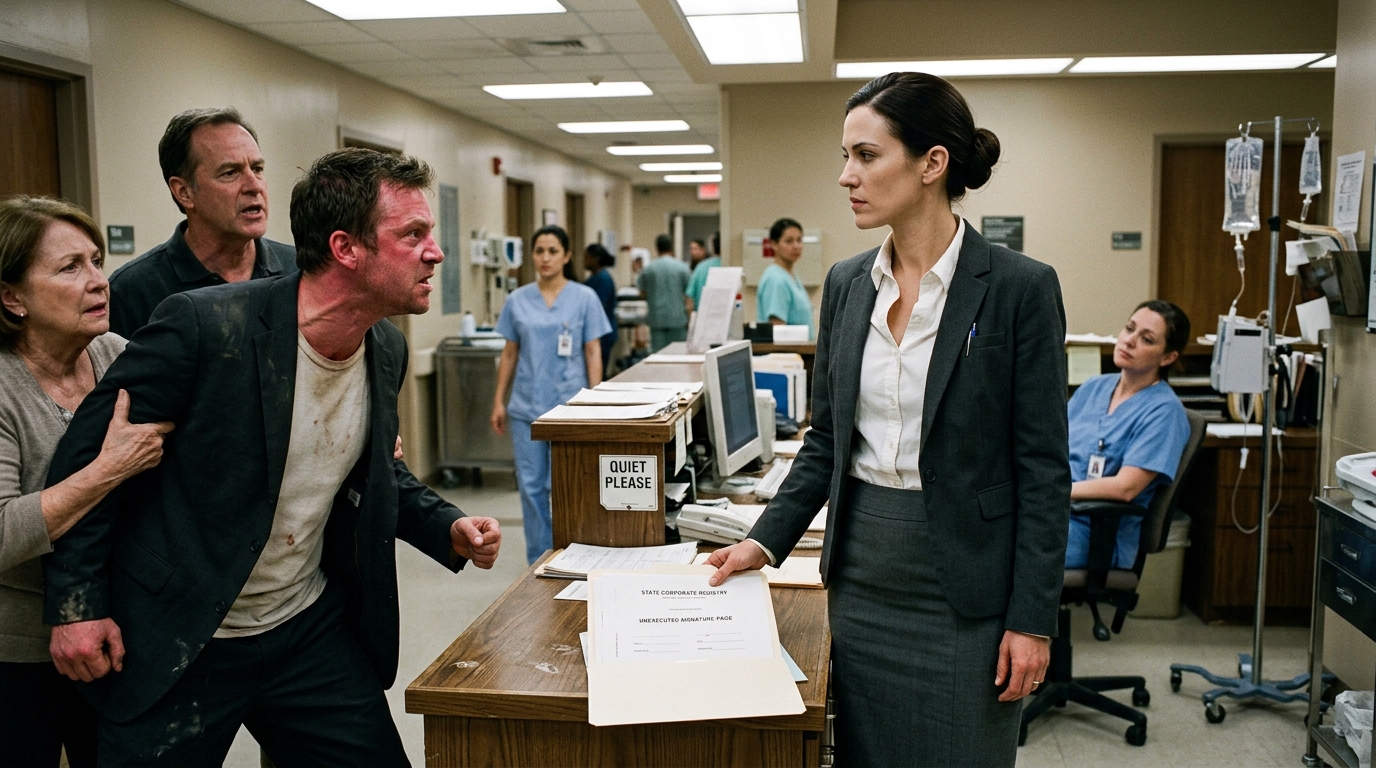
“I’m the President!” Tom yelled, his neck flushing red above his wrinkled collar as he stood at the foot of his father’s hospital bed. “You handed me the company three months ago, Dad! You can’t just let some clerk shut down our bank lines!”
The Chairman sat propped against two thin pillows, an IV line taped securely to the back of his hand. Catherine sat in the vinyl armchair beside him, her knuckles white around her handbag.
I pushed the door open. The soft hiss of the pneumatic hinge cut through Tom’s shouting, forcing him to spin around on his heel.
“You,” Tom sneered, lunging forward half a step until Catherine put a hand up to stop him. “You think you can play games with my accounts? Explain yourself right now. Tell them what you did to the payroll portal!”
I walked past him without answering, setting the manila folder directly on the bedside table next to the Chairman’s water cup.
“I didn’t touch your accounts, Tom,” I said, keeping my voice down for the nurses’ station down the hall. “You were never registered as the representative director. Your title was an internal courtesy—a trial run.”
Tom let out a sharp, breathless laugh, looking at his mother for support. “A trial run? I’m the eldest son! Dad put me in charge! Show me where it says I’m not the President!”
“Page four of the state corporate registry,” I said, tapping the edge of the folder. “Three months ago, when you demanded the desk, the Chairman signed the internal memo. But the formal change of officers requires a board vote and a corporate seal. I never filed the secondary schedules.”
“You sabotaged me!” Tom’s voice cracked, his fingers twitching toward the folder. “You’re just a glorified secretary! You don’t have the authority to block a corporate officer!”
“She didn’t block you, Tom,” the Chairman said, his voice raspy but clear as he reached over to touch the manila paper. “Emily owns ten percent of the voting stock. Her father bought those shares forty years ago when we poured the first concrete pad behind the yard.”
Tom froze, his chest heaving as the color drained from his jaw, leaving behind the dark stubble of three days without a real night’s sleep.
“Ten percent?” Tom whispered, looking between his mother and me like he was trying to solve a puzzle with half the pieces missing. “That doesn’t mean anything. You own eighty percent, Dad. You can overrule her right now.”
“I could,” the Chairman replied softly, looking at his son with an old, worn-out sadness that carried no anger left in it. “If I were still willing to sign my name next to yours.”
Tom’s mouth opened, but no sound came out. He took a fast step toward the bedside, his hands balling into fists inside his coat pockets as he prepared to deliver his next desperate counter-move.
CHAPTER 4: THE FINAL RECKONING
“You can’t do this!” Tom spat, his voice dropping into an ugly, desperate rasp as he pointed a trembling finger at me. “I’ll sue! I’ll take the company, I’ll take the equipment, I’ll take every single truck out in that yard!”
“You don’t own the trucks, Tom,” the Chairman said, his hand resting firm on the manila file. “The fleet is leased through the corporate entity. And as representative director, I’m initiating a formal dissolution of the business starting at noon.”
Tom took a step backward, his back hitting the cold vinyl wall beside the door. “Dissolution? You’d tear down thirty years of work just to keep me out?”
“No,” Catherine said softly, standing up from her chair and looking her son dead in the eye for the first time all morning. “We’re tearing it down because you proved thirty years of hard work means nothing to you unless you can bleed it dry.”
Tom looked at me, his face twisting into a mask of pure fury. “You set this up! You and Kelly planned this whole thing!”
“I did my job, Tom,” I said, picking up my purse from the visitor’s chair. “I kept the books clean. I logged every illegal credit card swipe, every forged invoice, and every wage you tried to cut from the crew. The labor board already has the packet. The severance payouts for the entire yard crew will be drawn directly from the corporate liquidation reserve before you see a single nickel.”
“You little—” Tom started, taking a aggressive stride toward me, but the Chairman hit the red call button on his bed rail with a sharp, heavy thump.
“Step out, Tom,” the old man commanded, his voice cold and steady. “Before security removes you from the floor.”
Tom looked around the room, searching for a single crack in the wall, a single person willing to buy into his loud, entitled performance. Finding none, he turned on his heel and stormed out, slamming the door so hard the glass pane rattled in its frame.
Three weeks later, the old paving yard was quiet, the heavy yellow equipment lined up in clean, orderly rows waiting for the bankruptcy auctioneer’s gavel.
I sat at a brand-new laminate desk inside a bright, sunlit office five miles down the road, the scent of fresh paint and dark roast coffee in the air. Outside the window, three dump trucks bearing the fresh, crisp logo of Kelly’s new independent contracting firm pulled out onto the main road, fully crewed by every single worker who had walked off Tom’s job site.
I picked up the heavy vintage desk stapler—the one I’d taken from my old desk on the morning I was fired—and pressed down firmly on a fresh stack of vendor invoices, the solid metal clack echoing comfortably through the quiet room.