A Quiet Echo: The Unfinished Resolve of an Old Soldier in a Changing World
CHAPTER 1: THE REMAINDER OF THE ECHO
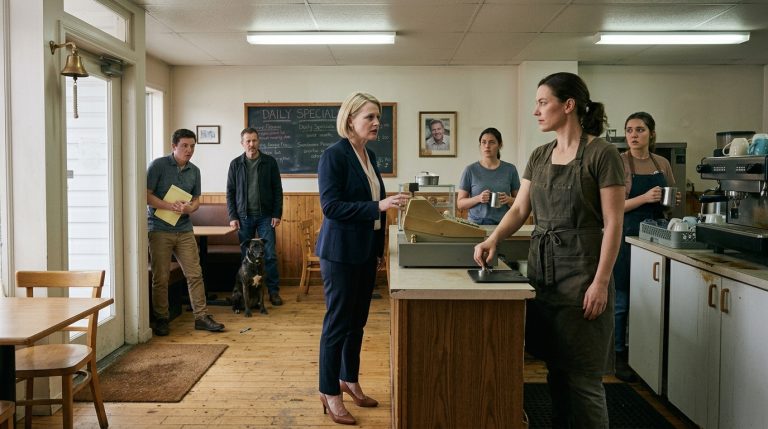
The silence in the Oak Barrel Diner was not the silence of peace. It was the silence of a held breath.
Raymond Clark watched the reflection of his own hands in the darkened window of the SUV as the vehicle pulled away from the curb. The city lights of Route 9 slid by, distorted by the light rain beginning to bead against the glass. He felt the phantom weight of a canteen in his hand, the strap biting into his shoulder, a ghost sensation that came whenever the adrenaline of a confrontation bled out of his system.
Beside him, Sergeant Major Thorne was a statue of composure. The man’s eyes were fixed forward, his posture unchanged from the moment he had stood in the diner doorway. He didn’t speak, respecting the internal orbit the older man was currently navigating.
“They were just kids, Thorne,” Raymond said, his voice sounding thin against the hum of the engine.
“They were a liability, Gunny,” Thorne countered, his voice low and devoid of malice. “To the Corps, and to the dignity of the people you served with.”
Raymond didn’t respond. He looked down at his lap. His hands, gnarled and trembling slightly, were empty, but his fingers twitched as if reaching for the cold, unyielding handle of a rifle. He reached into his pocket and his thumb found the Silver Star. It felt unusually heavy today, a leaden weight that seemed to pull at the fabric of his blazer.
As he pulled his hand out, a small, folded piece of paper—a scrap he didn’t remember putting there—slipped from the pocket and landed on the dark leather seat. He picked it up. It was a receipt from the diner, but written on the back, in a hand that looked remarkably like his own, was a single coordinate and a date from seventy-four years ago.
A sharp, metallic tang filled his mouth, replacing the stale scent of the diner coffee. Outside, the streetlights seemed to flicker in a rhythmic, stuttering pattern, mirroring the cadence of a distant mortar barrage.
“Sir?” Thorne turned his head, his brow furrowing as he noticed the sudden pallor of the older man’s skin. “You’re alright?”
Raymond didn’t answer. He was staring at the coordinate on the paper. As he watched, the ink seemed to bleed and shift, turning into a series of jagged, dark lines that resembled the topography of Hill 1282. He felt the sensation of frostbite blooming across his knuckles, stinging and numb.
He looked up at the Sergeant Major, trying to find his bearings, but the interior of the SUV was dissolving. The leather seats were becoming the rough, frozen canvas of a poncho shelter, and the muffled sound of the city was being replaced by a low, persistent whistle of wind through frozen pines.
Raymond realized with a sudden, sinking dread that he was no longer holding the receipt. He was holding the dog tags of a man who had been dead for over seven decades.
CHAPTER 2: THE RECRUITING STATIONS SHADOW
The transition was violent, a physical jolt that felt like being ripped from a warm, deep slumber into a blizzard. Raymond blinked, his breath hitching in his chest. The smell of frozen pine and the metallic tang of the ridge vanished, replaced instantly by the synthetic leather scent of the SUV’s upholstery and the faint, citrus-tinged air freshener swaying from the rearview mirror.
He was still in the SUV. Sergeant Major Thorne was watching him, his expression carefully neutral, though the tension in his jaw was a taut wire. The receipt was just a receipt—a piece of cheap, thermal-printed paper sitting harmlessly on the seat. The dog tags were gone. Raymond’s hand was empty.
“Gunny?” Thorne’s voice was the anchor that pulled him back to the surface. “You went away for a second there.”
Raymond smoothed his blazer, his movements deliberate, hiding the tremor in his fingers. He felt the cold sweat on his neck, a chill that defied the regulated climate control of the vehicle. “I’m fine, Sergeant Major. Just a… long day.”
“We’re arriving,” Thorne said, not pressing. He pulled the SUV into the parking lot of the Marine Corps recruiting station. It was a utilitarian building, brick and glass, tucked between a bank and a quiet office park. The six Marines who had accompanied them were already out of their vehicle, standing in a formation that seemed to command the very geometry of the asphalt.
They exited the SUV. The evening air was crisp, the wind whipping at the edges of their dress blue trousers. Thorne led the way, his stride rhythmic, purposeful. Every step they took felt like a return to an order Raymond recognized, a stark contrast to the chaotic, fluid cruelty of the diner.
Inside, the station was humming with a low-voltage intensity. A junior corporal at the front desk bolted upright as the door opened, his eyes widening at the sight of the Sergeant Major and the decorated veteran behind him.
“Sir!” the corporal barked, snapping a salute that was as clean as a whistle.
Thorne didn’t stop, but he acknowledged the greeting with a sharp nod. “At ease, Corporal. We’re going to the office.”
They moved into the back of the station, a space filled with the heavy, comforting smell of floor wax, old coffee, and institutional permanence. It was a far cry from the Oak Barrel, where the air had been thick with the arrogance of the present. Here, the past felt like a living architecture. On the walls were framed photos of previous generations—men with hard eyes and uniforms that mirrored the ones currently standing in the room.
Thorne gestured to a sturdy wooden chair. “Sit, Gunny. Get some water. I need to make a call to the CO and get this incident properly recorded. It’s not just a matter of protocol; it’s a matter of record.”
Raymond sat. The chair was hard, unforgiving, and deeply familiar. He watched as Thorne walked to his desk, the man’s movements efficient and practiced. The Sergeant Major pulled a file from a drawer, but his eyes caught Raymond’s reflection in the glass of a framed citation on the wall. The look was not one of pity, but of a quiet, shared understanding.
“I need to know,” Thorne said, his back to Raymond, his voice dropping an octave as he began to sort through papers. “What happened back there? When you were in the booth. You weren’t just thinking about the kids.”
Raymond’s hand drifted to his pocket, to the silver star. He hesitated. The urge to speak, to bridge the gap between the man he was and the man he had been on Hill 1282, was a physical pressure in his throat. But the discipline of a lifetime held him back.
“It’s just… memory, Sergeant Major,” Raymond said softly. “Sometimes it doesn’t want to stay buried.”
“Memories are like terrain,” Thorne replied, turning around. He leaned against the desk, his arms crossed. “You can map them, but you never know when the ground is going to shift. If there’s something else—something about those boys, or the situation—you need to tell me.”
Raymond looked around the room. The static of the radio in the corner, a low-frequency hum, spiked suddenly into a rhythmic crackle that sounded, for a heartbeat, like the chatter of a machine gun. He looked at the junior corporal at the desk, who was watching him with a mixture of reverence and fear. He felt the weight of the silver star, the physical anchor of his heroism, and he realized with a sharp, internal ache that the “legend” they were protecting was a man who felt more at home in a blizzard of steel than in a quiet room on Route 9.
“There’s nothing else,” Raymond said, though the words felt like a lie.
Thorne held his gaze for a long moment, the silence stretching between them. Then, the Sergeant Major turned back to his phone, but he didn’t dial. He waited, as if giving Raymond the space to change his mind. The room felt suddenly cramped, the walls closing in with the weight of the history hung upon them.
Raymond looked at his hands again. They were steady now, but his mind was drifting back to the coordinate on the back of the receipt—that phantom note he had seen, or imagined. He needed to know if it was real. He needed to know if he was slipping, or if someone, somewhere, was calling him back to the hill.
“Sergeant Major,” Raymond began, but the door to the office pushed open. The Commanding Officer walked in, his face etched with a grave intensity that signaled the end of any calm reflection.
“Thorne,” the CO said, his eyes locking onto Raymond. “We have a problem. The diner incident is blowing up, but not for the reasons we thought. A witness just uploaded audio from inside the diner. Someone was whispering names. Names that shouldn’t have been heard in that room.”
Raymond felt his heart skip a beat. The air in the room seemed to lose its oxygen. He stood up, his spine rigid, as the pieces of a puzzle he had spent seventy years trying to solve began to shift into an impossible, terrifying configuration.
CHAPTER 3: THE FIRST MIRROR
The CO’s words did not land with a thud; they landed with the sharp, crystalline snap of ice breaking underfoot. Raymond remained standing, his posture rigid, his hands resting naturally at his sides. The office, which had felt like a sanctuary of order mere moments ago, now felt like a stage where the lights were suddenly, aggressively, turned up.
“Names?” Thorne asked, his voice low, a warning growl. He moved closer to the CO, effectively shielding Raymond from the direct line of sight. “What names, sir?”
The CO looked at the tablet in his hand, his thumb scrolling. “Names from the record, Thorne. Specific callsigns. Things that shouldn’t have been audible unless someone was wearing a wire, or…” He paused, his gaze drifting to Raymond. “Unless someone was talking to ghosts.”
The flickering fluorescent light above the desk stuttered. For a fraction of a second, the office went dark, and the sound of the CO’s voice was replaced by the high-pitched, terrifying whine of incoming mortar fire. Raymond’s vision blurred. The dust motes dancing in the air of the recruiting station became the swirling, ash-choked snow of a Korean winter. He felt the phantom pressure of a heavy pack on his spine, the strap digging into a bruised shoulder.
He blinked, forcing the image back into the shadows. Focus.
“I don’t know what you’re talking about,” Raymond said. His voice was steady, but he could feel the dryness of his throat—a desert ache that had nothing to do with the office air. “I went for a cup of coffee. I was harassed. I stood my ground. That is all.”
“The internet doesn’t care about the facts, Gunny,” the CO said, his tone softening, though the urgency remained. “They care about the narrative. Someone is trying to turn this into a scandal. They’re claiming the whole thing was staged, that you were using the VFW blazer as a prop for some kind of social experiment.”
“A prop,” Raymond repeated. The word felt brittle, like dried leaves.
“They’re targeting the credibility of the Corps, Raymond,” Thorne said, turning toward him. “If this gets out that you were murmuring names—names of men who died on Hill 1282—they’re going to paint you as senile, or worse, as a fraud. We need to get ahead of this. We need to understand who was listening, and why they’re digging.”
Raymond walked to the window. Outside, the parking lot was empty, bathed in the orange glow of security lights. He watched a single dry leaf skitter across the asphalt. He remembered the boy from Ohio—Miller. He remembered the weight of his body. He remembered the promise he had made while the world was burning around them: I will get you home.
But home, as it turned out, was a complex, layered concept. He had brought Miller home in his heart, in the marrow of his bones, but he had left a part of his own soul on that hill. Was he senile? Was the world starting to catch up to the fact that he was essentially a walking memorial?
“I didn’t stage anything,” Raymond said, his reflection in the glass looking thin, ghostly. “I don’t even have a computer. I don’t know what these people want from me, other than to be left alone.”
“They want the truth,” the CO said, stepping toward him. “But not the truth you lived. They want the truth that fits their screens.”
Thorne leaned in, his voice a low, urgent murmur. “Gunny, Frank Kowalski is waiting in the lobby. He was the one who called me. He says he saw the kids—they weren’t just random students. They were connected to a local digital agency. Someone sent them there. This wasn’t an accident.”
The floor beneath Raymond’s feet seemed to tilt. The “decoy” was falling away. He had thought it was just the arrogance of youth, a symptom of a world that had forgotten how to stand straight. Now, he was looking at the jagged edges of something deeper, a deliberate, calculated strike against his life.
“I need to speak to him,” Raymond said.
“He’s in the lobby,” Thorne replied. “But be careful, Raymond. The man who saw you in that diner… he’s not just a witness. He’s a man who has been looking for you for a long time.”
Raymond turned away from the window. The office light flickered again, but this time, he didn’t look for the ghosts. He looked at his own hands, steady and calloused. If they wanted a show, he would give them a performance—but it would be one scripted by the hard-won lessons of twenty-two years of service, not by the vapid needs of a digital audience.
“Take me to him,” Raymond commanded, the authority in his voice cutting through the tension like a blade.
As they walked out of the office and back into the sterile, fluorescent-lit hallway, Raymond felt the weight of his legacy pressing down on him. Every step was a negotiation with gravity, every breath a choice. He was no longer just an old man in a diner; he was a focal point of a conflict he hadn’t sought but was now forced to navigate. And as he reached the lobby, he saw Frank Kowalski standing by the glass door—a man with the same hard, steady eyes as the men he had served with, a mirror held up to his own fading reality.
CHAPTER 4: THE THUNDER OF RECOLLECTION
The lobby of the recruiting station smelled of ozone and damp wool. Outside, the sky had bruised into a deep, sickly purple, and the first heavy drops of rain were striking the glass with the force of ball bearings. Frank Kowalski stood by the door, his frame framed against the gathering storm. He was a man who looked like he had been forged in the same furnace as the sergeant major, though his eyes held a more complicated, restless energy.
Raymond approached him slowly. The floor seemed to stretch, the distance between them filled with the muffled, rhythmic thrum of the rain intensifying on the roof.
“Gunny,” Frank said, his voice stripped of the professional veneer he used in the sales world. He stood at attention, not out of military habit, but out of a genuine, deferential necessity. “I didn’t think I’d get the chance to say this. I’ve spent twenty years trying to find a reason to talk to you without sounding like a fanboy.”
“You were there,” Raymond said, stopping just within Frank’s personal space. The air between them felt thick, pressurized, like the moments before a thunderclap.
“I was in the corner booth,” Frank nodded. “I saw them. I saw how you handled them. I saw the look in your eyes when you thought no one was watching.” Frank glanced toward the door, where the lightning flickered, casting long, stark shadows across his face. “It wasn’t about the coffee, was it?”
Raymond didn’t answer. He felt a sudden, sharp ache in his knee—a phantom memory of the cold, unyielding rock of Korea. Outside, a crack of thunder shook the foundation of the building. The glass in the doors rattled, a high-pitched, discordant vibration.
“The audio,” Frank continued, lowering his voice as Thorne and the CO hovered in the periphery. “People are talking about the names, Gunny. The names you were whispering when you thought you were alone. Miller. O’Connor. The sergeant you carried two miles through the drifts.”
Raymond felt the blood drain from his face. “I don’t whisper names,” he said, his voice coming out as a strained, gravelly rasp. “I remember them. That is different.”
“Is it?” Frank took a step closer, his expression intense, searching. “Because the kids—the ones in the diner—they weren’t just playing a prank. They were recording. They had a directional mic, Gunny. They weren’t just mocking an old man. They were fishing for something. They wanted you to break. And when you did, they captured it. The names, the coordinates, the way you looked when the present started to dissolve.”
The storm outside surged, a violent deluge that turned the streetlights into blurry, drowning halos. The power in the lobby flickered, the lights buzzing with the erratic, dying frequency of a failing circuit. Raymond felt the cold of the Chosin Reservoir—not a memory, but a tactile, biting temperature that seeped through his blazer and into his marrow.
“They didn’t just want a clip for their social media,” Frank said, his voice barely audible over the roar of the rain. “They’re working for someone who wants to discredit the entire local veterans’ association. They want to prove that the ‘heroes’ are just unstable, shell-shocked relics. They’re weaponizing your memory, Gunny.”
Raymond felt a profound, heavy weight settle in his chest. He looked at his hands, watching them ball into fists. He had tried to protect the dignity of the men he had served with by staying quiet, by living a life of soft, faded textures. He had been a monument, standing still while the world changed around him. But the world wasn’t content to let the monument stand.
“What do they want?” Raymond asked, his voice now cold, hard, and devoid of fear.
“They want you to go on the record,” Frank said, the urgency in his tone sharpening. “They want you to tell the story of Hill 1282, but they want to rewrite it. They want to make it look like a massacre, like an act of madness, not heroism. They think if they break you, the public will turn on the institution.”
The rain outside hammered the building with a relentless, punishing rhythm. Raymond felt the urge to leave, to step out into the storm and let the deluge wash away the complexity of the present. But he knew the terrain. He had held a line against an overwhelming enemy once; he could do it again.
“They chose the wrong day,” Raymond said. He looked toward Thorne and the CO. “They chose a day when I was tired, yes. But they also chose a day when I remembered exactly who I am.”
He turned to the Sergeant Major. “Get me a car, Thorne. Not an SUV. A civilian car. And get me to the address they’re using for their agency. If they want a story, I’ll give them one that will haunt them until the day they die.”
Frank Kowalski straightened, a grim smile touching his lips. He reached into his coat and produced a small, leather-bound notebook. “I’ve been tracking their movements, Gunny. I know where their office is. I know how they operate. But we need a plan. They’re waiting for you to walk into a trap.”
“Then we’ll walk into it,” Raymond said, his gaze fixed on the storm-swept glass. “And we’ll see who survives the night.”
He felt the Silver Star in his pocket, the sharp, cold edge of the metal biting into his skin. It was his anchor. And as the storm raged on, he felt the last vestiges of his hesitation shatter. The decoy of the diner incident was gone; the reality of the war he had been fighting for seventy years was now the only thing that mattered.
CHAPTER 5: THE DIGITAL FRONT
The ride was a study in controlled tension. The sedan provided by the Corps was an unremarkable, mid-sized vehicle, blending perfectly into the late-night traffic as they moved toward the outskirts of the city. Rain lashed the windshield in rhythmic, blinding sheets, turning the streetlights into smeared halos of orange and white. Raymond sat in the back, his gaze fixed on the road ahead, his hands resting on his knees. Frank sat beside him, his phone glowing with rapid-fire data transfers as he tracked the agency’s digital footprint.
“They’re still active,” Frank murmured, the light of the screen reflecting in his eyes. “They’re uploading segments now. The clips from the diner, spliced with voice-over that isn’t yours. They’re manufacturing a narrative of instability.”
Raymond didn’t look at the screen. He kept his focus on the horizon. He could feel the weight of the Silver Star in his pocket, a silent, cool contrast to the heat rising in his blood. The “decoy” was working—he was moving toward the heart of the agency, exactly where they wanted him, but they didn’t understand the man they were baiting. They thought they were dealing with a relic; they were actually dealing with a veteran who had spent decades waiting for a mission that required the absolute, unvarnished truth.
They pulled into a parking garage half a block from the digital agency’s office. It was a concrete tomb, echoing with the drip of water from above. The transition from the sedan to the pavement was silent, professional. Thorne and his team were close—a tactical shadow they had established earlier—but Raymond insisted on the final approach being his own.
“The server room is in the basement,” Frank whispered as they moved toward the stairwell, his voice tight with the weight of the objective. “It’s where they’re hosting the data. If we can get inside and pull the master log, we can prove the audio was synthesized. But the lock is biometric. They’ve been expecting a legal challenge, not a physical one.”
Raymond didn’t speak. He pushed open the heavy steel door to the stairwell, the metal groaning with a sound of tortured iron. They descended, the temperature dropping with every flight. The air became thick with the scent of ozone and cooling fans. When they reached the basement, they found a corridor of polished concrete and locked offices. At the far end, a heavy security door glowed with a faint, pulsing red light.
The hallway was empty, the silence punctuated only by the distant, rhythmic hum of the servers. As Raymond reached the door, he stopped. He didn’t see the keypad. He saw the barrier. He saw the illusion they had built to keep the truth out.
“It’s locked, Gunny,” Frank said, his hand hovering over his own phone. “I can’t bypass this without alerting their off-site security.”
Raymond leaned in, his eyes scanning the frame. He saw the small, physical discrepancy—a slight misalignment in the door’s hinge, the result of hurried, low-budget construction. A relic of poor maintenance in a world that favored digital superiority over physical integrity. He reached into his blazer, pulling out a small, sturdy multi-tool he had kept in his garage for years. It was a simple, rusted piece of steel, as dependable as the day he had bought it.
He began to work, his movements precise and slow. The clink of metal against metal echoed in the narrow corridor. He felt the resistance of the door, a physical manifestation of the agency’s hubris. They had built a wall of code, but they had forgotten that a wall is only as strong as its foundation.
“They’re moving, Gunny,” Frank whispered, his screen flashing a warning. “Security just got an alert that something is interfering with the power grid on the floor above. They’re on their way down.”
Raymond didn’t look up. He felt the hinge shift, a subtle, microscopic movement. The door was not a lock; it was a physical question, and he was providing the answer.
“Let them come,” Raymond said.
The door popped open with a dry, metallic snap. He stepped inside, into the cool, humming heart of the agency. Rows of black servers stood like monoliths in the dim light, their blue status LEDs blinking like heartbeats. He walked to the center console, the screen displaying a scrolling wall of code—the digital fabrication of his life, his legacy, his honor.
He didn’t need to be a hacker. He took the multi-tool and, with a single, brutal movement, slammed the shaft into the primary cooling manifold. Liquid nitrogen hissed into the air, a white, freezing fog that instantly blanketed the room. The servers screamed—a high-pitched electronic death rattle—as the heat sensors triggered a system-wide shutdown.
The lights in the room plunged into darkness. The hum died. In the sudden, suffocating silence, Raymond stood alone in the dark, the white fog swirling around him like the snow on Hill 1282. He felt the cold on his skin, the familiar, biting chill of his youth. He had stopped their operation, but as the security team’s footsteps thundered in the corridor outside, he realized the ultimate truth was not hidden in the servers.
The truth was that he had never really left the hill. He had been fighting this battle his entire life, in a hundred different ways, in a hundred different diners. And he was ready to finish it.
CHAPTER 6: THE SILENCE OF THE HILL
The footsteps outside stopped. The handle of the security door turned, the lock engaging with a heavy, final click before the door swung wide. A beam of white LED light cut through the freezing fog, sweeping the dark, humming room before pinning Raymond against the cooling racks.
“Step away from the console!” a voice commanded, sharp and professional.
Raymond didn’t move. He stood in the center of the white, swirling mist, his silhouette stark against the blinking lights of the dying servers. He felt the cold on his skin, a sharp, familiar bite that anchored him to the present. He wasn’t afraid of the security team, nor was he afraid of the men behind them—the digital orchestrators of his public undoing. He looked past the light, seeing the truth reflected in the glass of the server housing.
The truth wasn’t about the diner, or the students, or the digital agency. The truth was that he had been carrying the weight of Private Miller for seventy-four years, shielding a memory that had become a ghost. He had treated his honor as a fortress, but a fortress is just a tomb if you never let the light in.
“The power is down,” Raymond said, his voice quiet, calm, and resonant. “You can’t upload what doesn’t exist.”
The security guard stepped forward, his hand resting on his radio. He looked at the ruptured manifold, the liquid nitrogen hissing into the air, and then back at the old man in the blue blazer. There was no defiance in Raymond’s posture, only a profound, heavy clarity.
“Who are you?” the guard asked, his tone faltering.
“I am a man who kept his word,” Raymond replied.
In the hallway, the sound of heavier, more measured footsteps approached. Sergeant Major Thorne appeared in the doorway, his eyes sweeping the room, his expression one of intense, controlled relief. Behind him, the CO and Frank Kowalski moved into the room. The agency’s local director, a man in a tailored suit who had been watching the security feed from upstairs, stumbled into the room behind them, his face a mask of shock as he saw his life’s work flickering out in the darkness.
“It’s over,” Thorne said, his voice cutting through the tension. He walked to the console, looked at the dead screens, and then to the director. “Every piece of data you’ve gathered, every attempt to manipulate the narrative—it’s gone. We have a legal team on-site, and the local authorities have been notified of your digital activities. You’re finished.”
The director tried to speak, but no words came. He looked at the cooling racks, at the shattered remains of his digital empire, and then at the old man who had walked through his walls as if they were made of paper.
Raymond turned and walked toward the door. He didn’t look at the director, or the servers, or the security team. He walked past Thorne and into the corridor, his stride steady. He felt the weight in his pocket—the silver star—and for the first time in seven decades, it felt like nothing more than a piece of metal.
They walked out of the agency building and into the morning air. The storm had passed, leaving the city washed clean, the sunlight hitting the wet asphalt with a brilliant, golden intensity. Raymond stopped on the sidewalk, taking a deep breath of the air, which tasted of damp earth and coming spring.
“You did it, Gunny,” Frank said, stepping up beside him. “The server logs are corrupted beyond repair. They can’t release anything else.”
Raymond reached into his blazer pocket and pulled out the Silver Star. He held it in his palm, the morning sun glinting off the five points. He thought of Miller, the boy from Ohio, and the promise he had made in the heart of the blizzard. He finally understood that he hadn’t carried the weight to punish himself; he had carried it to remember. But the memory didn’t belong in the dark. It belonged to the light.
He walked over to a small, ornamental garden plot set into the concrete sidewalk, a patch of dirt where a young sapling had been planted. He knelt, the motion slow but fluid, and pressed the medal into the soft, damp earth, burying it beneath the roots of the tree. A physical act of letting go.
“Easy, Gunny,” Thorne said, stepping forward as if to help him rise, but Raymond stood on his own. He brushed the soil from his hands, his knuckles steady, his breathing deep and even.
“I’m finished, Sergeant Major,” Raymond said, his voice soft, an echo of peace that touched everyone in the small circle.
The symbolic closure settled over them like the morning calm. Raymond reached out and touched the trunk of the sapling, his fingers tracing the rough, young bark. It was a simple, grounding connection—a repair of the broken link between the past and the present. He wasn’t a relic anymore. He was a man, standing in the sunlight, the weight of the hill finally left in the ground where it belonged.
The character arc was complete. He had navigated the decoy, confronted the truth, and found his way back to himself. As he turned to walk toward the waiting car, he didn’t look back at the agency, or the city, or the ghosts. He walked with the quiet, measured pace of a man who had earned his own silence. The world was still changing, still chaotic, but he was finally, truly, home.