The Ghost Walker’s Reckoning: A Silent War Beneath the Surface of Command and Control
CHAPTER 1: THE STABILIZING PIN
The silence in the command center wasn’t empty; it was pressurized. It hummed with the electric vibration of a hundred servers, a steady, low-frequency drone that usually lulled Harold into a trance of productive labor. Today, that drone felt like a warning.
Harold reached for the handle of the buffer. His grip tightened, and he felt the sickening sway of the metal. The pin was missing. He didn’t look for it on the floor. He didn’t ask the ensigns if they had seen it. He knew the weight of this room, and he knew when it had turned hostile.
“Trouble, Mr. Beck?”
Lieutenant Commander Vance stood ten feet away, his back to the main display. He was nursing a fresh cup of coffee, his posture an over-rehearsed study in nonchalance. He wasn’t watching the fleet movements on the screens; he was watching the old man struggle with a piece of heavy machinery.
Harold straightened his back, a slow, deliberate movement that didn’t betray his age. He looked at the server rack immediately behind him—the main data relay for the Pacific theater. If the buffer whipped, if the handle slipped, the resulting impact would be enough to trip the circuit breakers, dumping the cache of every active mission currently running in the sector.
“Just equipment fatigue, Commander,” Harold said, his voice as dry as the dust he usually chased.
“Equipment fatigue,” Vance repeated, stepping closer. The click of his heels on the polished linoleum sounded like gunfire in the refrigerated air. “Seems like everything around here is getting a little too old, a little too worn out for the new standards.”
Harold let go of the handle, letting the machine lean precariously against his hip. He didn’t lean on it for support; he held it in place with a flick of his wrist. “Standards change, sir. Physics don’t.”
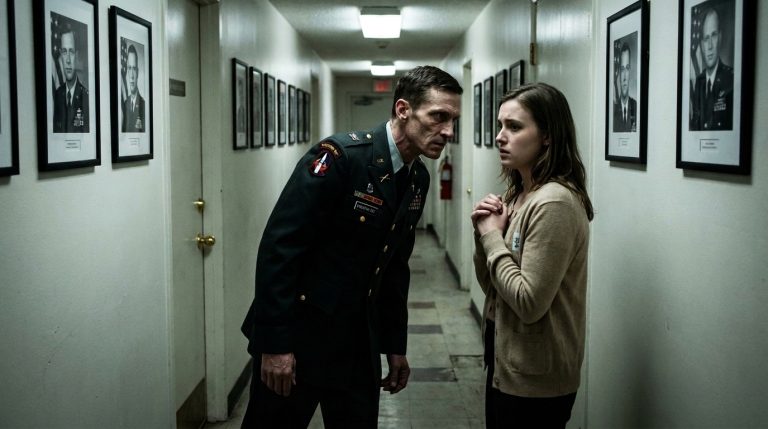
Vance stopped. The humor died in his eyes, replaced by a calculated, predatory flatness. He reached into his pocket and pulled out a tablet. “I’m initiating a full security audit of the maintenance staff today, Mr. Beck. My superiors are concerned about… irregularities in the vetting process.”
Harold felt the air in his chest tighten—not from fear, but from the sudden, cold realization of what was coming. This wasn’t just about a tattoo anymore. Vance wasn’t just clearing a janitor; he was building a wall to hide behind, and he was using Harold as the first stone to be cemented into place.
“That’s a lot of paperwork for a man who doesn’t know how to turn a wrench, sir,” Harold said softly.
Vance smiled, but it didn’t reach his eyes. “I don’t need to know how to turn a wrench to know when a part doesn’t belong in the machine.”
He tapped the screen of the tablet. Across the room, the primary wall display flickered, the tactical map vanishing to be replaced by a scrolling text stream of personnel files. One file reached the center of the display, highlighted in a damning, aggressive red.
BECK, HAROLD – STATUS: UNDER REVIEW.
Harold looked at the screen, then back at Vance. The realization hit him like a physical blow: Vance wasn’t looking for a gang history. He was looking for a ghost. And he didn’t know that some ghosts were designed to strike back when they were cornered.
“Commander,” Harold said, his voice dropping to a register that made the young Ensign Miller freeze at her terminal. “If you go any further into that file, you aren’t going to find what you’re looking for. But you will find things you can’t put back in the box.”
Vance stepped into Harold’s personal space, his face twisted in a sneer of pure, unadulterated arrogance. “Is that a threat, old man?”
“It’s a safety protocol,” Harold replied, and for the first time, he let his hand drop to his side, his fingers brushing the edge of his own shadow.
CHAPTER 2: THE ECHO IN THE WIRES
Vance’s hand didn’t tremble, but it hovered over the tablet with a frantic, uncoordinated energy. He was a man who played at power, and for the first time, he realized the man he was threatening hadn’t blinked. Harold stood his ground, his hands relaxed but ready, his center of gravity lowered in a way that Vance couldn’t hope to emulate.
“Safety protocol,” Vance scoffed, though the sneer lacked its earlier edge. He stepped back, putting the width of the command console between them. “I’ll have security check your mental fitness, Beck. That’s a threat against a superior officer.”
Harold didn’t answer. He turned, retrieved the floor buffer, and began to work the linoleum in a long, rhythmic arc. The sound of the machine was supposed to be a constant, but as he pushed it toward the main server array, the hum took on a different character.
Click. Crrr-shhh.
The sound of the machine grinding against the baseboard suddenly overlapped with the static hiss of a long-dead radio frequency. In the back of Harold’s mind, he wasn’t in the Command and Control center of a modern naval base. He was back in the A Shau Valley, the receiver pressed so hard against his ear that the metal etched a welt into his skin. He heard Needles’ voice, tinny and distant, gasping through the mud and the mortar fire.
Harold’s jaw tightened. He pulled the buffer back, forcing the memory into a small, locked box in his mind. Not now. The servers were humming a different tune now—a steady, digital pulse. He realized with a sudden, sharp clarity that the “security audit” Vance was running wasn’t just a threat to his job; it was an accidental probe into a system that was never meant to be connected to the public network.
Vance was scrolling through the personnel files, his fingers moving faster. He was looking for a skeleton, but he was digging in a graveyard that had been sealed with concrete decades ago.
“Ensign Miller,” Vance barked, not looking up from the tablet. “Pull the 1968 archives for base access. Let’s see what kind of ‘work’ our friend was doing before he decided to become a fixture on this deck.”
“Sir,” Miller said, her voice hesitant. “The 1968 files are archived at the Pentagon, mostly off-line. You’d need a higher clearance to—”
“I have the clearance,” Vance lied, his voice climbing an octave. It was a bluff, and everyone on the deck knew it. The atmosphere in the room shifted; the ensigns turned their heads, their interest piqued not by Vance’s authority, but by the sheer, desperate absurdity of his hunt.
Harold pushed the buffer, the weight of it grounding him. He watched Vance’s reflection in the dark glass of the server rack. He saw the Lieutenant Commander’s shoulders hunched, his eyes wide and unblinking. Vance was terrified—not of Harold, but of being wrong.
Harold knew the truth about those archives. They didn’t contain a criminal record for him; they contained a gap—a missing three-week period in ’68 where his platoon was officially ‘non-existent.’ If Vance pulled on that thread, he wouldn’t find a gang tag. He would pull the trigger on a document that proved the high command had used his unit as bait to test long-range communication gear under fire.
The machine bucked under Harold’s hand. He steadied it, looking down at the scarred metal casing. He had carried the truth for fifty years, written in the ink on his arm and the silence in his heart.
“You’re making a mistake, Commander,” Harold said, not looking up from his work. His voice carried across the room, steady and resonant, cutting through the hum of the cooling fans.
Vance spun around, his face reddening. “I don’t need advice from you, Beck. I’m doing my job. Protecting the integrity of this unit.”
“Integrity,” Harold said, and he allowed himself a thin, humorless smile. “That’s a heavy word to throw around a room full of machines that don’t know the difference between a pulse and a heartbeat.”
Harold turned the buffer, moving toward the far quadrant. As he passed Vance, he slowed down, his eyes locking onto the Lieutenant Commander’s. There was no aggression in Harold’s gaze—only a profound, weary pity. He saw the way Vance clutched the tablet, the white-knuckled grip of a man who had staked his entire identity on the illusion of his own importance.
“The archives are deep, son,” Harold murmured as he glided past. “Be careful what you bring to the surface. You might not like the color of the water.”
Vance watched him go, his mouth opening to retort, but the words died in his throat. He looked down at the tablet. The screen displayed a prompt: ACCESS DENIED – LEVEL 5 CLEARANCE REQUIRED.
Vance’s breath hitched. He tried the password again, his fingers tapping the glass with frantic, sweating intensity. Access Denied.
He wasn’t just looking for an old man’s history anymore. He was staring at a digital void, and for the first time, he felt the cold, creeping sensation that he had stepped off a ledge he couldn’t climb back up from. He looked toward the door, where Harold was already rhythmically buffing the floor near the exit, his movements as steady and inexorable as the turning of the tide. Vance stood alone in the center of the command deck, his authority feeling suddenly, dangerously thin.
CHAPTER 3: THE CIRCUIT BREAK
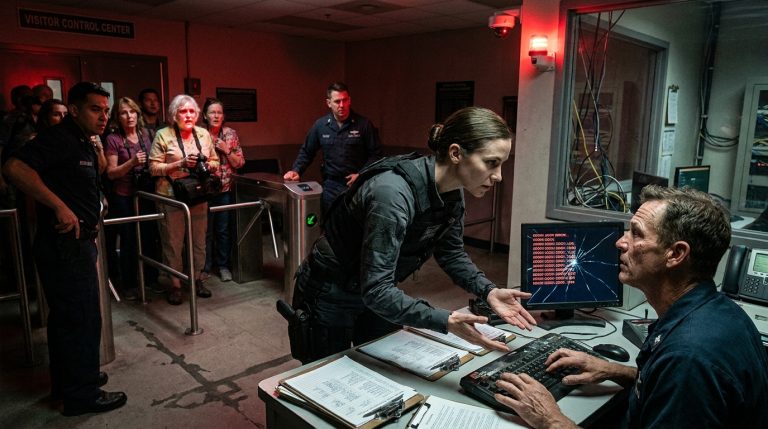
The surge was not a malfunction. It was a rhythmic, violent pulse that rippled through the linoleum floor, vibrating through the soles of Harold’s boots. The entire command center groaned. Every monitor on the main wall blacked out simultaneously, and the sterile blue glow was replaced by the harsh, clinical red of the emergency backup lights.
Vance stumbled, his hands flying off the tablet. “What is this? Miller! Get those systems back up! That’s an order!”
Ensign Miller was already moving, her hands dancing over the manual overrides. “It’s a cascade failure, sir! The whole rack is dumping power. I’ve lost connectivity to the internal servers!”
Harold stood perfectly still, his hands resting on the handle of his buffer. He didn’t look at the screens. He looked at the floor—at the thick, heavy cables snaking beneath the raised flooring, pulsing like veins. He knew this sound. It was the sound of a system being forced to shed weight, to purge the data that was clogging its arteries. Vance’s “security audit” had triggered a defense mechanism that had been buried in the base’s core code since the sixties.
“It’s not a failure,” Harold said, his voice low, audible only to the ensigns nearby. “It’s a purge.”
Vance whirled around, his face a mask of panicked rage. “What are you talking about, old man? You’re the one cleaning this floor. You’ve been tampering with the lines!”
He moved toward Harold, his stride wide and uncontrolled. The Lieutenant Commander was losing the veneer of his office, his tie loosened, his hair slightly disheveled. He was no longer the man in the air-conditioned room fighting wars on screens; he was a man who had suddenly realized the floor was disappearing beneath him.
“I don’t touch your wires, Commander,” Harold said, his tone as cool as the room’s temperature. “I just keep the dust off the surface. If the foundation is rotting, that’s not my fault.”
Before Vance could reach him, a sharp pop echoed from the server rack directly behind them. A plume of ozone-scented smoke curled into the air. The emergency lights flickered, casting long, dancing shadows across the faces of the crew. In that chaotic, shifting light, Harold saw something he hadn’t noticed before. Taped to the side of the main data relay was a small, brass-colored plate, weathered and nearly invisible against the black casing. It bore a serial number he recognized.
He didn’t need to read it. He knew the sequence. It was the tag of a prototype communication relay, the same one his team had been tasked with ‘protecting’ in the A Shau Valley. The realization tightened his chest. The hardware wasn’t just old—it was part of the original project, a relic that had been cannibalized and integrated into the base’s modern nervous system.
“You’re hiding something,” Vance hissed, stepping into Harold’s space. He grabbed the handle of the buffer, trying to pull it away, to assert his dominance through the only object Harold had to hold onto. “You’ve been here for fifteen years, watching, waiting for a chance to sabotage the records. Who are you working for?”
Harold didn’t resist. He let Vance pull. The sudden lack of tension caused the younger man to stumble backward, the heavy machine clattering to the floor with a deafening metallic clang. It hit the deck at an angle, the base hitting a floor panel that wasn’t properly secured. The panel flipped up, revealing a hidden compartment beneath the raised floor—a space meant for wiring that was instead filled with stacked, dust-covered magnetic tape reels.
The entire deck went silent. Even the frantic clicking of Miller’s keyboard ceased.
Vance stared at the reels, then down at Harold. His arrogance faltered, replaced by a cold, hollow confusion. “What… what is that?”
Harold looked at the tapes. He hadn’t known they were here. He had spent years sweeping over them, never realizing the weight of the history resting beneath his feet. The symbols on the tape canisters were marked in fading red grease pencil: TEAM SIDEWINDER – OPERATIONAL LOGS – EYES ONLY.
“That,” Harold said, his voice gravelly and slow, “is the archive you were looking for, Commander. But be careful. It doesn’t tell the story you want to hear.”
Vance reached down, his hand trembling as he brushed the dust from the nearest reel. He was a man obsessed with his own career, with his own clean, unblemished record, and yet, he was staring at the raw, unredacted reality of his own lineage. He looked up at Harold, and for a fleeting moment, the predator was gone, replaced by a scared, uncertain child.
“I have orders,” Vance whispered, though it wasn’t clear who he was talking to—himself, the Admiral, or the silent, watching crew.
“Orders are just noise,” Harold replied, reaching down to help him stand, not out of kindness, but because the moment demanded it. “The reality is what’s on those tapes.”
Harold grabbed the handle of his buffer, pulled the panel back into place with a sharp thud, and looked Vance in the eye. The Lieutenant Commander was pale, his eyes fixed on the floorboards as if they were made of glass. The power had returned to the room—the monitors flickered to life, the servers resumed their hum—but the authority Vance had held just minutes ago had vanished, dissipated into the ozone and the dust.
Harold didn’t wait for a reply. He started the buffer again, the motor roaring to life, and began to move, ignoring the man who stood shivering in the middle of his own command deck. The “Security Review” was over. The real investigation had just begun.
CHAPTER 4: THE MIRROR BREAKS
Vance’s gaze darted toward the observation glass. He knew the ensigns were watching, their faces pale and unreadable in the harsh glow of the emergency lighting. The “Security Review” had been his weapon, a clean, sterile tool to isolate and excise the old man who represented everything Vance despised about the past, but the weapon had shattered in his hands.
“Move back,” Vance commanded, his voice tight, lacking its usual veneer of authority. He knelt, his manicured fingers hovering over the reels. He was terrified to touch them, yet he couldn’t look away. “This is classified material. Unauthorized access—this is a breach, Beck!”
Harold didn’t retreat. He stood his ground, the buffer serving as a literal barrier between himself and the panicked officer. “That’s not a breach, sir. That’s an excavation.”
Captain Sterling’s voice cut through the air before Vance could respond, a low, resonant rumble that seemed to vibrate the deck plates. “Commander Vance, step away from the cache.”
The room snapped into focus. Captain Sterling stood at the entrance to the command deck, flanked by two Gunnery Sergeants whose eyes were scanning the room with the clinical detachment of predators. Sterling walked toward the center of the deck, his gait heavy and purposeful. He didn’t look at the servers; he looked at Harold, then at the tapes, and finally at Vance, who scrambled to his feet.
“Sir,” Vance stammered, his salute shaky. “I was conducting an audit. I found… I found evidence of unauthorized storage in the C&C deck.”
Sterling didn’t acknowledge the salute. He walked past Vance and stood beside Harold. He looked down at the reels, his jaw set in a hard, uncompromising line. “You didn’t find them, Commander. You uncovered them. There is a distinction.”
“I don’t understand, sir,” Vance muttered.
“Clearly,” Sterling replied, his voice devoid of heat but laden with a freezing contempt. He turned to the ensigns. “Ensign Miller, secure the area. No logs are to be wiped, no data transmitted. If a single byte of these tapes is digitized before I authorize it, I will consider it an act of sabotage against the Corps.”
“Yes, sir!” Miller scrambled to comply, her relief visible as she pulled the station away from Vance’s oversight.
Harold felt the sharp, stinging sensation of a siren—a sound from 1968, a high-pitched, wailing drone that usually signaled a mortar strike. He blinked, the command center’s red lights momentarily transforming into the blood-orange hue of a burning jungle canopy. He gripped the buffer’s handle harder, the vibration traveling up his arm and grounding him in the present. He couldn’t afford to waver. Not now.
“Mr. Beck,” Sterling said, his tone softening only slightly. “My father spoke of the ledger. The paper logs that were meant to accompany the tape reels. He said they were the only things that proved the ‘Ghost Walker’ missions weren’t just field failures.”
Harold looked at the Marine. The weight of the secret felt like lead in his gut. For fifteen years, he had been the janitor, the ghost, the man who cleaned the floors to keep the memories from cluttering the living space of the base. “The ledger isn’t here, Captain. It was never here.”
Vance, sensing his own career slipping into the abyss, made a desperate lunge for control. “If the ledger isn’t here, then this is just scrap! This is junk, and Beck has been hoarding it to sabotage my authority!”
The absurdity of the claim was met with a silence so absolute it felt physical. Sterling turned to face Vance, and for a moment, the room seemed to shrink, leaving only the two of them. “Your authority, Commander, is currently under review by the JAG office. We’ve been tracking the unauthorized inquiries you’ve made into the 1968 archives all morning. You weren’t looking for a gang history. You were looking to see if your father’s name was listed on the operational logs for the A Shau project.”
Vance froze. The color drained from his face until he looked like a statue of white marble. “I… I was tasked with internal security.”
“You were tasked with protecting your own lineage,” Sterling corrected, stepping into Vance’s space. “And in doing so, you forced the hand of the very people who were trying to keep your father’s involvement classified for the sake of national security. You didn’t just sabotage your own career, Vance. You blew the cover off a project that has been haunting this command for half a century.”
Harold watched as Vance’s ego finally collapsed. The Lieutenant Commander slumped, his shoulders rounding as if he had aged twenty years in twenty seconds. He looked at the floor, at the dust Harold had meticulously cleaned for a decade, and finally saw the reality of the ground he stood upon.
“The tapes,” Harold said, his voice cutting through the tension. “They don’t just show the failures. They show the orders. They show who signed off on the transmission frequencies that left my team blind in the valley.”
Sterling looked at Harold, his eyes reflecting a deep, inherited pain. “My father was the radio operator, Mr. Beck. He died knowing he couldn’t get a signal out. But he always said that wasn’t the equipment’s fault.”
“It wasn’t,” Harold confirmed, the ghost of the siren finally fading from his ears, replaced by the humming of the servers. “The equipment worked fine. It was the command that cut the link.”
Vance looked up, a glimmer of desperate realization in his eyes. “If this goes public… if the JAG office sees these… the command structure of this entire base…”
“Will be exposed,” Sterling finished. “And you, Vance, will be the one holding the shovel that digs the grave.”
Harold pulled the buffer back, the heavy, industrial machine feeling lighter than it had in years. The secret was out, but the final, devastating truth—the identity of the officer who had signed the kill order for the Ghost Walkers—remained locked in the ledger Harold kept hidden at home, a weapon he would only unleash when the time was right.
CHAPTER 5: THE COLLAPSE OF THE MACHINE
Vance’s knees buckled. It wasn’t a dramatic fall; he simply lost the will to remain upright. He hit the deck with a dull thud, his hands still clutching at the floor panel as if he could weld it shut again. The ensigns were frozen at their stations, the hum of the servers sounding, in this moment, like the mocking laughter of the ghosts trapped within the magnetic reels.
Captain Sterling stepped forward, the heels of his polished boots clicking against the linoleum with a measured, rhythmic finality. He reached down and plucked a small, cream-colored envelope from the floor—something that had fallen out of Vance’s inner pocket during his collapse. It was addressed to Vance, postmarked from a retirement community in Virginia, the handwriting shaky and aged.
“You weren’t just looking for records, Commander,” Sterling said, his voice quiet, slicing through the tension of the room. “You were looking for permission. You wanted your father to tell you that what he did was justified so that you could continue to believe your own uniform was earned.”
Vance didn’t answer. He stared at the floor, his face drained of all color. The bravado, the weaponized bureaucracy, the cold malice he had wielded as a shield—it had all evaporated, leaving only a man who realized his entire life had been built on a foundation of sand.
“Look at me,” Sterling commanded.
Vance slowly raised his head. His eyes were bloodshot, rimmed with the exhaustion of a man who had been fighting a war he didn’t understand.
“The Board of Inquiry is already en route,” Sterling continued, his tone devoid of pity. “They aren’t coming for the janitor. They are coming for the Lieutenant Commander who initiated an unauthorized security audit of a protected historical archive. They are coming for the man who tried to bury the truth to protect a family name that stopped meaning anything the moment it was used to cut off a radio signal in a valley in 1968.”
Harold stood to the side, his hands still resting on the buffer handle. He felt no triumph. There was no joy in watching a man unravel. There was only the heavy, aching fatigue that came from carrying the weight of history for so long. He looked at the tape reels—the physical evidence of the lives that had been sacrificed for “experimental communication technology.” He thought of Needles, of the way his hands shook, of the mud that had been their home for those weeks.
“Mr. Beck,” Sterling said, turning to him. “You’ve done your job. The floor is clean.”
Harold nodded, but he didn’t move. He looked at Vance, who was still huddled on the floor, his spirit effectively erased. It was a failure of the machine, a breakdown of the chain of command that had been inevitable from the start. But the “Security Review” had been the catalyst, and now the entire command center felt like a tomb.
“The ledger,” Harold said, his voice raspy, as if he hadn’t used it in years. “My ledger. It proves he didn’t just cut the signal. He verified the artillery coordinates before the strike.”
The silence in the room deepened. The ensigns stopped typing. Even the cooling fans seemed to slow. Sterling looked at Harold, his expression shifting from hard resolve to a grim, pained understanding. “If that is true, Mr. Beck, then the Board of Inquiry won’t just end Vance’s career. It will rewrite the history of this entire base.”
“History is already written,” Harold replied. “I’m just the one who knows how to read the ink.”
Vance let out a shuddering, broken breath. He reached for the envelope Sterling held, his fingers twitching. “He… he told me he was a hero. He told me he saved men.”
“He saved himself,” Sterling said, dropping the envelope into Vance’s lap. “And he did it by making sure your team, Mr. Beck’s team, never made it out to tell the difference.”
Vance clutched the letter to his chest, curled into a fetal position on the deck of the command center. He wasn’t the antagonist anymore. He was just the latest casualty of a war that had never actually ended.
Harold picked up his buffer. The machine felt heavy, a tool of labor, not a weapon of war. He looked at the server racks, at the rows of lights, and at the young woman, Ensign Miller, who was now quietly documenting the tape cache. The cycle was breaking. The silence wasn’t being filled with secrets anymore; it was being filled with the truth.
He didn’t need to stay to see the MPs arrive. He didn’t need to hear the shouts or the formal stripping of rank. He had spent fifteen years waiting for this moment, and now that it was here, he realized the only thing he wanted was to walk out into the sunlight.
“Captain,” Harold said, pausing at the threshold of the command deck.
Sterling turned, his stature impeccable. “Yes, Mr. Beck?”
“The floor is ready for the next shift.”
Harold pushed the buffer toward the storage closet, the motor humming a soft, steady song that sounded, for the first time, like peace. He left Vance shivering on the deck, a ghost of a commander in a room full of machines, and walked toward the exit. The door slid open, revealing the hallway that led to the outside world. He stepped through, leaving the sterile, pressurized cold behind him.
He didn’t look back. He didn’t need to. The ledger was at home, waiting for the sunlight. The truth was no longer a secret buried in the dirt or hidden beneath a floor panel. It was a weight, and for the first time in fifty years, Harold was ready to put it down.
CHAPTER 6: THE FINAL SWEEP
The hallway was quiet, save for the rhythmic clicking of Harold’s boots on the industrial tile. The air here was warmer, less filtered than the command center’s recirculated oxygen, smelling faintly of coffee and distant, outdoor rain. Harold didn’t walk fast. He moved with the measured pace of a man who had nowhere left to run and no one left to fear.
He reached his locker in the basement maintenance bay. It was a metal cage, rusted at the hinges and smelling of oil and old cleaning supplies. Inside, nestled behind a stack of spare mop heads, was the ledger. It was a small, bound notebook, its leather cover cracked by heat and time, filled with columns of call signs, artillery coordinates, and the damning signatures of officers who had long since ascended the ranks to positions of untouchable power.
He pulled it out. The weight of it wasn’t physical; it was the weight of memory. He looked at the entries, the meticulous penmanship of a man who had expected his own death at any moment. The final entry—the coordinates for the strike that had decimated his team—was signed in a hand he recognized not from the past, but from the present. The signature belonged to the Admiral, Vance’s mentor, the man who had authorized the “security audit” that had brought everything crashing down.
The door to the maintenance bay creaked open. Captain Sterling stepped inside, his presence filling the cramped, dim space. He looked at the ledger, then at Harold. He didn’t ask for it. He simply waited.
“You knew,” Harold said, not looking up. “You knew who signed the order.”
“I suspected,” Sterling replied, his voice low. “My father left me clues. He couldn’t say it aloud, but he left enough of a trail to point to the top. I needed the physical proof, Mr. Beck. The tapes were the start, but the ledger… the ledger is the anchor.”
Harold handed him the book. The transfer felt like the end of a long, arduous march. “It’s not just a book, Captain. It’s a tombstone.”
Sterling opened it, his fingers tracing the faded ink. He didn’t look at the coordinates or the call signs; he looked at the signature on the final page. His expression tightened, the mask of the Marine slipping to reveal a deep, simmering rage. “He’s still in power. He’s running the board for the next deployment.”
“Then you know what you have to do,” Harold said.
Sterling closed the book and looked at Harold. “I do. And I know what it will cost. My career, my rank, everything. But it’s the only way to stop the next Ghost Walker team from being used as bait.”
“It’s not a loss, Captain,” Harold said, his voice steady. “It’s an investment.”
Harold walked to his locker and began to pack his things. A worn coat, a thermos, a pair of thick, calloused gloves. He wasn’t leaving out of fear or dismissal; he was leaving because the job was done. The truth was out, the machines were being shut down for investigation, and for the first time in fifteen years, he didn’t have to worry about the floor.
CHAPTER 6: THE FINAL SWEEP
The hallway stretched out before Harold, long and antiseptic, its linoleum floor buffed to a mirror finish that caught the harsh fluorescent light. He walked slowly, the industrial buffer trailing behind him on its rubber wheels. Every step felt lighter, yet the gravity of what he had unleashed back in the command center anchored him to the moment.
He didn’t have to look back to know that the infrastructure of the base was already changing. He could hear the distant, frantic chatter of radios, the hurried footfalls of security personnel, and the sudden, sharp silence of a chain of command that had been severed.
He reached the end of the corridor and pushed through the heavy double doors that led to the maintenance bay. The air here was different—less refrigerated, smelling of ozone, grease, and the faint, lingering scent of dry earth. He navigated the rows of shelves, his mind replaying the final look on Vance’s face. It wasn’t the look of a defeated man, but of a man who had finally stopped pretending.
Harold pulled into the small maintenance alcove, a cramped space tucked behind the main loading docks. He parked the buffer, uncoiling the cord with a methodical, practiced motion. He took a damp cloth from his pocket—the same one he had used to clean the command deck for fifteen years—and wiped down the handle, removing the last traces of the day’s labor.
He reached into his breast pocket and withdrew a small, heavy key. It was old, the metal worn smooth by decades of being kept against his skin. He moved to the back of the alcove, shifted a heavy stack of empty supply crates, and revealed a small, recessed safe embedded into the concrete wall.
He inserted the key. The tumblers clicked—a sound like a dry branch snapping. Inside, wrapped in a faded, oil-stained military poncho, lay the ledger.
He pulled it out. The paper was yellowed and brittle, covered in the tight, disciplined handwriting of a man who knew every line could be his last. He opened it to the final entry, dated fifty years ago.
Coordinates verified. Transmission status: Denied. Target marked.
The signature at the bottom wasn’t just a name. It was the rank and serial number of the officer who had ordered the strike on Team Sidewinder—the same officer whose name was carved into the plaque in the main lobby, the same name that Vance had worn like armor.
Harold sat down on a crate, the ledger resting on his knees. He didn’t rush. He didn’t feel the need to call the press or demand a televised confession. The truth didn’t need a loudspeaker to be true. It just needed to be seen.
The heavy bay doors at the far end of the facility creaked open, admitting a slice of golden afternoon sun. Captain Sterling stepped through, followed by two men in civilian suits. They saw Harold sitting in the alcove, the ledger open on his lap.
They didn’t approach him with drawn weapons. They walked toward him with a quiet, solemn respect. Sterling stopped five feet away and looked at the book.
“Is it all there?” Sterling asked.
“Everything,” Harold said.
Sterling nodded. “The Board of Inquiry is ready to accept the evidence. They know what this means, Mr. Beck. They know that once this is digitized, there is no going back for anyone involved.”
“Good,” Harold said. He closed the book, the sound final. He handed it to Sterling.
Sterling accepted it with both hands, his posture stiffening as if he were taking hold of an heirloom. “I’m going to make sure this reaches the right people. Personally.”
“I know you will, Captain,” Harold said, standing up. He felt the ache in his back, the familiar pop of his vertebrae, but for the first time in years, the tension that had held his frame together had dissolved.
Sterling watched him for a moment. “What will you do now, sir?”
Harold looked at the maintenance bay, at the tools he had used to hide in plain sight, and then back at the open bay doors. The sun was dipping low, casting long, sharp shadows across the floor.
“I think I’m done cleaning,” Harold said.
He walked past Sterling and the two men, toward the exit. He didn’t stop at the supply desk. He didn’t clock out. He just walked out of the building and into the cool, evening air. The base was loud with the sound of incoming transport vehicles, but Harold didn’t hear them. He only heard the wind in the trees and the quiet, rhythmic beat of his own heart.
He reached the gravel parking lot, his boots crunching against the stone. He stopped by his old truck, a rusted, reliable thing that smelled of coffee and long drives. He leaned against the door, taking a deep breath of the air. It wasn’t the air of a base; it was the air of the world.
He reached into his pocket, pulled out the key to the alcove, and dropped it into a storm drain. The sound of it hitting the metal grate was tiny, but it signaled the end of the silence.
He climbed into the truck, started the engine, and pulled away. As he drove past the main gate, the security guards stood at attention, their eyes following the old man in the work coveralls as if he were a general. Harold didn’t salute them. He just drove, a ghost no longer, merging into the stream of traffic that moved toward the horizon, toward a future that, finally, had no secrets left to keep.