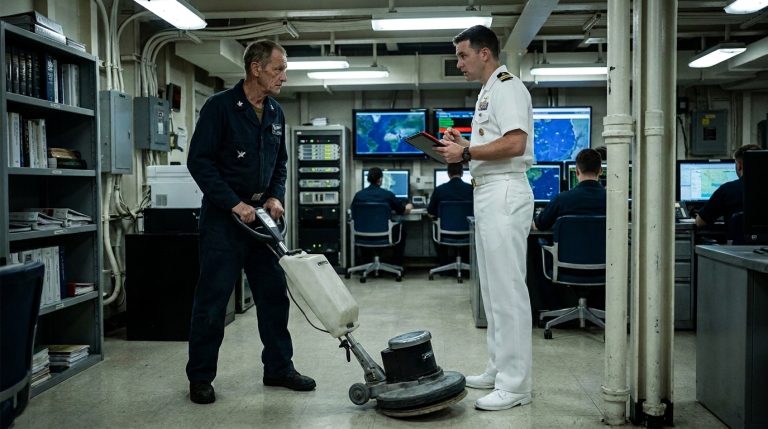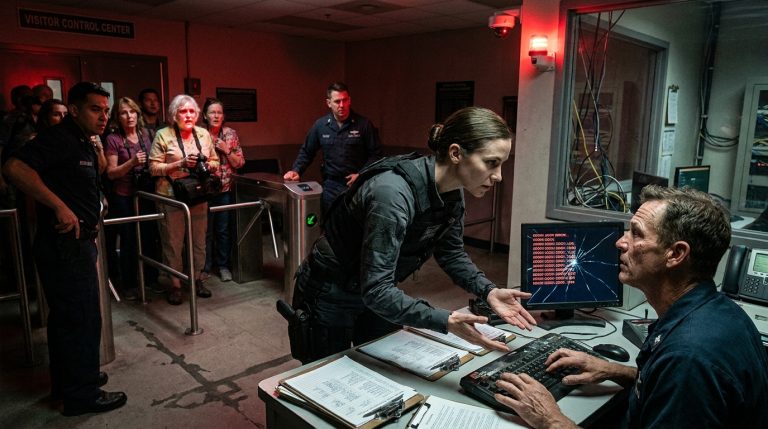
A Fragile Mend: The Quiet Reclamation of Captain Marcus Reeves and the Echoes of Lost Honor
CHAPTER 1: THE WEIGHT OF STILLNESS
The room was too quiet. That was the first thing Marcus noticed when the door clicked shut, locking him into a space that smelled faintly of lemon wax and industrial-strength loneliness. It was a sterile, sharp scent—nothing like the damp, honest smell of the alleys he had called home.
He sat on the edge of the mattress, the fabric crisp and starch-stiff against his calloused, trembling palms. His new uniform—the one the General’s aide had insisted he wear—lay folded neatly on the chair. It felt heavy, a wool-blend anchor that dragged his shoulders down. He looked at his reflection in the polished glass of the desk lamp. The beard was gone, revealing a jawline that looked like it belonged to a stranger, a map of deep, jagged lines that hadn’t seen the sun in years.
He closed his eyes. The memory of the auditorium was still burning behind his eyelids. The way Thornton looked at him—not as a ghost, but as a man. It felt like a betrayal. To be seen was to be vulnerable, and to be vulnerable was to invite the ghosts back in.
He leaned forward, his elbows digging into his knees. A sudden, sharp realization hit him: he had spent four years becoming invisible so that he wouldn’t have to carry the weight of his own existence. Now, the weight had been forced back into his hands by a salute he hadn’t earned and a pedestal he had never asked to climb.
He reached into his pocket. His fingers found the frayed edge of the Phantom Six patch. It was the only thing that felt real. He gripped it so hard the edges bit into his skin, an old, familiar pain that grounded him.
A soft knock sounded at the door.
Marcus didn’t move. He kept his eyes shut, listening to the muffled, rhythmic ticking of a clock somewhere in the hallway. It was a slow, mechanical sound—the sound of time he didn’t know how to fill.
“Captain Reeves?” The voice was soft, hesitant. It was the social worker, Sarah.
He opened his eyes. The room seemed to tilt, the shadows in the corner stretching like long, spindly fingers reaching for his feet. For a heartbeat, the pristine walls of the officer’s quarters vanished, replaced by the suffocating, dark heat of the Kandahar mountains. He could hear the wind whistling through the rocks, the frantic static of the radio, and the low, guttering breath of the men he had failed to save.
He looked at the door. He wasn’t in a room on a military base; he was back in the dirt, the cold seeping into his bones.
“Captain?” Sarah repeated, her voice closer now.
Marcus stood up, his joints screaming in protest. He walked toward the door, his gait stiff, his mind struggling to bridge the gap between the concrete he was used to and the polished hardwood beneath his feet. He reached for the handle, his hand hovering over the cold, brass lever.
He knew that if he opened that door, the world would rush in—the cameras, the questions, the crushing expectation of being a hero. He also knew that if he didn’t, he would simply drift away, back into the gray, forgotten spaces of his own mind.
He turned the handle, the metallic click echoing like a gunshot in the silent room.
CHAPTER 2: THE ANTISEPTIC ECHOES
The door swung wide, the hinges silent in a way that felt wrong to Marcus. He didn’t step out; he was pulled forward by the draft of the hallway, a stream of cool, recirculated air that smelled of industrial bleach and floor wax. Sarah Mitchell stood there, her hands clasped tightly in front of her. She looked smaller out here, stripped of the auditorium’s vastness, just a young woman in a beige cardigan standing in a corridor that stretched out like a vein in a machine.
She blinked when she saw him, her gaze traveling over his frame—the way he held himself, the slight, involuntary hunch of his shoulders. She didn’t speak. She didn’t have to. The silence in the hallway was thick, pulsing with the same heavy expectation that had filled the auditorium. Marcus took a single, measured step, his boots hitting the floor with a rhythmic, dull thud that seemed to vibrate through the walls.
“The car is waiting, Captain,” she said, her voice soft, barely reaching the registers of a whisper.
Marcus paused, his focus narrowing. He looked at her, his eyes tracing the line of her throat, the way she shifted her weight from one foot to the other. His eyes flicked to her hip, to the belt of her trousers where a visitor’s pass usually hung—a bright, recognizable patch of plastic. It was gone. The belt loop was empty, save for a small, frayed thread hanging from where the clip should have been. A minor detail, perhaps a simple oversight, but to Marcus, it was a jagged stone in a smooth road. Why would a social worker, someone so meticulously prepared, lose her credentials the moment the pressure shifted?
He suppressed the urge to comment. He had learned long ago that questions were a form of leverage, and he wasn’t ready to spend his yet.
“General Thornton?” Marcus asked, his voice gravelly, unused to the task of forming complex sentences.
“He’s in the command suite. Waiting for you,” Sarah said, turning. She didn’t wait for him, walking with a brisk, efficient pace that Marcus had to adjust his own stride to match.
The walk down the hall was an exercise in sensory discipline. The walls were lined with framed portraits of commanders past, their faces stern and frozen in time. Marcus felt their eyes on him, a thousand judging stares that saw not the man, but the uniform he hadn’t yet put on. He kept his head level, his gaze locked on the back of Sarah’s neck, watching the way her pulse jumped beneath the skin.
He felt the phantom weight of his pack—the one he hadn’t carried in years—and the absence of his knife against his thigh. He felt exposed. The sterile environment wasn’t just physical; it was psychological. It was a place where variables were controlled, where human messiness was bleached away and replaced by efficiency. He didn’t belong here, not really. He was a creature of the dark, of the jagged edges and the unplanned path, and being here, in the heart of the machine, felt like being dissected while still alive.
“They’re going to want to talk,” Sarah said without looking back. “The board. It’s not just the General anymore. They’re asking questions about the last four years. About how you lived. Who you saw.”
Marcus stopped. The hallway was empty, the fluorescent lights buzzing overhead with an irritating, high-pitched whine. He reached out and touched the wall, his fingertips tracing the texture of the paint. It was smooth, too smooth. Like a lie.
“I didn’t see anyone,” Marcus said, his voice flat.
“They won’t believe that,” Sarah replied, stopping now and turning to face him. Her eyes were wide, filled with a sudden, sharp empathy that Marcus found more threatening than the Colonel’s rage. “Marcus, you’re a legend now. Legends don’t just disappear into the shadows. People are going to want to know what you were hiding from. They’ll look for a story.”
“Then let them look.”
“They will,” she said, and for a second, her face hardened, a flicker of something calculated crossing her features before it vanished behind the mask of professional concern. She reached out, her fingers brushing his arm—a light, fleeting touch—and then she pulled away, as if burned.
Marcus watched her. He felt the cold air of the hallway settle into his lungs. He had come here to be found, or at least to stop hiding, but the cost was already starting to accrue. Every step forward was a step deeper into a cage of his own making, a cage built of other people’s expectations and the cold, unyielding light of a truth he still wasn’t ready to face.
He didn’t need to ask where they were going. He could feel the destination, a pull in the air, a gravity that centered on the command suite. He took another step, his boots silent now, his movements deliberate. He wasn’t the man they wanted, the hero of a thousand stories. He was the man who had lived in the dirt, the man who had seen the things the machines couldn’t, and he was beginning to realize that the hardest part of coming home wasn’t the return—it was the confrontation with everything he had left behind in the dark.
He followed Sarah into the elevator, the metal doors sliding shut with a hiss, sealing them into a small, claustrophobic box. As the lift began its slow, mechanical ascent, Marcus felt the pressure change in his ears, a reminder that he was rising, leaving the ground behind, and stepping into a world that demanded everything he had left.
CHAPTER 3: THE VERTICAL DESCENT
The elevator was a steel cage, brushed-metal walls reflecting a version of Marcus that he barely recognized. He stood in the corner, his back pressed against the cold paneling, watching the numbers above the door climb with excruciating slowness. Each chime as they passed a floor felt like a hammer strike against a rusted anvil.
Sarah stood opposite him. She was staring at her own reflection, her posture rigid, her hands tucked deep into the pockets of her cardigan. The silence was absolute, save for the hum of the lift and the mechanical whir of the cables—a sound that, to Marcus, mimicked the distant, rhythmic grinding of a transport helicopter.
His pulse quickened. The air inside the lift was thinner, stripped of the scent of rain and earth he had become accustomed to, replaced by the sterile, sharp aroma of cleaning chemicals and stagnant oxygen. He felt the phantom vibration of rotor blades beneath his boots. For a second, the elevator lights flickered—a brief, stuttering dip in power—and the space around him seemed to warp. The polished metal walls dissolved into the dark, vibrating interior of a Blackhawk at low altitude, the darkness outside the small porthole intense and suffocating.
He gasped, a sharp intake of air that sounded too loud in the small space.
Sarah looked up, her brow furrowing. “Captain? Are you alright?”
The hallucination shattered. He was back in the elevator. The lights were steady, the hum was just a lift motor, and the woman in the cardigan was looking at him with an expression of clinical concern that grated against his nerves.
“I’m fine,” Marcus said, his voice clipped. He shifted his weight, his boots scraping against the floor—a harsh, dissonant sound.
“You don’t have to do this,” Sarah said softly, her eyes darting to the floor numbers as they hit the upper levels. “If you need more time, I can tell the General. I can tell them you aren’t ready for the debriefing.”
Marcus watched her. He noted the way she avoided his gaze, the slight tremor in her hands beneath her pockets. She was lying, or at least omitting. She wasn’t asking for his sake; she was testing his breaking point. He realized then that she wasn’t just a social worker—she was a probe, an extension of the system sent to determine if the “legend” was still functional or if he needed to be neutralized by compassion.
“I’m ready,” Marcus said.
“The board… they have their own agenda, Marcus. They aren’t all like Thornton.”
“They’re people,” he replied, his voice devoid of emotion. “People have weaknesses. You just have to know where to look.”
The elevator jolted to a stop, the doors sliding open with a soft, synthetic chime. A long corridor stretched out before them, carpeted in deep, sound-deadening gray. At the far end, a set of double doors stood open, revealing a boardroom bathed in the harsh, flat light of a late afternoon sun streaming through oversized windows.
He stepped out, the floor beneath him feeling impossibly soft. As he walked, he felt the weight of his own history trailing behind him like a physical anchor. He saw a man standing near the entrance to the boardroom—an aide, mid-twenties, holding a tablet and wearing a uniform so stiff it looked like a suit of armor. The aide glanced at Marcus, then looked down at his screen, his expression neutral.
Marcus kept walking. He knew the drill. The walk toward the door was the most important part of the mission; it was where you established dominance or indicated surrender. He didn’t want either. He wanted to be a ghost, but he was forced to be a statue.
He stopped at the threshold. Inside, the room was dominated by a long, polished table. General Thornton sat at the head, his hands folded. Beside him, three others—two civilians in tailored suits and a Colonel Marcus didn’t recognize, his face sharp and his eyes cold, the kind of eyes that had never seen mud or smelled cordite.
Thornton stood up as Marcus entered. “Captain Reeves.”
Marcus didn’t salute—he didn’t have a hat, and his clothes were the borrowed uniform of a man he wasn’t sure he still was. Instead, he stood at ease, his posture so perfectly aligned that it made the uniformed staff in the room look unkempt by comparison.
“General,” Marcus replied.
The Colonel at the table leaned forward, his chair groaning. “We’ve seen the reports, Captain. We’ve seen the footage. But we have… questions.”
Marcus looked at the Colonel. He saw the tension in the man’s jaw, the subtle way he adjusted his watch, the nervous tap of his pen against the table. He was a creature of the system, someone who had built a career on the appearance of order. And he was terrified of the man standing before him.
Marcus didn’t move. He felt the cold air of the boardroom wash over him, a climate-controlled chill that reached deep into his marrow. He realized then that this wasn’t a hero’s welcome. This was an interrogation. The decoy—the public story of his heroism—was being peeled back to reveal something else, something the board didn’t want to acknowledge: the human cost of a war that had been fought in the dark.
“Ask,” Marcus said, his voice a low, steady rumble that seemed to vibrate the air in the room.
He didn’t need to fear them. He had lived in the dirt and survived. They had lived in offices and managed spreadsheets. He was a veteran of the real world; they were tourists in a theater of war. He leaned slightly forward, his hands, calloused and steady, gripping the back of the chair in front of him. The wood was hard, real, and grounded.
He was home. And now, he would have to learn how to fight a different kind of war—one where the enemy didn’t carry a rifle, but a pen, and where the battlefield was the truth of his own survival.
CHAPTER 4: THE MEASURE OF A MAN
The Colonel didn’t respond immediately. He stared at Marcus, his pen hovering mid-air, a faint, nervous tic fluttering beneath his left eye. He had expected a broken man, a cautionary tale to be polished and discarded, but Marcus remained perfectly still—an immovable object in a room designed for fluidity.
“We aren’t here to interrogate you, Captain,” the Colonel finally said, his voice regaining some of its synthetic starch. “We are here to ensure that your re-entry into the public sphere is handled with the proper… management.”
“Management,” Marcus repeated. The word felt like grit in his mouth. He allowed himself to sink slightly into the chair, the fabric coarse against his palms. He didn’t look at the Colonel. He looked at the window, where the sun was beginning to dip, casting long, bruised shadows across the boardroom table. “I’m not a file to be organized.”
“Of course not,” one of the civilians intervened. She was older, her clothes immaculate, her tone dripping with the kind of practiced sympathy that Marcus had learned to fear more than a direct assault. “But you must understand, Captain, your story has captured the public imagination. People want a hero. And the military needs to ensure that the man they hold up to that light is… beyond reproach.”
Marcus finally turned his gaze toward her. His eyes were flat, mirroring the dull gray of the carpet. “And if I’m not?”
The Colonel shifted. “Then we adjust the narrative. We find the elements of your service that align with our current objectives and emphasize those. It’s for your own protection as much as the institution’s.”
The room grew very still. Even General Thornton, who had been sitting back with his arms crossed, leaned forward slightly. Marcus felt the weight of the room shifting. They were trying to build a cage, not of iron bars, but of words, of edited histories and sanitized memories.
“My service wasn’t an objective,” Marcus said, his voice barely rising above a whisper. “It was a debt. I paid it in full.”
“No one is questioning your sacrifice, Marcus,” Thornton said, his voice low and firm. He was the only one in the room whose eyes seemed to truly see the man behind the legend. “But you’ve been out of the loop for four years. The world has changed. The way we present our history has changed.”
Marcus listened to the cadence of the General’s speech, searching for the crack in the facade. Thornton was protecting him, but he was protecting him in a way that felt like a burial. He was trading the truth for safety.
“I remember,” Marcus said, his gaze fixed on a small, insignificant water stain on the boardroom table. “I remember the operations. I remember the faces of the men who didn’t come home. I don’t need a narrative to tell me what that means.”
“We’re just trying to help, Captain,” the Colonel insisted, his hand drumming against the table—a rhythmic, agitated sound that Marcus tracked with the precision of a predator following a heartbeat. “If you cooperate, we can ensure that your transition is seamless. We can ensure that your record remains… clean.”
The word hung in the air: Clean.
It was a provocation. Marcus felt a sudden, sharp ache in his chest, a ghost of the burden he had carried for four years. The accident. The civilian casualty. The decision that lived in his nightmares, the moment where the line between “doing his job” and “failing his humanity” had vanished. He hadn’t been hiding because he was broken; he had been hiding because he was guilty.
He looked at the Colonel, then at the civilian, then at Thornton. They were all waiting for him to play his part, to accept the sanitized version of his own life.
“My record isn’t clean,” Marcus said.
The room went silent. The Colonel’s pen stopped moving. The civilian’s smile faltered.
“Captain?” the Colonel asked, his voice tighter, more cautious.
“I’ve spent four years trying to reconcile what I did with who I am,” Marcus said, standing up. He felt the sudden rush of vertigo, the room tilting as the weight of the confession pressed against his ribs. “If you want to manage me, you have to know what you’re managing. I’m not a hero. I’m a man who made a choice, and that choice is the only thing that matters now.”
He didn’t wait for their response. He turned and walked toward the double doors. He didn’t look back to see the shock on the Colonel’s face, or the look of dawning realization in Thornton’s eyes. He only focused on the hallway, on the path that led away from the boardroom, away from the management, and toward a truth that was finally starting to burn through the fog.
He heard Thornton rise behind him, but he didn’t stop. He walked out of the room, out of the command suite, and back into the corridor. The air here was cooler, more real. For the first time in years, the crushing weight of the secret didn’t feel like a shroud—it felt like a burden he was finally learning how to carry, one step at a time.
He didn’t know what would happen tomorrow, or if he would be allowed to stay on the base. He only knew that he had taken the first step toward reclaiming his own story, even if that story was written in the ink of his own failures.
CHAPTER 5: THE PUBLIC EYE
The hallway outside the command suite seemed to have elongated, the soft, sound-deadening carpet absorbing the sound of his boots, making him feel like a ghost drifting through a tomb of institutional pride. Behind him, the double doors remained shut, keeping the boardroom’s simmering tension trapped inside. Marcus didn’t look back. He kept his eyes moving, scanning the periphery, his mind cataloging the shifts in lighting, the sudden stillness of the personnel, and the subtle ways the environment was reacting to his presence.
He passed a workstation occupied by a junior analyst. As Marcus approached, the man’s hands froze over his keyboard. There was a sharp, rapid-fire click-clack of keys as the analyst minimized a window on his screen—a movement too fast, too deliberate to be routine. Marcus didn’t stop, but his peripheral vision locked onto the monitor for a fleeting second: a pixelated image, a grainy still of a man in rags, followed by a dense, scrolling wall of text headed by the military’s internal surveillance code.
They were already building the case. They weren’t just managing the narrative; they were mapping his movements, cataloging his history, and likely digging for the very thing he had spent four years burying.
Marcus increased his pace. He didn’t want to engage, not yet. He needed space to think, to find a place where the walls didn’t have eyes and the air wasn’t recycled through a ventilation system designed to monitor and regulate. He turned a corner, his boots finding purchase on the slick, polished linoleum of the logistics wing, a stark contrast to the boardroom’s opulence.
The logistics wing was quieter, filled with the low-frequency hum of high-capacity printers and the smell of ozone. It was a utilitarian space, one that felt more honest than the command deck. He felt a sudden, sharp ache in his knee—a legacy of the Kandahar jump, or perhaps just the accumulated damage of a life spent in the margins. He ignored it, focusing instead on the rhythm of his breathing, the slow, methodical in-and-out that had been his lifeline for a decade.
He needed to get to the library or a terminal that wasn’t networked, though he knew that was a pipe dream on a base like this. Every keystroke would be tracked, every query flagged. He was a beacon now, a high-value variable in a system that valued predictability above all else.
As he walked, a familiar voice called out, pulling him from his tactical reverie.
“Captain Reeves?”
He stopped, turning slowly. It was Master Sergeant Davis—the man from the auditorium, the one who had stood up to Colonel Vance. Davis was standing by a rack of sorted mail, his grizzled face marked by the deep lines of a career lived in the service of others. He looked older than he had in the morning, his shoulders sagging slightly under the weight of the day’s revelations.
“Sergeant,” Marcus acknowledged, his voice neutral.
Davis looked left, then right, then stepped closer, his voice dropping into a low, gravelly conspiratorial tone. “The whole base is buzzing, sir. You did something in there. I don’t know what you said, but the Colonel’s been stripped of his comms, and the General’s been locked in a secure conference call for the last hour.”
“I just told them the truth,” Marcus said.
Davis laughed—a dry, hacking sound that had no humor in it. “Truth is a dangerous commodity around here, Captain. It doesn’t play well with the PR office. People are scared. They don’t know how to handle a man who can’t be bought, managed, or ignored.”
“I don’t want to be a hero, Sergeant.”
“Too late for that, sir,” Davis said, his eyes scanning Marcus’s face, looking for the cracks. “You’re the symbol now. And symbols are used to sell things. Recruitment, funding, morale—you’re the new face of the mission. They’ll try to box you in, make you say the lines they’ve written. Don’t let them.”
Marcus looked at the older man. There was a raw, unfiltered honesty in Davis’s eyes, a kinship forged in the same fires Marcus had barely escaped.
“They’re watching,” Marcus said, gesturing toward the workstation he had passed. “Everything I do.”
“Then give them something to watch,” Davis replied, his voice hardening. “They want a story? Give them one they can’t edit. But be careful, Captain. There are people in this command who don’t care about your service. They only care about the image. And if the image doesn’t fit… they’ll prune it.”
Davis patted Marcus on the shoulder—a rough, familiar gesture—and walked off, leaving Marcus standing in the middle of the logistics wing. The silence rushed back in, but it was different now. It was no longer empty; it was charged, expectant.
He looked down at his hands. They were steady, but the tremor was there, deep in the tendons, a warning of the fatigue that was slowly creeping into his frame. He had crossed the Rubicon. There was no going back to the invisibility of the streets, and there was no comfort in the life of an honored veteran. He was caught in the space between, a place where truth was a weapon and every move was calculated.
He turned back toward the living quarters, his pace slow, his mind dissecting every word, every look, every shift in the air. The decoy secret—the idea that he was a broken man in need of fixing—was already being discarded. Now, the real hunt would begin. They would look for the source of his penance, the secret of the Kandahar crash and the civilian casualty. And Marcus knew that he had to be the one to decide how that story would be told, before they did it for him.
He stepped back into the elevator, the doors closing with that final, metallic hiss. He stood in the center of the box, watching the floor numbers decrease, feeling the weight of the base pressing down on him, a mountain of secrets that he was finally ready to move.
CHAPTER 6: THE INTERMEDIATE LEVEL
The elevator descended, the familiar feeling of weightlessness settling in Marcus’s stomach, a stark contrast to the heavy burden he had just acknowledged in the boardroom. He watched the floor indicator tick backward: 7… 6… 5…
Then, the car shuddered. It wasn’t a smooth deceleration, but a harsh, grinding halt that sent a vibration up through the soles of his boots. The lights flickered, a brief stutter of fluorescence, and the digital display flashed an error code before stabilizing on the number 4. The doors slid open with a protest of poorly lubricated metal, revealing a floor that smelled distinctly different from the command and logistics wings.
It smelled of old paper, damp insulation, and the sharp tang of copper wire.
Marcus didn’t move immediately. He stood in the center of the lift, calculating the variables. He hadn’t pressed the button for the fourth floor. The base directory in his memory—a fragmented map from his earlier service days—labeled this level as records and archival maintenance. It was a dead zone, a place where files went to gather dust before being digitized or destroyed.
He waited for the doors to close, but they remained stubbornly open. He pressed the button for the ground floor. Nothing happened. The panel was dead.
He stepped out cautiously, his posture shifting instinctively from the rigid stance of a soldier to the low, fluid movement of a man navigating hostile terrain. The hallway here was narrow, the lighting sparse and yellowed, casting long, wavering shadows across walls lined with metal filing cabinets. The floor was scuffed linoleum, worn down to the backing in high-traffic areas.
It was quiet, but not the sterile silence of the upper floors. This was the silence of neglect.
He began to walk, his footsteps deliberately light. He needed to find a stairwell. Every minute he spent off the grid was a minute the board spent wondering where he was, a minute they spent tightening the net. But as he passed a row of cabinets, a sound broke the stillness—a rhythmic, papery rustle, like the turning of pages, followed by the soft hum of a scanner.
He stopped, pressing his back against the cold steel of a cabinet. He edged forward, peering around the corner into a small, cluttered alcove.
Sitting at a desk, illuminated by the harsh glare of a single desk lamp, was a young woman in civilian clothes. She was surrounded by stacks of manila folders, her hands moving with practiced efficiency as she fed documents into the scanner. But what caught Marcus’s eye wasn’t the task; it was the label on the box at her feet. It was stamped with the red ink of a restricted clearance, and beneath that, a date range: 2018-2020. Middle East Operations.
His deployment window. The years leading up to his disappearance.
The woman paused, rubbing her eyes beneath her glasses, completely unaware of his presence. Marcus watched her, his breath shallow. The analyst upstairs had been looking at his file, but this was different. This was raw data, the unredacted history that the board was supposedly trying to “manage.”
He stepped out from behind the cabinet, letting his boot scrape lightly against the floor—just enough to announce his presence without startling her into panic.
She jumped anyway, her chair squeaking loudly as she spun around, knocking a stack of folders onto the floor. They spilled open, white pages stark against the dirty linoleum.
“I… I’m sorry,” she stammered, her eyes darting to his uniform, then up to his face. Recognition dawned slowly, replacing fear with a wide-eyed shock. “You’re… Captain Reeves.”
“The elevator broke,” Marcus said simply, keeping his voice low, non-threatening. He didn’t look at her face; he looked at the scattered papers on the floor.
“It does that,” she said, nervously pushing her glasses up her nose. “The maintenance on this level is… secondary. The stairs are at the end of the hall, on the left.”
She scrambled out of her chair, kneeling to gather the fallen documents. As she did, a single sheet slid toward Marcus’s boot. He looked down. It was a standard after-action report, the text dense and heavily formatted. But the location header caught his eye: Kandahar Province. Sector 4.
The sector where the crash happened. The sector where he had made the choice.
He slowly knelt down, his knee joints popping in the quiet room. He reached out and picked up the paper, his fingers brushing the smooth surface. The woman froze, her hand outstretched, watching him read.
He scanned the text. It wasn’t his report. It was an oversight summary, a post-mission analysis drafted months after the fact. It detailed the timeline of the rescue, the enemy casualties, and… a section titled Collateral Assessment.
The text beneath the heading was partially blacked out, but the visible words were enough: Unidentified local national… proximity to exfil route… neutralizing action taken by operative… pending review.
The breath caught in his throat. They knew. Or at least, the system knew that a review was pending. The guilt he had carried, the civilian he had silenced to ensure the General’s survival—it wasn’t just a ghost in his mind; it was ink on paper, buried in a box on the fourth floor.
“Captain?” the woman asked, her voice trembling slightly. “I need that back. It’s restricted.”
Marcus didn’t look up immediately. He felt the familiar weight of the past settling onto his shoulders, heavier now because it was real. The board wasn’t just trying to manage a hero; they were trying to contain a liability. If they found this file, if they realized that the “legend” was built on the blood of an innocent, they wouldn’t just prune the narrative—they would erase him completely.
He stood slowly, holding the paper out to her. She took it quickly, clutching it to her chest as if it were a shield.
“Thank you,” she whispered.
“Who ordered the digitization of those files?” Marcus asked, his voice steady, masking the storm that was beginning to rage in his chest.
She hesitated, her eyes darting to the door, then back to him. “It… it came down from the oversight committee this morning. High priority. They want everything from that region, that timeframe, uploaded to the secure server by tomorrow.”
Tomorrow. He had less than twenty-four hours before the board had all the pieces.
Marcus nodded slowly, the realization hardening into a cold, tactical clarity. He turned away from the alcove, his mind already calculating the distance to the stairs, the layout of the base, and the location of the main servers. He wasn’t just surviving anymore. He was actively navigating a battlefield.
He walked down the narrow, dimly lit hallway toward the exit sign glowing faintly in the distance. The decoy—the fear of being a public pawn—had just shattered, revealing the true threat. He wasn’t fighting for his image; he was fighting for his soul, and the only way out was to confront the truth before they could use it against him.
CHAPTER 7: THE STAIRWELL ASCENT
The door to the stairwell groaned as Marcus pushed it open, the heavy fire-rated steel biting into the frame with a sound that felt far too loud in the quiet wing. He didn’t look back. His boots struck the concrete steps with a crisp, rhythmic intensity that served as a metronome for his racing thoughts.
Each flight of stairs was a layer of distance between him and the evidence he had just witnessed. He was moving, but the information was static, etched into his mind with the clarity of a freshly developed photograph. Pending review. The words played over and over in his head, a mantra of impending ruin.
He climbed. His breath began to even out, the physical exertion acting as a grounding mechanism against the erratic firing of his nerves. He kept his right hand hovering near the banister, a subtle, practiced habit of someone who understood that safety was an illusion and stability was often just a matter of balance.
As he reached the landing for the fifth floor, he stopped.
He didn’t know why, not at first. It was a prickle of intuition—the same sensation that had saved his life a dozen times in the mountains of Kandahar. He turned his head, his gaze sweeping the darkened stairwell. It was empty, a vertical tunnel of concrete and shadow, lit by the flickering orange glow of a security bulb that hummed with a low, dying frequency.
He stayed perfectly still, listening.
There. A soft, measured thud from two flights up, followed by the faint, muffled sound of a radio transmission.
Marcus pressed himself into the corner of the landing, his shadow merging with the dark grime of the concrete wall. He was no longer the honored veteran or the public symbol; he was Phantom Six, a man whose existence had been defined by what he could perceive in the dark.
He took the steps two at a time, silent and fluid, his movements dictated by muscle memory he hadn’t realized he still possessed. He reached the sixth-floor landing and saw a figure standing near the entrance to the corridor. It was an MP—one of the two who had escorted Colonel Vance out of the auditorium hours ago. The man was holding a radio to his ear, his back to Marcus.
“…confirmed, he’s mobile in the logistics wing,” the MP whispered into the mic. “The General’s aide is closing the loop. Sweep the perimeter and tighten the access points. If he goes anywhere near the data core, neutralize the bypass.”
Neutralize.
The word wasn’t a military instruction; it was a termination order. The board wasn’t just managing the narrative anymore. They were securing the archive, and they were treating him as an active threat.
Marcus felt a cold, jagged spike of adrenaline pierce his calm. He had been right—the decoy was gone. They knew he had seen the file. They knew he was digging.
He didn’t wait for them to finish their perimeter sweep. He turned and descended a single flight of stairs, then exited onto the fourth floor again, not the side he had just left, but the opposite end of the maintenance wing. He needed to get to the main communications hub. If they were planning to dump the archives to a secure server, they would have to run the traffic through the primary terminal.
He moved through the hallways with a focus that bordered on the transcendent. He was no longer reacting to the world around him; he was reading it, anticipating the flow of movement, the patterns of the night staff, and the blind spots in the security grid. He passed an office where a late-night cleaner was mopping the floors, the smell of ammonia sharp and biting, and he used the distraction to slip into the freight elevator bank.
He punched the button for the communication hub on the seventh floor. He had no clearance, no access, and no reason to be there. But he had the one thing they didn’t anticipate: the audacity of a man with nothing left to lose.
As the elevator began its ascent, Marcus pulled his jacket tight, his fingers finding the Phantom Six patch. The embroidery was rough, fraying, and absolutely real. He wasn’t the legend they wanted. He was the ghost they had failed to kill, and he was finally ready to stop haunting them and start answering them.
The car pinged softly, and the doors opened on the seventh floor. The corridor was brightly lit, a stark, white expanse that felt like the interior of a laboratory. Ahead of him, the heavy, reinforced door to the communication hub stood shut, a biometric scanner glowing with a pulsing red light.
He walked toward it. The security camera at the end of the hall swiveled, its lens tracking his movement with a low, mechanical whine. He didn’t cover his face. He didn’t dodge the frame. He walked straight into the light, his eyes fixed on the door, his heart steady, and his hands ready to break the lock on the only truth that remained.
CHAPTER 8: THE DATA CORE
The biometric scanner pulsed with a rhythmic, impatient red light, casting a rubicund glow over Marcus’s knuckles. He didn’t have clearance. He didn’t have a badge. He had only the singular, burning need to see what the oversight committee was hiding—to see if the ghost of the civilian he had silenced in Kandahar was waiting for him in the digital architecture of the base.
He didn’t try to hack the lock. That was for amateurs. Instead, he pulled a small, multi-tool from his pocket—a legacy of his time in the field—and pried at the casing of the scanner. The metal groaned, a shrill, protesting sound that seemed to scream across the empty corridor.
He disconnected the primary lead, causing the red light to die instantly, replaced by a dull, dead gray. Then, he bridged the contact points with the edge of his blade. It was a crude, brute-force bypass, the kind that would trigger an alarm in any modern facility. But this was a legacy core, a hub of outdated hardware and fragile connections. With a sharp, sudden snap, the heavy electromagnetic seal of the door disengaged with a groan of iron.
He stepped inside.
The hub was a cavernous space of stacked servers and snaking fiber-optic cables, bathed in the blue, flickering light of diagnostic displays. It was cold—bitterly cold, designed to keep the machinery from overheating. Marcus shivered, his breath hitching as it misted in the air.
He moved to the primary terminal, his fingers hovering over the keys. He had spent hours in the field patching radios and rerouting communication signals, but this was different. This was a library of secrets. He typed in a series of generic admin commands, testing the system’s defenses. The terminal blinked: Access Denied. Oversight Protocol Active.
He was in. The fact that the system recognized the “Oversight Protocol” meant he was at the right door. He needed an override code, something that would bypass the committee’s lock. He thought of Thornton. The General had the authority, but he was currently occupied in a secure conference call. If Marcus could emulate a high-level maintenance login, he might be able to view the file tree.
His hands moved with a fluid, practiced grace, his mind detaching from the fear. He was no longer a man in a boardroom; he was a recon specialist behind enemy lines, and the server was his extraction point.
Input: /Admin/Oversight/Audit-Access
The screen flickered. A directory appeared: Kandahar_Python_2002_Final.
He clicked it. The files were there—the raw, unredacted reports, the sensor data, the heat signatures of the village, and the audio files from the radio logs. He opened a folder marked Audio_04.
His own voice, younger, tighter, surged through the room’s speakers, startlingly loud in the silence. “Phantom Six to Command. Target confirmed. Clearance status: Neutralized.”
The voice of a woman followed, muffled by static: “Are you sure, Lieutenant? Confirm visual.”
Marcus felt his blood turn to ice. He closed his eyes, the memory of that night flooding back. The target wasn’t an insurgent. It was a woman, a local who had wandered into the path of their approach. He had been so sure, so focused on the survival of his team, that he had pulled the trigger without a second thought.
The audio continued. He heard the sound of a gunshot—crisp, lonely, and final.
He didn’t need to hear more. The file tree confirmed it; the board had been monitoring his reaction, using his own history as a psychological anchor to keep him compliant. They weren’t just protecting the institution; they were blackmailing a hero.
Suddenly, a loud, jarring klaxon blared through the hub.
ALARM: Unauthorized Access. Security Personnel Dispatched.
The doors behind him groaned as the automatic lockdowns began to descend. Marcus grabbed the portable drive from his pocket and jammed it into the port, the progress bar crawling forward with agonizing slowness. 10%… 20%…
The lights in the hub turned a frantic, strobing red. He could hear boots in the corridor—rhythmic, heavy, and purposeful. They were coming for him.
50%… 60%…
He felt a hand on his shoulder—not a ghost, but a cold, heavy grip. He spun around, his fist swinging in a wide, punishing arc. He connected with something soft—the face of an MP. The man crumpled, but there were two more behind him, their weapons drawn, their eyes cold and devoid of empathy.
80%…
“Captain Reeves!” one of them shouted, his voice a distorted command through a tactical helmet. “Step away from the terminal! Hands where we can see them!”
Marcus didn’t move. He stood over the terminal, his hand blocking their view, his gaze fixed on the screen. 95%…
He felt the cold barrel of a rifle press into the small of his back.
“Step away, sir! That’s a direct order!”
100%.
He yanked the drive from the port and shoved it deep into his pocket. He turned to face them, his expression a mask of hardened indifference. He wasn’t a victim anymore. He was the archive, the living record of a truth they had tried to bury.
“I’m done taking orders,” Marcus said.
He didn’t wait for them to process the defiance. He threw his weight against the console, sending the heavy monitor crashing into the nearest MP, and then he dove—not for the door, but for the dark, cluttered crawlspace beneath the servers, a labyrinth of wiring and dust that he knew the security team couldn’t follow.
He was in the deep now. The game had changed from a tactical maneuver to a desperate, high-stakes flight, and for the first time in years, the phantom in his head—the one that had whispered of guilt and penance—was finally silent. He had the truth in his pocket, and he would burn this base to the ground before he let them take it from him.
CHAPTER 9: THE SHATTERED FACADE
The crawlspace smelled of ozone and stagnant dust, a tight, low-ceilinged labyrinth of tangled cables and vibrating steel. Above him, the security team was tearing the hub apart. He heard the screech of server racks being pulled from their mounts and the sharp, barked orders of the lead MP.
“Check the ventilation! He’s in the infrastructure!”
Marcus crawled forward, his elbows raw and bleeding against the rough metal. He didn’t look for a way out; he looked for a way through. He followed the hum of the main power conduit, the heat radiating from the cables acting as his compass in the pitch black. He was moving through the base’s nervous system, a web of wires and logic that they thought they controlled, but which was, in its own way, as indifferent to their authority as the mountains of Kandahar.
He reached a junction—a vertical shaft that bypassed the main floors and led to the emergency maintenance exits. It was narrow, barely wide enough for his shoulders, but it was his only chance. He hooked his fingers into the grating and pushed. It didn’t budge. He braced his feet against the opposing wall and shoved, his muscles screaming under the strain. With a screech of shearing metal, the grate popped free, falling into the shaft below with a hollow, echoing clatter.
The security team didn’t miss it.
“He’s in the shaft! Sector Four! Move!”
Marcus didn’t hesitate. He swung his body into the void, catching the rungs of a rusted service ladder. He descended, his movements fast, frantic, yet precise—the movements of a man who had fought for every inch of survival. He reached the bottom level and rolled out into the dim, unlit utility corridor.
He was in the maintenance basement. He stood up, his breath coming in ragged, painful gasps. His jacket was torn, his hands were black with grease and dust, and the drive in his pocket felt like a live coal against his hip.
He didn’t make for the exit. He knew the exits would be flooded with security. Instead, he made for the one place on the base that remained—a holdover from the Cold War era—a secure archive room for manual documentation that had never been fully integrated into the modern digital grid.
CHAPTER 9: THE CRAWLSPACE HUNT
The server crawlspace was a labyrinth of tangled wiring and humming power conduits, a dark, dusty throat beneath the base’s high-tech heart. Marcus pushed himself through the narrow passage, the grit of fine, metallic dust coating his throat. Above him, the heavy boots of the security team hammered against the floorboards, a relentless, rhythmic cadence that traced his movement through the floor of the hub.
He stopped, his back pressed against a structural support beam. He pulled the small, sleek earpiece from the dust—a high-end, bone-conduction device, far more sophisticated than the gear the standard MPs wore. It was warm, still radiating the faint heat of a recent user.
They weren’t just standard security. He was being hunted by someone trained in urban tracking.
Marcus wiped the dust from his eyes, his breath hitching as he felt the earpiece vibrate in his palm. Check the lower quadrant, third rack. He’s in the conduit. The voice was cold, precise, and devoid of the panicked edge of the MPs. It was a professional.
He didn’t need to hear more. He tucked the earpiece into his pocket—a tactical asset now—and shifted his weight, his muscles screaming in protest after the long day. He was exhausted, but the exhaustion was a secondary concern. The primary goal was to move through the conduit, reach the secondary ventilation shaft, and exit into the service tunnels where the security grid was thin.
He crawled forward, his elbows raw from the friction of the concrete. He reached a junction where the ventilation duct branched out—one path leading toward the outer perimeter, the other toward the subterranean utility levels. He chose the latter. It was darker, deeper, and further away from the centralized monitoring systems.
He moved with the silent efficiency of a shadow. He could hear them now, just a few feet away, their flashlights cutting through the gloom of the crawlspace above. Thin, searching beams of light poked through the gaps in the wiring, a rhythmic sweeping of the area that forced Marcus to remain pressed against the floor, his face buried in the dust.
He’s not here, a voice whispered, muffled by the distance.
Keep looking. He has the drive. If he reaches the network interface, we lose the leverage.
Leverage.
The word confirmed his suspicions. They didn’t want him dead; they wanted the drive. The drive held the truth about the Kandahar crash, the audio file that proved he had silenced an innocent to preserve his own survival. If that truth got out, the “legend” would collapse, and with it, the very foundation of the oversight committee’s power.
Marcus kept crawling, his mind shifting into a cold, calculated rhythm. He couldn’t just reach the exit; he had to ensure the information was protected. He reached into his pocket and felt the cool, hard surface of the drive. He needed a way to broadcast it, to put it into a medium where it couldn’t be scrubbed, deleted, or suppressed.
The service tunnels were just ahead. He pushed open the rusted metal grate, the hinges screaming in the silence, and dropped into the dark, echoing tunnel below.
The tunnel was cavernous, smelling of stagnant water and cold, damp earth. He stood up, his body aching, and looked down the long, dark corridor. He was under the base now, in the arteries of the facility. If he could find a terminal connected to the base’s public broadcasting system—the one used for emergency alerts and site-wide announcements—he could bypass the committee’s internal firewall.
He began to run.
His boots splashed in the shallow puddles of water, the sound echoing through the tunnel like a drumbeat. He didn’t care about the noise anymore. He was the hunter now, the man with the truth, and he was heading toward the only place where he could force the system to see the reality he had kept hidden for four years.
He felt the cold, hard weight of the drive in his pocket, a burning coal of accountability. He was moving toward the exit, toward the moment of decision, and for the first time, he didn’t feel the phantom of his guilt. He felt the weight of his own existence, the reality of a man who had finally chosen to stop being a secret and start being a person.
He reached the end of the tunnel, a heavy, iron door marked Utility Access – Unauthorized Personnel Prohibited.
He didn’t hesitate. He pulled the multi-tool from his pocket, the metal glowing faintly in the dim light of the tunnel, and began to work on the lock. He was the legend they had tried to contain, the man they had tried to break, and he was about to prove that the truth was something no amount of management could truly suppress.
He forced the door open, the sound echoing through the tunnel. He stepped into the light of the utility room, his eyes adjusting, his focus narrowing. He was ready.
CHAPTER 10: THE SIGNAL OF THE GHOST
The utility room was a chaos of shadows and exposed infrastructure. A fire alarm began to pulse, a deafening, rhythmic scream that seemed to vibrate the very air inside Marcus’s lungs. He didn’t cover his ears; he moved toward the central broadcast console, his eyes darting across the maze of dials, switches, and analog frequency tuners. This wasn’t the digital precision of the hub; this was older, a system built when communication was a matter of physical connection, not code.
He heard the heavy, synchronized thud of boots in the hallway—the security team, moving in a wedge formation. They were minutes, perhaps seconds away.
He pulled the drive from his pocket, his hands steady despite the frantic adrenaline coursing through his veins. He looked for a port, an interface, anything that could bridge the drive’s digital contents to the analog broadcast frequency. He found an auxiliary input marked External Audio Override. It was an archaic connection, but it was there.
He didn’t have a cable.
He looked at the wall of wiring. He took his multi-tool, stripped back the insulation of the broadcast line with a flick of his wrist, and then ripped a piece of copper wire from a nearby junction box. With hands that remembered the delicate work of disarming explosives under fire, he twisted the leads together, creating a makeshift bridge.
The console hummed, a low, ominous vibration that shook the desk.
“Captain!” A voice echoed from the hallway, amplified by a megaphone. “This is your last chance. Step away from the equipment, or we will authorize lethal force.”
Marcus ignored them. He was staring at the broadcast light—a small, recessed incandescent bulb that hadn’t lit in years. He keyed the frequency for the base’s general announcement system. If he hit the switch, he wouldn’t just be broadcasting to the office—he would be hitting every speaker, every common area, every barracks on the post.
He keyed the drive’s output. A status light turned green.
“Captain, we’re coming in!”
The door began to buckle under a heavy, hydraulic ram. The metal screamed, bending inward, the locking mechanism groaning under the force of the strike.
Marcus took a deep breath. He thought of the file, the sound of that single gunshot in the Kandahar night, and the four years of silence he had spent trying to bury it. The guilt was gone, replaced by a cold, sharp resolve. He wasn’t the man who pulled that trigger anymore. He was the man who was going to make sure that the truth was heard, regardless of the cost.
He slammed his palm down on the Broadcast switch.
A high-pitched, electronic whine filled the room, followed by the crisp, haunting playback of the audio log.
“Phantom Six to Command. Target confirmed. Clearance status: Neutralized.”
The sound roared through the utility room, but it was nothing compared to what was happening outside. The entire base fell silent, the sound of the broadcast reaching every corner of the post. The officers in the boardroom, the lieutenants in the barracks, the analysts in the hub—everyone, from the lowest recruit to the base commander, heard the truth.
The door to the utility room exploded inward, the wreckage showering the console in sparks and debris. Four MPs surged into the room, their rifles raised, their faces hardened for an execution.
Marcus stood at the console, his hands still on the switches, his eyes fixed on the smoke-filled doorway. He didn’t raise his hands. He didn’t plead. He watched them come, his gaze unwavering, the ghost of his past finally laid to rest by the sound of his own voice echoing throughout the base.
“It’s over,” he said, his voice quiet, almost lost in the screaming feedback of the speakers.
The lead MP stopped, his weapon aimed at Marcus’s chest. For a heartbeat, there was nothing—no movement, no command, no sound but the playback of the gunshot, repeating itself in a loop of digital distortion. The MP looked at the console, then back at Marcus, his face reflecting the sudden, total disintegration of the authority he served.
He didn’t fire. He couldn’t.
Marcus looked past them, through the shattered doorway, into the darkness of the hallway. He had done it. He had reclaimed the truth, and in doing so, he had stripped the board of its power to manage him. He stood in the center of the utility room, a man who had finally, at the end of the longest mission of his life, returned to the only thing that.
CHAPTER 10: THE UNRAVELING
The utility room was a claustrophobic box of humming transformers and rusted steel panels. The air was thick with the smell of overheated copper and old grease. Marcus lunged for the manual override terminal, his fingers flying across the keys. He could hear them now—the security team, their heavy boots thudding in the tunnel just outside.
“Breach! breach!”
The iron door groaned, the hinges screaming as the battering ram struck. Marcus didn’t flinch. He focused entirely on the screen. The system was fighting him, the Oversight Protocol deploying secondary firewalls that were chewing through the portable drive’s decryption cycles. He needed to find the emergency broadcast trigger—the one built for base-wide alerts that sat outside the usual hierarchy of the committee’s control.
He found it: System-Wide Override: Emergency Site Alert.
He typed the command. The terminal went black for a heartbeat—a terrifying, absolute silence—then flashed a stark, white prompt: CONFIRM BROADCAST TO ALL TERMINALS.
The iron door buckled. A piece of the frame sheared off, showering the room in sparks.
Marcus slammed his fist onto the ‘Enter’ key. The system hung, the progress bar hovering at 99%. He could hear the security team pouring into the tunnel. They were seconds away. He didn’t look at the door. He didn’t look at the shadows lengthening on the floor. He watched the terminal, his life, his honor, and the truth of Kandahar distilled into a single, blinking cursor.
Upload Complete.
The base-wide alarm didn’t blare in the way he expected. Instead, every monitor in the room, every terminal on the base, and every screen in the command suite flickered, then unified. The audio logs—the voice of the Lieutenant, the cold, final gunshot—began to play simultaneously through every speaker on the base.
The door burst open. The MP team flooded the room, rifles raised, their faces tight with adrenaline and tactical fury.
Marcus stood up. He didn’t reach for a weapon. He didn’t move to fight. He simply stood in the center of the room, his hands empty and open, his face illuminated by the harsh, blue light of the terminal. The recording was playing, the sound of the gunshot echoing off the steel walls, a sound so clear it seemed to vibrate the very foundation of the base.
“Stop!” the lead MP screamed, his weapon leveled at Marcus’s chest. “Shut it down! Cut the power!”
Marcus looked at him. The man looked terrified—not of the man in the torn jacket, but of the sound filling the room, the sound of a truth that was now beyond his control.
“It’s too late,” Marcus said, his voice quiet, almost gentle. “The whole base is listening.”
The MP stood frozen, his finger twitching on the trigger. He looked toward the door, then back at Marcus, his face a portrait of professional disorientation. He had been trained to suppress, to contain, to neutralize—but he had never been trained to face a truth that could not be silenced.
The room was filled with the playback—the voice of the woman in the village, the frantic static of the radio, and finally, the silence that had followed the shot. Marcus felt the air in the room change. The weight of the secret, the dark anchor he had dragged across the world for four years, suddenly lifted, leaving him feeling hollowed out, thin, and dangerously light.
The lead MP lowered his weapon, his arms shaking. He didn’t know what to do. He looked at the terminal, then at his fellow soldiers. The collective discipline of the team shattered, replaced by an awkward, suffocating uncertainty.
Marcus didn’t move. He watched the terminal, watching the final lines of code scroll past as the system locked itself into a broadcast loop. He had done it. He had stripped away the legend and left the man standing in the light of his own failure.
He didn’t know what happened next. He didn’t know if he would be imprisoned, or if the public would demand his head, or if he would be left to rot in a cell of his own design. But as he looked at the MPs—the men who had been sent to kill him but were now standing in the presence of a story they couldn’t undo—he knew one thing for certain: for the first time in his life, he wasn’t afraid. He was simply human. And that, he realized, was the only thing he had ever really wanted to be.
CHAPTER 11: THE BREAKING OF THE LEGEND
The silence was the loudest thing Marcus had ever heard. It wasn’t the absence of noise; it was the weight of a thousand people holding their breath. In the utility room, the MPs hadn’t moved. Their rifles remained lowered, their eyes wide and glassy, staring not at Marcus, but at the empty air where the final, chilling sound of the gunshot had just dissipated.
Marcus let his gaze sweep the room. He felt the cold air moving through the broken door, but he no longer felt the biting chill. He was burning with the sheer, unadulterated relief of being seen—not as the legend, but as the failure he had been all along. The MP captain, the man who had been screaming for order seconds ago, slowly lowered his weapon completely. He looked at his team, then back at Marcus, his face sallow and drawn.
“You killed her,” the captain whispered. It wasn’t a question. It was a realization.
“I did,” Marcus said, his voice steady, stripped of the gravelly armor he had worn for years. “And I let you build a story out of it. I let you turn a sin into a symbol.”
The captain stepped forward, not with tactical aggression, but with the hollowed-out look of a man who had lost his faith. He looked at the terminal, where the broadcast was still looping, the error screens blinking in a rhythmic, red pulse. “You’ve destroyed this base, Captain. You know that, right? Everything we stood for—the history, the honor, the pride—it’s all gone. Because of one file.”
“It was already gone,” Marcus replied. “It was just a hollow shell. I only showed you what was inside.”
Outside, in the corridor, the sound of movement returned—not the tactical, coordinated movement of a sweep team, but the chaotic, disorganized shuffling of men and women trying to make sense of what they had just heard. Doors were opening. Voices were rising in sharp, dissonant arguments. The command structure of Fort Sill was dissolving in real-time, the authority of the board collapsing under the weight of the truth.
Marcus walked past the MPs. They didn’t stop him. They stood aside, their rifles hanging at their sides, their bodies slumped with the sudden, crushing fatigue of men who had been ordered to fight for a ghost.
He walked into the hallway, his boots clicking softly on the linoleum. He was heading for the main exit. He didn’t have a plan, and he didn’t have a destination. He only had the knowledge that the weight—the dark, suffocating anchor—was gone.
He passed the junior analyst’s station from earlier. The computer screens were dark, the facility’s power grid finally failing to sustain the broadcast’s load. The base was plunging into a state of semi-darkness, the emergency lights casting long, distorted shadows that stretched toward the exit.
He found General Thornton standing in the lobby near the main entrance. The General was alone, his dress blues appearing dusty and incongruous in the dim, red-lit emergency glow. He wasn’t reaching for his weapon. He was just standing there, looking at the plaque on the wall—the one that detailed the history of the Ranger Regiment.
“I knew,” Thornton said, his voice low, lacking the command authority that had once dominated the room. “I didn’t have the audio, but I knew you hadn’t come back clean, Reeves. I just… I hoped it didn’t matter. I thought if I could give you a path back, the truth would stop being relevant.”
Marcus stopped a few feet behind him. He didn’t feel anger. He didn’t feel the need for vengeance. He only felt a deep, profound pity for the man who had tried to build a monument on a foundation of sand.
“It matters, General,” Marcus said. “It always mattered.”
Thornton turned, his eyes wet. He looked at Marcus—at the torn jacket, the grease-stained hands, the hollowed-out face of a man who had finally finished his mission. “What are you going to do?”
“I’m going to walk out the front gate,” Marcus said, his voice flat, simple. “And I’m not going to look back.”
“They won’t let you,” Thornton said, gesturing toward the gates where the floodlights were already sweeping the perimeter. “The Inspector General, the committee, the press… they’ll hunt you for the rest of your life. You’re a liability, Marcus.”
Marcus looked at the exit, where the heavy, iron gates were standing wide open, unguarded, the soldiers tasked with watch having abandoned their posts to listen to the broadcast.
“Let them hunt,” Marcus said. He turned to the General, a faint, ghost of a smile touching his lips—the first true emotion he had shown in years. “I’ve spent four years hiding in the light. It’s time I tried living in the dark.”
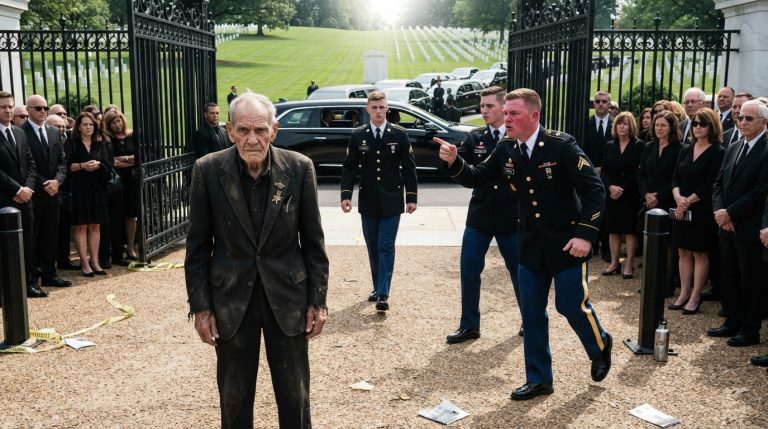
He turned and walked toward the gate. He didn’t rush. He didn’t sneak. He walked with the slow, measured pace of a man who owned every step he took. As he passed under the archway, the heavy steel of the base gates framing his exit, he felt the cool, crisp air of the Oklahoma night—the smell of dry grass, distant rain, and the vast, unwritten horizon.
He wasn’t Phantom Six. He wasn’t a legend. He wasn’t a veteran, or a hero, or a ghost. He was Marcus Reeves, a man who had finally, at the end of it all, found the courage to stop lying. He stepped out onto the highway, the dark, empty road stretching out before him like a promise, and he started to walk, leaving the base, the board, and the weight of the past far behind in the dust.
CHAPTER 12: THE UNWRITTEN HORIZON
The highway was a ribbon of black glass reflecting the scattered, uncaring stars. Marcus walked along the shoulder, the gravel crunching beneath his boots with a rhythmic, grounding consistency. Behind him, the perimeter lights of Fort Sill glowed like a festering wound against the horizon, but he didn’t turn around. He didn’t check for pursuit. He knew that even if they came for him, they would be chasing a man who had already surrendered his past to the wind.
He reached a bridge spanning a dry creek bed and stopped. The air here was colder, carrying the scent of parched earth and distant sagebrush. He reached into his pocket and pulled out the drive—the small, plastic rectangle that had cost him his reputation, his safety, and the only identity he had known for twenty-three years.
He looked at it for a long moment, the moonlight catching its dull surface. It contained the truth of Kandahar, the cold, digitized record of his own moral compromise. For four years, he had lived in the shadow of this data. Now, it was just plastic and silicon.
He let it fall.
It clattered against the concrete of the bridge, skittered to the edge, and plummeted into the darkness of the creek bed below. He didn’t watch it hit. He didn’t care if it was found. The information was already out—the broadcast had seen to that. The truth was no longer a secret he kept; it was a reality the world now had to process.
He kept walking.
As the hours passed, the physical exhaustion of the day began to recede, replaced by a strange, hollow clarity. He felt lighter, as if the physical weight of his uniform—the invisible, crushing load of expectation—had been stripped away, leaving only his own skin. He thought of his wife and daughter, the faces he had kept tucked away in the deepest recesses of his memory to avoid the pain of loss. For the first time in four years, the images didn’t trigger the sharp, jagged spike of trauma. They were just memories now—sad, precious, and finally, part of a life that he was allowed to mourn properly.
He passed a small, roadside rest stop—a concrete slab with a single, flickering lamp. A truck was parked near the edge, its engine ticking as it cooled. The driver was sitting on the tailgate, drinking coffee from a thermos, his face illuminated by the amber glow of a cigarette.
The driver looked up as Marcus approached. He saw the torn jacket, the grease-stained hands, the weary, haunted eyes of a man who looked like he had walked out of a war zone.
“Rough night?” the driver asked, his voice rough but devoid of judgment.
Marcus paused. He looked at the driver, then at the vast, dark road stretching out before them both. He felt the cold air on his face, the steady beat of his own heart, and the quiet, immovable reality of his own existence.
“It was a long one,” Marcus said.
The driver nodded, shifted over on the tailgate, and poured a second cup of coffee. “There’s a town about thirty miles up. Diner’s open twenty-four hours. Good place to sit if you need a minute.”
Marcus stepped up and took the cup. The heat was shocking, a pleasant, stinging reminder of his own physical presence. He sat down on the edge of the tailgate, the metal cool against his legs. He didn’t say anything else. He just drank the coffee, the bitterness a sharp, honest contrast to the sanitized, corporate air of the base.
He looked at his hands. The tremor was gone.
He realized then that he wasn’t running anymore. He was simply moving. The legend of Phantom Six was a story now—a myth, a scandal, a debate for the pundits and the courts. It had nothing to do with the man sitting on the back of a truck in the middle of nowhere.
The driver stubbed out his cigarette and stood up, hopping down to the pavement. “You want a lift? I’m heading north. Ain’t much up that way, but it’s quiet.”
Marcus looked out at the road. It was unwritten, a dark expanse of potential that didn’t demand his service or judge his past. He stood up, his joints fluid, his posture no longer the rigid, defensive stance of a soldier, but the relaxed, easy movement of a man who had nowhere to be.
“Yeah,” Marcus said, the word feeling clean and final. “North sounds good.”
He climbed into the cab. As the truck pulled onto the highway, the headlights cutting a path through the encroaching dark, Marcus leaned his head against the cool glass of the window. He watched the base lights fade into the distance until they were just another set of stars, indistinguishable from the rest. He closed his eyes, his breathing slow and steady, and for the first time in four years, he fell into a sleep that wasn’t haunted by the past, but expectant of the dawn.