The Standing Line: When a Corporate Threat Meets a Small-Town Everyman’s Refusal
CHAPTER 1: THE COLD LINE
The steam off the dark roast carried the faint, sharp smell of chicory. I set the heavy ceramic mug onto the laminate counter, line up the handle exactly three inches from the edge, and picked up the stainless-steel tamper. It had a solid two-pound weight, cold against my palm.
“Two sugars for Ralph, Grace,” Ben said from the corner table. His knuckles were swollen from forty years in the dirt, tapping a rhythm against his saucer. “And don’t let him tell you he’s off the sugar.”
“I hear him, Ben,” I said, wiping the steel tamper with a dry linen cloth. “He gets one spoon.”
The brass bell above the front door didn’t just jingle; it struck the wooden frame with a hard, metallic click. The cold air rushed in first, carrying the smell of exhaust and wet maple leaves from Main Street. Then came the navy blazer.
He didn’t wipe his loafers on the coir mat. He walked straight past the chalkboard display, a heavy black clipboard tucked under his arm like a sidearm.
“State Health Inspection,” the man said. He didn’t look at me. His eyes swept the floorboards, passed the counter, and landed directly on the far corner where Ray sat. “Unannounced.”
Ray’s hand froze mid-air, holding his coffee halfway to his mouth. Next to his work boots, Shadow lay flat on the floor, his red vest clean and tight across his ribs. The dog didn’t bark. He just shifted his chin onto Ray’s boot.
“Can I see your credential card first, sir?” I asked, setting the tamper down on the rubber mat with a dull thud.
“Logan Prescott,” he said, unclipping a laminated badge from his lapel and thrusting it forward without slowing his stride. He pointed the sharp corner of his clipboard toward Shadow. “That animal is an immediate code violation. Section 4-102. No domestic beasts in active food prep or dining zones.”
“He’s a working service animal,” I said. My voice stayed low, flat, where it usually sits when the espresso machine pressure spikes. “Mr. McMillan is a veteran. The dog stays.”
“The code doesn’t make exceptions for vests,” Prescott said. He took two fast steps toward Ray’s table. “Remove the dog from the premises right now, or I’m tagging this front door with a Class A shut-down order before ten a.m.”
Ray’s shoulders pulled tight toward his ears. He didn’t argue. He never argues. He just reached down to unclip Shadow’s leash from the table leg, his thumb trembling against the metal clasp.
“Put the leash back down, Ray,” I said.
I stepped out from behind the counter. My canvas apron caught on the corner of the register, pulling me back an inch before I smoothed it down.
“You’re making a mistake, broad-spectrum,” Prescott spat, raising his pen like he was about to mark a ledger. “You don’t override state enforcement.”
“I’m not overriding state law, Mr. Prescott,” I said, stopping three feet from his shoulder. “I’m telling you that dog doesn’t leave this room.”
The front door slammed open again before Prescott could answer. Deborah Lyall stood in the threshold, her designer trench coat pulled tight around her waist, her phone already pressed against her ear. She dropped the phone into her purse with a sharp snap.
“Grace,” Deborah said, her heels clicking like small hammers against the tile. “What on earth is going on here? I could hear the commotion from the parking lot.”
“Inspector Prescott wants Ray’s service dog outside,” I said.
Deborah didn’t look at Ray. She looked at Prescott’s clipboard, then at me. Her mouth pulled into a thin, pale line. “We follow state compliance to the letter, Grace. You know corporate policy on liability. If the inspector says the dog goes, the dog goes.”
“Not while I run this floor,” I said.
“Then you don’t run this floor,” Deborah said instantly. Her voice didn’t rise; it just went dead and hollow. “You’re refusing a direct corporate compliance order in front of an officer. Un-tie your apron. You’re fired.”
The cafe went dead silent. The only sound left was the low hum of the refrigeration unit behind the counter.
I didn’t argue. I didn’t reach for my phone. I reached down, untied the heavy cloth knot at my spine, and laid the folded apron flat on the nearest table.
CHAPTER 2: THE PAPER TRAP
“Step away from the drawer, Grace,” Deborah said, her voice sharp as broken tile. She snatched the brass key ring off the wooden peg near the coffee grinder. “Corporate policy is very clear about immediate offboarding. You drop access to the till, the safe, and the floor the second termination is pronounced.”
I didn’t move my feet. My shoes felt glued to the pine floorboards. “The register balance isn’t verified yet, Deborah. And the daily inventory log has to be signed off, or the regional warehouse won’t take the return crates.”
“I don’t care about the return crates,” she snapped, stepping around the end of the counter. Her expensive leather heels made a tight, dry crunch against the salt grit tracked in from the sidewalk. “I care about clearing this room before the state inspector writes a three-figure fine.”
Logan Prescott was already moving his pen across his yellow pad, the clip clicking with every line. “Failure to comply with an authorized closure order incurs a secondary municipal penalty. Five hundred dollars per hour, assessed to the leaseholder.”
Ray stood up slow from his corner booth, his boots making no sound at all. Shadow rose with him, keeping his chest pressed right against Ray’s left leg. “Grace,” Ray muttered, his voice gravel-rough. “Don’t get yourself locked up over my cup of coffee.”
“It’s not about the coffee, Ray,” I said, keeping my eyes fixed on Deborah’s right hand. She was reaching for the brass terminal lock at the base of the touchscreen register. “And Deborah doesn’t hold the lease keys. The parent company sub-leases through the local development authority.”
Deborah froze, her fingers hovering an inch above the keyhole. Her mascara shifted slightly as her left eye twitched—a tiny, involuntary micro-action that shattered her clean, polished mask. “What are you talking about?”
“Section Twelve of the manager agreement,” I said, taking one deliberate step back toward the main counter where the stainless-steel tamper still sat on the rubber mat. I didn’t pick it up. I just laid my palm over the cold metal top, feeling the heavy, solid density of the steel. “If a store manager is terminated without sixty minutes of notice during operational hours, the physical site must be locked down in ‘Safe-Hold Status’ by the outgoing manager until an audit team arrives.”
Prescott paused his pen mid-stroke. “Is that a corporate rule or a state code?”
“It’s in the contract I signed six years ago,” I said, looking straight at Deborah. “You can fire me right now. But until the district auditor signs the physical manifest, I’m required to lock the register drawers, lock the safe, and hold the primary door keys. You don’t get the keys until the paper is stamped.”
Deborah’s face went white, the flush disappearing straight out of her cheeks. “You’re playing games, Grace. Hand over the store keys or I’m calling the Mason city police to have you removed for trespassing.”
“Call them,” I said, pressing the steel tamper down onto the rubber pad until the mat flexed under the weight. “Chief Miller sits at table four every Thursday. He knows who holds the operational permit for this floor.”
Deborah reached into her trench coat pocket and pulled out her phone, her thumb stabbing at the glass screen with furious, clumsy strikes. “We’ll see how long your local friends support a terminated employee blocking a state official.”
I turned my back on her and looked at Lena, who was still standing by the espresso machine, holding a steam pitcher like a shield. “Lena, flip the front door sign to ‘Closed for Inventory.’ Then hand me the brass ring off the safe.”
CHAPTER 3: THE WEIGHT OF STEEL
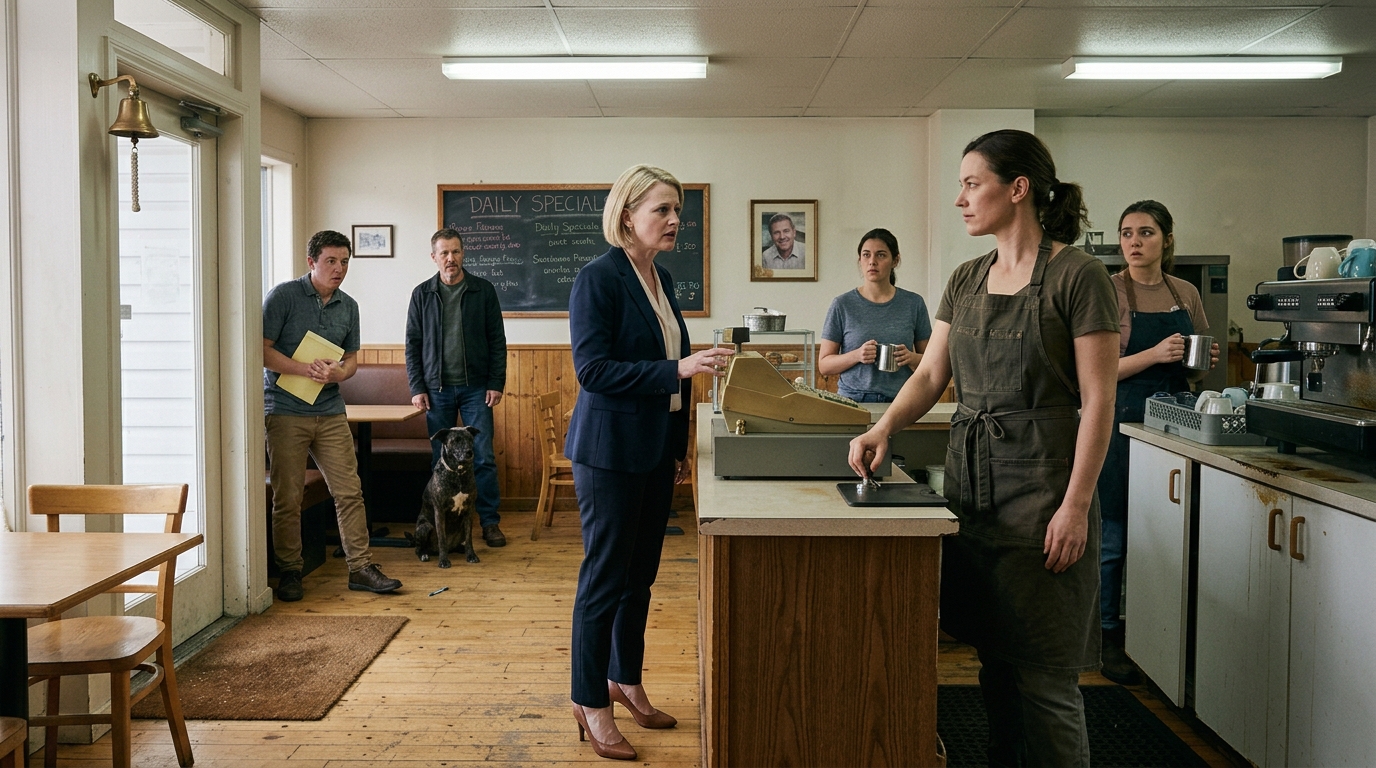
“Don’t touch those tags, Lena,” Deborah said, her voice dropping an octave into a low, harsh rasp. Her smartphone was pressed so hard against her ear that her gold earring cut into her jawline. “You pull those operational keys and you’re an accessory to obstruction. I’ll make sure your retail file follows you to every employer in this county.”
Lena looked at me, her eyes wide, her bottom lip caught between her teeth. She didn’t drop her hand, but she didn’t grab the brass ring either.
“She doesn’t report to you, Deborah,” I said, setting the two-pound steel tamper down on the wood counter with a slow, heavy clack. “She reports to the franchise manager on record. That’s still my name on the state business license pinned behind the door.”
Before Deborah could bark back, the floorboards didn’t just rattle—they vibrated.
A deep, rolling diesel thrum shook the front glass pane, rattling the loose ceramic mugs on the drying rack. Ray didn’t flinch, but Shadow sat straight up, his ears pinned back, his wet black nose working the air near the threshold.
Prescott lowered his clip-board to his side. “What is that? Construction work?”
Four green olive-drab hulls pulled up straight against the sidewalk curb outside, blocking out the morning glare. The tires were tall as my waist, caked in Georgia clay that dropped in dry chunks onto the asphalt. The lead vehicle’s air brakes hissed—a sharp, deafening release of pressure that cut through the glass.
The driver’s door swung open. A pair of spit-shined leather boots hit the sidewalk, followed by the crisp crease of dark blue trousers with a thick gold stripe down the seam.
Colonel Richard Gaines walked through the front door alone. He didn’t slam it. He let the brass bell strike the frame once, soft and clean. His dress blues were immaculate, every brass ribbon and medal sitting heavy across his chest, catching the pale fluorescent light of the dining room.
Behind him through the clear glass, two dozen Marines stood shoulder-to-shoulder on the pavement in total silence, arms folded, faces set like granite.
Deborah stepped backward, her heel catching the edge of a chair leg. “What is this? Is there a base exercise on Main Street?”
Colonel Gaines ignored her completely. He didn’t look at Prescott either. He walked straight to the far corner table where Ray was standing. Gaines stopped two feet away, brought his right hand up to the brim of his cover, and held a sharp, motionless salute.
Ray brought his own hand up, his knuckles stiff, returning it clean. “Colonel.”
“Sergeant McMillan,” Gaines said, his voice flat, dry, and resonant, like stones grinding together in a bucket. “You’re late for the logistics briefing at Fort Granger.”
“Got held up,” Ray said, glancing once at Prescott. “State compliance.”
Gaines turned his head slow, his cold gray eyes locking onto Prescott’s navy blazer. He didn’t raise his voice, but the space in the cafe seemed to shrink instantly. “You have an issue with Sergeant McMillan’s official presence, sir?”
Prescott swallowed hard, his throat clicking twice. He clutched his yellow notepad against his stomach like a small shield. “The… the health code, Colonel. Animals in dining spaces.”
“That animal is a certified military service asset assigned under federal mandate,” Gaines said, stepping closer until his brass buttons were six inches from Prescott’s face. “Federal mandate overrides municipal health codes on commercial leases operating within a ten-mile defense perimeter. Do you require the legal statute cited, or do you wish to call the state attorney general right now?”
Prescott’s pen slipped through his sweaty fingers, bouncing off his shoe before hitting the floor. He didn’t bend down to pick it up.
“And you,” Gaines turned his head toward Deborah, who was trying to slide her phone back into her purse without making a sound. “Ms. Lyall, I believe?”
“We… we are simply enforcing standard company policy, Colonel,” Deborah stammered, her hands shaking as she pulled her trench coat tighter around her waist. “This is a private corporate matter between the parent firm and an employee.”
“This building doesn’t belong to your parent firm,” Gaines said softly.
I paused, my palm flat against the counter, my thumb touching the cold edge of the steel tamper. “What did you say, Colonel?”
Gaines reached inside his inner breast pocket, pulled out a folded piece of heavy yellow parchment, and laid it flat on the laminate counter right next to my tamper. “The land parcel was deeded to the Donnelly Family Trust in 1952 with a permanent public covenant. The corporate lease your firm signed six years ago is legally void if the designated trustee is terminated without trust consent.”
Deborah’s mouth opened, but no sound came out. Her eyes darted from the yellow parchment to the framed photograph of Michael hanging on the wall right above the register.
I looked up at Michael’s picture. Framed in cheap oak, his flannel shirt faded, smiling at the camera. And right behind the bottom right corner of the glass frame, a tiny piece of clear tape held a small, tarnished brass key I had never noticed before.
CHAPTER 4: THE TITLE DISCREPANCY
I pulled the tape free with a soft snap, the tiny brass key dropping straight into the palm of my hand. It was cold, discolored around the shaft, and stamped with a three-digit serial number on the bow.
Deborah took two sharp steps toward the register, her hand outstretched. “Hand that over, Grace. That is company property if it was stored inside this building.”
“It’s not company property,” I said, setting the key down on top of the yellow parchment document Colonel Gaines had laid on the counter. The key landed right beside the cold steel tamper with a dull metal ring. “This key fits the lockbox under the floorboards in the office. Michael’s grandfather built it into the foundation in 1952.”
Inspector Prescott shifted his weight, his leather loafers squeaking against the wet tile. “Colonel, if there’s a property dispute, my office simply puts a seal on the door until civil court resolves it. That’s standard protocol.”
“Your office doesn’t seal federal trust land, Inspector,” Gaines said without turning his head. He pulled a thin leather folder from under his arm and laid it next to the parchment. “Ms. Lyall’s regional office filed a commercial lease transfer three weeks ago. They listed this parcel as corporate-owned assets under an expedited buyout clause.”
I looked straight at Deborah. Her upper lip was damp with a thin film of sweat, her costly foundation caking around the corners of her nose.
“You weren’t trying to enforce a health code, Deborah,” I said, my voice dropping flat and even. “You brought Inspector Prescott here today because you needed an official state citation to declare this location unfit for operation. An operational breach lets you break the sub-lease without triggering the sixty-day trustee review.”
Deborah’s jaw locked. She reached out and pulled her leather purse tight against her ribs. “That’s an absurd allegation. The parent firm has every right to audit underperforming units.”
“Underperforming?” Lena spoke up from behind the espresso machine, her voice surprisingly steady now. “We hit three hundred percent of our quarterly target last month. We’re the highest-volume morning stop in the district.”
“Volume doesn’t matter when the commercial lot behind us was re-zoned last Tuesday,” Gaines said, tapping the edge of his leather folder. “The regional development authority offered four million dollars for the entire corner block. Provided the land was sold free and clear of all encumbrances by the end of the month.”
Prescott looked from Gaines to Deborah, his eyes widening slightly. “Wait. You told my supervisor this was a routine sanitation enforcement request, Ms. Lyall.”
“Shut up, Logan,” Deborah snapped, dropping her polished corporate posture entirely. Her voice turned thin, sharp, and mean. “You signed off on the inspection order. You’re already on the paper trail.”
“I signed off on a food safety check!” Prescott backed away a step, his clipboard dropping an inch lower. “I’m not standing in front of a municipal auditor for a commercial real estate flip.”
“Neither am I,” I said. I picked up the small brass key, turned around, and walked straight to the office door behind the espresso bar.
Deborah took a lunging step forward to block the doorway—”You can’t enter that office, Grace! You’re terminated!”
Ray’s heavy boot came down hard on the floorboards with a loud thud. He didn’t touch her, but his broad, flannel-clad shoulder moved directly into her path, stopping her cold. Shadow stood at his side, low and quiet.
“Let her walk, ma’am,” Ray said softly. “It’s her floor.”
CHAPTER 5: THE CORNERED REGIONAL
I reached into the dark square under the floorboards and lifted the yellowed leather binder. It felt heavy, its edges stiff with age. On the front cover, stamped in faded gold leaf, were the words: Donnelly Family Trust & Land Deed — Parcel 402.
Deborah stood two feet inside the office doorway, her heels planted wide on the linoleum, her jaw clenched so tight the muscles in her neck stood out like wires. “That paper is sixty years out of date, Grace. Commercial zoning laws override personal trusts the second a corporate lease is executed.”
“Not when the lease was signed by an unauthorized signatory,” I said, carrying the heavy binder out to the main counter. I laid it flat right next to the two-pound steel tamper.
Colonel Gaines stepped closer, resting one gloved hand on the counter edge. He flipped the leather cover open with his thumb. Inside, pinned to the first page, was a blue county clerk seal stamped in 1952, along with a handwritten clause signed by Michael’s grandfather.
“The trustee signature required for any commercial assignment belongs strictly to the surviving spouse of the primary lineage,” Gaines read out loud, his deep voice carrying straight across the silent room. “In the event of military casualty, full sole-trustee authority vests immediately in Grace Donnelly.”
Deborah’s phone buzzed hard in her hand. She didn’t look down at the screen, but her thumb twitched violently against the glass case. “This is a civil matter. My legal team will file an emergency injunction in county court before five p.m. You can’t operate a public dining facility without corporate insurance coverage.”
“She doesn’t need corporate insurance coverage,” Ray said from the corner, his voice low and steady. “The local veterans post carries a umbrella policy for community gathering spaces. We signed the cross-indemnity paperwork three years ago.”
Deborah turned on Ray, her eyes blazing with cold, desperate fury. “You think a small-town veterans group can stand up against a multi-state restaurant conglomerate? We will tie this property up in appellate litigation until you can’t pay the electricity bill!”
“Try it,” I said, setting my palm flat on top of the original land deed. “The city council holds its emergency zoning review in the municipal hall across the street at eleven o’clock. Mayor Vance is chairing the board. I think he’ll be very interested to see that your development package relies on a fraudulent lease transfer.”
Logan Prescott took three quick steps backward toward the front door, tucking his yellow clipboard deep inside his blazer. “I am officially withdrawing the health violation order. My report will state that the facility was operating within federal compliance parameters.”
“Logan, you stay right here!” Deborah screamed, her voice cracking sharp across the quiet cafe.
“I don’t work for your parent firm, Deborah,” Prescott said, his hand already on the brass door handle. “And I’m not taking a perjury charge for your land deal.” He pulled the door open and slipped out into the morning chill without looking back.
Deborah stood alone in the center of the floorboards, surrounded by two dozen Marines outside the window and every regular customer inside holding their cold coffee mugs in silence. Her face was flushed dark red, her hands trembling as she clutched her leather purse like a weapon.
“This isn’t over, Grace,” she spat, her voice shaking with rage. “You don’t own the equipment behind that bar. You don’t own the espresso machine, the refrigeration, or the inventory.”
“Take the equipment, Deborah,” I said softly, looking her dead in the eye. “We’ll serve drip coffee out of camp kettles tomorrow morning at six a.m.”
CHAPTER 6: THE UNBROKEN QUIET
“You think you’ve won something here, Grace?” Deborah paused, her hand locked around the brass push-bar of the door frame. Her knuckles were white, her sharp posture hunched under the weight of her coat. “You’re holding onto a collapsing building in a dusty county. The corporate office will pull every vendor contract by midnight. You won’t have coffee beans, paper cups, or milk delivery by sunrise.”
“I buy my milk from the Miller family farm three miles down Route 9, Deborah,” I said, my hand resting steady on top of the old leather binder. “And the coffee roast comes straight from the post supplier in Savannah.”
Deborah pulled the door open, the heavy glass swinging out into the morning air. “Enjoy your ruin,” she spat, her heels striking the sidewalk in fast, erratic beats as she marched toward her sedan without looking back.
The door swung shut behind her, the pneumatic arm catching with a soft, steady hiss.
In the sudden stillness, the cafe felt larger. The low hum of the milk cooler in the corner sounded clean, rhythmic, and grounded. Outside, Colonel Gaines raised his gloved hand toward the sidewalk. The Marines moved in an orderly line back toward the Humvees, their boots striking the pavement together before the engines grumbled to life and rolled away down Main Street.
Ray looked down at Shadow, who was already sitting back on his hind legs, resting his snout against Ray’s knee. Ray let out a long, slow breath through his nose, his shoulders finally dropping two inches.
“Grace,” Ray said, reaching into his flannel pocket and pulling out a wrinkled five-dollar bill. He laid it flat on the laminate counter right next to the brass key. “Is my refill still good?”
“Your refill is always good, Ray,” I said.
I picked up the two-pound stainless-steel tamper, wiped the bottom flat against a dry linen towel, and set it squarely in its rubber ring beside the grinder. I didn’t reach for a corporate form or check a terminal screen. I just picked up a clean ceramic mug from the rack—the thick white one with the small blue rim—and filled it straight to the top with fresh dark roast.
Lena stepped back behind the espresso bar, picking up the damp rag to wipe down the stainless-steel steam wand. “What do we do about the front sign, Grace?”
“Leave the chalkboard as it is,” I said, setting Ray’s cup down in front of him. “We open tomorrow at six.”
Ray took the handle in his thick, scarred fingers, raised the cup, and took a slow sip. Outside the front window, the morning sun broke through the oak leaves on Main Street, casting a quiet, golden light across the pine floorboards.