The Weight of Salt and Iron: A Chronicle of Tactical Adaptation and the Price of Survival
CHAPTER 1: FUNNEL AND FRICTION
The air inside the Coronado training hall smelled of boiled coffee, dried salt crust, and the sour grease of unwashed tactical nylon. Outside, the midday sun beat down on the asphalt until the horizon vibrated, but inside, the temperature was kept at a flat, dead chill.
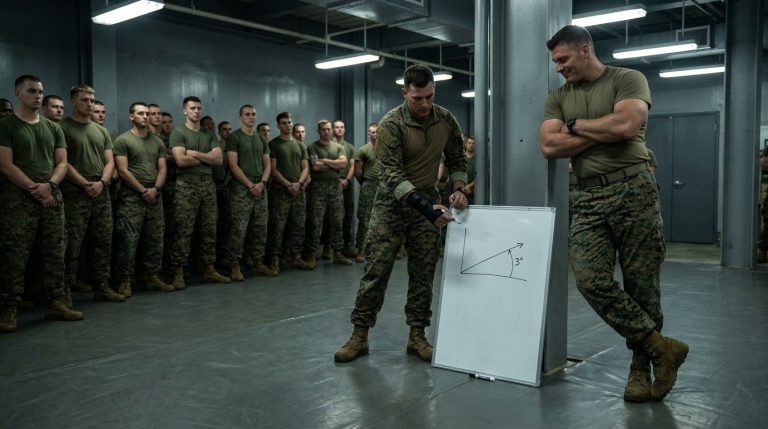
Dr. Elaine Thorne did not look like the shadow she was. She stood behind the metal podium, her pressed khakis showing a sharp, geometric crease, her wire-rimmed glasses catching the harsh fluorescent glare. To the twenty men sitting in the tiered amphitheater—men whose skin was raw from the grinder of the morning’s ocean swims—she was an administrative error. A bureaucratic insult dropped into the middle of their hell week.
“Textbook,” she murmured, her voice carrying no mass, yet cutting through the low rustle of heavy boots. She looked down at Trainee Merrick Davenport. He sat in the front row, his six-foot-four frame filling the plastic chair, his forearms crossed like rusted iron bars over his chest. His skin was caked with gray mud from the obstacle course, a thin line of red dried blood tracing the edge of his left ear.
“With respect, ma’am,” Davenport said, his voice a low, gravelly vibration that drew subtle nods from the men behind him. “The enemy doesn’t check our bibliography when the floor goes loud. We don’t win contracts with essays. We win them by moving faster and hitting harder than the guy behind the door.”
Thorne didn’t blink. She reached out and adjusted the cracked, silver digital stopwatch sitting on the edge of the podium. Its screen was dead, frozen on a sequence of unreadable black dashes. “Speed is the first refuge of the unthinking, Trainee. Show me your three-man room clearing procedure. Use the chalk lines on the south deck.”
Davenport rose, his movements deliberate, heavy with the confidence of a man who had broken every physical metric the command possessed. Two other recruits fell in behind him automatically. They moved with textbook precision—snapping corners, muzzles level, checking the fatal funnel with the synchronized snap of three well-oiled pistons. It was flawless. It was exactly what the manuals prescribed.
Thorne watched from the shadows of the whiteboard, her hands tucked loosely into her pockets. As Davenport took the final corner, his sleeve caught the edge of a steel desk, a brief, metallic clink breaking the rhythm.
“Dead,” Thorne said flatly.
Davenport froze, his training weapon still raised. His jaw tightened, a hard knot of muscle forming along his cheekbone. “The angle was covered, doc.”
“Your third man anchored his weight on his heels during the pivot, leaving a three-inch gap between his plate carrier and the frame,” she said, stepping forward. Her boots made no sound against the concrete. She picked up a piece of white chalk, her fingers pale against the dark board. “In Fallujah, that three-inch lag cost a four-man element their lives in an identical stack. You rely on the friction of your boots to compensate for a failure of structural perception. You are trading blood for velocity.”
She turned to face him, the movement pulling her right sleeve back just far enough to expose a jagged, silver-white scar that coiled around her wrist like old wire. It wasn’t surgical; the edges were puckered and rough, the mark of metal forced into skin under immense pressure.
Davenport’s eyes dropped to the scar, his chest rising and falling in heavy, calculated breaths. The room grew thick with a cold, competitive silence. He didn’t step back. He lowered the weapon slightly, his towering frame casting a long shadow that completely obscured her small form against the white board.
“We survive because we’re stronger than the problem, ma’am,” Davenport said, his voice dropping an octave, testing the boundary of the chain of command. “We’re trained to push through the failure point.”
“The strongest operator I ever knew thought exactly like you,” Thorne said, her voice remaining perfectly level, devoid of anger or warmth. She capped the marker with a sharp, definitive click. “He relied on muscle until the steel took his leverage away. He died in the dirt because his mind couldn’t find a second option when the first one broke.”
She looked directly into Davenport’s hardened eyes, her gaze as unyielding as the iron plates in his vest. “Your three minutes are up. Sit down.”
Davenport didn’t move immediately. For one heartbeat, the silence in the room became tactical, a calculation of risks between two forces that had not yet measured each other’s true mass. Then, with a slow, deliberate tilt of his chin, he stepped back into the aisle.
On the desk behind the podium, the cracked digital face of the frozen stopwatch glinted in the gray light, its silence heavier than the words she had left hanging in the air.
CHAPTER 2: THE SAND AND THE SULPHUR
“Your eyes are lying to you, Callaway. Shut them.”
The sensory manipulation vault smelled of damp concrete, old copper wire, and the distinct, sulfurous sting of discharged training blanks. It was a narrow chamber buried under the foundation of the training command, designed to trap sound and amplify disorientation. Above, the cooling pipes rattled with a steady, grinding friction that vibrated through the soles of Davenport’s boots.
Davenport leaned against the rusted iron frame of the observation window, his uninjured arm tucked tightly into the belt of his utility trousers, his left shoulder throbbing beneath its tight canvas sling. The heat in the small room was thick, smelling of dry dust and sweat. Through the thick glass, he watched Callaway stumble. The strobe lights inside the vault were rhythmic, cutting the darkness into jagged, desaturated slices of gray and silver.
“I have the threshold,” Callaway muttered, his voice strained over the intercom. “Three meters out from the doorframe. Visual indicates—”
“Visual indicates what the light wants you to see,” Thorne’s voice cut through the static, low and flat. She sat at the control console to Davenport’s left, her fingers resting lightly on the iron toggles of the frequency generator. She wasn’t looking at the screens; her eyes were fixed on a small, notched brass casing that sat next to her cracked stopwatch. The casing was corroded at the rim, its primer struck deep and surrounded by a faint ring of green oxidation. “The frequency is pulling your inner ear forty degrees off-axis. If you step left, you drop into the drainage trench.”
Davenport watched the screen. Callaway took a step, his boot heel grinding against the grit on the floor. He swung his training weapon toward a shadow that wasn’t there, his balance slipping as his center of mass shifted. A sharp, mechanical hum vibrated through the floorboards, and Callaway went down, his shoulder hitting the reinforced wall with a heavy, hollow thud.
“This isn’t warfare,” Davenport growled, his voice rasping in the cramped space. He didn’t look at Thorne, but his jaw set hard as he watched another man from his squad falter. “It’s a carnival trick. You’re breaking their rhythm before they even hit the sand. Out there, the sun is hot, the terrain is stone, and the threat has a face. You fight what you can see.”
“In the Alisgari, the insurgents didn’t give us faces, Trainee Davenport,” Thorne said without turning her head. Her fingers adjusted a dial, and the high-pitched whine inside the vault shifted, settling into a low, bone-deep rumble that made the loose plaster dust flake off the walls. “They gave us low-frequency acoustic loops that made our optics vibrate until the reticles split in two. They coated the floors in graphite oil and used sodium flares to bleach our night vision into white static. Your father spent three hours in a basement in Ramadi trying to shoot a speaker because he thought it was a sniper’s nest.”
The mention of his father hit the room like a wet sandbag. Davenport’s good hand clenched into a fist against his thigh. The metal buckle of his belt dug into his palm, a sharp spike of physical friction that grounded him against the sudden surge of heat in his chest.
“My father didn’t die in a basement,” Davenport said, his voice dropping into a dangerous, raspy quiet. “He died with his rifle hot. He died clearing the path.”
“He died because he didn’t know how to navigate an altered environment without his eyes,” Thorne said. She finally turned her head, the gray light from the monitor catching the edge of her glasses, turning them into solid silver discs. “He relied on the iron in his hands and the muscle in his back. When the air turned to sulphur and his inner ear collapsed from the concussion of a thermobaric strike, his strength just made him a larger target. Look at the data log on the secondary monitor.”
Davenport hesitated, then dragged his gaze to the smaller screen. It wasn’t standard Navy training software. The interface was archaic, a desaturated grid of green phosphor lines tracking biometric data from a mission dated fourteen years ago. The system label at the top read Obsidian Shield – Tactical Diagnostic Baseline.
His eyes scanned the columns of numbers—heart rates, core temperatures, neurological latency metrics. One line stood out, highlighted in a flickering amber tone: Subject 04 – Sensorimotor Collapse / Mechanical Override.
“What is this?” Davenport asked, his eyes narrowing as he noticed the serial number on the diagnostic report matched the stamp on the lockbox beneath the console. “This isn’t a combat log. This is an equipment test.”
“It’s a record of failure,” Thorne said, her voice dropping into a register that was almost mechanical in its lack of emotion. She reached out and slid the notched brass casing across the metal desk until it clicked against the base of her dead stopwatch. “We thought the gear would give us total visibility in the dark. We thought the technology would bridge the gap where human perception failed. But the seals on the pressure valves were compromised by the salt air. The oil leaked into the circuits. The machine didn’t save us; it blinded us from the inside out.”
Before Davenport could process the data on the screen, a loud, metallic screech echoed from the intercom. Inside the vault, the strobe lights stopped their rhythm and locked into a blinding, continuous glare. Callaway was on his knees, his hands clamped over his ears as the audio loop dissolved into a jagged, uncontrolled feedback spike.
Thorne reached for the master kill-switch, but the iron lever resisted, rusted stiff within its housing. A small wisp of gray, acrid smoke began to curl from the ventilation seam beneath the console, smelling sharply of scorched copper and old grease.
Davenport didn’t wait for an order. He stepped into the console’s space, using his good hand to slam his weight against the manual breaker on the wall. The metal handle ground against its tracks, sparks biting at his knuckles before the circuit finally snapped shut, plunging the vault and the observation room into a sudden, heavy darkness.
In the dead quiet that followed, the only sound was the rhythmic ticking of a cooling pipe and the ragged breathing of two people standing inches apart in the dark.
“The safety overrides didn’t fail because of the age of the base, Major,” Davenport whispered into the gloom, his calculation shifting as the smell of the burned insulation settled in his throat. He looked toward her shadow. “That breaker was welded shut from the inside. Someone didn’t want this room turned off.”
Thorne didn’t answer immediately. In the dim light of the hallway outside the door, Davenport saw her reach down and slowly pocket the notched brass casing, her movements deliberate, her face remaining entirely in the dark.
CHAPTER 3: THE PHYSICAL CRUCIBLE
“Step back from the console, Trainee.”
The darkness was thick, smelling of scorched copper wire and the dry, dead heat of the concrete basement. Davenport didn’t move. His boots remained planted on the grit-covered floorboards, his chest rising and falling against the tight canvas sling supporting his left shoulder. His good hand still gripped the manual breaker handle, the cold, rusted iron biting into his palm.
“The manual bypass is jammed open, Major,” Davenport said, his voice low and tight in the blackness. He could hear the metallic tick of the cooling pipes behind the wall, a steady, rhythmic expansion of iron under pressure. “It didn’t melt from the load. Someone drove a steel pin through the actuator arm. This room was set to stay active until the circuits burned out.”
A match struck. The sudden, small flame cast a desaturated orange glow across the room, illuminating the sharp lines of Thorne’s face and the glint of her wire-rimmed glasses. She didn’t look at the console; she looked directly at him, her fingers holding the small sliver of wood steady as the sulfur smoke curled up toward the low ceiling.
“Your observations are noted,” Thorne said calmly. She touched the flame to the wick of a small, oil-stained utility lantern sitting on the edge of the desk. The pale yellow light pushed the shadows back into the corners, catching the rusted edges of the equipment racks and the scratched plastic casing of the intercom console. “But your primary objective is the extraction of Callaway from the enclosure. The secondary relay is venting carbon monoxide from the burned insulation. Move.”
Davenport let go of the iron handle, his boots scraping against the concrete as he turned toward the heavy, reinforced door of the vault. The latch was a solid bar of cold-rolled steel, oxidized and rough to the touch. He jammed his right elbow over the lever, using his entire body weight to force it downward until the internal pins ground against each other with a dry, screeching complaint.
The door swung inward. A cloud of gray, acrid haze spilled over the threshold, tasting of stale chemical retardant and fine sand dust.
Inside the vault, the strobe lights were dead, but the high-intensity emergency arrays had kicked into a low, dim red glow. Callaway was leaning against the far wall, his face pale, his fingers digging into his knees as he tried to stabilize his breathing. The room was designed to disorient, the walls painted in irregular, desaturated geometric patterns that blurred the boundaries of the floor and ceiling in the low light.
“Get up, Callaway,” Davenport barked, his voice bouncing flatly off the acoustic padding. He reached out with his right arm, grabbing the back of the recruit’s tactical vest and hoisting him upward with a single, sharp pull. “The air is turning sour. Use my shoulder for leverage. Keep your eyes on the deck.”
“The deck is moving, man,” Callaway muttered, his boots slipping on the slick graphite oil that had been sprayed across the concrete to simulate low-traction environments. “Every time I look down, the floor feels like it’s tilting forty-five degrees.”
“It’s an illusion generated by the low-frequency drone,” Thorne’s voice came from the doorway. She stood in the frame, her silhouette dark against the pale light of the observation room. She had a thick canvas respirator pulled over her face, her eyes cold and analytical behind her lenses. “The physical surface is perfectly level. Your brain is translating the vibration of your eardrums into a kinetic error. Ignore the inner ear. Trust the mechanical resistance of your boots.”
Davenport hauled Callaway through the hatch, the weight of the larger recruit straining the muscles of his lower back. His injured left shoulder flared with a deep, pulsing heat, the friction of the bone against the inflamed joint socket a sharp reminder of his physical limits. He ignored it, dragging Callaway into the clean air of the observation platform until the recruit collapsed onto a wooden bench, coughing the sulfurous dust out of his lungs.
Thorne stepped past them, her movements swift and silent. She approached the wall box containing the secondary line switches, her hands sliding over the gray enamel casing. Davenport watched her closely. Her right hand moved with a slight, persistent tremor—the permanent nerve damage she had mentioned—but her fingers were precise as she found the manual fuel cutoff for the backup generator.
Snap.
The low, bone-deep rumble beneath the floorboards finally died, leaving only the sound of Callaway’s ragged breathing and the drip of condensation from the overhead pipes.
“The training log for today is terminated,” Thorne said, removing the respirator and letting it hang around her neck. She looked down at the desk where the old phosphor monitor was slowly cooling, its green lines fading into black. “The system degradation was outside acceptable parameters.”
“The system didn’t degrade,” Davenport said, stepping into her space, his towering frame casting a shadow over the metal console. He reached down and pointed to the small, rusted lockbox hidden beneath the lower shelf—the one marked with the Obsidian Shield designation. The padlock on the front was missing, its brass hasp sheared off recently with a bolt cutter. “Someone was extracting the raw data from the 2012 diagnostic loop while the drill was active. The override was pushed from an external terminal.”
Thorne stacked her notes with methodical precision, her face a mask of stone. She picked up the dead stopwatch, her thumb tracing the deep crack across its glass face.
“You are a trainee, Davenport. Your focus belongs on the obstacle course and the tactical stack,” she said, her voice dropping into a razor-sharp whisper that didn’t reach Callaway’s ears. “The structural maintenance of this facility is the responsibility of the logistics command. If there is an anomaly in the wiring, it will be handled by the proper authorities.”
“My father’s name was on that diagnostic file,” Davenport said, his voice dropping into a harsh, vibrating register that filled the narrow space between them. He stepped closer, his boots pressing against the bottom of the console desk. “Subject 04. I know his signature. I know the way he logged his operational hours. Why is his data being run through a sensory-deprivation test loop two days before our deployment evaluation?”
Thorne met his gaze, her eyes steady behind her glasses, showing no fear, no hesitation, and no intention of answering. She tucked the stopwatch into her pocket and picked up her leather briefcase, her boots clicking against the dry concrete as she headed toward the exit.
“Tomorrow morning, 0800,” she said without looking back. “The obstacle course will be modified for low-visibility operations. Bring your gear. All of it.”
As the heavy iron door of the training bay clicked shut behind her, Davenport looked back down at the cooling monitor. In the lower corner of the glass, a single line of automated diagnostic text remained visible before the residual charge dissipated completely: Data Transfer Complete. Destination: Fleet Logistics Command, Coronado Sector Shadow Network.
CHAPTER 4: THE BREAKING WEIGHT
The administrative block of the training command smelled of scorched dust and ancient linoleum wax. Davenport did not use the main corridor. He forced his way through the rear logistics door, his right hand gripping the edge of Thorne’s reinforced plastic desk before she could slide her files into the drawer. The physical friction of his heavy canvas sling scraped against the rusted iron edge of her desk lamp, sending a thin shower of dried paint flakes over her neat stacks of paperwork.
“You knew the override code,” Davenport said, his voice a low, raspy snarl that barely carried past the doorframe. He leaned his weight forward, his six-foot-four frame blocking the pale yellow light coming from the narrow window. His good hand pressed flat against a folder stamped Obsidian Shield – Post-Incident Assessment. “The file destination wasn’t an automatic backup. It was a manual pull from the base commander’s private routing node. Why are you checking my father’s neurological failure metrics now?”
Thorne did not look up immediately. Her pale fingers remained perfectly still against the leather spine of her briefcase. When she lifted her chin, the glare from her wire-rimmed glasses hid her eyes completely, transforming them into two flat, silver mirrors reflecting his own aggressive stance.
“Your administrative evaluation is scheduled for forty-eight hours from now, Trainee Davenport,” she said, her voice dry and smooth as polished flint. “The data on that screen is a matter of institutional record. It has no bearing on your ability to clear a room or manage a three-man stack under stress.”
“It has everything to do with why we are failing your sensory drills,” Davenport said, his knuckles turning white against the folder. The metallic tang of old grease from the training vault still hung in his teeth, sharp and bitter. “The frequency loop you ran today wasn’t designed to train our perception. It was the exact same baseline that locked my father’s sensorimotor suite in 2012. The data shows his core temperature spiked to one hundred and five degrees before his unit ever crossed the line of departure. The machine blinded him before the insurgents even fired a round.”
Thorne’s hand moved. It was a micro-action, subtle and sharp, but her fingers reached into her pocket and brought out the notched, rusted brass casing she had retrieved from the vault lockbox. She placed it on the desk between them with a hard, deliberate clink. The green oxidation around the struck primer caught the gray light from the courtyard outside.
“You think you understand the architecture of a failure because you can read a diagnostic log,” she said, her tone dipping into a cold, clinical cadence that cut through his anger like an iron wedge. “Your father was the chief of development for that specific sensory array. He wasn’t a victim of the equipment, Davenport. He was the authorization signature.”
Davenport froze. The air in the office felt instantly heavy, choked with the smell of the dry dust vibrating off the windowpanes. His mind raced over the numbers he had seen on the green phosphor screen—the structural metrics, the mechanical overrides, the highlighted amber lines.
“He wouldn’t run an uncertified system with his own men in the stack,” Davenport said, but the words felt hollow, scraping against his throat like dry sand. “He knew the tolerance limits better than anyone in the command.”
“He knew the tolerances were compromised by the salt air in the storage bunkers,” Thorne replied, her voice remaining level, carrying the brutal mass of an undisputed truth. She pushed the folder out from under his hand, her movements efficient and devoid of hesitation. “But the delivery timeline had already been logged with Fleet Logistics. If he delayed the operational test, the entire cognitive training doctrine would have been shelved by the oversight committee. He forced the loop to run because he believed his own physical endurance could compensate for the system’s mechanical decay.”
She stood up, her small stature doing nothing to diminish the absolute certainty of her presence. She leaned over the desk, her face inches from his, the desaturated light exposing the fine lines of exhaustion around her eyes.
“He wanted to prove that a Tier 1 operator could override the sensory distortion through sheer force of will,” she whispered, her words smelling faintly of black coffee and old paper. “And his arrogance cost his team their lives. He didn’t die from an ambush, Trainee. He died because his own mind collapsed under the friction of a machine he refused to turn off.”
Davenport’s hand dropped from the desk. His left shoulder throbbed with a rhythmic, sickening heat, the joint grinding inside its canvas binding as he stepped back. The decoy secret—the belief that his father had been sabotaged by faulty gear or an external terminal hack—shattered under the weight of her clinical delivery. It was a tactical checkmate. She had laid out the moral logic of his father’s choice, and it was a mirror image of Davenport’s own stubborn reliance on muscle and pride.
“You’re lying,” he muttered, though his eyes remained fixed on the rusted brass casing sitting between them—a piece of evidence that suddenly felt much heavier than a simple training blank.
“The logs don’t lie, Davenport. They just collect dust,” Thorne said, turning her back to him as she picked up her briefcase. “The evaluation starts at dawn. If you cannot accept the failure of your lineage, you will not survive the first stack. Class dismissed.”
He didn’t move for three seconds, his boots anchored to the worn floorboards as he stared at her silhouette against the fading light. The room was silent, save for the distant, metallic rattle of the base gates closing for the evening.
CHAPTER 5: THE COLD ARCHITECTURE OF LEGACY
“Say it again,” Davenport whispered. His voice did not echo; it scraped low against the raw cinderblock walls of the main auditorium.
The room was vast, desaturated under the high, hum-deadened fluorescent panels. The twenty other recruits of the unit sat like statues in the rising tiers, their mud-dried boots leaving small piles of gritty gray powder on the floorboards. None of them breathed loud. The smell of the morning’s cold bay swim—salt crust, stale neoprene, and copper-tinged sweat—hung thick in the stagnant air.
Major Thorne didn’t look up from her marker board. The black ink dried instantly against the slick plastic surface, forming a complex grid of a subterranean strongpoint in Kandahar. “Your father’s tactical file is open on your terminal screens, Trainee. I don’t repeat metrics that are already stamped in iron.”
“You called him arrogant,” Davenport said. He stood up from his tier, his boots grinding a handful of the dried silt into the deck. His left arm was still bound tightly within the olive-drab canvas sling, but his right hand hung loose, fingers twitching against the seam of his trousers. “You sat in that office and told me he ran his team into a failure loop to satisfy a logistical timeline. My father didn’t trade lives for a signature.”
Thorne set her marker down on the metal tray. The sharp clack of the plastic against the steel rail was loud, a clean fracture in the silence. She turned around slowly, her wire-rimmed glasses catching the harsh glare of the ceiling bulbs until her expression was completely obscured behind two blank sheets of reflected light.
“Chief Garrett Davenport was an exceptional operator,” she said, her voice dropping into that familiar, flat cadence that carried the density of cold iron. “But his exception was physical. When the sensory network in the Alisgari district went into sensorimotor collapse, he did not treat it as a structural failure. He treated it as a personal challenge. He believed that the thickness of his skin and the weight of his caliber could anchor a stack when the floor beneath them had ceased to exist.”
She walked toward the front row of desks, her hand sliding along the rusted metal modesty panels. When she stopped, she tapped her pale index finger against Callaway’s terminal housing.
“Look at Layer Three of the tactical diagnostic, Callaway. Read the input frequency at hour zero-two.”
Callaway’s fingers shifted over his desaturated keyboard, the mechanical switches clicking rapidly. He cleared his throat, the sound dry and nervous. “The loop was cycling at forty hertz, ma’am. That’s… that’s the threshold for induced vestibular vertigo. The system was actively feeding counter-signals into their helmets.”
“And your Chief did not order a manual disconnect,” Thorne said, her eyes shifting back to Davenport, locking onto his rigid frame with surgical precision. “He ordered his operators to close their visors and rely on the physical tether. He believed that if they moved with enough momentum, they could clear the funnel before the inner-ear distortion turned into physical shock. He was wrong. The friction of their boots wasn’t enough to hold the line against an environment that had been entirely weaponized against their perception.”
Davenport’s chest rose and fell in a heavy, jagged rhythm. The joint inside his injured shoulder burned, a deep, grinding ache that felt like gravel shifting under his skin. “He didn’t have a choice. If the system was locked from the outside—if the network was overridden by logistics—he had to push through. That’s what the manual says. You finish the breach.”
“The manual was written by men who died in the dirt, Trainee,” Thorne said, her voice dropping lower, cutting through his defense with cold, pragmatic weight. “The decoy you are looking for—the idea that some external hand or a faulty wire forced his hand—is an easy lie. It lets you believe that if you are simply stronger, or if your gear is cleaner, you won’t suffer the same collapse. But the truth is much simpler, and much more expensive.”
She reached down, her pale hand sliding inside her uniform jacket. When she drew it out, she didn’t hold the rusted brass casing. She held a small, desaturated logbook with a frayed canvas cover, its corners eaten away by salt air and old oil. She laid it flat on the desk before him.
“This is his handwritten operational journal from the deployment,” she said. “The last entry wasn’t written in blood. It was written in grease pencil before they even mounted the vehicles. Read the line at the margin.”
Davenport leaned down, his right hand shaking slightly as he pressed his thumb against the dry, rough paper. The graphite was faded, gray against the desaturated yellow of the page, but the handwriting was unmistakably his father’s—heavy, blocky print forced deep into the grain of the paper: Logistics reports relay failure in Sector 4 gear. System is throwing blind vectors. We go anyway. Muscle doesn’t need a signal.
The words sat on the page like a lead weight. The room remained completely motionless, the silence so dense that the low, distant rumble of the surf outside felt like a vibration inside Davenport’s own ribs. His entire framework—the belief that his father had been a perfect machine taken down by an imperfect world—fractured cleanly down the center.
“He went in knowing,” Davenport muttered, his voice losing its edge, turning into something dry and hollowed out.
“He went in trusting his body instead of his environment,” Thorne corrected, her voice soft but entirely devoid of pity. “And that is why his stack became a ledger of casualties. He left his mind behind because it was faster to use his back. If you do the same during tomorrow’s evaluation, you will not only fail this program—you will ensure that his mistake remains the final word on your name.”
She picked up the logbook and placed it back into her jacket, the click of her briefcase latch signaling the end of the hour. Davenport stood in the tier as the other recruits slowly began to file out, his eyes fixed on the empty space on the desk where the faded graphite had just been.