A Ghost in the Cockpit: How a Forgotten Veteran Repaired the Fractured Soul of Flight 447
CHAPTER 1: THE SILENCE AT 39,000 FEET
The cockpit was a cathedral of glass and humming circuitry, but in the span of a single heartbeat, the music died. Lisa Chen’s voice, a steady, rhythmic report on their cruising altitude, fractured into static. It wasn’t the jagged, white-noise pop of atmospheric interference; it was a smooth, absolute emptiness that swallowed the VHF signal whole.
Captain Derek Holloway’s fingers hovered over the console, his Rolex catching the dull, artificial glow of the panel. He jabbed at the primary comms, his movements sharp, transactional.
“Trans Global 447, Denver Center, do you copy?”
Only the hiss of recycled air answered him. He flipped the frequency, his brow furrowing. The transponder display, a reliable green pulse that defined their place in the sky, went black. The data link flatlined into a singular, haunting horizontal line. It was as if the aircraft had slipped out of the world’s observation, vanishing from the digital ether.
“We’re blind, Captain,” Chen whispered, her eyes darting to the overhead panel where every breaker sat in its proper, accusing position. “We’re completely blind.”
Holloway didn’t respond. He didn’t have the luxury of fear yet; he had the performance of competence. His hands, though slightly tremulous, kept their rhythm on the yolk. Outside, the world was a canvas of gray wool, a massive storm system that loomed like a bruised titan in the windshield. They couldn’t go through it, and now, they didn’t know if they were alone in the sky.
In the cabin, the passengers existed in a different dimension. A flight attendant moved past the galley, a plastic cup of ginger ale shivering on a tray. The hum of a laptop keyboard somewhere in row twelve remained rhythmic, indifferent to the fact that the plane had just become a ghost.
But then, the cockpit door shuddered.
It wasn’t the rhythmic tapping of a passenger asking for a pillow. It was a single, heavy strike—a blow that carried the weight of someone who knew exactly where the lock was weakest. Holloway spun in his seat, his face a mask of reflexive annoyance.
“Go away,” he barked into the intercom. “We’re busy.”
The response didn’t come from the intercom, but through the reinforced door itself, vibrating into the very bones of the aircraft. When the door finally hissed open—actuated by a command Chen had performed in a daze—the man standing in the threshold seemed to bring the cabin’s collective exhaustion with him.
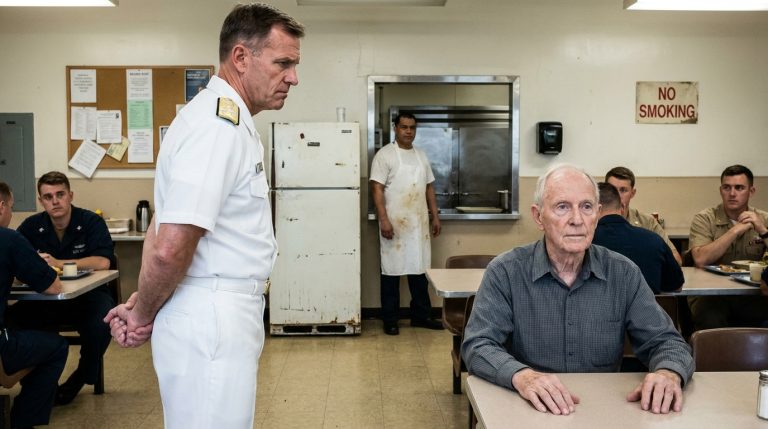
He was older than the flight, his hair a thin, white frost, his flannel shirt fraying at the collar. He didn’t look like a hero; he looked like a memory. He stepped inside, and the smell of jet fuel seemed to intensify, grounding the sterile air of the cockpit with the scent of a long-closed hangar.
Morrison didn’t look at the displays. He looked at the frequency dial, his pale blue eyes tracing the path of the wires as if he could see the signal dying within them. He reached into his pocket and pulled out an object that didn’t belong in the twenty-first century: a battered, olive-drab radio, its antenna bent like a fractured finger.
“This frequency never dies,” the old man said, his voice softer than the hum of the engines.
As he placed the device on the console, the cockpit monitor flickered. The green pulse returned, but it wasn’t their flight ID. It was a series of strange, scrolling characters that hadn’t been in use for thirty years.
CHAPTER 2: THE ANATOMY OF SILENCE
The flickering characters on the monitor were a dead language to the modern avionics, a series of jagged, archaic symbols that seemed to pulsate with the rhythmic heartbeat of a different era. Lisa Chen stared at them, her fingers hovering inches from the screen as if touching the glass might invite the digital infection into their main flight computer. She was breathing in shallow, ragged bursts, the sound amplified by the sudden, oppressive silence of the cockpit.
“It’s not a glitch, Derek,” she breathed, her voice trembling. “Whatever that is… it’s not coming from our system.”
Captain Holloway remained frozen, his eyes locked on the radio handset as if it were a venomous snake. He didn’t want to look at the old man, but he couldn’t help himself. Colonel Jack Morrison stood behind the center console, his posture unnervingly still. He didn’t look like a man who had just hijacked a flight path; he looked like a man who had simply returned to a familiar station. The faded flannel of his collar caught the dim, shifting light of the emergency displays, its texture frayed and heavy with the dust of a life lived outside the sterile, pressurized world of 39,000 feet.
Morrison’s hand was still resting on the olive-drab radio, his thumb tracing the jagged edge of the frequency dial. It was a tactical movement, one that suggested he wasn’t just observing the silence; he was dissecting it.
“The signal wasn’t lost,” Morrison said, his voice a low, gravelly vibration that seemed to cut through the hum of the air conditioning. “It was cordoned off.”
Holloway finally turned, his face flushed with a mixture of professional humiliation and raw, unadulterated fear. “Cordoned off? This is a Boeing 777, not a tactical training exercise! Who has the authority to block a civilian transponder over Kansas?”
Morrison didn’t answer with a name. Instead, he tilted his head, his pale blue eyes shifting toward the window, where the bruised, purple-gray clouds of the storm cell loomed like a wall of iron. For a moment, the sensory world seemed to sharpen for Chen—she noticed the way the cold seeped through the triple-paned glass, the metallic tang of ozone building in the cockpit, and the way the old man’s skin seemed to possess the faded, parchment-like texture of a map that had been folded and refolded a thousand times.
A sudden, sharp image flickered in Morrison’s mind—not of the plane, but of a different cockpit, a different storm, decades earlier. The phantom sensation of a failing engine, the smell of cordite, and the exact, crushing weight of a radio that had gone dead at the worst possible second. The memory hit him with the force of a physical impact, causing his hand to tighten involuntarily on the console. It was the reason he was here. Not to save these people—not primarily—but to fix a tear in the sky that he had left open forty years ago.
“The authority doesn’t matter,” Morrison replied, his gaze returning to the monitors. “What matters is that the line is being held. We are being funneled.”
“Funneled where?” Chen demanded, her voice rising in pitch.
Morrison pointed toward the radar, where the storm cell showed a peculiar, unnatural stability in its structure. “Toward a hole that hasn’t appeared yet. If we follow the primary navigation, we fly right into the heart of the pressure. But if we listen to the static, we find the path of least resistance.”
He reached out and, with a precision that bordered on the uncanny, adjusted a sequence of switches on the auxiliary panel—switches that weren’t meant to be touched in flight, and certainly not by a passenger. As he did, the weird, scrolling characters on the monitor stabilized. They became coordinates.
The cockpit suddenly jolted. A pocket of turbulence, hard and sharp, slammed the aircraft, tossing the instruments into a brief, violent dance. Holloway instinctively grabbed the yolk, but the plane fought back, the heavy, resistant pull of the air pressure feeling wrong, weighted.
“Something is pushing us,” Holloway yelled over the sudden roar of wind against the fuselage. “The air speed is climbing, but the engines are at idle!”
“It’s not the engines,” Morrison said, his voice calm, an anchor in the escalating chaos. “It’s the vacuum. Don’t fight it, Captain. If you fight the drag, the wings will shear. You have to feed the plane into the slipstream.”
Chen looked at Morrison, seeing not the ‘Grandpa’ they had mocked at the gate, but something much older and more dangerous. She saw the way he shifted his weight with the turbulence, his body moving in perfect synchronization with the metal, as if he were part of the airframe itself.
Outside, the first bolt of lightning illuminated the wall of cloud. It wasn’t the white, jagged flash of a normal storm; it was a deep, electric violet that pulsed along the edges of the wings. It was a color that shouldn’t exist at this altitude.
“We’re going to lose the wing-tips if we keep this descent angle,” Holloway shouted, his hands white-knuckled on the controls.
“Then let them drop,” Morrison replied, his eyes focused on the coordinate display. “But keep your eyes on the ghost. If we lose the signal now, the silence will become permanent.”
As the plane dipped into the violet light, the cockpit lights died completely, plunging them into a darkness so heavy it felt like lead. In the pitch black, only the glowing, archaic dial of Morrison’s handheld radio remained, a small, stubborn star in the heart of the abyss. The silence of the cabin was no longer just an absence of sound; it was a physical weight, pressing against their chests, demanding an answer that none of them were prepared to give.
Chen felt a shiver trace its way down her spine as the cabin interphone suddenly buzzed—a short, frantic sound that suggested the flight attendants in the back were seeing things that shouldn’t be possible. She reached for the handset, her heart hammering against her ribs.
“Lisa, don’t,” Morrison commanded, though he never looked away from the console. “Whatever is on the other end of that line, it isn’t one of your crew.”
The buzzing stopped, replaced by a voice. It wasn’t a human voice; it was the sound of a hundred voices speaking at once, layered over each other in a cacophony of distorted, overlapping memories.
CHAPTER 3: THE FREQUENCY OF MEMORY
The voices were not distinct, yet they were unmistakable. They were the frantic, overlapping transmissions of a dozen different cockpit crews, all echoing in the same cadence of panic that Jack Morrison had heard forty years ago over the jungles of Southeast Asia. Lisa Chen’s hand hovered inches from the intercom, her fingers trembling as the sound spilled into the cockpit—a chaotic, spectral choir of ‘Maydays’ and frantic altitude callouts.
“It’s not possible,” Holloway whispered, his face the color of the cloud banks they were slicing through. “That… that frequency shouldn’t exist. It’s an open channel. How could the past be bleeding into our comms?”
Morrison didn’t look back. His hands were still buried in the exposed wiring of the console, his fingers moving with a delicate, rhythmic certainty that defied the violent rocking of the 777. The air in the cockpit had grown cold—not the dry, sterile cold of high-altitude flight, but a damp, penetrating chill that smelled of rain-soaked earth and old copper.
“It’s not bleeding,” Morrison said, his voice stripped of all emotion, sounding as hollow as the transmissions filling the room. “It’s being pulled.”
He twisted a wire, and the cacophony snapped into a single, piercing tone. The oscillation of the radio was wrong. It wasn’t the steady hum of a working device; it was a throbbing, metallic resonance that made the very air in the cockpit feel viscous. Morrison reached out and pulled the emergency breaker for the cabin power. The lights died, save for the faint, bioluminescent glow of the archaic dial on his personal radio.
“Captain, take the manual override,” Morrison commanded. “Do not look at the monitors. The digital systems are trying to lock onto the distortion. You have to fly by the seat of your pants, the way you were taught before the computers started doing the thinking for you.”
Holloway hesitated, his professional pride clashing with the terror of his situation. But then a flash of violet lightning washed over them, illuminating the windshield. For a fraction of a second, the storm clouds seemed to thin, revealing a view that wasn’t the Kansas plains—it was a memory of an airfield, a runway carved out of mud and jungle, flickering like a dying bulb in the sky.
“Do it, Derek,” Chen urged, her voice breaking. She had grabbed the secondary yolk, her knuckles white. “He knows the frequency. He’s the only one who can navigate this.”
Holloway groaned, a sound of pure surrender, and wrenched the manual override. The 777 groaned in protest, the airframe shivering as the plane shifted from a stable cruise to a raw, physical machine fighting the atmosphere.
Morrison kept his attention on the olive-drab radio. He began to speak into the mic, his cadence formal, his terminology antiquated. “Ghost to Command. I have the beacon. I am at the threshold. I am returning the borrowed time.”
As he spoke, the cabin power flickered back on. The screens sputtered, but they didn’t show the navigation route anymore. They showed a map of coordinates that didn’t exist on any commercial flight chart—a series of intersecting lines that converged on the center of the storm.
“What is that?” Chen asked, pointing at a blinking icon on the radar. It was labeled ‘Alpha-Tango-Seven’.
“The decoy,” Morrison whispered. He reached into his pocket, his hand brushing against the rectangular object he had carried since takeoff. “They want us to think we’re being intercepted. They want us to believe there’s a rescue coming. But there is no rescue for a ghost, and there is no rescue for this flight if we don’t cross the threshold ourselves.”
He turned, for the first time looking directly at Holloway. The Captain saw a depth in the old man’s eyes that was terrifying—a look of absolute, soul-crushing resignation mixed with a glimmer of profound peace.
“You’ve been flying a route that was designed to fail, Captain,” Morrison said softly. “The suppression of our comms wasn’t a technical error. It was a filter. They needed someone who remembered how to fly through the noise to get this plane to the other side.”
A heavy, rhythmic thudding started to resonate through the floorboards. It wasn’t the engines. It sounded like something large, metallic, and heavy, pacing alongside the aircraft, keeping perfect distance despite the turbulence.
“Something is out there,” Chen whispered, her face pressed against the side window. “Something that doesn’t have lights.”
Morrison didn’t look. He turned his attention back to the radio, his thumb hovering over the transmit button. “I know. It’s been following me for a long time. Now, Captain, prepare for the transition. We aren’t going to Denver. We’re going to be a little late.”
The plane shuddered violently. A sound—not of wind, but of tearing metal—echoed through the cockpit as the windshield began to frost over in intricate, unnatural patterns. The temperature dropped further, and the smell of ozone became so thick it coated the back of their throats.
“Morrison, wait!” Holloway screamed as the plane banked at an impossible, vertical angle toward the heart of the violet cloud. “You’re going to tear the airframe apart!”
“The airframe is already gone, Captain,” Morrison replied, his voice barely audible over the roaring of the wind that suddenly sounded like a thousand voices. “We’re just the vessel for the remainder.”
He pressed the transmit button, and a blinding, silent light erupted from the antenna of the handheld radio, filling the cockpit, the cabin, and the very air around the 777, erasing the storm, the clouds, and the modern world entirely.
CHAPTER 4: THE VECTOR OF CONSEQUENCE
The light didn’t fade; it collapsed. It retreated into the corners of the cockpit like water receding from a shore, leaving behind a silence so deep it felt as though the engines had stopped, though the vibration in the floorboards persisted. Lisa Chen’s first sensation was the smell—not the sharp, metallic ozone of the storm, but the damp, earthy scent of a forgotten cellar. She gasped, her lungs burning as if the air had been suddenly replaced with something far thinner and colder.
“Report,” she managed to choke out, her voice sounding flat and alien in the cramped space.
Holloway was slumped over the yolk, his hands locked in a white-knuckled grip that had pulled the nose of the 777 into a steady, controlled descent. He wasn’t looking at the flight instruments; he was staring at the windshield. Outside, the violet light was gone, replaced by a sky of such intense, featureless gray that it looked like a shroud stretched across the horizon.
“We aren’t in Kansas,” Holloway whispered. His eyes were wide, the pupils dilated until the iris was a mere sliver of pale blue. “Look at the altitude, Lisa. Look at the radar.”
Chen leaned over the center console, her eyes tracking the displays. The altimeter was spinning, not with the erratic jump of a failing sensor, but with the measured, terrifying speed of an aircraft falling into a vacuum. The radar was a clean, undisturbed screen. No storm. No other aircraft. No topography. Just the empty, endless gray.
Jack Morrison was still in his seat, though the posture of his body had changed. The stiffness of the soldier had softened, replaced by a weary, heavy slouch. He was staring at the handheld radio in his lap, which was now dead, the olive-drab casing cold to the touch.
“The vector wasn’t a path to Denver,” Morrison said, his voice quiet, lacking the authority it had held only minutes before. “It was a path to the silence. The suppression… it wasn’t meant to keep us from calling for help. It was meant to keep us from seeing what was happening outside the window.”
“Where are we?” Chen asked, her voice gaining a desperate, sharp edge. “We were at 39,000 feet over the Midwest. You just flew us… where?”
Morrison didn’t answer immediately. He reached out and tapped the glass of the altimeter. “We are exactly where we need to be. We are in the gap between the things that have happened and the things that are about to. But the plane is taking a toll, Captain. Listen.”
A high-pitched, metallic whine began to echo through the cabin—a structural complaint from the fuselage. The pressurized hull was struggling to maintain its integrity against the atmospheric shift. A warning light blinked on the overhead panel: CABIN PRESSURE LOW.
“The seal is failing,” Holloway barked, his survival instincts finally overriding his shock. He punched the manual equalization switch, but nothing happened. “The valve won’t cycle! The pressure is dropping too fast!”
“Don’t fight the valve,” Morrison said, his hand moving to the gear lever. “The pressure isn’t falling because of a leak. It’s falling because the environment outside is equalizing with the environment inside. Open the vents, manually. If you keep the cabin sealed, you’re trying to keep a balloon inflated in a hurricane.”
“If I open the vents, the passengers will feel the drop!” Chen argued, her hand hovering over the controls.
“They’re already feeling it,” Morrison countered. He stood up, his movements fluid despite his age. He began to move toward the door, his hand gripping the frame for stability. “They’re in the transition. If you don’t release the pressure now, the hull will buckle before we ever reach the landing zone.”
Holloway looked at Chen, a frantic, silent communication passing between them. They were pilots, trained in the cold logic of the manual, yet here they were, taking orders from a man who treated their aircraft like a piece of paper in a windstorm. Holloway nodded, once. Chen pulled the manual release.
The cabin doors hissed, not with a standard venting sound, but with a deep, resonating groan that shook the floor. The cabin lights flickered, dimmed, and then cut out completely, leaving them in the emergency red glow of the cockpit. In the distance, through the windshield, a shadow began to resolve—a dark, jagged line on the horizon that looked like the silhouette of a mountain range that hadn’t been there a second ago.
“There,” Morrison said, pointing to the shape. “That is the tether. If we touch down there, the radio silence breaks. If we miss, we stay in the gap forever.”
“That’s not a runway!” Holloway shouted, his hand pulling the yolk back to arrest the descent. “That’s a ridge!”
“It’s the only place where the signal is strong enough to anchor us back to the world you know,” Morrison said. He walked toward the cockpit door, his gait steady. “I have to do this part alone. If I’m not back in the seat when we clear the approach, do not touch the radio. Just fly. Fly until you see the lights of a city that isn’t on your map.”
“Morrison, wait—” Chen started, but the old man was already gone, his silhouette disappearing into the dark, red-lit corridor of the cabin.
The plane hit a patch of turbulence so severe it felt like they had slammed into a solid wall. The 777 yawed hard to the right, and the metallic whine from the fuselage intensified, turning into a rhythmic, grinding shriek. The cockpit was vibrating, the loose papers on the console dancing in the air.
Holloway was fighting the controls, his teeth gritted. “He’s doing something to the fuel mixture! The engines are pulling differently!”
Chen looked at the radar again. A single, blinking green dot had appeared on the screen—a beacon. But it wasn’t at the airport. It was at the center of the dark, jagged ridge Morrison had pointed out. As she watched, the dot began to pulse, and with every pulse, the gray shroud outside the window seemed to ripple, as if the reality they were flying through was thinning out, revealing something else beneath.
She felt a sudden, sharp ache in her chest—not physical, but a cold, heavy sense of realization. This wasn’t a rescue. This was a restitution. The plane, the crew, the passengers—they were all just pieces of a debt that Morrison had been paying for half a century. And as the ridge loomed larger, filling the windshield with an impossible, looming shadow of stone and sky, she realized with a jolt of terror that the beacon wasn’t broadcasting to them.
It was calling them home.
CHAPTER 5: THE THRESHOLD OF DEBT
The red emergency lighting turned the cockpit into a chamber of pulsing veins, the entire airframe shuddering with the rhythmic, heavy grind of the struggle against the ridge. Lisa Chen stared at the windshield, where the silhouette of the jagged rock wasn’t just a physical obstacle; it was a wall of flickering static that seemed to breathe in time with the engines. She could feel the cabin’s atmospheric pressure—not on her skin, but as a dull, throbbing weight in her inner ear, the sensation of moving through something thicker than air.
“Holloway,” she whispered, her voice tight. “Look at the horizon line. It’s not moving.”
The Captain was silent, his hands locked onto the manual override, his focus entirely on the point of impact. The beacon on the radar was no longer blinking—it was a solid, blinding white glare that saturated the display. The ridge had grown to fill the entire field of vision, the stone surfaces indistinguishable from the heavy, metallic gray of the clouds.
“I can’t clear it,” Holloway muttered, his voice devoid of his usual arrogance. It was a hollow, defeated sound. “The plane isn’t responding to the pitch. It’s like we’re caught in a current.”
Behind them, the cockpit door remained sealed. There was no sound from the cabin—no screaming, no chatter, no movement. It was as if the 287 passengers had vanished into the thin, cold air. Chen reached for the intercom, her hand brushing the frayed, worn fabric of the seat cover that Morrison had been sitting in only minutes before. It felt warm, an unnatural, lingering heat that sent a jolt of static through her fingertips.
“He’s not coming back,” Chen realized aloud. The truth wasn’t a shock; it was a quiet, suffocating pressure.
She turned to the side window, pressing her forehead against the freezing glass. The ridge was so close now that she could see the texture of the rock—it was streaked with veins of something that shimmered with the same violet light that had pulled them from the sky. It wasn’t stone. It was metal. Miles and miles of scarred, oxidized wreckage, a graveyard of aluminum and history that stretched as far as the eye could see into the gray shroud.
“We’re not the first,” she whispered, the horror of it finally settling into her bones. “Holloway, we’re not the first one to fly this route.”
The plane lurched, the sound of the grinding metal beneath the fuselage growing deafening. The 777 was no longer flying; it was sliding, the tires finding purchase on a surface that shouldn’t have existed. The entire aircraft groaned, the floorboards bending under the immense, unseen weight of the landscape they were landing upon.
Holloway didn’t argue. He cut the engines, his hands moving with the grace of a man who had accepted the inevitable. The silence that followed was total. No wind. No electronic whine. No hum of the cooling fans. Just the soft, rhythmic ticking of the metal cooling in the unnatural cold.
The cockpit door didn’t open. The door handle simply clicked, the mechanism sliding back with a sound like a chambered round.
Chen watched the doorway, her breath hitching in her chest. She expected Morrison. She expected the General, or the CEO, or even the shadows of the passengers. But the door swung open to reveal nothing—only the long, dark, and perfectly still interior of the cabin.
She stood up, her legs feeling heavy, and walked into the aisle. The cabin was perfectly arranged. The trays were stowed, the seatbelts fastened, the overhead bins shut. But the seats were empty. Every single one. She walked to the back, her footsteps ringing against the floorboards as if she were in an abandoned cathedral. The air here was still, carrying the faint, metallic scent of ozone and the dry, dusty smell of an old flannel shirt.
She reached the back galley and stopped. There, resting on the middle seat of 34E, was the battered, olive-drab radio. It was the only thing left.
She reached out, her fingers trembling, and picked it up. It was heavy, far heavier than it looked, and as she held it, the weight felt like a lifetime of service, a lifetime of silence. She pressed the side of the casing, and for a fleeting second, the radio hissed to life.
It wasn’t a voice. It was a sound—the clear, resonant chime of a bell, ringing out into the infinite gray space outside the plane.
“Colonel?” she whispered, her voice cracking.
There was no answer. But in the reflection of the cabin window, she saw a movement. A silhouette, tall and stoic, standing on the ridge outside the plane. He wasn’t looking at the aircraft. He was looking at the horizon, his hand resting on a piece of debris that looked remarkably like the rudder of an old, forgotten propeller plane from another era.
He had completed the mission. He had bridged the gap between the ghost and the living.
Chen felt the plane shift, a sudden, sharp jolt that signaled the beginning of the end. She looked down at the radio in her hand, then back to the window, but the silhouette was gone. The gray shroud outside was beginning to break, the light shifting from the flat, oppressive gray to the warm, golden hue of a morning that she had forgotten existed.
The engines roared to life—not with the standard start-up sequence, but with a surge of power that felt like an exhale. The 777 began to move, pulling away from the ridge, climbing back toward a sky that was finally starting to turn blue.
She knew, with a certainty that reached into the core of her being, that they were returning. But she also knew that the price had been paid in full, and that the person who had brought them home would never be found on any manifest, in any record, or on any map that the world would ever hold again.
CHAPTER 6: THE LAST SIGNAL
The transition was not a sudden snapping back to reality, but a slow, agonizing liquefaction of the gray world into the familiar, humming stability of the Denver approach. The cabin lights surged back to full intensity, the hum of the ventilation system returning with a low-frequency thrum that made the entire airframe vibrate.
Lisa Chen stepped into the cockpit, her legs feeling like lead. Captain Holloway was staring at the flight path display. The erratic, jagged route they had traced through the storm was gone, replaced by a clean, standard descent vector into Denver International.
“We’re three miles out,” Holloway said, his voice flat, stripped of the arrogance that had defined him at the gate. He didn’t look at her. “The radios… they’re back. Denver Center is asking for our flight status.”
Chen looked at the console. The green pulse of the transponder was steady. The VHF radio was filled with the mundane, comforting chatter of commercial air traffic. She reached out and toggled the comms, her fingers brushing the spot where the olive-drab radio had sat. It was gone. The console was clean, the wiring intact, as if nothing had ever been tampered with.
“What do we tell them?” she asked.
Holloway finally looked at her, his eyes hollow. “We tell them we had a localized instrument failure and recovered. We tell them it was a routine flight. If we tell them what we saw—what we felt—they’ll ground us for the rest of our lives.”
Chen looked back toward the cabin. The passengers were beginning to stir, the rhythmic clicks of seatbelts unbuckling echoing like a drumbeat. They were waking up from a dream they didn’t know they’d had. They were oblivious to the fact that they had been drifting in the gap between seconds, that they had been anchored to the earth by a man who had been dead to the world for decades.
She thought of the ridge. She thought of the silhouette, and the bell, and the weight of the radio that had carried the history of a thousand lost souls. She realized then that Morrison hadn’t come to save them from a crash. He had come to finish a patrol. He had come to bridge the final, lingering frequency that kept his own ghost tethered to the cockpit he’d died in so long ago.
The landing was smooth—a physical, grounding impact that rattled their teeth and signaled the definitive return to the laws of physics. As the plane taxied to the gate, the world rushed back in. The bright, sterile lights of the terminal, the sight of the ground crew in their fluorescent vests, the distant, muffled sound of a life continuing without them.
Holloway parked the plane, but he didn’t head for the door. He sat there, his hands resting on the yolk, his head bowed.
“He’s gone, Lisa,” he whispered. “He was never on the manifest, was he?”
Chen shook her head, unable to speak. She walked out of the cockpit and into the cabin. The passengers were gathered in the aisles, their faces bright and expectant, ready to return to their jobs and their families. She walked down the aisle, her hand trailing along the seatbacks, the fabric feeling worn and familiar, like the flannel of a forgotten shirt.
When she reached 34E, she stopped. The seat was empty. There was no radio, no note, no sign that anyone had been there at all. But as she knelt to check the space beneath the seat, she found a single, small object: a tarnished brass wing-pin, the kind issued to pilots in an era before satellites and data links.
She picked it up. It was cold, and as it touched her skin, she felt a brief, gentle pulse of warmth, as if someone were squeezing her hand in a silent, final farewell.
She stood up and walked toward the exit. The jetway was crowded with passengers, all of them moving toward the terminal, toward the light, toward the future. She joined them, her footsteps matching the rhythm of the crowd, but she found herself walking slower, her ears tuned to the static of the airport, listening for a frequency that was no longer there.
Outside, the sun was rising over the Denver skyline, bathing the tarmac in a warm, golden, and profoundly ordinary light. She watched the F-16s she remembered—or thought she remembered—crouching on the horizon, but they were just silhouettes against the morning, distant and unreachable.
She stopped at the end of the jetway, the air of the terminal smelling of stale coffee and industrial cleaning fluid. She pulled the brass pin from her pocket and held it against the glass of the window, watching it catch the light. It wasn’t a hero’s medal, and it wasn’t a souvenir. It was a weight, an anchor that kept her anchored to the truth that had once occupied the silence of the sky.
She turned and walked into the terminal, the sound of her own footsteps blending into the noise of the world. She would never tell anyone what happened. She would never explain why she kept a piece of brass in her pocket for the rest of her life. She would simply fly, and in the quiet moments between the static and the signal, she would listen for the bell, a sound that reminded her that even in the deepest silence, there is a frequency that calls you home.
The sky outside was clear, wide, and indifferent. It held no ghosts, no ridges, no gaps. Just the wind, and the path, and the long, slow, and beautiful work of continuing on.