The Measured Velocity of Gravity: The Account of a Tactical Ascent and Calculated Silence
CHAPTER 1: THE WEIGHT OF DUST
The flight line sat under a dying sun, washed in a dull, rusted orange that offered no heat, only glare. The air smelled of burnt JP-8 and the fine, mineral grit of desert topsoil that found its way into the seams of everything. Beneath Mara’s boots, the crushed gravel shifted with a dry, rhythmic crunch. To her left, the twin turbofans of the parked airframe ticked as they cooled, the metal expanding and contracting with a sharp, mechanical cadence that she tracked without looking.
Inside the canvas command tent, the yellow glow of halogen work lights spilled through the open flap, casting long, skeletal shadows across the dirt outside.
“Sound off with call signs,” a voice barked from the interior.
The responses were instantaneous, clipped, and heavy with the practiced cadence of men who lived in each other’s pockets. Then Mara stepped toward the perimeter. Her voice was a low, flat stone dropped into deep water. She gave her call sign.
The silence lasted for half a second. Then, a short, wet laugh cut through the hum of the cooling generators. Another pilot snorted, stretching the syllables of her name into a singsong mockery that bounced off the uninsulated canvas walls.
Mara stayed just outside the flap. Her helmet was tucked precisely under her left arm, the visor down to keep the blowing grit from scoring the polycarbonate surface. Her flight suit was a faded, desaturated green—no custom name tags, no vibrant squadron crests, no personalized leather patches detailing low-level hours or midnight sorties. The fabric at the elbows and knees was worn down to a paler thread, shaped by the hard angles of cockpit bulkheads rather than the display racks of a supply depot.
Her eyes stayed fixed on the horizon line where the orange sky met the jagged silhouette of the western ridge. She did not blink. She did not shift the distribution of her weight across her heels.
“Sounds like something from a video game,” someone murmured inside, followed by a low ripple of collective agreement. The conversation surged back to life around her, instantly rendering her invisible.
It was a specific kind of cold. The atmosphere in the camp didn’t carry malice so much as a clinical assessment made before the data was even loaded. They had weighed her compact frame, her lack of local bravado, and her unadorned gear, and they had closed the file.
Mara turned away from the light. She didn’t seek the burn barrels where the night shift was beginning to gather, nor did she slide toward the chow tables. She walked back toward the nose of her aircraft. Her right hand, bare and calloused at the knuckles, extended to trace the seam of the intake cowl. Her fingers registered every flush rivet, checking for the microscopic play that signaled structural fatigue from high-G pulls.
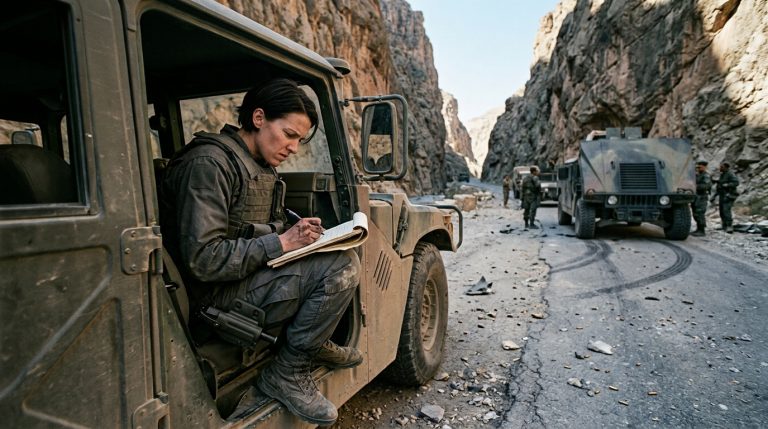
She opened her real-paper notebook against her knee, her pen moving in small, rigid block letters. She noted the wind velocity, the barometric drop, and the exact cooling time of the engine blocks.
From thirty yards away, a junior lieutenant watched her, leaning against a refueling bowser. “She looks lost,” the boy whispered to his lead.
Mara didn’t stop her pen. The flight line was an acoustic funnel; she heard the murmur over the sound of the wind. She simply turned the page, her face a mask of grey stone, waiting for the sky to go completely dark.
CHAPTER 2: THE FRACTURE POINT
“The grid is verified, Captain. We don’t have time to re-run the calculus while a patrol is taking effective fire.”
The mission planner’s words were sharp, dry, and heavy with the static electricity of the operations tent. He didn’t look up from the digital terminal, his fingers tapping against the edge of the plastic bezel with a frantic, uneven rhythm. Above him, the projector hummed, throwing the harsh, blue-white geometry of the valley map across the stretched vinyl wall. The lines flickered every time the external generator sputtered against the rising desert wind.
Mara didn’t adjust her posture. She stood near the corner of the map board, her leather-bound notebook open on her palm. Her fingers held the heavy steel casing of her pen with a loose, practiced grip that denied the tension filling the space. The air in the tent was thick, smelling of stale chicory coffee, damp canvas, and the distinct, metallic tang of overheated radio components.
“The northing and easting digits are transposed on the primary log,” Mara said. Her voice didn’t rise to meet his edge; it remained flat, cold, and level, like a chisel hitting slate. “Look at the western sector of the projected overlay. If you track the coordinates provided by the initial report, you are placing three vehicles inside a sheer vertical rock face. They reported movement along low cover. A cliff face offers no egress.”
A senior pilot standing near the projector crossed his arms, his flight suit zipper clinking against his survival vest with a small, metallic snap. “They’re in a panic out there, Cole. Under stress, infantrymen misread coordinates. We deploy on the data we have, not the data we wish we had.”
“The infantry didn’t misread the terrain,” Mara replied, her gaze moving slowly from the pilot’s eyes down to the handwritten columns in her own notebook. “The clerk entering the log into the tactical net dropped the decimal identifier. Look at the dry riverbed two thousand meters to the east. Flip the last two digits of the identifier. The grid aligns perfectly with the natural defilade of the wash. That is where they are bleeding.”
The silence that followed was heavy and abrasive, filled only by the low, wet hiss of the radio speaker on the command console.
“Contact… taking fire… moving north… can’t break…”
The transmission from the valley cut out, replaced by a wall of white noise that made the junior Joint Terminal Attack Controller (JTAC) rub his forehead with a fist. His knuckles were raw, stained with ink and grease. He looked at the map, then at Mara, his eyes darting between the sharp edges of the terrain features she had indicated.
Mara stepped closer to the table, the weight of her boots pressing firmly into the hard-packed earth. She didn’t use a laser pointer. She extended her bare index finger, her nail stopping exactly two millimeters above the glass surface of the display. The skin of her inner wrist pulled back slightly as her sleeve shifted, exposing the narrow, pale line of the burn scar. It was clean, uniform, and precisely the width of an old-generation cockpit wiring loom failure—the kind that occurred when an electrical fire trapped a pilot behind a jammed canopy lock.
The crew chief standing by the door caught sight of the mark, his eyes narrowing as he tracked the pale thread of tissue before she dropped her hand back into the shadow of her flight suit.
“If you launch the primary sortie to the cliff line,” Mara said, her eyes shifting to the JTAC, ignoring the senior pilot entirely, “they will spend four minutes orbiting empty stone before they realize the error. By then, the wind will have pushed the dust wall over the wash. You will lose the visual window. You will lose the patrol.”
The senior pilot snorted, but his hand had stopped hovering over his sidearm holster. The aggressive certainty in his shoulders had begun to stiffen into something colder—the first hairline fracture of doubt. “You’re assuming a lot for someone who arrived here three weeks ago with an empty record sleeve, Captain.”
“The terrain doesn’t care about my arrival date,” Mara said. She didn’t look at him. She didn’t look at any of them. Her focus remained locked on the tactical problem, calculating the time-distance ratios with the cold efficiency of a flight computer. “Divert the second element. Have them sweep the alternate wash on the approach. It costs ninety seconds of fuel. It saves six lives.”
The JTAC looked at the mission planner, his jaw tightening until the muscle bunched beneath his ear. The radio popped again, a jagged burst of static that carried the distant, rhythmic thumping of heavy machine-gun fire in the background. The sound was distinct—the slow, low-frequency cycle of an older weapon system used by local insurgent cells.
“Razer Two,” the JTAC muttered into his headset, his finger striking the transmit switch with enough force to crack the plastic casing. “Divert from primary vector. Re-route to alternate grid seven-five-six. Check the dry wash east of the ridge line for friendly movement.”
The tent held its breath. The generator coughed twice, dropping the lights into a dim, amber twilight before the regulator caught and slammed the brightness back into the room. Mara stood perfectly still in the shadow of the command pole, her notebook closed, the steel pen tucked into her sleeve pocket. She didn’t watch the map anymore. She watched the faces of the men who had spent three weeks laughing at her call sign, watching the slow, agonizing transformation of their expressions as the radio speaker began to crackle back to life with a different tone.
“Razer Two is on station at the alternate grid… visual on movement. Friendlies are in the wash. Repeat, friendlies located. Engaging targets along the tree line now.”
The senior pilot didn’t say a word. He turned his back to Mara, his shoulders rigid as he began to study a fuel log that didn’t need checking. The mission planner’s fingers froze on his keyboard, his eyes fixed on the blue icon shifting across his screen, marking the success of a diversion he had fought to prevent.
The JTAC didn’t look up, but his shoulders dropped three inches. “Good catch,” he whispered into the space between his microphone and the desk.
Mara didn’t acknowledge the comment. She turned toward the exit flap, her boots finding the exact same silent rhythm on the gravel as she stepped back out into the gathering dark. The wind was harder now, throwing sharp grains of sand against her collar, but her hands were entirely steady as she reached for her helmet.
CHAPTER 3: IN HOT
The canvas flap did not just open; it slammed against the support poles as a sharp gust of wind cut through the operations tent, carrying a heavy wave of cold air and fine grit. A tall silhouette stepped out of the desaturated twilight, the sharp angles of a heavy-weather flight jacket silhouetted against the dim amber glow of the exterior perimeter lights.
The room changed shape instantly. The casual posture of the mission planner evaporated, his spine straightening into a rigid line before his fingers left the keyboard.
The visiting squadron commander walked into the center of the workspace, his heavy flight boots hitting the hard-packed dirt with a heavy, dead thud. He did not look at the maps or the digital logs flickering on the main display. His eyes made a slow, deliberate sweep of the shadows near the back wall, cutting through the haze of cigarette smoke and stale steam from the coffee urns.
“What call sign?” the commander asked. His voice was lower than the wind, carrying the rasp of a throat scarred by years of high-altitude oxygen mix.
The senior pilot who had been avoiding Mara’s line of sight hesitated, his hand shifting nervously along the edge of his survival vest. “Uh, hers, sir,” he muttered, gesturing toward the dark corner where Mara stood beside the equipment racks.
The commander turned his head. His eyes fixed on Mara’s face, ignoring the plain, unpatched flight suit and the gray, unpainted helmet resting on the crate beside her. He took three deliberate steps across the gravel floor, his uniform tags casting a sharp shadow over her notebook.
Mara did not move. Her face remained a flat sheet of stone, her eyes holding the commander’s gaze with an unblinking, mechanical neutrality.
“I flew with her before,” the commander said quietly. He did not turn back toward the room, but his words carried across the silent space like a heavy weight sliding into place. “Different theater. High-threat airspace, bad weather, bad intel. Worse nights.”
He paused, his eyes dropping briefly to the narrow, clean burn scar on her inner wrist before returning to her face. “She brought two damaged aircraft home when neither should have made it back. She stayed on station when others had to pull off. Multiple emergency recoveries.”
The silence in the tent grew thick and suffocating. The senior pilot shifted his weight, his zipper making a tiny click against his armor plate, but he did not offer a response. The story they had spent three weeks building—the convenient narrative of an unproven transfer who had pulled strings for an easy deployment—had just disintegrated against the dirt floor, leaving a vacuum that no one knew how to fill.
Before the mission planner could adjust the charts, the tactical radio speaker popped with a sharp, high-pitched squeal that made the JTAC wince.
“Troops in contact… enemy shifting elements to the high ground… we are pinned down in the open wash… Razer Two is bingo fuel, repeating, Razer Two is coming off station…”
The JTAC looked up at the board, his face pale under the blue illumination of the map feed. The remaining aircraft on the tarmac were cold, their engines unspooled, their maintenance crews huddled inside the break shacks away from the rising wind. “We have no assets in the air,” the boy whispered, his fingers hovering over the emergency dispatch key. “Razer Two has to exit now or flame out over the ridge.”
The commander did not look at the board. He kept his eyes locked on Mara, his jaw tightening until the edge of his collar rubbed against his throat. “Can you take it?”
“Yes, sir,” Mara said.
There was no pause for breath, no sudden surge of adrenaline in her voice, no change in the steady, rhythmic cadence of her posture. She picked up her helmet from the crate, her fingers finding the exact indentations of the visor lock without a single wasted motion. She turned away from the table, her shoulder clearing the senior pilot by two inches as she headed for the exit.
The wind outside was a wall of black sand, tearing at the fabric of her sleeves as she crossed the crushed rock of the flight line. The ground crew was already scrambling, alerted by the emergency strobe on the tent pole. One maintainer pulled the wheel chocks with a violent yank, his face masked by a dust goggle as the canopy of Mara’s jet began to slide downward with a heavy, hydraulic hiss.
The interior of the cockpit was an island of cold glass and green instrument light. Mara slid the oxygen mask over her face, the rubber sealing tightly against her skin with a sharp intake of synthetic air. Her fingers flew across the control panel, flipping switches from memory, tracking the rise of the engine temperature gauges as the twin turbines began their low, vibrating growl beneath her seat.
The airframe shook, a heavy, metallic shudder that vibrated through her boots as the tires rolled onto the tactical runway. She did not look back at the lights of the command base. The world narrowed to the black rectangle of the heads-up display and the steady, cold counting of the coordinates in her notebook.
She rammed the throttles forward. The acceleration was an immediate, crushing hand against her chest, the physics of the ascent forcing the air from her lungs as the nose cut through the low dust layer into the pitch-black sky above the ridge line.
“Package Two, this is Control,” the JTAC’s voice crackled through her headset, tight and thin. “Target vector is zero-nine-zero. Enemy elements are advancing along the eastern rim of the wash. Friendly unit has zero visibility.”
“Copy,” Mara said, her voice flat against the roar of the air rushing past the canopy. “In hot.”
She dropped the nose, the aircraft screaming down through the cloud layer into the jagged throat of the valley. The terrain features rose out of the dark like broken teeth, the sharp edges of the stone ridges throwing long, black shadows across the dry riverbed below. She could see the flashes now—the tiny, rhythmic sparks of small-arms fire from the tree line cutting into the position where the friendly patrol was dug into the dirt.
She did not hesitate. Her right hand squeezed the stick, her thumb finding the weapon release switch with an effortless, cold precision. The airframe lightened as the ordnance detached, the heavy thud of the impact reverberating through the wings as a sheet of orange flame tore through the western edge of the trees.
The radio popped with a breathless scream from the ground. “Good hits! Good hits! Enemy fire is slacking!”
Mara didn’t reply. She pulled the stick back, the high-G turn draining the blood from her face as she prepared to circle back into the throat of the notch, her eyes scanning the dark for the next movement, completely dead to the noise.
CHAPTER 4: THE RESIDUAL TICK
The rubber of the main landing gear hit the tactical runway with a sharp, violent screech that resonated through the titanium floorboards of the cockpit. Mara applied the brakes in a calculated sequence, feeling the heavy friction of the carbon discs absorbing the momentum of twenty tons of metal and fuel. The nose came down firmly, its light cutting a narrow, pale path through the swirling wall of sand that had settled over the base.
She taxied toward her designated slot in absolute silence. The instrument panel flickered as she systematically executed the engine cooldown protocols, the green glow of the multi-function displays dying out one by one until only the standby indicators remained.
When the canopy swung open on its pneumatic arms, the raw desert wind hit her instantly. It carried the sharp, bitter scent of burnt electrical components, cold iron, and ionized air from the storm tracking overhead. She unclipped her survival harness, her knuckles stiff from the sustained G-forces of the final orbit, and reached for her helmet.
The flight line was quiet. The frantic urgency that had consumed the base an hour earlier had collapsed back into the routine maintenance rhythms of a forward operating outpost. Ground crews moved through the shadows with long flashlights, their voices low and muffled by their dust masks as they began checking the exterior panels of her aircraft for stress fractures or aerodynamic pitting.
Mara climbed down the metal ladder with slow, deliberate movements. Her joints ached with the specific, deep-seated fatigue of a tactical sortie executed at the absolute limit of the airframe’s parameters. Her bare fingers brushed the cooling aluminum skin of the fuselage, tracking a jagged scoring pattern along the engine intake where the high-velocity sand had stripped the gray paint down to bare, unpolished metal.
She picked up her gear bag from the dirt, her shoulder muscles tightening against the straps as she turned toward the operations tent.
The interior of the command space was cooler now. The generator had settled into a steady, low-frequency hum that lacked the frantic stammer from before. The mission planner was still seated at his console, but his screen was clear, the bright blue lines of the tactical routing replaced by a sterile, gray data log.
As Mara stepped into the light, the junior JTAC stopped typing. He looked up, his face lined with the deep exhaustion of the shift, his eyes tracking her as she crossed the packed earth floor to the debriefing table. He didn’t speak. The silence in the room was no longer the sharp, dismissive barrier she had encountered during her first three weeks; it had turned into something heavy, dense, and uncomfortably still.
The senior pilot who had challenged her coordinates was standing by the coffee urn, his hands wrapped around a dented tin mug. He didn’t look away this time. As Mara approached the equipment locker to stow her flight helmet, he set the mug down on the wooden crate with a small, distinct clink.
He didn’t offer an apology. In this sector, apologies were considered verbal clutter, a waste of processing time. Instead, he stood straight, his spine aligning into a formal, disciplined posture that lacked any trace of the theater he had displayed before the briefing. He raised his right hand to the brow of his cap. It was a correct salute—unembellished, steady, and entirely silent.
Mara paused for half a second, her helmet held by the chin strap. The light from the overhead halogen cast the sharp edge of her jaw in a dark shadow, highlighting the narrow, pale line of the burn scar on her inner wrist. She looked at him, her expression entirely unchanged, showing neither validation nor satisfaction. She raised her right hand, returned the salute with the exact same clinical precision, and let her arm fall back to her side.
The visiting commander stepped out from the rear office, his heavy flight jacket unzipped, revealing the faded webbing of his tactical harness. He looked between the two pilots, his head moving in a single, almost imperceptible nod that signaled the formal closing of the log.
“The patrol is clear of the valley floor,” the commander said, his voice flat. “The extraction elements hit the perimeter five minutes ago. No casualties on the ground.”
“Roger,” Mara said.
She opened her real-paper notebook against the edge of the metal locker, her steel pen making small, uniform characters as she recorded the final engine shutdown time, the ordnance consumption metrics, and the residual fuel weights. She did not linger to hear the comments from the shift change, nor did she check the updated roster on the whiteboard.
She snapped the notebook shut, the heavy cover making a dry sound that cut through the low hum of the tactical radios. She tucked the book under her arm, lifted her gear bag, and walked out of the tent into the dark, cold expanse of the flight line. Behind her, the twin turbofans of her jet continued to tick as they settled into the night, the cooling metal marking the exact velocity of a routine that would begin again before the sun reached the ridge.