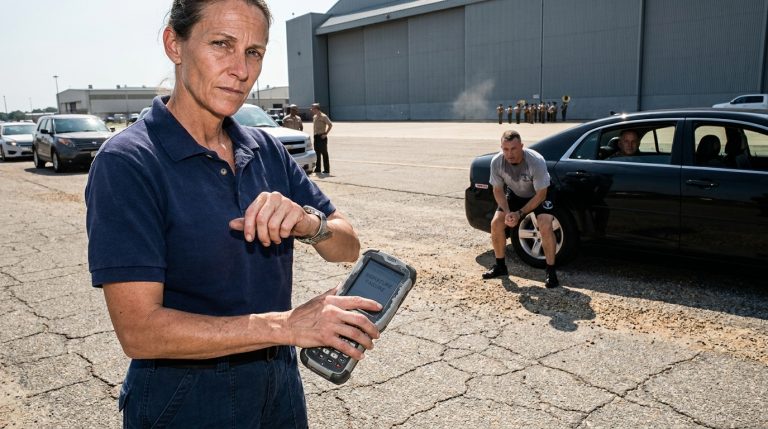
The Invisible Fracture: A Mother’s Precise Extraction Within the Walls of a Silent Military Fortress
CHAPTER 1: The Weight of Paper
The paper pass was a simple document, yet in the relentless, humid heat of the parade grounds, it felt heavy with the weight of a thousand potential failures. Captain Haze held it between two gloved fingers, the fabric of his uniform crisp enough to cut. He didn’t look at the ink; he looked at the texture of the cardstock, his eyes tracking the way the light caught the edge of the seal.
“It’s not just a pass, is it?” Haze asked, his voice barely rising above the distant, rhythmic thud of boots hitting the pavement. “You’ve been waiting for the exact moment the command staff is occupied with the flag ceremony to move toward the north sector.”
Brenda kept her face a mask of mild, maternal confusion, though her mind was already mapping the distance to the security gate behind him. She noticed the way Haze’s weight shifted slightly to his left—a defensive posture, a habit of someone accustomed to protecting a perimeter.
“I’m just a mother wanting to see my son graduate, Captain,” she said, her voice soft, projecting the exact frequency of harmlessness she knew would irritate him. “I didn’t realize that being early made me a liability.”
Haze’s gaze sharpened, turning cold. He didn’t buy it. He turned the pass over, and for a fleeting second, his thumb brushed against a faint, deliberate smudge of ink near the corner—a mark Brenda had placed there specifically to see if he was trained to spot field-altered documentation. He paused, his focus locking onto the smudge. The rhythm of the marching band began to swell, a cacophony of brass and drums that signaled the start of the final parade.
“Stay here,” Haze commanded, his eyes flickering toward the gate for a fraction of a second. “I have to verify this. If this is a mistake, you’ll be escorted off-base. If it isn’t…”
He didn’t finish the sentence. He tucked the pass into his breast pocket and turned, stepping onto the restricted path. As he did, he left his own radio exposed on his belt, its frequency dial turned slightly off-center. Brenda watched him walk away, her eyes tracing the line of his spine. She knew, with a sudden, sinking certainty, that he wasn’t going to verify the pass. He was going to call in a containment team.
She looked down at her own hands. They were steady, but the air around her felt thin, charged with the static of an impending error. Then, she saw it: lying in the dust where Haze had stood, a small, silver ID pin had fallen from his lapel. It wasn’t a standard marine insignia; it was an emblem for a unit that, according to her research, hadn’t existed for twenty years.
The parade music reached a crescendo, the sound vibrating in her very bones, but Brenda heard only the sharp, sudden click of the security gate locking behind the Captain. She was trapped on the outside, and the evidence of the truth was now lying in the dirt at her feet.
CHAPTER 2: The Architecture of a Lie
The dust on the ground was fine, chalky, and clung to the soles of her shoes with an irritating persistence. Brenda did not pick up the silver pin immediately. She kept her gaze fixed on the back of Captain Haze’s neck as he strode toward the security kiosk, his gait rhythmic, practiced, and utterly devoid of the hesitation one would expect from a man who had just misplaced a piece of his own gear. He didn’t check his lapel. He didn’t look down.
She waited until he was shielded by the silhouette of a passing transport vehicle before she crouched, her movements fluid and practiced. She plucked the pin from the dirt, feeling its cool, dense weight. It was small, a stylized wing with a serrated edge—a mark that shouldn’t have been on a modern Marine uniform. Her pulse ticked in her throat, a metronome counting down the seconds before Haze realized his mistake or, worse, realized she had seen it.
She stood, brushing the dust from her jeans, and tucked the metal into the coin pocket of her purse. Her surroundings, which had seemed like a typical military base a moment ago, now looked like a stage set. The manicured hedges, the rigid lines of the grandstands, the blinding white of the concrete—it all felt brittle, a veneer layered over something hollow.
“Ma’am, move along.”
The voice wasn’t Haze’s. It was younger, flatter, issuing from a private stationed at the side gate. The boy couldn’t have been more than nineteen, his face a map of adolescent acne and nervous energy. He was staring at her with the impatient, bored hostility common to men given their first taste of petty power.
“I’m waiting for the Captain,” Brenda replied, her tone neutral, almost bored. She didn’t look at him directly; she looked past him, scanning the interior of the gate. “He’s checking my pass.”
The private blinked, a flicker of confusion crossing his brow. “Captain Haze? He went into the North Terminal. He didn’t say anything about coming back here.”
Brenda felt the shift in the air. The “North Terminal”—a place that didn’t appear on the public maps of the base she had memorized. “My mistake,” she said, offering a small, self-deprecating smile that she knew would make him look away. “He told me to wait at the checkpoint. Perhaps I misunderstood.”
“Yeah, well, you can’t wait here. Either you’re with a party or you’re off-base,” he said, shifting his rifle slightly.
Brenda looked at him, truly looking at him now, and saw the same tension in his eyes that she had seen in Haze. They weren’t just guarding a gate; they were hyper-vigilant. She reached into her bag, pulling out the visitor pass she’d reclaimed from the ground earlier—a second copy she had kept tucked away, just in case.
“I’ll head back to the grandstand,” she conceded, turning away. But as she did, she didn’t walk toward the exit. She veered toward the maintenance access trail that hugged the perimeter fence, the path shielded by a dense row of overgrown oleanders.
Her mind was already working the problem, the logical flow of the last five minutes acting as a compass. Haze had taken her original pass. He was heading to the North Terminal. He had dropped an insignia from an obsolete, shadow-coded unit. Therefore, the ceremony was a distraction, a loud, brass-heavy curtain designed to keep the families looking at the parade deck while the real work happened in the North Terminal.
She moved quickly, the sharp, dry leaves of the oleanders scraping against her arms. She needed a way to get past the next checkpoint, and she needed it before the ceremony reached its conclusion. She pulled her phone from her purse, the screen dark. No signal. Of course. The base was a localized dead zone, intentionally scrubbed of outside connectivity.
She stopped suddenly. Ahead, the perimeter fence dipped into a drainage culvert, the grate partially pulled back. It was a maintenance failure, the kind of small, overlooked error that someone as efficient as Haze would never allow—unless he hadn’t been the one in charge of this sector.
She looked at the grate, then at the distant, rising swell of the graduation anthem. The music reached her, muffled and distorted by the wind, a patriotic sound that now felt like a taunt. She thought of Adam. She thought of the letter he had sent two months ago—the one that had stopped mid-sentence, the handwriting jagged and hurried, as if he had been pulled away by someone standing right behind him.
She knelt by the culvert. The smell was damp, earthy, and metallic—the scent of iron and stagnant water. It was a dark, narrow mouth leading under the heart of the base. She reached out, gripping the cold, rusted bars of the grate. They were slick with moss, vibrating slightly from the heavy machinery running somewhere deep beneath the surface.
She wasn’t just a mother here for a graduation. She was a ghost, walking into a graveyard she had spent years trying to forget. She took a breath, the air tasting of ozone and old secrets, and pushed the grate. It groaned, a low, grinding protest, but it gave way.
She slipped into the darkness of the culvert, the light of the parade deck fading behind her until she was left with nothing but the rhythmic, heavy thrum of the base’s hidden infrastructure beneath her feet. She was no longer watching the show. She was finally, at long last, beneath the stage.
CHAPTER 3: The Geometry of Silence
The concrete tunnel was slicker than it appeared from the entrance. Brenda kept her hands against the damp walls, her fingers tracing the rough, irregular seams of the masonry. The air here was stagnant, thick with the smell of wet silt and copper, a sharp contrast to the sun-baked dust of the surface. Every movement was a deliberate calculation; she balanced her weight on the balls of her feet, testing the stability of the floor before committing her full force.
The thrumming, which she had initially dismissed as a general mechanical vibration, began to change frequency. It was no longer a uniform hum; it was a rhythmic, pulsing throb that seemed to originate from the very floor beneath her. She stopped, pressing her ear to the cold wall. There—a slight variation in the pattern, a faint, rhythmic hissing that suggested pressurized air being routed through conduits concealed behind the tunnel’s reinforced siding.
This wasn’t a standard maintenance bypass. It was a secondary circulatory system for the facility, a vein buried beneath the muscle of the base.
She turned a sharp corner, the beam of her small, tactical penlight cutting a narrow, insistent path through the gloom. The tunnel widened slightly, revealing a series of heavy, industrial-grade steel baffles. They were bolted into the ceiling, designed to disperse sound. She reached the first one and ducked beneath it, the sharp edge of the steel catching the shoulder of her jacket. She ignored the tear.
As she moved forward, she noticed a change in the airflow. A sudden, cool draft brushed against her cheek, smelling faintly of synthetic ozone—the sterile, electric scent of high-end server rooms. The V-3 variance in the tunnel’s construction was becoming clear; the main culvert was beginning to fork. To the left, the dark, damp continuation of the drainage system; to the right, a narrow, grated opening that clearly hadn’t been touched in years, yet the air flowing from it was fresh, moved by active intake fans.
She pushed against the right-hand grate. It yielded with a high-pitched, metallic shriek that echoed violently down the corridor. Brenda froze, her heart hammering against her ribs like a trapped bird. She waited, counting the seconds, her hand hovering over the silver pin in her pocket. If anyone was patrolling the vents, the sound would have been a beacon.
Silence followed, heavy and suffocating. No boots, no shouts, no sudden alarm.
She stepped through the opening into a cramped, vertical service shaft. Rungs, bolted directly into the rock-hard concrete, climbed upward. She began to ascend, her muscles burning as she pulled herself higher, the space tightening until the walls felt like they were pressing against her lungs. She reached a landing, a small, enclosed space behind a ventilation register.
Through the narrow slats of the register, she could see into the room beyond. It wasn’t a storage area or a mechanical room. It was a briefing theater, bathed in the soft, blue glow of multiple monitors. The room was empty, save for a single desk placed at the center of a semi-circle of folding chairs. On the screen, a series of schematics scrolled by—not maps of the base, but complex physiological profiles.
Names flashed across the screen in rapid succession, green text ticking off statuses like a live casualty list. Brenda adjusted her position, squinting through the metal slats. She saw a familiar name, the letters forming a shape she knew better than her own heartbeat: ADAM LO – STATUS: ACTIVE – UNIT: GHOST-7.
The sight hit her like a physical blow. Adam was listed as active in a unit that supposedly didn’t exist, attached to a designation that made the blood run cold. She saw the date of the update: today, 08:00 hours. An hour before the graduation ceremony began.
She needed to know more, but as she leaned closer, the door to the theater hissed open. Captain Haze entered, his face illuminated by the harsh, unflattering light of the screens. He wasn’t alone. He was speaking to a man in a civilian suit, a man whose posture was too relaxed, whose movements were too efficient for a standard administrator.
“The perimeter is secure,” Haze said, his voice stripped of the performative edge he had used at the gate. “The mother is in containment or off-base. The distraction is holding.”
“And the recruit?” the civilian asked.
Haze tapped a key, and a grainy, real-time feed appeared on the screen. It showed a holding cell, empty save for a single bunk. Adam was not there. He was gone, scrubbed from the facility, moved to a secondary location that the maps didn’t even hint at.
Brenda tightened her grip on the ventilation register, her knuckles white. She didn’t move. She didn’t breathe. She watched as Haze leaned over the desk, his finger pointing to the empty cell on the monitor.
“He’s already in transport,” Haze said, his tone grim. “By the time they finish the parade, he’ll be off-site. We have a clean break.”
Brenda felt a chill that had nothing to do with the cool air of the shaft. Adam wasn’t just missing; he had been erased, and she was watching the architects of that erasure from a distance of ten feet. She had come here for a graduation, but she had walked into a war. And as the two men turned to leave the room, Haze’s eyes flickered toward the vent—not at her, but at the shadows—as if he sensed a disturbance in the air, a presence that didn’t belong.
She didn’t wait for him to investigate. She began to back down the rungs, her movements quiet, deliberate, and fueled by a cold, sharpened clarity. She had the truth now, and it was a weapon far more dangerous than she had anticipated.
CHAPTER 4: The Shadow Hunt
Brenda descended the rungs with a fluidity born of decades of disciplined movement. Her boots made no sound against the cold iron, her weight shifting smoothly as she transitioned from one grip to the next. The shaft was narrow, smelling of recirculated air and the faint, biting scent of industrial lubricant, but the true danger wasn’t the drop—it was the uncertainty of what lay below. She knew, based on the layout of the ventilation system she had glimpsed through the register, that the shaft terminated near the primary maintenance hub.
She reached the bottom and pressed her back against the cool, vibration-heavy concrete. Above her, the hum of the facility seemed to intensify, a steady, low-frequency pulse that suggested a massive amount of data being processed or power being routed. She pulled the silver pin from her pocket, the serrated wing catching the dim light of her tactical penlight. It was her only physical connection to the unit Adam had been pulled into, a jagged piece of evidence that screamed of a classification level far above what a standard recruitment operation would require.
She didn’t just need to find Adam; she needed to find the digital trail that explained where he had been taken.
The maintenance hub was laid out in a sprawling, utilitarian grid. Rows of server racks hummed with amber and green light, their cooling fans spinning in synchronized rotation. She stayed low, moving between the rows, her silhouette blending into the shadows cast by the dense cabling that snaked across the ceiling like hanging vines. She stopped at a terminal labeled Logistics/Transit—North Sector.
The screen was locked, requiring a dual-authentication key. She pulled the visitor’s pass she had salvaged from her purse. It wasn’t enough, but it contained a localized RFID chip. She didn’t expect it to open the lock, but she needed to see if the system would recognize the tag’s signature—or if it would trigger an alarm. She pressed the card against the sensor plate.
The terminal flashed red. ACCESS DENIED: UNAUTHORIZED CREDENTIAL.
She didn’t pull back. Instead, she entered a series of administrative overrides, the sequence memorized from a decade of field audits. It was a gamble, the kind of move that had cost her more than one assignment in the past, but the circumstances necessitated it. The terminal’s light flickered, the red blinking rhythmically before turning a steady, pulsing yellow. GUEST OVERRIDE ENGAGED. TEMPORARY MONITORING ACTIVE.
She had ninety seconds before the system flagged the discrepancy.
She navigated the directory with blurring speed. She bypassed the public graduation manifest and dug into the secure transit logs. There it was: UNIT GHOST-7—TRANSPORT CODE: 9-B-OMEGA. It wasn’t a civilian transport. It was a high-speed, subterranean rail link that connected the base to an off-site black-box facility three hundred miles away. The departure timestamp was 09:15.
That was fifteen minutes ago.
Her stomach tightened. Adam was already in motion. She looked at the transit map on the screen, tracing the route of the rail line. It ran parallel to the base’s main power conduit, which explained the vibration she had felt through the floor. She needed to know if the train could be intercepted or tracked. She opened the real-time telemetry file for the transit line, but as the data began to populate the screen, a new window popped up, masking the logs.
SECURITY ALERT: SYSTEM BREACH DETECTED. INITIATING TRACKING SEQUENCE.
The yellow light turned a blinding, aggressive white. She didn’t hesitate. She yanked the card from the sensor, but the terminal had already logged the attempt. A siren, thin and piercing, began to wail in the far distance, still muffled by the thick concrete, but closing in rapidly.
She turned and ran. She bypassed the main aisle and headed back toward the ventilation shaft, but the path was blocked by a rolling security gate that was already descending. She dropped to her knees, sliding beneath the closing steel with inches to spare, her jacket snagging on the metal. She felt the heavy clatter of the gate hitting the floor behind her, sealing off the hub.
She was trapped in the maintenance corridor. She could hear the distinct, rhythmic clack of heavy boots echoing against the concrete floors of the hub, growing louder by the second. They were hunting, and they were looking for an anomaly in their own perfect system. She stood up, her breath coming in shallow, controlled bursts, and looked up at the ceiling.
There was no vent here.
She turned into a side passage, a narrow crawlspace that led toward the secondary electrical storage room. If she couldn’t outrun them, she would have to outthink them. She reached into her bag, pulled out a small, metallic flare she had carried for emergencies, and taped it to the base of the conduit line leading to the server room. It wouldn’t cause a fire, but it would create a massive, localized electromagnetic spike.
She crouched behind a utility cabinet, the metal cold against her shoulder, and waited for the sound of the pursuers to round the corner. She knew that in a few seconds, the lights would go out, the security system would reset, and she would have her window to disappear into the heart of the base, into the very belly of the lie she had finally unmasked.
CHAPTER 5: The Decoy Revealed
The explosion of light was blinding, a flash-bang surge of electromagnetic energy that tore through the maintenance hub. Brenda didn’t wait to see the effect on the hardware. As the lights died, she was already moving, her senses sharpened by the sudden, heavy silence that descended as the server fans hissed to a halt. The emergency lights flickered to life—a dim, sickly crimson that washed over the corridor in long, predatory shadows.
She didn’t head for the exit. She knew the security teams would be converging on the hub, their movements coordinated by the very systems she had just disrupted. Instead, she slipped through the open gap at the base of the gate, her body pressing against the floor until the rough concrete scraped her cheek. Once through, she wasn’t in the hub anymore; she was in the corridor leading to the subterranean rail terminus.
Her lungs burned with the effort of staying silent. She kept to the wall, her hand sliding over the cold, vibration-less metal of the transit conduit. The train was gone. She could feel the lingering heat radiating from the rail line, a ghost of the momentum that had carried the decoy transport—and her son—out of reach.
She reached the boarding platform, a desolate stretch of grated steel illuminated by a single, flickering red bulb. It was here that she found the discrepancy. On the loading dock, a heavy transport crate sat abandoned, its lid partially pried open. It was marked with the same insignia as the silver pin—the serrated wing.
She approached the crate, her heart hammering a frantic rhythm against her ribs. She didn’t expect to find Adam, but she needed to know what had been shipped in his place. She pried the lid further, the metal groaning in the stillness. It wasn’t equipment. It was personal effects: a pair of boots, a civilian jacket, a stack of letters. She picked up a photograph tucked into the corner—a picture of Adam, but he was wearing a uniform she didn’t recognize, his face harder, aged by a fatigue that no nineteen-year-old should possess.
“You weren’t supposed to find that,” a voice said.
Brenda didn’t turn around. She knew the cadence of that voice—the sharp, clipped authority of Captain Haze. She stood, the photograph still clutched in her hand, and allowed herself to pivot slowly. Haze stood at the edge of the platform, his sidearm drawn, but his finger remained outside the trigger guard. He wasn’t aiming to kill; he was aiming to contain.
“Where is he, Haze?” Brenda asked, her voice steady, stripped of the polite facade she had worn at the checkpoint. “The log said he was on the 9:15 transport. But this crate? This isn’t the gear of a recruit.”
Haze stepped into the crimson light, his granite-carved features unreadable. “You’re looking at a ghost, Brenda. You spent your career tracking them; you should know that ghosts don’t go to training camps. They go to the places where the light doesn’t reach.”
“He’s nineteen,” she countered, her internal calculus moving past his intimidation. She noticed the slight tremor in his left hand—the tell-tale sign of a man who was no longer in control of the situation, a man following orders that he knew were wrong. “This wasn’t a graduation. It was a harvest. You didn’t recruit them to serve; you recruited them to be replaced.”
Haze paused, the muzzle of his weapon lowering by a fraction of an inch. The V-1 variance hit her with the force of a confession: the transport seal on the crate was broken from the inside.
“Adam isn’t a decoy,” Haze said, his voice dropping to a harsh, jagged whisper. “He’s the original. The ones you saw on the monitor? Those are the decoys. The unit they’re sending him to… it’s not an experiment. It’s an extraction. They’re pulling the consciousness of the ones they deem ‘malleable’ and discarding the rest.”
Brenda felt the world tilt on its axis. The Layer 1 decoy she had spent the entire day chasing—the idea of a secret unit—was nothing compared to the reality of the harvest. The silence in the terminal was no longer atmospheric; it was the suffocating weight of an impossible truth.
“Why tell me?” she asked, her grip tightening on the photograph.
“Because the train that left at 9:15 wasn’t carrying him,” Haze replied, looking toward the dark tunnel ahead. “It was carrying the data. He’s still here. And if you’re as smart as they say you were, you’ll know exactly where they’re keeping the ‘original’ before the final wipe.”
The alarm changed, the thin, piercing wail replaced by a deep, resonant klaxon that vibrated in the marrow of her bones. Haze spun around, looking toward the far end of the platform. “The purge has started,” he said, his voice urgent. “You have five minutes before this floor is flooded with enough sedative gas to put a platoon under. If you want your son, stop looking for the truth and start looking for the ventilation intake in the lower medical ward.”
He turned and ran, leaving her standing in the red-lit silence of the platform. Brenda looked at the photograph one last time, the image of Adam’s hardened face reflecting the price of her own ignorance, and sprinted into the darkness of the tunnel. She was no longer hunting for a secret; she was racing against the erasure of her own blood.
CHAPTER 6: The Anatomy of a Trap
The tunnel floor was slick with condensation, the iron grating beneath her boots groaning under the velocity of her sprint. Brenda’s lungs burned, each breath a jagged intake of air that tasted of oil and stale desperation. She kept her gaze forward, the beam of her penlight dancing over the rivet-studded walls. Her mind was a high-speed processor, replaying Haze’s words, the sudden tremor in his hand, the way he had looked not at her, but at the potential for an escape he seemingly could not reach himself.
Was he a defecting asset, or was he merely a shepherd guiding a stray back into the pen?
The corridor ended abruptly at a heavy, pneumatic door marked with a fading biohazard icon. Beyond it lay the lower medical ward. She didn’t hesitate. She pressed the manual release, the mechanism sighing as it broke the air-tight seal. As the door swung open, the scent hit her first: not the sterile, clinical tang of a hospital, but the sharp, acrid smell of ozone and burnt hair. It was a factory, not a clinic.
She moved into the ward, her boots clicking softly against the linoleum. The room was vast, dominated by rows of glass-fronted isolation chambers. Most were empty, their monitors dark, but near the center of the hall, one flickered with erratic, pulsating light. She approached it, her tactical awareness overriding the instinctive urge to call out.
Inside the chamber, a body was strapped to a vertical frame, cables snaking from the base of the skull into a central processing unit. The patient was motionless, a thin, synthetic veil obscuring the features. Brenda didn’t need to see the face to recognize the frame; she recognized the posture, the specific way the shoulders were braced against the tension of the restraints.
“Adam?” she whispered.
The body didn’t move. The monitors didn’t register a change in heart rate. Brenda reached for the emergency release, but her hand stopped inches from the keypad. She saw it then—the subtle, terrifying precision of the scene. The cables weren’t just connected; they were interwoven with the nervous system, pulsing with an amber light that synched perfectly with the heartbeat of the base itself. This wasn’t a prison. It was a junction.
She pulled back, her mind catching on the V-4 variance: the lack of security. No alarms, no guards, no motion sensors tripped. It was too quiet.
She turned, her hand moving to the weapon she’d improvised from a piece of sharpened conduit in the maintenance hub. Haze hadn’t sent her to a rescue; he had sent her to an observation point. She looked at the monitor above the isolation chamber again. The patient’s vitals weren’t steady; they were accelerating, the rhythm matching the pace of the base’s security grid.
She realized the trap as the light in the room shifted from red to a searing, artificial white. The isolation chamber was not designed to hold a prisoner; it was designed to broadcast a signal. Her presence, her heat signature, the very fact that she had breached the medical sector—it was the final trigger for a protocol she didn’t fully comprehend.
The floor beneath her began to vibrate. It wasn’t the machinery this time; it was the entire wing of the building shifting on its foundation. The walls of the medical ward were not solid concrete; they were sliding panels. She saw the shadow of Haze standing behind one of them, his silhouette framed against the corridor beyond, his expression one of calm, detached observation.
He hadn’t been fleeing. He had been waiting for the prey to walk into the center of the web.
“You were always the best analyst we had, Brenda,” Haze’s voice boomed over the room’s internal speakers, devoid of the human tremor he had displayed on the platform. “You needed to be the one to activate the primary sequence. You couldn’t have been forced; you had to choose to find the ward. You had to choose to initiate the contact.”
Brenda ducked behind the central console as the ceiling panels began to descend, a heavy, steel-mesh curtain designed to seal the room. She was locked in with the body in the chamber, the air in the room beginning to hiss with the onset of a pressurized gas. She didn’t have time to mourn the betrayal or to ponder the depth of the deception.
She looked at the cables attached to the chamber. If she cut them, she might break the circuit, but she would also risk killing the person inside. If she left them, she was a sitting duck for whatever security team was currently cycling the door.
She made her choice. She didn’t reach for the cables; she reached for the power shunt at the base of the chamber, the one Haze had assumed she wouldn’t have the technical knowledge to identify. With a single, brutal motion, she jammed the conduit into the secondary intake, diverting the gas discharge back into the room’s own central filtration system.
The hiss of the gas stopped, replaced by the sound of coughing—not from her, but from the person in the chamber. The body in the restraints jerked, the cables snapping as the surge of power backfired into the hub. Brenda dove forward, grabbing the handle of the chamber door as it shuddered open, the weight of the person falling into her arms.
It wasn’t Adam.
The person she pulled from the restraint was a man in his fifties, his face gaunt, his eyes hollow with the residue of a trauma that had clearly lasted years. He looked at her, his lips trembling as he whispered a single, devastating name.
She wasn’t looking for a son; she was looking for a husband who had been reported dead fifteen years ago.
CHAPTER 7: The Breach of Memory
Brenda braced herself, her arms trembling as she hauled her husband—David—away from the isolation chamber. The chamber groaned, a dying machine, as it began to vent a thick, yellowish vapor into the ward. The floor vibrated with the approach of a security detail; she could hear the heavy, measured cadence of boots in the corridor outside. She didn’t look back at the chamber or the shattered cables. Every ounce of her focus was distilled into the heat of David’s skin against hers and the path toward the emergency egress she had mapped in her memory minutes ago.
“Brenda?” David’s voice was a ragged, unrecognizable rasp. He leaned heavily on her, his legs failing to find purchase on the linoleum. “They… they said you were finished.”
“I’m here,” she hissed, guiding him toward the utility closet that opened into the ventilation intake. “Don’t speak. Just breathe.”
She kicked the closet door open and hauled him inside, the cramped space smelling of dust and high-voltage wiring. She slammed the door shut, locking it with a sharp click of the latch just as a security team burst into the medical ward. She held her breath, pressing a finger to David’s lips. Through the cracks in the door, she watched the team—four men in matte-black tactical gear, their visors dark, their weapons leveled at the shattered isolation chamber.
“Target identified,” one of them said, his voice clipped and artificial. “Signal lost. Initiating hard-reset of the ward.”
The team moved with a chilling, synchronized efficiency that told Brenda everything she needed to know. They weren’t soldiers; they were custodians of a secret so profound it required the systematic erasure of everyone who touched it. She saw Haze walk into the room, his eyes scanning the space with the indifference of a man who had already factored in the failure of his previous gamble.
“Find her,” Haze ordered, gesturing toward the ventilation ducts. “She has the husband. He’s the key to the final synchronization. If he dies, the entire project restarts from zero.”
Brenda’s stomach dropped. The harvest wasn’t about pulling consciousness from nineteen-year-olds; it was about cycling the original blueprints—people like David—to stabilize the younger hosts. The “decoy” recruits were the vessels; David was the foundation. The horror of the machine was not that it was killing, but that it was consuming the past to fuel a limitless, artificial future.
She looked at David, who was staring at his own hands, his eyes widening in the dim light as the realization of his own role settled in. He wasn’t a victim; he was the source.
“They’re going to kill you,” she whispered, her voice barely audible.
“They’re going to use me,” David corrected, his voice hardening, a flicker of the man she had married surfacing through the exhaustion. “And if you’re here, it means you’re the final component. They didn’t just want me. They wanted us both.”
Brenda’s grip on her improvised weapon tightened. She understood the full architecture of the trap now. Her presence on the base, the investigation, the “breach”—it had all been a calibrated sequence designed to lure her here so they could secure the final piece of their synchronization matrix.
She scanned the utility closet, her eyes locking onto the fire suppression system controls mounted to the wall. It was a manual override, a brute-force lever that would flood the entire wing with halon gas. It would choke the oxygen from the ward, but it would also short-circuit the magnetic locks on the containment vents in the ceiling—the only path out of this concrete box.
She reached for the lever, her movements steady. She looked at David, seeing the fear in his eyes, but also a glimmer of something else: an invitation to end the cycle.
“When I pull this, we don’t look back,” she said, her voice a promise. “We don’t look for Adam. We burn the foundation until there’s nothing left to synchronize.”
“Do it,” David said.
Brenda pulled the lever. A deep, mechanical roar filled the room as the halon discharge began, the air turning thick and heavy. Outside, the security team’s communications began to screech with feedback as the gas interfered with their electronics. Brenda forced the ventilation cover open, the metal screaming as she pried it away from the wall.
She shoved David into the opening, then hauled herself up after him. As she scrambled into the dark, churning air of the intake shaft, the medical ward behind them vanished into a whiteout of chemical gas and flickering alarm lights. She didn’t look back, even as the screams of the security team began to fade beneath the roar of the building’s own collapse. She was heading into the heart of the facility, into the final room where the core truth was locked, and for the first time in fifteen years, she had the only weapon that mattered: a truth that could finally be burned to the ground.
CHAPTER 8: The Architecture of Catharsis
The crawlspace terminated in a narrow service catwalk directly above the base’s primary server hub—the room she had glimpsed earlier, now expanded into a vast, cathedral-like space of blinking lights and humming conduits. David scrambled behind her, his breath ragged, his eyes wide as he looked down at the sheer scale of the operation. This was the engine room of the harvest, a sprawling geometry of human experience stored in glass canisters that stretched into the darkness.
“They won’t stop at us,” David whispered, his voice trembling. “They have the blueprints for everyone who passed through this gate.”
Brenda didn’t answer. She was mapping the room, her eyes tracing the central power coupling that fed the canisters. She knew the design—a relic of the same protocols she had audited years ago. If she could trigger a feedback loop in the coupling, the entire system would purge itself. It wouldn’t just disable the harvest; it would incinerate the very data that gave these people their power.
She reached into her bag, pulling out the silver pin—the serrated wing. It was the only thing she had that possessed the specific conductivity to bridge the relay gap in the coupling. It was a poetic irony: the symbol of their unit would be the instrument of their undoing.
“Stay here,” she commanded, her voice devoid of hesitation.
She didn’t wait for a response. She dropped from the catwalk, landing in a crouch on the primary maintenance floor. The sound of her boots hit the metal like a gunshot. Instantly, the room’s ambient hum changed pitch. The automated turrets—dormant for the duration of the purge—swiveled toward her.
“Brenda Lo,” a voice boomed from the overhead speakers—Captain Haze, his tone now cold, professional, and devoid of the tactical hesitation he had shown earlier. “You are entering a restricted zone. Exit or be neutralized.”
She didn’t run. She walked toward the central coupling, her movements measured. She saw the turret lasers painting red dots against her chest, but she didn’t flinch. She was the analyst who had mapped this facility from the outside, and she knew the one blind spot in the turret’s logic: it couldn’t fire if the power was spiking.
She reached the coupling and jammed the silver pin into the relay.
The sound was instantaneous—a high-pitched shriek of protesting metal as the current diverted. The room exploded in a shower of sparks. The turrets spun wildly, their targeting lasers tracing chaotic patterns against the walls before the power to them surged and died.
“System critical,” the automated voice intoned, the cadence slowing as the power failed. “Purge sequence initiated.”
Haze burst into the room through the main blast door, his weapon leveled, but he stopped dead. He saw the pin glowing white-hot in the relay, the air around it shimmering with the sheer density of the power surge. He realized then that he couldn’t stop it. He raised his weapon, his finger tightening on the trigger, but before he could fire, a heavy steel conduit—sheared off by the feedback—collapsed from the ceiling, pinning him to the floor.
It was justice, as clinical and unfeeling as the machine he had served.
Brenda stood over the coupling, the room darkening as the amber lights of the canisters died, one by one. The hum of the base slowed, deepened, and then faded into an absolute, ringing silence. She turned to see David dropping from the catwalk, his hands shaking as he looked at the rows of now-darkened glass.
The pay-off wasn’t a grand speech; it was the quiet, heavy stillness of a graveyard where the occupants had finally been allowed to sleep.
She walked over to the conduit pinning Haze. He was pinned, his face pale, his breath shallow. She didn’t look at him with malice; she looked at him with the detached curiosity of a professional auditing a broken tool. She leaned down and retrieved the silver pin from the relay. It was fused, misshapen, no longer an insignia but a piece of twisted scrap.
She turned back to David, who stood amidst the ruins of the machinery. She reached out, taking his hand. It was cold, calloused, and real. For the first time in fifteen years, the phantom weight of her past was gone. She pulled a heavy blanket from a nearby storage locker and draped it around his shoulders.
“It’s over,” she said softly.
They walked out through the main blast door, past the pinned Captain, and into the cool, dark night air of the parade ground. The base was a tomb, its secrets effectively deleted by the fire in the hub.
The graduation parade was long gone; the stands were empty, lit by the pale, indifferent glow of security floods. Brenda reached into her pocket and pulled out the photograph of Adam she had found earlier. She stared at it, the paper edges frayed by the day’s events. She didn’t have her son, but she had the truth—a truth that was now burned into the concrete of this foundation.
She looked up at the stars, the sky vast and unconcerned with the small, violent architecture of the world below. She squeezed David’s hand, felt the firm, rhythmic pressure of his grip, and began to walk, not toward the gate, but toward the horizon. They were broken, they were exhausted, and they were finally, at long last, finished.